
Exhibit 99.1
STATEMENT OF EXECUTIVE COMPENSATION FOR THE YEAR ENDED DECEMBER 31, 2024
Share Consolidation
Effective July 18, 2022, COSCIENS Biopharma Inc. (the “Corporation”, “COSCIENS”, “we” or “our”) consolidated all of its outstanding common shares (“Common Shares”) on a basis of one post-consolidation Common Share for every 25 pre-consolidation Common Shares (the “2022 Consolidation”). Further, on May 3, 2024, the Corporation consolidated all of its outstanding Common Shares on a basis of one post-consolidation Common Share for every four pre-consolidation Common Shares (the “2024 Consolidation”). Accordingly, all Common Shares, deferred share units, warrants and stock options were adjusted to reflect the 2022 Consolidation and the 2024 Consolidation. All figures used in this document reflect the 2022 Consolidation and the 2024 Consolidation unless otherwise stated.
Plan of Arrangement between Aeterna Zentaris Inc. and Ceapro Inc.
On June 3, 2024, COSCIENS (then Aeterna Zentaris Inc.) completed a merger of equals transaction with Ceapro Inc. (“Ceapro”), pursuant to which COSCIENS acquired 100 percent of the common shares of Ceapro pursuant to a court-approved plan of arrangement under the Canada Business Corporations Act. As a result, Ceapro is now a wholly-owned subsidiary of COSCIENS and COSCIENS is continuing the operations of Aeterna Zentaris Inc. and Ceapro on a combined basis (the “Arrangement”).
Currency
Unless otherwise indicated, all compensation information included in this document is presented in U.S. dollars and, to the extent a director or officer has been paid in a currency other than U.S. dollars, the amounts have been converted from such person’s home country currency to U.S. dollars based on the following annual average exchange rates: for the financial year ended December 31, 2024: €1.000 = U.S.$1.082 and CAN$1.000 = U.S.$0.730; for the financial year ended December 31, 2023: €1.000 = U.S.$1.082 and CAN$1.000 = U.S.$0.741; and for the financial year ended December 31, 2022: €1.000 = U.S.$1.053 and CAN$1.000 = U.S.$0.759.
DISCLOSURE OF COMPENSATION
On June 3, 2024, the former Nominating, Governance and Compensation Committee of the Corporation (the “NGCC”) was dissolved, and the former Nominating and Governance Committee (the “NGC”) and the former Human Resources and Compensation Committee (the “HRCC”) were formed to perform the functions of the NGCC. Following that, on November 6, 2024, the former NGC and HRCC, in order to streamline committee functions and reduce aggregate directors’ fees payable, were dissolved and replaced with the new Human Resources, Nominating and Governance Committee (the “HRNG”) which now performs the functions of the former NGC and HRCC. As at December 31, 2024, the HRNG was responsible for compensation matters, and its members at such time were Ms. Geneviève Foster (Chair), Dr. Ulrich Kosciessa, and Dr. William W. Li, all of whom were independent as at such date.
Remuneration of Directors
The compensation paid to members of our board of directors (our “Board”) who are not our employees (our “Outside Directors”) is designed to (i) attract and retain the most qualified people to serve on the Board and its committees, (ii) align the interests of the Outside Directors with those of our shareholders, and (iii) provide appropriate compensation for the risks and responsibilities related to being an effective Outside Director. This compensation is now recommended to the Board by the HRNG and was formerly recommended by the HRCC (and prior to that by the NGCC). The HRNG is currently composed of three Outside Directors, each of whom is independent, namely Ms. Geneviève Foster (Chair), Dr. Ulrich Kosciessa, and Dr. William W. Li.
| 1 |
The mandate of the HRNG provides (and the mandates of the former HRCC and NGCC provided) that it is responsible for, among other matters, assisting the Board in discharging its responsibilities relating to executive and other human resources matters including hiring, assessment, compensation matters (including the management of compensation-related risk) and succession planning.
Compensation of Outside Directors
Our Outside Directors are paid an annual cash retainer, the amount of which depends on the position held on the Board. Our Outside Directors will not be paid fees for attending Board meetings, unless some circumstance dictates that an unusual and burdensome number of meetings must be held. If such circumstance occurs, the Board may institute meeting payments. The annual retainers are paid in quarterly instalments on or about the last day of each calendar quarter. All payments are calculated in U.S. dollars. The amount of each payment is converted to the Outside Director’s home currency based on the exchange rate prevailing on the date of payment. Each Outside Director is paid the equivalent value of the payment in his or her home currency, net of any withholdings or deductions required by applicable law.
In 2023 and 2024, the Board retained Bowers Consulting LLC (“Bowers”), an independent consulting firm, to assist the Board and its committees with establishing and reviewing goals and performance objectives for the executive officers. In 2023, the Corporation paid Bowers $6,600 in respect of executive compensation-related fees, and in 2024, the Corporation paid Bowers $4,800 in respect of executive compensation-related fees.
See the heading below, “Total Compensation of Outside Directors” for details on the actual amounts paid to each Outside Director during the 2024 financial year.
The annual cash retainers for the Outside Directors in 2024 are set out below.
| Type of Compensation | Annual Retainer for the year 2024 ($) | Monthly Retainer for the year 2024 ($) | ||||||
| Chair of the Board Retainer | 90,000 | – | ||||||
| Board Member Retainer | 50,000 | – | ||||||
| Audit Committee Chair Retainer | 30,000 | – | ||||||
| Audit Committee Member Retainer | 7,500 | – | ||||||
| HRNG Chair Retainer(1) | 15,000 | – | ||||||
| HRNG Member Retainer(2) | 5,000 | – | ||||||
| Strategic Committee(3) | – | 6,500 | ||||||
| (1) | The Chair of: (a) the former NGCC was entitled to an annual retainer of $15,000 in 2024; (b) the former NGC was entitled to an annual retainer of $15,000 in 2024; and (c) the former HRCC was entitled to an annual retainer of $15,000 in 2024. Retainer payments (including in respect of the HRNG) were prorated relative to the duration of existence of each committee in 2024. | |
| (2) | Members of: (a) the former NGCC were each entitled to an annual retainer of $5,000 in 2024; (b) the former NGC were each entitled to an annual retainer of $5,000 in 2024; and (c) the former HRCC were each entitled to an annual retainer of $5,000 in 2024. Retainer payments (including in respect of the HRNG) were prorated relative to the duration of existence of each committee in 2024. | |
| (3) | The Strategic Committee of the Corporation (the “Strategic Committee”) was dissolved on June 3, 2024. Payments made in connection with membership thereof were made in each month from January 2024 until May 2024. |
| 2 |
Effective as of October 1, 2022, the members of the Strategic Committee received a monthly fee of $6,500 (annualized to $78,000). The Strategic Committee was formed in December 2021 as an ad hoc committee to consider and evaluate potential strategic transactions that could be undertaken by the Corporation. The Board elected to defer any decision on whether and what to pay as a fee or retainer to members of the Strategic Committee so that the Board could evaluate the amount of effort required of those members. In 2022, Bowers was engaged to consider and advise on the appropriate compensation for members of the Strategic Committee. The Board considered the recommendations of Bowers on an amount of compensation designed to reflect the significant time and effort required as the Board accelerated its strategic activities. After considering the recommendations of Bowers, the Board approved a monthly cash retainer of $6,500 for members of the Strategic Committee, payable commencing as of October 1, 2022. Prior to November 2, 2022, the Strategic Committee was comprised of Carolyn Egbert (Chair), Peter G. Edwards and Gilles Gagnon. On November 2, 2022, Dennis Turpin replaced Gilles Gagnon as a member of the Strategic Committee. The Strategic Committee was dissolved on June 3, 2024 following the completion of the Arrangement. Ms. Egbert, Mr. Edwards and Mr. Turpin each received $32,500 in fees in connection with their work with the Special Committee in 2024.
All directors are reimbursed for travel and other out-of-pocket expenses incurred in attending Board or committee meetings. Retainers are prorated when an Outside Director joins the Board during a financial year.
Outstanding Option-Based Awards and Share-Based Awards
The following table shows all awards outstanding to each Outside Director as at December 31, 2024:
| Name | Issuance Date (mm/dd-yyyy) | Number of Securities Underlying Unexercised Options(1) (#) | Option Exercise Price(1) ($) | Option Expiration Date(1) (mm-dd-yyyy) | Value of Unexercised In-the-money Options(1)(2) ($) | Issuance Date (mm-dd-yyyy) | Number of Shares or Units of Shares that have Not Vested(3)(#) | Market or Payout Value of Share-based Awards that have Not Vested(3)(4) ($) | Market or payout value of vested share-based awards not paid out or distributed(3)(4) ($) | |||||||||||||||||||||
| Foster, Geneviève | 04/19/2022 | 3,540 | 16.16 | 04/19/2027 | — | — | — | — | — | |||||||||||||||||||||
| 01/03/2023 | 1,416 | 19.27 | 01/03/2028 | — | — | — | — | — | ||||||||||||||||||||||
| — | — | — | — | — | 07/12/2024 | — | — | 34,625 | ||||||||||||||||||||||
| Kosciessa, Ulrich | 04/27/2015 | 3,540 | 11.19 | 04/27/2025 | — | — | — | — | — | |||||||||||||||||||||
| 01/03/2020 | 472 | 11.19 | 01/03/2025 | — | — | — | — | — | ||||||||||||||||||||||
| 01/03/2023 | 1,416 | 19.27 | 01/03/2028 | — | — | — | — | — | ||||||||||||||||||||||
| — | — | — | — | — | 07/12/2024 | — | 34,625 | |||||||||||||||||||||||
| Li, William W. | 01/02/2015 | 1,770 | 19.89 | 01/02/2025 | — | — | — | — | — | |||||||||||||||||||||
| 01/03/2020 | 472 | 11.19 | 01/03/2025 | — | — | — | — | — | ||||||||||||||||||||||
| 01/03/2023 | 1,416 | 19.27 | 01/03/2028 | — | — | — | — | — | ||||||||||||||||||||||
| — | — | — | — | — | 07/12/2024 | — | — | 34,625 | ||||||||||||||||||||||
| Miller, Ronald W. | 03/01/2022 | 3,540 | 13.67 | 04/19/2027 | — | — | — | — | — | |||||||||||||||||||||
| 01/03/2023 | 1,416 | 19.27 | 01/03/2028 | — | — | — | — | — | ||||||||||||||||||||||
| — | — | — | — | — | 07/12/2024 | — | — | 41,550 | ||||||||||||||||||||||
| (1) | Refers to an option-based award. | |
| (2) | “Value of unexercised in-the-money options” at financial year-end is calculated based on the difference between the closing prices of the Common Shares on the Nasdaq Capital Market (“NASDAQ”) on the last trading day of the fiscal year (December 31, 2024) of $2.77 and the exercise price of the options, multiplied by the number of unexercised options. | |
| (3) | Refers to a share-based award. | |
| (4) | The Corporation used the closing price of its Common Shares on the NASDAQ as at the last trading day of the fiscal year (December 31, 2024) of $2.77. |
| 3 |
Total Compensation of Outside Directors
The table below summarizes the total compensation paid to our Outside Directors during the financial year ended December 31, 2024 (all amounts are expressed in U.S. dollars). All amounts in the table below reflect the compensation earned by the Outside Directors in respect of their capacities as directors of (a) Aeterna Zentaris Inc. prior to the completion of the Arrangement, and (b) of COSCIENS Biopharma Inc. following completion of the Arrangement, and do not reflect compensation paid by Ceapro to such individuals in such individuals’ capacities with Ceapro prior to the completion of the Arrangement. For more details on amounts paid by Ceapro prior to the completion of the Arrangement to certain directors, refer to the Corporation’s Annual Report on Form 20-F in respect of the year ended December 31, 2024 (the “Annual Report”), available on the Corporation’s profile on EDGAR at www.sec.gov. Our Outside Directors are generally paid in their home currency. Mr. Miller, Mr. Turpin, Ms. Foster, and Mr. Labbé were paid in Canadian dollars. Ms. Egbert, Mr. Edwards and Mr. Li were paid in U.S. dollars. Mr. Kosciessa was paid in Euros.
| Name | Fees earned(1) ($) | Share-based Awards(2) ($) | Option-based Awards ($) | Non-Equity Incentive Plan Compensation ($) | Pension Value ($) | All Other Compensation ($) | Total ($) | |||||||||||||||||||||
| Edwards, Peter G.(3) | 63,750 | — | — | — | — | — | 63,750 | |||||||||||||||||||||
| Egbert, Carolyn(4) | 97,500 | 79,000 | — | — | — | — | 176,500 | |||||||||||||||||||||
| Foster, Geneviève | 47,755 | 79,000 | — | — | — | — | 126,755 | |||||||||||||||||||||
| Kosciessa, Ulrich | 54,448 | 79,000 | — | — | — | — | 133,448 | |||||||||||||||||||||
| Labbé, Pierre(5) | 20,000 | — | — | — | — | — | 20,000 | |||||||||||||||||||||
| Li, William W. | 27,334 | 79,000 | — | — | — | — | 106,334 | |||||||||||||||||||||
| Miller, Ronald W. | 72,767 | 94,800 | — | — | — | — | 167,567 | |||||||||||||||||||||
| Turpin, Dennis(6) | 171,248 | — | — | — | — | — | 171,248 | |||||||||||||||||||||
(1) In respect of our financial year ended December 31, 2024, we paid an aggregate amount of $554,802 in fees to all of our Outside Directors for services rendered in their capacity as directors, excluding reimbursement of out-of-pocket expenses and the value of share-based and option-based awards granted in 2024. Ms. Egbert, Mr. Edwards and Mr. Turpin each received $32,500 in fees in connection with their work with the Special Committee in 2024.
(2) Amounts shown represent the value of the DSUs on the grant date ($6.32). The value of one DSU on the grant date is the closing price of one Common Share on the NASDAQ on the last trading day preceding the date of grant.
(3) Mr. Peter G. Edwards ceased to be a director on July 16, 2024.
(4) Ms. Carolyn Egbert ceased to be a director on October 8, 2024.
(5) Mr. Pierre Labbé joined the Board on October 1, 2024.
(6) Mr. Dennis Turpin ceased to be a director on October 1, 2024.
Compensation of Executive Officers
The following is disclosure of information related to the compensation that we paid to our named executive officers (“Named Executive Officers”) during 2024. For 2024, our Named Executive Officers were as follows:
| ● | Mr. Gilles Gagnon, who, since 2008, served as President and Chief Executive Officer of Ceapro, and of COSCIENS beginning on June 3, 2024 until May 5, 2025; |
| 4 |
| ● | Dr. Klaus Paulini, who, from October 4, 2019 to June 3, 2024, served as President and Chief Executive Officer of the Corporation, and served as Managing Director of AEZS Zentaris GmbH (“AEZS Germany”) from July 2019 to January 31, 2025; | |
| ● | Mr. Giuliano La Fratta, who, since January 24, 2022 has served as the Senior Vice President, Finance and Chief Financial Officer of the Corporation; | |
| ● | Ms. Stacy Prefontaine, who served as Chief Financial Officer of Ceapro prior to the completion of the Arrangement and departed from Ceapro in February 2025; | |
| ● | Dr. Michael Teifel, who serves as Senior Vice President and Chief Science Officer of the Corporation; | |
| ● | Dr. Matthias Gerlach, who serves as Senior Vice President Manufacturing & Managing Director, AEZS Germany; and | |
| ● | Dr. Nicola Ammer, who served as Chief Medical Officer and Senior Vice President Clinical Development until March 31, 2025; |
Determining Compensation
In 2024, until its dissolution on June 3, 2024, the former NGCC carried out the duties described below. Then, until it was dissolved along with the former NGC on November 6, 2024, the former HRCC carried out the duties described below. The duties below are now carried out by the HRNG.
The compensation of executive officers of the Corporation and its subsidiaries is recommended to the Board by the HRNG. The HRNG is responsible for, among other matters: (i) making recommendations to the Board with respect directors’ compensation; (ii) taking all reasonable actions to ensure that appropriate human resources policies, procedures and systems, e.g., recruitment and retention policies, competency and performance metrics and measurements, training and development programs, and market-based, competitive compensation and benefits structures, are in place so that we can attract, motivate and retain the quality of personnel required to achieve our business objectives; and (iii) assisting the Board in discharging its responsibilities relating to the recruitment, retention, development, assessment, compensation and succession planning for our executive and senior management members. The Board has adopted a formal mandate for the HRNG.
Thus, the HRNG recommends the appointment of senior officers, including the terms and conditions of their appointment and termination, and reviews the evaluation of the performance of our senior officers, including recommending their compensation and overseeing risk identification and management in relation to executive compensation policies and practices. The Board, which includes the members of the HRNG, reviews the Chief Executive Officer’s corporate strategy, goals and performance objectives and evaluates and measures his or her performance and compensation against the achievement of such goals and objectives.
The HRNG recognizes that the industry, regulatory and competitive environment in which we operate requires a balanced level of risk-taking to promote and achieve the performance expectations of executives of a company in the Corporation’s industry. The HRNG is of the view that our executive compensation program should not encourage senior executives to take inappropriate or unreasonable risk. In this regard, the HRNG recommends the implementation of compensation methods that appropriately connect a portion of senior executive compensation with our short-term and longer-term performance, as well as that of each individual executive officer and that take into account the advantages and risks associated with such compensation methods. The HRNG is also responsible for establishing compensation policies that are intended to reward the creation of shareholder value while reflecting a balance between our short-term and longer-term performance and that of each executive officer.
The HRNG is currently composed of Ms. Geneviève Foster (Chair), Dr. Ulrich Kosciessa, and Dr. William W. Li, all of whom are independent. The Board believes that the members of the HRNG collectively have the knowledge, experience and background required to fulfill its mandate:
| 5 |
Geneviève Foster is a corporate director and a business lawyer and serves as the Chair of the HRNG. Since 2008, as a solo business lawyer, she provides services and counsel to a select group of companies which operate in various industries including life sciences and pharma. Through her involvement with her client companies and their boards, Ms. Foster developed an expertise in leading publicly traded and privately held companies in the establishment of strategic plans, international development, sound governance practices and value-creating transactions. She began her career with a national law firm after which she became general counsel of private and publicly traded companies. She served as the Vice President, Legal Affairs and Corporate Secretary at Warnex Inc., a TSX-listed company which developed and licensed innovative technologies and operated medical and pharmaceutical laboratories. Additional career appointments include Director, Legal Affairs and Corporate Secretary of Boomerang Tracking Inc., a TSX-listed company which used cellular technology to track stolen vehicles, and Spectra Telecom ST Inc., an affiliate of SNC-Lavalin and Telesystem in the engineering and construction of wireless telecom towers on the international scene. Ms. Foster holds a Bachelor of Business Administration, a Bachelor of Law and is a member of the Quebec Bar. She is fluent in both English and French. In addition to her previous position on the board of directors of Ceapro, she currently sits on the board of directors of the Quebec CPA Order. Previously, she served as a board member and executive of BioQuebec and as a board member of Oxfam Quebec. In 2023, Ms. Foster completed the Directors Education Program offered by the Institute of Corporate Directors - Rotman University and she holds the ICD.D designation.
Dr. Ulrich Kosciessa serves as a director on our Board. Dr. Kosciessa currently serves as the Chief Executive Officer of Germany-based Photonamic GmbH & Co. KG and as the Chief Operating Officer of Tokyo-based SBI Pharmaceuticals Co. LTD. He has worked for 20 years for Medac GmbH, a global pharmaceutical company with operations in 70 countries where he served as a member of the Executive Management Board, as Managing Director of Medac International and as Chairman of the Board of Medac Pharma Inc., a U.S.-based subsidiary of Medac GmbH focused on specialty pharmaceuticals for autoimmune diseases and cancer. Throughout his career at Medac, Dr. Kosciessa has formed several subsidiaries and affiliates as well as established a network of global partners, growing the company’s international business more than 50% since 2005. In addition, since 2006, Dr. Kosciessa has also served as Chief Executive Officer of Photonamic, a subsidiary of Medac GmbH focused on research and development of photodynamic therapy and diagnostics. He has successfully developed two Photonamic products currently marketed in Europe, North America, South America, the Asian Pacific region and Australia. From 2006 to 2008, Dr. Kosciessa served as Chief Executive Officer at Immune Laboratory of Hannover, a research-based organization focused on autologous dendritic cell-based tumor vaccines. Prior to joining Medac GmbH, Dr. Kosciessa was a postdoctoral researcher at the neuroscience/neurodegenerative diseases division of Schering AG, a multinational pharmaceutical company. He received a B.Sc. in Biology and a Ph.D. in Molecular Biology from Georg-August University of Göttingen, Germany.
Dr. William W. Li serves as a director on our Board. Dr. Li is the President, Medical Director and Co-founder of the Angiogenesis Foundation, which leads a worldwide revolution in diet and disease prevention based on emerging clinical research and technological advances. Through his work at the Angiogenesis Foundation, he has developed a unique social enterprise model based on international collaborations with leading medical academic centers, biopharmaceutical companies and government agencies, including the National Institutes of Health, National Cancer Institute and the Food and Drug Administration. Dr. Li’s expertise extends across numerous medical specialties including oncology, hematology, cardiology, diabetes, ophthalmology, dermatology and wound care along with a diverse category of other disease areas and health conditions. Dr. Li’s extensive work has been published in Science, The New England Journal of Medicine, Nature Reviews Clinical Oncology, The Lancet and other leading peer-reviewed medical journals. He is a highly sought international lecturer and advisor, and has been recognized by O Magazine, The Atlantic, USA Today, The New York Times, TIME Magazine, Wall Street Journal and CNN, as well as the Bill and Melinda Gates Foundation and the Clinton Global Initiative. Additionally, Dr. Li’s diet and disease prevention expertise has been featured on “The Doctor Oz Show” television show including his recent Eat to Defeat Cancer initiative, a healthy eating campaign in over 130 countries. Dr. Li received his A.B. with honors from Harvard College, and his M.D. from the University of Pittsburgh School of Medicine, Pennsylvania. He completed his clinical training in General Internal Medicine at the Massachusetts General Hospital in Boston. Dr. Li has held appointments on the clinical faculties of Harvard Medical School, Tufts University, and at Dartmouth Medical School. He is an Honorary Fellow of the American College of Wound Care Specialists and has served as advisor and consultant to leading global public and private companies.
| 6 |
Compensation Discussion & Analysis
In 2024, until its dissolution on June 3, 2024, the former NGCC carried out the duties described below. Then, until it was dissolved along with the former NGC on November 6, 2024, the former HRCC carried out the duties described below. The duties below are now carried out by the HRNG.
Compensation Philosophy and Objectives
Our Board, through the HRNG, establishes our executive compensation program that is market-based and at a competitive percentile grouping for both total cash and total direct compensation. The HRNG has established a compensation program that is designed to attract, motivate and retain high-performing senior executives, encourage and reward superior performance and align the executives’ interests with those of our shareholders by:
| ● | providing the opportunity for an executive to earn compensation that is competitive with the compensation received by executives serving in the same or measurably similar positions within comparable companies; |
| ● | providing the opportunity for executives to participate in equity-based incentive compensation plans; |
| ● | aligning executive compensation with our corporate objectives; and |
| ● | attracting and retaining highly qualified individuals in key positions. |
Compensation Elements
Our executive compensation is targeted at the 50th percentile for small cap biopharmaceutical companies within both the local and national markets and is comprised of both fixed and variable components. The variable components include equity and non-equity incentive plans. Each compensation component is intended to serve a different function, but all elements are intended to work in concert to maximize both corporate and individual performance by establishing specific, competitive operational and corporate goals and by providing financial incentives to employees based on their level of attainment of these goals.
Our current executive compensation program is comprised of the following four basic components: (i) base salary; (ii) an annual bonus linked to both individual and corporate performance; (iii) equity incentives, including stock options, previously granted under our second amended and restated stock option plan adopted by the Board on March 29, 2016, and ratified by our shareholders on May 10, 2016 (the “Stock Option Plan”), and presently granted under the Corporation’s long-term incentive plan adopted by the Board on March 27, 2018 and ratified by our shareholders on May 8, 2018 (the “Long-Term Incentive Plan”), established for the benefit of our directors, certain executive officers and other Participants (as defined below under the heading “Long-Term Equity Compensation – Summary of the Stock Option Plan”) as may be designated from time to time by either the Board or the HRNG; and (iv) other elements of compensation, consisting of benefits, perquisites and retirement benefits.
Base Salary. Base salaries are intended to provide a steady income to our executive officers regardless of share price. In determining individual base salaries, the HRNG takes into consideration individual circumstances that may include the scope of an executive’s position, the executive’s relevant competencies or experience and retention risk. The HRNG also takes into consideration the fulfillment of our corporate objectives, as well as the individual performance of the executive.
| 7 |
Short-Term, Non-Equity Incentive Compensation. Our short-term, non-equity incentive compensation plan sets a target cash bonus for each executive officer, expressed as a percentage of the executive officer’s base salary. The amount of cash bonus paid to an executive officer depends on the extent to which he or she contributed to the achievement of the annual performance objectives established by the Board for the year. The annual performance objectives are specific operational, clinical, regulatory, financial, commercial and corporate goals that are intended to advance our product pipeline, to promote the success of our commercial efforts and to enhance our financial position. The annual performance objectives are set at the end of each financial year as part of the annual review of corporate strategies. The performance objectives are not established for individual executive officers but rather by functional area(s), many of which are carried out by or fall within the responsibility of our President and Chief Executive Officer, Chief Financial Officer (or principal financial officer) and our other executive officers, including our Named Executive Officers. The award of a cash bonus requires the approval of both the HRNG and the Board and is based upon an assessment of each individual’s performance, as well as our overall performance at a corporate level. The determination of individual performance does not involve quantitative measures using a mathematical calculation in which each individual performance objective is given a numerical weight. Instead, the HRNG’s determination of individual performance is a subjective determination as to whether a particular executive officer substantially achieved the stated objectives or over-performed or under-performed with respect to corporate objectives that were deemed to be important to our success.
Long-Term Equity Compensation Plan of Executive Officers. The long-term component of the compensation of our executive officers is based exclusively on the Long-Term Incentive Plan, which permits the issuance of a number of equity-based awards based on the contribution of the officers and their responsibilities. The Board adopted a policy regarding stock option grants in December 2014, which provides that each Named Executive Officer is eligible to receive options to acquire our Common Shares having a value, based on the Black-Scholes option pricing model, equal to a specified multiple of his or her salary. The specified multiple for the President and Chief Executive Officer is 1.5. The specified multiple for each other Named Executive Officer is 0.75. To encourage retention and focus management on developing and successfully implementing our continuing growth strategy, stock options vest over a period of three years, with the first third vesting on the first anniversary of the date of grant. Since the adoption of the Long-Term Incentive Plan in 2018, we have broadened the types of equity-based awards which we may issue beyond stock options (to include, among other types, restricted stock units (“RSUs”), DSUs and others).
Other Forms of Compensation. Our executive employee benefits program also includes life, medical, dental and disability insurance to the same extent and in the same manner as all other employees as either enrollment in the payroll system benefits program or by additional percentage compensation to self-enroll in private insurance policies. These benefits and perquisites are designed to be competitive overall with equivalent positions in comparable North American organizations in the life sciences industry. We also contribute to our North American employees’ retirement plans up to an annual maximum amount of $19,500 for employees in the United States and Canada. The contribution amounts for our United States and Canadian employees are subject to limitations imposed by the United States Internal Revenue Service and the Canada Revenue Agency respectively, on contributions to our most highly compensated employees. Employees based in Frankfurt, Germany also benefit from certain employer contributions into the employees’ pension funds. Our executive officers, including the Named Executive Officers, are eligible to participate in such employer-contribution plans to the same extent and in the same manner as all other employees.
Positioning
The HRNG is authorized to engage its own independent consultant for input on executive compensation matters. While the HRNG may rely on external information and advice, all of the decisions with respect to executive compensation are made by the Board upon the recommendation of the HRNG and may reflect factors and considerations other than, or that may differ from, the information and recommendations provided by any external compensation consultants that may be retained from time to time.
Risk Assessment of Executive Compensation Program
The Board, through the HRNG, oversees the implementation of compensation methods that tie a portion of executive compensation to our short-term and long-term performance and that of each executive officer and that take into account the advantages and risks associated with such compensation methods. In addition, the Board oversees the creation of compensation policies that are intended to reward the creation of shareholder value while reflecting a balance between our short-term and long-term performance and that of each executive officer. The HRNG has considered in general terms the concept of risk as it relates to our executive compensation program.
| 8 |
Base salaries are fixed in amount to provide a steady income to the executive officers regardless of share price and thus do not encourage or reward risk-taking to the detriment of other important business, operational, commercial or clinical metrics or milestones. The variable compensation elements (annual bonuses and equity-based awards) are designed to reward each of short-term, mid-term and long-term performance. For short-term performance, a discretionary annual bonus may be awarded based on the timing and level of attainment of specific operational and corporate goals that the HRNG believes to be challenging yet does not encourage unnecessary or excessive risk-taking. While our bonus payments are generally based on annual performance, a maximum bonus payment is pre-fixed for each senior executive officer and represents only a portion of each individual’s overall total compensation opportunities. In exceptional circumstances, a particular executive officer may be awarded a bonus that exceeds his or her maximum pre-fixed or target bonus amount. Finally, a significant portion of executive compensation is provided in the form of equity-based awards, which is intended to further align the interests of executives with those of shareholders. The HRNG believes that these awards do not encourage unnecessary or excessive risk-taking since the ultimate value of the awards is tied to our share price, and in the case of grants under the Long-Term Incentive Plan, are generally subject to mid-term and long-term vesting schedules to help ensure that executives generally have significant value tied to long-term share price performance.
The HRNG believes that the variable compensation elements (annual bonuses and equity-based awards) represent a percentage of overall compensation that is sufficient to motivate our executive officers to produce superior short-term, mid-term and long-term corporate results, while the fixed compensation element (base salary) is also sufficient to discourage executive officers from taking unnecessary or excessive risks. The HRNG and the Board also generally have the discretion to adjust annual bonuses and equity-based awards based on individual performance and any other factors they may determine to be appropriate in the circumstances. Such factors may include, where necessary or appropriate, the level of risk-taking a particular executive officer may have engaged in during the preceding year.
Based on the foregoing, the HRNG has not identified any specific risks associated with our executive compensation program that are reasonably likely to have a material adverse effect on us. The HRNG believes that our executive compensation program does not encourage or reward any unnecessary or excessive risk-taking behavior.
Our directors, executive officers and employees are prohibited from purchasing, selling or otherwise trading in derivative securities relating to our Common Shares. Derivative securities are securities whose value varies in relation to the price of our securities. Examples of derivative securities include warrants to purchase our Common Shares, and put or call options written on our Common Shares, as well as individually arranged derivative transactions, such as financial instruments, including, for greater certainty, prepaid variable forward contracts, equity swaps, collars, or units of exchange funds, which are designed to hedge or offset a decrease in market value of our equity securities granted as executive compensation or directors’ remuneration. Options to acquire our Common Shares and other equity-based awards issued pursuant to the Stock Option Plan or Long-Term Incentive Plan are not derivative securities for this purpose.
2024 Compensation
Base Salary. The primary element of our compensation program is base salary. Our view is that a competitive base salary is a necessary element for retaining qualified executive officers. In determining individual base salaries, the HRNG takes into consideration individual circumstances that may include the scope of an executive’s position, the executive’s relevant competencies or experience and retention risk. The HRNG also takes into consideration the fulfillment of our corporate objectives, as well as the individual performance of the executive.
| 9 |
Short-Term, Non-Equity Incentive Compensation. For the financial year ended December 31, 2024, the Board did not approve any short-term, non-equity incentive compensation (also referred to as bonus compensation) to any of the Named Executive Officers. Amounts reflected under the heading “Summary Compensation Table” below in respect of annual incentive plan payouts in 2024 refer to amounts paid in early 2024 in respect of performance in 2023. While the Corporation’s performance goals were partially met in 2024, given the Corporation’s financial performance in 2024, the Board did not approve any short-term non-equity compensation to any of the Named Executive Officers. However, in light of the significant efforts made by Messrs. Gagnon and La Fratta to complete the merger and integration activities following the Arrangement closing in 2024, in March 2025, Mr. Gagnon was awarded a one-time bonus of $60,000, and Mr. La Fratta was awarded a one-time bonus of $40,000.
Long-Term Equity Compensation
For the financial year ended December 31, 2024, the Board did not approve any issuance of stock option awards to any of the Named Executive Officers, with the exception of replacement options issued in connection with the Arrangement.
Summary of the Long-Term Incentive Plan
The purpose of the Long-Term Incentive Plan is to (i) promote our long-term financial interests and growth by attracting and retaining management and other personnel and key service providers with the training, experience and ability to enable them to make a substantial contribution to the success of our business; (ii) motivate management personnel by means of growth-related incentives to achieve long-range goals; and (iii) further the alignment of interests of participants with those of our shareholders through opportunities for increased share ownership in the Corporation.
The HRNG is the administrator of the Long-Term Incentive Plan (the “Administrator”). At any time, the Board may serve as the Administrator of the Long-Term Incentive Plan, in lieu of, or in addition, to the HRNG. Except as provided otherwise under the Long-Term Incentive Plan, the Administrator has plenary authority to grant awards pursuant to the terms of the Long-Term Incentive Plan to eligible individuals, determine the types of awards and the number of shares to be covered by the awards (and in making such determinations, to consider factors such as previously awarded grants), establish the terms and conditions for awards, including the exercise price and term of awards, and take all other actions necessary or desirable to carry out the purpose and intent of the Long-Term Incentive Plan.
Participation in the Long-Term Incentive Plan is generally open to all officers, employees and other individuals, including Outside Directors. However, any individual whose services to the Corporation or any of its subsidiaries are limited to capital-raising transactions, or the promotion and maintenance of a market for the Corporation securities, are ineligible to participate in the Long-Term Incentive Plan. Prospective officers, employees and other service providers who have accepted offers to provide services to the Corporation may also participate in the Long-Term Incentive Plan.
The Long-Term Incentive Plan enables the grant of stock options, stock appreciation rights (“SARs”), stock awards, stock unit awards, performance shares, cash-based performance units, deferred share units and other stock-based awards, each of which may be granted separately or in tandem with other awards.
The maximum number of Common Shares issuable under the Long-Term Incentive Plan is fixed at 11.4% of the issued and outstanding Common Shares at any given time, less the number of Common Shares issuable pursuant to stock options granted at such time under the Stock Option Plan. There were 140,774 awards outstanding under the Long-Term Incentive Plan representing approximately 4.5% of all issued and outstanding Common Shares as of December 31, 2024. As of December 31, 2024, there were 217,257 Common Shares unallocated and available for future grants of awards that are settled in Common Shares under the Long-Term Incentive Plan. See above for a complete description of the Stock Option Plan.
| 10 |
The burn rate for the Long-Term Incentive Plan for the most recently completed fiscal year is set out below:
| Long-Term Incentive Plan | ||||||||||||
| Year End | Awards Granted | Weighted Average Shares Outstanding | Burn Rate(1) | |||||||||
| December 31, 2024 | 77,949 | 2,581,308 | 3.0 | % | ||||||||
| December 31, 2023 | 21,712 | 1,847,233 | 1.2 | % | ||||||||
| December 31, 2022 | 10,620 | 1,854,537 | 0.6 | % | ||||||||
| (1) | Annual burn rate is expressed as a percentage and is calculated by dividing the number of securities granted under the Long-Term Incentive Plan by the weighted average number of securities outstanding for the applicable fiscal year. |
The number of securities issuable to insiders, at any time, or issued within any one-year period, under all of our security-based compensation arrangements, cannot exceed 10% of our issued and outstanding securities and no single participant may hold options to purchase, from time to time, more than 5% of our issued and outstanding Common Shares.
The aggregate fair value of options granted under all of our security-based compensation arrangements to any one of our Outside Directors entitled to receive a benefit under the Long-Term Incentive Plan, within any one-year period, cannot exceed $100,000 valued on a Black-Scholes basis and as determined by the HRNG; and the aggregate number of securities issuable to all of our Outside Directors entitled to receive a benefit under the Long-Term Incentive Plan, within any one-year period, under all of our security-based compensation arrangements, cannot exceed 1% of its issued and outstanding securities.
Except as provided below or within an award agreement, each award granted under the Long-Term Incentive Plan (other than a performance unit that cannot be paid in shares) will be subject to a minimum vesting period or minimum restriction period as follows: (i) each stock option or SAR will be subject to a minimum vesting period of 12 months from the date of grant, (ii) each award of stock, stock units, performance shares, performance units payable in shares and other stock- based awards (“Full Value Awards”) granted to non-employee directors will be subject to a minimum restriction period of 12 months from the date of grant, and (iii) each Full Value Award granted to a participant other than a non-employee director will be subject to a minimum restriction period of 12 months from the date of grant if vesting of or lapse of restrictions on such award is based on the satisfaction of performance goals and a minimum restriction period of 36 months from the date of grant, applied in either pro rata installments or a single installment, if vesting of or lapse of restrictions on such award is based solely on the participant’s satisfaction of specified service requirements with us (provided that no such Full Value Awards will vest or have its restrictions lapse during the first 12 months following the date of grant). If the grant of a performance award is conditioned on satisfaction of performance goals, the performance period must not be less than 12 months’ duration, but no additional minimum restriction period need apply to such award. The minimum vesting period or minimum restriction period will not apply in the case of death or disability of a participant or in the event of a change in control. Awards that result in the issuance of an aggregate of up to 5% of the share pool under the Long-Term Incentive Plan may be granted without regard to such minimum vesting period or minimum restriction period.
A SAR is the right to receive a payment equal to the excess of the Fair Market Value (as defined below) of a specified number of shares on the date the SAR is exercised over the base price per share specified in the award agreement. The base price for each SAR cannot be less than 100% of the Fair Market Value of Common Shares on the grant date and the term of a SAR cannot be more than 10 years from the grant date, unless required otherwise by applicable law. At the discretion of the Administrator, the payment upon a SAR exercise may be in cash, shares or a combination of the two. The “Fair Market Value” means the official closing price per Common Share for the regular market session on the day of determination.
| 11 |
Options under the Long-Term Incentive Plan may not have a term in excess of ten years’ duration unless required otherwise by applicable law, and the exercise price per share subject to a stock option granted under the Long-Term Incentive Plan shall not be less than the Fair Market Value (or 110% of Fair Market Value if applicable in the case of certain incentive stock options) of one Common Share on the date of grant of the stock option.
Awards granted under the Long-Term Incentive Plan shall not be subject in any manner to alienation, anticipation, sale, transfer, assignment, pledge, or encumbrance, except as otherwise determined by the Administrator; provided, however, that this restriction shall not apply to the Common Shares received in connection with an award after the date that the restrictions on transferability of such shares set forth in the applicable award agreement have lapsed.
Except as provided in the applicable award agreement or otherwise determined by the Administrator, and subject to the minimum vesting period or minimum restriction period described above, upon termination of service (as defined in the Long-Term Incentive Plan):
| ● | Stock options or SARs shall be forfeited, to the extent stock options or SARs are not vested and exercisable; |
| ● | During the applicable restriction period, restricted stock and any accrued but unpaid dividends that are at that time subject to restrictions shall be forfeited; and |
| ● | During the applicable deferral period or portion thereof to which forfeiture conditions apply, or upon failure to satisfy any other conditions precedent to the delivery of Common Shares or cash to which RSUs, performance shares or performance units relate, all performance shares, performance units and RSUs and any other accrued but unpaid dividend equivalents with respect to such RSUs that are then subject to deferral or restriction shall be forfeited. |
In the event of a change in control (as defined in the Long-Term Incentive Plan) of the Corporation, outstanding awards will terminate upon the effective time of the change in control unless provision is made for the continuation, assumption or substitution of awards by the surviving or successor entity or its parent. Unless an award agreement says otherwise, the following will occur with respect to awards that terminate in connection with a change in control of the Corporation:
| ● | stock options and SARs, whether vested or unvested, will become fully exercisable and holders of these awards will be permitted immediately before the change in control to exercise them; |
| ● | restricted stock and RSUs with time-based vesting (i.e., not subject to achievement of performance goals) will become fully vested immediately before the change in control, and RSUs will be settled as promptly as is practicable in accordance with applicable law; and |
| ● | restricted stock, RSUs, performance shares, and performance units that vest based on the achievement of performance goals will become fully vested and earned based on the target performance level as to the performance goals, such that 100% of the target award is earned as of the date of the change of control; and the RSUs and performance units will be settled as promptly as is practicable in accordance with applicable law. The Long-Term Incentive Plan will terminate on the earlier of (i) the earliest date as of which all awards granted under the Long-Term Incentive Plan have been satisfied in full or terminated and no shares approved for issuance under the Long-Term Incentive Plan remain available to be granted under new awards, or (ii) the tenth anniversary of date the Long-Term Incentive Plan, as amended and restated, is approved by our shareholders. |
| 12 |
The Administrator may amend, alter or discontinue the Long-Term Incentive Plan, but no amendment, alteration or discontinuation will be made that would materially impair the rights of a participant with respect to a previously granted award without his or her consent, except such an amendment made to comply with applicable law or rule of any securities exchange or market on which our Common Shares are listed or admitted for trading or to prevent adverse tax or accounting consequences to the Corporation or the participant. In no event, however, will an amendment be made without the approval of our shareholders to the extent such amendment would (i) materially increase the benefits accruing to participants under the Long-Term Incentive Plan, (ii) increase the number of shares that may be issued under the Long-Term Incentive Plan or to a participant, (iii) materially expand the eligibility for participation in the Long-Term Incentive Plan, (iv) eliminate or modify the prohibition on repricing of stock options and SARs, (v) lengthen the maximum term or lower the minimum exercise price or base price permitted for stock options and SARs, (vi) modify the prohibition on the issuance of reload or replenishment options, (vii) amend the amendment provisions in the Long-Term Incentive Plan, or (viii) amend the Long-Term Incentive Plan to remove or exceed the 10% insider participation limit.
Summary of the Stock Option Plan
We established the Stock Option Plan in order to attract and retain directors, officers, employees and suppliers of ongoing services, who will be motivated to work towards ensuring our success. The Board has full and complete authority to interpret the Stock Option Plan, to establish applicable rules and regulations and to make all other determinations it deems necessary or useful for the administration of the Stock Option Plan, provided that such interpretations, rules, regulations and determinations are consistent with the rules of all stock exchanges and quotation systems on which our securities are then traded and with all relevant securities legislation.
The proposed number of Common Shares issuable pursuant to the Long-Term Incentive Plan is fixed at 11.4% of the issued and outstanding Common Shares at any given time less the number of Common Shares issuable pursuant to stock options granted at such time under the Stock Option Plan. See below for a complete description of the Long-Term Incentive Plan. As of December 31, 2024, there were 294,269 Common Shares unallocated and available for future grants of options under the Stock Option Plan; however, the Corporation does not intend on issuing any new stock options under the Stock Option Plan, and instead will issue any future stock options under the Long-Term Incentive Plan.
The burn rate for the Stock Option Plan for the most recently completed fiscal year is set out below:
| Stock Option Plan | ||||||||||||
| Year End | Options Granted | Weighted Average Shares Outstanding | Burn Rate(1) | |||||||||
| December 31, 2024 | 0 | 2,581,308 | 0 | % | ||||||||
| December 31, 2023 | 0 | 1,847,233 | 0 | % | ||||||||
| December 31, 2022 | 0 | 1,854,537 | 0 | % | ||||||||
| (1) | Annual burn rate is expressed as a percentage and is calculated by dividing the number of securities granted under the Stock Option Plan by the weighted average number of securities outstanding for the applicable fiscal year. |
Under the Stock Option Plan, (i) the number of securities issuable to insiders, at any time, or issued within any one-year period, under all of our security-based compensation arrangements, cannot exceed 10% of our issued and outstanding securities; and (ii) no single person eligible to receive grants under the Stock Option Plan (each a “Participant”) may hold options to purchase, from time to time, more than 5% of our issued and outstanding Common Shares. In addition: (i) the aggregate fair value of options granted under all of our security-based compensation arrangements to any one of our Outside Directors entitled to receive a benefit under the Stock Option Plan, within any one-year period, cannot exceed $100,000 valued on a Black-Scholes basis and as determined by the HRNG; and (ii) the aggregate number of securities issuable to all of our Outside Directors entitled to receive a benefit under the Stock Option Plan, within any one-year period, under all of our security-based compensation arrangements, cannot exceed 1% of its issued and outstanding securities.
| 13 |
Options granted under the Stock Option Plan may be exercised at any time within a maximum period of seven or ten years following the date of their grant (the “Outside Expiry Date”), depending on the date of grant. The Board or the HRNG, as the case may be, designates, at its discretion, the specific Participants to whom stock options are granted under the Stock Option Plan and determines the number of Common Shares covered by each of such option grants, the grant date, the exercise price of each option, the Outside Expiry Date and any other matter relating thereto, in each case in accordance with the applicable rules and regulations of the regulatory authorities. The price at which the Common Shares may be purchased may not be lower than the greater of the closing prices of the Common Shares on the NASDAQ on the last trading day preceding the date of grant of the option. Options granted under the Stock Option Plan shall vest in equal tranches over a three-year period (one-third each year, starting on the first anniversary of the grant date) or as otherwise determined by the Board or the HRNG, as the case may be. Participants may not assign their options (nor any interest therein) other than by will or in accordance with the applicable laws of estates and succession.
Unless the Board or the HRNG decides otherwise, Participants cease to be entitled to exercise their options under the Stock Option Plan: (i) immediately, in the event a Participant who is an officer or employee resigns or voluntarily leaves his or her employment or his or her employment is terminated with cause and, in the case of a Participant who is a non-employee director of us or one of our subsidiaries, the date on which such Participant ceases to be a member of the relevant Board; (ii) six months following the date on which employment is terminated as a result of the death of a Participant who is an officer or employee and, in the case of a Participant who is an Outside Director, six months following the date on which such Participant ceases to be a member of the Board by reason of death; (iii) 90 days following the date on which a Participant’s employment is terminated for a reason other than those mentioned in (i) or (ii) above including, without limitation, upon the disability, long-term illness, retirement or early retirement of the Participant; and (iv) where the Participant is a service supplier, 30 days following the date on which such Participant ceases to act as such, for any cause or reason (each, an “Early Expiry Date”).
The Stock Option Plan also provides that, if the expiry date of one or more options (whether an Early Expiry Date or an Outside Expiry Date) occurs during a Blackout Period (as defined below) or within the seven business days immediately after a blackout period imposed by us, the expiry date will be automatically extended to the date that is seven business days after the last day of the blackout period. For the purposes of the foregoing, “Blackout Period” means the period during which trading in our securities is restricted in accordance with our corporate policies.
If (i) we accept an offer to amalgamate, merge or consolidate with any other entity (other than one of our wholly-owned subsidiaries) or to sell or license all or substantially all of our assets to any other entity (other than one of our wholly-owned subsidiaries); (ii) we sign a support agreement in customary form pursuant to which the Board agrees to support a takeover bid and recommends that our shareholders tender their Common Shares to such takeover bid; or (iii) holders of more than 50% of our then outstanding Common Shares tender all of their Common Shares to a takeover bid made to all of the holders of the Common Shares to purchase all of the then issued and outstanding Common Shares, then, in each case, all of the outstanding options shall, without any further action required to be taken by us, immediately vest. Each Participant shall thereafter be entitled to exercise all of such options at any time up to and including, but not after the close of business on that date which is ten days following the Closing Date (as defined below). Upon the expiration of such ten-day period, all rights of the Participant to such options or to the exercise of same (to the extent not already exercised) shall automatically terminate and have no further force or effect whatsoever. “Closing Date” is defined to mean (x) the closing date of the amalgamation, merger, consolidation, sale or license transaction in the case of clause (i) above; (y) the first expiry date of the takeover bid on which each of the offeror’s conditions are either satisfied or waived in the case of clause (ii) above; or (z) the date on which it is publicly announced that holders of greater than 50% of our then outstanding Common Shares have tendered their Common Shares to a takeover bid in the case of clause (iii) above.
| 14 |
The Stock Option Plan provides that the following amendments may be made to the Stock Option Plan only upon approval of each of the Board and our shareholders as well as receipt of all required regulatory approvals:
| ● | any amendment to Section 3.2 of the Stock Option Plan (which sets forth the limit on the number of options that may be granted to insiders) that would have the effect of permitting, without having to obtain shareholder approval on a “disinterested vote” at a duly convened shareholders’ meeting, the grant of any option(s) under the Stock Option Plan otherwise prohibited by Section 3.2 of the Stock Option Plan; |
| ● | any amendment to the number of securities issuable under the Stock Option Plan (except for certain permitted adjustments, such as in the case of stock splits, consolidations or reclassifications); |
| ● | any amendment that would permit any option granted under the Stock Option Plan to be transferable or assignable other than by will or in accordance with the applicable laws of estates and succession; |
| ● | the addition of a cashless exercise feature, payable in cash or securities, which does not provide for a full deduction of the number of underlying securities from the Stock Option Plan reserve; |
| ● | the addition of a deferred or restricted share unit component or any other provision that results in employees receiving securities while no cash consideration is received by us; |
| ● | with respect to any Participant, whether or not such Participant is an “insider” and except in respect of certain permitted adjustments, such as in the case of stock splits, consolidations or reclassifications; |
| ● | any reduction in the exercise price of any option after the option has been granted; |
| ● | any cancellation of an option and the re-grant of that option under different terms; |
| ● | any extension to the term of an option beyond its Outside Expiry Date to a Participant who is an “insider” (except for extensions made in the context of a Blackout Period); |
| ● | any amendment to the method of determining the exercise price of an option granted pursuant to the Stock Option Plan; |
| ● | the addition of any form of financial assistance or any amendment to a financial assistance provision which is more favorable to employees; and |
| ● | any amendment to the foregoing amending provisions requiring Board, shareholder and regulatory approvals. |
The Stock Option Plan further provides that the following amendments may be made to the Stock Option Plan upon approval of the Board and upon receipt of all required regulatory approvals, but without shareholder approval:
| ● | amendments of a “housekeeping” or clerical nature or to clarify the provisions of the Stock Option Plan; | |
| ● | amendments regarding any vesting period of an option; | |
| ● | amendments regarding the extension of an option beyond an Early Expiry Date in respect of any Participant, or the extension of an option beyond the Outside Expiry Date in respect of any Participant who is a “non-insider”; | |
| ● | adjustments to the number of issuable Common Shares underlying, or the exercise price of, outstanding options resulting from a split or a consolidation of the Common Shares, a reclassification, the payment of a stock dividend, the payment of a special cash or non-cash distribution to our shareholders on a pro rata basis provided such distribution is approved by our shareholders in accordance with applicable law, a recapitalization, a reorganization or any other event which necessitates an equitable adjustment to the outstanding options in proportion with corresponding adjustments made to all outstanding Common Shares; and | |
| ● | discontinuing or terminating the Stock Option Plan; and any other amendment which does not require shareholder approval under the terms of the Stock Option Plan. |
| 15 |
Outstanding Option-Based Awards and Share-Based Awards
The following table shows all awards outstanding to our Named Executive Officers as of December 31, 2024:
| Option-based Awards | Share-based Awards | |||||||||||||||||||||||||||||
| Name | Issuance Date (mm/dd/yyyy) | Number of Securities Underlying Unexercised Options(1) (#) | Option Exercise Price ($) | Option Expiration Date (mm/dd/yyyy) | Value of Unexercised In-the- money Options(2) ($) | Issuance Date (mm/dd/ yyyy) | Number of Shares or Units of shares that have Not Vested (#) | Market or Payout Value of Share- based Awards that have Not Vested ($) | Market or payout value of vested share-based awards not paid out or distributed ($)(3) | |||||||||||||||||||||
| Gagnon, Gilles | 01/02/2015 | 3,540 | 19.89 | 01/02/2025 | — | — | — | — | — | |||||||||||||||||||||
| 01/03/2017 | 9,440 | 54.38 | 01/03/2027 | — | — | — | — | — | ||||||||||||||||||||||
| 01/03/2020 | 1,416 | 11.19 | 01/03/2025 | — | — | — | — | — | ||||||||||||||||||||||
| 01/03/2023 | 3,540 | 19.27 | 01/03/2028 | — | — | — | — | — | ||||||||||||||||||||||
| — | — | — | — | — | 05/15/2020 | — | — | 831 | ||||||||||||||||||||||
| — | — | — | — | — | 05/19/2021 | — | — | 1,939 | ||||||||||||||||||||||
| — | — | — | — | — | 08/03/2022 | — | — | 13,850 | ||||||||||||||||||||||
| — | — | — | — | — | 06/14/2023 | — | — | 17,313 | ||||||||||||||||||||||
| La Fratta, Giuliano | 1/10/2022 | 500 | 35.52 | 01/10/2029 | — | — | — | — | — | |||||||||||||||||||||
| Prefontaine, Stacy | 02/02/2015 | 2,360 | 15.54 | 02/02/2025 | — | — | — | — | — | |||||||||||||||||||||
| 01/02/2018 | 1,416 | 15.54 | 01/02/2028 | — | — | — | — | — | ||||||||||||||||||||||
| 01/03/2020 | 826 | 11.19 | 01/03/2025 | — | — | — | — | — | ||||||||||||||||||||||
| 01/03/2023 | 1,770 | 19.27 | 01/03/2028 | — | — | — | — | — | ||||||||||||||||||||||
| 12/04/2019 | 200 | 87.00 | 12/04/2026 | — | — | — | — | — | ||||||||||||||||||||||
| Gerlach, Matthias | 12/14/2020 | 250 | 36.60 | 12/14/2027 | — | — | — | — | — | |||||||||||||||||||||
| 12/17/2021 | 500 | 42.05 | 12/17/2028 | — | — | — | — | — | ||||||||||||||||||||||
| Ammer, Nicola | 12/04/2019 | 250 | 87.00 | 12/04/2026 | — | — | — | — | — | |||||||||||||||||||||
| 12/14/2020 | 250 | 36.60 | 12/14/2027 | — | — | — | — | — | ||||||||||||||||||||||
| 12/17/2021 | 500 | 42.05 | 12/17/2028 | — | — | — | — | — | ||||||||||||||||||||||
| Teifel, Michael | 12/17/2021 | 500 | 42.05 | 12/17/2028 | — | — | — | — | — | |||||||||||||||||||||
| (1) | The number of securities underlying unexercised options represents all awards outstanding as at December 31, 2024. | |
| (2) | “Value of unexercised in-the-money options” at financial year-end is calculated based on the difference between the closing price of the Common Shares on the NASDAQ on the last trading day of the fiscal year (December 31, 2024) of $2.77 and the exercise price of the options, multiplied by the number of unexercised options. | |
| (3) | The Corporation used the closing price of its Common Shares on the NASDAQ as at the last trading day of the fiscal year (December 31, 2024) of $2.77. |
For the financial year ended December 31, 2024, the Board did not approve any issuance of stock option awards to any of the Named Executive Officers.
| 16 |
Incentive Plan Awards – Value Vested or Earned During the Year
The following table shows the incentive plan awards value vested or earned for each Named Executive Officer for the financial year ended December 31, 2024:
Option-based | Share-based | Non-equity incentive plan compensation — Value earned during the year | ||||||||||
| $ | $ | $ | ||||||||||
| Gagnon, Gilles | — | — | — | |||||||||
| Paulini, Klaus | — | — | — | |||||||||
| La Fratta, Giuliano | — | — | — | |||||||||
| Prefontaine, Stacy | — | — | — | |||||||||
| Gerlach, Mattias | — | — | — | |||||||||
| Ammer, Nicola | — | — | — | |||||||||
| Teifel, Michael | — | — | — | |||||||||
| (1) | Represents the aggregate dollar value that would have been realized if the options had been exercised on the vesting date, based on the difference between the closing price of the Common Shares on the NASDAQ and the exercise price on such vesting date. If closing price of the Common Shares on the NASDAQ on the vesting date was lower than the exercise price, then $nil was considered realized. |
Summary Compensation Table
The Summary Compensation Table set forth below shows compensation information for each of the Named Executive Officers for services rendered in all capacities during each of the financial years ended December 31, 2024, 2023 and 2022 (as applicable). All amounts in the table below reflect the compensation earned by the Named Executive Officers in respect of their capacities as officers of (a) Aeterna Zentaris Inc. prior to the completion of the Arrangement, and (b) of COSCIENS Biopharma Inc. following completion of the Arrangement, and do not reflect compensation paid by Ceapro to such individuals in such individuals’ capacities with Ceapro prior to the completion of the Arrangement. For more details on amounts paid by Ceapro prior to the completion of the Arrangement to certain Named Executive Officers, refer to the Corporation’s Annual Report on Form 20-F in respect of the year ended December 31, 2024 (i.e. the Annual Report), available on the Corporation’s profile on EDGAR at www.sec.gov. All amounts in the table below are in U.S. dollars. Mr. Gagnon’s, Mr. La Fratta’s, and Ms. Prefontaine’s cash payments were made in Canadian dollars. All cash amounts paid to Dr. Paulini, Dr. Gerlach, Dr. Teifel and Dr. Ammer were made in Euros.
| 17 |
| Non-equity incentive plan compensation(1) | ||||||||||||||||||||||||||||||||||
| Name and principal position | Year | Salary ($) | Share-based awards ($) | Option-based awards ($) | Annual incentive plans ($) | Long- term incentive plans ($) | Pension Value ($)(2) | All Other Compensation(3) ($) | Total Compensation ($) | |||||||||||||||||||||||||
| Gagnon, Gilles(4) | 2024 | 363,275 | — | — | — | — | — | 31,270 | 394,545 | |||||||||||||||||||||||||
| Former President and | 2023 | — | — | — | — | 100,400 | — | 63,107 | 163,507 | |||||||||||||||||||||||||
| Chief Executive Officer | 2022 | — | — | — | — | 71,000 | — | 57,286 | 128,286 | |||||||||||||||||||||||||
| Paulini, Klaus(5) | 2024 | 333,629 | — | — | 43,271 | (7) | — | 369,221 | — | 746,121 | ||||||||||||||||||||||||
| Former President and | 2023 | 324,097 | — | — | 46,543 | — | 593,905 | — | 964,545 | |||||||||||||||||||||||||
| Chief Executive Officer; Former Managing Director AEZS Germany | | 2022 | | | 319,614 | | | | — | | | | — | | | | 45,561 | | | | — | | | | 218,798 | | | | — | | | | 583,972 | |
| La Fratta, Giuliano | 2024 | 240,422 | — | — | 37,320 | (7) | — | — | 12,021 | 289,763 | ||||||||||||||||||||||||
| Senior Vice | 2023 | 206,805 | — | — | 37,045 | — | — | 10,340 | 254,190 | |||||||||||||||||||||||||
| President, Finance and Chief Financial Officer | 2022 | 208,262 | — | 14,944 | 31,192 | — | — | 12,921 | 267,319 | |||||||||||||||||||||||||
| Prefontaine, Stacy | 2024 | 93,279 | — | — | — | — | — | — | 93,279 | |||||||||||||||||||||||||
| Former Chief | 2023 | — | — | — | — | — | — | — | — | |||||||||||||||||||||||||
| Financial Officer of Ceapro(6) | 2022 | — | — | — | — | — | — | — | — | |||||||||||||||||||||||||
| Gerlach, Matthias | 2024 | 214,496 | — | — | 20,013 | (7) | — | 24,993 | — | 259,502 | ||||||||||||||||||||||||
| Senior Vice | 2023 | 188,532 | — | — | 24,895 | — | 49,683 | — | 263,110 | |||||||||||||||||||||||||
| President Manufacturing and Supply Chain | 2022 | 200,316 | — | — | 24,370 | — | (247,820 | ) | — | (23,115 | ) | |||||||||||||||||||||||
| Ammer, Nicola | 2024 | 179,815 | — | — | 17,308 | (7) | — | 5,028 | — | 202,151 | ||||||||||||||||||||||||
| Former Chief | 2023 | 173,993 | — | — | 28,813 | — | 9,746 | — | 207,552 | |||||||||||||||||||||||||
| Medical Officer and Senior Vice President Clinical Development | 2022 | 173,724 | — | — | 23,310 | — | (29,047 | ) | — | 167,987 | ||||||||||||||||||||||||
| Teifel, Michael | 2024 | 194,098 | — | — | 20,018 | (7) | — | 3,327 | — | 217,443 | ||||||||||||||||||||||||
| Chief Science | 2023 | 188,757 | — | — | 23,813 | — | 35,672 | — | 248,242 | |||||||||||||||||||||||||
| Officer and Senior Vice-President | 2022 | 153,558 | — | — | 23,310 | — | (139,729 | ) | — | 37,138 | ||||||||||||||||||||||||
| (1) | Non-equity incentive plan compensation includes cash bonuses and DSUs. |
| (2) | Dr. Paulini participated in the DUPK (as defined below), a defined-contribution pension plan maintained by Unterstützungskasse Degussa e.V. that was introduced for employees who began their employment with AEZS Germany (or its predecessors) prior to December 31, 1999. The DUPK included indirect obligations through a funded multi-employer contribution plan as well as direct unfunded defined benefit plans obligations. Dr. Gerlach participates, and Dr. Ammer participated, in RUK 1 (as defined below), a defined-contribution pension plan maintained by Unterstützungskasse Degussa e.V. Dr. Teifel participates in RUK 2 (as defined below), a defined-contribution pension plan maintained by Unterstützungskasse Degussa e.V. The pension value represents the change in the pension liability between December 31, 2023 and 2024 for each Named Executive Officer. In 2024, there was an increase in the discount rate actuarial assumption from 3.30% in 2023 to 3.40% in 2024, that is used to estimate the Pension Plan (as defined below) obligation. For several of the Named Executive Officers, this resulted in an increase in their pension value and is reflected in the above table. |
| 18 |
| (3) | Represents amounts contributed to registered retirement savings plans or 401K accounts, and in the case of Mr. Gagnon includes director’s fees received as an outside director until he became the President and Chief Executive Officer of the Corporation in 2024 following the completion of the Arrangement, at which time he no longer received compensation in his role as a director. |
| (4) | Mr. Gagnon received fees and DSUs for acting as a director of the Corporation in 2022 and 2023 and received $31,270 for his role as an outside director in 2024 until he became the President and Chief Executive Officer of the Corporation in 2024 following the completion of the Arrangement, at which time he no longer received compensation in his role as a director. Prior to the completion of the Arrangement, Mr. Gagnon was President and Chief Executive Officer of Ceapro. Amounts reflected in the table do not reflect compensation provided by Ceapro to Mr. Gagnon for his roles with Ceapro prior to the completion of the Arrangement. For details on Mr. Gagnon’s compensation from Ceapro prior to the completion of the Arrangement, refer to the Annual Report, available on the Corporation’s profile on EDGAR at www.sec.gov. |
| (5) | Dr. Paulini ceased his roles as President and Chief Executive Officer of the Corporation, managing director of AEZS Germany, and executive director on June 3, 2024, but remained an employee of AEZS Germany for a transitional period that ended on January 31, 2025. Dr. Paulini did not receive any compensation in his role as a managing director of AEZS Germany or as an executive director. Upon his termination on January 31, 2025, Dr. Paulini received a severance payment of $311,558. |
| (6) | Ms. Prefontaine was the Chief Financial Officer of Ceapro until the completion of the Arrangement, and remained with Ceapro in a transitional role until February 2025. Amounts reflected in the table do not reflect compensation provided by Ceapro to Ms. Prefontaine prior to the completion of the Arrangement and only reflect compensation since the date of the Arrangement. For details on Ms. Prefontaine’s compensation from Ceapro prior to the completion of the Arrangement, refer to the Annual Report, available on the Corporation’s profile on EDGAR at www.sec.gov. |
| (7) | Refers to a bonus amount paid in early 2024 in respect of performance in 2023. |
The value of option-based awards set out in the table above represents the closing price of the Common Shares on the NASDAQ on the last trading day preceding the date of grant multiplied by the Black-Scholes factor as at such date and the number of stock options granted on such date. For the option grant to Mr. La Fratta on January 10, 2022, the value of the grant was $35.52 and the Black-Scholes factor used was 84%. The Corporation used the Black-Scholes valuation model as it most accurately captured the fair value of such options.
Compensation of the Chief Executive Officer
The compensation of our Chief Executive Officer is governed by our executive compensation policy described below under the heading “Summary”, and the Chief Executive Officer participates, together with the other Named Executive Officers, in all our incentive plans.
Mr. Gagnon’s total earnings during the financial year ended December 31, 2024 were $394,545. The former President and Chief Executive Officer, Dr. Paulini, had total earnings (for all roles) during the financial year ended December 31, 2024 of $746,121 (inclusive of the increase in pension value as described in footnote 2 of the Summary Compensation Table above).
For the financial year ended December 31, 2024, the Board did not approve an award of stock options to either Mr. Gagnon or Dr. Paulini in accordance with the Long-Term Incentive Plan.
See under the heading above, “Long-Term Equity Compensation Plan – Summary of the Stock Option Plan”, for a complete description of the Stock Option Plan. See under the heading above, “Long-Term Equity Compensation Plan – Summary of the Long-Term Incentive Plan”, for a complete description of the Long-Term Incentive Plan.
| 19 |
Securities Authorized for Issuance under Equity Compensation Plans
The following table sets forth, as at December 31, 2024, the information with respect to all of our compensation plans pursuant to which our equity securities are authorized for issuance:
| Plan Category | (a) Number of securities to be issued upon exercise of outstanding options, warrants and rights | (b) Weighted-average exercise price of outstanding options, warrants and rights ($) | (c) Number of securities remaining available for further issuance under equity compensation plans
(excluding securities reflected in column (a)) | |||||||||
| Equity compensation plans approved by security holders | 128,524 | 7.54 | 217,257 | |||||||||
| Equity compensation plans not approved by security holders | – | – | – | |||||||||
| Total: | 128,524 | 7.54 | 217,257 | |||||||||
Performance Graph
On December 31, 2024, the closing price of a Common Share on the NASDAQ was $2.77. The following graph shows the cumulative return of a $100 investment in the Common Shares made on December 31, 2019 on the NASDAQ, compared with the total return of the Nasdaq Capital Market Composite Index and the Nasdaq Biotechnology Index for each financial year shown on this graph.
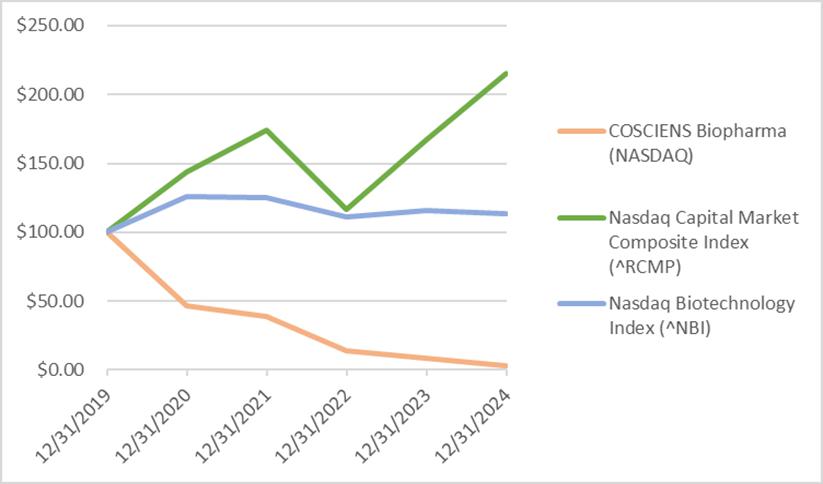
| 20 |
| 12/31/2019 | 12/31/2020 | 12/31/2021 | 12/31/2022 | 12/31/2023 | 12/31/2024 | |||||||||||||||||||
| COSCIENS (NASDAQ) | $ | 100.00 | $ | 46.76 | $ | 39.04 | $ | 13.98 | $ | 8.18 | $ | 3.04 | ||||||||||||
| Nasdaq Capital Market Composite Index (^RCMP) | $ | 100.00 | $ | 143.64 | $ | 174.36 | $ | 116.65 | $ | 167.30 | $ | 215.22 | ||||||||||||
| Nasdaq Biotechnology Index (^NBI) | $ | 100.00 | $ | 125.69 | $ | 124.89 | $ | 111.27 | $ | 115.42 | $ | 113.84 | ||||||||||||
Our executive compensation is reviewed annually and approved by the Board upon the recommendation of the HRNG. The HRNG considers several factors in connection with its determination of appropriate levels of executive compensation, including, but not limited to, the demand for and supply of skilled professionals in the life sciences and biopharmaceutical sectors generally, an executive’s individual performance, our performance (which is not necessarily tied exclusively to the trading price of our Common Shares) and other factors discussed above under the heading “Compensation Discussion & Analysis”. In addition, during the five-year period ended December 31, 2024, we were predominantly a pre-profit biopharmaceutical company, and thus the market price of our publicly traded equity securities may not fully reflect the long-term value of our underlying assets.
The trading price of our Common Shares is subject to fluctuation based on several factors, many of which are beyond our control and some of which are disclosed and discussed in our annual information form, management’s discussion and analysis, Annual Report on Form 20-F and other documents that we file from time to time with securities regulatory authorities and which are available on our profiles on SEDAR+ at www.sedarplus.ca or EDGAR at www.sec.gov.
The performance graph set forth above shows that holders of our Common Shares have lost a significant portion of the value of their investment since year-end 2020. During the period covered by the performance graph, we replaced our senior management team and began to implement our strategy of transforming our business from being totally focused on drug discovery and development to being a specialty biotechnology company developing and commercializing a diversified portfolio of pharmaceutical and diagnostic products focused on areas of significant unmet medical need. In 2021, we modified our business focus as follows: to investigate further therapeutic uses of Macimorelin, to expand pipeline development activities, to further expand the commercialization of Macimorelin in available territories and to co-fund with Novo Nordisk Biopharm Ltd. of the pediatric clinical trial, Study P02, in the E.U. and U.S. for Macimorelin trial costs up to €9.4 million. By December 31, 2022, the Corporation had in-licensed and continued to progress four pre-clinical development programs relating to potential therapeutics (neuromyelitis optica spectrum disorder, Parkinson’s Disease, hypoparathyroidism and amyotrophic lateral sclerosis), entered into license and supply agreements with NK Meditech Ltd, effective November 30, 2021, entered into a supply agreement with Atnahs Pharma UK Limited effective March 15, 2023 and continued its pivotal Study P02. In 2024, we completed the Arrangement and have begun to commercialize a diversified portfolio of cosmeceutical and nutraceutical, as well as pharmaceutical, products.
Therefore, the trend in the performance graph of our Common Shares on the NASDAQ does not correlate to the changes in compensation paid to our Named Executive Officers during the five-year period ended December 31, 2024.
Summary
In accordance with our executive compensation policy, a significant portion of the compensation of our executive officers is based upon an equitable balance between the Corporation’s performance and performance consistent with position responsibilities. During this period of transformation, while we work toward our goal of becoming a global leader in natural-based products and health and wellness, the HRNG’s rationale for executive compensation is to encourage and reward performance that positions us for both short-term and long-term success, while protecting and building shareholder value. The HRNG reviews the compensation programs of the executive officers annually in order to ensure their competitiveness and compliance with our objectives, values and strategies.
| 21 |
If the circumstances so require, the HRNG may recommend employment conditions and provisions of non-standard employment contracts that are different from those set out in the Corporation’s policies.
By the Human Resources, Nominating and Governance Committee:
Geneviève Foster (Chair), Ulrich Kosciessa, and William W. Li
PENSION PLAN BENEFITS
Each Named Executive Officer who is employed with AEZS Germany participates or participated during the financial year ended December 31, 2024 in one or more of the defined benefit and multi-employer defined contribution pension plans (the “Pension Plans”) as identified below. The information below is given as of December 31, 2024 unless otherwise stated.
Degussa Pensionskasse (“DUPK”)
Dr. Paulini participated in the DUPK until January 31, 2025, a defined-contribution pension plan maintained by Unterstützungskasse Degussa e.V. that was introduced for employees who began their employment with AEZS Germany (or its predecessors) prior to December 31, 1999. The DUPK includes indirect obligations through a funded multi-employer contribution plan as well as direct unfunded defined benefit plans obligations.
Under the funded multi-employer contribution portion of the DUPK, the contributions by AEZS Germany and Dr. Paulini were calculated based on Dr. Paulini’s total salary during the prior year. Dr. Paulini contributed 2% of his monthly average salary and AEZS Germany contributed an amount of 1.784 times his contribution. The contributions were limited to the social security contribution assessment ceiling. In 2024, the social security contribution assessment ceiling was $7,906 (€7,300) per month. Accordingly, Dr. Paulini contributed $158.12 (€146.00) monthly and AEZS Germany contributed $282.08 (€260.46) monthly.
Under the unfunded defined benefit portion of the DUPK, Dr. Paulini earned additional claims for future pension payments for the part of his salary that exceeded the social security contribution assessment ceiling (“Supplementary Pensions”) that were unfunded and were presented as a pensions benefit obligation on the balance sheet of the Corporation. The Supplementary Pensions amounted to 1.25% annually of a fictional salary peak, which was a percentage of the social security contribution assessment ceiling. Further, Dr. Paulini was entitled to annual Christmas benefits (“Christmas Benefits”), which amounted to 1.4% of the last pensionable monthly income for each year of service, limited by the social security contribution assessment ceiling. Dr. Paulini’s contribution and AEZS Germany’s contribution were transferred monthly to the pension fund, and AEZS Germany’s contribution was calculated with the salary payments and treated as provision for pension payment. We are liable to Dr. Paulini for the pension benefits that were promised if the private pension provider does not, or cannot, pay the promised pension payments. Dr. Paulini is entitled to receive a pension payment based on the contributions that were made during his employment, and will also receive the Supplementary Pensions and Christmas Benefits, after reaching the statutory retirement age, independent of whether he worked with AEZS Germany until such age. All direct pension obligations as well as pension obligations from deferred compensation were included and have been included in the pensions benefit obligation of the Corporation.
| 22 |
Rückgedeckte Unterstützungskasse 1 (“RUK 1”)
Dr. Gerlach participates in RUK 1, a defined-contribution pension plan maintained by Unterstützungskasse Degussa e.V. Under RUK 1, AEZS Germany contributes 2.4% of Dr. Gerlach’s monthly gross salary and Dr. Gerlach contributes 2% of his monthly gross salary. The contributions are limited to the social security contribution assessment ceiling. However, AEZS Germany provides an additional contribution of 18% of his monthly pensionable salary for the part of his salary that exceeds the social security contribution assessment ceiling. In 2024, the social security contribution assessment ceiling was $7,905 (€7,550) per month. Accordingly, AEZS Germany will contribute at most $1,596.23 (€1,473.90) (which includes the additional contribution of 18%) monthly and Dr. Gerlach will contribute at most $158.12 (€146.00) monthly. Both contributions are calculated with the monthly salary accounting and transferred to the relief fund monthly. We are liable to Dr. Gerlach for the pension benefits that have been promised if the private pension provider does not, or cannot, pay the promised pension payments. Dr. Gerlach will receive a pension payment based on the contributions that were made during his employment after he has reached the statutory retirement age, independent of whether he works with AEZS Germany until such age.
In 2024, Dr. Ammer participated in RUK 1, a defined-contribution pension plan maintained by Unterstützungskasse Degussa e.V. Under RUK 1, AEZS Germany contributed 2.4% of Dr. Ammer’s monthly gross salary and Dr. Ammer contributed 3% of her monthly gross salary. The contributions were limited to the social security contribution assessment ceiling. In 2024, the social security contribution assessment ceiling was $7,905 (€7,550) per month. Accordingly, AEZS Germany was to contribute at most $189.74 (€175.20) monthly and Dr. Ammer was to contribute at most $237.18 (€219.00) monthly. Both contributions were calculated with the monthly salary accounting and transferred to the relief fund monthly. We are liable to Dr. Ammer for the pension benefits that have been promised if the private pension provider does not, or cannot, pay the promised pension payments. Dr. Ammer will receive a pension payment based on the contributions that were made during her employment after she has reached the statutory retirement age, independent of whether she worked with AEZS Germany until such age.
Rückgedeckte Unterstützungskasse 2 (“RUK 2”)
Dr. Teifel participates in RUK 2, a defined-contribution pension plan maintained by Unterstützungskasse Degussa e.V. Under RUK 2, AEZS Germany contributes 2.4% of Dr. Teifel’s monthly gross salary and Dr. Teifel contributes 3% of his monthly gross salary. The contributions are limited to the social security contribution assessment ceiling. In 2024, the social security contribution assessment ceiling is $7,905 (€7,550) per month. Accordingly, AEZS Germany will contribute at most $189.74 (€175.20) monthly and Dr. Teifel will contribute at most $237.18 (€219.00) monthly. Both contributions are calculated with the monthly salary accounting and transferred to the relief fund monthly. We are liable to Dr. Teifel for the pension benefits that have been promised if the private pension provider does not, or cannot, pay the promised pension payments. Dr. Teifel will receive a pension payment based on the contributions that were made during her employment after he has reached the statutory retirement age, independent of whether he works with AEZS Germany until such age.
Benefit Summary Tables
The table below includes the following information about each Named Executive Officer participating in the pension, retirement or similar plans of the Corporation:
| ● | years of credited service as at December 31, 2024; |
| ● | estimated annual benefit accrued, or earned, for service to December 31, 2024 and to the normal retirement age of 65; and |
| ● | a reconciliation of the accrued obligation from December 31, 2023 to December 31, 2024. |
| 23 |
| Number of years credited | Annual benefits payable ($)(2) | Opening present value of defined benefit | Compensatory | Non-compensatory | Closing present value of defined benefit | |||||||||||||||||||||||
| Name |
service (#)(1) | At year end | At age 65 |
obligation ($)(3) | change ($)(4) |
change ($)(5) |
obligation ($)(3) | |||||||||||||||||||||
| Paulini, Klaus(6) | 27 | 109,165 | 110,320 | 1,947,250 | 369,221 | — | 2,316,471 | |||||||||||||||||||||
| Gerlach, Matthias | 24 | 14,693 | 22,726 | 217,785 | 24,993 | — | 242,779 | |||||||||||||||||||||
| Ammer, Nicola(7) | 10 | 2,842 | 5,003 | 38,835 | 5,028 | — | 43,863 | |||||||||||||||||||||
| Teifel, Michael | 20 | 15,293 | 16,143 | 246,204 | 3,327 | — | 249,531 | |||||||||||||||||||||
(1) The number of years of credited service as at December 31, 2024 corresponds to the actual years of service with AEZS Germany.
(2) For each Named Executive Officer, the amount of annual benefits payable at December 31, 2024 is the pension the Named Executive Officer would be entitled to starting at age 65 based on termination of employment at December 31, 2024. For each Named Executive Officer, the annual benefits payable at age 65 is the annual benefits payable at December 31, 2024 increased to reflect estimated credited service at age 65.
(3) The present value is the estimated value of the pension obligation to the date indicated using the actuarial assumptions and methods that are consistent with those used in determining pension liabilities as disclosed in the Corporation’s consolidated financial statements. In the past, certain Pension Plans were accounted for as defined contribution plans as sufficient information was not available for the Corporation to account for its proportionate share of the defined benefit obligation, plan assets and cost associated with such Pension Plans. In 2021, additional information became available to the Corporation, which began to account for its proportionate share of the defined benefit obligation and plan assets. The opening present value of defined benefit obligation for each Named Executive Officer was adjusted to reflect the revised accounting treatment.
(4) Compensatory change represents the change in the pension liability between December 31, 2023 and 2024 for each Named Executive Officer.
(5) The calculations of reported amounts use the same actuarial assumptions and methods that are used for calculating accrued benefit obligations and annual expenses, as disclosed in the Corporation’s consolidated financial statements as of December 31, 2024 and 2023 and for the years ended December 31, 2024, 2023 and 2022 in Note 15, “Employee future benefits” and as prescribed by International Financial Reporting Standards. The methods and assumptions used to determine estimated amounts will not be identical to the methods and assumptions used by other issuers so, as a result, the figures may not be directly comparable across issuers. All amounts shown above are based on assumptions and represent contractual entitlements that may change over time.
(6) Dr. Paulini continued in a transitional role with AEZS Germany until January 31, 2025.
(7) Dr. Ammer departed the Corporation on March 31, 2025.
The table below includes amounts from AEZS Germany’s defined contribution plans. Any difference between (i) the sum of the “accumulated value at start of year” column plus the “compensatory” column and (ii) the “accumulated value at end of year” column is attributable to the employee’s contributions to the pension plan during the year ended December 31, 2024, as well as changes in the foreign exchange rate, each employee’s contributions being made in Euros.
| Name | Accumulated value at start of year ($) | Compensatory ($) | Accumulated value at year end ($) | |||||||||
| Teifel, Michael | 14,004 | 2,352 | 19,017 | |||||||||
| 24 |
EMPLOYMENT AND CHANGE OF CONTROL AGREEMENTS
Employment and Change of Control Agreements
We had, or one of our subsidiaries had, entered into an employment agreement and, in some cases, a change of control agreement, with each of our Named Executive Officers. The applicable terms of the agreements that provide for payments to our Named Executive Officers upon termination, resignation, retirement, change of control of the Corporation or change in the Named Executive Officer’s responsibilities are described below.
Klaus Paulini
We entered into an employment agreement with Dr. Paulini, effective as of October 4, 2019 (the “Employment Agreement”) for his position as Chief Executive Officer of the Corporation. The Corporation, through AEZS Germany, also entered into a service agreement with Dr. Klaus Paulini effective as of July 26, 2019 (the “Services Agreement”) for his position as Managing Director of AEZS Germany. The Employment Agreement provided that we will pay Dr. Paulini an initial base salary of €260,000 per annum, which included payment for his service as Managing Director of AEZS Germany. Additionally, pursuant to the Employment Agreement, we provided Dr. Paulini with an initial grant of 8,750 stock options in November 2019. Under the terms of the Services Agreement, Dr. Paulini could receive subsequent grants of stock options at the discretion of the Board or the relevant committee, an annual bonus subject to the determination and approval of the relevant committee and participation in an employer-sponsored pension scheme.
Dr. Paulini resigned as a director and as Chief Executive Officer of the Corporation on June 3, 2024. He remained an employee of AEZS Germany for a transitional period to assist with the integration of Ceapro and Aeterna Zentaris Inc., and on January 31, 2025, he received a severance payment in an amount equal to €300,000 in accordance with the terms of his Employment Agreement.
Gilles Gagnon
Mr. Gagnon, Ceapro and Prodev Pharma Inc. (Mr. Gagnon’s consulting company) (“Prodev”) were parties to a service agreement dated January 1, 2017 pursuant to which Mr. Gagnon and Prodev provided services to Ceapro (the “Ceapro Agreement”). As a result of the Arrangement, pursuant to a termination letter and release, the Ceapro Agreement was terminated effective September 30, 2024. Concurrently, Mr. Gagnon and the Corporation entered into a fixed-term employment agreement effective October 1, 2024 (the “Fixed-Term Agreement”), pursuant to which Mr. Gagnon: (i) would remain the Chief Executive Officer of the Corporation until the earlier of the date of appointment of a new Chief Executive Officer and September 30, 2025 (the latter date being the “Termination Date”); and (ii) currently serves as a special consultant to the new Chief Executive Officer, as such Chief Executive Officer was appointed prior to the Termination Date.
Following the Termination Date, subject to the below, the Corporation will pay Mr. Gagnon a gross amount of CAD$670,000 (the “Gross Amount”), which corresponds to: (i) 12 months of base salary, and (ii) a bonus in the amount of CAD$120,000, within a reasonable delay following the receipt by the Corporation of a final release confirming that it has fulfilled all obligations to Mr. Gagnon. Mr. Gagnon’s participation in any benefit and incentive plans of the Corporation ceases on the Termination Date.
Pursuant to the Fixed-Term Agreement, in the event that Mr. Gagnon is terminated for just cause prior to the Termination Date, Mr. Gagnon would only be entitled to all accrued but unpaid wages and vacation pay owing up to the date of termination of his employment, and would not be entitled to any notice of termination of employment (or pay in lieu of), and would not be entitled to payment of the Gross Amount. In the event that Mr. Gagnon is terminated without just cause, he would be entitled to receive all accrued but unpaid wages and vacation pay owing up to the date of termination of his employment, the payment of his base salary until the Termination Date, as well as the Gross Amount.
| 25 |
Giuliano La Fratta
We entered into an employment agreement in January 2022 with Giuliano La Fratta, Senior Vice President, Finance and Chief Financial Officer (“CFO”). In accordance with the terms of his employment agreement, Mr. La Fratta will receive an RRSP contribution equal to 5% of his base salary.
If there is a termination of the CFO’s employment by us without “Cause” (as defined in the relevant employment agreement), then the CFO will be entitled to receive a severance payment depending on the length of his service. At the end of December 31, 2024 the CFO would have been entitled to receive a severance payment in the amount equal to CAD$753,500.
The Corporation entered into a change of control agreement with Mr. La Fratta on November 18, 2022 which was subsequently amended on November 10, 2023. The change of control agreement provides that it expires on: (a) November 18, 2024 if no change of control occurs prior to such date; or (b) if a change of control occurs within the 12-month period beginning on November 18, 2023, the last day of the 12-month period beginning on the date on which the change of control occurred. As such, the agreement will expire on the last day of the 12-month period beginning on the date the Arrangement closed.
Under the change of control agreement, Mr. La Fratta is entitled to certain payments if, following a change of control, his employment is terminated either by COSCIENS without cause or by Mr. La Fratta if his salary or duties and responsibilities are materially reduced following a change of control. Upon the occurrence of either of the foregoing, Mr. La Fratta is entitled to receive: all accrued but unpaid salary, vehicle allowance and vacation pay; an amount equal to 18 months of his base salary; an amount equal to his annual bonus; an amount equal to 1.5 times his annual bonus based on the target annual bonus for the year in which the change of control occurs; and a cash amount equal to 1.5 times the annual premium cost to the Corporation of providing his insured health benefits. Additionally, all outstanding options will automatically vest upon a change of control.
Stacy Prefontaine
Ms. Prefontaine was the Chief Financial Officer of Ceapro until the closing of the Arrangement, and remained with Ceapro in a transitional role until February 2025. Upon the termination of her employment agreement, Ms. Prefontaine received a severance payment of CAD$203,040.
Matthias Gerlach
AEZS Germany entered into an employment agreement in January 2001 with Dr. Gerlach, Senior Vice President Manufacturing and Supply Chain and Managing Director of AEZS Germany. In accordance with the terms of his employment agreement, Dr. Gerlach will receive a pension payment after he has reached the statutory retirement age, independent of whether he works with AEZS Germany until such age, in an amount to be based on the contributions that were made during his employment with AEZS Germany.
Michael Teifel
AEZS Germany entered into an employment agreement in May 2021 with Dr. Michael Teifel, Chief Science Officer and Senior Vice President Non-Clinical Development. In accordance with the terms of his employment agreement, Dr. Teifel will receive a pension payment after he has reached statutory retirement age, independent of whether he works with AEZS Germany until such age, in an amount to be based on the contributions that were made during the employment with AEZS Germany.
| 26 |
Nicola Ammer
AEZS Germany entered into an employment agreement in April 2015 with Dr. Ammer, former Chief Medical Officer, Senior Vice President Clinical Development. In accordance with the terms of her employment agreement, Dr. Ammer will receive a pension payment after she has reached the statutory retirement age, independent of whether she worked with AEZS Germany until such age, in an amount to be based on the contributions that were made during her employment with AEZS Germany. See Section 7 above, “Pension Plan Benefits”, for more information on Dr. Ammer’s pension benefits. Dr. Ammer ceased to be employed by the Corporation on March 31, 2025.
Summary Termination Value Table
The table below shows estimated incremental payments that would be triggered, pursuant to their individual employment contracts, in the event of a termination of employment of our Named Executive Officers who were employed on December 31, 2024 and who remain employed.
| Name | Termination Provisions Value (CAD$)(1) (2) | |||
| Gagnon, Gilles | 670,000 | |||
| La Fratta, Giuliano | 753,500 | |||
| Gerlach, Matthias | — | |||
| Teifel, Michael | — | |||
(1) The termination values assume that the triggering event took place on the last business day of our financial year-end (December 31, 2024).
(2) Value of earned/unused vacation, if applicable, and amounts owing for expense reimbursement are not included as they are not considered as “incremental” payments made in connection with termination of employment.
***
| 27 |