Exhibit 99.6

2024 Annual Report
Exhibit 99.6
2024 Annual Report
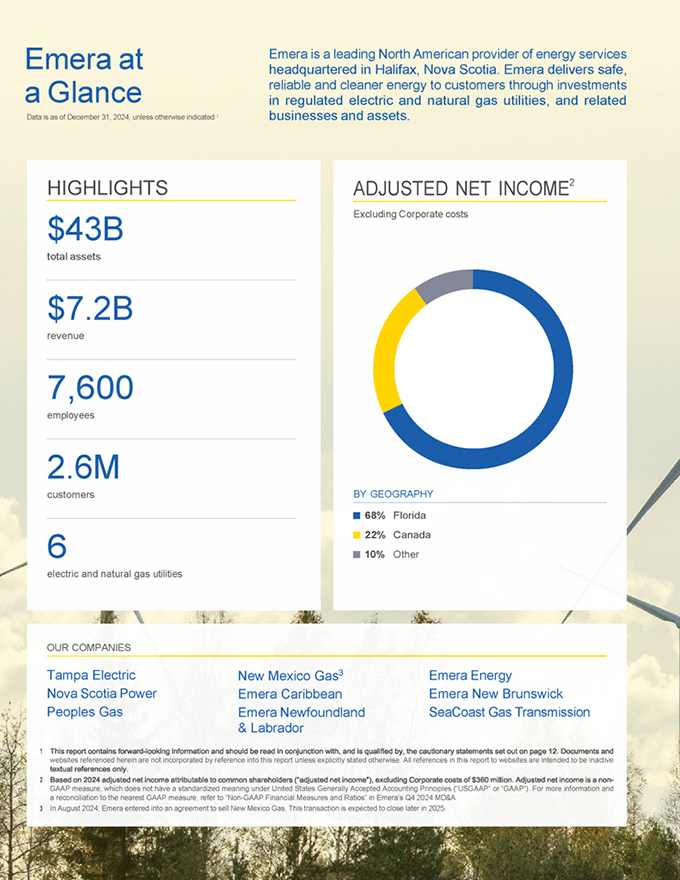
Emera at a Glance Data is as of December 31, 2024, unless otherwise indicated.1 Emera is a leading North American provider of energy services headquartered in Halifax, Nova Scotia. Emera delivers safe, reliable and cleaner energy to customers through investments in regulated electric and natural gas utilities, and related businesses and assets. HIGHLIGHTS $43B total assets $7.2B revenue 7,600 employees 2.6M customers 6 electric and natural gas utilities ADJUSTED NET INCOME2 Excluding Corporate costs BY GEOGRAPHY 68% Florida 22% Canada 10% Other OUR COMPANIES Tampa Electric New Mexico Gas3 Emera Energy Nova Scotia Power Emera Caribbean Emera New Brunswick Peoples Gas Emera Newfoundland SeaCoast Gas Transmission & Labrador 1 this report contains forward-looking information and should be read in conjunction with, and is qualified by, the cautionary statement set out on page 12 documents and websites referenced herein are not incorporated by reference into this report unless explicitly stated otherwise. All references in this report to websites are intended to be inactive textual references only. 2 Based on 2024 adjusted net income attributable to common shareholders (“adjusted net income”), excluding corporate costs of $360 million, adjusted net income is a non- GAAP measure, which does not have a standardized meaning under United States Generally Accepted Accounting Principles (“USGAAP” or “GAAP”). For more information and a reconciliation to the nearest GAAP measure, refer to “Non-GAAP Financial Measures and Ratios” in Emera’s Q4 2024 MD&A. 3 In August 2024, Emera entered into an agreement to sell New Mexico Gas. This transaction is expected to close later in 2025.
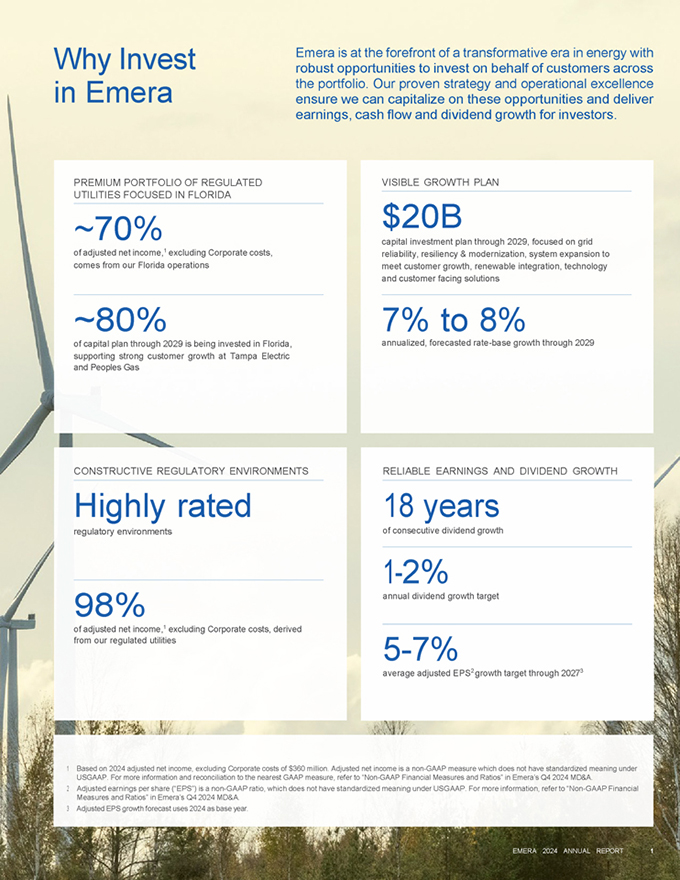
Why Invest in Emera Emera is at the forefront of a transformative era in energy with robust opportunities to invest on behalf of customers across the portfolio. Our proven strategy and operational excellence ensure we can capitalize on these opportunities and deliver earnings, cash flow and dividend growth for investors. PREMIUM PORTFOLIO OF REGULATED VISIBLE GROWTH PLAN UTILITIES FOCUSED IN FLORIDA ~70% $20B capital investment plan through 2029, focused on grid of adjusted net income,1 excluding Corporate costs, reliability, resiliency & modernization, system expansion to comes from our Florida operations meet customer growth, renewable integration, technology and customer facing solutions ~80% 7% to 8% of capital plan through 2029 is being invested in Florida, annualized, forecasted rate-base growth through 2029 supporting strong customer growth at Tampa Electric and Peoples Gas CONSTRUCTIVE REGULATORY ENVIRONMENTS RELIABLE EARNINGS AND DIVIDEND GROWTH Highly rated 18 years regulatory environments of consecutive dividend growth 1-2% 98% annual dividend growth target of adjusted net income,1 excluding Corporate costs, derived from our regulated utilities 5-7% average adjusted EPS2 growth target through 20273 1 Based on 2024 adjusted net income, excluding Corporate costs of $360 million. Adjusted net income is a non-GAAP measure which does not have standardized meaning under USGAAP. For more information and reconciliation to the nearest GAAP measure, refer to “Non-GAAP Financial Measures and Ratios” in Emera’s Q4 2024 MD&A. 2 Adjusted earnings per share (“EPS”) is a non-GAAP ratio, which does not have standardized meaning under USGAAP. For more information, refer to “Non-GAAP Financial Measures and Ratios” in Emera’s Q4 2024 MD&A. 3 Adjusted EPS growth forecast uses 2024 as base year.
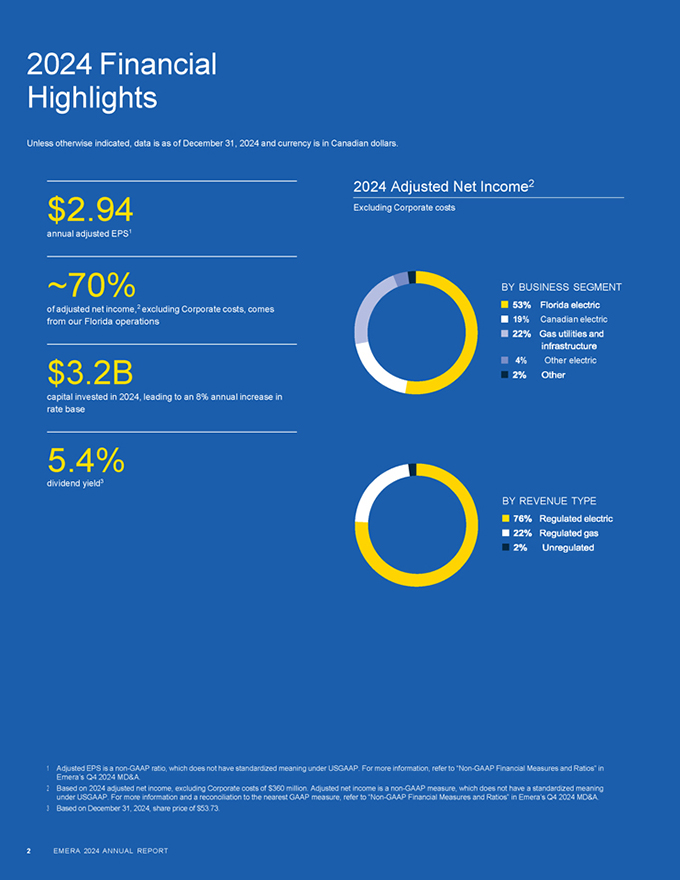
EMERA 2024 ANNUAL REPORT 1 2024 Financial Highlights Unless otherwise indicated, data is as of December 31, 2024 and currency is in Canadian dollars. $2.94 annual adjusted EPS1 ~70% of adjusted net income,2 excluding Corporate costs, comes from our Florida operations $3.2B capital invested in 2024, leading to an 8% annual increase in rate base 5.4% dividend yield3 2024 Adjusted Net Income2 Excluding Corporate costs 1 Adjusted EPS is a non-GAAP ratio, which does not have standardized meaning under USGAAP. For more information, refer to “Non-GAAP Financial Measures and Ratios” in Emera’s Q4 2024 MD&A. 2 Based on 2024 adjusted net income, excluding Corporate costs of $360 million. Adjusted net income is a non-GAAP measure, which does not have a standardized meaning under USGAAP. For more information and a reconciliation to the nearest GAAP measure, refer to “Non-GAAP Financial Measures and Ratios” in Emera’s Q4 2024 MD&A. 3 Based on December 31, 2024, share price of $53.73. 2 EMERA 2024 ANNUAL REPORT
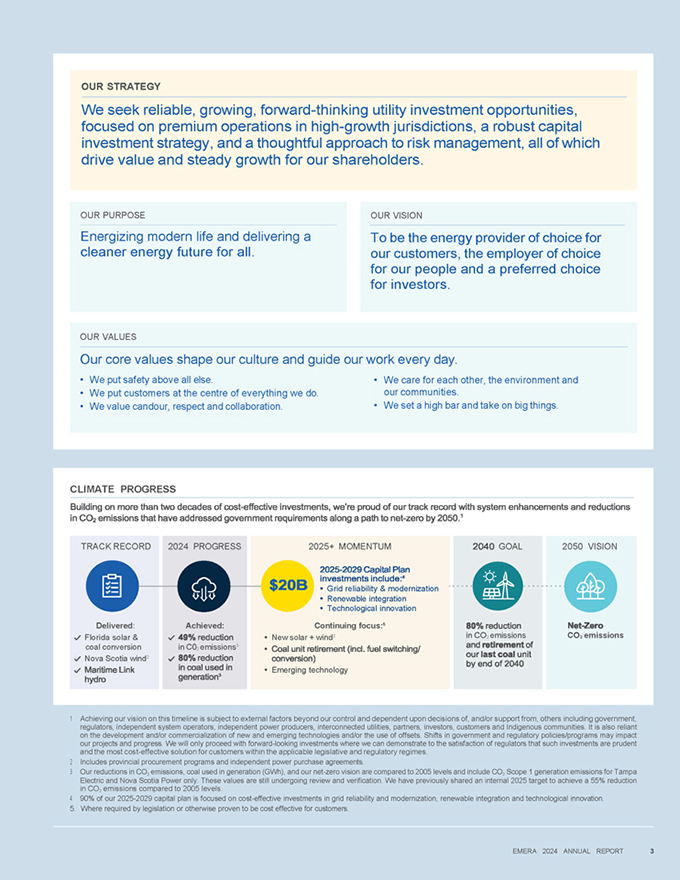
OUR STRATEGY We seek reliable, growing, forward-thinking utility investment opportunities, focused on premium operations in high-growth jurisdictions, a robust capital investment strategy, and a thoughtful approach to risk management, all of which drive value and steady growth for our shareholders. OUR PURPOSE Energizing modern life and delivering a cleaner energy future for all. OUR VISION To be the energy provider of choice for our customers, the employer of choice for our people and a preferred choice for investors. OUR VALUES Our core values shape our culture and guide our work every day. We put safety above all else. We put customers at the centre of everything we do. We value candour, respect and collaboration. We care for each other, the environment and our communities. We set a high bar and take on big things. CLIMATE PROGRESS Building on more than two decades of cost-effective investment, we’re proud of our track record with system enhancements and reductions in CO2 emissions that have addressed government requirements along a path to net zero by 2050.1 1 Achieving our vision on this timeline is subject to external factors beyond our control and dependent upon decisions of, and/or support from, others including government, regulators, independent system operators, independent power producers, interconnected utilities, partners, investors, customers and Indigenous communities. It is also reliant on the development and/or commercialization of new and emerging technologies and/or the use of offsets. Shifts in government and regulatory policies/programs may impact our projects and progress. We will only proceed with forward-looking investments where we can demonstrate to the satisfaction of regulators that such investments are prudent and the most cost-effective solution for customers within the applicable legislative and regulatory regimes. 2 Includes provincial procurement programs and independent power purchase agreements. 3 Our reductions in CO2 emissions, coal used in generation (GWh), and our net-zero vision are compared to 2005 levels and include CO2 Scope 1 generation emissions for Tampa Electric and Nova Scotia Power only. These values are still undergoing review and verification. We have previously shared an internal 2025 target to achieve a 55% reduction in CO2 emissions compared to 2005 levels. 4 90% of our 2025-2029 capital plan is focused on cost-effective investments in grid reliability and modernization, renewable integration and technological innovation. 5. Where required by legislation or otherwise proven to be cost effective for customers. EMERA 2024 ANNUAL REPORT 3
Letter from the Chair and the CEO
|
Karen Sheriff Chair, Emera Inc. Board of Directors
Scott Balfour President and Chief Executive Officer, Emera Inc. |  |  | ||
| Fellow Shareholders, | It’s a transformative era for the energy sector as economic, social, political, technological and environmental trends are shaping a future where energy is a cornerstone of progress. This is being amplified by advancements made toward the energy transition — where we’re experiencing a fundamental shift in how energy is generated, delivered and consumed. | |||
| Our sector saw numerous challenges, and opportunities throughout the year including evolving customer expectations, customer affordability challenges, unprecedented weather events, supply chain constraints, evolving government and energy policy and ongoing global economic and geopolitical impacts. | ||||
| Our operating companies rose to these challenges and seized opportunities, staying focused on reliably and cost effectively delivering for customers today, while working to ensure we can continue to meet their needs in the future. This commitment to customers and operational excellence enables Emera to stay focused on providing sustainable, long- term value to shareholders. | ||||
| Our operating teams’ commitment to customers was exemplified in 2024 by the response to two record-breaking storms that impacted our Florida utilities. Hurricane Helene hit in late September, followed less than two weeks later by Hurricane Milton — the strongest storm to hit Tampa Bay in a century. After Milton, more than 6,000 workers, including teams from Nova Scotia Power and across the continent, worked nonstop to restore service to hundreds of thousands of Tampa Electric customers within a week, logging over 900,000 work hours in tough conditions with no serious safety incidents. | ||||
| In recognition of this outstanding work, the Tampa Electric team was awarded the Edison Electric Institute Emergency Response Award for 2024. We’re incredibly proud of our team’s dedication to customers despite the challenging circumstances. | ||||
| The Peoples Gas system fared very well, with fewer than 1,500 of its more than 500,000 customers experiencing service interruptions during the hurricanes. As electric utilities focused on safely restoring power, Peoples Gas provided critical emergency backup energy for homes, businesses, shelters and healthcare facilities, demonstrating the resilience and | ||||
| 4 | EMERA 2024 ANNUAL REPORT |

reliability of natural gas and its essential role in Florida’s energy system. The team also took steps to protect the system from damage during the restoration, launching a targeted damage prevention campaign to reinforce the importance of safe-digging practices in affected areas. This exceptional level of dedication to customers is shared by every member of the team across Emera — and it’s reinforced by our unwavering commitment to operational excellence and to delivering increasing value to shareholders. As a result, we accomplished a lot together, for customers and shareholders, throughout the year. 2024 Highlights We achieved a number of significant milestones in 2024 as we continued to focus our efforts on driving growth and enhancing shareholder value. We successfully executed our strategic plan to strengthen our balance sheet, create flexibility in our capital funding program and optimize our portfolio for future growth. This included the sale of our interest in the Labrador-Island Link, which closed in June, and the sale of New Mexico Gas, expected to close later this year. Once complete, these will generate combined proceeds that exceed our $1.3 billion target by more than double. We completed a $500 million issuance of hybrid securities, primarily used to repay long-term holding company debt. We moderated our dividend growth rate to provide more flexibility in financing the robust capital profile we have in front of us, while also continuing to deliver growing dividends for investors. EMERA 2024 ANNUAL REPORT 5
Letter from the Chair and the CEO
Our ambitious plan positions us well to seize growth opportunities ahead
$3.2B capital plan for 2024 completed | In Nova Scotia, we worked with the federal and provincial governments, to securitize more than $600 million of under-recovered fuel costs and deferred fuel costs at Nova Scotia Power, reducing debt and decreasing the impact from the recovery of these costs from customers through rates.
| |
| Executing on our ambitious plan supports our premium portfolio of high-quality assets across North America and positions us well to seize the growth opportunities ahead.
| ||
49% reduction in CO2 emissions since 2005 | We successfully completed our $3.2 billion capital plan for the year — our largest annual program to date — as we continued to invest in reliability and resiliency, system expansion to meet customer growth, as well as renewables and renewable integration investments largely to meet legislated decarbonization requirements in some of our jurisdictions. As a result, we made significant achievements across the Company in 2024, including:
| |
| • At the end of 2024, we achieved a 49 per cent reduction in CO2 emissions and reduced our use of coal in generation by 80 per cent, both compared to 2005 levels.1
| ||
| • Tampa Electric continued to expand its solar fleet in 2024. Two new projects totaling 100 MW were brought into service, bringing total solar capacity to 1,350 MW. Another 745 MW is planned to be added by the end of 2028. In addition to supporting reliability, solar generation has saved Tampa Electric customers $321 million USD in fuel costs since 2017. | ||
| • Peoples Gas constructed pipelines to two renewable natural gas (RNG) producers to connect additional RNG into Florida’s natural gas supply. In addition to the three RNG facilities already connected, the team is building pipelines to connect the Polk County municipal landfill and Southern Cross Dairy facilities to the intrastate transmission pipeline. The dairy connection will be bidirectional, allowing the facility to access natural gas as a reliable backup during a power outage. Both connections are expected to be in service this year. | ||
| • After receiving regulatory approval in 2024, Nova Scotia Power started construction of its 150 MW grid-scale battery storage project, an equity partnership with Nova Scotia’s 13 Mi’kmaq communities. The project includes three 50 MW battery storage sites that will enable more renewable energy and enhance reliability for customers. Two sites are expected to be operational this year, with the third to be complete in 2026. | ||
| • The Maritime Link performed well in 2024, once again achieving over 99.9 per cent availability. The Link delivered nearly two million megawatts of clean hydroelectricity to Nova Scotia, serving approximately 19 per cent of Nova Scotia Power’s energy requirements and resulting in $100M in savings for Nova Scotians over the course of the year. | ||
| 1 | Reductions are still undergoing verification. CO2 emissions reduction includes Scope 1 generation emissions for Tampa Electric and Nova Scotia Power only. |
| 6 | EMERA 2024 ANNUAL REPORT |
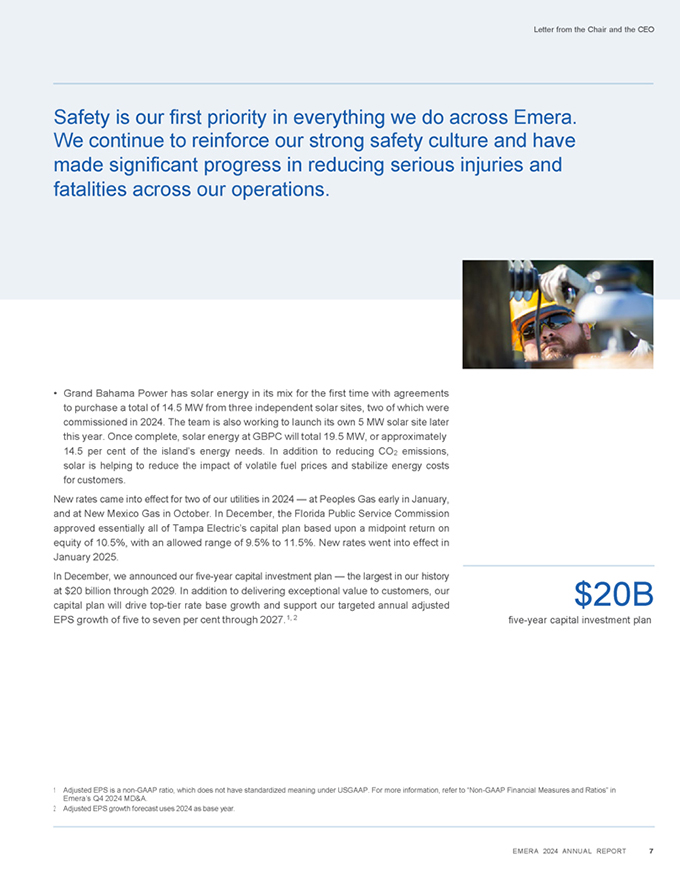
Letter from the Chair and the CEO Safety is our first priority in everything we do across Emera. We continue to reinforce our strong safety culture and have made significant progress in reducing serious injuries and fatalities across our operations. Grand Bahama Power has solar energy in its mix for the first time with agreements to purchase a total of 14.5 MW from three independent solar sites, two of which were commissioned in 2024. The team is also working to launch its own 5 MW solar site later this year. Once complete, solar energy at GBPC will total 19.5 MW, or approximately 14.5 per cent of the island’s energy needs. In addition to reducing CO2 emissions, solar is helping to reduce the impact of volatile fuel prices and stabilize energy costs for customers. New rates came into effect for two of our utilities in 2024 — at Peoples Gas early in January, and at New Mexico Gas in October. In December, the Florida Public Service Commission approved essentially all of Tampa Electric’s capital plan based upon a midpoint return on equity of 10.5%, with an allowed range of 9.5% to 11.5%. New rates went into effect in January 2025. In December, we announced our five-year capital investment plan — the largest in our history at $20 billion through 2029. In addition to delivering exceptional value to customers, our $20B capital plan will drive top-tier rate base growth and support our targeted annual adjusted EPS growth of five to seven per cent through 2027.1, 2 five-year capital investment plan 1 Adjusted EPS is a non-GAAP ratio, which does not have standardized meaning under USGAAP. For more information, refer to “Non-GAAP Financial Measures and Ratios” in Emera’s Q4 2024 MD&A. 2 Adjusted EPS growth forecast uses 2024 as base year. EMERA 2024 ANNUAL REPORT 7
Letter from the Chair and the CEO
Emera is well-positioned to capitalize on opportunities to deliver for our customers and our shareholders.
| Safety | ||
| Safety is a top priority in everything we do across Emera. We continue working to reinforce our strong safety culture and remain relentlessly focused on reducing serious injuries and fatalities across our operations. | ||
| Our commitment to safety is strengthened by visible safety leadership, and we continually work to build on this. Throughout 2024, members of the leadership team conducted safety engagements across the business. This included participating in a wide range of activities such as risk assessments, compliance checks, inspections and safety conversations. We believe these engagements allow leaders to underpin our commitment with frontline employees, further reinforcing our robust safety culture. | ||
| Despite remaining well under the industry average, our key safety metrics for 2024 were disappointing. We saw a 30 per cent increase in our year-over-year total recordable injury rate, placing us 24 per cent higher than our five-year average. Our lost time injury (LTI) frequency rate for the year increased by 40 per cent over 2023, three per cent higher than our five-year average. | ||
| We’re committed to learning from all incidents as we stay focused on safety first and continue working to build an Emera where no one gets hurt. | ||
|
| Financial Results | |
| $849M annual adjusted net income1 | We reported annual adjusted net income1 for 2024 of $849 million and adjusted EPS1 of $2.94. These results were in line with $2.96 in 2023 and the benchmark for our adjusted EPS growth guidance.
| |
| Our regulated utilities, particularly those in Florida, continue to drive our earnings growth with a six per cent increase in adjusted earnings1 contributions in 2024. Adjusted earnings1 growth across our regulated utilities was offset by lower earnings from equity investments as a result of the Labrador Island Link transaction in Q2 2024 and lower contributions from Emera Energy due to less favourable market conditions. | ||
| We remained focused on delivering value to our shareholders. In 2024, our Board of Directors approved an increase in our quarterly dividend of $0.03 per common share, marking our 18th consecutive year of dividend increases. This increase was in line with our adjusted dividend growth targetannounced as partofour strategic update in June. We also announced our three-year average adjusted EPS1 growth target of five to seven per cent through 2027,2 reflecting our confidence in our continued growth and strong performance. Emera shareholders can continue to expect dependable and growing dividends, underpinned by our prudent financial management and disciplined capital allocation. | ||
| 1 | Adjusted net income and adjusted EPS are a non-GAAP measure and a non-GAAP ratio, respectively, which do not have standardized meaning under USGAAP. For more information and a reconciliation to the nearest GAAP measure, refer to “Non-GAAP Financial Measures and Ratios” in Emera’s Q4 2024 MD&A. |
| 2 | Adjusted EPS growth forecast uses 2024 as base year. |
| 8 | EMERA 2024 ANNUAL REPORT |
Letter from the Chair and the CEO
| We saw a positive response to the strategic update we provided to the market mid-year. We saw strong share price performance in the second half of the year, both on an absolute and relative basis. We outperformed our closest peers on both the Canadian and US utility indices, as well as on the broader market. | ||
| With key trends converging to drive an unprecedented increase in demand for reliable energy, our growth drivers remain strong, evidenced by our forecasted seven to eight per cent rate-base growth CAGR over the next five years, as we invest to meet customer needs. We’re confident that as we make these customer-focused investments, we will also deliver long-term value for Emera shareholders. | ||
| Board Changes | ||
| After more than 10 years of service, Jackie Sheppard stepped down as Chair of the Emera Board in February 2025. Jackie’s leadership and her expertise in strategic planning, public markets, legal and corporate governance were critical in guiding Emera through a period of significant growth and expansion, including the 2016 acquisition of TECO and the successful completion of the Maritime Link project. We will continue to benefit from her expertise as she stays on as a Director through 2025. On behalf of the entire Board and management team, thank you Jackie for your invaluable commitment to Emera. | ||
| Karen Sheriff has been appointed the new Chair of the Board. Since joining as a Director in 2021, Karen’s leadership experience in public and private companies, as well as in regulated environments, has made her a strong addition to the Board and will be instrumental in guiding Emera’s next phase of growth. | ||
| We welcomed Carla Tully to the Board in June 2024. Carla is the former Chief Executive Officer and Co-Founder of Earthrise Energy. Her profound experience in the energy and infrastructure sectors in North America and Europe, combined with her track record in leading and growing businesses, have made her a strong addition to our Board. | ||
| It’s been a busy year of progress. With a stronger balance sheet, a disciplined capital investment plan, and a premium portfolio of assets located in high-quality jurisdictions across North America, Emera is well-positioned to capitalize on opportunities to deliver for our customers and our shareholders. | Thank You | |
| This a direct result of the hard work and talent of the teams across our business that drive our success. | ||
| To the Board of Directors and the entire Emera team, thank you for your relentless focus on customers and continued commitment to shareholders. Together, we’ve made great progress, and our business is well-placed for future growth. | ||
| To our valued shareholders, thank you for your confidence in Emera. | ||
 |  | |||
| Karen Sheriff | Scott Balfour | |||
| Chair, Board of Directors, | President and Chief Executive Officer, | |||
| Emera Inc. | Emera Inc. |
| EMERA 2024 ANNUAL REPORT | 9 |
Financial Review
| 12 | Forward-looking Information | |
| 12 | Introduction and Strategic Overview | |
| 13 | Non-GAAP Financial Measures and Ratios | |
| 15 | Consolidated Financial Review | |
| 15 | Significant Items Affecting Earnings | |
| 16 | Consolidated Financial Highlights | |
| 18 | Consolidated Income Statement Highlights | |
| 20 | Business Overview and Outlook | |
| 20 | Florida Electric Utility | |
| 21 | Canadian Electric Utilities | |
| 23 | Gas Utilities and Infrastructure | |
| 24 | Other Electric Utilities | |
| 25 | Other | |
| 26 | Consolidated Balance Sheet Highlights | |
| 27 | Other Developments | |
| 29 | Financial Highlights | |
| 29 | Florida Electric Utility | |
| 30 | Canadian Electric Utilities | |
| 32 | Gas Utilities and Infrastructure | |
| 34 | Other Electric Utilities | |
| 36 | Other | |
| 38 | Liquidity and Capital Resources | |
| 39 | Consolidated Cash Flow Highlights | |
| 40 | Working Capital | |
| 40 | Contractual Obligations | |
| 41 | Forecasted Consolidated | |
| Capital Expenditures | ||
| 41 | Debt Management | |
| 43 | Credit Ratings | |
| 43 | Guaranteed Debt | |
| 44 | Outstanding Stock Data | |
| 45 | Pension Funding | |
| 45 | Off-Balance Sheet Arrangements | |
| 46 | Dividend Payout Ratio | |
| 46 | Transactions with Related Parties | |
| 46 | Enterprise Risk and Risk Management | |
| 54 | Risk Management including Financial Instruments | |
| 56 | Disclosure and Internal Controls | |
| 56 | Critical Accounting Estimates | |
| 60 | Changes in Accounting Policies and Practices | |
| 60 | Future Accounting Pronouncements | |
| 61 | Summary of Quarterly Results | |
| 63 | Management Report | |
| 64 | Independent Auditor’s Report | |
| 68 | Report of Independent Registered Public Accounting Firm | |
| 71 | Consolidated Financial Statements | |
| 77 | Notes to the Consolidated Financial Statements | |
| 137 | Emera Leadership and Board | |
| 138 | Shareholder Information | |
| 10 | EMERA 2024 ANNUAL REPORT |
Management’s Discussion and Analysis
Management’s Discussion & Analysis
As at February 21, 2025
Management’s Discussion & Analysis (“MD&A”) provides a review of the results of operations of Emera Incorporated and its consolidated subsidiaries and investments (collectively referred to as “Emera” or the “Company”) during the fourth quarter of, and for the full year of, 2024 relative to the same periods in 2023 and selected financial information for 2022; and its financial position as at December 31, 2024 relative to December 31, 2023. The Company’s activities are carried out through five reportable segments: Florida Electric Utility, Canadian Electric Utilities, Gas Utilities and Infrastructure, Other Electric Utilities, and Other.
This MD&A should be read in conjunction with the Emera annual audited consolidated financial statements and supporting notes as at and for the year ended December 31, 2024. Emera follows United States Generally Accepted Accounting Principles (“USGAAP” or “GAAP”). Additional information related to Emera, including the Company’s Annual Information Form, can be found on Sedar+ at www.sedarplus.ca.
The accounting policies used by Emera’s rate-regulated entities may differ from those used by Emera’s non-rate-regulated businesses with respect to the timing of recognition of certain assets, liabilities, revenues and expenses. At December 31, 2024, Emera’s rate-regulated subsidiaries and investments include:
| Rate-Regulated Subsidiary or Equity Investment | Accounting Policies Approved/Examined By | |
| Subsidiary | ||
| Tampa Electric Company (“TEC”) | Florida Public Service Commission (“FPSC”) and the Federal Energy Regulatory Commission (“FERC”) | |
| Nova Scotia Power Inc. (“NSPI”) | Nova Scotia Utility and Review Board (“UARB”) | |
| Peoples Gas System, Inc. (“PGS”) | FPSC | |
| New Mexico Gas Company, Inc. (“NMGC”) | New Mexico Public Regulation Commission (“NMPRC”) | |
| SeaCoast Gas Transmission, LLC (“SeaCoast”) | FPSC | |
| Emera Brunswick Pipeline Company Limited (“Brunswick Pipeline”) | Canadian Energy Regulator (“CER”) | |
| Barbados Light & Power Company Limited (“BLPC”) | Fair Trading Commission, Barbados (“FTC”) | |
| Grand Bahama Power Company Limited (“GBPC”) | The Grand Bahama Port Authority (“GBPA”) | |
| Equity Investments | ||
| NSP Maritime Link Inc. (“NSPML”) | UARB | |
| Maritimes & Northeast Pipeline Limited Partnership and Maritimes & Northeast Pipeline, LLC (“M&NP”) | CER and FERC | |
| St. Lucia Electricity Services Limited (“Lucelec”) | National Utility Regulatory Commission | |
All amounts are in Canadian dollars (“CAD”), except for the Florida Electric Utility, Gas Utilities and Infrastructure, and Other Electric Utilities sections of the MD&A, which are reported in United States dollars (“USD”) unless otherwise stated.
| EMERA 2024 ANNUAL REPORT | 11 |
Management’s Discussion and Analysis
Forward-looking Information
This MD&A contains “forward-looking information” (“FLI”) and statements which reflect the current view with respect to the Company’s expectations regarding future growth, results of operations, performance, the expected timing and outcome of the pending sale of NMGC, business prospects and opportunities, and may not be appropriate for other purposes within the meaning of applicable Canadian securities laws. All such information and statements are made pursuant to safe harbour provisions contained in applicable securities legislation. The words “anticipates”, “believes”, “budget”, “could”, “estimates”, “expects”, “forecast”, “intends”, “may”, “might”, “plans”, “projects”, “schedule”, “should”, “targets”, “will”, “would” and similar expressions are often intended to identify FLI, although not all FLI contains these identifying words. The FLI reflects management’s current beliefs and is based on information currently available to Emera’s management and should not be read as guarantees of future events, performance or results, and will not necessarily be accurate indications of whether, or the time at which, such events, performance or results will be achieved.
FLI is based on reasonable assumptions and is subject to risks, uncertainties and other factors that could cause actual results to differ materially from historical results or results anticipated by the FLI. Factors that could cause results or events to differ from current expectations include, without limitation: regulatory and political risk; change in law risk; operating and maintenance risks; changes in economic conditions; commodity price and availability risk; liquidity and capital markets risk; changes in credit ratings; future dividend growth, rate base growth, and adjusted earnings per common share (“EPS”) growth; timing and costs associated with certain capital investments; expected impacts on Emera of challenges in the global economy; estimated energy consumption rates; maintenance of adequate insurance coverage; changes in customer energy usage patterns; developments in technology that could reduce demand for electricity; climate change risk; weather risk, including higher frequency and severity of weather events; risk of wildfires; unanticipated maintenance and other expenditures; system operating and maintenance risk; derivative financial instruments and hedging; interest rate risk; inflation risk; counterparty risk; disruption of fuel supply; country risks; supply chain risk; environmental risks; foreign exchange (“FX”); regulatory and government decisions, including changes to environmental legislation, financial reporting and tax legislation; risks associated with pension plan performance and funding requirements; loss of service area; risk of failure of information technology (“IT”) infrastructure and cybersecurity risks; uncertainties associated with infectious diseases, pandemics and similar public health threats; market energy sales prices; labour relations; and availability of labour and management resources.
Readers are cautioned not to place undue reliance on FLI, as actual results could differ materially from the plans, expectations, estimates or intentions and statements expressed in the FLI. All FLI in this MD&A is qualified in its entirety by the above cautionary statements and, except as required by law, Emera undertakes no obligation to revise or update any FLI as a result of new information, future events or otherwise.
Introduction and Strategic Overview
Emera (TSX: EMA) is a North American provider of energy services, owning and operating a portfolio of cost-of-service, rate- regulated electric and gas utilities. Its largest operations are in Florida, with additional operations in Atlantic Canada, New Mexico, and the Caribbean. Emera is headquartered in Halifax, Nova Scotia.
Emera’s business strategy is centered on continued investment in its regulated utilities, combined with a focus on operational excellence and efficiency, to safely and reliably deliver energy to its 2.6 million customers. Effective execution of these priorities supports predictable and growing earnings, cash flow and dividends for shareholders.
Earnings opportunities in regulated utilities are a function of the magnitude of net investment in the utility (known as “rate base”), the amount of equity in the capital structure, and the targeted return on that equity (“ROE”), all as established and approved through regulation. Earnings are also affected by sales volumes and operating expenses. In 2024, Emera’s regulated cost-of-service utilities in Florida accounted for 65 per cent of average consolidated rate base, with Atlantic Canada comprising 27 per cent, and the Caribbean and New Mexico at 4 per cent each.
Emera’s capital investment plan is forecasted to be approximately $20 billion from 2025 through 2029 and is focused on delivering value for customers through prudent investments in reliability and system resiliency, infrastructure modernization, expansion to address customer growth, integration of renewables, and technological innovations to deliver better customer experiences. It is anticipated that approximately 80 per cent of this capital investment will be made in Emera’s Florida utilities, necessitated by customer growth and system requirements at both TEC and PGS.
| 12 | EMERA 2024 ANNUAL REPORT |
Management’s Discussion and Analysis
| As at millions of dollars | 2025 | 2026 | 2027 | 2028 | 2029 | Total | ||||||||||||||||||
| Capital investment plan | $ | 3,420 | $ | 3,990 | $ | 4,050 | $ | 4,380 | $ | 4,590 | $ | 20,430 | ||||||||||||
| Average consolidated rate base | ||||||||||||||||||||||||
| US operations | $ | 21,520 | $ | 23,340 | $ | 25,140 | $ | 27,050 | $ | 29,400 | ||||||||||||||
| Canadian operations | 7,630 | 8,000 | 8,370 | 8,590 | 8,870 | |||||||||||||||||||
|
|
|
|
|
|
|
|
|
|
| |||||||||||||||
| Total | $ | 29,150 | $ | 31,340 | $ | 33,510 | $ | 35,640 | $ | 38,270 | ||||||||||||||
|
|
|
|
|
|
|
|
|
|
| |||||||||||||||
| * | Capital investment plan and average consolidated rate base exclude NMGC. Refer to “Other Developments” for more information on the pending sale of NMGC. |
Emera’s capital investment plan will be funded primarily through internally generated cash flows, debt raised at the operating company level consistent with regulated capital structures, equity issuances, and the anticipated sale of NMGC. Generally, Emera’s equity requirements are expected to be funded through the issuance of preferred equity, and the issuance of common equity through Emera’s dividend reinvestment plan (“DRIP”) and its at-the-market program (“ATM program”). Maintaining investment-grade credit ratings is a core strategic priority of the Company.
Emera has increased dividends per common share paid for 18 consecutive years and has provided forward annual dividend growth guidance of one to two per cent. Emera’s anticipates adjusted EPS average growth of five to seven per cent through 2027 which will support reduction in the ratio of dividend payout to adjusted net income. For further information on the non- GAAP ratios “Adjusted EPS” and “Dividend Payout Ratio of Adjusted Net Income”, refer to the “Non-GAAP Financial Measures and Ratios” section.
Non-GAAP Financial Measures and Ratios
Emera uses financial measures and ratios that do not have standardized meaning under USGAAP and are calculated by adjusting certain GAAP measures for specific items. They may not be comparable to similar measures presented by other entities. These measures and ratios are discussed and reconciled below.
ADJUSTED NET INCOME, ADJUSTED EPS – BASIC, AND DIVIDEND PAYOUT RATIO OF ADJUSTED NET INCOME
Emera calculates an adjusted net income attributable to common shareholders (“adjusted net income”) measure by excluding items below from net income attributable to common shareholders. Management believes excluding these items better distinguishes ongoing operations of the business and allows investors to better understand and evaluate the business.
Emera calculates adjusted net income for the Florida Electric Utility, Canadian Electric Utilities, Gas Utilities and Infrastructure, Other Electric Utilities, and Other segments. Reconciliation to the nearest GAAP measure is included in each segment. For more information refer to the Financial Highlights section for each of Florida Electric Utility, Gas Utilities and Infrastructure, Other Electric Utilities, and Other.
Adjusted EPS – basic and dividend payout ratio of adjusted net income are non-GAAP ratios which are calculated using adjusted net income, as described above. For further details on dividend payout ratio of adjusted net income, refer to the “Dividend Payout Ratio” section.
ADJUSTING ITEM IMPACTING ALL PERIODS:
Mark-to-market (“MTM”) Adjustments:
Management believes excluding from net income the effect of MTM valuations and changes thereto, until settlement, better aligns the intent and financial effect of these contracts with the underlying cash flows, and therefore excludes MTM adjustments for evaluation of performance and incentive compensation. The MTM adjustments are related to the following:
| • | held-for-trading (“HFT”) commodity derivative instruments, including adjustments related to the price differential between the point where natural gas is sourced and where it is delivered, and the related amortization of transportation capacity recognized as a result of certain Emera Energy marketing and trading transactions; |
| • | the business activities of Bear Swamp Power Company LLC (“Bear Swamp”) included in Emera’s equity income; |
| • | equity securities held in BLPC and Emera Energy; and FX hedges entered into to hedge USD denominated operating unit earnings exposure. |
| EMERA 2024 ANNUAL REPORT | 13 |
Management’s Discussion and Analysis
ADJUSTING ITEMS IMPACTING 2024:
Gain on Sale of Emera’s Indirect Minority Interest in the LIL (“Gain on sale of LIL”):
In Q2 2024, Emera recognized a $107 million gain, after tax and transaction costs, on the sale of LIL. In Q4 2024, Emera recognized a $22 million tax benefit related to the reversal of a prior year valuation allowance. A portion of the taxable capital gain on sale of LIL was offset by prior year loss carryforwards, of which the tax benefit was subject to a valuation allowance as at December 31, 2023. For further details refer to the “Significant Items Affecting Earnings” and “Other Developments” sections.
Financing Structure Wind-Up:
In Q4 2024, Emera recognized a $58 million tax benefit related to denied interest and financing expenses and the wind- up of a specific financing structure. For further details refer to the “Significant Items Affecting Earnings” and “Other Developments” sections.
Charges Related to Wind-Down Costs and Certain Asset Impairments:
In Q4 2024, the Company recognized $26 million, after-tax, in wind-down costs and certain asset impairments, primarily at Block Energy LLC (“Block Energy”). For further details, refer to the “Significant Items Affecting Earnings” section.
Charges Related to the Pending Sale of NMGC:
On August 5, 2024, Emera entered into an agreement to sell NMGC. In Q3 2024, the Company recognized $206 million in non-cash goodwill and other impairment charges, after-tax, and an additional loss of $19 million in estimated transaction costs, after-tax, related to the pending sale. For further details, refer to the “Significant Items Affecting Earnings” and “Other Developments” sections.
ADJUSTING ITEMS IMPACTING 2022:
GBPC Impairment Charge:
In Q4 2022, the Company recognized a $73 million non-cash goodwill impairment charge related to GBPC due to a decline in the fair value (“FV”) of the reporting unit.
NSPML Unrecoverable Costs:
In Q1 2022, the UARB issued a decision to disallow recovery of $9 million in costs ($7 million after-tax) included in NSPML’s final capital cost application.
RECONCILIATION OF NET INCOME ATTRIBUTABLE TO COMMON SHAREHOLDERS TO ADJUSTED NET INCOME:
| For the | Three months ended December 31 | Year ended December 31 | ||||||||||||||||||
| millions of dollars (except per share amounts) | 2024 | 2023 | 2024 | 2023 | 2022 | |||||||||||||||
| Net income attributable to common shareholders | $ | 154 | $ | 289 | $ | 494 | $ | 978 | $ | 945 | ||||||||||
| Gain on sale of LIL, after-tax (1) | 22 | — | 129 | — | — | |||||||||||||||
| Financing structure wind-up | 58 | — | 58 | — | — | |||||||||||||||
| Charges related to wind-down costs and certain asset impairments, after-tax (2) | (26 | ) | — | (26 | ) | — | — | |||||||||||||
| Charges related to the pending sale of NMGC, after-tax (3)(4) | — | — | (225 | ) | — | — | ||||||||||||||
| MTM (loss) gain, after-tax (5) | (146 | ) | 114 | (291 | ) | 169 | 175 | |||||||||||||
| GBPC impairment charge | — | — | — | — | (73 | ) | ||||||||||||||
| NSPML unrecoverable costs | — | — | — | — | (7 | ) | ||||||||||||||
| Adjusted net income | $ | 246 | $ | 175 | $ | 849 | $ | 809 | $ | 850 | ||||||||||
| EPS – basic | $ | 0.52 | $ | 1.04 | $ | 1.71 | $ | 3.57 | $ | 3.56 | ||||||||||
| Adjusted EPS – basic | $ | 0.84 | $ | 0.63 | $ | 2.94 | $ | 2.96 | $ | 3.20 | ||||||||||
| (1) | Includes an income tax recovery of $22 million for the three months ended December 31, 2024 and net of income tax expense of $53 million for the year ended December 31, 2024 (2023 – nil). |
| (2) | Net of income tax recovery of $6 million for the three months and year ended December 31, 2024 (2023 – nil). |
| (3) | Represents (i) $206 million in non-cash goodwill and other impairment charges, after-tax and (ii) $19 million in transaction costs, after-tax for the year ended December 31, 2024 (2023 – nil). |
| (4) | Net of income tax recovery of $21 million for the year ended December 31, 2024 (2023 – nil). |
| (5) | Net of income tax recovery of $57 million for the three months ended December 31, 2024 (2023 – $44 million expense) and $117 million recovery for the year ended December 31, 2024 (2023 – $68 million expense) (2022 – $73 million expense). |
| 14 | EMERA 2024 ANNUAL REPORT |
Management’s Discussion and Analysis
EBITDA AND ADJUSTED EBITDA
Earnings before interest, income taxes, depreciation and amortization (“EBITDA”) and adjusted EBITDA are non-GAAP financial measures used by Emera. These financial measures are used by numerous investors and lenders to better understand cash flows and credit quality. EBITDA is useful to assess Emera’s operating performance and indicates the Company’s ability to service or incur debt, invest in capital, and finance working capital requirements.
Adjusted EBITDA represents EBITDA excluding the income effect of the gain on sale of LIL, charges related to wind-down costs and certain asset impairments, charges related to the pending sale of NMGC, MTM adjustments, the 2022 GBPC impairment charge, and the 2022 NSPML unrecoverable costs.
RECONCILIATION OF NET INCOME TO EBITDA AND ADJUSTED EBITDA:
| For the | Three months ended December 31 | Year ended December 31 | ||||||||||||||||||
| millions of dollars | 2024 | 2023 | 2024 | 2023 | 2022 | |||||||||||||||
| Net income (1) | $ | 173 | $ | 307 | $ | 568 | $ | 1,045 | $ | 1,009 | ||||||||||
| Interest expense, net | 248 | 241 | 973 | 925 | 709 | |||||||||||||||
| Income tax (recovery) expense | (199 | ) | 51 | (159 | ) | 128 | 185 | |||||||||||||
| Depreciation and amortization | 296 | 264 | 1,162 | 1,049 | 952 | |||||||||||||||
| EBITDA | $ | 518 | $ | 863 | $ | 2,544 | $ | 3,147 | $ | 2,855 | ||||||||||
| Gain on sale of LIL, excluding income tax | — | — | 182 | — | — | |||||||||||||||
| Charges related to wind-down costs and certain asset impairments, excluding income tax | (32 | ) | — | (32 | ) | — | — | |||||||||||||
| Charges related to the pending sale of NMGC, excluding income tax | — | — | (246 | ) | — | — | ||||||||||||||
| MTM (loss) gain, excluding income tax | (203 | ) | 158 | (408 | ) | 237 | 248 | |||||||||||||
| GBPC impairment charge | — | — | — | — | (73 | ) | ||||||||||||||
| NSPML unrecoverable costs | — | — | — | — | (7 | ) | ||||||||||||||
| Adjusted EBITDA | $ | 753 | $ | 705 | $ | 3,048 | $ | 2,910 | $ | 2,687 | ||||||||||
| (1) | Net income is before Non-controlling interest in subsidiaries and Preferred stock dividends. |
Consolidated Financial Review
Significant Items Affecting Earnings
The items detailed below have had a significant impact on Net Income Attributable to Common Shareholders but have been excluded from Adjusted Net Income as described in the section entitled “Non-GAAP Financial Measures and Ratios”.
FINANCING STRUCTURE WIND-UP
During 2024, the Company incurred $185 million of interest and financing expenses in connection with a specific financing structure. The current and future interest and financing expenses are expected to be denied under the recently enacted Excessive Interest and Financing Expenses Limitation (“EIFEL”) legislation and, as a result, the financing structure has been wound up. It was determined that Emera is more likely than not to realize the benefit of the current denied interest and financing expenses in future periods and therefore a $54 million deferred income tax asset and related income tax benefit ($0.19 per common share) was recorded during Q4 2024. In addition, Emera recognized a $4 million income tax benefit ($0.01 per common share) related to the reversal of a deferred income tax liability on the wind-up of the financing structure. The total tax benefit of $58 million was recorded in “Income Tax (Recovery) Expense” on the Consolidated Statements of Income and included in the Other segment. For further details on the EIFEL legislation, refer to the “Other Developments” section.
CHARGES RELATED TO WIND-DOWN COSTS AND CERTAIN ASSET IMPAIRMENTS
In Q4 2024, Emera recognized $32 million ($26 million after-tax, or $0.09 per common share) in wind-down costs and certain asset impairments, primarily at Block Energy. These were recorded in “Other Income, net” and “Impairment Charges” on the Consolidated Statements of Income and included mainly in the Other segment.
| EMERA 2024 ANNUAL REPORT | 15 |
Management’s Discussion and Analysis
GAIN ON SALE OF LIL
On June 4, 2024, Emera completed the sale of its LIL equity interest. A gain on sale of $182 million after transaction costs ($107 million, after tax and transaction costs, or $0.37 per common share), was recognized in “Other Income, net” on the Consolidated Statements of Income in Q2 2024 and included in the Other segment. In Q4 2024, Emera recognized a $22 million ($0.08 per common share) tax benefit related to the reversal of a prior year valuation allowance. A portion of the taxable capital gain on the sale of the LIL equity interest was offset by prior year loss carryforwards, of which the tax benefit had been subject to a valuation allowance as at December 31, 2023. This tax benefit was recorded in “Income Tax (Recovery) Expense” on the Consolidated Statements of Income in Q4 2024 and included in the Other segment. For further details on the transaction, refer to the “Other Developments” section.
CHARGES RELATED TO THE PENDING SALE OF NMGC
In Q3 2024, Emera recognized non-cash goodwill and other impairment charges of $221 million ($206 after-tax, or $0.72 per common share) related to the NMGC reporting unit. These charges were recorded in “Impairment charges” on the Consolidated Statements of Income and included in the Other and Gas Utilities and Infrastructure segments, respectively. For further details on the pending sale of NMGC, refer to the “Other Developments” section. For further details on the non-cash goodwill impairment charge, refer to note 23 in the consolidated financial statements.
Additionally, in Q3 2024, Emera recorded a loss of $25 million ($19 million after-tax, or $0.06 per common share) in estimated transaction costs related to the pending sale of NMGC. These transaction costs were recorded in “Other Income, net” on the Consolidated Statement of Income and included in the Other segment. For further details, refer to the “Other Developments” section.
EARNINGS IMPACT OF MTM LOSS, AFTER-TAX
Quarter-to-date the 2023 MTM gain, after-tax, of $114 million decreased $260 million to a $146 million MTM loss, after-tax, for the same period in 2024. For the year ended, the 2023 MTM gain, after-tax, of $169 million decreased $460 million to a $291 million MTM loss, after-tax, for the same period in 2024. These decreases were primarily due to changes in existing positions, partially offset by lower amortization of gas transportation at Emera Energy Services (“EES”).
Consolidated Financial Highlights
| For the millions of dollars | Three months ended December 31 | Year ended December 31 | ||||||||||||||||||
| Adjusted net income | 2024 | 2023 | 2024 | 2023 | 2022 | |||||||||||||||
| Florida Electric Utility | $ | 120 | $ | 115 | $ | 644 | $ | 627 | $ | 596 | ||||||||||
| Canadian Electric Utilities | 77 | 68 | 232 | 247 | 222 | |||||||||||||||
| Gas Utilities and Infrastructure | 87 | 59 | 267 | 214 | 221 | |||||||||||||||
| Other Electric Utilities | 21 | 4 | 48 | 35 | 29 | |||||||||||||||
| Other | (59 | ) | (71 | ) | (342 | ) | (314 | ) | (218 | ) | ||||||||||
| Adjusted net income | $ | 246 | $ | 175 | $ | 849 | $ | 809 | $ | 850 | ||||||||||
| Gain on sale of LIL, after-tax | 22 | — | 129 | — | — | |||||||||||||||
| Financing structure wind-up | 58 | — | 58 | — | — | |||||||||||||||
| Charges related to wind-down costs and certain asset impairments, after-tax | (26 | ) | — | (26 | ) | — | — | |||||||||||||
| Charges related to the pending sale of NMGC, after-tax | — | — | (225 | ) | — | — | ||||||||||||||
| MTM (loss) gain, after-tax | (146 | ) | 114 | (291 | ) | 169 | 175 | |||||||||||||
| GBPC impairment charge | — | — | — | — | (73 | ) | ||||||||||||||
| NSPML unrecoverable costs | — | — | — | — | (7 | ) | ||||||||||||||
| Net income attributable to common shareholders | $ | 154 | $ | 289 | $ | 494 | $ | 978 | $ | 945 | ||||||||||
| 16 | EMERA 2024 ANNUAL REPORT |
Management’s Discussion and Analysis
The following table highlights significant changes in adjusted net income from 2023 to 2024:
| For the millions of dollars | Three months ended December 31 | Year ended December 31 | ||||||
| Adjusted net income – 2023 | $ | 175 | $ | 809 | ||||
| Operating Unit Performance | ||||||||
| Increased earnings at NSPI due to increased income tax recovery, partially offset by higher operating, maintenance and general expenses (“OM&G”) due primarily to a lower storm cost deferral | 31 | 19 | ||||||
| Increased earnings quarter-over-quarter at Other Electric Utilities primarily due to the timing of recovery of fuel costs and lower OM&G. Year-over-year increased primarily due to higher sales volumes, partially offset by higher OM&G | 17 | 13 | ||||||
| Increased earnings quarter-over-quarter at NMGC due to higher revenue from new base rates, partially offset by higher income tax expense. Decreased earnings year-over-year due to lower asset optimization revenue, partially offset by higher revenue from new base rates | 14 | (4 | ) | |||||
| Increased earnings at PGS due to higher revenue from new base rates and customer growth, partially offset by increased interest expense, depreciation, OM&G, and income tax expense | 11 | 58 | ||||||
| Increased earnings at TEC due to higher revenues from customer growth and new base rates, and the impact of a weaker CAD, partially offset by higher OM&G, and depreciation. Year-over-year increased earnings also due to lower income tax expense and lower interest expense, partially offset by unfavourable weather | 5 | 17 | ||||||
| Decreased earnings year-over-year at EES due to favourable hedging opportunities in Q1 2023 and less favourable market conditions in 2024 | (3 | ) | (16 | ) | ||||
| Decreased earnings at Bear Swamp primarily due to the recognition of investment tax credits in 2023 | (13 | ) | (20 | ) | ||||
| Decreased income from equity investments due to the sale of LIL equity interest | (16 | ) | (32 | ) | ||||
| Corporate | ||||||||
| Decreased deferred income tax asset valuation allowance due to utilization of tax loss carryforwards | 36 | 39 | ||||||
| Increased income tax recovery due to increased loss before provision for income taxes | 15 | 20 | ||||||
| Increased interest expense due to the impact of a weaker CAD on USD interest expense, increased total Corporate debt and increased interest rates | (9 | ) | (38 | ) | ||||
| Increased OM&G quarter-over-quarter primarily due to the timing difference in the valuation of long-term incentive expense and related hedges | (16 | ) | (1 | ) | ||||
| Other Variances | (1 | ) | (15 | ) | ||||
|
|
|
|
| |||||
| Adjusted net income – 2024 | $ | 246 | $ | 849 | ||||
|
|
|
|
| |||||
| For the | Year ended December 31 | |||||||||||
| millions of dollars | 2024 | 2023 | 2022 | |||||||||
| Operating cash flow before changes in working capital | $ | 2,194 | $ | 2,336 | $ | 1,147 | ||||||
| Change in working capital | 452 | (95 | ) | (234 | ) | |||||||
| Operating cash flow | $ | 2,646 | $ | 2,241 | $ | 913 | ||||||
| Investing cash flow | $ | (2,218 | ) | $ | (2,917 | ) | $ | (2,569 | ) | |||
| Financing cash flow | $ | (818 | ) | $ | 939 | $ | 1,555 | |||||
For further discussion of cash flow, refer to the “Consolidated Cash Flow Highlights” section.
| As at | December 31 | |||||||||||
| millions of dollars | 2024 | 2023 | 2022 | |||||||||
| Total assets | $ | 42,951 | $ | 39,480 | $ | 39,742 | ||||||
|
|
|
|
|
|
| |||||||
| Total long-term debt (including current portion) (1) | $ | 18,407 | $ | 18,365 | $ | 16,318 | ||||||
|
|
|
|
|
|
| |||||||
| (1) | On August 5, 2024, Emera announced an agreement to sell NMGC. As at December 31, 2024, NMGC’s assets and liabilities were classified as held for sale and are excluded from this table. For further details, refer to the “Other Developments” section and note 4 in the consolidated financial statements. |
| EMERA 2024 ANNUAL REPORT | 17 |
Management’s Discussion and Analysis
Consolidated Income Statement Highlights
| For the millions of dollars | Three months ended December 31 | Year ended December 31 | Year ended December 31 | |||||||||||||||||||||||||
| (except per share amounts) | 2024 | 2023 | Variance | 2024 | 2023 | Variance | 2022 | |||||||||||||||||||||
| Operating revenues | $ | 1,763 | $ | 1,972 | $ | (209 | ) | $ | 7,200 | $ | 7,563 | $ | (363 | ) | $ | 7,588 | ||||||||||||
| Operating expenses | 1,524 | 1,467 | (57 | ) | 6,120 | 5,769 | (351 | ) | 5,959 | |||||||||||||||||||
| Income from operations | $ | 239 | $ | 505 | $ | (266 | ) | $ | 1,080 | $ | 1,794 | $ | (714 | ) | $ | 1,629 | ||||||||||||
| Other (expense) income, net | $ | (29 | ) | $ | 51 | $ | (80 | ) | $ | 203 | $ | 158 | $ | 45 | $ | 145 | ||||||||||||
| Interest expense, net | $ | 248 | $ | 241 | $ | (7 | ) | $ | 973 | $ | 925 | $ | (48 | ) | $ | 709 | ||||||||||||
| Income tax (recovery) expense | $ | (199 | ) | $ | 51 | $ | 250 | $ | (159 | ) | $ | 128 | $ | 287 | $ | 185 | ||||||||||||
| Net income attributable to common shareholders | $ | 154 | $ | 289 | $ | (135 | ) | $ | 494 | $ | 978 | $ | (484 | ) | $ | 945 | ||||||||||||
| Adjusted net income | $ | 246 | $ | 175 | $ | 71 | $ | 849 | $ | 809 | $ | 40 | $ | 850 | ||||||||||||||
| Weighted average shares of common stock outstanding (in millions) | 294.1 | 277.7 | 16.4 | 289.1 | 273.6 | 15.5 | 265.5 | |||||||||||||||||||||
| EPS – basic | $ | 0.52 | $ | 1.04 | $ | (0.52 | ) | $ | 1.71 | $ | 3.57 | $ | (1.86 | ) | $ | 3.56 | ||||||||||||
| EPS – diluted | $ | 0.52 | $ | 1.04 | $ | (0.52 | ) | $ | 1.71 | $ | 3.57 | $ | (1.86 | ) | $ | 3.55 | ||||||||||||
| Adjusted EPS – basic | $ | 0.84 | $ | 0.63 | $ | 0.21 | $ | 2.94 | $ | 2.96 | $ | (0.02 | ) | $ | 3.20 | |||||||||||||
| Adjusted EBITDA | $ | 753 | $ | 705 | $ | 48 | $ | 3,048 | $ | 2,910 | $ | 138 | $ | 2,687 | ||||||||||||||
| Dividends per common share declared | $ | 0.7250 | $ | 0.7175 | $ | 0.0075 | $ | 2.8775 | $ | 2.7875 | $ | 0.0900 | $ | 2.6775 | ||||||||||||||
| Dividends per first preferred shares declared: | ||||||||||||||||||||||||||||
| Series A | $ | 0.5456 | $ | 0.5456 | $ | — | $ | 0.5456 | ||||||||||||||||||||
| Series B | $ | 1.6966 | $ | 1.5583 | $ | 0.1383 | $ | 0.6869 | ||||||||||||||||||||
| Series C | $ | 1.6085 | $ | 1.2873 | $ | 0.3212 | $ | 1.1802 | ||||||||||||||||||||
| Series E | $ | 1.1250 | $ | 1.1250 | $ | — | $ | 1.1250 | ||||||||||||||||||||
| Series F | $ | 1.0505 | $ | 1.0505 | $ | — | $ | 1.0505 | ||||||||||||||||||||
| Series H | $ | 1.5810 | $ | 1.3140 | $ | 0.2670 | $ | 1.2250 | ||||||||||||||||||||
| Series J | $ | 1.0625 | $ | 1.0625 | $ | — | $ | 1.0625 | ||||||||||||||||||||
| Series L | $ | 1.1500 | $ | 1.1500 | $ | — | $ | 1.1500 | ||||||||||||||||||||
OPERATING REVENUES
For Q4 2024, operating revenues decreased $209 million compared to Q4 2023 and, excluding decreased MTM gain of $291 million, increased $82 million. For the year ended December 31, 2024, operating revenues decreased $363 million compared to 2023 and, excluding decreased MTM gain of $559 million, increased $196 million. The increases were due to new rates at PGS, NSPI, TEC and NMGC; the impact of a weaker CAD; and increased customer growth at TEC and PGS. The increases were partially offset by lower fuel recovery clause and storm surcharge revenue (offset in OM&G) at TEC; and lower fuel revenue at NMGC. Year-over-year increase was also due to a change in the fuel cost recovery methodology for an industrial customer in 2023 at NSPI (offset in fuel for generation and purchased power).
OPERATING EXPENSES
For Q4 2024, operating expenses increased $57 million compared to Q4 2023, and, excluding charges related to wind-down costs and certain asset impairments of $4 million, increased $53 million. For the year ended December 31, 2024, operating expenses increased $351 million compared to 2023, and excluding the goodwill and other impairment charges primarily related to the pending sale of NMGC of $225 million, increased $126 million due to higher depreciation at TEC and PGS; the impact of a weaker CAD; higher OM&G due to timing of deferred clause recoveries at PGS and TEC; lower storm cost deferral and higher demand side management program costs at NSPI; and higher labour costs at PGS. This was partially offset by lower natural gas prices at NMGC, PGS and TEC and lower storm cost recognition at TEC (offset in revenue). Year-over-year increase was also due to a change in fuel cost recovery for an industrial customer in 2023 at NSPI (offset in revenue).
| 18 | EMERA 2024 ANNUAL REPORT |
Management’s Discussion and Analysis
OTHER INCOME, NET
For Q4 2024, other income, net decreased $80 million compared to Q4 2024 due to charges related to wind-down costs and certain asset impairments and higher FX losses.
For the year ended December 31, 2024, other income, net increased $45 million compared to the same period in 2023 due to the gain on sale of LIL, after transaction costs, partially offset by higher FX losses, charges related wind-down costs and certain asset impairments, transaction costs related to the pending sale of NMGC, and lower interest income.
INTEREST EXPENSE, NET
For Q4 2024, interest expense, net increased $7 million and for the year ended December 31,2024, increased $48 million compared to the same periods in 2023 due to the impact of a weaker CAD on USD interest expense, increased borrowings to support ongoing operations and higher interest rates.
INCOME TAX (RECOVERY) EXPENSE
For Q4 2024, income tax recovery increased $250 million compared to Q4 2023 due to decreased income before provision for income taxes, decreased deferred income tax asset valuation allowance and recognition of tax benefits associated with denied interest and financing expenses.
For the year ended December 31, 2024, income tax recovery increased $287 million compared to 2023 due to decreased income before provision for income taxes (excluding the gain on sale of LIL and charges related to the pending sale of NMGC), decreased deferred income tax asset valuation allowance and recognition of tax benefits associated with denied interest and financing expenses. This increased recovery was partially offset by the net tax impact of the gain on sale of LIL and charges related to the pending sale of NMGC.
NET INCOME AND ADJUSTED NET INCOME
For Q4 2024, net income attributable to common shareholders compared to Q4 2023, was favourably impacted by the $58 million tax benefit related to a specific financing structure and its wind-up and the $22 million valuation allowance reversal related to the gain on sale of LIL, and unfavourably impacted by the $26 million charges related to wind-down costs and certain asset impairments, and the $260 million decrease in MTM gains. Excluding these impacts, adjusted net income increased $71 million, primarily due to increased earnings at NSPI, Other Electric Utilities, NMGC, PGS, and TEC, and increased Corporate income tax recovery. This was partially offset by lower equity earnings from LIL; increased Corporate OM&G due to timing of long-term incentive expenses and related hedges; increased Corporate interest expense; and decreased earnings at Emera Energy.
For the year ended December 31, 2024, net income attributable to common shareholders, compared to the same period in 2023, was favourably impacted by the $129 million gain on sale of LIL, and the $58 million tax benefit related to a specific financing structure and its wind-up and unfavourably impacted by the $26 million in charges related to wind-down costs and certain asset impairments, $225 million in charges related to the pending sale of NMGC, and the $460 million decrease in MTM gains. Excluding these changes, adjusted net income increased $40 million. The increase was primarily due to increased earnings at PGS, NSPI, TEC, and Other Electric Utilities, and increased Corporate income tax recovery. This was partially offset by increased Corporate interest expense; lower equity earnings from LIL; and decreased earnings at Emera Energy.
EPS – BASIC AND ADJUSTED EPS – BASIC
For Q4 2024, EPS – basic was lower than in Q4 2023 due to the impact of decreased earnings, as discussed above, and an increase in weighted average shares outstanding. Adjusted EPS – basic was higher in Q4 2024, compared to Q4 2023, due to increased adjusted earnings as discussed above, partially offset by an increase in weighted average shares outstanding.
For the year ended December 31, 2024, EPS – basic was lower than in 2023 due to the impact of an increase in weighted average shares outstanding and decreased earnings, as discussed above. Adjusted EPS – basic was lower in 2024, compared to 2023, due to the impact of an increase in weighted average shares outstanding, partially offset by increased adjusted earnings, as discussed above.
EFFECT OF FOREIGN CURRENCY TRANSLATION
Emera operates in the United States (“US”), Canada and various Caribbean countries and, as such, generates revenues and incurs expenses denominated in local currencies which are translated into CAD for financial reporting. Changes in translation rates, particularly in the value of the USD against the CAD, can positively or adversely affect results.
| EMERA 2024 ANNUAL REPORT | 19 |
Management’s Discussion and Analysis
Results of foreign operations are translated at the weighted average rate of exchange, and assets and liabilities of foreign operations are translated at period end rates. The relevant CAD/USD exchange rates on net income attributable to common shareholders for 2024 and 2023 are as follows:
| Three months ended December 31 | Year ended December 31 | |||||||||||||||
| 2024 | 2023 | 2024 | 2023 | |||||||||||||
| Weighted average CAD/USD | $ | 1.37 | $ | 1.36 | $ | 1.36 | $ | 1.35 | ||||||||
| Period end CAD/USD exchange rate | $ | 1.44 | $ | 1.32 | $ | 1.44 | $ | 1.32 | ||||||||
The table below includes Emera’s significant segments whose contributions to adjusted net income are recorded in USD currency:
| For the | Three months ended December 31 | Year ended December 31 | ||||||||||||||
| millions of USD | 2024 | 2023 | 2024 | 2023 | ||||||||||||
| Florida Electric Utility (1) | $ | 85 | $ | 85 | $ | 470 | $ | 466 | ||||||||
| Gas Utilities and Infrastructure (2)(3) | 56 | 41 | 178 | 142 | ||||||||||||
| Other Electric Utilities | 15 | 3 | 35 | 26 | ||||||||||||
| Other segment (4)(5) | (33 | ) | (18 | ) | (131 | ) | (95 | ) | ||||||||
|
|
|
|
|
|
|
|
| |||||||||
| Total (1)(3)(5) | $ | 123 | $ | 111 | $ | 552 | $ | 539 | ||||||||
|
|
|
|
|
|
|
|
| |||||||||
| (1) | Excludes $2 million USD, after-tax, in other impairment charges for the three months and year ended December 31, 2024. |
| (2) | Includes USD net income from PGS, NMGC, SeaCoast and M&NP. |
| (3) | Excludes $6 million USD, after-tax, in other impairment charges associated with the pending sale of NMGC for the year ended December 31, 2024. |
| (4) | Includes Emera Energy’s USD adjusted net income from EES, Bear Swamp and interest expense on Emera Inc.’s USD denominated debt. |
| (5) | Excludes $84 million USD in MTM losses, after-tax, for the three months ended December 31, 2024 (2023 – $73 million USD MTM gain, after-tax) and $189 million in USD MTM losses, after-tax, for the year ended December 31, 2024 (2023 – $116 million USD MTM gain, after-tax). |
Weakening of the CAD increased adjusted net income by $2 million in Q4 2024 and $5 million for the year ended December 31, 2024, compared to the same periods in 2023. Impacts of the changes in the translation of the CAD include the impacts of Corporate FX hedges used to mitigate translation risk of USD earnings in the Other segment.
The translation impact of a weaker CAD on USD earnings was more than offset by the realized and unrealized losses on FX hedges used to mitigate translation risk of USD earnings, resulting in a $29 million decrease to net income in Q4 2024 and $35 million decrease to net income for the year ended December 31, 2024, compared to the same periods in 2023.
Business Overview and Outlook
Florida Electric Utility
The Florida Electric Utility segment consists of TEC, a vertically integrated regulated electric utility engaged in the generation, transmission and distribution of electricity, serving customers in West Central Florida. TEC has $13 billion USD of assets and approximately 855,000 customers at December 31, 2024. TEC owns 6,620 megawatts (“MW”) of generating capacity, of which 73 per cent is natural gas fired, 20 per cent is solar and 7 per cent is coal. TEC also owns 2,192 kilometres of transmission facilities and 20,693 kilometres of distribution facilities. TEC meets the planning criteria for reserve capacity established by the FPSC, which is a 20 per cent reserve margin over firm peak demand.
Beginning in 2025, TEC’s approved regulated ROE range is 9.50 per cent to 11.50 per cent (2024 – 9.25 per cent to 11.25 per cent) based on an allowed equity capital structure of 54 per cent (2024 – 54 per cent). An ROE of 10.50 per cent (2024 – 10.20 per cent) is used for the calculation of the return on investments for clauses.
TEC anticipates earning within its ROE range in 2025. As a result of new base rates effective January 1, 2025, TEC’s 2025 USD earnings are expected to be higher than in 2024. Normalizing 2024 for weather, TEC’s sales volumes in 2025 are projected to be higher than in 2024 due to customer growth. TEC expects customer growth rates in 2025 to be comparable to 2024, reflective of the expected economic growth in Florida.
| 20 | EMERA 2024 ANNUAL REPORT |
Management’s Discussion and Analysis
On April 2, 2024, TEC filed a rate case with the FPSC for new base rates. On December 3, 2024, the FPSC rendered a decision which includes annual base rate increases of $185 million USD in 2025 and adjustments of $87 million USD and $9 million USD in 2026 and 2027, respectively. The rates include recovery of solar generation projects, energy storage capacity, a more resilient and modernized energy control center, and other resiliency and reliability projects. The allowed equity in the capital structure will continue to be 54 per cent from investor sources of capital and the allowed regulatory ROE range is 9.50 per cent to 11.50 per cent with a 10.50 per cent midpoint. On February 3, 2025, the FPSC issued the final order approving the decision, effective January 1, 2025. On February 18, 2025, a motion for reconsideration on certain aspects of the rate case order was filed with the FPSC. TEC will respond to this motion in February 2025. TEC expects the FPSC to reach a final decision on the motion in Q2 2025.
On September 26, 2024, Hurricane Helene passed 100 miles west of Tampa and made landfall approximately 200 miles north of Tampa, in Taylor County, as a Category 4 hurricane. TEC’s service territory was impacted by the tropical storm force winds and storm surge which resulted in a peak number of customers out of 100,000. As of December 31, 2024, TEC deferred $49 million USD to the storm reserve for future recovery.
On October 9, 2024, Hurricane Milton made landfall approximately 50 miles south of Tampa, near Sarasota, and was the worst weather event to impact the area in over 100 years. The Category 3 hurricane had a significant impact on TEC’s service territory which resulted in a peak number of customers out of 600,000. As of December 31, 2024, TEC deferred $340 million USD to the storm reserve for future recovery.
As at December 31, 2024, total restoration costs charged to the storm reserve account have exceeded the storm reserve balance (for additional details on the storm reserve, refer to note 7 in Emera’s consolidated financial statements) and therefore $377 million USD has been deferred as a regulatory asset for future recovery. On February 4, 2025, the FPSC approved TEC’s petition filed on December 27, 2024 for the recovery of $466 million USD for costs associated with Hurricane Idalia, Hurricane Debby, Hurricane Helene and Hurricane Milton and the associated interest to replenish the storm reserve over an 18-month recovery period beginning in March 2025. The amount of cost-recovery is subject to a true-up mechanism with the FPSC.
On April 2, 2024, TEC requested a mid-course adjustment to its fuel and capacity charges, reflecting a $138 million USD reduction over 12 months, from June 2024 through May 2025. The requested reduction was due to a decrease in actual and projected 2024 natural gas prices since TEC submitted its projected 2024 costs in the fall of 2023. On May 7, 2024, the FPSC approved the mid-course adjustment.
In 2025, capital investment in the Florida Electric Utility segment is expected to be $1.7 billion USD (2024 – $1.4 billion USD), including allowance for funds used during construction (“AFUDC”). Capital projects include solar investments, grid modernization, storm hardening investments, building resilience and energy storage.
Canadian Electric Utilities
The Canadian Electric Utilities segment includes NSPI and NSPML. NSPI is a vertically integrated regulated electric utility engaged in the generation, transmission and distribution of electricity and the primary electricity supplier to customers in Nova Scotia. NSPML is a 100 per cent equity interest in the Maritime Link Project (“Maritime Link”), a transmission project between the island of Newfoundland and Nova Scotia.
On June 4, 2024, Emera completed the sale of its LIL equity interest. For further information, refer to the “Significant Items Affecting Earnings” and “Other Developments” sections.
NSPI
With $7.1 billion of assets and approximately 557,000 customers at December 31, 2024, NSPI owns 2,422 MW of generating capacity, of which 44 per cent is coal and/or oil-fired; 28 per cent is natural gas and/or oil; 19 per cent is hydro, wind, or solar; 7 per cent is petroleum coke (“petcoke”) and 2 per cent is biomass-fueled generation. In addition, NSPI has contracts to purchase renewable energy from independent power producers (“IPPs”) and community feed-in tariff (“COMFIT”) participants, which own 533 MW of capacity. NSPI also has rights to 153 MW of Maritime Link capacity, representing Newfoundland and Labrador Hydro’s (“NLH”) Nova Scotia Block (“NS Block”) delivery obligations, as discussed below. NSPI owns approximately 5,000 kilometres of transmission facilities and 28,000 kilometres of distribution facilities.
NLH is obligated to provide NSPI with approximately 900 Gigawatt hours (“GWh”) of energy annually over 35 years. In addition, for the first five years of the NS Block, NLH is obligated to provide approximately 240 GWh of additional energy from the Supplemental Energy Block transmitted through the Maritime Link. NSPI has the option of purchasing additional market-priced energy from NLH through the Energy Access Agreement. The Energy Access Agreement enables NSPI to access a market-priced bid from NLH for up to 1.8 Terawatt hours (“TWh”) of energy in any given year and, on average, 1.2 TWh of energy per year through August 31, 2041.
| EMERA 2024 ANNUAL REPORT | 21 |
Management’s Discussion and Analysis
NSPI’s approved regulated ROE range is 8.75 per cent to 9.25 per cent, based on an actual five-quarter average regulated common equity component of up to 40 per cent of approved rate base.
NSPI anticipates earning below its allowed ROE range in 2025. NSPI expects earnings in 2025 to be consistent with 2024. Sales volumes are expected to be higher in 2025 than 2024.
On September 24, 2024, the Government of Canada finalized an agreement with NSPI, NSPML and the Province of Nova Scotia (the “Province”) on terms and conditions for a federal loan guarantee (“FLG”) of $500 million in debt to be issued by NSPML to help Nova Scotia customers manage unrecovered costs of the replacement energy that was required during the several years of delay in the Muskrat Falls hydroelectricity project. On September 25, 2024, NSPI and NSPML filed applications with the UARB related to the FLG. On November 29, 2024, the UARB approved NSPML’s application to issue the debt, transfer the proceeds to NSPI as a refund of a portion of previous NSPML assessment payments (“NSPML Refund”), and to increase its annual assessment charge to NSPI to recover the refund and related financing costs over a 28-year period. On December 16, 2024, the net proceeds of the NSPML debt issuance were transferred to NSPI and applied against the FAM regulatory asset balance. On February 18, 2025, the UARB approved NSPI’s application to increase 2025 fuel rates to service the incremental NSPML debt.
On December 2, 2024, the UARB approved the recovery of $24 million of major storm restoration and incremental financing costs deferred to NSPI’s storm rider in 2023 to be recovered over a 12-month period beginning on January 1, 2025.
On June 27, 2024, the UARB approved the deferred recognition of $25 million in incremental operating costs incurred during the Hurricane Fiona storm restoration efforts in September 2022. Following UARB approval, the $25 million was reclassified to “Regulatory assets” from “Other long-term assets”. The UARB also directed NSPI to reclassify $10 million of undepreciated costs related to assets retired because of Hurricane Fiona to “Regulatory assets” from “PP&E” on the Consolidated Balance Sheets. NSPI began amortizing both of these regulatory assets over a 10-year period beginning July 1, 2024.
On June 13, 2024, the UARB approved $238 million of capital investment, including AFUDC, for the Battery Energy Storage System Project. The project is comprised of three 50 MW, four-hour battery facilities. Two facilities are anticipated to be in- service in late 2025 and the third facility in 2026.
On April 17, 2024, the UARB approved the sale of $117 million of the FAM regulatory asset to Invest Nova Scotia, a provincial Crown corporation. On April 30, 2024, the transaction closed and the $117 million was remitted to NSPI, which resulted in a corresponding decrease of the FAM regulatory asset. NSPI is collecting the amortization and financing costs related to the $117 million from customers on behalf of Invest Nova Scotia over a 10-year period, which began in Q2 2024, and is remitting those amounts to Invest Nova Scotia quarterly.
In 2025, capital investment, including AFUDC, is expected to be $480 million (2024 – $487 million). NSPI is primarily investing in capital projects required to support power system reliability and reliable service for customers.
ENVIRONMENTAL LEGISLATION AND REGULATIONS
NSPI is subject to environmental laws and regulations set by both the Government of Canada and the Province. NSPI continues to work with both levels of government to comply with these laws and regulations to maximize efficiency of emission control measures and minimize customer cost. NSPI anticipates that costs prudently incurred to achieve legislated compliance will be recoverable under NSPI’s regulatory framework. NSPI faces risks associated with achieving climate-related and environmental legislative requirements, including the risk of non-compliance, which could adversely affect NSPI’s operations and financial performance. For further discussion on these risks and environmental legislation and regulations, refer to the “Enterprise Risk and Risk Management” section. Recent developments related to provincial and federal environmental laws and regulations are outlined below.
Clean Electricity Regulations (“CER”):
On December 17, 2024, Environment and Climate Change Canada released a finalized version of the CER. The CER establish performance standards to further limit greenhouse gas (“GHG”) emissions from fossil fuel-generated electricity starting in 2035 and help facilitate the Government of Canada’s intention of achieving a net-zero electricity grid by 2050. Compliance with the finalized version of the CER is not anticipated to require significant capital investment incremental to achieve the 2030 targets as NSPI’s planned capital investment during this period is driven by the Province’s goals to transition off coal and reach 80 per cent renewable electricity sales by 2030.
| 22 | EMERA 2024 ANNUAL REPORT |
Management’s Discussion and Analysis
Nova Scotia Energy Reform Act:
On April 5, 2024, the Province enacted Bill 404 – Energy Reform (2024) Act. The legislation enacted the Energy and Regulatory Board Act, which established the Nova Scotia Energy Board (“NSEB”). The NSEB is a new board which will regulate energy and utility entities in Nova Scotia, with a mandate of increased focus on meeting energy transition demands. The legislation also enacts the More Access to Energy Act, which provides for the establishment of and phased transition to the Nova Scotia Independent Energy System Operator. NSPI is fully engaged in supporting the Province on these initiatives.
RER:
On May 26, 2023, NSPI initiated an appeal, through a proceeding with the UARB, of the $10 million penalty levied on NSPI by the Province for non-compliance with the RER compliance period ending in 2022. The hearing for the matter is currently scheduled for June 2025.
NSPML
Equity earnings from the Maritime Link are dependent on the approved ROE and operational performance of NSPML. NSPML’s approved regulated ROE range is 8.75 per cent to 9.25 per cent, based on an actual five-quarter average regulated common equity component of up to 30 per cent.
Equity earnings from NSPML in 2025 are expected to consistent with 2024. The NSPML investment is recorded as “Investments subject to significant influence” on Emera’s Consolidated Balance Sheets.
The Maritime Link assets entered service on January 15, 2018, enabling the transmission of energy between Newfoundland and Nova Scotia, improved reliability and ancillary benefits, supporting the efficiency and reliability of energy in both provinces. NLH’s NS Block delivery obligations commenced on August 15, 2021, and the NS Block will be delivered over the next 35 years pursuant to the project agreements.
On September 24, 2024, the Government of Canada finalized an agreement with NSPI, NSPML, and the Province on terms and conditions for a FLG of $500 million in debt to be issued by NSPML. For further information, refer to the NSPI section above.
On November 29, 2024, NSPML received approval from the UARB to collect up to $197 million in 2025 from NSPI; which includes $158 million for the recovery of costs associated with the Maritime Link, and $39 million associated with the additional FLG debt and financing costs discussed in the NSPI section above. Payments from NSPI are subject to a holdback of up to $4 million per month. There was no holdback recorded for the year ended December 31, 2024. NSPML expects to file an application to terminate the holdback mechanism in early 2025.
NSPML does not anticipate any significant capital investment in 2025.
Gas Utilities and Infrastructure
The Gas Utilities and Infrastructure segment includes PGS, NMGC, SeaCoast, Brunswick Pipeline and Emera’s equity investment in M&NP. PGS is a regulated gas distribution utility engaged in the purchase, distribution and sale of natural gas serving customers in Florida. NMGC is an intrastate regulated gas distribution utility engaged in the purchase, transmission, distribution and sale of natural gas serving customers in New Mexico. SeaCoast is a regulated intrastate natural gas transmission company offering services in Florida. Brunswick Pipeline is a regulated 145-kilometre pipeline delivering re-gasified liquefied natural gas from Saint John, New Brunswick, to markets in the northeastern US.
On August 5, 2024, Emera announced an agreement to sell NMGC. The transaction is expected to close in late 2025, subject to certain approvals, including approval by the NMPRC. As a result of the pending sale, NMGC’s assets and liabilities were classified as held for sale as of Q3 2024. For more information on the pending transaction, refer to the “Other Developments” section.
PGS
With $3.1 billion USD of assets and approximately 508,000 customers, the PGS system includes 25,240 kilometres of natural gas mains and 14,530 kilometres of service lines. Natural gas throughput (the amount of gas delivered to its customers, including transportation-only service) was 2 billion therms in 2024.
The approved ROE range for PGS is 9.15 per cent to 11.15 per cent based on an allowed equity capital structure of 54.7 per cent. An ROE of 10.15 per cent is used for the calculation of return on investments for clauses.
PGS anticipates earning near the bottom of its allowed ROE range in 2025 as a result of the continued investments across Florida to maintain reliability and service new customers. Capital investments are expected to outpace revenue growth. USD arnings for 2025 are expected to be consistent with 2024 primarily due to higher operating costs and depreciation driven by ongoing capital investments to support customer demand and system needs.
| EMERA 2024 ANNUAL REPORT | 23 |
Management’s Discussion and Analysis
On January 30, 2025, PGS notified the FPSC of its intent to seek a base rate increase effective January 2026, reflecting a revenue requirement of approximately $90 to $110 million USD and subsequent year adjustment for 2027 of approximately
$25 to $40 million USD. PGS’ proposed rates support on-going growth in Florida and a continued commitment to delivering safe and reliable service to PGS customers. The filing range amounts are estimates until PGS files its detailed case in March 2025. The FPSC is scheduled to hear the case in Q3 2025 with a decision expected by the end of 2025.
In 2025, capital investment, including AFUDC, is expected to be approximately $360 million USD (2024 – $323 million USD). PGS will make investments to maintain the reliability of their systems and support customer growth.
NMGC
With $1.5 billion USD of assets and approximately 550,000 customers, NMGC’s system includes approximately 2,405 kilometres of transmission pipelines and 17,810 kilometres of distribution pipelines. Annual natural gas throughput was approximately 1 billion therms in 2024.
The approved ROE for NMGC is 9.375 per cent, on an allowed equity capital structure of 52 per cent.
NMGC’s USD earnings contributions to Emera in 2025 are expected to be lower than in 2024 as a result of the pending sale of NMGC that is currently expected to close in October 2025.
On September 14, 2023, NMGC filed a rate case with the NMPRC for new base rates. On March 1, 2024, NMGC filed with the NMPRC a settlement with the support of all parties in the case for an increase of $30 million USD in annual base revenues and maintaining NMGC’s ROE at 9.375 per cent. The rates reflect the recovery of increased operating costs and capital investments in pipeline projects and related infrastructure, as well as a new customer information and billing system. NMGC also agreed to withdraw, and to not reassert in a future rate case application, its request for a regulatory asset for costs associated with its 2022 application for a certificate of public convenience and necessity for a liquefied natural gas storage facility in New Mexico. The NMPRC approved the rate case settlement on July 25, 2024. New rates became effective October 1, 2024.
Other Electric Utilities
Other Electric Utilities includes Emera (Caribbean) Incorporated (“ECI”), a holding company with regulated electric utilities. ECI’s regulated utilities include vertically integrated regulated electric utilities of BLPC on the island of Barbados, GBPC on Grand Bahama Island, and an equity investment in Lucelec on the island of St. Lucia.
Other Electric Utilities’ USD earnings in 2025 are expected to be consistent with the prior year.
In 2025, capital investment in the Other Electric Utilities segment is expected to be approximately $140 million USD, including AFUDC (2024 – $59 million USD), primarily in more efficient and cleaner sources of generation, including renewables and battery storage.
BLPC
With $538 million USD of assets and approximately 135,000 customers, BLPC owns 243 MW of generating capacity, of which 96 per cent is oil-fired and 4 per cent is solar. BLPC owns approximately 188 kilometres of transmission facilities and 3,989 kilometres of distribution facilities. BLPC’s approved regulated return on rate base is 10 per cent.
On May 24, 2024, the Government of Barbados signed the Income Tax (Amendment and Validation) Act into law. The legislation, effective January 1, 2024, implemented a corporate income tax rate of 9 per cent, requiring BLPC to remeasure its deferred income tax liabilities. On July 18, 2024, BLPC requested the deferred recovery of the $5 million USD remeasurement. BLPC is seeking amortization of the costs over a period to be approved by the FTC during a future rate setting process.
In 2021, BLPC submitted a general rate review application to the FTC. In September 2022, the FTC granted BLPC interim rate relief, allowing an increase in base rates of approximately $1 million USD per month. On February 15, 2023, the FTC issued a decision on the application which included the following significant items: an allowed regulatory ROE of 11.75 per cent, an equity capital structure of 55 per cent, a directive to update the major components of rate base to September 16, 2022, and a directive to establish regulatory liabilities totalling approximately $71 million USD. On March 7, 2023, BLPC filed a Motion for Review and Variation (the “Motion”) and applied for a stay of the FTC’s decision, which was subsequently granted. On November 20, 2023, the FTC issued their decision dismissing the Motion. Interim rates continue to be in effect through to a date to be determined in a final decision and order.
| 24 | EMERA 2024 ANNUAL REPORT |
Management’s Discussion and Analysis
On December 1, 2023, BLPC appealed certain aspects of the FTC’s February 15 and November 20, 2023 decisions to the Supreme Court of Barbados in the High Court of Justice (the “Court”) and requested that they be stayed. On December 11, 2023, the Court granted the stay. BLPC’s position is that the FTC made errors of law and jurisdiction in their decisions and believes the success of the appeal is probable, and as a result, the adjustments to BLPC’s final rates and rate base, including any adjustments to regulatory assets and liabilities, have not been recorded at this time. The appeal is currently scheduled to be heard in 2025.
BLPC currently operates pursuant to a single integrated license to generate, transmit and distribute electricity on the island of Barbados until 2028. In 2019, the Government of Barbados passed legislation requiring multiple licenses for the supply of electricity. In 2021, BLPC reached commercial agreement with the Government of Barbados for each of the license types, subject to the passage of implementing legislation. The timing of the final enactment is unknown at this time, but BLPC will work towards the implementation of the licenses once enacted.
GBPC
With $340 million USD of assets and approximately 19,500 customers, GBPC owns 98 MW of oil-fired generation, approximately 90 kilometres of transmission facilities and 994 kilometres of distribution facilities. GBPC’s approved regulatory return on rate base is 8.52 per cent.
On August 1, 2024, as required by the GBPA Operating Protocol and Regulatory Framework Agreement, GBPC filed a rate plan proposal. Review of the rate application is expected to be completed in 2025.
On June 1, 2024, the Electricity Act, 2024 took effect. The legislation purports to remove the jurisdiction of the GBPA over GBPC and to have the Utilities Regulation and Competition Authority, another Bahamian regulator, regulate GBPC. The GBPA has opposed the legislated removal of its regulatory authority over GBPC, citing conflict with the Hawksbill Creek Agreement, the 1955 agreement with the Bahamian government that provided for the development and administration of the Freeport area. Management expects the matter of regulatory jurisdiction over GBPC to be the subject of legal proceedings, however, does not foresee that the legislation or the outcome of such proceedings will have a material impact to Emera.
Other
The Other segment includes business operations that in a normal year are below the required threshold for reporting as separate segments; and corporate expense and revenue items that are not directly allocated to the operations of Emera’s subsidiaries and investments.
Business operations in the Other segment include Corporate; Emera Energy Services (EES), a physical energy marketing and trading business; a 50 per cent joint venture interest in Bear Swamp, a 660 MW pumped storage hydroelectric facility in northwestern Massachusetts; and Block Energy. In Q4 2024, Block Energy initiated the process to wind-up operations.
Corporate items included are certain corporate-wide functions including executive management, strategic planning, treasury services, legal, financial reporting, tax planning, corporate business development, corporate governance, investor relations, risk management, insurance, acquisition and disposition related costs, gains or losses on select assets sales, and corporate human resource activities. It includes interest revenue on intercompany financings and interest expense on corporate debt in both Canada and the US. It also includes costs associated with corporate activities that are not directly allocated to the operations of Emera’s subsidiaries and investments.
Earnings from EES are generally dependent on market conditions. In particular, volatility in natural gas and electricity markets, which can be influenced by weather, local supply constraints and other supply and demand factors, can provide higher levels of margin opportunity. The business is seasonal, with Q1 and Q4 usually providing the greatest opportunity for earnings. EES is generally expected to deliver annual adjusted net income of $15 to $30 million USD.
The adjusted net loss from the Other segment is expected to be lower in 2025 than 2024, due primarily to the wind-up of Block Energy in 2024.
The Other segment does not anticipate any significant capital investment in 2025.
| EMERA 2024 ANNUAL REPORT | 25 |
Management’s Discussion and Analysis
Consolidated Balance Sheet Highlights
Significant changes in the Consolidated Balance Sheets between December 31, 2023 and December 31, 2024 include:
| millions of dollars | Total Increase (Decrease) | Increase (Decrease) due to held for sale classification (1) | Other Increase (Decrease) | Explanation of Other Increase (Decrease) | ||||||||||
| Assets | ||||||||||||||
| Cash and cash equivalents | $ | (371 | ) | $ | (8 | ) | $ | (363 | ) | Decreased due to investment in PP&E, net repayments on committed credit facilities at Corporate and NSPI, repayment of short-term debt at TEC, retirement of long-term debt at Emera, TEC and New Mexico Gas Intermediate, Inc (“NMGI”), and dividends paid on Emera common stock. These were partially offset by cash from operations, proceeds from debt issuances at TEC and EUSHI Finance, Inc. (“EUSHI Finance”), proceeds received on the sale of the LIL equity interest and proceeds from common shares issued | ||||
| Derivative instruments (current and long-term) | (74 | ) | (1 | ) | (73 | ) | Decreased due to reversal of 2023 contracts at EES, partially offset by higher commodity prices at NSPI | |||||||
| Regulatory assets (current and long-term) | 322 | (34 | ) | 356 | Increased due to higher storm costs recovery clause assets at TEC and NSPI, the effect of FX translation of Emera’s non- Canadian affiliates, and reclassification of early retired plant from PP&E to a regulatory asset at TEC. These were partially offset by decreased FAM balance at NSPI due to the NSPML refund, and decreased fuel clause recovery balance at TEC due to higher over-recoveries | |||||||||
| Receivables and other assets (current and long-term) | 70 | (150 | ) | 220 | Increased due to higher cash collateral positions on derivative instruments and increased trade receivables as a result of higher commodity prices at EES, and the effect of FX translation of Emera’s non-Canadian affiliates. These were partially offset by lower gas transportation assets at EES and lower trade receivables at TEC | |||||||||
| Assets held for sale (current and long- term), net of liabilities | 973 | 973 | — | |||||||||||
| PP&E, net of accumulated depreciation and amortization | 1,792 | (1,828 | ) | 3,620 | Increased due to capital additions in excess of depreciation and the effect of FX translation of Emera’s non-Canadian affiliates, partially offset by a reclassification of early retired plant to TEC capital cost recovery regulatory asset | |||||||||
| Investments subject to significant influence | (748 | ) | — | (748 | ) | Decreased primarily due to sale of LIL equity interest | ||||||||
| Goodwill | (13 | ) | (303 | ) | 290 | Increased due to the effect of FX translation of Emera’s non-Canadian affiliates, partially offset by the non-cash impairment charge recognized primarily related to NMGC | ||||||||
| (1) | On August 5, 2024, Emera announced the sale of NMGC. As at December 31, 2024 NMGC’s assets and liabilities were classified as held for sale. For further details, refer to the “Other Developments” section and note 3 in the consolidated financial statements. |
| 26 | EMERA 2024 ANNUAL REPORT |
Management’s Discussion and Analysis
| millions of dollars | Total Increase (Decrease) | Increase (Decrease) due to held for sale classification (1) | Other Increase (Decrease) | Explanation of Other Increase (Decrease) | ||||||||||
| Liabilities and Equity | ||||||||||||||
| Short-term debt and long- term debt (including current portion) | $ | 9 | $ | (742 | ) | $ | 751 | Increased due the effect of FX translation of Emera’s non-Canadian affiliates, proceeds from long-term debt issuance at TEC, and issuance of junior subordinated notes at EUSHI Finance. These were partially offset by repayment of Emera’s committed credit facilities using the LIL transaction proceeds, repayment of short-term debt at TEC and NSPI, and retirement of long-term debt at Corporate, TEC, and NMGI | ||||||
| Accounts payable | 538 | (131 | ) | 669 | Increased due to storm cost payable at TEC, the effect of FX translation of Emera’s non-Canadian affiliates, and increased commodity prices at EES | |||||||||
| Deferred income tax liabilities, net of deferred income tax assets | (205 | ) | (167 | ) | (38 | ) | No significant change after removing impact of held for sale classification | |||||||
| Derivative instruments (current and long-term) | 113 | (1 | ) | 114 | Increased due to new contracts in 2024 and changes in existing positions at EES, higher FX forward liability at Corporate due to changes in the FX hedges, partially offset by higher commodity prices and settlements of derivative instruments at NSPI | |||||||||
| Regulatory liabilities (current and long-term) | 108 | (284 | ) | 392 | Increased due to effect of FX translation of Emera’s non- Canadian affiliates and recognition of fuel cost recovery liabilities at TEC and NSPI due to over-recovery of fuel costs | |||||||||
| Other liabilities (current and long-term) | 152 | (34 | ) | 186 | Increased due the effect of FX translation of Emera’s non-Canadian affiliates and higher accrued interest on long-term debt at NSPI | |||||||||
| Common stock | 580 | — | 580 | Increased due to shares issued | ||||||||||
| Accumulated other comprehensive income | 956 | — | 956 | Increased due to the effect of FX translation of Emera’s non-Canadian affiliates | ||||||||||
| Retained earnings | (335 | ) | — | (335 | ) | Decreased due to dividends paid in excess of net income | ||||||||
| (1) | On August 5, 2024, Emera announced the sale of NMGC. As at December 31, 2024 NMGC’s assets and liabilities were classified as held for sale. For further details, refer to the “Other Developments” section and note 3 in the consolidated financial statements. |
Other Developments
CANADIAN TAX LEGISLATION CHANGES
On June 20, 2024, Bill C-59, an Act to implement certain provisions of the fall economic statement tabled in Parliament on November 21, 2023, and certain provisions of the budget tabled in Parliament on March 28, 2023, was enacted. Bill C-59 includes the EIFEL regime, which is effective January 1, 2024. EIFEL applies to limit a company’s net interest and financing expense deduction to no more than 30 per cent of EBITDA for tax purposes. Any denied interest and financing expenses under the EIFEL regime can be carried forward indefinitely. During 2024, the Company incurred $185 million of interest and financing expenses in connection with a specific financing structure. The interest and financing expenses related to the financing structure as well as $88 million of other interest and financing expenses are expected to be denied under the EIFEL regime. It was determined that the Company is more likely than not to realize the tax benefit of the denied interest and financing expenses in future periods and therefore a $79 million deferred income tax asset has been recorded as at December 31, 2024.
PENDING SALE OF NMGC
On August 5, 2024, Emera entered into an agreement to sell its indirect wholly owned subsidiary NMGC for a total enterprise value of approximately $1.3 billion USD, consisting of cash proceeds and the transfer of debt and customary closing adjustments. The transaction is expected to close in late 2025, subject to certain approvals, including approval by the NMPRC. As a result of the pending sale, NMGC’s assets and liabilities are classified as held for sale.
| EMERA 2024 ANNUAL REPORT | 27 |
Management’s Discussion and Analysis
As the transaction proceeds will be lower than the carrying amount of the assets and liabilities being sold, Emera assessed the NMGC reporting unit for goodwill impairment by comparing the FV of expected transaction proceeds to the carrying value of net assets, including goodwill of $366 million USD (“NMGC carrying amount”). The goodwill of the reporting unit was determined to be impaired and a non-cash goodwill impairment charge of $210 million ($198 million, after-tax) or $155 million USD ($146 million USD, after-tax) was recorded in “Impairment Charges” on the Consolidated Statements of Income in Q3 2024.
Following the goodwill impairment assessment, the held for sale assets and liabilities were measured at the lower of their carrying amount or fair value less costs to sell. The measurement resulted in an additional loss for the estimated future transaction costs of $16 million ($12 million after-tax), in addition to incurred transaction costs of $9 million ($7 million after- tax) recorded in “Other Income, net” on the Consolidated Statements of Income in Q3 2024.
The Company will continue to record depreciation on the NMGC assets through the transaction closing date, as the depreciation continues to be reflected in customer rates and will be reflected in the carryover basis of the assets when sold. Depreciation and amortization of $26 million ($19 million USD) was recorded on these assets from August 5, 2024, the date they were classified as held for sale, through December 31, 2024.
INCREASE IN COMMON DIVIDEND
On September 18, 2024, the Emera Board of Directors approved an increase in the annual common share dividend rate to $2.90 from $2.87 per common share. The first payment was effective November 15, 2024.
SALE OF LIL EQUITY INTEREST
On June 4, 2024, Emera completed the sale of its 31.1 per cent LIL equity interest for a total transaction value of $1.2 billion, including cash proceeds of $957 million and $235 million for assuming Emera’s contractual obligation to fund the remaining initial capital investment, which represents additional LIL equity interest for the acquirer. Cash proceeds from the sale in the amount of $30 million is held in escrow pending finalization of certain agreements with the LIL general partner. The escrow proceeds receivable is held at FV and included in the gain on sale, after transaction costs. As of December 31, 2024, the estimated FV of the escrow proceeds receivable is $25 million. In Q2 2024, a gain on sale, after tax and transaction costs, of $107 million, was included in the Other segment (the gain on sale, net of transaction costs of $182 million was recognized in “Other Income, net” on the Consolidated Statements of Income). In Q4 2024, Emera recognized a $22 million tax benefit due to the reversal of a prior year valuation allowance related to loss carryforwards applied against a portion of the taxable capital gain on the sale of LIL. This tax benefit was recorded in “Income Tax (Recovery) Expense” on the Consolidated Statements of Income in Q4 2024 and included in the Other segment. Proceeds from the sale were used to reduce corporate debt and fund investment in the Company’s regulated utility businesses.
APPOINTMENTS
BOARD OF DIRECTORS
Effective February 21, 2025, Karen Sheriff was appointed Chair of the Emera Board of Directors, succeeding Jackie Sheppard. Ms. Sheriff joined the Emera Board of Directors in February 2021 and since that time has served as a member of the Management Resources and Compensation Committee, the Risk and Sustainability Committee as well as Chair of the Nominating and Corporate Governance Committee.
Effective June 26, 2024, Carla Tully joined the Emera Board of Directors. Ms. Tully is the former Chief Executive Officer and Co-Founder of Earthrise Energy, PBC, an energy transition company. She also previously served as Executive Vice President and Managing Director of Renewable Energy at MAP Energy and held various senior leadership roles with AES Corporation.
Effective March 6, 2024, Brian J. Porter joined the Emera Board of Directors. Mr. Porter is the former President and Chief Executive Officer of The Bank of Nova Scotia (Scotiabank), a global bank operating in Canada and the Americas.
| 28 | EMERA 2024 ANNUAL REPORT |
Management’s Discussion and Analysis
Financial Highlights
Florida Electric Utility
| For the | Three months ended December 31 | Year ended December 31 | ||||||||||||||
| millions of USD (except as indicated) | 2024 | 2023 | 2024 | 2023 | ||||||||||||
| Operating revenues – regulated electric | $ | 582 | $ | 613 | $ | 2,526 | $ | 2,637 | ||||||||
| Regulated fuel for generation and purchased power | $ | 151 | $ | 162 | $ | 622 | $ | 682 | ||||||||
| Contribution to consolidated adjusted net income | $ | 85 | $ | 85 | $ | 470 | $ | 466 | ||||||||
| Contribution to consolidated adjusted net income – CAD | $ | 120 | $ | 115 | $ | 644 | $ | 627 | ||||||||
| Charges related to wind-down costs and certain asset impairments, after-tax (1) | $ | (2 | ) | $ | — | $ | (2 | ) | $ | — | ||||||
| Contribution to consolidated net income | $ | 83 | $ | 85 | $ | 468 | $ | 466 | ||||||||
| Contribution to consolidated net income – CAD | $ | 117 | $ | 115 | $ | 641 | $ | 627 | ||||||||
| Average fuel costs in dollars per MWh | $ | 31 | $ | 34 | $ | 28 | $ | 31 | ||||||||
| (1) | Net of income tax recovery of $1 million for the three months and year ended December 31, 2024. |
The impact of the change in the FX rate increased CAD earnings and adjusted earnings for the three months and year ended December 31, 2024, by $3 million and $10 million, respectively.
NET INCOME
Highlights of net income changes are summarized in the following table:
| For the millions of USD | Three months ended December 31 | Year ended December 31 | ||||||
| Contribution to consolidated net income – 2023 | $ | 85 | $ | 466 | ||||
| Decreased operating revenues primarily due to decreased fuel recovery clause revenue, lower storm surcharge revenue (offset in OM&G), and the unfavourable load impact of Hurricane Milton, partially offset by customer growth and new base rates. Revenues were also impacted by favourable weather of $10 million quarter-over-quarter, and unfavourable weather of $10 million year-over-year | (31 | ) | (111 | ) | ||||
| Decreased fuel for generation and purchased power due to lower natural gas prices | 11 | 60 | ||||||
| Decreased OM&G due to lower storm cost recognition (offset in revenue), partially offset by the timing of deferred clause recoveries and higher solar operations, labour, and software maintenance costs | 16 | 47 | ||||||
| Increased depreciation and amortization due to additions to facilities and generation projects placed in service | (9 | ) | (32 | ) | ||||
| Decreased interest expense year-over-year due to lower borrowings | — | 7 | ||||||
| Decreased state and municipal taxes due to lower retail sales tax, partially offset by higher property taxes | 4 | 14 | ||||||
| Decreased income tax expense year-over-year due to increased production tax credits related to solar facilities | — | 18 | ||||||
| Other | 7 | (1 | ) | |||||
|
|
|
|
| |||||
| Contribution to consolidated net income – 2024 | $ | 83 | $ | 468 | ||||
|
|
|
|
| |||||
| EMERA 2024 ANNUAL REPORT | 29 |
Management’s Discussion and Analysis
OPERATING REVENUES – REGULATED ELECTRIC
Annual electric revenues and sales volumes are summarized in the following table by customer class:
| Electric Revenues (millions of USD) | Electric Sales Volumes (Gigawatt hours (“GWh”)) | |||||||||||||||
| 2024 | 2023 | 2024 | 2023 | |||||||||||||
| Residential | $ | 1,507 | $ | 1,711 | 10,269 | 10,307 | ||||||||||
| Commercial | 686 | 803 | 6,481 | 6,462 | ||||||||||||
| Industrial | 162 | 203 | 2,019 | 2,082 | ||||||||||||
| Other (1) | 171 | (80 | ) | 2,276 | 2,194 | |||||||||||
|
|
|
|
|
|
|
|
| |||||||||
| Total | $ | 2,526 | $ | 2,637 | 21,045 | 21,045 | ||||||||||
|
|
|
|
|
|
|
|
| |||||||||
| (1) | Other includes regulatory deferrals related to clauses, sales to public authorities, off-system sales to other utilities. |
REGULATED FUEL FOR GENERATION AND PURCHASED POWER
Annual production volumes are summarized in the following table:
| Production Volumes (GWh) | ||||||||
| 2024 | 2023 | |||||||
| Natural gas | 18,027 | 17,843 | ||||||
| Solar | 2,250 | 1,748 | ||||||
| Purchased power | 1,569 | 1,443 | ||||||
| Coal | 32 | 744 | ||||||
|
|
|
|
| |||||
| Total | 21,878 | 21,778 | ||||||
|
|
|
|
| |||||
TEC’s fuel costs are affected by commodity prices and generation mix that is largely dependent on economic dispatch of the generating fleet, bringing the lowest cost options on first (renewable energy from solar or battery storage), such that the incremental cost of production increases as sales volumes increase. Generation mix may also be affected by plant outages, plant performance, availability of lower priced short-term purchased power, availability of renewable solar generation, and compliance with environmental standards and regulations.
REGULATORY ENVIRONMENT
TEC is regulated by the FPSC and is also subject to regulation by the FERC. The FPSC sets rates at a level that allows utilities such as TEC to collect total revenues or revenue requirements equal to their cost of providing service, plus an appropriate return on invested capital. Base rates are determined in FPSC rate setting hearings which can occur at the initiative of TEC, the FPSC, or other interested parties. For further details on TEC’s regulatory environment, base rates and recovery mechanisms, refer to note 7 in the consolidated financial statements.
Canadian Electric Utilities
On June 4, 2024, Emera completed the sale of its LIL equity interest. For further details on the transaction, refer to the “Other Developments” section.
| For the | Three months ended December 31 | Year ended December 31 | ||||||||||||||
| millions of dollars (except as indicated) | 2024 | 2023 | 2024 | 2023 | ||||||||||||
| Operating revenues – regulated electric | $ | 479 | $ | 439 | $ | 1,855 | $ | 1,671 | ||||||||
| Regulated fuel for generation and purchased power (1) | $ | (216 | ) | $ | 234 | $ | 509 | $ | 777 | |||||||
| Contribution to consolidated net income | $ | 77 | $ | 68 | $ | 232 | $ | 247 | ||||||||
| Average fuel costs in dollars per MWh (2) | $ | (73 | ) | $ | 81 | $ | 45 | $ | 70 | |||||||
| (1) | Regulated fuel for generation and purchased power includes NSPI’s FAM deferral on the Consolidated Statements of Income, however, it is excluded in the segment overview. |
| (2) | 2024 Average fuel costs include the $486 million NSPML Refund which decreased average fuel costs by $164 per MWh and $43 per MWh for the three months and year ended December 31, 2024, respectively. Average fuel costs for the year ended December 31, 2023 include reversal of the $166 million of the Nova Scotia Cap-and-Trade Program provision which decreased average fuel costs by $15 per MWh. For more information the NSPML Refund and the Nova Scotia Cap-and-Trade Program provision reversal, refer to note 7 in the consolidated financial statements. |
| 30 | EMERA 2024 ANNUAL REPORT |
Management’s Discussion and Analysis
Canadian Electric Utilities’ contribution to consolidated net income is summarized in the following table:
| For the | Three months ended December 31 | Year ended December 31 | ||||||||||||||
| millions of dollars | 2024 | 2023 | 2024 | 2023 | ||||||||||||
| NSPI | $ | 71 | $ | 40 | $ | 160 | $ | 141 | ||||||||
| Equity investment in NSPML | 6 | 12 | 44 | 46 | ||||||||||||
| Equity investment in LIL | — | 16 | 28 | 60 | ||||||||||||
|
|
|
|
|
|
|
|
| |||||||||
| Contribution to consolidated net income | $ | 77 | $ | 68 | $ | 232 | $ | 247 | ||||||||
|
|
|
|
|
|
|
|
| |||||||||
NET INCOME
Highlights of net income changes are summarized in the following table:
| For the millions of dollars | Three months ended December 31 | Year ended December 31 | ||||||
| Contribution to consolidated net income – 2023 | $ | 68 | $ | 247 | ||||
| Increased operating revenues at NSPI due to new rates. Year-over-year also due to changes in fuel cost recovery methodology for an industrial customer in 2023 (1) | 40 | 184 | ||||||
| Decreased regulated fuel for generation and purchased power at NSPI due to the NSPML Refund (1) and decreased commodity prices, partially offset by change in generation mix and increased sales volumes. Year-over-year decrease was partially offset by the reversal of the Nova Scotia Cap-and-Trade Program provision (1) in 2023 | 450 | 268 | ||||||
| Increased FAM deferral at NSPI primarily due to the NSPML Refund.(1) Year-over-year increase also due to changes in the fuel cost recovery methodology for an industrial customer in 2023 and under-recovery of fuel costs in 2023, partially offset by the reversal of the Nova Scotia Cap-and- Trade Program provision (1) in 2023 | (484 | ) | (428 | ) | ||||
| Increased OM&G due to a lower storm cost deferral, and higher demand side management program costs at NSPI | (8 | ) | (24 | ) | ||||
| Decreased income from equity investments due to the sale of LIL | (16 | ) | (34 | ) | ||||
| Increased income tax recovery at NSPI due to the utilization of tax loss carryforwards offset to a regulatory deferred income tax liability, partially offset by decreased tax deductions in excess of accounting depreciation related to property, plant and equipment | 40 | 32 | ||||||
| Other | (13 | ) | (13 | ) | ||||
|
|
|
|
| |||||
| Contribution to consolidated net income – 2024 | $ | 77 | $ | 232 | ||||
|
|
|
|
| |||||
| (1) | For more information on the changes in fuel cost recovery methodology for an industrial customer in 2023, the $486 million NSPML Refund, and the $166 million reversal of the Nova Scotia Cap-and-Trade Program provision, refer to note 7 in the consolidated financial statements. |
NSPI
OPERATING REVENUES – REGULATED ELECTRIC
Annual electric revenues and sales volumes are summarized in the following tables by customer class:
| Electric Revenues (millions of dollars) | Electric Sales Volumes (GWh) | |||||||||||||||
| 2024 | 2023 | 2024 | 2023 | |||||||||||||
| Residential | $ | 997 | $ | 910 | 5,096 | 4,986 | ||||||||||
| Commercial | 499 | 463 | 3,046 | 3,053 | ||||||||||||
| Industrial | 276 | 219 | 2,217 | 2,164 | ||||||||||||
| Other | 41 | 41 | 222 | 239 | ||||||||||||
|
|
|
|
|
|
|
|
| |||||||||
| Total | $ | 1,813 | $ | 1,633 | 10,581 | 10,442 | ||||||||||
|
|
|
|
|
|
|
|
| |||||||||
| EMERA 2024 ANNUAL REPORT | 31 |
Management’s Discussion and Analysis
REGULATED FUEL FOR GENERATION AND PURCHASED POWER
Annual production volumes are summarized in the following table:
| Production Volumes (GWh) | ||||||||
| 2024 | 2023 | |||||||
| Coal | 3,347 | 3,086 | ||||||
| Natural gas | 2,317 | 1,946 | ||||||
| Purchased power | 620 | 881 | ||||||
| Petcoke | 374 | 553 | ||||||
| Oil | 132 | 145 | ||||||
|
|
|
|
| |||||
| Total non-renewables | 6,790 | 6,611 | ||||||
|
|
|
|
| |||||
| Purchased power – IPP, COMFIT and imports | 3,464 | 3,251 | ||||||
| Wind, hydro and solar | 932 | 1,149 | ||||||
| Biomass | 140 | 128 | ||||||
|
|
|
|
| |||||
| Total renewables | 4,536 | 4,528 | ||||||
|
|
|
|
| |||||
| Total production volumes | 11,326 | 11,139 | ||||||
|
|
|
|
| |||||
NSPI’s fuel costs are affected by commodity prices and generation mix, which is largely dependent on economic dispatch of the generating fleet. NSPI brings the lowest cost options on stream first after renewable energy from IPPs including COMFIT participants, for which NSPI has power purchase agreements in place, and the NS Block of energy, including the Supplemental Energy Block, which carries no additional fuel cost outside of the UARB approved annual assessments paid to NSPML for the use of the Maritime Link.
Generation mix may also be affected by plant outages, carbon pricing programs, including the Nova Scotia Output-Based Pricing System, availability of renewable generation, availability of energy from the NS Block, plant performance, and compliance with environmental regulations.
REGULATORY ENVIRONMENT – NSPI
NSPI is a public utility as defined in the Public Utilities Act and is subject to regulation under the Public Utilities Act by the UARB. The Public Utilities Act gives the UARB supervisory powers over NSPI’s operations and expenditures. Electricity rates for NSPI’s customers are subject to UARB approval. NSPI is not subject to a general annual rate review process, but rather participates in hearings held from time to time at NSPI’s or the UARB’s request. For further details on NSPI’s regulatory environment and recovery mechanisms, refer to note 7 in the consolidated financial statements.
Gas Utilities and Infrastructure
On August 5, 2024, Emera announced an agreement to sell NMGC. The transaction is expected to close in late 2025, subject to certain approvals, including regulatory approval by the NMPRC. For more information on the pending transaction, refer to the “Other Developments” section.
| For the | Three months ended December 31 | Year ended December 31 | ||||||||||||||
| millions of USD (except as indicated) | 2024 | 2023 | 2024 | 2023 | ||||||||||||
| Operating revenues – regulated gas (1) | $ | 317 | $ | 290 | $ | 1,160 | $ | 1,114 | ||||||||
| Operating revenues – non-regulated | 3 | 3 | 15 | 15 | ||||||||||||
|
|
|
|
|
|
|
|
| |||||||||
| Total operating revenue | $ | 320 | $ | 293 | $ | 1,175 | $ | 1,129 | ||||||||
|
|
|
|
|
|
|
|
| |||||||||
| Regulated cost of natural gas | $ | 81 | $ | 99 | $ | 289 | $ | 391 | ||||||||
| Contribution to consolidated adjusted net income | $ | 61 | $ | 43 | $ | 194 | $ | 158 | ||||||||
| Contribution to consolidated adjusted net income – CAD | $ | 87 | $ | 59 | $ | 267 | $ | 214 | ||||||||
| Charges related to the pending sale of NMGC, after-tax (2) | $ | — | $ | — | $ | (6 | ) | $ | — | |||||||
| Contribution to consolidated net income | $ | 61 | $ | 43 | $ | 188 | $ | 158 | ||||||||
| Contribution to consolidated net income – CAD | $ | 87 | $ | 59 | $ | 259 | $ | 214 | ||||||||
| (1) | Operating revenues – regulated gas includes $12 million of finance income from Brunswick Pipeline (2023 – $11 million) for the three months ended December 31, 2024 and $46 million (2023 – $46 million) for the year ended December 31 2024; however, it is excluded from the gas revenues and cost of natural gas analysis below. |
| (2) | Includes an other impairment charge, net of income tax recovery of nil and $2 million for the three months and the year ended December 31, 2024, respectively. |
| 32 | EMERA 2024 ANNUAL REPORT |
Management’s Discussion and Analysis
Gas Utilities and Infrastructure’s contribution to consolidated adjusted net income is summarized in the following table:
| For the | Three months ended December 31 | Year ended December 31 | ||||||||||||||
| millions of USD | 2024 | 2023 | 2024 | 2023 | ||||||||||||
| PGS | $ | 28 | $ | 21 | $ | 120 | $ | 79 | ||||||||
| NMGC | 23 | 14 | 39 | 43 | ||||||||||||
| Other | 10 | 8 | 35 | 36 | ||||||||||||
|
|
|
|
|
|
|
|
| |||||||||
| Contribution to consolidated adjusted net income | $ | 61 | $ | 43 | $ | 194 | $ | 158 | ||||||||
|
|
|
|
|
|
|
|
| |||||||||
Impact of the change in the FX rate increased CAD earnings and adjusted earnings for the three months and year ended December 31, 2024, by $3 million and $4 million respectively.
NET INCOME
Highlights of net income changes are summarized in the following table:
| For the millions of USD | Three months ended December 31 | Year ended December 31 | ||||||
| Contribution to consolidated net income – 2023 | $ | 43 | $ | 158 | ||||
| Increased gas revenues due to new base rates at PGS and NMGC, and customer growth at PGS, partially offset by lower fuel revenues at NMGC | 27 | 54 | ||||||
| Decreased asset optimization revenues at NMGC | — | (8 | ) | |||||
| Decreased cost of natural gas due to lower natural gas prices primarily at NMGC | 18 | 102 | ||||||
| Increased OM&G primarily due to the timing of deferred clause recoveries and higher labour cost at PGS | (5 | ) | (31 | ) | ||||
| Increased depreciation primarily due to asset growth at PGS and the effect of reversal of accumulated depreciation in 2023 as a result of the 2021 rate case settlement at PGS | (13 | ) | (39 | ) | ||||
| Increased interest expense, net year-over-year, primarily due to higher interest rates and increased borrowings to support ongoing operations and capital investments primarily at PGS | 1 | (15 | ) | |||||
| Increased income tax expense primarily due to increased income before provision for income taxes at PGS. Quarter-over-quarter increase also due to increased income before provision for income taxes at NMGC | (13 | ) | (21 | ) | ||||
| Charges related to the pending sale of NMGC, after-tax | — | (6 | ) | |||||
| Other | 3 | (6 | ) | |||||
|
|
|
|
| |||||
| Contribution to consolidated net income – 2024 | $ | 61 | $ | 188 | ||||
|
|
|
|
| |||||
OPERATING REVENUES – REGULATED GAS
Annual gas revenues and sales volumes are summarized in the following tables by customer class:
| Gas Revenues (millions of USD) | Gas Volumes (millions of Therms) | |||||||||||||||
| 2024 | 2023 | 2024 | 2023 | |||||||||||||
| Residential | $ | 520 | $ | 537 | 410 | 414 | ||||||||||
| Commercial | 362 | 315 | 824 | 839 | ||||||||||||
| Industrial (1) | 69 | 69 | 1,620 | 1,615 | ||||||||||||
| Other (2) | 163 | 147 | 278 | 266 | ||||||||||||
|
|
|
|
|
|
|
|
| |||||||||
| Total (3) | $ | 1,114 | $ | 1,068 | 3,132 | 3,134 | ||||||||||
|
|
|
|
|
|
|
|
| |||||||||
| (1) | Industrial gas revenue includes sales to power generation customers. |
| (2) | Other gas revenue includes off-system sales to other utilities and various other items. |
| (3) | Total gas revenue excludes $46 million of finance income from Brunswick Pipeline (2023 – $46 million). |
| EMERA 2024 ANNUAL REPORT | 33 |
Management’s Discussion and Analysis
REGULATED COST OF NATURAL GAS
PGS and NMGC purchase gas from various suppliers depending on the needs of their customers. In Florida, gas is delivered to the PGS distribution system through interstate pipelines on which PGS has firm transportation capacity for delivery by PGS to its customers. NMGC’s natural gas is transported on major interstate pipelines and NMGC’s intrastate transmission and distribution system for delivery to customers.
In Florida, natural gas service is unbundled for non-residential customers and residential customers who use more than 1,999 therms annually and elect the option. In New Mexico, NMGC is required, if requested, to provide transportation-only services for all customer classes. The commodity portion of bundled sales is included in operating revenues, at the cost of the gas on a pass-through basis, therefore no net earnings effect when a customer shifts to transportation-only sales.
Annual gas sales by type are summarized in the following table:
| Gas Volumes by Type (millions of Therms) | ||||||||
| 2024 | 2023 | |||||||
| Transportation | 2,434 | 2,461 | ||||||
| System supply | 698 | 673 | ||||||
|
|
|
|
| |||||
| Total | 3,132 | 3,134 | ||||||
|
|
|
|
| |||||
REGULATORY ENVIRONMENTS
PGS is regulated by the FPSC. The FPSC sets rates at a level that allows utilities such as PGS to collect total revenues or revenue requirements equal to their cost of providing service, plus an appropriate return on invested capital.
NMGC is subject to regulation by the NMPRC. The NMPRC sets rates at a level that allows NMGC to collect total revenues equal to its cost of providing service, plus an appropriate return on invested capital.
For further information on PGS’s and NMGC’s regulatory environment and recovery mechanisms, refer to note 7 in the consolidated financial statements.
Other Electric Utilities
| For the | Three months ended December 31 | Year ended December 31 | ||||||||||||||
| millions of USD (except as indicated) | 2024 | 2023 | 2024 | 2023 | ||||||||||||
| Operating revenues – regulated electric | $ | 107 | $ | 104 | $ | 413 | $ | 390 | ||||||||
| Regulated fuel for generation and purchased power | $ | 55 | $ | 57 | $ | 215 | $ | 204 | ||||||||
| Contribution to consolidated adjusted net income | $ | 15 | $ | 3 | $ | 35 | $ | 26 | ||||||||
| Contribution to consolidated adjusted net income – CAD | $ | 21 | $ | 4 | $ | 48 | $ | 35 | ||||||||
| Equity securities MTM (loss) gain | $ | (1 | ) | $ | 2 | $ | — | $ | 2 | |||||||
| Contribution to consolidated net income | $ | 14 | $ | 5 | $ | 35 | $ | 28 | ||||||||
| Contribution to consolidated net income – CAD | $ | 19 | $ | 6 | $ | 48 | $ | 37 | ||||||||
| Electric sales volumes (GWh) | 323 | 323 | 1,307 | 1,260 | ||||||||||||
| Electric production volumes (GWh) | 347 | 345 | 1,403 | 1,362 | ||||||||||||
| Average fuel cost in dollars per MWh | $ | 159 | $ | 165 | $ | 153 | $ | 150 | ||||||||
The impact of the change in the FX rate increased CAD earnings and adjusted earnings by $1 million for the three months and year ended December 31, 2024.
| 34 | EMERA 2024 ANNUAL REPORT |
Management’s Discussion and Analysis
Other Electric Utilities’ contribution to consolidated adjusted net income is summarized in the following table:
| For the | Three months ended December 31 | Year ended December 31 | ||||||||||||||
| millions of USD | 2024 | 2023 | 2024 | 2023 | ||||||||||||
| BLPC | $ | 13 | $ | 4 | $ | 27 | $ | 18 | ||||||||
| GBPC | 3 | — | 11 | 11 | ||||||||||||
| Other | (1 | ) | (1 | ) | (3 | ) | (3 | ) | ||||||||
|
|
|
|
|
|
|
|
| |||||||||
| Contribution to consolidated adjusted net income | $ | 15 | $ | 3 | $ | 35 | $ | 26 | ||||||||
|
|
|
|
|
|
|
|
| |||||||||
NET INCOME
Highlights of net income changes are summarized in the following table:
| For the millions of USD | Three months ended December 31 | Year ended December 31 | ||||||
| Contribution to consolidated net income – 2023 | $ | 5 | $ | 28 | ||||
| Increased operating revenues quarter-over-quarter due to the timing of recovery of fuels costs Year-over-year increased primarily due to higher sales volumes | 3 | 23 | ||||||
| Increased fuel for generation and purchased power year-over-year due to higher sales volumes at BLPC | 2 | (11 | ) | |||||
| Increased OM&G, year-over-year due to higher insurance premiums and increased generation maintenance costs at GBPC and BLPC | 1 | (8 | ) | |||||
| Other | 3 | 3 | ||||||
|
|
|
|
| |||||
| Contribution to consolidated net income – 2024 | $ | 14 | $ | 35 | ||||
|
|
|
|
| |||||
REGULATORY ENVIRONMENTS
BLPC is regulated by the FTC. Rates are set to recover prudently incurred costs of providing electricity service to customers plus an appropriate return on capital invested.
GBPC is regulated by the GBPA. Rates are set to recover prudently incurred costs of providing electricity service to customers plus an appropriate return on rate base.
For further details on BLPC and GBPC’s regulatory environments and recovery mechanisms, refer to note 7 in the consolidated financial statements.
| EMERA 2024 ANNUAL REPORT | 35 |
Management’s Discussion and Analysis
Other
| For the | Three months ended December 31 | Year ended December 31 | ||||||||||||||
| millions of dollars | 2024 | 2023 | 2024 | 2023 | ||||||||||||
| Marketing and trading margin (1)(2) | $ | 35 | $ | 35 | $ | 77 | $ | 96 | ||||||||
| Other non-regulated operating revenue | 10 | 5 | 32 | 27 | ||||||||||||
|
|
|
|
|
|
|
|
| |||||||||
| Total operating revenues – non-regulated | $ | 45 | $ | 40 | $ | 109 | $ | 123 | ||||||||
|
|
|
|
|
|
|
|
| |||||||||
| Contribution to consolidated adjusted net (loss) income | $ | (59 | ) | $ | (71 | ) | $ | (342 | ) | $ | (314 | ) | ||||
| Gain on sale of LIL, after-tax (3)(4) | 22 | — | 129 | — | ||||||||||||
| Financing structure wind-up | 58 | — | 58 | — | ||||||||||||
| Charges related to wind-down costs and certain asset impairments, after-tax (5) | (23 | ) | — | (23 | ) | — | ||||||||||
| Charges related to the pending sale of NMGC, after-tax (6) | — | — | (217 | ) | — | |||||||||||
| MTM (loss) gain, after-tax (7) | (144 | ) | 112 | (291 | ) | 167 | ||||||||||
|
|
|
|
|
|
|
|
| |||||||||
| Contribution to consolidated net (loss) income | $ | (146 | ) | $ | 41 | $ | (686 | ) | $ | (147 | ) | |||||
|
|
|
|
|
|
|
|
| |||||||||
| (1) | Marketing and trading margin represents EES’s purchases and sales of natural gas and electricity, pipeline and storage capacity costs and energy asset management services’ revenues. |
| (2) | Marketing and trading margin excludes a MTM loss, pre-tax of $159 million in Q4 2024 (2023 – $131 million gain) and a MTM loss, pre-tax of $357 million for the year ended December 31, 2024 (2023 – $216 million gain). |
| (3) | On June 4, 2024, Emera completed the sale of its LIL equity interest. For further details on the transaction, refer to the “Significant Items Affecting Earnings” and “Other Developments” sections. |
| (4) | Includes an income tax recovery of $22 million for the three months ended December 31, 2024 and net income tax expense of $53 million for the year ended December 31, 2024 (2023 – nil). |
| (5) | Primarily relates to Block Energy, net of income tax recovery of $6 million for the year ended December 31, 2024 (2023 – nil). |
| (6) | Includes a goodwill impairment charge of $210 million ($198 million after-tax) and transaction costs of $25 million ($19 million after-tax) for the year ended December 31, 2024 (2023 – nil). |
| (7) | Net of income tax recovery of $57 million for the three months ended December 31, 2024 (2023 – $44 million expense) and $117 million recovery for the year ended December 31, 2024 (2023 – $68 million expense). |
Other’s contribution to consolidated adjusted net (loss) income is summarized in the following table:
| For the | Three months ended December 31 | Year ended December 31 | ||||||||||||||
| millions of dollars | 2024 | 2023 | 2024 | 2023 | ||||||||||||
| Emera Energy: | ||||||||||||||||
| EES | $ | 16 | $ | 19 | $ | 30 | $ | 46 | ||||||||
| Other | (2 | ) | 6 | 2 | 18 | |||||||||||
| Corporate – see breakdown of adjusted contribution below | (73 | ) | (91 | ) | (360 | ) | (356 | ) | ||||||||
| Block Energy | — | (4 | ) | (13 | ) | (18 | ) | |||||||||
| Other | — | (1 | ) | (1 | ) | (4 | ) | |||||||||
|
|
|
|
|
|
|
|
| |||||||||
| Contribution to consolidated adjusted net (loss) income | $ | (59 | ) | $ | (71 | ) | $ | (342 | ) | $ | (314 | ) | ||||
|
|
|
|
|
|
|
|
| |||||||||
| 36 | EMERA 2024 ANNUAL REPORT |
Management’s Discussion and Analysis
NET INCOME
Highlights of net income changes are summarized in the following table:
| For the millions of dollars | Three months ended December 31 | Year ended December 31 | ||||||
| Contribution to consolidated net (loss) income – 2023 | $ | 41 | $ | (147 | ) | |||
| Decreased marketing and trading margin year-over-year due to favourable hedging opportunities in Q1 2023 and less favourable market conditions in 2024, specifically lower natural gas prices and volatility | — | (19 | ) | |||||
| Increased OM&G quarter-over-quarter primarily due to the timing difference in the valuation of long-term incentive expense and related hedges | (18 | ) | (2 | ) | ||||
| Increased interest expense due to the impact of a weaker CAD on USD interest expense, increased total debt and increased interest rates | (9 | ) | (38 | ) | ||||
| Corporate FX losses on the translation of USD short-term debt balances | (5 | ) | (9 | ) | ||||
| Decreased deferred income tax asset valuation allowance due to the utilization of tax loss carryforwards | 36 | 39 | ||||||
| Increased income tax recovery due to increased loss before provision for income taxes, partially offset by the recognition of investment tax credits related to Bear Swamp facility upgrades in 2023 | 3 | 4 | ||||||
| Gain on sale of LIL, after-tax | 22 | 129 | ||||||
| Financing structure wind-up | 58 | 58 | ||||||
| Charges related to wind-down costs and certain asset impairments, after-tax | (23 | ) | (23 | ) | ||||
| Charges related to the pending sale of NMGC, after-tax | — | (217 | ) | |||||
| The 2023 MTM gain, after-tax, decreased to a loss for the same periods in 2024 due to changes in existing positions, partially offset by lower amortization of gas transportation assets at EES | (254 | ) | (457 | ) | ||||
| Other | 3 | (4 | ) | |||||
|
|
|
|
| |||||
| Contribution to consolidated net (loss) income – 2024 | $ | (146 | ) | $ | (686 | ) | ||
|
|
|
|
| |||||
EMERA ENERGY
EES derives revenue and earnings from wholesale marketing and trading of natural gas and electricity within the Company’s risk tolerances, including those related to value-at-risk (“VaR”) and credit exposure. EES purchases and sells physical natural gas and electricity, the related transportation and transmission capacity rights, and provides energy asset management services. The primary market area for the natural gas and power marketing and trading business is northeastern North America, including the Marcellus and Utica shale supply areas. EES also participates in the US Southeast, Gulf Coast and Midwest, and Central Canadian and Alberta natural gas markets. Its counterparties include electric and gas utilities, natural gas producers, electricity generators and other marketing and trading entities. EES operates in a competitive environment, and the business relies on knowledge of the region’s energy markets, understanding of pipeline and transmission infrastructure, a network of counterparty relationships and a focus on customer service. EES manages its commodity risk by limiting open positions, utilizing financial products to hedge purchases and sales, and investing in transportation capacity rights to enable movement across its portfolio.
EES’ contribution to consolidated adjusted net income was $16 million in Q4 2024, compared to $19 million in Q4 2023; and $30 million ($21 million USD) for the year ended December 31, 2024, compared to $46 million ($33 million USD) for the same period in 2023. Market conditions in 2024 were less favourable compared to 2023 due to lower natural gas prices and volatility.
MTM ADJUSTMENTS
Emera Energy’s “Marketing and trading margin”, “Non-regulated fuel for generation and purchased power”, “Income from equity investments” and “Income tax (recovery) expense” are affected by MTM adjustments. Variance explanations of the MTM changes for this quarter and for the year are explained in the table above.
Emera Energy has a number of asset management agreements (“AMA”) with counterparties, including local gas distribution utilities, power utilities and natural gas producers in North America. The AMAs involve Emera Energy buying or selling gas for a specific term, and the corresponding release of the counterparties’ gas transportation/storage capacity to Emera Energy. MTM adjustments on these AMAs arise on the price differential between the point where gas is sourced and where it is delivered. At inception, the MTM adjustment is offset fully by the value of the corresponding gas transportation asset, which is amortized over the term of the AMA contract.
| EMERA 2024 ANNUAL REPORT | 37 |
Management’s Discussion and Analysis
Subsequent changes in gas price differentials, to the extent they are not offset by the accounting amortization of the gas transportation asset, will result in MTM gains or losses recorded in income. MTM adjustments may be substantial during the term of the contract, especially in the winter months of a contract when delivered volumes and market pricing are usually at peak levels. As a contract is realized, and volumes reduce, MTM volatility is expected to decrease. Ultimately, the gas transportation asset and the MTM adjustment reduce to zero at the end of the contract term. As the business grows, and AMA volumes increase, MTM volatility resulting in gains and losses may also increase.
Emera Corporate has FX forwards to manage the cash flow risk of forecasted USD cash inflows. Fluctuations in the FX rate result in MTM gains or losses are recorded in “Other income, net” on the Consolidated Statements of Income.
CORPORATE
Corporate’s adjusted loss is summarized in the following table:
| For the | Three months ended December 31 | Year ended December 31 | ||||||||||||||
| millions of dollars | 2024 | 2023 | 2024 | 2023 | ||||||||||||
| Operating expenses (1) | $ | (23 | ) | $ | (7 | ) | $ | (74 | ) | $ | (73 | ) | ||||
| Interest expense | (97 | ) | (88 | ) | (367 | ) | (329 | ) | ||||||||
| Income tax recovery | 76 | 25 | 170 | 111 | ||||||||||||
| Preferred dividends | (19 | ) | (18 | ) | (73 | ) | (66 | ) | ||||||||
| Other (2)(3) | (10 | ) | (3 | ) | (16 | ) | 1 | |||||||||
|
|
|
|
|
|
|
|
| |||||||||
| Corporate adjusted net loss (4)(5)(6)(7) | $ | (73 | ) | $ | (91 | ) | $ | (360 | ) | $ | (356 | ) | ||||
|
|
|
|
|
|
|
|
| |||||||||
| (1) | Operating expenses include OM&G and depreciation. |
| (2) | Other includes realized gains and losses on FX hedges entered into to hedge USD denominated operating unit earnings exposure. |
| (3) | Includes a realized net loss, pre-tax of $5 million ($4 million after-tax) for the three months ended December 31, 2024 (2023 – $4 million net loss, pre-tax and $3 million loss, after-tax) and a $12 million net loss, pre-tax ($9 million after-tax) for the year ended December 31, 2024 (2023 – $11 million net loss, pre-tax and $8 million loss after-tax) on FX hedges, as discussed above. |
| (4) | Excludes a MTM loss, after-tax of $25 million for the three months ended December 31, 2024 (2023 – $15 million gain, after-tax) and a MTM loss, after-tax of $31 million for the year ended December 31, 2024 (2023 – $20 million gain, after-tax). |
| (5) | Excludes a gain on sale of LIL, after-tax, of $107 million for the year ended December 31, 2024 (2023 – nil). |
| (6) | Excludes certain charges related to the pending sale of NMGC of $234 million ($217 million after-tax) for the year ended December 31, 2024 (2023 – nil). |
| (7) | Excludes the tax recovery of $58 million related to a specific financing structure and its wind-up and $22 million on reversal of a prior year valuation allowance related to the sale of LIL for the three months and year ended December 31, 2024 (2023 – nil). |
Liquidity and Capital Resources
The Company generates internally sourced cash from its various regulated and non-regulated energy investments. Utility customer bases are diversified by both sales volumes and revenues among customer classes. Emera’s non-regulated businesses provide diverse revenue streams and counterparties to the business. Circumstances that could affect the Company’s ability to generate cash include changes to global macro-economic conditions, downturns in markets served by Emera, impact of fuel commodity price changes on collateral requirements and timely recoveries of fuel and storm costs from customers, the loss of one or more large customers, regulatory decisions affecting customer rates and the recovery of regulatory assets, and changes in environmental legislation. Emera’s subsidiaries are generally in a financial position to contribute cash dividends to Emera provided they do not breach their debt covenants, where applicable, after giving effect to the dividend payment, and that they maintain their credit metrics.
Emera’s future liquidity and capital needs will be predominately for working capital requirements, ongoing rate base investment, business acquisitions, greenfield development, dividends and debt servicing. Emera has an approximate $20 billion capital investment plan over the 2025 through 2029 period and supports ongoing growth. Capital investments at Emera’s regulated utilities are subject to regulatory approval.
Emera currently has a strong liquidity position and ability to service debt obligations as they come due to meet any near-term capital investment requirements as currently planned. Emera plans to use cash from operations, debt raised at the utilities, Corporate equity, and proceeds from the pending sale of NMGC to support normal operations, repayment of existing debt, and capital requirements. Debt raised at certain of the Company’s utilities is subject to applicable regulatory approvals. Generally, Corporate equity requirements in support of the Company’s capital investment plan are expected to be funded through issuance of preferred equity and issuance of common equity through Emera’s DRIP and ATM programs.
| 38 | EMERA 2024 ANNUAL REPORT |
Management’s Discussion and Analysis
Emera has total committed credit facilities with varying maturities that cumulatively provide $2.3 billion CAD and $1.6 billion USD of credit, with approximately $1.1 billion CAD and $593 million USD undrawn and available at December 31, 2024. The Company was holding a cash balance of $204 million, which includes $8 million classified as assets held for sale, related to the pending sale of NMGC, at December 31, 2024. For further discussion, refer to the “Debt Management” section below.
Consolidated Cash Flow Highlights
Significant changes in the Consolidated Statements of Cash Flows between the years ended December 31, 2024 and 2023 include:
| millions of dollars | 2024 | 2023 | $ Change | |||||||||
| Cash, cash equivalents and restricted cash, beginning of period | $ | 588 | $ | 332 | $ | 256 | ||||||
| Provided by (used in): | ||||||||||||
| Operating cash flow before changes in working capital | 2,194 | 2,336 | (142 | ) | ||||||||
| Change in working capital | 452 | (95 | ) | 547 | ||||||||
| Operating activities | $ | 2,646 | $ | 2,241 | $ | 405 | ||||||
| Investing activities | (2,218 | ) | (2,917 | ) | 699 | |||||||
| Financing activities | (818 | ) | 939 | (1,757 | ) | |||||||
| Effect of exchange rate changes on cash, cash equivalents, restricted cash, and cash associated with assets held for sale | 23 | (7 | ) | 30 | ||||||||
| Cash, cash equivalents, restricted cash, and cash associated with assets held for sale, end of period | $ | 221 | $ | 588 | $ | (367 | ) | |||||
CASH FLOW FROM OPERATING ACTIVITIES
Net cash provided by operating activities increased $405 million to $2,646 million for the year ended December 31, 2024, compared to $2,241 million in 2023.
Cash from operations before changes in working capital decreased $142 million for the year ended December 31, 2024. This decrease was due to increased storm cost recovery regulatory asset related to Hurricane Helene and Hurricane Milton at TEC, lower fuel clause recoveries at TEC, and the reversal of the Nova Scotia Cap-and-Trade Program provision in Q1 2023 at NSPI. These were partially offset by the NSPML Refund, favourable change in regulatory liabilities due to the 2023 gas hedge settlements at NMGC, increased electric revenue at NSPI, proceeds from the FAM asset sale to Invest Nova Scotia at NSPI, and increased earnings and the recovery of the conservation clause expense at PGS.
Changes in working capital increased operating cash flows by $547 million for the year ended December 31, 2024. This increase was due to increased accounts payable at TEC due to Hurricane Helene and Hurricane Milton storm cost accruals, favourable changes in cash collateral positions at NSPI, lower accounts receivable at TEC, reversal of the Nova Scotia Cap-and- Trade Program provision in Q1 2023 at NSPI, favourable changes in fuel inventory at NSPI and TEC, and favourable changes in accounts payable at NSPI, NMGC, and PGS. These were partially offset by unfavourable changes in cash collateral positions at EES, unfavourable changes in accounts receivable at NMGC due to the receipt of the 2023 gas hedge settlement, unfavourable changes in natural gas inventory at EES, and unfavourable changes in accounts receivable at NSPI.
CASH FLOW USED IN INVESTING ACTIVITIES
Net cash used in investing activities decreased $699 million to $2,218 million for the year ended December 31, 2024, compared to $2,917 million in 2023. The decrease was primarily due to the proceeds of $927 million received on the sale of Emera’s LIL equity interest, partially offset by higher capital investment in 2024.
Capital expenditures for the year ended December 31, 2024, including AFUDC, were $3,206 million compared to $2,976 million in 2023. Details of 2024 capital spending by segment are shown below:
| • | $1,998 million – Florida Electric Utility (2023 – $1,771 million); |
| • | $494 million – Canadian Electric Utilities (2023 – $461 million); |
| • | $626 million – Gas Utilities and Infrastructure (2023 – $673 million); |
| • | $81 million – Other Electric Utilities (2023 – $63 million); and |
| • | $7 million – Other (2023 – $8 million). |
| EMERA 2024 ANNUAL REPORT | 39 |
Management’s Discussion and Analysis
CASH FLOW FROM FINANCING ACTIVITIES
Net cash used in financing activities decreased $1,757 million to $818 million for the year ended December 31, 2024, compared to net cash provided by financing activities of $939 million in 2023. This decrease was due to lower issuance of long-term debt at PGS, NSPI, and NMGC, higher repayment of Emera’s committed credit facilities using the LIL transaction proceeds, retirement of long-term debt at Emera, TEC and NMGC, and higher net repayments under committed credit facilities at NSPI. These were partially offset by proceeds from the fixed-to-fixed reset rate junior subordinated notes issuance by EUSHI Finance Inc., lower short-term debt repayments at TEC, and issuance of long-term debt at TEC.
Working Capital
As at December 31, 2024, Emera’s cash and cash equivalents were $196 million (2023 – $567 million) and Emera’s investment in non-cash working capital was $224 million (2023 – $831 million). Of the cash and cash equivalents held at December 31, 2024, $185 million was held by Emera’s foreign subsidiaries (2023 – $482 million). A portion of these funds are invested in countries that have certain exchange controls, approvals, and processes for repatriation. Such funds are available to fund local operating and capital requirements unless repatriated.
Contractual Obligations
As at December 31, 2024, contractual commitments for each of the next five years and in aggregate thereafter consisted of the following:
| millions of dollars | 2025 | 2026 | 2027 | 2028 | 2029 | Thereafter | Total | |||||||||||||||||||||
| Long-term debt principal (1) | $ | 234 | $ | 3,279 | $ | 120 | $ | 651 | $ | 1,764 | $ | 13,192 | $ | 19,240 | ||||||||||||||
| Interest payment obligations (2)(3) | 884 | 799 | 712 | 705 | 636 | 8,210 | 11,946 | |||||||||||||||||||||
| Purchased power (4) | 307 | 277 | 368 | 368 | 369 | 4,487 | 6,176 | |||||||||||||||||||||
| Transportation (5)(6) | 742 | 545 | 544 | 454 | 412 | 3,228 | 5,925 | |||||||||||||||||||||
| Capital projects | 604 | 287 | 24 | — | — | — | 915 | |||||||||||||||||||||
| Fuel, gas supply and storage (7) | 591 | 94 | 21 | 5 | — | — | 711 | |||||||||||||||||||||
| Pension and post-retirement obligations (8) | 31 | 32 | 68 | 72 | 73 | 224 | 500 | |||||||||||||||||||||
| Asset retirement obligations | 9 | 1 | 1 | 2 | 1 | 422 | 436 | |||||||||||||||||||||
| Other | 160 | 95 | 80 | 59 | 59 | 264 | 717 | |||||||||||||||||||||
|
|
|
|
|
|
|
|
|
|
|
|
|
|
| |||||||||||||||
| $ | 3,562 | $ | 5,409 | $ | 1,938 | $ | 2,316 | $ | 3,314 | $ | 30,027 | $ | 46,566 | |||||||||||||||
|
|
|
|
|
|
|
|
|
|
|
|
|
|
| |||||||||||||||
As detailed below, contractual obligations at December 31, 2024 includes those related to NMGC. On completion of the sale of NMGC, all remaining future contractual obligations will be transferred to the buyer. For further details on the pending transaction, refer to the “Other Developments” section.
| (1) | Includes $696 million related to NMGC (2026: $100 million, and $576 million thereafter). |
| (2) | Future interest payments are calculated based on the assumption that all debt is outstanding until maturity. For debt instruments with variable rates, interest is calculated for all future periods using the rates in effect at December 31, 2024, including any expected required payment under associated swap agreements. |
| (3) | Includes $353 million related to NMGC (2025: $26 million, 2026: $26 million, 2027: $23 million, 2028: $23 million, 2029: $23 million, and $232 million thereafter). |
| (4) | Annual requirement to purchase electricity from IPPs or other utilities over varying contract lengths. |
| (5) | Purchasing commitments for transportation of fuel and transportation capacity on various pipelines. Includes a commitment of $135 million related to a gas transportation contract between PGS and SeaCoast through 2040. |
| (6) | Includes $86 million related to NMGC (2025: $30 million, 2026: $24 million, 2027: $16 million, 2028: $12 million, and 2029: $4 million). |
| (7) | Includes $177 million related to NMGC (2025: $109 million, 2026: $52 million, 2027: $13 million, and 2028: $3 million). |
| (8) | Includes the estimated contractual obligation, which is calculated as the current legislatively required contributions to the registered funded pension plans, plus the estimated costs of further benefit accruals contracted under NSPI’s Collective Bargaining Agreement and estimated benefit payments related to other unfunded benefit plans. |
NSPI has a contractual obligation to pay NSPML for use of the Maritime Link over approximately 38 years from its January 15, 2018 in-service date. In November 2024, the UARB approved the collection of up to $197 million from NSPI for the recovery of Maritime Link costs in 2025. The timing and amounts payable to NSPML for the remainder of the 38-year commitment period are subject to UARB approval.
Emera has committed to obtain certain transmission rights in New Brunswick during summer periods (April through October, inclusive) for NLH’s use, if requested, effective August 15, 2021 and continuing for 50 years. As transmission rights are contracted, the obligations are included within “Other” in the above table.
| 40 | EMERA 2024 ANNUAL REPORT |
Management’s Discussion and Analysis
Forecasted Consolidated Capital Investments
The 2025 forecasted consolidated capital investments, including AFUDC, are as follows:
| millions of dollars | Florida Electric Utility | Canadian Electric Utilities | Gas Utilities and Infrastructure | Other Electric Utilities | Other | Total | ||||||||||||||||||
| Generation | $ | 358 | $ | 117 | $ | — | $ | 32 | $ | — | $ | 507 | ||||||||||||
| New renewable generation | 567 | — | — | 81 | — | 648 | ||||||||||||||||||
| Electric transmission | 169 | 188 | — | 53 | — | 410 | ||||||||||||||||||
| Electric distribution | 614 | 140 | — | — | — | 754 | ||||||||||||||||||
| Gas transmission and distribution | — | — | 481 | — | — | 481 | ||||||||||||||||||
| Facilities, equipment, vehicles, and other | 547 | 40 | 5 | 23 | 5 | 620 | ||||||||||||||||||
|
|
|
|
|
|
|
|
|
|
|
|
| |||||||||||||
| $ | 2,255 | $ | 485 | $ | 486 | $ | 189 | $ | 5 | $ | 3,420 | |||||||||||||
|
|
|
|
|
|
|
|
|
|
|
|
| |||||||||||||
Debt Management
In addition to funds generated from operations, Emera and its subsidiaries have, in aggregate, access to unsecured committed syndicated revolving and non-revolving bank lines of credit in either CAD or USD per the table below.
| millions of dollars in currency as noted below | Maturity | Credit Facilities | Utilized | Undrawn and Available | ||||||||||||
| In CAD: | ||||||||||||||||
| Emera – committed revolving credit facility | June 2029 | $ | 1,300 | $ | 792 | $ | 508 | |||||||||
| NSPI – committed revolving credit facility | June 2029 | 800 | 189 | 611 | ||||||||||||
| Emera – non-revolving facility | February 2026 | 200 | 200 | — | ||||||||||||
| In USD: | ||||||||||||||||
| TEC – committed revolving credit facility | December 2028 | 800 | 637 | 163 | ||||||||||||
| TECO Finance – committed revolving credit facility | December 2028 | 400 | 184 | 216 | ||||||||||||
| PGS – revolving facility | December 2028 | 250 | 138 | 112 | ||||||||||||
| NMGC – revolving credit facility | December 2026 | 125 | 34 | 91 | ||||||||||||
| Other – committed revolving credit facilities | Various | 24 | 13 | 11 | ||||||||||||
Emera and its subsidiaries have certain financial and other covenants associated with their debt and credit facilities. Covenants are tested regularly, and the Company is in compliance with covenant requirements as at December 31, 2024. Emera’s significant covenant is listed below:
| Financial Covenant | Requirement | As at December 31, 2024 | ||||||
| Emera | ||||||||
| Syndicated credit facilities | Debt to capital ratio | Less than or equal to 0.70 to 1 | 0.55 : 1 | |||||
Recent significant financing activity for Emera and its subsidiaries are discussed below by segment:
FLORIDA ELECTRIC UTILITIES
On July 12, 2024, TEC repaid a $300 million USD note upon maturity. This note was repaid with proceeds from commercial paper.
On April 1, 2024, TEC amended its $800 million USD unsecured committed revolving credit facility to extend the maturity date from December 17, 2026 to December 1, 2028. There were no other changes in commercial terms from the prior agreement.
On January 30, 2024, TEC issued $500 million USD of senior unsecured bonds that bear interest at 4.90 per cent with a maturity date of March 1, 2029. Proceeds from the issuance were primarily used for the repayment of short-term borrowings outstanding under the 5-year credit facility.
| EMERA 2024 ANNUAL REPORT | 41 |
Management’s Discussion and Analysis
CANADIAN ELECTRIC UTILITIES
On June 24, 2024, NSPI amended its unsecured non-revolving credit facility to extend the maturity date from July 15, 2024 to June 24, 2025 and reduce the facility from $400 million to $300 million. On December 16, 2024, NSPI repaid the $300 million unsecured non-revolving credit facility using the net proceeds from the NSPML debt issuance transferred to NSPI as approved by the UARB. For more information on the FLG, refer to the “Business Overview and Outlook – Canadian Electric Utilities” section.
On June 24, 2024, NSPI amended its unsecured committed revolving credit facility to extend the maturity date from December 16, 2027 to June 24, 2029. There were no other material changes in commercial terms from the prior agreement.
On June 13, 2024, NSPI entered a non-revolving credit facility to finance the Battery Energy Storage Project. NSPI can request funds under the facility quarterly for amounts related to incurred project costs up to the total commitment of the lessor of $120 million and 45.06 per cent of the total eligible project costs over the term of the agreement. The facility will be available until 6 months after completion of the project, not to exceed May 21, 2027, and matures 20 years following the end of the period. As at December 31, 2024, NSPI had utilized $19 million from the facility, which bears interest at 2.51 per cent.
GAS UTILITIES AND INFRASTRUCTURE
On December 10, 2024, Brunswick Pipeline amended its non-revolving loan agreement. The maturity date was extended to December 2028 and now includes annual principal repayments.
On July 30, 2024, NMGI repaid its $150 million USD fixed rate notes upon maturity.
OTHER ELECTRIC UTILITIES
On May 2, 2024, BLPC amended its $92 million Barbadian dollar ($46 million USD) loan facility to extend the maturity date from February 19, 2025 to July 19, 2028. There were no other material changes in commercial terms from the prior agreement.
OTHER
On June 24, 2024, Emera amended its unsecured committed revolving credit facility increasing the facility from $900 million to $1,300 million. Emera also extended the maturity date from June 24, 2027 to June 24, 2029. There were no other material changes in commercial terms from the prior agreement.
On June 24, 2024, Emera repaid its $400 million unsecured non-revolving credit facility set to mature in August 2024.
On June 18, 2024, EUSHI Finance completed an issuance of $500 million USD fixed-to-fixed reset rate junior subordinated notes. The notes initially bear interest at a rate of 7.625 per cent, and will reset on December 15, 2029, and every five years thereafter, to a rate per annum equal to the five-year U.S. treasury rate plus 3.136 per cent. The notes mature on December 15, 2054. EUSHI Finance, at its option, may redeem the notes, in whole or in part, 90 days prior to the first interest reset date, and any semi-annual interest payment date thereafter, at a redemption price equal to the principal amount.
Proceeds from the $500 million USD note issuance discussed above were used to repay an Emera US Finance LP $300 million USD senior note upon maturity in June 2024, and to repay an NMGI $150 million USD fixed rate notes upon maturity in July 2024. The remaining proceeds were used for general corporate purposes.
On June 17, 2024, Emera repaid $200 million on the December 2024 unsecured non-revolving facility, decreasing the facility from $400 million to $200 million. In December 2024, Emera repaid the $200 million upon maturity.
On April 1, 2024, TECO Finance amended its $400 million USD unsecured committed revolving credit facility to extend the maturity date from December 17, 2026 to December 1, 2028. There were no other changes in commercial terms from the prior agreement.
On February 16, 2024, Emera amended its $400 million unsecured non-revolving facility to extend the maturity date from February 19, 2024 to February 19, 2025. There were no other changes in commercial terms from the prior agreement. On July 19, 2024, Emera reduced the amount of the facility from $400 million to $200 million. On February 20, 2025, Emera extended the agreement for an additional year to February 2026 with no other changes in terms. This facility was classified as long-term debt at December 31, 2024.
| 42 | EMERA 2024 ANNUAL REPORT |
Management’s Discussion and Analysis
Credit Ratings
Emera and its subsidiaries have been assigned the following senior unsecured debt ratings:
| Fitch | S&P | Moody’s | DBRS | |||||||||||||
| Emera (1) | BBB (Negative) | BBB- (Stable) | Baa3 (Negative) | N/A | ||||||||||||
| TEC (1) | A (Negative) | BBB+ (Stable) | A3 (Negative) | N/A | ||||||||||||
| PGS | A (Negative) | N/A | N/A | N/A | ||||||||||||
| NMGC (2) | BBB+ (Stable) | N/A | N/A | N/A | ||||||||||||
| NSPI (1) | N/A | BBB- (Stable) | N/A | BBB (high)(stable) | ||||||||||||
| (1) | On January 22, 2025, Standard and Poor’s (“S&P”) revised its outlook on Emera and its subsidiaries to stable from negative with no change to existing ratings. |
| (2) | On May 30, 2024, Fitch Ratings (“Fitch”) revised NMGC’s outlook to stable from negative. |
Guaranteed Debt
As of December 31, 2024, the Company had $2.95 billion USD (2023 – $2.75 billion USD) senior unsecured notes and junior subordinated notes (collectively referred to as the “US Notes”) outstanding.
The US Notes are fully and unconditionally guaranteed, on a joint and several basis, and in the case of the fixed-to-fixed reset rate junior subordinated notes due 2054 only, on a joint, several and subordinated basis, by Emera and Emera US Holdings Inc. (“EUSHI”) (in such capacity, the “Guarantor Subsidiaries”). Emera owns, directly or indirectly, all of the limited and general partnership interests in Emera US Finance LP. EUSHI Finance is owned indirectly by Emera through EUSHI.
Other subsidiaries of the Company do not guarantee the US Notes (such subsidiaries are referred to as the “Non-Guarantor Subsidiaries”); however, Emera has unrestricted access to the assets of consolidated entities.
In compliance with Rule 13-01 of Regulation S-X, the Company is including summarized financial information for Emera, EUSHI, Emera US Finance LP and EUSHI Finance (together, the “Obligor Group”), on a combined basis after transactions and balances between the combined entities have been eliminated. Investments in and equity earnings of the Non-Guarantor Subsidiaries have been excluded from the summarized financial information.
The Obligor Group was not determined using geographic, service line or other similar criteria and, as a result, the summarized financial information includes portions of Emera’s domestic and international operations. Accordingly, this basis of presentation is not intended to present Emera’s financial condition or results of operations for any purpose other than to comply with the specific requirements for guarantor reporting.
SUMMARIZED STATEMENT OF INCOME (LOSS)
The Company recognized income related to guaranteed debt under the following categories:
| For the | Year ended December 31 | |||||||
| millions of dollars | 2024 | 2023 | ||||||
| Loss from operations | $ | (279 | ) | $ | (62 | ) | ||
| Net gains (1) | $ | 442 | $ | 394 | ||||
| (1) | Includes $1,352 million (2023 – $962 million) in interest and dividend income, net, from non-guarantor subsidiaries. |
| EMERA 2024 ANNUAL REPORT | 43 |
Management’s Discussion and Analysis
SUMMARIZED BALANCE SHEET
The Company has the following categories on the balance sheet related to guaranteed debt:
| As at | December 31 | |||||||
| millions of dollars | 2024 | 2023 | ||||||
| Current assets (1) | $ | 391 | $ | 272 | ||||
| Goodwill | 5,858 | 5,871 | ||||||
| Other assets (2) | 6,474 | 6,263 | ||||||
|
|
|
|
| |||||
| Total assets (3) | $ | 12,723 | $ | 12,406 | ||||
|
|
|
|
| |||||
| Current liabilities (4) | $ | 611 | $ | 1,264 | ||||
| Long-term liabilities (5) | 13,129 | 11,956 | ||||||
|
|
|
|
| |||||
| Total liabilities | $ | 13,740 | $ | 13,220 | ||||
|
|
|
|
| |||||
| (1) | Includes $217 million (2023 – $178 million) in amounts due from non-guarantor subsidiaries. |
| (2) | Includes $5,937 million (2023 – $5,906 million) in amounts due from non-guarantor subsidiaries. |
| (3) | Excludes investments in non-guarantor subsidiaries. Consolidated Emera total assets are $42,951 million (2023 – $39,480 million). |
| (4) | Includes $184 million (2023 – $167 million) due to non-guarantor subsidiaries. |
| (5) | Includes $5,980 million (2023 – $5,854 million) due to non-guarantor subsidiaries. |
Outstanding Stock Data
COMMON STOCK
| Issued and outstanding: | millions of shares | millions of dollars | ||||||
| Balance, December 31, 2023 | 284.12 | $ | 8,462 | |||||
| Issuance of common stock under ATM program (1) | 5.12 | 261 | ||||||
| Issued under the DRIP, net of discounts | 6.10 | 291 | ||||||
| Senior management stock options exercised and Employee Share Purchase Plan | 0.60 | 28 | ||||||
|
|
|
|
| |||||
| Balance, December 31, 2024 | 295.94 | $ | 9,042 | |||||
|
|
|
|
| |||||
| (1) | For the year ended December 31, 2024, a total of 5,117,273 common shares were issued under Emera’s ATM program at an average price of $51.52 per share for gross proceeds of $264 million ($261 million, net of after-tax issuance costs). As at December 31, 2024, an aggregate gross sales limit of $336 million remained available for issuance under the ATM program. |
As at February 14, 2025, the amount of issued and outstanding common shares was 297.7 million.
If all outstanding stock options were converted as at February 14, 2025, an additional 3.8 million common shares would be issued and outstanding.
ATM EQUITY PROGRAM
On November 18, 2024, Emera increased the size of the ATM Program to allow the Company to issue up to $1 billion of common shares from treasury to the public from time to time, at the Company’s discretion, at the prevailing market price. The ATM Program was increased by an amendment dated November 18, 2024 to its prospectus supplement dated November 14, 2023 and an amendment dated November 13, 2024 to its short form base shelf prospectus dated October 3, 2023.
PREFERRED STOCK
As at February 19, 2025, Emera had the following preferred shares issued and outstanding: Series A – 4.9 million; Series B – 1.1 million; Series C – 10.0 million; Series E – 5.0 million; Series F – 8.0 million; Series H – 12.0 million; Series J – 8.0 million, and Series L – 9.0 million. Emera’s preferred shares do not have voting rights unless the Company fails to pay, in aggregate, eight quarterly dividends.
On January 8, 2025, Emera announced that it would not redeem the outstanding Series F preferred shares on February 15, 2025. During the conversion period between January 15, 2025 and January 31, 2025, subject to certain conditions, the holders of Series F shares had the right, at their option, to convert all or any of their Series F shares, on a one-for-one basis into Cumulative Floating Rate First Preferred Shares, Series G on February 15, 2025.
On January 16, 2025, Emera announced that the annual fixed dividend per share for Series F shares will be reset from $1.0505 to $1.4372 for the five-year period from and including February 15, 2025.
| 44 | EMERA 2024 ANNUAL REPORT |
Management’s Discussion and Analysis
On February 6, 2025, Emera announced after having taken into account all conversion notices received from holders none of the Series F preferred shares were converted to Series G preferred shares.
Pension Funding
For funding purposes, Emera determines required contributions to its largest defined benefit (“DB”) pension plans based on smoothed asset values. This reduces volatility in the cash funding requirement as the impact of investment gains and losses are recognized over a multi-year period. Expected cash flow for DB pension plans is $41 million in 2025 (2024 – $36 million). All pension plan contributions are tax deductible and will be funded with cash from operations.
Emera’s DB pension plans employ a long-term strategic approach with respect to asset allocation, real return and risk. The underlying objective is to earn an appropriate return, given the Company’s goal of preserving capital with an acceptable level of risk for the pension fund investments.
To achieve the overall long-term asset allocation, pension assets are managed by external investment managers per each pension plan’s investment policy and governance framework. The asset allocation includes investments in the assets of domestic and global equities, domestic and global bonds and short-term investments. The Company reviews investment manager performance on a regular basis and adjusts the plans’ asset mixes as needed in accordance with the pension plans’ investment policy.
Emera’s projected contributions to defined contribution pension plans are $56 million for 2025 (2024 – $51 million).
DEFINED BENEFIT PENSION PLAN SUMMARY
| in millions of dollars | ||||||||||||||||
| Plans by region | TECO Holdings | NSPI | Caribbean | Total | ||||||||||||
| Assets as at December 31, 2024 | $ | 987 | $ | 1,495 | $ | 11 | $ | 2,493 | ||||||||
| Accounting obligation at December 31, 2024 | $ | 970 | $ | 1,380 | $ | 17 | $ | 2,367 | ||||||||
| Accounting expense (income) during fiscal 2024 | $ | 5 | $ | (11 | ) | $ | 3 | $ | (3 | ) | ||||||
Off-Balance Sheet Arrangements
DEFEASANCE
Upon privatization in 1992, NSPI became responsible for managing a portfolio of defeasance securities that provide principal and interest streams to match the related defeased debt, which at December 31, 2024 totalled $200 million (2023 – $200 million). The securities are held in trust for an affiliate of the Province of Nova Scotia. Approximately 66 per cent of the defeasance portfolio consists of investments in the related debt, eliminating all risk associated with this portion of the portfolio.
GUARANTEES AND LETTERS OF CREDIT
Emera has guarantees and letters of credit on behalf of third parties outstanding. The following significant guarantees and letters of credit were not included within the Consolidated Balance Sheets as at December 31, 2024:
TECO Holdings, Inc. (“TECO Holdings”) has a guarantee in connection with SeaCoast’s performance of obligations under a gas transportation precedent agreement. The guarantee is for a maximum potential amount of $45 million USD if SeaCoast fails to pay or perform under the contract. The guarantee expires five years after the gas transportation precedent agreement termination date, which was terminated on January 1, 2022. The counterparty has the right to require TECO Holdings to provide replacement credit support either in the form of a substitute guarantee from an affiliate with an investment grade credit rating or a letter of credit or cash deposit of $27 million USD.
TECO Holdings has a guarantee in connection with SeaCoast’s performance obligations under a firm service agreement, which expires December 31, 2055, subject to two extension terms at the option of the counterparty with a final expiration date of December 31, 2071. The guarantee is for a maximum potential amount of $13 million USD if SeaCoast fails to pay or perform under the firm service agreement. The counterparty has the right to require TECO Holdings to provide replacement credit support in the form of either a substitute guarantee from an affiliate with an investment grade credit rating or a letter of credit or cash deposit of $13 million USD.
Emera has a guarantee of $66 million USD relating to outstanding notes of ECI. This guarantee will automatically terminate on the date upon which the obligations have been repaid in full.
| EMERA 2024 ANNUAL REPORT | 45 |
Management’s Discussion and Analysis
NSPI has guarantees on behalf of its subsidiary, NS Power Energy Marketing Incorporated, in the amount of $104 million USD (2023 – $104 million USD) with terms of varying lengths.
The Company has standby letters of credit and surety bonds in the amount of $105 million USD (December 31, 2023 – $103 million USD) to third parties that have extended credit to Emera and its subsidiaries. These letters of credit and surety bonds typically have a one-year term and are renewed annually as required.
Emera, on behalf of NSPI, has a standby letter of credit to secure obligations under a supplementary retirement plan. The expiry date of this letter of credit was extended to June 2025. The amount committed as at December 31, 2024 was $58 million (December 31, 2023 – $56 million).
Emera has provided an indemnity to a counterparty in relation to certain future tax amounts that could arise from specific future changes in Canadian federal law, subject to certain conditions and limitations. No such changes in law have been proposed at this time. A reasonable estimate of the potential amount of future payments that could result from future claims under this indemnity cannot be calculated, but the risk of having to make any significant payments under this indemnity is considered to be remote.
Dividend Payout Ratio
Emera has provided annual dividend growth guidance of one to two per cent per year. On September 18, 2024, the Board approved an increase in the annual common share dividend rate to $2.9000 from $2.8700 per common share. The first quarterly dividend payment at the increased rate was paid on November 15, 2024.
Emera’s common share dividends paid in 2024 were $2.8775 ($0.7175 in Q1, Q2, and Q3 and $0.7250 in Q4) per common share and for 2023 were $2.7875 ($0.6900 in Q1, Q2, and Q3 and $0.7175 in Q4) per common share. This represents a dividend payout ratio of net income of 168 per cent in 2024 (2023 – 78 per cent) and a dividend payout ratio of adjusted net income of 98 per cent in 2024 (2023 – 94 per cent).
Transactions with Related Parties
In the ordinary course of business, Emera provides energy and other services and enters into transactions with its subsidiaries, associates and other related companies on terms similar to those offered to non-related parties. Intercompany balances and intercompany transactions have been eliminated on consolidation, except for the net profit on certain transactions between non-regulated and regulated entities in accordance with accounting standards for rate-regulated entities. All material amounts are under normal interest and credit terms.
Significant transactions between Emera and its associated companies are as follows:
| • | Transactions between NSPI and NSPML related to the Maritime Link assessment are reported in the Consolidated Statements of Income. NSPI’s expense is reported in Regulated fuel for generation and purchased power, totalling a recovery of $324 million for the year ended December 31, 2024 (2023 – $163 million expense). NSPML is accounted for as an equity investment, and therefore corresponding earnings related to this revenue are reflected in Income from equity investments. For further details, refer to the “Business Overview and Outlook – Canadian Electric Utilities – NSPML” and “Contractual Obligations” sections. |
| • | Natural gas transportation capacity purchases from M&NP are reported in the Consolidated Statements of Income. Purchases from M&NP reported net in Operating revenues, Non-regulated, totalled $11 million for the year ended December 31, 2024 (2023 – $14 million). |
There were no significant receivables or payables between Emera and its associated companies reported on Emera’s Consolidated Balance Sheets as at December 31, 2024 and at December 31, 2023.
Enterprise Risk and Risk Management
Emera has an enterprise-wide risk management process, overseen by its Enterprise Risk Management Committee (“ERMC”) and monitored by the Board, to ensure risks are appropriately identified, assessed, monitored and subject to appropriate controls. The Board has a Risk and Sustainability Committee (“RSC”) to assist the Board in carrying out its risk and sustainability oversight responsibilities. The RSC’s mandate includes oversight of the Company’s Enterprise Risk Management framework, including the identification, assessment, monitoring and management of enterprise risks.
| 46 | EMERA 2024 ANNUAL REPORT |
Management’s Discussion and Analysis
The significant business risks to Emera are described below, many of which are beyond the Company’s control, and could have a material adverse effect on Emera or its subsidiaries, or their business operations, liquidity or access to or cost of capital, financial position, prospects, and/or results of operations (herein considered a “Material Adverse Effect”). The nature of risk is such that no such list is comprehensive, and the actual effect of any of the risks discussed could be materially different from what is described below. Additionally, other risks not presently known may arise, risks not currently considered material may become material in the future, or two or more risks which are not themselves material, could together be material.
REGULATORY AND POLITICAL RISK
The Company’s rate-regulated subsidiaries and certain investments are subject to complex legislative and regulatory frameworks that cover material aspects of their businesses. These frameworks influence key factors such as rates and cost structures, revenue requirements, allowed ROEs, capital structures, rate base and capital investments, and the recovery of purchased electricity and fuel costs and other costs. Regulators also review the prudency of costs and make other decisions that can impact customer rates and the reliability of service. Emera’s cost-of-service utilities must obtain regulatory approvals for material aspects of their businesses, including changing or adding rates and/or riders. Such approvals often require public hearing proceedings involving numerous stakeholders, and there is no assurance in the outcomes or impact of any regulatory process or decision.
If Emera is unable to recover in a timely manner a material amount of costs or a return on invested capital through regulatory mechanisms or otherwise, is disallowed the recovery of certain costs, is subject to regulatory penalties, is not permitted to make certain capital investments, or is not permitted to invest in or divest certain utility assets, it could result in a Material Adverse Effect, including valuation impairments. Regulatory lag, the time between the incurrence of costs and the granting of the rates to recover those costs by regulators, may also result in a Material Adverse Effect.
Aspects of the acquisition, ownership, operations, siting, planning, construction, and decommissioning of electric generation, storage, transmission and distribution facilities and natural gas transportation and distribution systems are also subject to regulatory processes and approvals of regulators, government departments and agencies, and other third parties. The failure to obtain, maintain, and renew such approvals or significant changes in the terms and conditions thereof could have a Material Adverse Effect.
The regulatory framework, process and regulatory decisions may also be adversely affected by changes in government, shifts in government or public policy, legislative changes, regulatory decisions, geopolitical changes, changes in the economic environment, or other factors. Government interference in the regulatory process or regulatory decisions can undermine regulatory stability, predictability, and independence. Any such changes could have a Material Adverse Effect.
CHANGE IN LAW RISK
The Company is also exposed to changes in the political environment and leadership, changes in law or regulations, changes to governmental policies, trade disputes, and the imposition of tariffs, any of which may impact the Company’s businesses, the markets for energy and inputs thereto, or general economic conditions, and which may result in a Material Adverse Effect. This may include initiatives regarding deregulation or restructuring of the energy industry, which may result in increased competition, and increased or unrecovered costs. State and local policies in some US jurisdictions have sought to prevent or limit the ability of utilities to provide customers the choice to use natural gas while in other jurisdictions policies have been adopted to prevent limitations on the use of natural gas.
Emera cannot predict future legislative, policy, or regulatory changes, whether caused by economic, political or other factors, or the resulting operating or compliance costs or other impacts. It may be difficult for Emera to respond in an effective and timely manner to such future legislative, policy or regulatory changes.
ENVIRONMENTAL LEGISLATION:
Emera is subject to extensive regulation by federal, provincial, state, regional and local authorities regarding environmental matters, primarily related to its utility operations. This includes laws, regulations and policies relating to GHG emissions, renewable energy standards, climate change, air quality, water quality and usage, waste management, wastewater discharges, soil quality, aquatic and terrestrial habitats, hazardous waste, health, endangered species, and wildlife mortality.
In some jurisdictions where Emera operates, government legislation and policy has included timelines for mandated shutdowns of coal-fired generating facilities, has required a certain percentage of electricity be generated from renewables, carbon pricing, emissions limits and cap and trade mechanisms. Over the medium and long terms, these could potentially lead to a significant portion of hydrocarbon infrastructure assets being subject to additional regulation and limitations in respect of GHG emissions and operations.
| EMERA 2024 ANNUAL REPORT | 47 |
Management’s Discussion and Analysis
Both the Government of Nova Scotia and the Government of Canada have enacted or introduced legislation that includes goals of net-zero GHG emissions by 2050. The Province of Nova Scotia has established targets with respect to the percentage of renewable energy in NSPI’s generation mix and reductions in GHG emissions, as well as the goal to phase out coal-fired electricity generation by 2030. The Government of Canada has also enacted regulations imposing emissions standards on coal-fired generation that would effectively require the decommissioning of such facilities. While Nova Scotia is exempted from such regulations through 2029, there is no guarantee that such exemption will continue into the future. Failure to meet such goals by 2030 or comply with applicable legislation or regulation could result in a Material Adverse Effect.
Per- and polyfluoroalkyl substances (“PFAS”) are man-made chemicals that are widely used in consumer products and can persist and bio-accumulate in the environment. The Company does not manufacture PFAS but because these emerging contaminants of concern are so ubiquitous in products and the environment, it may impact Emera’s operations. Changes in environmental laws and regulations related to PFAS could result in new costs or obligations for investigation and cleanup and change the Company’s strategy for land acquisition for projects such as solar generation and could result in a Material Adverse Effect.
These and new or revised environmental laws, regulations, policies, or interpretations of those laws, regulations or policies could result in a Material Adverse Effect by, among other things, preventing or delaying the development of energy infrastructure projects, restricting the use or output of certain facilities, requiring the early retirement of certain generation facilities that could result in stranded costs, limiting the availability or use of certain fuels required for the production of electricity, requiring additional pollution control equipment, curtailing sales of natural gas to new customers, which could reduce future customer growth in Emera’s natural gas businesses, changing the nature and timing of capital investments, requiring significant capital investments, imposing operating or other costs associated with compliance including carbon taxes or emissions allowances, or by limiting or eliminating certain operations or rendering such operations uneconomical. Impacts could be more significant in the future as the result of new or revised laws or requirements or stricter or more expansive application of existing environmental laws, regulations and policies. Failure to recover environmental costs in a timely manner through rates may also result in a Material Adverse Effect.
In addition to imposing continuing compliance obligations, there are permit requirements, laws and regulations authorizing the imposition of penalties for non-compliance, exposing Emera to legal or regulatory proceedings, disputes, civil fines, injunctive relief, criminal penalties and other sanctions, which could result in a Material Adverse Effect.
WEATHER RISK
A Material Adverse Effect may arise from weather seasonal variations impacting energy consumption, as well as severe weather events, changing air temperatures, wildfires and other severe weather conditions that are expected to become more frequent and intense as a result of climate change. Refer to “Climate Change Risk”.
The temperature, seasonal variations, and other weather conditions significantly influence the availability and demand for electricity and natural gas by customers, the price of energy commodities, such as fuel used by the Company’s utilities, and the production of electricity at power generation facilities. For example, NSPI could see lower sales in winter months if temperatures are warmer than expected.
Severe weather events or conditions such as hurricanes, floods, storm surge, tornadoes, droughts, fires, extreme temperatures, snow or ice storms, and other natural disasters create a risk of physical damage to the Company’s assets and a risk of extended service outages or fuel supply disruptions. For example, high winds can cause widespread damage to transmission and distribution infrastructure, solar generation, and wind-powered generation. Substantially all of the Company’s fossil fueled generation assets are located at or near coastal sites and, as such, are exposed to the separate and combined effects of rising sea levels and increasing storm intensity, including storm surges and flooding.
Severe weather events or conditions could reduce revenues and require the Company to incur additional costs, such as repair and replacement costs, costs of replacement power and fuel, increased insurance costs, and the need to access additional financing sources. These could result in a Material Adverse Effect if not resolved or mitigated in a timely and efficient manner through insurance or regulatory cost recovery. This risk to transmission and distribution facilities is typically not insured, and as such the restoration cost is generally recovered through regulatory processes, either in advance through reserves, or after the fact through the establishment of regulatory assets. Recovery is not assured, is subject to prudency review, and may be subject to delay resulting in increased debt and debt servicing costs.
| 48 | EMERA 2024 ANNUAL REPORT |
Management’s Discussion and Analysis
Severe weather events or other catastrophic natural disasters could also result in long-term reductions in demand for electricity or natural gas or the slowing of customer growth in one or more of the Company’s service territories, which could have a Material Adverse Effect. The impact of extreme weather events would be amplified if the same events affect multiple utilities in the Company’s portfolio.
High winds and lack of precipitation also increase the risk of wildfires resulting from the Company’s infrastructure or for which the Company may otherwise have responsibility. If it is found to be responsible for such a fire, the Company could suffer material costs, losses and damages, all or some of which may not be recoverable through insurance, legal, regulatory cost recovery or other processes. If not recovered through these means or if recovery is delayed, they could result in a Material Adverse Effect. Resulting costs could include fire suppression costs, regeneration, timber value, increased insurance costs and costs arising from damages and losses incurred by third parties.
The Company purchases power from third-party owned hydroelectricity sources and operates hydroelectric generation in certain of its markets. Such generation depends on availability of water and the hydrological profile of water sources. Changes in precipitation patterns, water temperatures and air temperatures could adversely affect the availability of water and consequently the amount of electricity that may be produced from such facilities.
CLIMATE CHANGE RISK
PHYSICAL RISK:
Climate change may negatively impact the Company’s operations as a result of increased frequency and intensity of weather events and related physical risks, any of which could result in a Material Adverse Effect (for more information refer to “Weather Risk” and “System Operating and Maintenance Risks”). An increase in physical risk associated with climate change can also adversely impact the cost and availability of insurance, insurance deductibles and self-retention, as well as credit ratings, which could affect credit risk spreads on new long-term debt and credit facilities, as well as their availability (refer to “Liquidity and Capital Markets Risk”).
TRANSITION RISK:
As government policy and the economy transition toward decarbonization in many jurisdictions, the Company is exposed to risks arising from policy, legal, technology, and market changes, which could result in a Material Adverse Effect. The energy transition will require the Company to address changes to environmental policies, laws and regulations which are being proposed and adopted in many jurisdictions in response to concerns regarding the effects or impacts of climate change (refer to “Environmental Legislation”). The pace of such new initiatives is expected to accelerate in some jurisdictions.
The Company will be required to manage the impacts of these changes on customer demand and rates, while integrating increased amounts of intermittent renewable energy sources and new technologies, implementing and making the investments required to meet new resiliency and security standards, and adapting the Company’s infrastructure and generating capacity to meet changing customer demands and usage patterns. The energy transition and the ability of the Company to achieve mandated climate related targets and goals will require significant capital investment, effective engagement with policymakers, regulators and stakeholders, and depend upon many factors which are outside of the Company’s direct control. Depending on the regulatory response to government legislation and regulations, the Company may be exposed to the risk of reduced recovery through rates in respect of the affected assets.
Given concerns regarding carbon-emitting generation, assets and businesses may, over time, become difficult or uneconomic to insure in commercial insurance markets. Some insurance companies have begun to limit their exposure to coal-fired electricity generation and are evaluating the medium and long-term impacts of climate change which may result in less insurance capacity, more restrictive coverage and increased premiums. The Company could also face litigation or regulatory action related to environmental harms from GHG emissions or failure to substantiate certain environmental claims.
The failure to effectively respond to climate change transition risks could adversely affect the Company’s ability to deliver safe, reliable, and cost-effective service, the Company’s reputation with stakeholders, its ability to operate and grow, and the Company’s access to, and cost of, capital, each of which could result in a Material Adverse Effect.
CYBERSECURITY RISK
Emera is exposed to potential risks related to cyberattacks, data breaches, cyber-extortion, and unauthorized access that could result in a Material Adverse Effect. The Company relies on IT systems, cloud infrastructure, third-party service providers and the diligence of its team members to effectively manage and safely operate its assets. This includes controls for interconnected systems of generation, distribution and transmission as well as financial, billing and other enterprise systems.
| EMERA 2024 ANNUAL REPORT | 49 |
Management’s Discussion and Analysis
As the Company operates critical energy infrastructure, it may be at greater risk of cyberattacks, which could include those from nation-state cyber threat actors. Major emerging and ongoing global conflicts may also elevate this risk, by increasing the sophistication, magnitude, and frequency of cyberattacks.
Cyberattacks can reach the Company’s assets and information via their interfaces with third parties or the public internet and gain access to critical and non-critical infrastructures. Cyberattacks can also occur via personnel with access to critical assets or trusted networks. Methods used to attack critical assets could include generic or energy-sector-specific malware delivered via network transfer, removable media, attachments, links in e-mails or other communications, or social engineering. The methods used by attackers are continuously evolving and can be difficult to predict and detect and may become more sophisticated, frequent, severe, and difficult to stop to the extent that attackers are able to leverage evolving artificial intelligence models or tools.
Despite security measures in place, the Company’s systems, assets and information could experience security breaches that could cause system failures, disrupt energy supply and delivery, business operations, or adversely affect safety. Such breaches could compromise customer, employee-related or other information systems and could result in loss of service to customers, unavailability of critical assets, safety issues, compromise billing and customer-facing information, such as outage maps, disrupt internal control and financial processes, or result in the release, loss, corruption, destruction, and/or misuse of critical, sensitive, confidential or proprietary information, intellectual property, or personal information of customers or employees. These breaches could also delay delivery or result in contamination or degradation of hydrocarbon products the Company transports, stores or distributes.
Cyberattacks or unauthorized access may cause lost revenues, costs, losses, regulatory penalties and third-party damages all, or some of which may not be recoverable through insurance, legal, regulatory cost recovery or other processes. Resulting costs could include, amongst others, response, recovery and remediation costs, increased protection or insurance costs and costs arising from damages and losses incurred by third parties. This could result in a Material Adverse Effect and there is no assurance that cyberattacks or other security breaches can be adequately addressed in a timely manner.
The Company seeks to manage these risks by aligning to a common set of cybersecurity standards and policies derived, in part, on the National Institute of Standards and Technology’s Cyber Security Framework, periodic security testing, program maturity objectives, cybersecurity incident readiness program, and employee communication and training. With respect to certain of its assets, the Company is required to comply with rules and standards relating to cybersecurity and IT including, but not limited to, those mandated by bodies such as the North American Electric Reliability Corporation, Northeast Power Coordinating Council, and the United States Department of Homeland Security. The status of key elements of the Company’s cybersecurity program is reported to the RSC. The Board oversees risk and mitigation plans in relation to cybersecurity risks and receives a quarterly update in a risk dashboard at each regularly scheduled Board meeting.
ENERGY CONSUMPTION RISK
Emera’s rate-regulated utilities are affected by demand for energy based on changing customer patterns due to fluctuations in a number of factors including general economic conditions, weather events, customers’ focus on energy efficiency, changes in rates, and advancements in new technologies such as rooftop solar, electric vehicles, data centers, and battery storage. Government policies promoting energy efficiency, distributed generation, and new technology developments that enable those policies, have the potential to impact how electricity enters the system and how it is bought and sold. In addition, increases in distributed generation may impact demand resulting in lower load and revenues. These changes could negatively impact Emera’s operations, rate base, net earnings, and cash flows and result in a Material Adverse Effect.
FOREIGN EXCHANGE RISK
The Company is exposed to foreign currency exchange rate changes. Emera operates internationally, with a significant amount of the Company’s net income earned outside of Canada. As such, Emera is exposed to movements in exchange rates between the CAD and, particularly, the USD, which could positively or adversely affect results.
Emera manages currency risks through matching US denominated debt to finance its US operations and may use foreign currency derivative instruments to hedge specific transactions and earnings exposure. The Company may enter FX forward and swap contracts to limit exposure on certain foreign currency transactions such as fuel purchases, revenue streams and capital expenditures, and on net income earned outside of Canada. The regulatory framework for the Company’s rate- regulated subsidiaries permits the recovery of prudently incurred costs, including FX.
| 50 | EMERA 2024 ANNUAL REPORT |
Management’s Discussion and Analysis
The Company does not utilize derivative financial instruments for foreign currency trading or speculative purposes or to hedge the value of its investments in foreign subsidiaries. Exchange gains and losses on net investments in foreign subsidiaries do not impact net income as they are reported in Accumulated Other Comprehensive Income (Loss) (“AOCI”).
LIQUIDITY AND CAPITAL MARKETS RISK
Liquidity risk relates to Emera’s ability to ensure sufficient funds are available to meet its financial obligations. Emera’s access to capital and cost of borrowing is subject to several risk factors, including financial market conditions, market disruptions and ratings assigned by various market analysts, including credit rating agencies. Disruptions in capital markets could prevent Emera from issuing new securities or cause the Company to issue securities with less than preferred terms and conditions. Emera’s growth plan requires significant capital investments in PP&E and the risk associated with changes in interest rates could have an adverse effect on the cost of financing. The Company’s future access to capital and cost of borrowing may be impacted by various market disruptions. The inability to access cost-effective capital could have a material impact on Emera’s ability to fund its growth plan.
Emera is subject to financial risk associated with changes in its credit ratings. There are a number of factors that rating agencies evaluate to determine credit ratings, including the Company’s business, its regulatory framework and legislative environment, political interference in the regulatory process, the ability to recover costs and earn returns, diversification, leverage, liquidity and increased exposure to climate change-related impacts, including increased frequency and severity of hurricanes and other severe weather events. A decrease in a credit rating could result in higher interest rates in future financings, increased borrowing costs under certain existing credit facilities, limit access to the commercial paper market, or limit the availability of adequate credit support for subsidiary operations. For certain derivative instruments, if the credit ratings of the Company were reduced below investment grade, the full value of the net liability of these positions could be required to be posted as collateral.
The Company has exposure to its own common share price through the issuance of various forms of stock-based compensation, which affect earnings through revaluation of the outstanding units every period. The Company uses equity derivatives to reduce the earnings volatility derived from stock-based compensation.
GENERAL ECONOMIC RISK
The Company has exposure to the macro-economic conditions in North America and in other geographic regions in which Emera operates. Like most utilities, economic factors such as consumer income, employment and housing affect demand for electricity and natural gas and, in turn, the Company’s financial results. Adverse changes in general economic conditions and inflation may impact the ability of customers to afford rate increases arising from increases to fuel, operating, capital, environmental compliance, and other costs, and therefore could have a Material Adverse Effect. This may also result in higher credit and counterparty risk, adverse shifts in government policy and legislation, and/or increased risk to full and timely recovery of costs and regulatory assets.
INTEREST RATE RISK:
Emera utilizes a combination of fixed and floating rate debt financing for operations and capital expenditures, resulting in an exposure to interest rate risk.
For Emera’s regulated subsidiaries, the cost of debt is a component of rates and prudently incurred debt costs are recovered from customers. Regulatory ROE will generally follow the direction of interest rates, such that regulatory ROEs are likely to fall in times of reducing interest rates and rise in times of increasing interest rates, albeit not directly and generally with a lag period reflecting the regulatory process. Rising interest rates may also negatively affect the economic viability of project development and acquisition initiatives.
Interest rates could also be impacted by changes in credit ratings. For more information, refer to “Liquidity and Capital Markets Risk.”
As with most other utilities and other similar yield-returning investments, Emera’s share price may be affected by changes in interest rates and could underperform the market in an environment of rising interest rates.
INFLATION RISK:
The Company may be exposed to changes in inflation that may result in increased operating and maintenance costs, capital investment, and fuel costs compared to the revenues provided by customer rates.
| EMERA 2024 ANNUAL REPORT | 51 |
Management’s Discussion and Analysis
PUBLIC HEALTH CRISIS RISK
An outbreak of infectious disease, a pandemic or other public health threats, or a fear of any of the foregoing, could result in a Material Adverse Effect to Emera and its subsidiaries. This could include causing operating, supply chain and project development delays and disruptions, labour shortages and shutdowns (including as a result of government regulation and prevention measures), which could have a negative impact on the Company’s operations.
Any adverse changes in general economic and market conditions arising as a result of a public health threat could negatively impact demand for electricity and natural gas, revenue, operating costs, timing and extent of capital investments, capital market activities, and counterparty risk; which could result in a Material Adverse Effect.
HEALTH AND SAFETY
The Company’s operations inherently involve risk to the health and safety of employees, contractors and members of the public. Personal injury or loss of life resulting from failure to implement or observe appropriate health and safety procedures or comply with health and safety laws and regulations could result in adverse operational, reputational, legal, regulatory, or financial impacts, any of which could have a Material Adverse Effect.
PROJECT DEVELOPMENT AND LAND USE RIGHTS RISK
The Company’s capital plan includes significant investment in generation, infrastructure modernization, and customer- focused technologies. Any projects planned or currently in construction, particularly significant capital projects, may be subject to risks that could result in a Material Adverse Effect including, but not limited to, impact on costs from schedule delays, increased demand for renewable energy inputs, risk of cost overruns, ensuring compliance with operating and environmental requirements and other events within or beyond the Company’s control. The Company’s projects may also require approvals and permits at the federal, provincial, state, regional and local levels. There is no assurance that Emera will be able to obtain the necessary project approvals or applicable permits or receive regulatory approval to recover the costs in rates.
Some of the Company’s assets are located on land owned by third parties, including Indigenous Peoples, and may be subject to land claims. Present or future assets may be located on lands that have been used for traditional purposes and therefore subject to specific consultations, consents, or conditions for development or operation. If the Company’s rights to locate and operate its assets on any such lands are subject to expiry or become invalid, it may incur material costs to renew rights or obtain such rights. If reasonable terms for land-use rights cannot be negotiated, the Company may incur significant costs to remove and relocate its assets and restore the land. Additional costs incurred could cause projects to be uneconomical to proceed with.
COUNTERPARTY RISK
Emera is exposed to risk related to its reliance on certain key partners, suppliers, and customers, any of which may endure financial challenges resulting from commodity price and market volatility, economic instability or adversity, adverse political or regulatory changes and other causes which may cause or contribute to such parties’ insolvency, bankruptcy, restructuring or default on their contractual obligations to Emera. Emera is also exposed to potential losses related to amounts receivable from customers, energy marketing collateral deposits and derivative assets due to a counterparty’s non-performance under an agreement.
There is no assurance that management strategies will be effective, and significant counterparty defaults could result in a Material Adverse Effect.
SUPPLY CHAIN RISK
Emera’s ability to meet customer energy requirements, respond to storm-related disruptions and execute on the capital investment program in a cost-effective and timely manner are dependent on maintaining an efficient supply chain. Domestic and global supply chain issues may delay the delivery, increase the cost, or result in shortages of certain materials, fuel, equipment and other resources that are critical to the Company’s operations. These disruptions may be further exacerbated by inflationary pressures, labour shortages, more frequent and severe weather events, government incentives increasing demand for clean energy projects, changes in carbon-related costs, policies and regulations, and the impact of international conflicts. In addition, global supply chains and the financial condition and results of the business could be Materially Adversely Affected by the imposition of custom duties or other tariffs, or an increase in trade restrictions in the future. Failure to eliminate or manage supply chain constraints may impact the availability and cost of items and labour that are necessary to support operations and capital investment and could have a Material Adverse Effect.
| 52 | EMERA 2024 ANNUAL REPORT |
Management’s Discussion and Analysis
FUEL SUPPLY DISRUPTIONS:
Emera’s electric and natural gas utilities are also exposed to the risk of fuel supply chain disruptions, both within and outside their service territories, which may be caused by severe weather or natural disasters. This may also be caused by damage to, operational issues with, terrorist or cyberattacks on, third party fuel production, storage, pipeline, and distribution facilities. Significant unanticipated fuel supply disruptions could result in increased exposure to commodity price risk for Emera’s regulated electric and gas utilities and Emera Energy, and these could have a Material Adverse Effect.
COMMODITY PRICE RISK
The Company’s utility fuel supply and purchase of other commodities is subject to commodity price risk. In addition, Emera Energy is subject to commodity price risk through its portfolio of commodity contracts and arrangements.
REGULATED UTILITIES:
The Company’s utility fuel supply is exposed to broader global market conditions, which may include impacts on delivery reliability and price, despite contracted terms. Supply and demand dynamics in fuel markets can be affected by a wide range of factors which are difficult to predict and may change rapidly, including but not limited to, currency fluctuations, changes in global economic conditions, natural disasters, transportation or production disruptions, and geo-political risks, such as political instability, conflicts, changes to international trade agreements, tariffs, trade sanctions or embargos.
Prolonged and substantial increases in fuel prices could result in decreased rate affordability, increased risk of recovery of costs or regulatory assets, and/or negative impacts on customer consumption patterns and sales, any of which could result in a Material Adverse Effect.
EMERA ENERGY MARKETING AND TRADING:
The majority of Emera Energy’s portfolio of electricity and gas marketing and trading contracts and, in particular, its natural gas asset management arrangements, are contracted on a back-to-back basis, avoiding any material long or short commodity positions. However, the portfolio is subject to commodity price risk, particularly with respect to basis point differentials between relevant markets in the event of an operational issue, imposition of tariffs, or counterparty default. Changes in commodity prices can also result in increased collateral requirements associated with physical contracts and financial hedges, resulting in higher liquidity requirements and increased costs to the business.
FUTURE EMPLOYEE BENEFIT PLAN PERFORMANCE AND FUNDING RISK
Emera subsidiaries have both defined benefit and defined contribution employee pension plans that cover employees and retirees. All defined benefit plans are closed to new entrants, except for the TECO Holdings Group Retirement Plan and the Grand Bahama Power Company Limited Union Employees’ Pension Plan. The cost of providing these benefit plans varies depending on plan provisions, interest rates, inflation, investment performance and actuarial assumptions concerning the future. Actuarial assumptions include earnings on plan assets, discount rates (interest rates used to determine funding levels, contributions to the plans and the pension and post-retirement liabilities) and expectations around future salary growth, inflation and mortality. The three largest drivers of cost are investment performance, interest rates and inflation, which are affected by global financial and capital markets. Depending on future interest rates and future inflation and actual versus expected investment performance, Emera could be required to make larger contributions in the future to fund these plans, which could have a Material Adverse Effect.
LABOUR RISK
Emera’s ability to deliver service to its customers and to execute its growth plan depends on attracting, developing and retaining a skilled workforce. Utilities are faced with demographic challenges related to trades, technical staff and engineers with an increasing number of employees expected to retire over the next several years. Failure to attract, develop and retain an appropriately qualified workforce could have a Material Adverse Effect.
Approximately 30 per cent of Emera’s labour force is represented by unions and subject to collective labour agreements. The inability to maintain or negotiate future agreements on acceptable terms could result in higher labour costs and work disruptions, which could adversely affect service to customers and have a Material Adverse Effect.
| EMERA 2024 ANNUAL REPORT | 53 |
Management’s Discussion and Analysis
IT RISK
Emera relies on various IT systems to manage operations, including increasing reliance on IT solutions operated by third parties, such as software as a service and third-party cloud hosting. This subjects Emera to inherent costs and risks associated with maintaining, upgrading, replacing and changing these systems. This includes impairment of its IT, potential disruption of internal control systems, substantial capital expenditures, demands on management time and other risks of delays, difficulties in upgrading existing systems, transitioning to new systems or integrating new systems into its current systems. Emera’s digital transformation strategy, including investment in infrastructure modernization and customer focused technologies, is driving increased investment in IT solutions, resulting in increased project risks associated with the implementation of these solutions.
INCOME TAX RISK
The computation of the Company’s provision for income taxes is impacted by changes in tax legislation in Canada, the US and the Caribbean and any such changes could have a Material Adverse Effect. The value of Emera’s existing deferred income tax assets and liabilities are determined by existing tax laws and could be negatively impacted by changes in laws.
SYSTEM OPERATING AND MAINTENANCE RISKS
The safe and reliable operation of electric generation and electric and natural gas transmission and distribution systems is critical to Emera’s operations. There are a variety of hazards and operational risks inherent in operating electric utilities and natural gas transmission and distribution pipelines. Electric generation, transmission and distribution operations can be impacted by risks such as mechanical failures, supply chain issues impacting timely access to critical equipment, activities of third parties, terrorism, cyberattacks, human error, damage to facilities, and infrastructure caused by hurricanes, storms, falling trees, lightning strikes, floods, fires and other natural disasters. Natural gas pipeline operations can also be impacted by risks such as leaks, explosions, mechanical failures, activities of third parties, terrorism, cyberattacks, and damage to the pipeline facilities and equipment caused by hurricanes, storms, floods, fires and other natural disasters. Electric utility and natural gas transmission and distribution pipeline operation interruption could negatively affect customer and public confidence, and public safety and have a Material Adverse Effect.
Insurance, warranties, or recovery through regulatory mechanisms may not cover any or all these losses, which could have a Material Adverse Effect.
UNINSURED RISK
Emera and its subsidiaries maintain insurance to cover accidental loss suffered to its facilities and to provide indemnity in the event of liability to third parties. A significant portion of Emera’s electric utilities’ transmission and distribution assets and its gas utilities’ distribution assets are not insured, as is customary in the industry, as the cost of coverage is prohibitive. In addition, Emera accepts deductibles and self-insured retentions under its various insurance policies. Insurance is subject to coverage limits as well as time sensitive claims discovery and reporting provisions and there can be no assurance that the types of liabilities or losses that may be incurred will be covered by insurance.
The occurrence of significant uninsured claims, claims in excess of the insurance coverage limits, or claims that fall within a significant self-insured retention could have a Material Adverse Effect, if regulatory recovery is not available.
Risk Management Including Financial Instruments
The Company manages exposure to normal operating and market risks relating to commodity prices, FX, interest rates and share prices through contractual protections with counterparties where practicable, and by using financial instruments consisting mainly of FX forwards and swaps, interest rate options and swaps, equity derivatives, and coal, oil and gas futures, options, forwards and swaps. In addition, the Company has contracts for the physical purchase and sale of natural gas. These physical and financial contracts are classified as HFT. Collectively, these contracts and financial instruments are considered derivatives.
The Company recognizes the FV of all its derivatives on its balance sheet, except for non-financial derivatives that meet the normal purchases and normal sales (“NPNS”) exception. Physical contracts that meet the NPNS exception are not recognized on the balance sheet; these contracts are recognized in income when they settle. A physical contract generally qualifies for the NPNS exception if the transaction is reasonable in relation to the Company’s business needs, the counterparty owns or controls resources within the proximity to allow for physical delivery, the Company intends to receive physical delivery of the commodity, and the Company deems the counterparty creditworthy. The Company continually assesses contracts designated under the NPNS exception and will discontinue the treatment of these contracts under this exemption if the criteria are no longer met.
| 54 | EMERA 2024 ANNUAL REPORT |
Management’s Discussion and Analysis
Derivatives qualify for hedge accounting if they meet stringent documentation requirements and can be proven to effectively hedge identified risk both at the inception and over the term of the instrument. Specifically, for cash flow hedges, change in the FV of derivatives is deferred to AOCI and recognized in income in the same period the related hedged item is realized. Where documentation or effectiveness requirements are not met, the derivatives are recognized at FV with any changes in FV value recognized in net income in the reporting period, unless deferred as a result of regulatory accounting.
Derivatives entered into by NSPI, NMGC and GBPC that are documented as economic hedges or for which the NPNS exception has not been taken, are subject to regulatory accounting treatment. The change in FV of the derivatives is deferred to a regulatory asset or liability. The gain or loss is recognized in the hedged item when the hedged item is settled. Management believes any gains or losses resulting from settlement of these derivatives related to fuel for generation and purchased power will be refunded to or collected from customers in future rates. TEC and PGS have no derivatives related to hedging.
Derivatives that do not meet any of the above criteria are designated as HFT, with changes in FV normally recorded in net income of the period. The Company has not elected to designate any derivatives to be included in the HFT category where another accounting treatment would apply.
DERIVATIVE ASSETS AND LIABILITIES RECOGNIZED ON THE BALANCE SHEET
| As at millions of dollars | December 31 2024 | December 31 2023 | ||||||
| Regulatory Deferral: | ||||||||
| Derivative instrument assets (1) | $ | 45 | $ | 16 | ||||
| Derivative instrument liabilities (2) | (40 | ) | (76 | ) | ||||
| Regulatory assets (1) | 53 | 88 | ||||||
| Regulatory liabilities (2) | (44 | ) | (17 | ) | ||||
|
|
|
|
| |||||
| Net asset | $ | 14 | $ | 11 | ||||
|
|
|
|
| |||||
| HFT Derivatives: | ||||||||
| Derivative instrument assets (1) | $ | 122 | $ | 202 | ||||
| Derivatives instruments liabilities (2) | (542 | ) | (421 | ) | ||||
|
|
|
|
| |||||
| Net liability | $ | (420 | ) | $ | (219 | ) | ||
|
|
|
|
| |||||
| Other Derivatives: | ||||||||
| Derivative instrument assets (1) | $ | — | $ | 22 | ||||
| Derivatives instruments liabilities (2) | (36 | ) | (7 | ) | ||||
|
|
|
|
| |||||
| Net asset (liability) | $ | (36 | ) | $ | 15 | |||
|
|
|
|
| |||||
| (1) | Current, other and assets held for sale. |
| (2) | Current, long-term and liabilities associated with assets held for sale. |
REALIZED AND UNREALIZED GAINS (LOSSES) RECOGNIZED IN NET INCOME
| For the | Year ended December 31 | |||||||
| millions of dollars | 2024 | 2023 | ||||||
| Regulatory Deferral: | ||||||||
| Regulated fuel for generation and purchased power (1) | $ | (44 | ) | $ | 62 | |||
|
|
|
|
| |||||
| HFT Derivatives: | ||||||||
| Non-regulated operating revenues | $ | 207 | $ | 1,037 | ||||
|
|
|
|
| |||||
| Other Derivatives: | ||||||||
| OM&G | $ | 14 | $ | (9 | ) | |||
| Other income, net | (56 | ) | 17 | |||||
|
|
|
|
| |||||
| Net gains (losses) | $ | (42 | ) | $ | 8 | |||
|
|
|
|
| |||||
| Total net gains | $ | 121 | $ | 1,107 | ||||
|
|
|
|
| |||||
| (1) | Realized gains (losses) on derivative instruments settled and consumed in the period, hedging relationships that have been terminated or the hedged transaction is no longer probable. Realized gains (losses) recorded in inventory will be recognized in “Regulated fuel for generation and purchased power” when the hedged item is consumed. |
As of December 31, 2024, the unrealized gain in AOCI was $12 million, after-tax (December 31, 2023 – $14 million, after-tax). For the year ended December 31, 2024, unrealized gains of $2 million (2023 – $2 million) have been reclassified from AOCI into interest expense.
| EMERA 2024 ANNUAL REPORT | 55 |
Management’s Discussion and Analysis
Disclosure and Internal Controls
Management is responsible for establishing and maintaining adequate disclosure controls and procedures (“DC&P”) and internal control over financial reporting (“ICFR”), as defined in National Instrument 52-109 Certification of Disclosure in Issuers’ Annual and Interim Filings (“NI 52-109”). The Company’s internal control framework is based on criteria published in the Internal Control Integrated Framework (2013), a report issued by the Committee of Sponsoring Organizations (“COSO”) of the Treadway Commission. Management, including the Chief Executive Officer and Chief Financial Officer, evaluated the design and effectiveness of the Company’s DC&P and ICFR as at December 31, 2024 to provide reasonable assurance regarding the reliability of financial reporting in accordance with USGAAP.
Management recognizes the inherent limitations in internal control systems, no matter how well designed. Control systems determined to be appropriately designed can only provide reasonable assurance with respect to the reliability of financial reporting and may not prevent or detect all misstatements.
There were no changes in the Company’s ICFR, during the year ended December 31, 2024, that have materially affected, or are reasonably likely to materially affect, the Company’s internal control over financial reporting.
Critical Accounting Estimates
The preparation of consolidated financial statements in accordance with USGAAP requires management to make estimates and assumptions. These may affect reported amounts of assets and liabilities at the date of the financial statements and reported amounts of revenues and expenses during the reporting periods. Significant areas requiring use of management estimates relate to rate-regulated assets and liabilities, accumulated reserve for cost of removal, pension and post-retirement benefits, unbilled revenue, useful lives for depreciable assets, goodwill and long-lived assets impairment assessments, income taxes, asset retirement obligations (“ARO”), and valuation of financial instruments. Management evaluates the Company’s estimates on an ongoing basis based upon historical experience, current and expected conditions and assumptions believed to be reasonable at the time the assumption is made, with any adjustments recognized in income in the year they arise.
RATE REGULATION
The rate-regulated accounting policies of Emera’s rate-regulated subsidiaries and regulated equity investments are subject to examination and approval by their respective regulators and may differ from the accounting policies of non-rate-regulated companies. Differences occur when regulators render their decisions on rate applications or other matters, and generally involve a difference in the timing of revenue and expense recognition. The accounting for these items is based on expectations of the future actions of the regulators. Assumptions and judgments used by regulatory authorities continue to have an impact on recovery of costs, rates earned on invested capital, and the timing and amount of assets to be recovered. Application of regulatory accounting guidance is a critical accounting policy as a change in these assumptions may result in a material impact on reported assets, liabilities and the results of operations.
As at December 31, 2024, the Company had recorded $3,427 million (2023 – $3,105 million) of regulatory assets and $1,880 million (2023 – $1,772 million) of regulatory liabilities.
ACCUMULATED RESERVE – COST OF REMOVAL
TEC, PGS, NMGC and NSPI recognize non-ARO costs of removal (“COR”) as regulatory liabilities. The non-ARO COR represent estimated funds received from customers through depreciation rates to cover future COR of PP&E upon retirement that are not legally required. The companies accrue for COR over the life of the related assets based on depreciation studies approved by their respective regulators. Costs are estimated based on historical experience and future expectations, including expected timing and estimated future cash outlays. As at December 31, 2024, the balance of the Accumulated reserve – COR within regulatory liabilities was $733 million (2023 – $849 million).
PENSION AND OTHER POST-RETIREMENT EMPLOYEE BENEFITS
The Company provides post-retirement benefits to employees, including defined benefit pension plans. The cost of providing these benefits is dependent upon many factors that result from actual plan experience and assumptions of future expectations.
The accounting related to employee post-retirement benefits is a critical accounting estimate. Changes in the estimated benefit obligation, affected by employee demographics – including age, compensation levels, employment periods, contribution levels and earnings – could have a material impact on reported assets, liabilities, accumulated other comprehensive income and results of operations. Changes in key actuarial assumptions, including anticipated rates of return on plan assets and discount rates used in determining the accrued benefit obligation and benefit costs, could change annual funding requirements. This could have a significant impact on the Company’s annual earnings and cash requirements.
| 56 | EMERA 2024 ANNUAL REPORT |
Management’s Discussion and Analysis
Pension plan assets are comprised primarily of equity and fixed income investments. Fluctuations in actual equity market returns and changes in interest rates may result in changes to pension costs in future periods.
The Company’s accounting policy is to amortize the net actuarial gain or loss that exceeds 10 per cent of the greater of the projected benefit obligation/accumulated post-retirement benefit obligation (“PBO”) and the market-related value of assets, over active plan members’ average remaining service period. For the largest plans this is currently 8.2 years (8.4 years for 2024 benefit cost) for Canadian plans and a weighted average of 11.6 years for US plans. The Company’s use of smoothed asset values reduces volatility related to amortization of actuarial investment experience. As a result, the main cause of volatility in reported pension cost is the discount rate used to determine the PBO.
The discount rate used to determine benefit costs is based on the yield of high quality long-term corporate bonds in each operating entity’s country and is determined with reference to bonds which have the same duration as the PBO as at January 1 of the fiscal year. The following table shows the discount rate for benefit cost purposes and the expected return on plan assets for each plan:
| 2024 | 2023 | |||||||||||||||
| Discount rate for benefit cost purposes | Expected return on plan assets | Discount rate for benefit cost purposes | Expected return on plan assets | |||||||||||||
| TECO Holdings Group Retirement Plan | 5.27 | % | 7.05 | % | 5.55 | % | 7.05 | % | ||||||||
| TECO Holdings Group Supplemental Executive Retirement Plan (1) | 5.15 | % | N/A | 5.45%/5.31 | % | N/A | ||||||||||
| TECO Holdings Group Benefit Restoration Plan (1) | 5.18 | % | N/A | 5.48/5.30/5.49 | % | N/A | ||||||||||
| TECO Holdings Post-retirement Health and Welfare Plan | 5.28 | % | N/A | 5.53%/6.14 | % | N/A | ||||||||||
| NMGC Retiree Medical Plan | 5.28 | % | 4.25 | % | 5.55 | % | 2.50 | % | ||||||||
| NSPI | 4.63%, 4.62 | % | 6.00 | % | 5.17%, 5.19 | % | 6.25 | % | ||||||||
| GBPC Salaried | 5.75 | % | 6.00 | % | 5.75 | % | 6.00 | % | ||||||||
| GBPC Union | 5.75 | % | 5.35 | % | 5.75 | % | 5.35 | % | ||||||||
| (1) | The discount rate for benefit cost purposes is updated throughout the year as special events occur, such as settlements and curtailments. |
Based on management’s estimate, the reported benefit cost for defined benefit and defined contribution plans was $56 million in 2024 (2023 – $43 million). The reported benefit cost is impacted by numerous assumptions, including the discount rate and asset return assumptions. A 0.25 per cent change in the discount rate and asset return assumptions would have had +/- impact on the 2024 benefit cost of $0.5 million and $3.0 million, respectively (2023 – $0.5 million and $2.5 million).
UNBILLED REVENUE
Electric and gas revenues are billed on a systematic basis over a one or two-month period for NSPI and a one-month period for other Emera utilities. At the end of each month, the Company must make an estimate of energy delivered to customers since the date their meter was last read and determine related revenues earned but not yet billed. The unbilled revenue is estimated based on several factors, including current month’s generation, estimated customer usage by class, weather, line losses, inter-period changes to customer classes and applicable customer rates. Based on the extent of estimates included in determination of unbilled revenue, actual results may differ from the estimate. At December 31, 2024, unbilled revenues totalled $342 million (2023 – $363 million) on total regulated operating revenues of $7,447 million (2023 – $7,235 million).
PP&E
PP&E represents 61 per cent of total assets on the Company’s balance sheet and includes generation, transmission and distribution, and other assets of the Company.
Depreciation is determined by the straight-line method, based on the estimated remaining service lives of depreciable assets in each category. The service lives of regulated PP&E are determined based on depreciation studies and require appropriate regulatory approval. Due to the magnitude of the Company’s PP&E, changes in estimated depreciation rates can have a material impact on depreciation expense and accumulated depreciation.
Depreciation expense was $1,135 million for the year ended December 31, 2024 (2023 – $1,019 million).
| EMERA 2024 ANNUAL REPORT | 57 |
Management’s Discussion and Analysis
GOODWILL IMPAIRMENT ASSESSMENTS
Goodwill is calculated as the excess of the purchase price of an acquired entity over the estimated FV of identifiable assets acquired, and liabilities assumed at the acquisition date.
Goodwill is subject to assessment for impairment at the reporting unit level annually, or if an event or change in circumstances indicates that the FV of a reporting unit may be below its carrying value. Application of the goodwill impairment test requires management judgment on significant assumptions and estimates. When assessing goodwill for impairment, the Company has the option of first performing a qualitative assessment to determine whether a quantitative assessment is necessary. In performing a qualitative assessment, management considers, among other factors, macroeconomic conditions, industry and market considerations and overall financial performance.
If the Company performs a qualitative assessment and determines it is more likely than not that its FV is less than its carrying amount, or if the Company chooses to bypass the qualitative assessment, a quantitative test is performed. The quantitative test compares the FV of the reporting unit to its carrying amount, including goodwill. If the carrying amount of the reporting unit exceeds its FV, an impairment loss is recorded. Significant assumptions used in estimating the FV of a reporting unit include discount and growth rates, rate case assumptions including future cost of capital, valuation of the reporting units’ net operating loss (“NOL”), and projected operating and capital cash flows. Adverse changes in these assumptions could result in a future material impairment of the goodwill assigned to Emera’s reporting units.
As of December 31, 2024, Emera’s goodwill represents the excess of the acquisition purchase price for TECO Energy, Inc. (TEC, PGS and NMGC reporting units) over the FV assigned to identifiable assets acquired and liabilities assumed. In Q3 2024, Emera entered into an agreement to sell NMGC. As a result, a quantitative goodwill impairment assessment was performed on the NMGC reporting unit and the Company recorded a goodwill impairment charge of $210 million ($198 million, after-tax) or $155 million USD ($146 million USD, after-tax). The reduced NMGC goodwill balance of $303 million is included in the NMGC disposal unit classified as held for sale. For further details, refer to note 23 in the consolidated financial statements.
In Q4 2024, a qualitative assessment was performed for TEC, given the significant excess of FV over carrying amounts calculated during the last quantitative test in Q4 2023. Management concluded it was more likely than not that the FV of this reporting unit exceeded its carrying amount, including goodwill. As such, no quantitative testing was required. Given the length of time passed since the last quantitative impairment test for the PGS reporting unit, Emera elected to bypass a qualitative assessment and performed a quantitative impairment assessment in Q4 2024 using a combination of the income and market approach. This assessment estimated that the FV of the PGS reporting unit exceeded its carrying amount, including goodwill, and as a result no impairment charges were recognized.
As of December 31, 2024, the Company had goodwill with a total carrying amount of $5,858 million (December 31, 2023 – $5,871 million). The change in the carrying value of goodwill from 2023 to 2024 was primarily a result of the impairment of the goodwill assigned to the NMGC reporting unit and NMGC goodwill included in disposal units classified as held for sale, partially offset by the effect of the FX translation of Emera’s foreign affiliates.
LONG-LIVED ASSETS IMPAIRMENT ASSESSMENTS
The Company assesses whether there has been an impairment of long-lived assets and intangibles when a triggering event occurs, such as a significant market disruption or the sale of a business. The assessment involves comparing undiscounted expected future cash flows, to the carrying value of the asset. When the undiscounted cash flow analysis indicates a long-lived asset is not recoverable, the amount of the impairment loss is determined by measuring the excess of the carrying amount of the long-lived asset over its estimated FV.
The Company believes accounting estimates related to asset impairments are critical estimates, as they are highly susceptible to change and the impact of an impairment on reported assets and earnings could be material. Management is required to make assumptions based on expectations regarding results of operations for significant/indefinite future periods and current and expected market conditions in such periods. Markets can experience significant uncertainties. Estimates based on the Company’s assumptions relating to future results of operations or other recoverable amounts are based on a combination of historical experience, fundamental economic analysis, observable market activity and independent market studies. The Company’s expectations regarding uses and holding periods of assets are based on internal long-term budgets and projections, which consider external factors and market forces, as of the end of each reporting period. Assumptions made by management are consistent with generally accepted industry approaches and assumptions used for valuation and pricing activities.
In 2024, impairment charges of $19 million ($14 million after-tax) were recognized on certain assets, $8 million of which was included in “Other income, net” with $11 million included in “Impairment Charges” on the Consolidated Income Statement. No impairment charges related to long-lived assets were recognized in 2023.
| 58 | EMERA 2024 ANNUAL REPORT |
Management’s Discussion and Analysis
INCOME TAXES
Income taxes are determined based on expected tax treatment of transactions recorded in the consolidated financial statements. In determining income taxes, tax legislation is interpreted in a variety of jurisdictions, the likelihood that deferred income tax assets will be recovered from future taxable income is assessed, and assumptions are made about expected timing of reversal of deferred income tax assets and liabilities. Uncertainty associated with application of tax statutes and regulations and outcomes of tax audits and appeals, requires that judgments and estimates be made in the accrual process and in calculation of effective tax rates. Only income tax benefits that meet the “more likely than not” threshold may be recognized or continue to be recognized. Unrecognized tax benefits are evaluated quarterly and changes are recorded based on new information, including issuance of relevant guidance by the courts or tax authorities and developments occurring in examinations of the Company’s tax returns.
The Company believes accounting estimates related to income taxes are critical estimates. Realization of deferred income tax assets depends on the generation of sufficient taxable income, both operating and capital, in future periods. A change in estimated valuation allowance could have a material impact on reported assets and results of operations. Administrative actions of tax authorities, changes in tax law or regulation, and uncertainty associated with the application of tax statutes and regulations, could change the Company’s estimate of income taxes, including the potential for elimination or reduction of the Company’s ability to realize tax benefits and to utilize deferred income tax assets.
ASSET RETIREMENT OBLIGATIONS
Measurement of the FV of AROs requires the Company to make reasonable estimates concerning the method and timing of settlement associated with legally obligated costs. There are uncertainties in estimating future asset-retirement costs due to potential events, such as changing legislation or regulations, and advances in remediation technologies. Emera has AROs associated with remediation of generation, transmission, distribution and pipeline assets.
An ARO represents the FV of estimated cash flows necessary to discharge the future obligation using the Company’s credit-adjusted risk-free rate. The amounts are reduced by actual expenditures incurred. Estimated future cash flows are based on completed depreciation studies, remediation reports, prior experience, estimated useful lives, and governmental regulatory requirements. The present value of the liability is recorded and the carrying amount of the related long-lived asset is correspondingly increased. The amount capitalized at inception is depreciated in the same manner as the related long-lived asset. Over time, the liability is accreted to its estimated future value. Accretion expense is included as part of “Depreciation and amortization expense”. Any accretion expense not yet approved by the regulator is recorded in “PP&E” and included in the next depreciation study. Accordingly, changes to the ARO or cost recognition attributable to changes in the factors discussed above, should not impact the results of operations of the Company.
Some of the Company’s transmission and distribution assets may have conditional AROs that are not recognized in the consolidated financial statements as the FV of these obligations could not be reasonably estimated given insufficient information to do so. A conditional ARO refers to a legal obligation to perform an asset retirement activity in which the timing and/or method of settlement are conditional on a future event that may or may not be within the control of the entity. Management monitors these obligations and a liability is recognized at FV when an amount can be determined.
As at December 31, 2024, AROs recorded on the balance sheet were $217 million (2023 – $192 million). The Company estimates the undiscounted amount of cash flow required to settle the obligations is approximately $453 million (2023 – $426 million), which will be incurred between 2025 and 2061. The majority of these costs will be incurred between 2028 and 2050.
FINANCIAL INSTRUMENTS
The Company is required to determine the FV of all derivatives except those that qualify for the NPNS exception. FV is the price that would be received for the sale of an asset or paid to transfer a liability in an orderly arms-length transaction between market participants at the measurement date. FV measurements are required to reflect assumptions that market participants would use in pricing an asset or liability based on the best available information, including the risks inherent in a particular valuation technique, such as a pricing model, and the risks inherent in the inputs to the model.
LEVEL DETERMINATIONS AND CLASSIFICATIONS
The Company uses Level 1, 2, and 3 classifications in the FV hierarchy. The FV measurement of a financial instrument is included in only one of the three levels and is based on the lowest level input significant to the derivation of the FV. FV is determined, directly or indirectly, using inputs that are observable for the asset or liability. Only in limited circumstances does the Company enter into commodity transactions involving non-standard features where market observable data is not available or have contract terms that extend beyond five years.
| EMERA 2024 ANNUAL REPORT | 59 |
Management’s Discussion and Analysis
Changes in Accounting Policies and Practices
The new USGAAP accounting policy that is applicable to, and adopted by the Company in 2024, is described as follows:
IMPROVEMENTS TO REPORTABLE SEGMENT DISCLOSURES
The Company adopted Accounting Standard Update (“ASU”) 2023-07, Segment Reporting (Topic 280), Improvements to Reportable Segment Disclosures. The change in the standard improves reportable segment disclosure requirements, primarily through enhanced disclosures about significant segment expenses. The changes improve financial reporting by requiring disclosure of incremental segment information on an annual and interim basis for all public entities to enable investors to develop more decision-useful financial analyses. The guidance was effective for annual reporting periods beginning after December 15, 2023, and for interim periods beginning after December 15, 2024. Adoption of the standard resulted in additional qualitative disclosures provided in note 5.
Future Accounting Pronouncements
The Company considers the applicability and impact of all ASUs issued by the Financial Accounting Standards Board (“FASB”). The following updates have been issued by the FASB, but as allowed, have not yet been adopted by Emera. Any ASUs not included below were assessed and determined to be either not applicable to the Company or to have an insignificant impact on the consolidated financial statements.
DISAGGREGATION OF INCOME STATEMENT EXPENSES
In November 2024, the FASB issued ASU 2024-03, Income Statement Reporting – Comprehensive Income – Expense Disaggregation Disclosures (Subtopic 220-40): Disaggregation of Income Statement Expenses. The standard update improves the disclosures about a public business entity’s expenses by requiring more detailed information about the types of expenses (including purchases of inventory, employee compensation, depreciation and amortization) included within income statement expense captions. The guidance will be effective for annual reporting periods beginning after December 15, 2026, and interim reporting periods beginning after December 15, 2027. Early adoption is permitted. The standard updates are to be applied prospectively with the option for retrospective application. The Company is currently evaluating the impact of adoption of the standard update on its consolidated financial statements disclosures.
IMPROVEMENTS TO INCOME TAX DISCLOSURES
In December 2023, the FASB issued ASU 2023-09, Income Taxes (Topic 740): Improvements to Income Tax Disclosures. The standard enhances the transparency, decision usefulness and effectiveness of income tax disclosures by requiring consistent categories and greater disaggregation of information in the reconciliation of income taxes computed using the enacted statutory income tax rate to the actual income tax provision and effective income tax rate, as well as the disaggregation of income taxes paid (refunded) by jurisdiction. The standard also requires disclosure of income (loss) before provision for income taxes and income tax expense (recovery) in accordance with U.S. Securities and Exchange Commission Regulation S-X 210.4-08(h), Rules of General Application – General Notes to Financial Statements: Income Tax Expense, and the removal of disclosures no longer considered cost beneficial or relevant. The guidance will be effective for annual reporting periods beginning after December 15, 2024. Early adoption is permitted. The standard will be applied on a prospective basis, with retrospective application permitted. The Company is currently evaluating the impact of adoption of the standard on its consolidated financial statements disclosures.
| 60 | EMERA 2024 ANNUAL REPORT |
Management’s Discussion and Analysis
Summary of Quarterly Results
| For the quarter ended | ||||||||||||||||||||||||||||||||
| millions of dollars (except per share amounts) | Q4 2024 | Q3 2024 | Q2 2024 | Q1 2024 | Q4 2023 | Q3 2023 | Q2 2023 | Q1 2023 | ||||||||||||||||||||||||
| Operating revenues | $ | 1,763 | $ | 1,802 | $ | 1,617 | $ | 2,018 | $ | 1,972 | $ | 1,740 | $ | 1,418 | $ | 2,433 | ||||||||||||||||
| Net income attributable to common shareholders | $ | 154 | $ | 4 | $ | 129 | $ | 207 | $ | 289 | $ | 101 | $ | 28 | $ | 560 | ||||||||||||||||
| EPS – basic | $ | 0.52 | $ | 0.01 | $ | 0.45 | $ | 0.73 | $ | 1.04 | $ | 0.37 | $ | 0.10 | $ | 2.07 | ||||||||||||||||
| EPS – diluted | $ | 0.52 | $ | 0.01 | $ | 0.45 | $ | 0.73 | $ | 1.04 | $ | 0.37 | $ | 0.10 | $ | 2.07 | ||||||||||||||||
Quarterly operating revenues and adjusted net income are affected by seasonality. The first quarter provides strong earnings contributions due to a significant portion of the Company’s operations being in northeastern North America, where winter is the peak electricity usage season. The third quarter provides strong earnings contributions due to summer being the heaviest electric consumption season in Florida. Seasonal and other weather patterns, as well as the number and severity of storms, can affect demand for energy and the cost of service. Quarterly results could also be affected by items outlined in the “Significant Items Affecting Earnings” section. Quarter-over-quarter variances are discussed further below.
Q4 2024 COMPARED TO Q4 2023
For explanation of variances, refer to the “Consolidated Income Statement Highlights” section.
Q3 2024 COMPARED TO Q3 2023
Q3 2024 net income attributable to common shareholders decreased by $97 million and EPS – basic and diluted decreased by $0.36 compared to Q3 2023. The decreases were primarily due to charges related to the pending sale of NMGC; decreased earnings at Emera Energy; lower equity earnings from LIL; lower Corporate income tax recovery due to decreased losses before provision for income taxes; increased Corporate interest expense due to increased interest rates and increased total debt; and increased Corporate preferred share dividends. These changes were partially offset by decreased MTM losses; increased earnings at TEC, PGS, NSPI and NMGC; and lower Corporate OM&G due to the timing difference in the valuation of long-term incentive expense and related hedges. The change in EPS was also impacted by an increase in weighted average shares outstanding.
Q2 2024 COMPARED TO Q2 2023
Q2 2024 net income attributable to common shareholders increased by $101 million and EPS – basic and diluted increased by $0.35 compared to Q2 2023. The increases were primarily due to the gain on sale of LIL, after transaction costs; increased earnings at PGS and TEC; increased Corporate income tax recovery due to increased losses before provision for income taxes; and decreased MTM losses. These changes were partially offset by decreased earnings at NMGC and NSPI; higher Corporate interest expense due to increased interest rates and increased total average debt; and FX losses on the translation of USD short-term debt balances in Corporate. The change in EPS was also impacted by an increase in weighted average shares outstanding.
Q1 2024 COMPARED TO Q1 2023
Q1 2024 net income attributable to common shareholders decreased by $353 million and EPS – basic and diluted decreased by $1.34 compared to Q1 2023. The decreases were primarily due to increased MTM losses; lower earnings at TEC, NMGC, NSPI and EES; increased Corporate OM&G due to the timing difference in the valuation of long-term incentive expense and related hedges; and increased Corporate interest expense due to increased total debt. These changes were partially offset by higher earnings at PGS and NSPML; and higher income tax recovery at Corporate. The change in EPS was also impacted by an increase in weighted average shares outstanding.
| EMERA 2024 ANNUAL REPORT | 61 |

Consolidated Financial Statements
| 62 | EMERA 2024 ANNUAL REPORT |
Management Report
MANAGEMENT’S RESPONSIBILITY FOR FINANCIAL REPORTING
The accompanying consolidated financial statements of Emera Incorporated and the information in this annual report are the responsibility of management and have been approved by the Board of Directors (“Board”).
The consolidated financial statements have been prepared by management in accordance with United States Generally Accepted Accounting Principles. When alternative accounting methods exist, management has chosen those it considers most appropriate in the circumstances. In preparation of these consolidated financial statements, estimates are sometimes necessary when transactions affecting the current accounting period cannot be finalized with certainty until future periods. Management represents that such estimates, which have been properly reflected in the accompanying consolidated financial statements, are based on careful judgments and are within reasonable limits of materiality. Management has determined such amounts on a reasonable basis in order to ensure that the consolidated financial statements are presented fairly in all material respects. Management has prepared the financial information presented elsewhere in the annual report and has ensured that it is consistent with that in the consolidated financial statements.
Emera Incorporated maintains effective systems of internal accounting and administrative controls, consistent with reasonable cost. Such systems are designed to provide reasonable assurance that the financial information is reliable and accurate, and that Emera Incorporated’s assets are appropriately accounted for and adequately safeguarded.
The Board is responsible for ensuring that management fulfils its responsibilities for financial reporting and is ultimately responsible for reviewing and approving the consolidated financial statements. The Board carries out this responsibility principally through its Audit Committee.
The Audit Committee is appointed by the Board, and its members are directors who are not officers or employees of Emera Incorporated. The Audit Committee meets periodically with management, as well as with the internal auditors and with the external auditors, to discuss internal controls over the financial reporting process, auditing matters and financial reporting issues, to satisfy itself that each party is properly discharging its responsibilities, and to review the annual report, the consolidated financial statements and the external auditors’ report. The Audit Committee reports its findings to the Board for consideration when approving the consolidated financial statements for issuance to the shareholders. The Audit Committee also considers, for review by the Board and approval by the shareholders, the appointment of the external auditors.
The consolidated financial statements have been audited by Ernst & Young LLP, the external auditors, in accordance with Canadian Generally Accepted Auditing Standards and with the standards of the Public Company Accounting Oversight Board. Ernst & Young LLP has full and free access to the Audit Committee.
February 21, 2025
 |  | |
| “Scott Balfour” | “Gregory Blunden” | |
| President and Chief Executive Officer | Chief Financial Officer | |
| EMERA 2024 ANNUAL REPORT | 63 |
Independent Auditor’s Report
To the Shareholders and the Board of Directors of Emera Incorporated
OPINION
We have audited the consolidated financial statements of Emera Incorporated (the “Company”), which comprise the Consolidated Balance Sheets as at December 31, 2024 and 2023, and the Consolidated Statements of Income, Consolidated Statements of Comprehensive Income, Consolidated Statements of Changes in Equity and Consolidated Statements of Cash Flows for the years then ended, and notes to the consolidated financial statements, including a summary of significant accounting policies.
In our opinion, the accompanying consolidated financial statements present fairly, in all material respects, the consolidated financial position of the Company as at December 31, 2024 and 2023, and the consolidated results of its operations and its consolidated cash flows for the years then ended in accordance with United States generally accepted accounting principles (“USGAAP”).
BASIS FOR OPINION
We conducted our audit in accordance with Canadian generally accepted auditing standards. Our responsibilities under those standards are further described in the Auditor’s responsibilities for the audit of the consolidated financial statements section of our report. We are independent of the Company in accordance with the ethical requirements that are relevant to our audit of the consolidated financial statements in Canada, and we have fulfilled our other ethical responsibilities in accordance with these requirements. We believe that the audit evidence we have obtained is sufficient and appropriate to provide a basis for our opinion.
KEY AUDIT MATTERS
Key audit matters are those matters that, in our professional judgment, were of most significance in the audit of the consolidated financial statements of the current period. These matters were addressed in the context of the audit of the consolidated financial statements as a whole, and in forming the auditor’s opinion thereon, and we do not provide a separate opinion on these matters. For each matter below, our description of how our audit addressed the matter is provided in that context.
We have fulfilled the responsibilities described in the Auditor’s responsibilities for the audit of the consolidated financial statements section of our report, including in relation to these matters. Accordingly, our audit included the performance of procedures designed to respond to our assessment of the risks of material misstatement of the consolidated financial statements. The results of our audit procedures, including the procedures performed to address the matters below, provide the basis for our audit opinion on the accompanying consolidated financial statements.
| Accounting for the effects of rate regulation | ||
| Key Audit Matter | As disclosed in note 7 of the consolidated financial statements, the Company has $3.4 billion in regulatory assets and $1.9 billion in regulatory liabilities. The Company’s rate-regulated subsidiaries are subject to regulation by various federal, state and provincial regulatory authorities in the geographic regions in which they operate. The regulatory rates are designed to recover the prudently incurred costs of providing the regulated products or services and provide a reasonable return on the equity invested or assets, as applicable. In addition to regulatory assets and liabilities, rate regulation impacts multiple financial statement line items, including, but not limited to, property, plant and equipment (“PP&E”), operating revenues and expenses, income taxes, and depreciation expense. | |
| Auditing the impact of rate regulation on the Company’s financial statements is complex and highly judgmental due to the significant judgments made by the Company to support its accounting and disclosure for regulatory matters when final regulatory decisions or orders have not yet been obtained or when regulatory formulas are complex. There is also subjectivity involved in assessing the potential impact of future regulatory decisions on the financial statements. Although the Company expects to recover costs from customers through rates, there is a risk that the regulator will not approve full recovery of the costs incurred. The Company’s judgments include making an assessment of the probability of recovery of and return on costs incurred, of the potential disallowance of part of the cost incurred, or of the probable refund to customers of gains or amounts previously collected from customers through future rates. | ||
| 64 | EMERA 2024 ANNUAL REPORT |
Independent Auditor’s Report
| How Our Audit Addressed the Key Audit Matter | We performed audit procedures that included, amongst others, assessing the Company’s evaluation of the probability of future recovery for regulatory assets, PP&E, and refund of regulatory liabilities by obtaining and reviewing relevant regulatory orders, filings, testimony, hearings and correspondence, and other publicly available information. For regulatory matters for which regulatory decisions or orders have not yet been obtained, we inspected the rate-regulated subsidiaries’ filings for any evidence that might contradict the Company’s assertions, and reviewed other regulatory orders, filings and correspondence for other entities within the same or similar jurisdictions to assess the likelihood of recovery or refund in future rates based on the regulator’s treatment of similar costs under similar circumstances. We obtained and evaluated an analysis from the Company and corroborated that analysis with letters from legal counsel, when appropriate, regarding cost recoveries, gains or amounts previously collected from customers or future changes in rates. We also assessed the methodology, accuracy and completeness of the Company’s calculations of regulatory asset and liability balances based on provisions and formulas outlined in rate orders and other correspondence with the regulators. We evaluated the Company’s disclosures related to the impacts of rate regulation. | |
| Fair value (“FV”) measurement of derivative financial instruments | ||
| Key Audit Matter | Held-for-trading (“HFT”) derivative assets of $270 million and liabilities of $690 million, disclosed in note 16 to the consolidated financial statements, are measured at FV. The Company recognized $207 million in realized and unrealized gains during the year with respect to HFT derivatives.
Auditing the Company’s valuation of HFT derivatives is complex and highly judgmental due to the complexity of the contract terms and valuation models, and the significant estimation required in determining the FV of the contracts. In determining the FV of HFT derivatives, significant assumptions about future economic and market assumptions with uncertain outcomes are used, including third- party sourced forward commodity pricing curves based on illiquid markets, internally developed correlation factors and basis differentials. These assumptions have a significant impact on the FV of the HFT derivatives. | |
| How Our Audit Addressed the Key Audit Matter | We performed audit procedures that included, amongst others, reviewing executed contracts and agreements for the identification of inputs and assumptions impacting the valuation of derivatives. With the support of our valuation specialists, we assessed the methodology and mathematical accuracy of the Company’s valuation models and compared the commodity pricing curves used by the Company to current market and economic data. For the forward commodity pricing curves, we compared the Company’s pricing curves to independently sourced pricing curves. We also assessed the methodology and mathematical accuracy of the Company’s calculations to develop correlation factors and basis differentials. In addition, we assessed whether the FV hierarchy disclosures in note 17 to the consolidated financial statements were consistent with the source of the significant inputs and assumptions used in determining the FV of derivatives. | |
OTHER INFORMATION
Management is responsible for the other information. The other information comprises:
| • | Management’s Discussion and Analysis |
| • | The information, other than the consolidated financial statements and our auditor’s reports thereon, in the Annual Report |
Our opinion on the consolidated financial statements does not cover the other information and we do not express any form of assurance conclusion thereon.
In connection with our audit of the consolidated financial statements, our responsibility is to read the other information, and in doing so, consider whether the other information is materially inconsistent with the consolidated financial statements or our knowledge obtained in the audit or otherwise appears to be materially misstated.
| EMERA 2024 ANNUAL REPORT | 65 |
Independent Auditor’s Report
We obtained Management’s Discussion & Analysis prior to the date of this auditor’s report. If, based on the work we have performed, we conclude that there is a material misstatement of this other information, we are required to report that fact. We have nothing to report in this regard.
The Annual Report is expected to be made available to us after the date of the auditor’s report. If based on the work we will perform on this other information, we conclude there is a material misstatement of other information, we are required to report that fact to those charged with governance.
RESPONSIBILITIES OF MANAGEMENT AND THOSE CHARGED WITH GOVERNANCE FOR THE CONSOLIDATED FINANCIAL STATEMENTS
Management is responsible for the preparation and fair presentation of the consolidated financial statements in accordance with USGAAP, and for such internal control as management determines is necessary to enable the preparation of consolidated financial statements that are free from material misstatement, whether due to fraud or error.
In preparing the consolidated financial statements, management is responsible for assessing the Company’s ability to continue as a going concern, disclosing, as applicable, matters related to going concern and using the going concern basis of accounting unless management either intends to liquidate the Company or to cease operations, or has no realistic alternative but to do so.
Those charged with governance are responsible for overseeing the Company’s financial reporting process.
AUDITOR’S RESPONSIBILITIES FOR THE AUDIT OF THE CONSOLIDATED FINANCIAL STATEMENTS
Our objectives are to obtain reasonable assurance about whether the consolidated financial statements as a whole are free from material misstatement, whether due to fraud or error, and to issue an auditor’s report that includes our opinion. Reasonable assurance is a high level of assurance, but is not a guarantee that an audit conducted in accordance with Canadian generally accepted auditing standards will always detect a material misstatement when it exists. Misstatements can arise from fraud or error and are considered material if, individually or in the aggregate, they could reasonably be expected to influence the economic decisions of users taken on the basis of these consolidated financial statements.
As part of an audit in accordance with Canadian generally accepted auditing standards, we exercise professional judgment and maintain professional skepticism throughout the audit. We also:
| • | Identify and assess the risks of material misstatement of the consolidated financial statements, whether due to fraud or error, design and perform audit procedures responsive to those risks, and obtain audit evidence that is sufficient and appropriate to provide a basis for our opinion. The risk of not detecting a material misstatement resulting from fraud is higher than for one resulting from error, as fraud may involve collusion, forgery, intentional omissions, misrepresentations, or the override of internal control. |
| • | Obtain an understanding of internal control relevant to the audit in order to design audit procedures that are appropriate in the circumstances, but not for the purpose of expressing an opinion on the effectiveness of the Company’s internal control. |
| • | Evaluate the appropriateness of accounting policies used and the reasonableness of accounting estimates and related disclosures made by management. |
| • | Conclude on the appropriateness of management’s use of the going concern basis of accounting and, based on the audit evidence obtained, whether a material uncertainty exists related to events or conditions that may cast significant doubt on the Company’s ability to continue as a going concern. If we conclude that a material uncertainty exists, we are required to draw attention in our auditor’s report to the related disclosures in the consolidated financial statements or, if such disclosures are inadequate, to modify our opinion. Our conclusions are based on the audit evidence obtained up to the date of our auditor’s report. However, future events or conditions may cause the Company to cease to continue as a going concern. |
| • | Evaluate the overall presentation, structure and content of the consolidated financial statements, including the disclosures, and whether the consolidated financial statements represent the underlying transactions and events in a manner that achieves fair presentation. |
| • | Plan and perform the group audit to obtain sufficient appropriate audit evidence regarding the financial information of the entities or business units within the Company as a basis for forming an opinion on the consolidated financial statements. We are responsible for the direction, supervision and review of the work performed for the purposes of the group audit. We remain solely responsible for our audit opinion. |
| 66 | EMERA 2024 ANNUAL REPORT |
Independent Auditor’s Report
We communicate with those charged with governance regarding, among other matters, the planned scope and timing of the audit and significant audit findings, including any significant deficiencies in internal control that we identify during our audit.
We also provide those charged with governance with a statement that we have complied with relevant ethical requirements regarding independence, and to communicate with them all relationships and other matters that may reasonably be thought to bear on our independence, and where applicable, related safeguards.
From the matters communicated with those charged with governance, we determine those matters that were of most significance in the audit of the consolidated financial statements of the current period and are therefore the key audit matters. We describe these matters in our auditor’s report unless law or regulation precludes public disclosure about the matter or when, in extremely rare circumstances, we determine that a matter should not be communicated in our report because the adverse consequences of doing so would reasonably be expected to outweigh the public interest benefits of such communication.
The engagement partner on the audit resulting in this independent auditor’s report is Tracy Brennan.
| Chartered Professional Accountants |
| Halifax, Canada |
| February 21, 2025 |
| EMERA 2024 ANNUAL REPORT | 67 |
Report of Independent Registered Public Accounting Firm
To the Shareholders and the Board of Directors of Emera Incorporated
OPINION ON THE CONSOLIDATED FINANCIAL STATEMENTS
We have audited the accompanying Consolidated Balance Sheets of Emera Incorporated (the “Company”) as of December 31, 2024 and 2023, the related Consolidated Statements of Income, Consolidated Statements of Comprehensive Income, Consolidated Statements of Changes in Equity and Consolidated Statements of Cash Flows for the years then ended, and the related notes (collectively referred to as the “consolidated financial statements”). In our opinion, the consolidated financial statements present fairly, in all material respects, the consolidated financial position of the Company as of December 31, 2024 and 2023, and the consolidated results of its operations and its consolidated cash flows for each of the two years in the period ended December 31, 2024, in conformity with United States generally accepted accounting principles.
BASIS FOR OPINION
These consolidated financial statements are the responsibility of the Company‘s management. Our responsibility is to express an opinion on the Company‘s consolidated financial statements based on our audits. We are a public accounting firm registered with the Public Company Accounting Oversight Board (United States) (“PCAOB”) and are required to be independent with respect to the Company in accordance with the U.S. federal securities laws and the applicable rules and regulations of the Securities and Exchange Commission and the PCAOB.
We conducted our audits in accordance with the standards of the PCAOB. Those standards require that we plan and perform the audits to obtain reasonable assurance about whether the consolidated financial statements are free of material misstatement, whether due to error or fraud. The Company is not required to have, nor were we engaged to perform, an audit of its internal control over financial reporting. As part of our audits we are required to obtain an understanding of internal control over financial reporting but not for the purpose of expressing an opinion on the effectiveness of the Company’s internal control over financial reporting. Accordingly, we express no such opinion.
Our audits included performing procedures to assess the risks of material misstatement of the consolidated financial statements, whether due to error or fraud, and performing procedures that respond to those risks. Such procedures included examining, on a test basis, evidence regarding the amounts and disclosures in the consolidated financial statements. Our audits also included evaluating the accounting principles used and significant estimates made by management, as well as evaluating the overall presentation of the consolidated financial statements. We believe that our audits provide a reasonable basis for our opinion.
CRITICAL AUDIT MATTERS
The critical audit matters communicated below are matters arising from the current period audit of the financial statements that were communicated or required to be communicated to the audit committee and that: (1) relate to accounts or disclosures that are material to the financial statements and (2) involved our especially challenging, subjective or complex judgments. The communication of critical audit matters does not alter in any way our opinion on the consolidated financial statements, taken as a whole, and we are not, by communicating the critical audit matters below, providing separate opinions on the critical audit matters or on the accounts or disclosures to which they relate.
| 68 | EMERA 2024 ANNUAL REPORT |
Report of Independent Registered Public Accounting Firm
| Accounting for the effects of rate regulation | ||
| Description of the Matter | As disclosed in note 7 of the consolidated financial statements, the Company has $3.4 billion in regulatory assets and $1.9 billion in regulatory liabilities. The Company’s rate-regulated subsidiaries are subject to regulation by various federal, state and provincial regulatory authorities in the geographic regions in which they operate. The regulatory rates are designed to recover the prudently incurred costs of providing the regulated products or services and provide a reasonable return on the equity invested or assets, as applicable. In addition to regulatory assets and liabilities, rate regulation impacts multiple financial statement line items, including, but not limited to, property, plant and equipment (“PP&E”), operating revenues and expenses, income taxes, and depreciation expense.
Auditing the impact of rate regulation on the Company’s financial statements is complex and highly judgmental due to the significant judgments made by the Company to support its accounting and disclosure for regulatory matters when final regulatory decisions or orders have not yet been obtained or when regulatory formulas are complex. There is also subjectivity involved in assessing the potential impact of future regulatory decisions on the financial statements. Although the Company expects to recover costs from customers through rates, there is a risk that the regulator will not approve full recovery of the costs incurred. The Company’s judgments include making an assessment of the probability of recovery of and return on costs incurred, of the potential disallowance of part of the cost incurred, or of the probable refund of gains or amounts previously collected from customers through future rates. | |
| How We Addressed the Matter in Our Audit | We performed audit procedures that included, amongst others, assessing the Company’s evaluation of the probability of future recovery for regulatory assets, PP&E, and refund of regulatory liabilities by obtaining and reviewing relevant regulatory orders, filings, testimony, hearings and correspondence, and other publicly available information. For regulatory matters for which regulatory decisions or orders have not yet been obtained, we inspected the rate-regulated subsidiaries’ filings for any evidence that might contradict the Company’s assertions, and reviewed other regulatory orders, filings and correspondence for other entities within the same or similar jurisdictions to assess the likelihood of recovery or refund in future rates based on the regulator’s treatment of similar costs under similar circumstances. We obtained and evaluated an analysis from the Company and corroborated that analysis with letters from legal counsel, when appropriate, regarding cost recoveries, gains or amounts previously collected from customers or future changes in rates. We also assessed the methodology, accuracy and completeness of the Company’s calculations of regulatory asset and liability balances based on provisions and formulas outlined in rate orders and other correspondence with the regulators. We evaluated the Company’s disclosures related to the impacts of rate regulation. | |
| FV measurement of derivative financial instruments | ||
| Description of the Matter | Held-for-trading (“HFT”) derivative assets of $270 million and liabilities of $690 million, disclosed in note 16 to the consolidated financial statements, are measured at FV. The Company recognized $207 million in realized and unrealized gains during the year with respect to HFT derivatives.
Auditing the Company’s valuation of HFT derivatives is complex and highly judgmental due to the complexity of the contract terms and valuation models, and the significant estimation required in determining the FV of the contracts. In determining the FV of HFT derivatives, significant assumptions about future economic and market assumptions with uncertain outcomes are used, including third- party sourced forward commodity pricing curves based on illiquid markets, internally developed correlation factors and basis differentials. These assumptions have a significant impact on the FV of the HFT derivatives. | |
| EMERA 2024 ANNUAL REPORT | 69 |
Report of Independent Registered Public Accounting Firm
| How We Addressed the Matter in Our Audit | We performed audit procedures that included, amongst others, reviewing executed contracts and agreements for the identification of inputs and assumptions impacting the valuation of derivatives. With the support of our valuation specialists, we assessed the methodology and mathematical accuracy of the Company’s valuation models and compared the commodity pricing curves used by the Company to current market and economic data. For the forward commodity pricing curves, we compared the Company’s pricing curves to independently sourced pricing curves. We also assessed the methodology and mathematical accuracy of the Company’s calculations to develop correlation factors and basis differentials. In addition, we assessed whether the FV hierarchy disclosures in note 17 to the consolidated financial statements were consistent with the source of the significant inputs and assumptions used in determining the FV of derivatives. |
| Chartered Professional Accountants |
| We have served as the Company‘s auditor since 1998. |
| Halifax, Canada |
| February 21, 2025 |
| 70 | EMERA 2024 ANNUAL REPORT |
Emera Incorporated
Consolidated Statements of Income
| For the | Year ended December 31 | |||||||
| millions of dollars (except per share amounts) | 2024 | 2023 | ||||||
| Operating revenues | ||||||||
| Regulated electric | $ | 5,872 | $ | 5,746 | ||||
| Regulated gas | 1,575 | 1,489 | ||||||
| Non-regulated | (247 | ) | 328 | |||||
|
|
|
|
| |||||
| Total operating revenues (note 6) | 7,200 | 7,563 | ||||||
|
|
|
|
| |||||
| Operating expenses | ||||||||
| Regulated fuel for generation and purchased power | 1,992 | 1,881 | ||||||
| Regulated cost of natural gas | 396 | 527 | ||||||
| Operating, maintenance and general expenses (“OM&G”) | 1,918 | 1,879 | ||||||
| Provincial, state, and municipal taxes | 427 | 433 | ||||||
| Depreciation and amortization | 1,162 | 1,049 | ||||||
| Impairment charges (note 23) | 225 | — | ||||||
|
|
|
|
| |||||
| Total operating expenses | 6,120 | 5,769 | ||||||
|
|
|
|
| |||||
| Income from operations | 1,080 | 1,794 | ||||||
|
|
|
|
| |||||
| Income from equity investments (note 8) | 99 | 146 | ||||||
| Other income, net (note 9) | 203 | 158 | ||||||
| Interest expense, net (note 10) | 973 | 925 | ||||||
|
|
|
|
| |||||
| Income before provision for income taxes | 409 | 1,173 | ||||||
|
|
|
|
| |||||
| Income tax (recovery) expense (note 11) | (159 | ) | 128 | |||||
|
|
|
|
| |||||
| Net income | 568 | 1,045 | ||||||
|
|
|
|
| |||||
| Non-controlling interest in subsidiaries (“NCI”) | 1 | 1 | ||||||
| Preferred stock dividends | 73 | 66 | ||||||
|
|
|
|
| |||||
| Net income attributable to common shareholders | $ | 494 | $ | 978 | ||||
|
|
|
|
| |||||
| Weighted average shares of common stock outstanding (in millions) (note 13) | ||||||||
| Basic | 289 | 274 | ||||||
| Diluted | 289 | 274 | ||||||
|
|
|
|
| |||||
| Earnings per common share (note 13) | ||||||||
| Basic | $ | 1.71 | $ | 3.57 | ||||
| Diluted | $ | 1.71 | $ | 3.57 | ||||
|
|
|
|
| |||||
| Dividends per common share declared | $ | 2.8775 | $ | 2.7875 | ||||
|
|
|
|
| |||||
The accompanying notes are an integral part of these consolidated financial statements.
| EMERA 2024 ANNUAL REPORT | 71 |
Emera Incorporated
Consolidated Statements of Comprehensive Income
| For the | Year ended December 31 | |||||||
| millions of dollars | 2024 | 2023 | ||||||
| Net income | $ | 568 | $ | 1,045 | ||||
|
|
|
|
| |||||
| Other comprehensive income (loss) (“OCI”), net of tax | ||||||||
| Foreign currency translation adjustment (1) | 1,027 | (270 | ) | |||||
| Unrealized (losses) gains on net investment hedges (2) | (139 | ) | 38 | |||||
| Cash flow hedges – reclassification adjustment for gains included in income | (2 | ) | (2 | ) | ||||
| Unrealized gains on available-for-sale investment | 2 | — | ||||||
| Net change in unrecognized pension and post-retirement benefit obligation (3) | 68 | (39 | ) | |||||
|
|
|
|
| |||||
| OCI (4) | 956 | (273 | ) | |||||
|
|
|
|
| |||||
| Comprehensive income | 1,524 | 772 | ||||||
|
|
|
|
| |||||
| Comprehensive income attributable to NCI | 1 | 1 | ||||||
|
|
|
|
| |||||
| Comprehensive Income of Emera Incorporated | $ | 1,523 | $ | 771 | ||||
|
|
|
|
| |||||
The accompanying notes are an integral part of these consolidated financial statements.
| (1) | Net of tax expense of $10 million for the year ended December 31, 2024 (2023 – $7 million recovery). |
| (2) | The Company has designated $1.2 billion United States dollar (USD) denominated Hybrid Notes as a hedge of the foreign currency exposure of its net investment in USD denominated operations. |
| (3) | Net of tax expense of nil for the year ended December 31, 2024 (2023 – $1 million expense). |
| (4) | Net of tax expense of $10 million for the year ended December 31, 2024 (2023 – $6 million recovery). |
| 72 | EMERA 2024 ANNUAL REPORT |
Emera Incorporated
Consolidated Balance Sheets
| As at millions of dollars | December 31 2024 | December 31 2023 | ||||||
| Assets | ||||||||
| Current assets | ||||||||
| Cash and cash equivalents | $ | 196 | $ | 567 | ||||
| Restricted cash | 17 | 21 | ||||||
| Inventory (note 15) | 781 | 790 | ||||||
| Derivative instruments (notes 16 and 17) | 115 | 174 | ||||||
| Regulatory assets (note 7) | 595 | 339 | ||||||
| Receivables and other current assets (note 19) | 1,811 | 1,817 | ||||||
| Assets held for sale (note 4) | 173 | — | ||||||
|
|
|
|
| |||||
| 3,688 | 3,708 | |||||||
|
|
|
|
| |||||
| Property, plant and equipment (“PP&E”), net of accumulated depreciation and amortization of $10,442 and $9,994, respectively (note 21) | 26,168 | 24,376 | ||||||
|
|
|
|
| |||||
| Other assets | ||||||||
| Deferred income taxes (note 11) | 392 | 208 | ||||||
| Derivative instruments (notes 16 and 17) | 51 | 66 | ||||||
| Regulatory assets (note 7) | 2,832 | 2,766 | ||||||
| Net investment in direct finance and sales type leases (note 20) | 610 | 621 | ||||||
| Investments subject to significant influence (note 8) | 654 | 1,402 | ||||||
| Goodwill (note 23) | 5,858 | 5,871 | ||||||
| Other long-term assets (note 33) | 538 | 462 | ||||||
| Assets held for sale (note 4) | 2,160 | — | ||||||
|
|
|
|
| |||||
| 13,095 | 11,396 | |||||||
|
|
|
|
| |||||
| Total assets | $ | 42,951 | $ | 39,480 | ||||
|
|
|
|
| |||||
The accompanying notes are an integral part of these consolidated financial statements.
| EMERA 2024 ANNUAL REPORT | 73 |
Emera Incorporated
Consolidated Balance Sheets (continued)
| As at millions of dollars | December 31 2024 | December 31 2023 | ||||||
| Liabilities and Equity | ||||||||
| Current liabilities | ||||||||
| Short-term debt (note 24) | $ | 1,400 | $ | 1,433 | ||||
| Current portion of long-term debt (note 26) | 234 | 676 | ||||||
| Accounts payable | 1,992 | 1,454 | ||||||
| Derivative instruments (notes 16 and 17) | 526 | 386 | ||||||
| Regulatory liabilities (note 7) | 262 | 168 | ||||||
| Other current liabilities (note 25) | 489 | 427 | ||||||
| Liabilities associated with assets held for sale (note 4) | 212 | — | ||||||
|
|
|
|
| |||||
| 5,115 | 4,544 | |||||||
|
|
|
|
| |||||
| Long-term liabilities | ||||||||
| Long-term debt (note 26) | 18,173 | 17,689 | ||||||
| Deferred income taxes (note 11) | 2,331 | 2,352 | ||||||
| Derivative instruments (notes 16 and 17) | 91 | 118 | ||||||
| Regulatory liabilities (note 7) | 1,618 | 1,604 | ||||||
| Pension and post-retirement liabilities (note 22) | 274 | 265 | ||||||
| Other long-term liabilities (note 8 and 27) | 910 | 820 | ||||||
| Liabilities associated with assets held for sale (note 4) | 1,148 | — | ||||||
|
|
|
|
| |||||
| 24,545 | 22,848 | |||||||
|
|
|
|
| |||||
| Equity | ||||||||
| Common stock (note 12) | 9,042 | 8,462 | ||||||
| Cumulative preferred stock (note 29) | 1,422 | 1,422 | ||||||
| Contributed surplus | 84 | 82 | ||||||
| Accumulated other comprehensive income (“AOCI”) (note 14) | 1,261 | 305 | ||||||
| Retained earnings | 1,468 | 1,803 | ||||||
|
|
|
|
| |||||
| Total Emera Incorporated equity | 13,277 | 12,074 | ||||||
| NCI (note 30) | 14 | 14 | ||||||
|
|
|
|
| |||||
| Total equity | 13,291 | 12,088 | ||||||
|
|
|
|
| |||||
| Total liabilities and equity | $ | 42,951 | $ | 39,480 | ||||
|
|
|
|
| |||||
Commitments and contingencies (note 28)
The accompanying notes are an integral part of these consolidated financial statements.
Approved on behalf of the Board of Directors
 |  | |||
| “Karen Sheriff” | “Scott Balfour” | |||
| Chair of the Board | President and Chief Executive Officer |
| 74 | EMERA 2024 ANNUAL REPORT |
Emera Incorporated
Consolidated Statements of Cash Flows
| For the | Year ended December 31 | |||||||
| millions of dollars | 2024 | 2023 | ||||||
| Operating activities | ||||||||
| Net income | $ | 568 | $ | 1,045 | ||||
| Adjustments to reconcile net income to net cash provided by operating activities: | ||||||||
| Depreciation and amortization | 1,165 | 1,060 | ||||||
| Income from equity investments, net of dividends | (8 | ) | (22 | ) | ||||
| Allowance for funds used during construction (“AFUDC”) – equity | (53 | ) | (38 | ) | ||||
| Deferred income taxes, net | (191 | ) | 97 | |||||
| Net change in pension and post-retirement liabilities | (46 | ) | (68 | ) | ||||
| NSPI fuel adjustment mechanism (“FAM”) | 451 | (88 | ) | |||||
| Net change in fair value (“FV”) of derivative instruments | 228 | (666 | ) | |||||
| Net change in regulatory assets and liabilities | (226 | ) | 554 | |||||
| Net change in capitalized transportation capacity | 175 | 434 | ||||||
| Goodwill impairment charge | 214 | — | ||||||
| Gain on sale of LIL, excluding transaction costs | (191 | ) | — | |||||
| Other operating activities, net | 108 | 28 | ||||||
| Changes in non-cash working capital (note 31) | 452 | (95 | ) | |||||
|
|
|
|
| |||||
| Net cash provided by operating activities | 2,646 | 2,241 | ||||||
|
|
|
|
| |||||
| Investing activities | ||||||||
| Additions to PP&E | (3,151 | ) | (2,937 | ) | ||||
| Proceeds from disposal of investment subject to significant influence | 927 | — | ||||||
| Other investing activities | 6 | 20 | ||||||
|
|
|
|
| |||||
| Net cash used in investing activities | (2,218 | ) | (2,917 | ) | ||||
|
|
|
|
| |||||
| Financing activities | ||||||||
| Change in short-term debt, net | 56 | (66 | ) | |||||
| Proceeds from short-term debt with maturities greater than 90 days | — | 548 | ||||||
| Repayment of short-term debt with maturities greater than 90 days | — | (1,086 | ) | |||||
| Proceeds from long-term debt, net of issuance costs | 1,361 | 1,932 | ||||||
| Retirement of long-term debt | (1,086 | ) | (151 | ) | ||||
| Net repayments under committed credit facilities | (825 | ) | (96 | ) | ||||
| Issuance of common stock, net of issuance costs | 284 | 424 | ||||||
| Dividends on common stock | (538 | ) | (488 | ) | ||||
| Dividends on preferred stock | (73 | ) | (66 | ) | ||||
| Other financing activities | 3 | (12 | ) | |||||
|
|
|
|
| |||||
| Net cash (used in) provided by financing activities | (818 | ) | 939 | |||||
|
|
|
|
| |||||
| Effect of exchange rate changes on cash, cash equivalents, restricted cash and cash associated with assets held for sale | 23 | (7 | ) | |||||
|
|
|
|
| |||||
| Net (decrease) increase in cash, cash equivalents, restricted cash and cash associated with assets held for sale | (367 | ) | 256 | |||||
| Cash, cash equivalents, and restricted cash, beginning of year | 588 | 332 | ||||||
|
|
|
|
| |||||
| Cash, cash equivalents, restricted cash, and cash associated with assets held for sale, end of year | $ | 221 | $ | 588 | ||||
|
|
|
|
| |||||
| Cash, cash equivalents, restricted cash and cash associated with assets held for sale consists of: | ||||||||
| Cash | $ | 191 | $ | 559 | ||||
| Short-term investments | 5 | 8 | ||||||
| Restricted cash | 17 | 21 | ||||||
| Assets held for sale | 8 | — | ||||||
|
|
|
|
| |||||
| Cash, cash equivalents, restricted cash and cash associated with assets held for sale | $ | 221 | $ | 588 | ||||
|
|
|
|
| |||||
Supplementary Information to Consolidated Statements of Cash Flows (note 31)
The accompanying notes are an integral part of these consolidated financial statements.
| EMERA 2024 ANNUAL REPORT | 75 |
Emera Incorporated
Consolidated Statements of Changes in Equity
| millions of dollars | Common Stock | Preferred Stock | Contributed Surplus | AOCI | Retained Earnings | NCI | Total Equity | |||||||||||||||||||||
| Balance, December 31, 2023 | $ | 8,462 | $ | 1,422 | $ | 82 | $ | 305 | $ | 1,803 | $ | 14 | $ | 12,088 | ||||||||||||||
| Net income of Emera Inc. | — | — | — | — | 567 | 1 | 568 | |||||||||||||||||||||
| Other comprehensive income, net of tax expense of $10 million | — | — | — | 956 | — | — | 956 | |||||||||||||||||||||
| Dividends declared on preferred stock (note 29) | — | — | — | — | (73 | ) | — | (73 | ) | |||||||||||||||||||
| Dividends declared on common stock ($2.8775/share) | — | — | — | — | (829 | ) | — | (829 | ) | |||||||||||||||||||
| Issued under the at-the-market program (“ATM”), net of after-tax issuance costs | 261 | — | — | — | — | — | 261 | |||||||||||||||||||||
| Issued under the Dividend Reinvestment Program (“DRIP”), net of discount | 291 | — | — | — | — | — | 291 | |||||||||||||||||||||
| Senior management stock options exercised and Employee Common Share Purchase Plan (“ECSPP”) | 28 | — | 2 | — | — | — | 30 | |||||||||||||||||||||
| Other | — | — | — | — | — | (1 | ) | (1 | ) | |||||||||||||||||||
|
|
|
|
|
|
|
|
|
|
|
|
|
|
| |||||||||||||||
| Balance, December 31, 2024 | $ | 9,042 | $ | 1,422 | $ | 84 | $ | 1,261 | $ | 1,468 | $ | 14 | $ | 13,291 | ||||||||||||||
|
|
|
|
|
|
|
|
|
|
|
|
|
|
| |||||||||||||||
| Balance, December 31, 2022 | $ | 7,762 | $ | 1,422 | $ | 81 | $ | 578 | $ | 1,584 | $ | 14 | $ | 11,441 | ||||||||||||||
| Net income of Emera Inc. | — | — | — | — | 1,044 | 1 | 1,045 | |||||||||||||||||||||
| Other comprehensive loss, net of tax recovery of $6 million | — | — | — | (273 | ) | — | — | (273 | ) | |||||||||||||||||||
| Dividends declared on preferred stock (note 29) | — | — | — | — | (66 | ) | — | (66 | ) | |||||||||||||||||||
| Dividends declared on common stock ($2.7875/share) | — | — | — | — | (759 | ) | — | (759 | ) | |||||||||||||||||||
| Issued under the ATM, net of after-tax issuance costs | 397 | — | — | — | — | — | 397 | |||||||||||||||||||||
| Issued under the DRIP, net of discount | 272 | — | — | — | — | — | 272 | |||||||||||||||||||||
| Senior management stock options exercised and ECSPP | 31 | — | 1 | — | — | — | 32 | |||||||||||||||||||||
| Other | — | — | — | — | — | (1 | ) | (1 | ) | |||||||||||||||||||
|
|
|
|
|
|
|
|
|
|
|
|
|
|
| |||||||||||||||
| Balance, December 31, 2023 | $ | 8,462 | $ | 1,422 | $ | 82 | $ | 305 | $ | 1,803 | $ | 14 | $ | 12,088 | ||||||||||||||
|
|
|
|
|
|
|
|
|
|
|
|
|
|
| |||||||||||||||
The accompanying notes are an integral part of these consolidated financial statements.
| 76 | EMERA 2024 ANNUAL REPORT |
Emera Incorporated
Notes to the Consolidated Financial Statements
As at December 31, 2024 and 2023
| 1. | Summary of Significant Accounting Policies |
NATURE OF OPERATIONS
Emera Incorporated (“Emera” or the “Company”) is an energy and services company that invests in electricity generation, transmission and distribution, and gas transmission and distribution.
At December 31, 2024, Emera’s reportable segments include the following:
| • | Florida Electric Utility, which consists of Tampa Electric (“TEC”), a vertically integrated regulated electric utility, serving approximately 855,000 customers in West Central Florida; |
| • | Canadian Electric Utilities, which includes: |
| • | Nova Scotia Power Inc. (“NSPI”), a vertically integrated regulated electric utility and the primary electricity supplier in Nova Scotia, serving approximately 557,000 customers; and |
| • | a 100 per cent equity interest in NSP Maritime Link Inc. (“NSPML”), which developed the Maritime Link Project, a $1.8 billion, including AFUDC, transmission project between the island of Newfoundland and Nova Scotia. |
On June 4, 2024, Emera completed the sale of its 31.1 per cent indirect minority equity interest in the Labrador Island Link Partnership (“LIL”), which was previously included in the Canadian Electric Utilities segment. For further details, refer to note 4.
| • | Gas Utilities and Infrastructure, which includes: |
| • | Peoples Gas System Inc. (“PGS”), a regulated gas distribution utility, serving approximately 508,000 customers across Florida; |
| • | New Mexico Gas Company, Inc. (“NMGC”), a regulated gas distribution utility, serving approximately 550,000 customers in New Mexico. On August 5, 2024, Emera announced an agreement to sell NMGC. The transaction is expected to close in late 2025, subject to certain approvals, including approval by the New Mexico Public Regulation Commission (“NMPRC”). For further details, refer to note 4. |
| • | Emera Brunswick Pipeline Company Limited (“Brunswick Pipeline”), a 145-kilometre pipeline delivering re-gasified liquefied natural gas from Saint John, New Brunswick to the United States (“US”) border under a 25-year firm service agreement with Repsol Energy North America Canada Partnership (“Repsol Energy Canada”), which expires in 2034; |
| • | SeaCoast Gas Transmission, LLC (“SeaCoast”), a regulated intrastate natural gas transmission company offering services in Florida; and |
| • | a 12.9 per cent equity interest in Maritimes & Northeast Pipeline (“M&NP”), a 1,400-kilometre pipeline that transports natural gas throughout markets in Atlantic Canada and the northeastern US. |
| • | Other Electric Utilities, which includes Emera (Caribbean) Incorporated (“ECI”), a holding company with regulated electric utilities that include: |
| • | The Barbados Light & Power Company Limited (“BLPC”), a vertically integrated regulated electric utility on the island of Barbados, serving approximately 135,000 customers; |
| • | Grand Bahama Power Company Limited (“GBPC”), a vertically integrated regulated electric utility on Grand Bahama Island, serving approximately 19,500 customers; and |
| • | a 19.5 per cent equity interest in St. Lucia Electricity Services Limited (“Lucelec”), a vertically integrated regulated electric utility on the island of St. Lucia. |
| EMERA 2024 ANNUAL REPORT | 77 |
Notes to the Consolidated Financial Statements
| • | Emera’s other segment includes investments in energy-related non-regulated companies that are below the required threshold for reporting as separate segments and corporate expense and revenue items that are not directly allocated to the operations of Emera’s subsidiaries and investments. This includes: |
| • | Emera Energy, which consists of: |
| • | Emera Energy Services (“EES”), a physical energy business that purchases and sells natural gas and electricity and provides related energy asset management services; |
| • | Brooklyn Power Corporation (“Brooklyn Energy”), a 30 MW biomass co-generation electricity facility in Brooklyn, Nova Scotia; and |
| • | a 50.0 per cent joint venture interest in Bear Swamp Power Company LLC (“Bear Swamp”), a 660 MW pumped storage hydroelectric facility in northwestern Massachusetts. |
| • | Emera US Finance LP (“Emera Finance”), EUSHI Finance, Inc. and TECO Finance, Inc. (“TECO Finance”), financing subsidiaries of Emera; |
| • | Emera US Holdings Inc., a wholly owned holding company for certain of Emera’s assets located in the US; and |
| • | Other investments. |
BASIS OF PRESENTATION
These consolidated financial statements are prepared and presented in accordance with United States Generally Accepted Accounting Principles (“USGAAP”) and, in the opinion of management, include all adjustments that are of a recurring nature and necessary to fairly state the financial position of Emera.
All dollar amounts are presented in Canadian dollars (“CAD”), unless otherwise indicated.
PRINCIPLES OF CONSOLIDATION
These consolidated financial statements include the accounts of Emera Incorporated, its majority-owned subsidiaries, and a variable interest entity (“VIE”) in which Emera is the primary beneficiary. Emera uses the equity method of accounting to record investments in which the Company has the ability to exercise significant influence, and for VIEs in which Emera is not the primary beneficiary.
The Company performs ongoing analysis to assess whether it holds any VIEs or whether any reconsideration events have arisen with respect to existing VIEs. To identify potential VIEs, management reviews contractual and ownership arrangements such as leases, long-term purchase power agreements, tolling contracts, guarantees, jointly owned facilities and equity investments. VIEs of which the Company is deemed the primary beneficiary must be consolidated. The primary beneficiary of a VIE has both the power to direct the activities of the VIE that most significantly impacts its economic performance and the obligation to absorb losses or the right to receive benefits of the VIE that could potentially be significant to the VIE. In circumstances where Emera has an investment in a VIE but is not deemed the primary beneficiary, the VIE is accounted for using the equity method. For further details on VIEs, refer to note 33.
Intercompany balances and transactions have been eliminated on consolidation, except for the net profit on certain transactions between certain non-regulated and regulated entities in accordance with accounting standards for rate-regulated entities. The net profit on these transactions, which would be eliminated in the absence of the accounting standards for rate- regulated entities, is recorded in non-regulated operating revenues. An offset is recorded to PP&E, regulatory assets, regulated fuel for generation and purchased power, or OM&G, depending on the nature of the transaction.
USE OF MANAGEMENT ESTIMATES
The preparation of consolidated financial statements in accordance with USGAAP requires management to make estimates and assumptions. These may affect reported amounts of assets and liabilities at the date of the financial statements and reported amounts of revenues and expenses during the reporting periods. Significant areas requiring use of management estimates relate to rate-regulated assets and liabilities, accumulated reserve for cost of removal, pension and post-retirement benefits, unbilled revenue, useful lives for depreciable assets, goodwill and long-lived assets impairment assessments, income taxes, asset retirement obligations (“ARO”), and valuation of financial instruments. Management evaluates the Company’s estimates on an ongoing basis based upon historical experience, current and expected conditions and assumptions believed to be reasonable at the time the assumption is made, with any adjustments recognized in income in the year they arise.
| 78 | EMERA 2024 ANNUAL REPORT |
Notes to the Consolidated Financial Statements
REGULATORY MATTERS
Regulatory accounting applies where rates are established by, or subject to approval by, an independent third-party regulator. Rates are designed to recover prudently incurred costs of providing regulated products or services and provide an opportunity for a reasonable rate of return on invested capital, as applicable. For further detail, refer to note 7.
FOREIGN CURRENCY TRANSLATION
Monetary assets and liabilities denominated in foreign currencies are converted to CAD at the rates of exchange prevailing at the balance sheet date. The resulting differences between the translation at the original transaction date and the balance sheet date are included in income.
Assets and liabilities of foreign operations whose functional currency is not the Canadian dollar are translated using exchange rates in effect at the balance sheet date and the results of operations at the average exchange rate in effect for the period. The resulting exchange gains and losses on the assets and liabilities are deferred on the balance sheet in AOCI.
The Company designates certain USD denominated debt held in CAD functional currency companies as hedges of net investments in USD denominated foreign operations. The change in the carrying amount of these investments, measured at exchange rates in effect at the balance sheet date, is recorded in OCI.
REVENUE RECOGNITION
REGULATED ELECTRIC AND GAS REVENUE:
Electric and gas revenues, including energy charges, demand charges, basic facilities charges and clauses and riders, are recognized when obligations under the terms of a contract are satisfied, which is when electricity and gas are delivered to customers over time as the customer simultaneously receives and consumes the benefits. Electric and gas revenues are recognized on an accrual basis and include billed and unbilled revenues. Revenues related to the sale of electricity and gas are recognized at rates approved by the respective regulators and recorded based on metered usage, which occurs on a periodic, systematic basis, generally monthly or bi-monthly. At the end of each reporting period, electricity and gas delivered to customers, but not billed, is estimated and corresponding unbilled revenue is recognized. The Company’s estimate of unbilled revenue at the end of the reporting period is calculated by estimating the megawatt hours (“MWh”) or therms delivered to customers at the established rates expected to prevail in the upcoming billing cycle. This estimate includes assumptions as to the pattern of energy demand, weather, line losses and inter-period changes to customer classes.
NON-REGULATED REVENUE:
Marketing and trading margins are comprised of Emera Energy’s corresponding purchases and sales of natural gas and electricity, pipeline capacity costs and energy asset management revenues. Revenues are recorded when obligations under terms of the contract are satisfied and are presented on a net basis reflecting the nature of contractual relationships with customers and suppliers.
Energy sales are recognized when obligations under the terms of the contracts are satisfied, which is when electricity is delivered to customers over time.
Other non-regulated revenues are recorded when obligations under the terms of the contract are satisfied.
OTHER:
Sales, value add, and other taxes, except for gross receipts taxes discussed below, collected by the Company concurrent with revenue-producing activities are excluded from revenue.
FRANCHISE FEES AND GROSS RECEIPTS
TEC and PGS recover from customers certain costs incurred, on a dollar-for-dollar basis, through prices approved by the Florida Public Service Commission (“FPSC”). The amounts included in customers’ bills for franchise fees and gross receipt taxes are included as “Regulated electric” and “Regulated gas” revenues in the Consolidated Statements of Income. Franchise fees and gross receipt taxes payable by TEC and PGS are included as an expense on the Consolidated Statements of Income in “Provincial, state and municipal taxes”.
NMGC is an agent in the collection and payment of franchise fees and gross receipt taxes and is not required by a tariff to present the amounts on a gross basis. Therefore, NMGC’s franchise fees and gross receipt taxes are presented net with no line item impact on the Consolidated Statements of Income.
| EMERA 2024 ANNUAL REPORT | 79 |
Notes to the Consolidated Financial Statements
PP&E
PP&E is recorded at original cost, including AFUDC or capitalized interest, net of contributions received in aid of construction.
The cost of additions, including betterments and replacements of units, are included in “PP&E” on the Consolidated Balance Sheets. When units of regulated PP&E are replaced, renewed or retired, their cost, plus removal or disposal costs, less salvage proceeds, is charged to accumulated depreciation, with no gain or loss reflected in income. Where a disposition of non- regulated PP&E occurs, gains and losses are included in income as the dispositions occur.
The cost of PP&E represents the original cost of materials, contracted services, direct labour, AFUDC for regulated property or interest for non-regulated property, ARO, and overhead attributable to the capital project. Overhead includes corporate costs such as finance, information technology and labour costs, along with other costs related to support functions, employee benefits, insurance, procurement, and fleet operating and maintenance. Expenditures for project development are capitalized if they are expected to have a future economic benefit.
Normal maintenance projects and major maintenance projects that do not increase overall life of the related assets are expensed as incurred. When a major maintenance project increases the life or value of the underlying asset, the cost is capitalized.
Depreciation is determined by the straight-line method, based on the estimated remaining service lives of the depreciable assets in each functional class of depreciable property. For some of Emera’s rate-regulated subsidiaries, depreciation is calculated using the group remaining life method, which is applied to the average investment, adjusted for anticipated costs of removal less salvage, in functional classes of depreciable property. The service lives of regulated assets require regulatory approval.
Intangible assets, which are included in “PP&E” on the Consolidated Balance Sheets, consist primarily of computer software and land rights. Amortization is determined by the straight-line method, based on the estimated remaining service lives of the asset in each category. For some of Emera’s rate-regulated subsidiaries, amortization is calculated using the amortizable life method which is applied to the net book value to date over the remaining life of those assets. The service lives of regulated intangible assets require regulatory approval.
GOODWILL
Goodwill is calculated as the excess of the purchase price of an acquired entity over the estimated FV of identifiable assets acquired and liabilities assumed at the acquisition date. Goodwill is carried at initial cost less any write-down for impairment and is adjusted for the impact of foreign exchange (“FX”). Goodwill is subject to assessment for impairment at the reporting unit level annually, or if an event or change in circumstances indicates that the FV of a reporting unit may be below its carrying value. When assessing goodwill for impairment, the Company has the option of first performing a qualitative assessment to determine whether a quantitative assessment is necessary. In performing a qualitative assessment management considers, among other factors, macroeconomic conditions, industry and market considerations and overall financial performance.
If the Company performs a qualitative assessment and determines it is more likely than not that its FV is less than its carrying amount, or if the Company chooses to bypass the qualitative assessment, a quantitative test is performed. The quantitative test compares the FV of the reporting unit to its carrying value, including goodwill (“carrying amount”). If the carrying amount of the reporting unit exceeds its FV, an impairment loss is recorded. Management estimates the FV of the reporting unit by using the income approach, or a combination of the income and market approach. The income approach uses a discounted cash flow analysis which relies on management’s best estimate of the reporting unit’s projected cash flows. The analysis includes an estimate of terminal values based on these expected cash flows using a methodology which derives a valuation using an assumed perpetual annuity based on the reporting unit’s residual cash flows. The discount rate used is a market participant rate based on a peer group of publicly traded comparable companies and represents the weighted average cost of capital of comparable companies. For the market approach, management estimates FV based on comparable companies and transactions within comparable industries, or in the case of the NMGC quantitative assessment in 2024, transactions involving the reporting unit. Significant assumptions used in estimating the FV of a reporting unit using an income approach include discount and growth rates, rate case assumptions including future cost of capital, valuation of the reporting unit’s net operating loss (“NOL”) and projected operating and capital cash flows. Adverse changes in these assumptions could result in a future material impairment of the goodwill assigned to Emera’s reporting units.
| 80 | EMERA 2024 ANNUAL REPORT |
Notes to the Consolidated Financial Statements
As of December 31, 2024, Emera’s goodwill represented the excess of the acquisition purchase price for TECO Energy, Inc. (TEC, PGS and NMGC reporting units) over the FV assigned to identifiable assets acquired and liabilities assumed. In Q3 2024, Emera entered into an agreement to sell NMGC. As a result, a quantitative goodwill impairment assessment was performed on the NMGC reporting unit and the Company recorded a goodwill impairment charge of $210 million ($198 million, after-tax) or $155 million USD ($146 million USD, after-tax). The reduced NMGC goodwill balance of $303 million is included in the NMGC disposal unit classified as held for sale. For further details, refer to note 23.
In Q4 2024, a qualitative assessment was performed for TEC given the significant excess of FV over carrying amounts calculated during the last quantitative test in Q4 2023. Management concluded it was more likely than not that the FV of this reporting unit exceeded its carrying amount, including goodwill. As such, no quantitative testing was required. Given the length of time passed since the last quantitative impairment test for the PGS reporting unit, Emera elected to bypass a qualitative assessment and performed a quantitative impairment assessment in Q4 2024 using a combination of the income and market approach. This assessment estimated that the FV of the PGS reporting unit exceeded its carrying amount, including goodwill, and as a result, no impairment charges were recognized.
INCOME TAXES AND INVESTMENT TAX CREDITS
Emera recognizes deferred income tax assets and liabilities for the future tax consequences of events that have been included in financial statements or income tax returns. Deferred income tax assets and liabilities are determined based on the difference between the carrying value of assets and liabilities on the Consolidated Balance Sheets, and their respective tax bases using enacted tax rates in effect for the year in which the differences are expected to reverse. The effect of a change in income tax rates on deferred income tax assets and liabilities is recognized in earnings in the period when the change is enacted, unless required to be offset to a regulatory asset or liability by law or by order of the regulator. Emera recognizes the effect of income tax positions only when it is more likely than not that they will be realized. Management reviews all readily available current and historical information, including forward-looking information, and the likelihood that deferred income tax assets will be recovered from future taxable income is assessed and assumptions are made about the expected timing of reversal of deferred income tax assets and liabilities. If management subsequently determines it is likely that some or all of a deferred income tax asset will not be realized, a valuation allowance is recorded to reflect the amount of deferred income tax asset expected to be realized.
Generally, investment tax credits are recorded as a reduction to income tax expense in the current or future periods to the extent that realization of such benefit is more likely than not. Investment tax credits earned on regulated assets by TEC, PGS and NMGC are deferred and amortized as required by regulatory practices.
TEC, PGS, NMGC and BLPC collect income taxes from customers based on current and deferred income taxes. NSPI, NSPML and Brunswick Pipeline collect income taxes from customers based on income tax that is currently payable, except for the deferred income taxes on certain regulatory balances specifically prescribed by regulators. For the balance of regulated deferred income taxes, NSPI, NSPML and Brunswick Pipeline recognize regulatory assets or liabilities where the deferred income taxes are expected to be recovered from or returned to customers in future years. These regulated assets or liabilities are grossed up using the respective income tax rate to reflect the income tax associated with future revenues that are required to fund these deferred income tax liabilities, and the income tax benefits associated with reduced revenues resulting from the realization of deferred income tax assets. GBPC is not subject to income taxes.
Emera classifies interest and penalties associated with unrecognized tax benefits as interest and operating expense, respectively. For further detail, refer to note 11.
DERIVATIVES AND HEDGING ACTIVITIES
The Company manages its exposure to normal operating and market risks relating to commodity prices, FX, interest rates and share prices through contractual protections with counterparties where practicable, and by using financial instruments consisting mainly of FX forwards and swaps, interest rate options and swaps, equity derivatives, and coal, oil and gas futures, options, forwards and swaps. In addition, the Company has contracts for the physical purchase and sale of natural gas. These physical and financial contracts are classified as HFT. Collectively, these contracts and financial instruments are considered derivatives.
| EMERA 2024 ANNUAL REPORT | 81 |
Notes to the Consolidated Financial Statements
The Company recognizes the FV of all its derivatives on its balance sheet, except for non-financial derivatives that meet the normal purchases and normal sales (“NPNS”) exception. Physical contracts that meet the NPNS exception are not recognized on the balance sheet; these contracts are recognized in income when they settle. A physical contract generally qualifies for the NPNS exception if the transaction is reasonable in relation to the Company’s business needs, the counterparty owns or controls resources within the proximity to allow for physical delivery, the Company intends to receive physical delivery of the commodity, and the Company deems the counterparty creditworthy. The Company continually assesses contracts designated under the NPNS exception and will discontinue the treatment of these contracts under this exemption if the criteria are no longer met.
Derivatives qualify for hedge accounting if they meet stringent documentation requirements and can be proven to effectively hedge identified risk both at the inception and over the term of the instrument. Specifically, for cash flow hedges, change in the FV of derivatives is deferred to AOCI and recognized in income in the same period the related hedged item is realized. Where documentation or effectiveness requirements are not met, the derivatives are recognized at FV with any changes in FV recognized in net income in the reporting period, unless deferred as a result of regulatory accounting.
Derivatives entered into by NSPI, NMGC and GBPC that are documented as economic hedges or for which the NPNS exception has not been taken, are subject to regulatory accounting treatment. The change in FV of the derivatives is deferred to a regulatory asset or liability. The gain or loss is recognized in the hedged item when the hedged item is settled. Management believes any gains or losses resulting from settlement of these derivatives related to fuel for generation and purchased power will be refunded to or collected from customers in future rates. TEC and PGS have no derivatives related to hedging.
Derivatives that do not meet any of the above criteria are designated as HFT, with changes in FV normally recorded in net income of the period. The Company has not elected to designate any derivatives to be included in the HFT category where another accounting treatment would apply.
Emera classifies gains and losses on derivatives as a component of non-regulated operating revenues, fuel for generation and purchased power, other expenses, inventory, and OM&G, depending on the nature of the item being economically hedged. Transportation capacity arising as a result of marketing and trading derivative transactions is recognized as an asset in “Receivables and other current assets” and amortized over the period of the transportation contract term. Cash flows from derivative activities are presented in the same category as the item being hedged within operating activities on the Consolidated Statements of Cash Flows. Non-hedged derivatives are included in operating cash flows on the Consolidated Statements of Cash Flows.
Derivatives, as reflected on the Consolidated Balance Sheets, are not offset by the FV amounts of cash collateral with the same counterparty. Rights to reclaim cash collateral are recognized in “Receivables and other current assets” and obligations to return cash collateral are recognized in “Accounts payable”.
LEASES
The Company determines whether a contract contains a lease at inception by evaluating whether the contract conveys the right to control the use of an identified asset for a period of time in exchange for consideration.
Emera has leases with independent power producers (“IPP”) and other utilities for annual requirements to purchase wind and hydro energy over varying contract lengths which are classified as finance leases. These finance leases are not recorded on the Company’s Consolidated Balance Sheets as payments associated with the leases are variable in nature and there are no minimum fixed lease payments. Lease expense associated with these leases is recorded as “Regulated fuel for generation and purchased power” on the Consolidated Statements of Income.
Operating lease liabilities and right-of-use assets are recognized on the Consolidated Balance Sheets based on the present value of the future minimum lease payments over the lease term at commencement date. As most of Emera’s leases do not provide an implicit rate, the incremental borrowing rate at commencement of the lease is used in determining the present value of future lease payments. Lease expense is recognized on a straight-line basis over the lease term and is recorded as “OM&G” on the Consolidated Statements of Income.
Where the Company is the lessor, a lease is a sales-type lease if certain criteria are met and the arrangement transfers control of the underlying asset to the lessee. For arrangements where the criteria are met due to the presence of a third-party residual value guarantee, the lease is a direct financing lease.
For direct finance leases, a net investment in the lease is recorded that consists of the sum of the minimum lease payments and residual value, net of estimated executory costs and unearned income. The difference between the gross investment and the cost of the leased item is recorded as unearned income at the inception of the lease. Unearned income is recognized in income over the life of the lease using a constant rate of interest equal to the internal rate of return on the lease.
| 82 | EMERA 2024 ANNUAL REPORT |
Notes to the Consolidated Financial Statements
For sales-type leases, the accounting is similar to the accounting for direct finance leases however, the difference between the FV and the carrying value of the leased item is recorded at lease commencement rather than deferred over the term of the lease.
Emera has certain contractual agreements that include lease and non-lease components, which management has elected to account for as a single lease component.
CASH, CASH EQUIVALENTS AND RESTRICTED CASH
Cash equivalents consist of highly liquid short-term investments with original maturities of three months or less at acquisition.
RECEIVABLES AND ALLOWANCE FOR CREDIT LOSSES
Utility customer receivables are recorded at the invoiced amount and do not bear interest. Standard payment terms for electricity and gas sales are approximately 30 days. A late payment fee may be assessed on account balances after the due date. The Company recognizes allowances for credit losses to reduce accounts receivable for amounts expected to be uncollectable. Management estimates credit losses related to accounts receivable by considering historical loss experience, customer deposits, current events, the characteristics of existing accounts and reasonable and supportable forecasts that affect the collectability of the reported amount. Provisions for credit losses on receivables are expensed to maintain the allowance at a level considered adequate to cover expected losses. Receivables are written off against the allowance when they are deemed uncollectible.
INVENTORY
Fuel and materials inventories are valued at the lower of weighted-average cost or net realizable value, unless evidence indicates the weighted-average cost will be recovered in future customer rates.
ASSET IMPAIRMENT
LONG-LIVED ASSETS:
Emera assesses whether there has been an impairment of long-lived assets and intangibles when a triggering event occurs, such as a significant market disruption or sale of a business.
The assessment involves comparing undiscounted expected future cash flows to the carrying value of the asset. When the undiscounted cash flow analysis indicates a long-lived asset is not recoverable, the amount of the impairment loss is determined by measuring the excess of the carrying amount of the long-lived asset over its estimated FV. The Company’s assumptions relating to future results of operations or other recoverable amounts, are based on a combination of historical experience, fundamental economic analysis, observable market activity and independent market studies. The Company’s expectations regarding uses and holding periods of assets are based on internal long-term budgets and projections, which consider external factors and market forces, as of the end of each reporting period. The assumptions made are consistent with generally accepted industry approaches and assumptions used for valuation and pricing activities.
In 2024, impairment charges of $19 million ($14 million after-tax) were recognized on certain assets, $8 million of which was included in Other income, net with $11 million included in Impairment charges on the Consolidated Income Statement. No impairment charges related to long-lived assets were recognized in 2023.
EQUITY METHOD INVESTMENTS:
The carrying value of investments accounted for under the equity method are assessed for impairment by comparing the FV of these investments to their carrying values, if a FV assessment was completed, or by reviewing for the presence of impairment indicators. If an impairment exists, and it is determined to be other-than-temporary, a charge is recognized in earnings equal to the amount the carrying value exceeds the investment’s FV. No impairment of equity method investments was required in either 2024 or 2023.
FINANCIAL ASSETS:
Equity investments, other than those accounted for under the equity method, are measured at FV, with changes in FV recognized in the Consolidated Statements of Income. Equity investments that do not have readily determinable FV are recorded at cost minus impairment, if any, plus or minus changes resulting from observable price changes in orderly transactions for the identical or similar investments. No impairment of financial assets was required in either 2024 or 2023.
ASSET RETIREMENT OBLIGATIONS
An ARO is recognized if a legal obligation exists in connection with the future disposal or removal costs resulting from the permanent retirement, abandonment or sale of a long-lived asset. A legal obligation may exist under an existing or enacted law or statute, written or oral contract, or by legal construction under the doctrine of promissory estoppel.
| EMERA 2024 ANNUAL REPORT | 83 |
Notes to the Consolidated Financial Statements
An ARO represents the FV of estimated cash flows necessary to discharge the future obligation, using the Company’s credit adjusted risk-free rate. The amounts are reduced by actual expenditures incurred. Estimated future cash flows are based on completed depreciation studies, remediation reports, prior experience, estimated useful lives, and governmental regulatory requirements. The present value of the liability is recorded and the carrying amount of the related long-lived asset is correspondingly increased. The amount capitalized at inception is depreciated in the same manner as the related long-lived asset. Over time, the liability is accreted to its estimated future value. AROs are included in “Other long-term liabilities” and accretion expense is included as part of “Depreciation and amortization”. Any regulated accretion expense not yet approved by the regulator is recorded in “PP&E” and included in the next depreciation study.
Some of the Company’s transmission and distribution assets may have conditional AROs that are not recognized in the consolidated financial statements, as the FV of these obligations could not be reasonably estimated, given insufficient information to do so. A conditional ARO refers to a legal obligation to perform an asset retirement activity in which the timing and/or method of settlement are conditional on a future event that may or may not be within the control of the entity. Management monitors these obligations and a liability is recognized at FV in the period in which an amount can be determined.
COST OF REMOVAL (“COR”)
TEC, PGS, NMGC and NSPI recognize non-ARO COR as regulatory liabilities or regulatory assets. The non-ARO COR represent funds received from customers through depreciation rates to cover estimated future non-legally required COR of PP&E upon retirement. The companies accrue for COR over the life of the related assets based on depreciation studies approved by their respective regulators. The costs are estimated based on historical experience and future expectations, including expected timing and estimated future cash outlays.
STOCK-BASED COMPENSATION
The Company has several stock-based compensation plans: a common share option plan for senior management; an employee common share purchase plan; a deferred share unit (“DSU”) plan; a performance share unit (“PSU”) plan; and a restricted share unit (“RSU”) plan. The Company accounts for its plans in accordance with the FV-based method of accounting for stock- based compensation. Stock-based compensation cost is measured at the grant date, based on the calculated FV of the award, and is recognized as an expense over the employee’s or director’s requisite service period using the graded vesting method. Stock-based compensation plans recognized as liabilities are initially measured at FV and re-measured at FV at each reporting date, with the change in liability recognized in income.
EMPLOYEE BENEFITS
The costs of the Company’s pension and other post-retirement benefit programs for employees are expensed over the periods during which employees render service. The Company recognizes the funded status of its defined-benefit and other post- retirement plans on the balance sheet and recognizes changes in funded status in the year the change occurs. The Company recognizes unamortized gains and losses and past service costs in “AOCI” or “Regulatory assets” on the Consolidated Balance Sheets. The components of net periodic benefit cost other than the service cost component are included in “Other income, net” on the Consolidated Statements of Income. For further detail, refer to note 22.
GOVERNMENT GRANTS
The Company accounts for government grants by applying a grant accounting model by analogy to International Accounting Standards (“IAS”) 20, Accounting for Government Grants and Disclosure of Government Assistance. A grant relating to an asset is reflected in the determination of the carrying amount of the asset. A grant relating to income is presented as a deduction from the related expense it is intended to compensate.
In 2024, the Company received an aggregate of $47 million (2023 – $7 million) of government grants from various Canadian and US government agencies towards capital projects included in PP&E. The capital projects receiving grants primarily relate to the Company’s decarbonization and environmental compliance initiatives. Further details on significant grant programs utilized in 2024 and 2023 are noted below.
NATURAL RESOURCES CANADA (“NRCAN”) SMART RENEWABLES & ELECTRIFICATION PATHWAYS (“SREP”):
On March 27, 2024, NSPI was approved for a grant under the NRCan SREPs to fund the construction of three 50 MW battery storage systems in Nova Scotia. NSPI can make claims under the grant for 33 per cent of eligible project costs to a maximum $109 million. Eligible costs can be incurred until March 31, 2027. For the year-end December 31, 2024, NSPI received $26 million (2023 – nil) in funding under the grant, which has been recorded as a reduction to the carrying amount of the project in PP&E.
| 84 | EMERA 2024 ANNUAL REPORT |
Notes to the Consolidated Financial Statements
2. Change in Accounting Policy
The new USGAAP accounting policy that is applicable to, and adopted by the Company in 2024, is described as follows:
IMPROVEMENTS TO REPORTABLE SEGMENT DISCLOSURES
The Company adopted Accounting Standard Update (“ASU”) 2023-07, Segment Reporting (Topic 280), Improvements to Reportable Segment Disclosures. The change in the standard improves reportable segment disclosure requirements, primarily through enhanced disclosures about significant segment expenses. The changes improve financial reporting by requiring disclosure of incremental segment information on an annual and interim basis for all public entities to enable investors to develop more decision-useful financial analyses. The guidance was effective for annual reporting periods beginning after December 15, 2023, and for interim periods beginning after December 15, 2024. Adoption of the standard resulted in additional qualitative disclosures provided in note 5.
3. Future Accounting Pronouncements
The Company considers the applicability and impact of all ASUs issued by the Financial Accounting Standards Board (“FASB”). The following updates have been issued by the FASB, but as allowed, have not yet been adopted by Emera. Any ASUs not included below were assessed and determined to be either not applicable to the Company or to have an insignificant impact on the consolidated financial statements.
DISAGGREGATION OF INCOME STATEMENT EXPENSES
In November 2024, the FASB issued ASU 2024-03, Income Statement Reporting – Comprehensive Income – Expense Disaggregation Disclosures (Subtopic 220-40): Disaggregation of Income Statement Expenses. The standard update improves the disclosures about a public business entity’s expenses by requiring more detailed information about the types of expenses (including purchases of inventory, employee compensation, depreciation and amortization) included within income statement expense captions. The guidance will be effective for annual reporting periods beginning after December 15, 2026, and interim reporting periods beginning after December 15, 2027. Early adoption is permitted. The standard updates are to be applied prospectively with the option for retrospective application. The Company is currently evaluating the impact of adoption of the standard update on its consolidated financial statements disclosures.
IMPROVEMENTS TO INCOME TAX DISCLOSURES
In December 2023, the FASB issued ASU 2023-09, Income Taxes (Topic 740): Improvements to Income Tax Disclosures. The standard enhances the transparency, decision usefulness and effectiveness of income tax disclosures by requiring consistent categories and greater disaggregation of information in the reconciliation of income taxes computed using the enacted statutory income tax rate to the actual income tax provision and effective income tax rate, as well as the disaggregation of income taxes paid (refunded) by jurisdiction. The standard also requires disclosure of income (loss) before provision for income taxes and income tax expense (recovery) in accordance with U.S. Securities and Exchange Commission Regulation S-X 210.4-08(h), Rules of General Application – General Notes to Financial Statements: Income Tax Expense, and the removal of disclosures no longer considered cost beneficial or relevant. The guidance will be effective for annual reporting periods beginning after December 15, 2024. Early adoption is permitted. The standard will be applied on a prospective basis, with retrospective application permitted. The Company is currently evaluating the impact of adoption of the standard on its consolidated financial statements disclosures.
4. Dispositions
PENDING SALE OF NMGC
On August 5, 2024, Emera entered into an agreement to sell its indirect wholly owned subsidiary NMGC for a total enterprise value of approximately $1.3 billion USD, consisting of cash proceeds and the transfer of debt and customary closing adjustments. The transaction is expected to close in late 2025, subject to certain approvals, including approval by the NMPRC. As a result of the pending sale, NMGC’s assets and liabilities are classified as held for sale.
As the transaction proceeds will be lower than the carrying amount of the assets and liabilities being sold, Emera assessed the NMGC reporting unit for goodwill impairment by comparing the FV of expected transaction proceeds to the carrying value of net assets, including goodwill of $366 million USD (“NMGC carrying amount”). The goodwill of the reporting unit was determined to be impaired and a non-cash goodwill impairment charge of $210 million ($198 million, after-tax) or $155 million USD ($146 million USD, after-tax) was recorded in “Impairment Charges” on the Consolidated Statements of Income in Q3 2024.
| EMERA 2024 ANNUAL REPORT | 85 |
Notes to the Consolidated Financial Statements
Following the goodwill impairment assessment, the held for sale assets and liabilities were measured at the lower of their carrying amount or fair value less costs to sell. The measurement resulted in an additional loss for the estimated future transaction costs of $16 million ($12 million after-tax), in addition to incurred transaction costs of $9 million ($7 million after-tax) recorded in “Other Income, net” on the Consolidated Statements of Income in Q3 2024.
The Company will continue to record depreciation on the NMGC assets through the transaction closing date, as the depreciation continues to be reflected in customer rates and will be reflected in the carryover basis of the assets when sold. Depreciation and amortization of $26 million ($19 million USD) was recorded on these assets from August 5, 2024, the date they were classified as held for sale, through December 31, 2024.
Details of the assets and liabilities classified as held for sale are as follows:
| As at millions of dollars | December 31 2024 | |||
| Cash and cash equivalents | $ | 8 | ||
| Inventory | 9 | |||
| Derivative instruments | 1 | |||
| Regulatory assets | 28 | |||
| Receivables and other current assets | 127 | |||
|
|
| |||
| Current assets held for sale | $ | 173 | ||
|
|
| |||
| PP&E | 1,828 | |||
| Regulatory assets | 6 | |||
| Goodwill | 303 | |||
| Other long-term assets | 23 | |||
|
|
| |||
| Long-term assets held for sale | $ | 2,160 | ||
|
|
| |||
| Total assets held for sale | $ | 2,333 | ||
|
|
| |||
| Short-term debt | $ | 46 | ||
| Derivative instruments | 1 | |||
| Regulatory liabilities | 10 | |||
| Accounts payable and other current liabilities | 155 | |||
|
|
| |||
| Current liabilities associated with assets held for sale | 212 | |||
|
|
| |||
| Long-term debt | 696 | |||
| Deferred income taxes | 167 | |||
| Regulatory liabilities | 274 | |||
| Other long-term liabilities | 11 | |||
|
|
| |||
| Long-term liabilities associated with assets held for sale | $ | 1,148 | ||
|
|
| |||
| Total liabilities associated with assets held for sale | $ | 1,360 | ||
|
|
| |||
SALE OF LIL EQUITY INTEREST
On June 4, 2024, Emera completed the sale of its 31.1 per cent indirect minority equity interest in the LIL for a total transaction value of $1.2 billion, including cash proceeds of $957 million and $235 million for assuming Emera’s contractual obligation to fund the remaining initial capital investment, which represents additional LIL equity interest for the acquirer. Cash proceeds from the sale in the amount of $30 million is held in escrow pending finalization of certain agreements with the LIL general partner. The escrow proceeds receivable is held at FV and included in the gain on sale, after transaction costs. As of December 31, 2024, the estimated FV of the escrow proceeds receivable is $25 million. In Q2 2024, a gain on sale, after transaction costs, of $182 million, ($107 million, after tax and transaction costs), was recognized in “Other Income, net” on the Consolidated Statements of Income and included in the Other segment. In Q4 2024, Emera recognized a $22 million tax benefit due to the reversal of a prior year valuation allowance related to loss carryforwards applied against a portion of the taxable capital gain on the sale of LIL. This tax benefit was recorded in “Income Tax (Recovery) Expense” on the Consolidated Statements of Income in Q4 2024 and included in the Other segment.
| 86 | EMERA 2024 ANNUAL REPORT |
Notes to the Consolidated Financial Statements
5. Segment Information
Emera manages its reportable segments separately due in part to their different operating, regulatory and geographical environments. Segments are reported based on each subsidiary’s contribution of revenues, net income attributable to common shareholders and total assets, as reported to the Company’s chief operating decision maker (“CODM”). Emera’s CODM is the Chief Executive Officer.
For the Company’s reportable segments, the CODM uses several measures to allocate capital and resources for each segment, predominantly in the annual budget and forecasting processes. The CODM evaluates segment performance by considering budget-to-actual variances for these measures monthly. The measure used by the CODM that is the most consistent with USGAAP measurement principles is net income attributable to common shareholders.
| millions of dollars | Florida Electric Utility | Canadian Electric Utilities | Gas Utilities and Infrastructure | Other Electric Utilities | Other | Inter- Segment Eliminations | Total | |||||||||||||||||||||
| For the year ended December 31, 2024 | ||||||||||||||||||||||||||||
| Operating revenues from external customers (1) | $ | 3,451 | $ | 1,855 | $ | 1,595 | $ | 566 | $ | (267 | ) | $ | — | $ | 7,200 | |||||||||||||
| Inter-segment revenues (1) | 9 | — | 14 | — | 19 | (42 | ) | — | ||||||||||||||||||||
|
|
|
|
|
|
|
|
|
|
|
|
|
|
| |||||||||||||||
| Total operating revenues | 3,460 | 1,855 | 1,609 | 566 | (248 | ) | (42 | ) | 7,200 | |||||||||||||||||||
|
|
|
|
|
|
|
|
|
|
|
|
|
|
| |||||||||||||||
| Regulated fuel for generation and purchased power | 852 | 859 | — | 295 | — | (14 | ) | 1,992 | ||||||||||||||||||||
|
|
|
|
|
|
|
|
|
|
|
|
|
|
| |||||||||||||||
| Regulated cost of natural gas | — | — | 396 | — | — | — | 396 | |||||||||||||||||||||
|
|
|
|
|
|
|
|
|
|
|
|
|
|
| |||||||||||||||
| OM&G | 779 | 408 | 454 | 143 | 154 | (20 | ) | 1,918 | ||||||||||||||||||||
|
|
|
|
|
|
|
|
|
|
|
|
|
|
| |||||||||||||||
| Provincial, state and municipal taxes | 273 | 48 | 103 | 3 | — | — | 427 | |||||||||||||||||||||
|
|
|
|
|
|
|
|
|
|
|
|
|
|
| |||||||||||||||
| Depreciation and amortization | 622 | 282 | 182 | 69 | 7 | — | 1,162 | |||||||||||||||||||||
|
|
|
|
|
|
|
|
|
|
|
|
|
|
| |||||||||||||||
| Impairment charges | — | — | 11 | — | 214 | — | 225 | |||||||||||||||||||||
|
|
|
|
|
|
|
|
|
|
|
|
|
|
| |||||||||||||||
| Income from equity investments | — | 73 | 20 | 4 | 2 | — | 99 | |||||||||||||||||||||
|
|
|
|
|
|
|
|
|
|
|
|
|
|
| |||||||||||||||
| Other income, net | 66 | 28 | 16 | 12 | 73 | 8 | 203 | |||||||||||||||||||||
|
|
|
|
|
|
|
|
|
|
|
|
|
|
| |||||||||||||||
| Interest expense, net (2) | 265 | 168 | 151 | 22 | 367 | — | 973 | |||||||||||||||||||||
|
|
|
|
|
|
|
|
|
|
|
|
|
|
| |||||||||||||||
| Income tax expense (recovery) | 94 | (41 | ) | 89 | 1 | (302 | ) | — | (159 | ) | ||||||||||||||||||
|
|
|
|
|
|
|
|
|
|
|
|
|
|
| |||||||||||||||
| NCI in subsidiaries | — | — | — | 1 | — | — | 1 | |||||||||||||||||||||
|
|
|
|
|
|
|
|
|
|
|
|
|
|
| |||||||||||||||
| Preferred stock dividends | — | — | — | — | 73 | — | 73 | |||||||||||||||||||||
|
|
|
|
|
|
|
|
|
|
|
|
|
|
| |||||||||||||||
| Net income (loss) attributable to common shareholders | $ | 641 | $ | 232 | $ | 259 | $ | 48 | $ | (686 | ) | $ | — | $ | 494 | |||||||||||||
|
|
|
|
|
|
|
|
|
|
|
|
|
|
| |||||||||||||||
| Capital expenditures | $ | 1,942 | $ | 481 | $ | 619 | $ | 81 | $ | 4 | $ | — | $ | 3,127 | ||||||||||||||
|
|
|
|
|
|
|
|
|
|
|
|
|
|
| |||||||||||||||
| As at December 31, 2024 | ||||||||||||||||||||||||||||
| Total assets | $ | 24,375 | $ | 7,609 | $ | 8,439 | $ | 1,444 | $ | 1,810 | $ | (726 | ) | $ | 42,951 | |||||||||||||
|
|
|
|
|
|
|
|
|
|
|
|
|
|
| |||||||||||||||
| Investments subject to significant influence | $ | — | $ | 475 | $ | 124 | $ | 55 | $ | — | $ | — | $ | 654 | ||||||||||||||
|
|
|
|
|
|
|
|
|
|
|
|
|
|
| |||||||||||||||
| Goodwill | $ | 5,035 | $ | — | $ | 823 | $ | — | $ | — | $ | — | $ | 5,858 | ||||||||||||||
|
|
|
|
|
|
|
|
|
|
|
|
|
|
| |||||||||||||||
| (1) | All significant inter-company balances and transactions have been eliminated on consolidation except for certain transactions between non-regulated and regulated entities. Management believes elimination of these transactions would understate PP&E, OM&G, or regulated fuel for generation and purchased power. Inter-company transactions that have not been eliminated are measured at the amount of consideration established and agreed to by the related parties. Eliminated transactions are included in determining reportable segments. |
| (2) | Segment net income is reported on a basis that includes internally allocated financing costs of $29 million for the year ended December 31, 2024, between the Gas Utilities and Infrastructure and Other segments. |
| EMERA 2024 ANNUAL REPORT | 87 |
Notes to the Consolidated Financial Statements
| millions of dollars | Florida Electric Utility | Canadian Electric Utilities | Gas Utilities and Infrastructure | Other Electric Utilities | Other | Inter- Segment Eliminations | Total | |||||||||||||||||||||
| For the year ended December 31, 2023 | ||||||||||||||||||||||||||||
| Operating revenues from external customers (1) | $ | 3,548 | $ | 1,671 | $ | 1,510 | $ | 526 | $ | 308 | $ | — | $ | 7,563 | ||||||||||||||
| Inter-segment revenues (1) | 8 | — | 14 | — | 31 | (53 | ) | — | ||||||||||||||||||||
|
|
|
|
|
|
|
|
|
|
|
|
|
|
| |||||||||||||||
| Total operating revenues | 3,556 | 1,671 | 1,524 | 526 | 339 | (53 | ) | 7,563 | ||||||||||||||||||||
|
|
|
|
|
|
|
|
|
|
|
|
|
|
| |||||||||||||||
| Regulated fuel for generation and purchased power | 920 | 699 | — | 275 | — | (13 | ) | 1,881 | ||||||||||||||||||||
|
|
|
|
|
|
|
|
|
|
|
|
|
|
| |||||||||||||||
| Regulated cost of natural gas | — | — | 527 | — | — | — | 527 | |||||||||||||||||||||
|
|
|
|
|
|
|
|
|
|
|
|
|
|
| |||||||||||||||
| OM&G | 830 | 384 | 405 | 130 | 151 | (21 | ) | 1,879 | ||||||||||||||||||||
|
|
|
|
|
|
|
|
|
|
|
|
|
|
| |||||||||||||||
| Provincial, state and municipal taxes | 289 | 45 | 91 | 3 | 5 | — | 433 | |||||||||||||||||||||
|
|
|
|
|
|
|
|
|
|
|
|
|
|
| |||||||||||||||
| Depreciation and amortization | 571 | 276 | 126 | 68 | 8 | — | 1,049 | |||||||||||||||||||||
|
|
|
|
|
|
|
|
|
|
|
|
|
|
| |||||||||||||||
| Income from equity investments | — | 109 | 21 | 4 | 12 | — | 146 | |||||||||||||||||||||
|
|
|
|
|
|
|
|
|
|
|
|
|
|
| |||||||||||||||
| Other income, net | 69 | 32 | 11 | 7 | 20 | 19 | 158 | |||||||||||||||||||||
|
|
|
|
|
|
|
|
|
|
|
|
|
|
| |||||||||||||||
| Interest expense, net (2) | 271 | 170 | 129 | 23 | 332 | — | 925 | |||||||||||||||||||||
|
|
|
|
|
|
|
|
|
|
|
|
|
|
| |||||||||||||||
| Income tax expense (recovery) | 117 | (9 | ) | 64 | — | (44 | ) | — | 128 | |||||||||||||||||||
|
|
|
|
|
|
|
|
|
|
|
|
|
|
| |||||||||||||||
| NCI in subsidiaries | — | — | — | 1 | — | — | 1 | |||||||||||||||||||||
|
|
|
|
|
|
|
|
|
|
|
|
|
|
| |||||||||||||||
| Preferred stock dividends | — | — | — | — | 66 | — | 66 | |||||||||||||||||||||
|
|
|
|
|
|
|
|
|
|
|
|
|
|
| |||||||||||||||
| Net income (loss) attributable to common shareholders | $ | 627 | $ | 247 | $ | 214 | $ | 37 | $ | (147 | ) | $ | — | $ | 978 | |||||||||||||
|
|
|
|
|
|
|
|
|
|
|
|
|
|
| |||||||||||||||
| Capital expenditures | $ | 1,736 | $ | 450 | $ | 664 | $ | 63 | $ | 8 | $ | — | $ | 2,921 | ||||||||||||||
|
|
|
|
|
|
|
|
|
|
|
|
|
|
| |||||||||||||||
| As at December 31, 2023 | ||||||||||||||||||||||||||||
| Total assets | $ | 21,119 | $ | 8,634 | $ | 7,735 | $ | 1,311 | $ | 1,938 | $ | (1,257 | ) | $ | 39,480 | |||||||||||||
|
|
|
|
|
|
|
|
|
|
|
|
|
|
| |||||||||||||||
| Investments subject to significant influence | $ | — | $ | 1,236 | $ | 118 | $ | 48 | $ | — | $ | — | $ | 1,402 | ||||||||||||||
|
|
|
|
|
|
|
|
|
|
|
|
|
|
| |||||||||||||||
| Goodwill | $ | 4,628 | $ | — | $ | 1,240 | $ | — | $ | 3 | $ | — | $ | 5,871 | ||||||||||||||
| (1) | All significant inter-company balances and transactions have been eliminated on consolidation except for certain transactions between non-regulated and regulated entities. Management believes elimination of these transactions would understate PP&E, OM&G, or regulated fuel for generation and purchased power. Inter-company transactions that have not been eliminated are measured at the amount of consideration established and agreed to by the related parties. Eliminated transactions are included in determining reportable segments. |
| (2) | Segment net income is reported on a basis that includes internally allocated financing costs of $95 million for the year ended December 31, 2023, between the Florida Electric Utility, Gas Utilities and Infrastructure and Other segments. |
GEOGRAPHICAL INFORMATION
Revenues (based on country of origin of the product or service sold)
| Year ended December 31 | ||||||||
| For the millions of dollars | 2024 | 2023 | ||||||
| United States | $ | 4,712 | $ | 5,310 | ||||
| Canada | 1,922 | 1,727 | ||||||
| Barbados | 427 | 389 | ||||||
| The Bahamas | 139 | 137 | ||||||
| $ | 7,200 | $ | 7,563 | |||||
| PP&E: | ||||||||
| As at millions of dollars | December 31 2024 | December 31 2023 | ||||||
| United States (1) | $ | 20,084 | $ | 18,588 | ||||
| Canada | 5,068 | 4,878 | ||||||
| Barbados | 645 | 576 | ||||||
| The Bahamas | 371 | 334 | ||||||
|
|
|
|
| |||||
| $ | 26,168 | $ | 24,376 | |||||
| (1) | On August 5, 2024, Emera announced an agreement to sell NMGC. As at December 31, 2024, NMGC’s assets and liabilities were classified as held for sale and excluded from the table above. For further details on the pending transaction, refer to note 4. |
| 88 | EMERA 2024 ANNUAL REPORT |
Notes to the Consolidated Financial Statements
6. Revenue
The following disaggregates the Company’s revenue by major source:
| Electric | Gas | Other | ||||||||||||||||||||||||||
| millions of dollars | Florida Electric Utility | Canadian Electric Utilities | Other Electric Utilities | Gas Utilities and Infrastructure | Other | Inter- Segment Eliminations | Total | |||||||||||||||||||||
| For the year ended December 31, 2024 | ||||||||||||||||||||||||||||
| Regulated Revenue | ||||||||||||||||||||||||||||
| Residential | $ | 2,063 | $ | 997 | $ | 203 | $ | 712 | $ | — | $ | — | $ | 3,975 | ||||||||||||||
| Commercial | 939 | 499 | 300 | 496 | — | — | 2,234 | |||||||||||||||||||||
| Industrial | 223 | 276 | 28 | 94 | — | (14 | ) | 607 | ||||||||||||||||||||
| Other electric | 372 | 41 | 7 | — | — | — | 420 | |||||||||||||||||||||
| Regulatory deferrals | (157 | ) | — | 15 | — | — | — | (142 | ) | |||||||||||||||||||
| Other (1) | 20 | 42 | 13 | 224 | — | (9 | ) | 290 | ||||||||||||||||||||
| Finance income (2)(3) | — | — | — | 63 | — | — | 63 | |||||||||||||||||||||
|
|
|
|
|
|
|
|
|
|
|
|
|
|
| |||||||||||||||
| Regulated revenue | $ | 3,460 | $ | 1,855 | $ | 566 | $ | 1,589 | $ | — | $ | (23 | ) | $ | 7,447 | |||||||||||||
|
|
|
|
|
|
|
|
|
|
|
|
|
|
| |||||||||||||||
| Non-Regulated Revenue | ||||||||||||||||||||||||||||
| Marketing and trading margin (4) | — | — | — | — | 77 | — | 77 | |||||||||||||||||||||
| Other non-regulated operating revenue | — | — | — | 20 | 32 | (24 | ) | 28 | ||||||||||||||||||||
| Mark-to-market (3) | — | — | — | — | (357 | ) | 5 | (352 | ) | |||||||||||||||||||
|
|
|
|
|
|
|
|
|
|
|
|
|
|
| |||||||||||||||
| Non-regulated revenue | $ | — | $ | — | $ | — | $ | 20 | $ | (248 | ) | $ | (19 | ) | $ | (247 | ) | |||||||||||
|
|
|
|
|
|
|
|
|
|
|
|
|
|
| |||||||||||||||
| Total operating revenues | $ | 3,460 | $ | 1,855 | $ | 566 | $ | 1,609 | $ | (248 | ) | $ | (42 | ) | $ | 7,200 | ||||||||||||
| For the year ended December 31, 2023 | ||||||||||||||||||||||||||||
| Regulated Revenue | ||||||||||||||||||||||||||||
| Residential | $ | 2,307 | $ | 910 | $ | 183 | $ | 724 | $ | — | $ | — | $ | 4,124 | ||||||||||||||
| Commercial | 1,083 | 463 | 285 | 425 | — | — | 2,256 | |||||||||||||||||||||
| Industrial | 274 | 219 | 33 | 93 | — | (13 | ) | 606 | ||||||||||||||||||||
| Other electric | 395 | 41 | 7 | — | — | — | 443 | |||||||||||||||||||||
| Regulatory deferrals | (522 | ) | — | 12 | — | — | — | (510 | ) | |||||||||||||||||||
| Other (1) | 19 | 38 | 6 | 199 | — | (8 | ) | 254 | ||||||||||||||||||||
| Finance income (2)(3) | — | — | — | 62 | — | — | 62 | |||||||||||||||||||||
|
|
|
|
|
|
|
|
|
|
|
|
|
|
| |||||||||||||||
| Regulated revenue | $ | 3,556 | $ | 1,671 | $ | 526 | $ | 1,503 | $ | — | $ | (21 | ) | $ | 7,235 | |||||||||||||
|
|
|
|
|
|
|
|
|
|
|
|
|
|
| |||||||||||||||
| Non-Regulated | ||||||||||||||||||||||||||||
| Marketing and trading margin (4) | — | — | — | — | 96 | — | 96 | |||||||||||||||||||||
| Other non-regulated operating revenue | — | — | — | 21 | 27 | (23 | ) | 25 | ||||||||||||||||||||
| Mark-to-market (3) | — | — | — | — | 216 | (9 | ) | 207 | ||||||||||||||||||||
|
|
|
|
|
|
|
|
|
|
|
|
|
|
| |||||||||||||||
| Non-regulated revenue | $ | — | $ | — | $ | — | $ | 21 | $ | 339 | $ | (32 | ) | $ | 328 | |||||||||||||
|
|
|
|
|
|
|
|
|
|
|
|
|
|
| |||||||||||||||
| Total operating revenues | $ | 3,556 | $ | 1,671 | $ | 526 | $ | 1,524 | $ | 339 | $ | (53 | ) | $ | 7,563 | |||||||||||||
|
|
|
|
|
|
|
|
|
|
|
|
|
|
| |||||||||||||||
| (1) | Other includes rental revenues, which do not represent revenue from contracts with customers. |
| (2) | Revenue related to Brunswick Pipeline’s service agreement with Repsol Energy Canada. |
| (3) | Revenue which does not represent revenues from contracts with customers. |
| (4) | Includes gains (losses) on settlement of energy related derivatives, which do not represent revenue from contracts with customers. |
REMAINING PERFORMANCE OBLIGATIONS:
Remaining performance obligations primarily represent gas transportation contracts, lighting contracts, and long-term steam supply arrangements with fixed contract terms. As of December 31, 2024, the aggregate amount of the transaction price allocated to remaining performance obligations was $495 million (2023 – $488 million), including $3 million related to NMGC. This amount includes $135 million of future performance obligations related to a gas transportation contract between SeaCoast and PGS through 2040. This amount excludes contracts with an original expected length of one year or less and variable amounts for which Emera recognizes revenue at the amount to which it has the right to invoice for services performed. Emera expects to recognize revenue for the remaining performance obligations through 2044.
| EMERA 2024 ANNUAL REPORT | 89 |
Notes to the Consolidated Financial Statements
7. Regulatory Assets and Liabilities
Regulatory assets represent prudently incurred costs that have been deferred because it is probable they will be recovered through future rates or tolls collected from customers. Management believes existing regulatory assets are probable for recovery either because the Company received specific approval from the applicable regulator, or due to regulatory precedent established for similar circumstances. If management no longer considers it probable that an asset will be recovered, deferred costs are charged to income.
Regulatory liabilities represent obligations to make refunds to customers or to reduce future revenues for previous collections. If management no longer considers it probable that a liability will be settled, the related amount is recognized in income.
For regulatory assets and liabilities that are amortized, the amortization is as approved by the respective regulator.
| As at millions of dollars | December 31 2024 (1) | December 31 2023 | ||||||
| Regulatory assets | ||||||||
| Deferred income tax regulatory assets | $ | 1,227 | $ | 1,233 | ||||
| TEC capital cost recovery for early retired assets | 737 | 671 | ||||||
| Storm cost recovery clauses | 613 | 52 | ||||||
| Pension and post-retirement medical plan | 395 | 364 | ||||||
| TEC capital cost recovery for retired Polk Unit 1 components | 205 | — | ||||||
| Deferrals related to derivative instruments | 42 | 88 | ||||||
| Cost recovery clauses | 33 | 151 | ||||||
| Environmental remediations | 29 | 26 | ||||||
| Stranded cost recovery | 27 | 25 | ||||||
| NSPI FAM | — | 395 | ||||||
| Other (2) | 119 | 100 | ||||||
|
|
|
|
| |||||
| $ | 3,427 | $ | 3,105 | |||||
|
|
|
|
| |||||
| Current | $ | 595 | $ | 339 | ||||
| Long-term | 2,832 | 2,766 | ||||||
|
|
|
|
| |||||
| Total regulatory assets | $ | 3,427 | $ | 3,105 | ||||
|
|
|
|
| |||||
| Regulatory liabilities | ||||||||
| Deferred income tax regulatory liabilities | 828 | 830 | ||||||
| Accumulated reserve – COR | 733 | 849 | ||||||
| Cost recovery clauses | 121 | 32 | ||||||
| NSPI FAM | 56 | — | ||||||
| Deferrals related to derivative instruments | 44 | 17 | ||||||
| BLPC Self-insurance fund (“SIF”) (note 33) | 32 | 29 | ||||||
| Other (2) | 66 | 15 | ||||||
|
|
|
|
| |||||
| $ | 1,880 | $ | 1,772 | |||||
|
|
|
|
| |||||
| Current | $ | 262 | $ | 168 | ||||
| Long-term | 1,618 | 1,604 | ||||||
|
|
|
|
| |||||
| Total regulatory liabilities | $ | 1,880 | $ | 1,772 | ||||
|
|
|
|
| |||||
| (1) | On August 5, 2024, Emera announced an agreement to sell NMGC. As at December 31, 2024, NMGC’s assets and liabilities were classified as held for sale and excluded from the table above. For further details on the pending transaction, refer to note 4. |
| (2) | Comprised of regulatory assets and liabilities that are not individually significant. |
DEFERRED INCOME TAX REGULATORY ASSETS AND LIABILITIES
To the extent deferred income taxes are expected to be recovered from or returned to customers in future years, a regulatory asset or liability is recognized as appropriate.
TEC CAPITAL COST RECOVERY FOR EARLY RETIRED ASSETS
Represents the remaining net book value of Big Bend Power Station Units 1 through 3 and smart meter assets that were early retired. The balance earns a rate of return as permitted by the FPSC and is recovered as a separate line item on customer bills for a period of 15 years, beginning in January 2022.
| 90 | EMERA 2024 ANNUAL REPORT |
Notes to the Consolidated Financial Statements
STORM COST RECOVERY CLAUSES
TEC AND PGS STORM RESERVE:
The storm reserve is for hurricanes and other named storms that cause significant damage to TEC and PGS systems. As allowed by the FPSC, if charges to the storm reserve exceed the storm reserve liability, the excess is to be carried as a regulatory asset. TEC and PGS can petition the FPSC to seek recovery of restoration costs over a 12-month period or longer, as determined by the FPSC, as well as replenish the reserve.
NSPI STORM RIDER:
NSPI has a UARB approved storm rider for each of 2023, 2024 and 2025, which gives NSPI the ability to apply to the UARB for recovery of costs if major storm restoration expenses exceed approximately $10 million in a given year. The storm rider was effective as of the General Rate Application (“GRA”) decision date. The application for deferral and recovery of the storm rider is made in the year following the year of the incurred cost, with recovery beginning in the year after the application.
GBPC STORM RESTORATION:
This asset includes storm restoration costs incurred by GBPC related to Hurricane Dorian in 2020 and Hurricane Matthew in 2016.
PENSION AND POST-RETIREMENT MEDICAL PLAN
This asset is primarily related to the deferred costs of pension and post-retirement benefits at TEC, PGS and, in 2023, NMGC. Deferred costs of postretirement benefits that are included in expense are recognized as cost of service for rate-making purposes as permitted by the FPSC and New Mexico Public Regulation Commission (“NMPRC”), as applicable and amortized over the remaining service life of plan participants.
TEC CAPITAL COST RECOVERY FOR RETIRED POLK UNIT 1 COMPONENTS
This regulatory asset relates to the remaining net book value of certain components of Polk Unit 1 that were early retired on December 31, 2024. The balance earns a rate of return as permitted by the FPSC and will be recovered through base rates over an 11-year recovery period beginning on January 1, 2025.
DEFERRALS RELATED TO DERIVATIVE INSTRUMENTS
This asset is primarily related to NSPI deferring changes in FV of derivatives that are documented as economic hedges or that do not qualify for NPNS exemption, as a regulatory asset or liability as approved by the UARB. The realized gain or loss is recognized when the hedged item settles in regulated fuel for generation and purchased power, other income, inventory, or OM&G, depending on the nature of the item being economically hedged.
COST RECOVERY CLAUSES
These assets and liabilities are clauses and riders related to TEC, PGS and, in 2023, NMGC. They are recovered or refunded through cost-recovery mechanisms approved by the FPSC or NMPRC, as applicable, on a dollar-for-dollar basis in a subsequent period.
ENVIRONMENTAL REMEDIATIONS
This asset is primarily related to PGS costs associated with environmental remediation at Manufactured Gas Plant sites. The balance is included in rate base, partially offsetting the related liability, and earns a rate of return as permitted by the FPSC. The timing of recovery is based on a settlement agreement approved by the FPSC.
STRANDED COST RECOVERY
Due to decommissioning of a GBPC steam turbine in 2012, the GBPA approved recovery of a $21 million USD stranded cost through electricity rates; it is included in rate base and expected to be included in rates in future years.
NSPI FAM
NSPI has a FAM, approved by the UARB, allowing NSPI to recover fluctuating fuel and certain fuel-related costs from customers through regularly scheduled fuel rate adjustments. Differences between prudently incurred fuel costs and amounts recovered from customers through electricity rates in a year are deferred to a FAM regulatory asset or liability and recovered from or returned to customers in subsequent periods.
ACCUMULATED RESERVE – COR
This regulatory asset or liability represents the non-ARO COR reserve in TEC, PGS, NSPI and in 2023, NMGC. AROs represent the FV of estimated cash flows associated with the Company’s legal obligation to retire its PP&E. Non-ARO COR represent estimated funds received from customers through depreciation rates to cover future COR of PP&E value upon retirement that are not legally required. This reduces rate base for ratemaking purposes. This liability is reduced as COR are incurred and increased as depreciation is recorded for existing assets and as new assets are put into service.
| EMERA 2024 ANNUAL REPORT | 91 |
Notes to the Consolidated Financial Statements
Regulatory Environments and Updates
FLORIDA ELECTRIC UTILITY
TEC is regulated by the FPSC and is also subject to regulation by the Federal Energy Regulatory Commission. The FPSC sets rates at a level that allows utilities such as TEC to collect total revenues or revenue requirements equal to their cost of providing service, plus an appropriate return on invested capital. Base rates are determined in FPSC rate setting hearings which can occur at the initiative of TEC, the FPSC or other interested parties.
TEC’s approved regulated return on equity (“ROE”) range for 2024 and 2023 was 9.25 per cent to 11.25 per cent based on an allowed equity capital structure of 54 per cent. An ROE of 10.20 per cent (2023 – 10.20 per cent) is used for the calculation of the return on investments for clauses.
Base Rates:
On April 2, 2024, TEC filed a rate case with the FPSC for new base rates. On December 3, 2024, the FPSC rendered a decision which includes annual base rate increases of $185 million USD in 2025 and adjustments of $87 million USD and $9 million USD in 2026 and 2027, respectively. The allowed equity in the capital structure will continue to be 54 per cent from investor sources of capital and the allowed regulatory ROE range is 9.50 per cent to 11.50 per cent with a 10.50 per cent midpoint. On February 3, 2025, the FPSC issued the final order approving the decision, effective January 1, 2025. On February 18, 2025, a motion for reconsideration on certain aspects of the rate case order was filed with the FPSC.
On August 16, 2023, TEC filed a petition to implement the 2024 Generation Base Rate Adjustment provisions pursuant to the 2021 rate case settlement agreement. Inclusive of TEC’s ROE adjustment, the increase of $22 million USD was approved by the FPSC on November 17, 2023.
Fuel Recovery and Other Cost Recovery Clauses:
TEC has a fuel recovery clause approved by the FPSC, allowing the opportunity to recover fluctuating fuel expenses from customers through annual fuel rate adjustments. The FPSC annually approves cost-recovery rates for purchased power, capacity, environmental and conservation costs, including a return on capital invested. Differences between prudently incurred fuel costs and the cost-recovery rates and amounts recovered from customers through electricity rates in a year are deferred to a regulatory asset or liability and recovered from or returned to customers in subsequent periods.
On April 2, 2024, TEC requested a mid-course adjustment to its fuel and capacity charges, reflecting a $138 million USD reduction over 12 months, from June 2024 through May 2025. The requested reduction was due to a decrease in actual and projected 2024 natural gas prices since TEC submitted its projected 2024 costs in the fall of 2023. On May 7, 2024, the FPSC approved the mid-course adjustment.
On January 23, 2023, TEC requested an adjustment to its fuel charges to recover the 2022 fuel under-recovery of $518 million USD over a period of 21 months. The request also included an adjustment to 2023 projected fuel costs to reflect the reduction in natural gas prices since September 2022 for a projected reduction of $170 million USD for the balance of 2023. The changes were approved by the FPSC on March 7, 2023, and were effective beginning on April 1, 2023.
Storm Reserve:
On September 26, 2024, Hurricane Helene passed 100 miles west of Tampa and made landfall approximately 200 miles north of Tampa, in Taylor County, as a Category 4 hurricane. TEC’s service territory was impacted by the tropical storm force winds and storm surge which resulted in a peak number of customers out of 100,000. As of December 31, 2024, TEC deferred
$49 million USD to the storm reserve for future recovery.
On October 9, 2024, Hurricane Milton made landfall approximately 50 miles south of Tampa, near Sarasota, and was the worst weather event to impact the area in over 100 years. The Category 3 hurricane had a significant impact on TEC’s service territory which resulted in a peak number of customers out of 600,000. As of December 31, 2024, TEC deferred $340 million USD to the storm reserve for future recovery.
As at December 31, 2024, total restoration costs charged to the storm reserve account have exceeded the storm reserve balance, and therefore $377 million USD has been deferred as a regulatory asset for future recovery. On February 4, 2025, the FPSC approved TEC’s petition, filed on December 27, 2024, for the recovery of $466 million USD for costs associated with Hurricane Idalia, Hurricane Debby, Hurricane Helene and Hurricane Milton and the associated interest which will replenish the storm reserve over an 18-month recovery period beginning March 2025. The amount of cost-recovery is subject to a true-up mechanism with the FPSC.
| 92 | EMERA 2024 ANNUAL REPORT |
Notes to the Consolidated Financial Statements
In September 2022, TEC was impacted by Hurricane Ian, with $119 million USD of restoration costs charged against TEC’s FPSC approved storm reserve. On January 23, 2023, TEC petitioned the FPSC for recovery of the storm reserve regulatory asset and the replenishment of the balance in the storm reserve to the approved storm reserve level of $56 million USD, for a total of $131 million USD. The storm cost recovery surcharge was approved by the FPSC on March 7, 2023, and TEC began applying the surcharge in April 2023. Subsequently, on November 9, 2023, the FPSC approved TEC’s petition, filed on August 16, 2023, to update the total storm cost collection to $134 million USD. The remaining balance of $29 million USD as of December 31, 2023, was collected over 12 months in 2024.
Storm Protection Cost Recovery Clause and Settlement Agreement:
The Storm Protection Plan Cost Recovery Clause provides a process for Florida investor-owned utilities, including TEC, to recover transmission and distribution storm hardening costs for incremental activities not already included in base rates. Differences between prudently incurred clause-recoverable costs and amounts recovered from customers through electricity rates in a year are deferred and recovered from or returned to customers in a subsequent year. The current approved plan addressed the years 2023, 2024 and 2025 and was approved by the FPSC in October, 2022.
CANADIAN ELECTRIC UTILITIES
NSPI
NSPI is a public utility as defined in the Public Utilities Act of Nova Scotia (“Public Utilities Act”) and is subject to regulation under the Public Utilities Act by the UARB. The Public Utilities Act gives the UARB supervisory powers over NSPI’s operations and expenditures. Electricity rates for NSPI’s customers are also subject to UARB approval. NSPI is not subject to a general annual rate review process, but rather participates in hearings held from time to time at NSPI’s or the UARB’s request.
NSPI is regulated under a cost-of-service model, with rates set to recover prudently incurred costs of providing electricity service to customers and provide a reasonable return to investors. NSPI’s approved regulated ROE range for 2024 and 2023 was 8.75 per cent to 9.25 per cent based on an actual five quarter average regulated common equity component of up to 40 per cent of approved rate base.
GRA:
On February 2, 2023, the UARB approved the GRA settlement agreement between NSPI, key customer representatives and participating interest groups. This resulted in average customer rate increases of 6.9 per cent effective on February 2, 2023, and further average increases of 6.5 per cent on January 1, 2024, with any under or over-recovery of fuel costs addressed through the UARB’s established FAM process. It also established a storm rider and a demand-side management rider. On March 27, 2023, the UARB issued a final order approving the electricity rates effective on February 2, 2023.
Fuel Recovery:
On April 17, 2024, the UARB approved the sale of $117 million of the FAM regulatory asset to Invest Nova Scotia, a provincial Crown corporation. On April 30, 2024, the transaction closed and the $117 million was remitted to NSPI, which resulted in a corresponding decrease of the FAM regulatory asset. NSPI is collecting the amortization and financing costs related to the
$117 million from customers on behalf of Invest Nova Scotia over a 10-year period, which began in Q2 2024, and is remitting those amounts to Invest Nova Scotia quarterly.
Federal Loan Guarantee (“FLG”):
On September 24, 2024, the Government of Canada finalized an agreement with NSPI, NSPML and the Province of Nova Scotia (the “Province”) on terms and conditions for a FLG of $500 million in debt to be issued by NSPML to help Nova Scotia customers manage unrecovered costs of the replacement energy that was required during the several years of delay in the Muskrat Falls hydroelectricity project. On September 25, 2024, NSPI and NSPML filed applications with the UARB related to the FLG. On November 29, 2024, the UARB approved NSPML’s application to issue the debt, transfer the proceeds to NSPI as a refund of a portion of previous NSPML assessment payments, and to increase its annual assessment charge to NSPI to recover the refund and related financing costs over a 28-year period. On December 16, 2024, the net proceeds of the NSPML debt issuance were transferred to NSPI and applied against the FAM regulatory asset balance. On February 18, 2025, the UARB approved NSPI’s application to increase 2025 fuel rates to service the incremental NSPML debt.
| EMERA 2024 ANNUAL REPORT | 93 |
Notes to the Consolidated Financial Statements
Storm Rider:
On December 2, 2024, the UARB approved the recovery of $24 million of major storm restoration and incremental financing costs deferred to NSPI’s storm rider in 2023 to be recovered over a 12-month period beginning on January 1, 2025.
Hurricane Fiona:
On June 27, 2024, the UARB approved the deferred recognition of $25 million in incremental operating costs incurred during the Hurricane Fiona storm restoration efforts in September 2022. Following UARB approval, the $25 million was reclassified to “Regulatory assets” from “Other long-term assets”. The UARB also directed NSPI to reclassify $10 million of undepreciated costs related to assets retired because of Hurricane Fiona to “Regulatory assets” from “PP&E” on the Consolidated Balance Sheets. NSPI began amortizing both of these regulatory assets over a 10-year period beginning July 1, 2024.
Nova Scotia Cap-and-Trade (“Cap-and-Trade”) Program:
On December 31, 2022, the FAM included a cumulative $166 million in fuel costs related to the accrued purchase of emissions credits and $6 million related to credits purchased from provincial auctions. On March 16, 2023, the Province provided NSPI with emissions allowances sufficient to achieve compliance for the 2019 through 2022 period. As such, compliance costs accrued of $166 million were reversed in Q1 2023. The credits NSPI purchased from provincial auctions in the amount of $6 million were not refunded and no further costs were incurred to achieve compliance with the Cap-and-Trade Program.
Extra Large Industrial Active Demand Tariff:
On July 5, 2023, NSPI received approval from the UARB to change the methodology in which fuel cost recovery from an industrial customer is calculated. Due to significant volatility in commodity prices in 2022, the previous methodology did not result in a reasonable determination of the fuel cost to serve this customer. The change in methodology, effective January 1, 2022, results in a shifting of fuel costs from this industrial customer to the FAM. This adjustment was recorded in Q2 2023 resulting in a $51 million increase to the FAM regulatory asset and an offsetting decrease to unbilled revenue within Receivables and other current assets. This adjustment had minimal impact on earnings.
NSPML
Equity earnings from the Maritime Link are dependent on the approved ROE and operational performance of NSPML. NSPML’s approved regulated ROE range is 8.75 per cent to 9.25 per cent, based on an actual five-quarter average regulated common equity component of up to 30 per cent.
Newfoundland and Labrador Hydro’s (“NLH”) Nova Scotia Block (“NS Block”) delivery obligations commenced in 2021 and delivery will continue over the next 35 years pursuant to the agreements.
On September 24, 2024, the Government of Canada finalized an agreement with NSPI, NSPML, and the Province on terms and conditions for a FLG of $500 million in debt to be issued by NSPML. For further information, refer to the NSPI section above.
On November 29, 2024, NSPML received approval from the UARB to collect up to $197 million in 2025 from NSPI; which includes $158 million for the recovery of costs associated with the Maritime Link, and $39 million associated with the additional FLG debt and financing costs noted in the NSPI section above. Payments from NSPI are subject to a holdback of up to $4 million per month. There was no holdback recorded for the year ended December 31, 2024.
On December 21, 2023, NSPML received approval from the UARB to collect up to $164 million in 2024 from NSPI for the recovery of costs associated with the Maritime Link subject to a holdback of $4 million per month.
On October 4, 2023 and January 31, 2024, the UARB issued decisions providing clarification on remaining aspects of the Maritime Link holdback mechanism primarily relating to release of past and future holdback amounts and requirements to end the holdback mechanism. In these decisions, the UARB agreed with the Company’s submission that $12 million ($8 million related to 2022 and $4 million related to 2023) of the previously recorded holdback remain credited to NSPI’s FAM, with the remainder released to NSPML and recorded in Emera’s “Income from equity investments”. The UARB also confirmed that NSPML can apply for termination of the holdback mechanism upon 90 per cent of NS Block deliveries being achieved for 12 consecutive months (subject to potential relief for planned outages or exceptional circumstances) and the net outstanding balance of previously underdelivered NS Block energy is less than 10 per cent of the contracted annual amount. In addition, the UARB increased the monthly holdback amount from $2 million to $4 million beginning December 1, 2023.
| 94 | EMERA 2024 ANNUAL REPORT |
Notes to the Consolidated Financial Statements
GAS UTILITIES AND INFRASTRUCTURE
PGS
PGS is regulated by the FPSC. The FPSC sets rates at a level that allows utilities such as PGS to collect total revenues or revenue requirements equal to their cost of providing service, plus an appropriate return on invested capital.
PGS’s approved ROE range for 2024 and 2023 was 9.15 per cent to 11.15 per cent with a 10.15 per cent midpoint, based on an allowed equity capital structure of 54.7 per cent.
Base Rates:
On April 4, 2023, PGS filed a rate case with the FPSC and a hearing for the matter was held in September 2023. On November 9, 2023, the FPSC approved a $118 million USD increase to base revenues which includes $11 million USD transferred from the cast iron and bare steel replacement rider, for a net incremental increase to base revenues of $107 million USD. This reflects a 10.15 per cent midpoint ROE with an allowed equity capital structure of 54.7 per cent. A final order was issued on December 27, 2023, with the new rates effective January 2024.
Fuel Recovery:
PGS recovers the costs it pays for gas supply and interstate transportation for system supply through its Purchased Gas Adjustment Clause (“PGAC”). This clause is designed to recover actual costs incurred by PGS for purchased gas, gas storage services, interstate pipeline capacity, and other related items associated with the purchase, distribution, and sale of natural gas to its customers. These charges may be adjusted monthly based on a cap approved annually by the FPSC.
Recovery of Energy Conservation and Pipeline Replacement Programs:
The FPSC annually approves a conservation charge that is intended to permit PGS to recover prudently incurred expenditures in developing and implementing cost effective energy conservation programs which are required by Florida law and approved and monitored by the FPSC. PGS also has a Cast Iron/Bare Steel Pipe Replacement clause to recover the cost of accelerating the replacement of cast iron and bare steel distribution lines in the PGS system. In February 2017, the FPSC approved expansion of the Cast Iron/Bare Steel clause to allow recovery of accelerated replacement of certain obsolete plastic pipe. The majority of cast iron and bare steel pipe has been removed from its system, with replacement of obsolete plastic pipe continuing until 2028 under the rider.
NMGC
NMGC is subject to regulation by the NMPRC. The NMPRC sets rates at a level that allows NMGC to collect total revenues equal to its cost of providing service, plus an appropriate return on invested capital.
NMGC’s approved ROE for 2024 and 2023 was 9.375 per cent on an allowed equity capital structure of 52 per cent.
Base Rates:
On September 14, 2023, NMGC filed a rate case with the NMPRC for new base rates. On March 1, 2024, NMGC filed with the NMPRC a settlement with the support of all parties in the case for an increase of $30 million USD in annual base revenues and maintaining NMGC’s ROE at 9.375 per cent. The rates reflect the recovery of increased operating costs and capital investments in pipeline projects and related infrastructure, as well as a new customer information and billing system. NMGC also agreed to withdraw, and to not reassert in a future rate case application, its request for a regulatory asset for costs associated with its 2022 application for a certificate of public convenience and necessity for a liquefied natural gas storage facility in New Mexico. The NMPRC approved the rate case settlement on July 25, 2024. New rates became effective October 1, 2024.
Fuel Recovery:
NMGC recovers gas supply costs through a PGAC. This clause recovers actual costs for purchased gas, gas storage services, interstate pipeline capacity, and other related items associated with the purchase, transmission, distribution, and sale of natural gas to its customers. On a monthly basis, NMGC can adjust charges based on the next month’s expected cost of gas and any prior month under-recovery or over-recovery. The NMPRC requires that NMGC annually file a reconciliation of the PGAC period costs and recoveries. NMGC must file a PGAC Continuation Filing with the NMPRC every four years to establish that the continued use of the PGAC is reasonable and necessary. NMGC received approval of its PGAC Continuation in December 2024, for the four-year period ending December 2028.
| EMERA 2024 ANNUAL REPORT | 95 |
Notes to the Consolidated Financial Statements
BRUNSWICK PIPELINE
Brunswick Pipeline is a 145-kilometre pipeline delivering natural gas from the Saint John LNG import terminal near Saint John, New Brunswick to markets in the northeastern US. Brunswick Pipeline entered into a 25-year firm service agreement commencing in July 2009 with Repsol Energy Canada. The agreement provides for a predetermined toll increase in the fifth and fifteenth year of the contract. The pipeline is considered a Group II pipeline regulated by the Canada Energy Regulator (“CER”). The CER Gas Transportation Tariff is filed by Brunswick Pipeline in compliance with the requirements of the CER Act and sets forth the terms and conditions of the transportation rendered by Brunswick Pipeline.
OTHER ELECTRIC UTILITIES
BLPC
BLPC is regulated by the Fair Trading Commission (“FTC”), under the Utilities Regulation (Procedural) Rules 2003. BLPC is regulated under a cost-of-service model, with rates set to recover prudently incurred costs of providing electricity service to customers plus an appropriate return on capital invested. BLPC’s approved regulated return on rate base was 10 per cent for 2024 and 2023.
Licenses:
BLPC currently operates pursuant to a single integrated license to generate, transmit and distribute electricity on the island of Barbados until 2028. In 2019, the Government of Barbados passed legislation requiring multiple licenses for the supply of electricity. In 2021, BLPC reached commercial agreement with the Government of Barbados for each of the license types, subject to the passage of implementing legislation. The timing of the final enactment is unknown at this time, but BLPC will work towards the implementation of the licenses once enacted.
Base Rates:
In 2021, BLPC submitted a general rate review application to the FTC. In September 2022, the FTC granted BLPC interim rate relief, allowing an increase in base rates of approximately $1 million USD per month. On February 15, 2023, the FTC issued a decision on the application which included the following significant items: an allowed regulatory ROE of 11.75 per cent, an equity capital structure of 55 per cent, a directive to update the major components of rate base to September 16, 2022, and a directive to establish regulatory liabilities totalling approximately $71 million USD. On March 7, 2023, BLPC filed a Motion for Review and Variation (the “Motion”) and applied for a stay of the FTC’s decision, which was subsequently granted. On November 20, 2023, the FTC issued their decision dismissing the Motion. Interim rates continue to be in effect through to a date to be determined in a final decision and order.
On December 1, 2023, BLPC appealed certain aspects of the FTC’s February 15 and November 20, 2023, decisions to the Supreme Court of Barbados in the High Court of Justice (the “Court”) and requested that they be stayed. On December 11, 2023, the Court granted the stay. BLPC’s position is that the FTC made errors of law and jurisdiction in their decisions and believes the success of the appeal is probable, and as a result, the adjustments to BLPC’s final rates and rate base, including any adjustments to regulatory assets and liabilities, have not been recorded at this time. The appeal is currently scheduled to be heard in 2025.
Fuel Recovery:
BLPC’s fuel costs flow through a fuel pass-through mechanism which provides opportunity to recover all prudently incurred fuel costs from customers in a timely manner. The calculation of the fuel charge is adjusted on a monthly basis and reported to the FTC for approval.
Clean Energy Transition Rider (“CETR”):
On May 31, 2023, the FTC approved BLPC’s application to establish an alternative cost recovery mechanism to recover prudently incurred costs associated with its CETR (the “Decision”). The mechanism is intended to facilitate the timely recovery between rate cases of costs associated with approved renewable energy assets. BLPC will be required to submit an individual application for the recovery of costs of each asset through the cost recovery mechanism, meeting the minimum criteria as set out in the Decision. On October 5, 2023, BLPC applied to the FTC to recover the costs of a battery storage system through the CETR. On May 6, 2024, the FTC approved the recovery of a 15 MW battery storage system through the CETR.
| 96 | EMERA 2024 ANNUAL REPORT |
Notes to the Consolidated Financial Statements
Barbados Domestic Tax Rate Change:
On May 24, 2024, the Government of Barbados signed the Income Tax (Amendment and Validation) Act into law. The legislation, effective January 1, 2024, implemented a corporate income tax rate of 9 per cent, requiring BLPC to remeasure its deferred income tax liabilities. On July 18, 2024, BLPC requested the deferred recovery of the $5 million USD remeasurement. BLPC is seeking amortization of the costs over a period to be approved by the FTC during a future rate setting process.
GBPC
GBPC is regulated by the GBPA. The GBPA has granted GBPC a licensed, regulated and exclusive franchise to produce, transmit and distribute electricity on the island until 2054. Rates are set to recover prudently incurred costs of providing electricity service to customers plus an appropriate return on rate base. GBPC’s approved regulated return on rate base was 8.52 per cent for 2024 (2023 – 8.32 per cent).
Electricity Act, 2024:
On June 1, 2024, the Electricity Act, 2024 took effect. The legislation purports to remove the jurisdiction of the GBPA over GBPC and to have the Utilities Regulation and Competition Authority, another Bahamian regulator, regulate GBPC.
Base Rates:
There is a fuel pass-through mechanism and tariff review policy with new rates submitted every three years. On August 1, 2024, as required by the GBPA Operating Protocol and Regulatory Framework Agreement, GBPC filed a rate plan proposal and is awaiting regulatory review.
Fuel Recovery:
GBPC’s fuel costs flow through a fuel pass-through mechanism which provides the opportunity to recover all prudently incurred fuel costs from customers in a timely manner. In 2023 and 2024, the fuel pass through charge was adjusted monthly, in-line with actual fuel costs.
8. Investments Subject to Significant Influence and Equity Income
| Carrying Value As at December 31 | Equity Income For the year ended December 31 | Percentage of Ownership | ||||||||||||||||||
| millions of dollars | 2024 | 2023 | 2024 | 2023 | 2024 | |||||||||||||||
| NSPML | $ | 475 | $ | 489 | $ | 44 | $ | 46 | 100.0 | |||||||||||
| M&NP (1) | 124 | 118 | 20 | 21 | 12.9 | |||||||||||||||
| Lucelec (1) | 55 | 48 | 4 | 4 | 19.5 | |||||||||||||||
| LIL (2) | — | 747 | 29 | 63 | — | |||||||||||||||
| Bear Swamp (3) | — | — | 2 | 12 | 50.0 | |||||||||||||||
|
|
|
|
|
|
|
|
| |||||||||||||
| $ | 654 | $ | 1,402 | $ | 99 | $ | 146 | |||||||||||||
|
|
|
|
|
|
|
|
| |||||||||||||
| (1) | Emera has significant influence over the operating and financial decisions of these companies through Board representation and therefore, records its investment in these entities using the equity method. |
| (2) | On June 4, 2024, Emera completed the sale of its equity interest in the LIL. For further details, refer to note 4. |
| (3) | The investment balance in Bear Swamp is in a credit position primarily as a result of a $179 million distribution received in 2015. Bear Swamp’s credit investment balance of $92 million (2023 – $81 million) is recorded in Other long-term liabilities on the Consolidated Balance Sheets. |
| EMERA 2024 ANNUAL REPORT | 97 |
Notes to the Consolidated Financial Statements
Equity investments include a $9 million difference between the cost and the underlying FV of the investees’ assets as at the date of acquisition. The excess is attributable to goodwill.
Emera accounts for its variable interest investment in NSPML as an equity investment (note 33). NSPML’s consolidated summarized balance sheets are illustrated as follows:
| As at millions of dollars | December 31 2024 | December 31 2023 | ||||||
| Balance Sheets | ||||||||
| Current assets | $ | 37 | $ | 21 | ||||
| PP&E | 1,425 | 1,473 | ||||||
| Regulatory assets (1) | 778 | 272 | ||||||
| Non-current assets | 27 | 29 | ||||||
|
|
|
|
| |||||
| Total assets | $ | 2,267 | $ | 1,795 | ||||
|
|
|
|
| |||||
| Current liabilities | $ | 55 | $ | 48 | ||||
| Long-term debt (2) | 1,570 | 1,109 | ||||||
| Non-current liabilities | 167 | 149 | ||||||
| Equity | 475 | 489 | ||||||
|
|
|
|
| |||||
| Total liabilities and equity | $ | 2,267 | $ | 1,795 | ||||
|
|
|
|
| |||||
| (1) | On November 29, 2024, the UARB approved the creation of a $500 million regulatory asset for debt issued as a result of the FLG. For further details, refer to note 7. |
| (2) | On December 16, 2024, NSPML issued a $500 million bond under the FLG. For further details refer to note 7. |
9. Other Income, Net
| For the | Year ended December 31 | |||||||
| millions of dollars | 2024 | 2023 | ||||||
| Gain on sale of LIL, net of transaction costs (1) | $ | 182 | $ | — | ||||
| AFUDC | 53 | 38 | ||||||
| Pension non-current service cost recovery | 35 | 35 | ||||||
| Interest income | 23 | 43 | ||||||
| Transaction costs related to the pending sale of NMGC (1) | (25 | ) | — | |||||
| Charges related to wind-down costs and certain asset impairments (2) | (29 | ) | — | |||||
| FX (losses) gains | (58 | ) | 20 | |||||
| Other | 22 | 22 | ||||||
|
|
|
|
| |||||
| $ | 203 | $ | 158 | |||||
|
|
|
|
| |||||
| (1) | For more information related to the gain on sale, after transaction costs, of Emera’s indirect minority interest in the LIL and the pending sale of NMGC, refer to note 4. |
| (2) | Primarily related to the wind-down of Block Energy LLC. |
10. Interest Expense, Net
Interest expense, net consisted of the following:
| For the | Year ended December 31 | |||||||
| millions of dollars | 2024 | 2023 | ||||||
| Interest on debt | $ | 1,004 | $ | 954 | ||||
| Allowance for borrowed funds used during construction | (23 | ) | (16 | ) | ||||
| Other | (8 | ) | (13 | ) | ||||
|
|
|
|
| |||||
| $ | 973 | $ | 925 | |||||
|
|
|
|
| |||||
| 98 | EMERA 2024 ANNUAL REPORT |
Notes to the Consolidated Financial Statements
11. Income Taxes
The income tax provision, for the years ended December 31, differs from that computed using the enacted combined Canadian federal and provincial statutory income tax rate for the following reasons:
| millions of dollars | 2024 | 2023 | ||||||
| Income before provision for income taxes | $ | 409 | $ | 1,173 | ||||
|
|
|
|
| |||||
| Statutory income tax rate | 29.0 | % | 29.0 | % | ||||
|
|
|
|
| |||||
| Income taxes, at statutory income tax rate | 119 | 340 | ||||||
| Deferred income taxes on regulated income recorded as regulatory assets and regulatory liabilities | (90 | ) | (72 | ) | ||||
| Interest and financing expenses | (58 | ) | — | |||||
| Valuation allowance | (58 | ) | 3 | |||||
| Tax credits | (57 | ) | (53 | ) | ||||
| Goodwill impairment charge | 49 | — | ||||||
| Amortization of deferred income tax regulatory liabilities | (36 | ) | (33 | ) | ||||
| Foreign tax rate variance | (31 | ) | (36 | ) | ||||
| Additional impact from the sale of LIL equity interest | 22 | — | ||||||
| Tax effect of equity earnings | (14 | ) | (15 | ) | ||||
| Manufacturing allowance | (9 | ) | (8 | ) | ||||
| Other | 4 | 2 | ||||||
|
|
|
|
| |||||
| Income tax (recovery) expense | $ | (159 | ) | $ | 128 | |||
|
|
|
|
| |||||
| Effective income tax rate | (39 | %) | 11 | % | ||||
|
|
|
|
| |||||
BAHAMIAN DOMESTIC MINIMUM TOP-UP TAX ACT (“DOMESTIC TOP-UP TAX ACT”):
On November 28, 2024, the Domestic Top-up Tax Act was enacted with an effective date of January 1, 2024. The Domestic Top-up Tax Act did not have an impact on the Company.
EXCESSIVE INTEREST AND FINANCING EXPENSES LIMITATION (“EIFEL”) REGIME:
On June 20, 2024, Bill C-59, an Act to implement certain provisions of the fall economic statement tabled in Parliament on November 21, 2023, and certain provisions of the budget tabled in Parliament on March 28, 2023, was enacted. Bill C-59 includes the EIFEL regime, which is effective January 1, 2024. EIFEL applies to limit a company’s net interest and financing expense deduction to no more than 30 per cent of earnings before interest, income taxes, depreciation, and amortization for tax purposes. Any denied interest and financing expenses under the EIFEL regime can be carried forward indefinitely.
During 2024, the Company incurred $185 million of interest and financing expenses in connection with a specific financing structure. The interest and financing expenses related to the financing structure as well as $88 million of other interest and financing expenses are expected to be denied under the EIFEL regime. It was determined that the Company is more likely than not to realize the tax benefit of the denied interest and financing expenses in future periods and therefore a $79 million deferred income tax asset has been recorded as at December 31, 2024. In Q4 2024, the Company recognized a $58 million tax benefit related to the denied interest and financing expenses and the reversal of the related deferred income tax liability in connection with the financing structure and its wind-up.
CANADIAN GLOBAL MINIMUM TAX ACT (“GMTA”):
On June 20, 2024, the GMTA was enacted with an effective date of January 1, 2024. The GMTA did not have an impact on the Company.
BARBADOS DOMESTIC TAX RATE CHANGE:
On May 24, 2024, the Government of Barbados signed the Income Tax (Amendment and Validation) Act into law. The legislation, effective January 1, 2024, implemented a corporate income tax rate of 9 per cent, requiring BLPC to remeasure its deferred income tax liabilities.
BARBADOS CORPORATION TOP-UP TAX (AMENDMENT) ACT (“TOP-UP TAX ACT”):
On May 24, 2024, the Top-up Tax Act was enacted with an effective date of January 1, 2024. The Top-up Tax Act did not have an impact on the Company.
| EMERA 2024 ANNUAL REPORT | 99 |
Notes to the Consolidated Financial Statements
UNITED STATES INFLATION REDUCTION ACT (“IRA”):
On August 16, 2022, the IRA was signed into legislation. The IRA includes numerous tax incentives for clean energy, such as the extension and modification of existing investment and production tax credits for projects placed in service through 2024, and introduces new technology-neutral clean energy related tax credits beginning in 2025. As of December 31, 2024, the Company has recorded a $82 million (December 31, 2023 – $30 million) regulatory liability on the Consolidated Balance Sheets in recognition of its obligation to pass the incremental tax benefits realized to customers.
The following table reflects the composition of taxes on income from continuing operations presented in the Consolidated Statements of Income for the years ended December 31:
| millions of dollars | 2024 | 2023 | ||||||
| Current income taxes | ||||||||
| Canada | $ | 29 | $ | 26 | ||||
| United States | 4 | 5 | ||||||
| Deferred income taxes | ||||||||
| Canada | (200 | ) | 93 | |||||
| United States | 155 | 128 | ||||||
| Adjustments to beginning of the year valuation allowance | ||||||||
| Canada | (61 | ) | — | |||||
| Investment tax credits | ||||||||
| United States | (6 | ) | (29 | ) | ||||
| Operating loss carryforwards | ||||||||
| Canada | (4 | ) | (93 | ) | ||||
| United States | (76 | ) | (2 | ) | ||||
|
|
|
|
| |||||
| Income tax (recovery) expense | $ | (159 | ) | $ | 128 | |||
|
|
|
|
| |||||
The following table reflects the composition of income before provision for income taxes presented in the Consolidated Statements of Income for the years ended December 31:
| millions of dollars | 2024 | 2023 | ||||||
| Canada | $ | 156 | $ | 171 | ||||
| United States | 203 | 964 | ||||||
| Other | 50 | 38 | ||||||
|
|
|
|
| |||||
| Income before provision for income taxes | $ | 409 | $ | 1,173 | ||||
|
|
|
|
| |||||
| 100 | EMERA 2024 ANNUAL REPORT |
Notes to the Consolidated Financial Statements
The deferred income tax assets and liabilities presented in the Consolidated Balance Sheets as at December 31 consisted of the following:
| millions of dollars | 2024 | 2023 | ||||||
| Deferred income tax assets: | ||||||||
| Tax loss carryforwards | $ | 1,118 | $ | 1,195 | ||||
| Tax credit carryforwards | 534 | 454 | ||||||
| Regulatory liabilities | 225 | 175 | ||||||
| Derivative instruments | 144 | 205 | ||||||
| Other | 462 | 372 | ||||||
|
|
|
|
| |||||
| Total deferred income tax assets before valuation allowance | 2,483 | 2,401 | ||||||
| Valuation allowance | (322 | ) | (363 | ) | ||||
|
|
|
|
| |||||
| Total deferred income tax assets after valuation allowance | $ | 2,161 | $ | 2,038 | ||||
|
|
|
|
| |||||
| Deferred income tax liabilities: | ||||||||
| PP&E | $ | (3,421 | ) | $ | (3,223 | ) | ||
| Regulatory assets | (198 | ) | (196 | ) | ||||
| Derivative instruments | (105 | ) | (235 | ) | ||||
| Investments subject to significant influence | (46 | ) | (216 | ) | ||||
| Other | (330 | ) | (312 | ) | ||||
|
|
|
|
| |||||
| Total deferred income tax liabilities | $ | (4,100 | ) | $ | (4,182 | ) | ||
|
|
|
|
| |||||
| Consolidated Balance Sheets presentation: | ||||||||
| Long-term deferred income tax assets | $ | 392 | $ | 208 | ||||
| Long-term deferred income tax liabilities | (2,331 | ) | (2,352 | ) | ||||
|
|
|
|
| |||||
| Net deferred income tax liabilities | $ | (1,939 | ) | $ | (2,144 | ) | ||
|
|
|
|
| |||||
Considering all evidence regarding the utilization of the Company’s deferred income tax assets, it has been determined that Emera is more likely than not to realize all recorded deferred income tax assets, except for certain loss carryforwards and unrealized capital losses on long-term debt and investments. A valuation allowance of $322 million has been recorded as at December 31, 2024 (2023 – $363 million) related to the loss carryforwards, long-term debt and investments. During 2024, the Company recognized a $58 million tax benefit primarily due to the utilization of certain loss carryforwards, which were subject to a valuation allowance as at December 31, 2023.
The Company intends to indefinitely reinvest earnings from certain foreign operations. Accordingly, $4.7 billion as at December 31, 2024 (2023 – $4.7 billion) in cumulative temporary differences for which deferred taxes might otherwise be required, have not been recognized. It is impractical to estimate the amount of income and withholding tax that might be payable if a reversal of temporary differences occurred.
Emera’s NOL, capital loss and tax credit carryforwards and their expiration periods as at December 31, 2024 consisted of the following:
| millions of dollars | Tax Carryforwards | Subject to Valuation Allowance | Net Tax Carryforwards | Expiration Period | ||||||||||||
| Canada | ||||||||||||||||
| NOL | $ | 2,420 | $ | (967 | ) | $ | 1,453 | 2026–2044 | ||||||||
| Capital loss | 55 | (55 | ) | — | Indefinite | |||||||||||
| Tax credit | 2 | (1 | ) | 1 | 2028–2042 | |||||||||||
|
|
|
|
|
|
|
|
| |||||||||
| United States | ||||||||||||||||
| Federal NOL | $ | 1,587 | $ | (1 | ) | $ | 1,586 | 2036–Indefinite | ||||||||
| State NOL | 1,351 | (1 | ) | 1,350 | 2026–Indefinite | |||||||||||
| Tax credit | 533 | (3 | ) | 530 | 2025–2044 | |||||||||||
|
|
|
|
|
|
|
|
| |||||||||
| Other | ||||||||||||||||
| NOL | $ | 91 | $ | (23 | ) | $ | 68 | 2025–2031 | ||||||||
|
|
|
|
|
|
|
|
| |||||||||
| EMERA 2024 ANNUAL REPORT | 101 |
Notes to the Consolidated Financial Statements
The following table provides details of the change in unrecognized tax benefits for the years ended December 31 as follows:
| millions of dollars | 2024 | 2023 | ||||||
| Balance, January 1 | $ | 37 | $ | 33 | ||||
| Increases due to tax positions related to current year | 6 | 5 | ||||||
| Increases due to tax positions related to a prior year | 2 | 1 | ||||||
| Decreases due to tax positions related to a prior year | (3 | ) | (2 | ) | ||||
|
|
|
|
| |||||
| Balance, December 31 | $ | 42 | $ | 37 | ||||
|
|
|
|
| |||||
Unrecognized tax benefits relate to the timing of certain tax deductions at NSPI and research and development tax credits primarily at TEC. The total amount of unrecognized tax benefits as at December 31, 2024 was $42 million (2023 – $37 million), which would affect the effective tax rate if recognized. The total amount of accrued interest with respect to unrecognized tax benefits was $10 million (2023 – $9 million) with $1 million interest expense recognized in the Consolidated Statements of Income (2023 – $2 million). No penalties have been accrued. The balance of unrecognized tax benefits could change in the next 12 months as a result of resolving Canada Revenue Agency (“CRA”) and Internal Revenue Service audits. A reasonable estimate of any change cannot be made at this time.
NSPI and the CRA are currently in a dispute with respect to the timing of certain tax deductions for its 2006 through 2010 and 2013 through 2016 taxation years. The ultimate permissibility of the tax deductions is not in dispute; rather, it is the timing of those deductions. The cumulative net amount in dispute to date is $126 million (2023 – $126 million), including interest. NSPI has prepaid $55 million (2023 – $55 million) of the amount in dispute, as required by CRA.
On November 29, 2019, NSPI filed a Notice of Appeal with the Tax Court of Canada with respect to its dispute of the 2006 through 2010 taxation years. Should NSPI be successful in defending its position, all payments including applicable interest will be refunded. If NSPI is unsuccessful in defending any portion of its position, the resulting taxes and applicable interest will be deducted from amounts previously paid, with the difference, if any, either owed to, or refunded from, the CRA. The related tax deductions will be available in subsequent years.
Should NSPI be similarly reassessed by the CRA for years not currently in dispute, further payments will be required; however, the ultimate permissibility of these deductions would be similarly not in dispute.
NSPI and its advisors believe that NSPI has reported its tax position appropriately. NSPI continues to assess its options to resolving the dispute; however, the outcome of the Notice of Appeal process is not determinable at this time.
Emera files a Canadian federal income tax return, which includes its Nova Scotia provincial income tax. Emera’s subsidiaries file Canadian, US, Barbados, and St. Lucia income tax returns. As at December 31, 2024, the Company’s tax years still open to examination by taxing authorities include 2006 and subsequent years.
12. Common Stock
Authorized: Unlimited number of non-par value common shares.
| Issued and outstanding: | 2024 | 2023 | ||||||||||||||
| millions of shares | millions of dollars | millions of shares | millions of dollars | |||||||||||||
| Balance, January 1 | 284.12 | $ | 8,462 | 269.95 | $ | 7,762 | ||||||||||
| Issuance of common stock under ATM program (1)(2) | 5.12 | 261 | 8.29 | 397 | ||||||||||||
| Issued under the DRIP, net of discounts | 6.10 | 291 | 5.26 | 272 | ||||||||||||
| Senior management stock options exercised and Employee Share Purchase Plan | 0.60 | 28 | 0.62 | 31 | ||||||||||||
|
|
|
|
|
|
|
|
| |||||||||
| Balance, December 31 | 295.94 | $ | 9,042 | 284.12 | $ | 8,462 | ||||||||||
|
|
|
|
|
|
|
|
| |||||||||
| (1) | For the year ended December 31, 2023, a total of 8,287,037 common shares were issued under Emera’s ATM program at an average price of $48.27 per share for gross proceeds of $400 million ($397 million net of after-tax issuance costs). |
| (2) | For the year ended December 31, 2024, a total of 5,117,273 common shares were issued under Emera’s ATM program at an average price of $51.52 per share for gross proceeds of $264 million ($261 million net of after-tax issuance costs). As at December 31, 2024, an aggregate gross sales limit of $336 million remained available for issuance under the ATM program. |
| 102 | EMERA 2024 ANNUAL REPORT |
Notes to the Consolidated Financial Statements
As at December 31, 2024, the following common shares were reserved for issuance: 6 million (2023 – 6 million) under the senior management stock option plan, 2 million (2023 – 2 million) under the employee common share purchase plan and 12 million (2023 – 18 million) under the DRIP.
The issuance of common shares under the common share compensation arrangements does not allow the plans to exceed 10 per cent of Emera’s outstanding common shares. As at December 31, 2024, Emera was in compliance with this requirement.
ATM EQUITY PROGRAM
On November 18, 2024, Emera increased the size of the ATM Program to allow the Company to issue up to $1 billion of common shares from treasury to the public from time to time, at the Company’s discretion, at the prevailing market price. The ATM Program was increased by an amendment dated November 18, 2024 to its prospectus supplement dated November 14, 2023 and an amendment dated November 13, 2024 to its short form base shelf prospectus dated October 3, 2023.
13. Earnings Per Share
Basic earnings per share is determined by dividing net income attributable to common shareholders by the weighted average number of common shares outstanding during the period. Diluted EPS is computed by dividing net income attributable to common shareholders by the weighted average number of common shares outstanding during the period, adjusted for the exercise and/or conversion of all potentially dilutive securities. Such dilutive items include Company contributions to the senior management stock option plan, convertible debentures and shares issued under the DRIP.
The following table reconciles the computation of basic and diluted earnings per share:
| For the | Year ended December 31 | |||||||
| millions of dollars (except per share amounts) | 2024 | 2023 | ||||||
| Numerator | ||||||||
| Net income attributable to common shareholders | $ | 493.6 | $ | 977.7 | ||||
|
|
|
|
| |||||
| Diluted numerator | 493.6 | 977.7 | ||||||
|
|
|
|
| |||||
| Denominator | ||||||||
| Weighted average shares of common stock outstanding – basic | 289.1 | 273.6 | ||||||
| Stock-based compensation | 0.1 | 0.2 | ||||||
|
|
|
|
| |||||
| Weighted average shares of common stock outstanding – diluted | 289.2 | 273.8 | ||||||
|
|
|
|
| |||||
| Earnings per common share | ||||||||
| Basic | $ | 1.71 | $ | 3.57 | ||||
| Diluted | $ | 1.71 | $ | 3.57 | ||||
|
|
|
|
| |||||
| EMERA 2024 ANNUAL REPORT | 103 |
Notes to the Consolidated Financial Statements
14. Accumulated Other Comprehensive Income
The components of AOCI are as follows:
| millions of dollars | Unrealized gain (loss) on translation of self-sustaining foreign operations | Net change in net investment hedges | Gains (losses) on derivatives recognized as cash flow hedges | Net change on available- for-sale investments | Net change in unrecognized pension and post-retirement benefit costs | Total AOCI | ||||||||||||||||||
| For the year ended December 31, 2024 |
| |||||||||||||||||||||||
| Balance, January 1, 2024 | $ | 369 | $ | (24 | ) | $ | 14 | $ | (2 | ) | $ | (52 | ) | $ | 305 | |||||||||
| OCI before reclassifications | 1,027 | (139 | ) | — | 2 | — | 890 | |||||||||||||||||
| Amounts reclassified from AOCI | — | — | (2 | ) | — | 68 | 66 | |||||||||||||||||
|
|
|
|
|
|
|
|
|
|
|
|
| |||||||||||||
| Net current period OCI | 1,027 | (139 | ) | (2 | ) | 2 | 68 | 956 | ||||||||||||||||
|
|
|
|
|
|
|
|
|
|
|
|
| |||||||||||||
| Balance, December 31, 2024 | $ | 1,396 | $ | (163 | ) | $ | 12 | $ | — | $ | 16 | $ | 1,261 | |||||||||||
|
|
|
|
|
|
|
|
|
|
|
|
| |||||||||||||
| For the year ended December 31, 2023 | ||||||||||||||||||||||||
| Balance, January 1, 2023 | $ | 639 | $ | (62 | ) | $ | 16 | $ | (2 | ) | $ | (13 | ) | $ | 578 | |||||||||
| OCI before reclassifications | (270 | ) | 38 | — | — | — | (232 | ) | ||||||||||||||||
| Amounts reclassified from AOCI | — | — | (2 | ) | — | (39 | ) | (41 | ) | |||||||||||||||
|
|
|
|
|
|
|
|
|
|
|
|
| |||||||||||||
| Net current period OCI | (270 | ) | 38 | (2 | ) | — | (39 | ) | (273 | ) | ||||||||||||||
|
|
|
|
|
|
|
|
|
|
|
|
| |||||||||||||
| Balance, December 31, 2023 | $ | 369 | $ | (24 | ) | $ | 14 | $ | (2 | ) | $ | (52 | ) | $ | 305 | |||||||||
|
|
|
|
|
|
|
|
|
|
|
|
| |||||||||||||
The reclassifications out of AOCI are as follows:
| For the | Year ended December 31 | |||||||||
| millions of dollars | 2024 | 2023 | ||||||||
| Affected line item in the Consolidated Financial Statements | ||||||||||
| Gains on derivatives recognized as cash flow hedges | ||||||||||
| Interest rate hedge | Interest expense, net | $ | (2 | ) | $ | (2 | ) | |||
|
|
|
|
| |||||||
| Net change in unrecognized pension and post-retirement benefit costs | ||||||||||
| Actuarial losses | Other income, net | $ | 2 | $ | — | |||||
| Past service (gains) costs | Other income, net | (2 | ) | 2 | ||||||
| Amounts reclassified into obligations | Pension and post-retirement benefits | 68 | (40 | ) | ||||||
|
|
|
|
| |||||||
| Total before tax | 68 | (38 | ) | |||||||
|
|
|
|
| |||||||
| Income tax expense | — | (1 | ) | |||||||
|
|
|
|
| |||||||
| Total net of tax | $ | 68 | $ | (39 | ) | |||||
|
|
|
|
| |||||||
| Total reclassifications out of AOCI, net of tax, for the period | $ | 66 | $ | (41 | ) | |||||
|
|
|
|
| |||||||
15. Inventory
| As at millions of dollars | December 31 2024 | December 31 2023 | ||||||
| Materials | $ | 453 | $ | 408 | ||||
| Fuel | 328 | 382 | ||||||
|
|
|
|
| |||||
| Total | $ | 781 | $ | 790 | ||||
|
|
|
|
| |||||
| 104 | EMERA 2024 ANNUAL REPORT |
Notes to the Consolidated Financial Statements
16. Derivative Instruments
Derivative assets and liabilities relating to the foregoing categories consisted of the following:
| Derivative Assets | Derivative Liabilities | |||||||||||||||
| As at millions of dollars | December 31 2024 | December 31 2023 | December 31 2024 | December 31 2023 | ||||||||||||
| Regulatory deferral: | ||||||||||||||||
| Commodity swaps and forwards | $ | 25 | $ | 16 | $ | 44 | $ | 76 | ||||||||
| FX forwards | 27 | 3 | 3 | 3 | ||||||||||||
|
|
|
|
|
|
|
|
| |||||||||
| 52 | 19 | 47 | 79 | |||||||||||||
|
|
|
|
|
|
|
|
| |||||||||
| HFT derivatives: | ||||||||||||||||
| Power swaps and physical contracts | 34 | 29 | 30 | 36 | ||||||||||||
| Natural gas swaps, futures, forwards, physical contracts | 236 | 319 | 660 | 531 | ||||||||||||
|
|
|
|
|
|
|
|
| |||||||||
| 270 | 348 | 690 | 567 | |||||||||||||
|
|
|
|
|
|
|
|
| |||||||||
| Other derivatives: | ||||||||||||||||
| Equity derivatives | — | 4 | 2 | — | ||||||||||||
| FX forwards | — | 18 | 34 | 7 | ||||||||||||
|
|
|
|
|
|
|
|
| |||||||||
| — | 22 | 36 | 7 | |||||||||||||
|
|
|
|
|
|
|
|
| |||||||||
| Total gross current derivatives | 322 | 389 | 773 | 653 | ||||||||||||
|
|
|
|
|
|
|
|
| |||||||||
| Impact of master netting agreements: | ||||||||||||||||
| Regulatory deferral | (7 | ) | (3 | ) | (7 | ) | (3 | ) | ||||||||
| HFT derivatives | (148 | ) | (146 | ) | (148 | ) | (146 | ) | ||||||||
|
|
|
|
|
|
|
|
| |||||||||
| Total impact of master netting agreements | (155 | ) | (149 | ) | (155 | ) | (149 | ) | ||||||||
|
|
|
|
|
|
|
|
| |||||||||
| Less: Derivatives classified as held for sale (1) | (1 | ) | — | (1 | ) | — | ||||||||||
|
|
|
|
|
|
|
|
| |||||||||
| Total derivatives | $ | 166 | $ | 240 | $ | 617 | $ | 504 | ||||||||
|
|
|
|
|
|
|
|
| |||||||||
| Current (2) | 115 | 174 | 526 | 386 | ||||||||||||
| Long-term (2) | 51 | 66 | 91 | 118 | ||||||||||||
|
|
|
|
|
|
|
|
| |||||||||
| Total derivatives | $ | 166 | $ | 240 | $ | 617 | $ | 504 | ||||||||
|
|
|
|
|
|
|
|
| |||||||||
| (1) | On August 5, 2024, Emera announced an agreement to sell NMGC. As at December 31, 2024, NMGC’s assets and liabilities were classified as held for sale. For further details on the pending transaction, refer to note 4. |
| (2) | Derivative assets and liabilities are classified as current or long-term based upon the maturities of the underlying contracts. |
CASH FLOW HEDGES
On May 26, 2021, a treasury lock was settled for a gain of $19 million that is being amortized through interest expense over 10 years as the underlying hedged item settles. As of December 31, 2024, the unrealized gain in AOCI was $12 million, after-tax (December 31, 2023 – $14 million, after-tax). For the year ended December 31, 2024, unrealized gains of $2 million (2023 – $2 million) have been reclassified from AOCI into interest expense, net. The Company expects $2 million of unrealized gains currently in AOCI to be reclassified into net income within the next twelve months.
| EMERA 2024 ANNUAL REPORT | 105 |
Notes to the Consolidated Financial Statements
REGULATORY DEFERRAL
The Company has recorded the following changes with respect to derivatives receiving regulatory deferral:
| millions of dollars | Commodity swaps and forwards | FX forwards | Physical natural gas purchases | Commodity swaps and forwards | FX forwards | |||||||||||||||
| For the year ended December 31 | 2024 | 2023 | ||||||||||||||||||
| Unrealized gain (loss) in regulatory assets | $ | (27 | ) | $ | 5 | $ | — | $ | (109 | ) | $ | (3 | ) | |||||||
| Unrealized gain (loss) in regulatory liabilities | 11 | 33 | (3 | ) | (73 | ) | — | |||||||||||||
| Realized gain in regulatory assets | (8 | ) | — | — | (5 | ) | — | |||||||||||||
| Realized loss in regulatory liabilities | 4 | — | — | 2 | — | |||||||||||||||
| Realized (gain) loss in inventory (1) | 11 | (8 | ) | — | 4 | (10 | ) | |||||||||||||
| Realized (gain) loss in regulated fuel for generation and purchased power (2) | 50 | (6 | ) | (49 | ) | (9 | ) | (4 | ) | |||||||||||
| Other | — | — | — | (14 | ) | — | ||||||||||||||
|
|
|
|
|
|
|
|
|
|
| |||||||||||
| Total change in derivative instruments | $ | 41 | $ | 24 | $ | (52 | ) | $ | (204 | ) | $ | (17 | ) | |||||||
|
|
|
|
|
|
|
|
|
|
| |||||||||||
| (1) | Realized (gains) losses will be recognized in fuel for generation and purchased power when the hedged item is consumed. |
| (2) | Realized (gains) losses on derivative instruments settled and consumed in the period and hedging relationships that have been terminated or the hedged transaction is no longer probable. |
As at December 31, 2024, the Company had the following notional volumes designated for regulatory deferral that are expected to settle as outlined below:
| millions | 2025 | 2026–2027 | ||||||
| Physical natural gas purchases: | ||||||||
| Natural gas (MMBtu) | 6 | — | ||||||
|
|
|
|
| |||||
| Commodity swaps and forwards purchases: | ||||||||
| Natural gas (MMBtu) | 21 | 23 | ||||||
| Power (MWh) | 1 | — | ||||||
| Coal (metric tonnes) | 1 | — | ||||||
|
|
|
|
| |||||
| FX forwards: | ||||||||
| FX contracts (millions of USD) | $ | 208 | $ | 69 | ||||
| Weighted average rate | 1.3361 | 1.3296 | ||||||
| % of USD requirements | 50 | % | 17 | % | ||||
|
|
|
|
| |||||
HFT DERIVATIVES
The Company has recognized the following realized and unrealized gains (losses) with respect to HFT derivatives:
| For the | Year ended December 31 | |||||||
| millions of dollars | 2024 | 2023 | ||||||
| Power swaps and physical contracts in non-regulated operating revenues | $ | 12 | $ | (6 | ) | |||
| Natural gas swaps, forwards, futures and physical contracts in non-regulated operating revenues | 195 | 1,043 | ||||||
|
|
|
|
| |||||
| Total gains in net income | $ | 207 | $ | 1,037 | ||||
|
|
|
|
| |||||
| 106 | EMERA 2024 ANNUAL REPORT |
Notes to the Consolidated Financial Statements
As at December 31, 2024, the Company had the following notional volumes of outstanding HFT derivatives that are expected to settle as outlined below:
| millions | 2025 | 2026 | 2027 | 2028 | 2029 and thereafter | |||||||||||||||
| Natural gas purchases (Mmbtu) | 262 | 111 | 43 | 30 | 73 | |||||||||||||||
| Natural gas sales (Mmbtu) | 299 | 69 | 16 | 8 | 4 | |||||||||||||||
| Power purchases (MWh) | 1 | — | — | — | — | |||||||||||||||
| Power sales (MWh) | 1 | — | — | — | — | |||||||||||||||
|
|
|
|
|
|
|
|
|
|
| |||||||||||
OTHER DERIVATIVES
As at December 31, 2024, the Company had equity derivatives in place to manage cash flow risk associated with forecasted future cash settlements of deferred compensation obligations and FX forwards in place to manage cash flow risk associated with forecasted USD cash inflows. The equity derivatives hedge the return on 2.9 million shares and extends until December 2025. The FX forwards have a combined notional amount of $520 million USD and expire in 2025 through 2026.
| Year ended December 31 | ||||||||||||||||
| For the millions of dollars | 2024 | 2023 | ||||||||||||||
| FX Forwards | Equity Derivatives | FX Forwards | Equity Derivatives | |||||||||||||
| Unrealized gain (loss) in OM&G | $ | — | $ | (2 | ) | $ | — | $ | 4 | |||||||
| Unrealized gain (loss) in other income, net | (44 | ) | — | 28 | — | |||||||||||
| Realized gain (loss) in OM&G | — | 16 | — | (13 | ) | |||||||||||
| Realized loss in other income, net | (12 | ) | — | (11 | ) | — | ||||||||||
|
|
|
|
|
|
|
|
| |||||||||
| Total gains (losses) in net income | $ | (56 | ) | $ | 14 | $ | 17 | $ | (9 | ) | ||||||
|
|
|
|
|
|
|
|
| |||||||||
CREDIT RISK
The Company is exposed to credit risk with respect to amounts receivable from customers, energy marketing collateral deposits and derivative assets. Credit risk is the potential loss from a counterparty’s non-performance under an agreement. The Company manages credit risk with policies and procedures for counterparty analysis, exposure measurement, and exposure monitoring and mitigation. Credit assessments are conducted on all new customers and counterparties, and deposits or collateral are requested on any high-risk accounts.
The Company assesses the potential for credit losses on a regular basis and, where appropriate, maintains provisions. With respect to counterparties, the Company has implemented procedures to monitor the creditworthiness and credit exposure of counterparties and to consider default probability in valuing the counterparty positions. The Company monitors counterparties’ credit standing, including those that are experiencing financial problems, have significant swings in default probability rates, have credit rating changes by external rating agencies, or have changes in ownership. Net liability positions are adjusted based on the Company’s current default probability. Net asset positions are adjusted based on the counterparty’s current default probability. The Company assesses credit risk internally for counterparties that are not rated.
As at December 31, 2024, the maximum exposure the Company had to credit risk was $1.3 billion (2023 – $1.2 billion), which included accounts receivable net of collateral/deposits and assets related to derivatives.
It is possible that volatility in commodity prices could cause the Company to have material credit risk exposures with one or more counterparties. If such counterparties fail to perform their obligations under one or more agreements, the Company could suffer a material financial loss. The Company transacts with counterparties as part of its risk management strategy for managing commodity price, FX and interest rate risk. Counterparties that exceed established credit limits can provide a cash deposit or letter of credit to the Company for the value in excess of the credit limit where contractually required. The total cash deposits/collateral on hand as at December 31, 2024 was $303 million (2023 – $310 million), which mitigated the Company’s maximum credit risk exposure. The Company uses the cash as payment for the amount receivable or returns the deposit/ collateral to the customer/counterparty where it is no longer required by the Company.
| EMERA 2024 ANNUAL REPORT | 107 |
Notes to the Consolidated Financial Statements
The Company enters into commodity master arrangements with its counterparties to manage certain risks, including credit risk to these counterparties. The Company generally enters into International Swaps and Derivatives Association agreements, North American Energy Standards Board agreements and, or Edison Electric Institute agreements. The Company believes entering into such agreements offers protection by creating contractual rights relating to creditworthiness, collateral, non- performance and default.
As at December 31, 2024, the Company had $140 million (2023 – $142 million) in financial assets, considered to be past due, which have been outstanding for an average 61 days. The FV of these financial assets was $128 million (2023 – $127 million), the difference of which was included in the allowance for credit losses. These assets primarily relate to accounts receivable from electric and gas revenue.
CONCENTRATION RISK
The Company’s concentrations of risk consisted of the following:
| As at | December 31, 2024 | December 31, 2023 | ||||||||||||||
| millions of dollars | % of total exposure | millions of dollars | % of total exposure | |||||||||||||
| Receivables, net | ||||||||||||||||
| Regulated utilities: | ||||||||||||||||
| Residential | $ | 376 | 22 | % | $ | 476 | 31 | % | ||||||||
| Commercial | 184 | 11 | % | 194 | 13 | % | ||||||||||
| Industrial | 73 | 4 | % | 84 | 5 | % | ||||||||||
| Other | 105 | 6 | % | 103 | 7 | % | ||||||||||
| Cash collateral | 46 | 3 | % | 94 | 6 | % | ||||||||||
|
|
|
|
|
|
|
|
| |||||||||
| 784 | 46 | % | 951 | 62 | % | |||||||||||
|
|
|
|
|
|
|
|
| |||||||||
| Trading group: | ||||||||||||||||
| Credit rating of A- or above | 88 | 5 | % | 47 | 3 | % | ||||||||||
| Credit rating of BBB- to BBB+ | 42 | 2 | % | 33 | 2 | % | ||||||||||
| Not rated | 165 | 10 | % | 108 | 7 | % | ||||||||||
|
|
|
|
|
|
|
|
| |||||||||
| 295 | 17 | % | 188 | 12 | % | |||||||||||
|
|
|
|
|
|
|
|
| |||||||||
| Other accounts receivable | 331 | 20 | % | 151 | 10 | % | ||||||||||
| Classification as assets held for sale (1) | 118 | 7 | % | — | 0 | % | ||||||||||
|
|
|
|
|
|
|
|
| |||||||||
| 1,528 | 90 | % | 1,290 | 84 | % | |||||||||||
|
|
|
|
|
|
|
|
| |||||||||
| Derivative Instruments (current and long-term) | ||||||||||||||||
| Credit rating of A- or above | 91 | 5 | % | 138 | 9 | % | ||||||||||
| Credit rating of BBB- to BBB+ | 1 | 0 | % | 7 | 1 | % | ||||||||||
| Not rated | 74 | 5 | % | 95 | 6 | % | ||||||||||
|
|
|
|
|
|
|
|
| |||||||||
| 166 | 10 | % | 240 | 16 | % | |||||||||||
|
|
|
|
|
|
|
|
| |||||||||
| $ | 1,694 | 100 | % | $ | 1,530 | 100 | % | |||||||||
|
|
|
|
|
|
|
|
| |||||||||
| (1) | On August 5, 2024, Emera announced the sale of NMGC. As at December 31, 2024 NMGC’s assets and liabilities were classified as held for sale. For further details, refer to note 4. |
CASH COLLATERAL
The Company’s cash collateral positions consisted of the following:
| As at millions of dollars | December 31 2024 | December 31 2023 | ||||||
| Cash collateral provided to others | $ | 198 | $ | 101 | ||||
| Cash collateral received from others | $ | 5 | $ | 22 | ||||
| 108 | EMERA 2024 ANNUAL REPORT |
Notes to the Consolidated Financial Statements
Collateral is posted in the normal course of business based on the Company’s creditworthiness, including its senior unsecured credit rating as determined by certain major credit rating agencies. Certain derivatives contain financial assurance provisions that require collateral to be posted if a material adverse credit-related event occurs. If a material adverse event resulted in the senior unsecured debt falling below investment grade, the counterparties to such derivatives could request ongoing full collateralization.
As at December 31, 2024, the total FV of derivatives in a liability position was $617 million (December 31, 2023 – $504 million). If the credit ratings of the Company were reduced below investment grade, the full value of the net liability position could be required to be posted as collateral for these derivatives.
17. FV Measurements
The Company is required to determine the FV of all derivatives except those which qualify for the NPNS exemption (see note 1) and uses a market approach to do so. The three levels of the FV hierarchy are defined as follows:
Level 1 – Where possible, the Company bases the fair valuation of its financial assets and liabilities on quoted prices in active markets (“quoted prices”) for identical assets and liabilities.
Level 2 – Where quoted prices for identical assets and liabilities are not available, the valuation of certain contracts must be based on quoted prices for similar assets and liabilities with an adjustment related to location differences. Also, certain derivatives are valued using quotes from over-the-counter clearing houses.
Level 3 – Where the information required for a Level 1 or Level 2 valuation is not available, derivatives must be valued using unobservable or internally developed inputs. The primary reasons for a Level 3 classification are as follows:
| • | While valuations were based on quoted prices, significant assumptions were necessary to reflect seasonal or monthly shaping and locational basis differentials. |
| • | The term of certain transactions extends beyond the period when quoted prices are available and, accordingly, assumptions were made to extrapolate prices from the last quoted period through the end of the transaction term. |
| • | The valuations of certain transactions were based on internal models, although quoted prices were utilized in the valuations. |
Derivative assets and liabilities are classified in their entirety, based on the lowest level of input that is significant to the FV measurement.
| EMERA 2024 ANNUAL REPORT | 109 |
Notes to the Consolidated Financial Statements
The following tables set out the classification of the methodology used by the Company to FV its derivatives:
| December 31, 2024 | ||||||||||||||||
| As at millions of dollars | Level 1 | Level 2 | Level 3 | Total | ||||||||||||
| Assets | ||||||||||||||||
| Regulatory deferral: | ||||||||||||||||
| Commodity swaps and forwards | $ | 15 | $ | 3 | $ | — | $ | 18 | ||||||||
| FX forwards | — | 27 | — | 27 | ||||||||||||
|
|
|
|
|
|
|
|
| |||||||||
| 15 | 30 | — | 45 | |||||||||||||
|
|
|
|
|
|
|
|
| |||||||||
| HFT derivatives: | ||||||||||||||||
| Power swaps and physical contracts | 2 | 23 | 5 | 30 | ||||||||||||
| Natural gas swaps, futures, forwards, physical contracts and related transportation | 13 | 52 | 27 | 92 | ||||||||||||
|
|
|
|
|
|
|
|
| |||||||||
| 15 | 75 | 32 | 122 | |||||||||||||
|
|
|
|
|
|
|
|
| |||||||||
| Less: Derivatives classified as held for sale (1) | — | (1 | ) | — | (1 | ) | ||||||||||
|
|
|
|
|
|
|
|
| |||||||||
| Total assets | 30 | 104 | 32 | 166 | ||||||||||||
|
|
|
|
|
|
|
|
| |||||||||
| Liabilities | ||||||||||||||||
| Regulatory deferral: | ||||||||||||||||
| Commodity swaps and forwards | $ | 18 | $ | 19 | $ | — | $ | 37 | ||||||||
| FX forwards | — | 3 | — | 3 | ||||||||||||
|
|
|
|
|
|
|
|
| |||||||||
| 18 | 22 | — | 40 | |||||||||||||
|
|
|
|
|
|
|
|
| |||||||||
| HFT derivatives: | ||||||||||||||||
| Power swaps and physical contracts | 2 | 21 | 4 | 27 | ||||||||||||
| Natural gas swaps, futures, forwards and physical contracts | (11 | ) | 89 | 437 | 515 | |||||||||||
|
|
|
|
|
|
|
|
| |||||||||
| (9 | ) | 110 | 441 | 542 | ||||||||||||
|
|
|
|
|
|
|
|
| |||||||||
| Other derivatives: | ||||||||||||||||
| FX forwards | — | 34 | — | 34 | ||||||||||||
| Equity derivatives | 2 | — | — | 2 | ||||||||||||
|
|
|
|
|
|
|
|
| |||||||||
| 2 | 34 | — | 36 | |||||||||||||
|
|
|
|
|
|
|
|
| |||||||||
| Less: Derivatives classified as held for sale (1) | — | (1 | ) | — | (1 | ) | ||||||||||
|
|
|
|
|
|
|
|
| |||||||||
| Total liabilities | 11 | 165 | 441 | 617 | ||||||||||||
|
|
|
|
|
|
|
|
| |||||||||
| Net assets (liabilities) | $ | 19 | $ | (61 | ) | $ | (409 | ) | $ | (451 | ) | |||||
|
|
|
|
|
|
|
|
| |||||||||
| (1) | On August 5, 2024, Emera announced an agreement to sell NMGC. As at December 31, 2024, NMGC’s assets and liabilities were classified as held for sale. For further details on the pending transaction, refer to note 4. |
| 110 | EMERA 2024 ANNUAL REPORT |
Notes to the Consolidated Financial Statements
| As at millions of dollars | December 31, 2023 | |||||||||||||||
| Level 1 | Level 2 | Level 3 | Total | |||||||||||||
| Assets | ||||||||||||||||
| Regulatory deferral: | ||||||||||||||||
| Commodity swaps and forwards | $ | 7 | $ | 6 | $ | — | $ | 13 | ||||||||
| FX forwards | — | 3 | — | 3 | ||||||||||||
|
|
|
|
|
|
|
|
| |||||||||
| 7 | 9 | — | 16 | |||||||||||||
|
|
|
|
|
|
|
|
| |||||||||
| HFT derivatives: | ||||||||||||||||
| Power swaps and physical contracts | (5 | ) | 23 | — | 18 | |||||||||||
| Natural gas swaps, futures, forwards, physical contracts and related transportation | 42 | 108 | 34 | 184 | ||||||||||||
|
|
|
|
|
|
|
|
| |||||||||
| 37 | 131 | 34 | 202 | |||||||||||||
|
|
|
|
|
|
|
|
| |||||||||
| Other derivatives: | ||||||||||||||||
| FX forwards | — | 18 | — | 18 | ||||||||||||
| Equity derivatives | 4 | — | — | 4 | ||||||||||||
|
|
|
|
|
|
|
|
| |||||||||
| 4 | 18 | — | 22 | |||||||||||||
|
|
|
|
|
|
|
|
| |||||||||
| Total assets | 48 | 158 | 34 | 240 | ||||||||||||
|
|
|
|
|
|
|
|
| |||||||||
| Liabilities | ||||||||||||||||
| Regulatory deferral: | ||||||||||||||||
| Commodity swaps and forwards | 43 | 30 | — | 73 | ||||||||||||
| FX forwards | — | 3 | — | 3 | ||||||||||||
|
|
|
|
|
|
|
|
| |||||||||
| 43 | 33 | — | 76 | |||||||||||||
|
|
|
|
|
|
|
|
| |||||||||
| HFT derivatives: | ||||||||||||||||
| Power swaps and physical contracts | — | 24 | — | 24 | ||||||||||||
| Natural gas swaps, futures, forwards and physical contracts | 13 | 19 | 365 | 397 | ||||||||||||
|
|
|
|
|
|
|
|
| |||||||||
| 13 | 43 | 365 | 421 | |||||||||||||
|
|
|
|
|
|
|
|
| |||||||||
| Other derivatives: | ||||||||||||||||
| FX forwards | — | 7 | — | 7 | ||||||||||||
|
|
|
|
|
|
|
|
| |||||||||
| — | 7 | — | 7 | |||||||||||||
|
|
|
|
|
|
|
|
| |||||||||
| Total liabilities | 56 | 83 | 365 | 504 | ||||||||||||
|
|
|
|
|
|
|
|
| |||||||||
| Net assets (liabilities) | $ | (8 | ) | $ | 75 | $ | (331 | ) | $ | (264 | ) | |||||
|
|
|
|
|
|
|
|
| |||||||||
The change in the FV of the Level 3 financial assets and liabilities for the year ended December 31, 2024 was as follows:
| HFT Derivatives | ||||||||||||
| millions of dollars | Power | Natural gas | Total | |||||||||
| Assets | ||||||||||||
| Balance, beginning of period | $ | — | $ | 34 | $ | 34 | ||||||
| Total realized and unrealized gains (losses) included in non-regulated operating revenues | 5 | (7 | ) | (2 | ) | |||||||
|
|
|
|
|
|
| |||||||
| Balance, December 31, 2024 | $ | 5 | $ | 27 | $ | 32 | ||||||
|
|
|
|
|
|
| |||||||
| Liabilities | ||||||||||||
| Balance, beginning of period | $ | — | $ | 365 | $ | 365 | ||||||
| Total realized and unrealized gains (losses) included in non-regulated operating revenues | 4 | 72 | 76 | |||||||||
|
|
|
|
|
|
| |||||||
| Balance, December 31, 2024 | $ | 4 | $ | 437 | $ | 441 | ||||||
|
|
|
|
|
|
| |||||||
Significant unobservable inputs used in the FV measurement of Emera’s natural gas and power derivatives include third-party sourced pricing for instruments based on illiquid markets. Significant increases (decreases) in any of these inputs in isolation would result in a significantly lower (higher) FV measurement. Other unobservable inputs used include internally developed correlation factors and basis differentials; own credit risk; and discount rates. Internally developed correlations and basis differentials are reviewed on a quarterly basis based on statistical analysis of the spot markets in the various illiquid term markets. Discount rates may include a risk premium for those long-term forward contracts with illiquid future price points to incorporate the inherent uncertainty of these points. Any risk premiums for long-term contracts are evaluated by observing similar industry practices and in discussion with industry peers.
| EMERA 2024 ANNUAL REPORT | 111 |
Notes to the Consolidated Financial Statements
The Company uses a modelled pricing valuation technique for determining the FV of Level 3 derivative instruments. The following table outlines quantitative information about the significant unobservable inputs used in the FV measurements categorized within Level 3 of the FV hierarchy:
| millions of dollars | FV | Significant Unobservable Input | Low | High | Weighted average (1) | |||||||||||||||||||
| Assets | Liabilities | |||||||||||||||||||||||
| As at December 31, 2024 | ||||||||||||||||||||||||
| HFT derivatives – Power swaps and physical contracts | $ | 5 | $ | 4 | Third-party pricing | $ | 25.60 | $ | 139.65 | $ | 82.63 | |||||||||||||
|
|
|
|
|
|
|
|
|
|
| |||||||||||||||
| HFT derivatives – Natural gas swaps, futures, forwards and physical contracts | 27 | 437 | Third-party pricing | $ | 2.20 | $ | 17.54 | $ | 8.57 | |||||||||||||||
|
|
|
|
|
|
|
|
|
|
| |||||||||||||||
| Total | $ | 32 | $ | 441 | ||||||||||||||||||||
|
|
|
|
| |||||||||||||||||||||
| Net liability | $ | 409 | ||||||||||||||||||||||
|
|
| |||||||||||||||||||||||
| As at December 31, 2023 | ||||||||||||||||||||||||
| HFT derivatives – Natural gas swaps, futures, forwards and physical contracts | $ | 34 | $ | 365 | Third-party pricing | $ | 1.27 | $ | 16.25 | $ | 4.85 | |||||||||||||
|
|
|
|
|
|
|
|
|
|
| |||||||||||||||
| Total | $ | 34 | $ | 365 | ||||||||||||||||||||
|
|
|
|
| |||||||||||||||||||||
| Net liability | $ | 331 | ||||||||||||||||||||||
|
|
| |||||||||||||||||||||||
| (1) | Unobservable inputs were weighted by the relative FV of the instruments. |
Long-term debt is a financial liability not measured at FV on the Consolidated Balance Sheets. The balance consisted of the following:
| As at millions of dollars | Carrying Amount | FV | Level 1 | Level 2 | Level 3 | Total | ||||||||||||||||||
| December 31, 2024 | $ | 18,407 | $ | 17,941 | $ | — | $ | 17,688 | $ | 253 | $ | 17,941 | ||||||||||||
| December 31, 2023 | $ | 18,365 | $ | 16,621 | $ | — | $ | 16,363 | $ | 258 | $ | 16,621 | ||||||||||||
|
|
|
|
|
|
|
|
|
|
|
|
| |||||||||||||
The Company has designated $1.2 billion USD denominated Hybrid Notes as a hedge of the foreign currency exposure of its net investment in USD denominated operations. The Company’s Hybrid Notes are contingently convertible into preferred shares in the event of bankruptcy or other related events. A redemption option on or after June 15, 2026 is available and at the control of the Company. The Hybrid Notes are classified as Level 2 financial assets. As at December 31, 2024, the FV of the Hybrid Notes was $1.2 billion (2023 – $1.2 billion). An after-tax foreign currency loss of $139 million was recorded in AOCI for the year ended December 31, 2024 (2023 – $38 million after-tax gain).
18. Related Party Transactions
In the ordinary course of business, Emera provides energy and other services and enters into transactions with its subsidiaries, associates and other related companies on terms similar to those offered to non-related parties. Intercompany balances and intercompany transactions have been eliminated on consolidation, except for the net profit on certain transactions between non-regulated and regulated entities in accordance with accounting standards for rate-regulated entities. All material amounts are under normal interest and credit terms.
| 112 | EMERA 2024 ANNUAL REPORT |
Notes to the Consolidated Financial Statements
Significant transactions between Emera and its associated companies are as follows:
| • | Transactions between NSPI and NSPML related to the Maritime Link assessment are reported in the Consolidated Statements of Income. NSPI’s expense is reported in Regulated fuel for generation and purchased power, totalling a recovery of $324 million for the year ended December 31, 2024 (2023 – $163 million expense). NSPML is accounted for as an equity investment, and therefore corresponding earnings related to this revenue are reflected in Income from equity investments. |
| • | Natural gas transportation capacity purchases from M&NP are reported in the Consolidated Statements of Income. Purchases from M&NP reported net in Operating revenues, Non-regulated, totalled $11 million for the year ended December 31, 2024 (2023 – $14 million). |
There were no significant receivables or payables between Emera and its associated companies reported on Emera’s Consolidated Balance Sheets as at December 31, 2024 and at December 31, 2023.
19. Receivables and Other Current Assets
| As at millions of dollars | December 31 2024 | December 31 2023 | ||||||
| Customer accounts receivable – billed | $ | 834 | $ | 805 | ||||
| Customer accounts receivable – unbilled | 342 | 363 | ||||||
| Capitalized transportation capacity (1) | 216 | 358 | ||||||
| Cash collateral provided to others | 198 | 101 | ||||||
| Prepaid expenses | 105 | 105 | ||||||
| Income tax receivable | 22 | 10 | ||||||
| Allowance for credit losses | (12 | ) | (15 | ) | ||||
| Other | 106 | 90 | ||||||
|
|
|
|
| |||||
| Total receivables and other current assets | $ | 1,811 | $ | 1,817 | ||||
|
|
|
|
| |||||
| (1) | Capitalized transportation capacity represents the value of transportation/storage received by EES on asset management agreements at the inception of the contracts. The asset is amortized over the term of each contract. |
20. Leases
LESSEE
The Company has operating leases for buildings, land, telecommunication services, and rail cars. Emera’s leases have remaining lease terms of 1 year to 61 years, some of which include options to extend the leases for up to 65 years. These options are included as part of the lease term when it is considered reasonably certain they will be exercised.
| As at millions of dollars | Classification | December 31 2024 | December 31 2023 | |||||||
| Right-of-use asset | Other long-term assets | $ | 52 | $ | 54 | |||||
|
|
|
|
| |||||||
| Lease liabilities | ||||||||||
| Current | Other current liabilities | 3 | 3 | |||||||
| Long-term | Other long-term liabilities | 54 | 55 | |||||||
|
|
|
|
| |||||||
| Total lease liabilities | $ | 57 | $ | 58 | ||||||
|
|
|
|
| |||||||
The Company recorded lease expense of $123 million for the year ended December 31, 2024 (2023 – $127 million), of which $112 million (2023 – $119 million) related to variable costs for power generation facility finance leases, recorded in “Regulated fuel for generation and purchased power” in the Consolidated Statements of Income.
| EMERA 2024 ANNUAL REPORT | 113 |
Notes to the Consolidated Financial Statements
Future minimum lease payments under non-cancellable operating leases for each of the next five years and in aggregate thereafter are as follows:
| millions of dollars | 2025 | 2026 | 2027 | 2028 | 2029 | Thereafter | Total | |||||||||||||||||||||
| Minimum lease payments | $ | 5 | $ | 3 | $ | 3 | $ | 3 | $ | 3 | $ | 115 | $ | 132 | ||||||||||||||
| Less imputed interest | (75 | ) | ||||||||||||||||||||||||||
|
|
| |||||||||||||||||||||||||||
| Total | $ | 57 | ||||||||||||||||||||||||||
|
|
| |||||||||||||||||||||||||||
Additional information related to Emera’s leases is as follows:
| Year ended December 31 | ||||||||
| For the | 2024 | 2023 | ||||||
| Cash paid for amounts included in the measurement of lease liabilities: | ||||||||
| Operating cash flows for operating leases (millions of dollars) | $ | 10 | $ | 8 | ||||
| Right-of-use assets obtained in exchange for lease obligations: | ||||||||
| Operating leases (millions of dollars) | $ | — | $ | 1 | ||||
| Weighted average remaining lease term (years) | 44 | 44 | ||||||
|
|
|
|
| |||||
| Weighted average discount rate – operating leases | 3.96 | % | 3.93 | % | ||||
|
|
|
|
| |||||
LESSOR
The Company’s net investment in direct finance and sales-type leases primarily relates to Brunswick Pipeline, Seacoast, compressed natural gas (“CNG”) stations, a renewable natural gas (“RNG”) facility and heat pumps.
The Company manages its risk associated with the residual value of the Brunswick Pipeline lease through proper routine maintenance of the asset.
Customers have the option to purchase CNG station assets by paying a make-whole payment at the date of the purchase based on a targeted internal rate of return or may take possession of the CNG station asset at the end of the lease term for no cost. Customers have the option to purchase heat pumps at the end of the lease term for a nominal fee.
Commencing in October 2023, the Company leased a RNG facility to a biogas producer that is classified as a sales-type lease. The term of the facility lease is 15 years, with a nominal value purchase at the end of the term and a net investment of approximately $35 million USD.
Direct finance and sales-type lease unearned income is recognized in income over the life of the lease using a constant rate of interest equal to the internal rate of return on the lease and is recorded as “Operating revenues – regulated gas” and “Other income, net” on the Consolidated Statements of Income.
| 114 | EMERA 2024 ANNUAL REPORT |
Notes to the Consolidated Financial Statements
The total net investment in direct finance and sales-type leases consist of the following:
| As at millions of dollars | December 31 2024 | December 31 2023 | ||||||
| Total minimum lease payment to be received | $ | 1,310 | $ | 1,360 | ||||
| Less: amounts representing estimated executory costs | (182 | ) | (190 | ) | ||||
|
|
|
|
| |||||
| Minimum lease payments receivable | $ | 1,128 | $ | 1,170 | ||||
| Estimated residual value of leased property (unguaranteed) | 183 | 183 | ||||||
| Less: Credit loss reserve | (2 | ) | (2 | ) | ||||
| Less: unearned finance lease income | (655 | ) | (693 | ) | ||||
|
|
|
|
| |||||
| Net investment in direct finance and sales-type leases | $ | 654 | $ | 658 | ||||
|
|
|
|
| |||||
| Principal due within one year (included in “Receivables and other current assets”) | 44 | 37 | ||||||
|
|
|
|
| |||||
| Net Investment in direct finance and sales type leases – long-term | $ | 610 | $ | 621 | ||||
|
|
|
|
| |||||
As at December 31, 2024, future minimum lease payments to be received for each of the next five years and in aggregate thereafter were as follows:
| millions of dollars | 2025 | 2026 | 2027 | 2028 | 2029 | Thereafter | Total | |||||||||||||||||||||
| Minimum lease payments to be received | $ | 99 | $ | 100 | $ | 99 | $ | 97 | $ | 96 | $ | 819 | $ | 1,310 | ||||||||||||||
| Less: executory costs | (182 | ) | ||||||||||||||||||||||||||
|
|
| |||||||||||||||||||||||||||
| Total | $ | 1,128 | ||||||||||||||||||||||||||
|
|
| |||||||||||||||||||||||||||
21. Property, Plant and Equipment
PP&E consisted of the following regulated and non-regulated assets:
| As at millions of dollars | Estimated useful life | December 31 2024 (1) | December 31 2023 | |||||||||
| Generation | 5 to 131 | $ | 14,297 | $ | 13,500 | |||||||
| Transmission | 10 to 80 | 3,106 | 2,835 | |||||||||
| Distribution | 10 to 65 | 8,512 | 7,417 | |||||||||
| Gas transmission and distribution | 15 to 75 | 4,658 | 5,536 | |||||||||
| General plant and other (2) | 2 to 60 | 3,078 | 2,985 | |||||||||
|
|
|
|
| |||||||||
| Total cost | 33,651 | 32,273 | ||||||||||
| Less: Accumulated depreciation (2) | (10,442 | ) | (9,994 | ) | ||||||||
|
|
|
|
| |||||||||
| 23,209 | 22,279 | |||||||||||
| Construction work in progress (2) | 2,959 | 2,097 | ||||||||||
|
|
|
|
| |||||||||
| Net book value | $ | 26,168 | $ | 24,376 | ||||||||
|
|
|
|
| |||||||||
| (1) | On August 5, 2024, Emera announced an agreement to sell NMGC. As at December 31, 2024, NMGC’s assets and liabilities were classified as held for sale and excluded from the table above. For further details on the pending transaction, refer to note 4. |
| (2) | SeaCoast owns a 50% undivided ownership interest in a jointly owned 26-mile pipeline lateral located in Florida, which went into service in 2020. At December 31, 2024, SeaCoast’s share of plant in service was $27 million USD (2023 – $27 million USD), and accumulated depreciation of $3 million USD (2023 – $2 million USD). SeaCoast’s undivided ownership interest is financed with its funds and all operations are accounted for as if such participating interest were a wholly owned facility. SeaCoast’s share of direct expenses of the jointly owned pipeline is included in “OM&G” in the Consolidated Statements of Income. |
| EMERA 2024 ANNUAL REPORT | 115 |
Notes to the Consolidated Financial Statements
22. Employee Benefit Plans
Emera maintains a number of contributory defined-benefit (“DB”) and defined-contribution (“DC”) pension plans, which cover substantially all of its employees. The Company also provides non-pension benefits for its retirees.
Emera’s net periodic benefit cost included the following:
BENEFIT OBLIGATION AND PLAN ASSETS:
Changes in the benefit obligation and plan assets, and the funded status for plans were as follows:
| For the millions of dollars | Year ended December 31 | |||||||||||||||
| 2024 | 2023 | |||||||||||||||
| DB pension plans | Non-pension benefit plans | DB pension plans | Non-pension benefit plans | |||||||||||||
| Change in Projected Benefit Obligation (“PBO”) and Accumulated Post-retirement Benefit Obligation (“APBO”): | ||||||||||||||||
| Balance, January 1 | $ | 2,273 | $ | 227 | $ | 2,158 | $ | 243 | ||||||||
| Service cost | 35 | 3 | 30 | 3 | ||||||||||||
| Plan participant contributions | 6 | 5 | 6 | 6 | ||||||||||||
| Interest cost | 110 | 12 | 111 | 13 | ||||||||||||
| Plan amendments | — | — | — | (14 | ) | |||||||||||
| Benefits paid | (153 | ) | (21 | ) | (147 | ) | (29 | ) | ||||||||
| Actuarial losses (gains) (1) | 13 | (3 | ) | 146 | 10 | |||||||||||
| Settlements and curtailments | — | — | (8 | ) | — | |||||||||||
| FX translation adjustment | 83 | 18 | (23 | ) | (5 | ) | ||||||||||
|
|
|
|
|
|
|
|
| |||||||||
| Balance, December 31 | $ | 2,367 | $ | 241 | $ | 2,273 | $ | 227 | ||||||||
|
|
|
|
|
|
|
|
| |||||||||
| Change in plan assets: | ||||||||||||||||
| Balance, January 1 | $ | 2,298 | $ | 48 | $ | 2,163 | $ | 46 | ||||||||
| Employer contributions | 36 | 13 | 42 | 23 | ||||||||||||
| Plan participant contributions | 6 | 5 | 6 | 6 | ||||||||||||
| Benefits paid | (153 | ) | (21 | ) | (147 | ) | (29 | ) | ||||||||
| Actual return on assets, net of expenses | 226 | 4 | 262 | 3 | ||||||||||||
| Settlements and curtailments | — | — | (8 | ) | — | |||||||||||
| FX translation adjustment | 80 | 5 | (20 | ) | (1 | ) | ||||||||||
|
|
|
|
|
|
|
|
| |||||||||
| Balance, December 31 | $ | 2,493 | $ | 54 | $ | 2,298 | $ | 48 | ||||||||
|
|
|
|
|
|
|
|
| |||||||||
| Funded status, end of year | $ | 126 | $ | (187 | ) | $ | 25 | $ | (179 | ) | ||||||
|
|
|
|
|
|
|
|
| |||||||||
| (1) | The actuarial losses recognized in the period are primarily due to changes in the discount rate, higher than expected indexation, and compensation-related assumption changes. |
PLANS WITH PBO/APBO IN EXCESS OF PLAN ASSETS:
The aggregate financial position for pension plans where the PBO or APBO (for post-retirement benefit plans) exceeded the plan assets for the years ended December 31 were as follows:
| millions of dollars | 2024 | 2023 | ||||||||||||||
| DB pension plans | Non-pension benefit plans | DB pension plans | Non-pension benefit plans | |||||||||||||
| PBO/APBO | $ | 95 | $ | 219 | $ | 120 | $ | 205 | ||||||||
| FV of plan assets | 11 | — | 37 | — | ||||||||||||
|
|
|
|
|
|
|
|
| |||||||||
| Funded status | $ | (84 | ) | $ | (219 | ) | $ | (83 | ) | $ | (205 | ) | ||||
|
|
|
|
|
|
|
|
| |||||||||
| 116 | EMERA 2024 ANNUAL REPORT |
Notes to the Consolidated Financial Statements
PLANS WITH ACCUMULATED BENEFIT OBLIGATION (“ABO”) IN EXCESS OF PLAN ASSETS:
The ABO for the DB pension plans was $2,255 million as at December 31, 2024 (2023 – $2,172 million). The aggregate financial position for those plans with an ABO in excess of the plan assets for the years ended December 31 were as follows:
| millions of dollars | 2024 | 2023 | ||||||
| DB pension plans | DB pension plans | |||||||
| ABO | $ | 90 | $ | 114 | ||||
| FV of plan assets | 11 | 37 | ||||||
|
|
|
|
| |||||
| Funded status | $ | (79 | ) | $ | (77 | ) | ||
|
|
|
|
| |||||
BALANCE SHEET:
The amounts recognized in the Consolidated Balance Sheets consisted of the following:
| As at millions of dollars | December 31 2024 | December 31 2023 | ||||||||||||||
| DB pension plans | Non-pension benefit plans | DB pension plans | Non-pension benefit plans | |||||||||||||
| Other current liabilities | $ | (5 | ) | $ | (21 | ) | $ | (5 | ) | $ | (18 | ) | ||||
| Liabilities associated with assets held for sale (1) | — | (1 | ) | — | — | |||||||||||
| Long-term liabilities | (78 | ) | (196 | ) | (78 | ) | (187 | ) | ||||||||
| Other long-term assets | 208 | — | 108 | 26 | ||||||||||||
| Assets held for sale (1) | 1 | 31 | — | — | ||||||||||||
| AOCI, net of tax and regulatory assets | 354 | 22 | 385 | 20 | ||||||||||||
| Deferred income tax expense in AOCI | (8 | ) | (1 | ) | (8 | ) | (1 | ) | ||||||||
|
|
|
|
|
|
|
|
| |||||||||
| Net amount recognized | $ | 472 | $ | (166 | ) | $ | 402 | $ | (160 | ) | ||||||
|
|
|
|
|
|
|
|
| |||||||||
| (1) | On August 5, 2024, Emera announced an agreement to sell NMGC. As at December 31, 2024, NMGC’s assets and liabilities were classified as held for sale. For further details on the pending transaction, refer to note 4. |
AMOUNTS RECOGNIZED IN AOCI AND REGULATORY ASSETS:
Unamortized gains and losses and past service costs arising on post-retirement benefits are recorded in AOCI or regulatory assets. The following table summarizes the change in AOCI and regulatory assets:
| millions of dollars | Regulatory assets | Actuarial (gains) losses | Past service gains | |||||||||
| DB Pension Plans: | ||||||||||||
| Balance, January 1, 2024 | $ | 324 | $ | 53 | $ | — | ||||||
| Amortized in current period | (9 | ) | (3 | ) | — | |||||||
| Current year additions | 19 | (67 | ) | — | ||||||||
| Change in FX rate | 29 | — | — | |||||||||
|
|
|
|
|
|
| |||||||
| Balance, December 31, 2024 | $ | 363 | $ | (17 | ) | $ | — | |||||
|
|
|
|
|
|
| |||||||
| Non-pension benefits plans: | ||||||||||||
| Balance, January 1, 2024 | $ | 29 | $ | (8 | ) | $ | (2 | ) | ||||
| Amortized in current period | 2 | 1 | 2 | |||||||||
| Current year reductions | (5 | ) | (1 | ) | — | |||||||
| Change in FX rate | 3 | — | — | |||||||||
|
|
|
|
|
|
| |||||||
| Balance, December 31, 2024 | $ | 29 | $ | (8 | ) | $ | — | |||||
|
|
|
|
|
|
| |||||||
| EMERA 2024 ANNUAL REPORT | 117 |
Notes to the Consolidated Financial Statements
| As at millions of dollars | December 31 2024 | December 31 2023 | ||||||||||||||
| DB pension plans | Non-pension benefit plans | DB pension plans | Non-pension benefit plans | |||||||||||||
| Actuarial (gains) losses | $ | (17 | ) | $ | (8 | ) | $ | 53 | $ | (8 | ) | |||||
| Past service gains | — | — | — | (2 | ) | |||||||||||
| Deferred income tax expense | 8 | 1 | 8 | 1 | ||||||||||||
|
|
|
|
|
|
|
|
| |||||||||
| AOCI, net of tax | (9 | ) | (7 | ) | 61 | (9 | ) | |||||||||
| Regulatory assets | 363 | 29 | 324 | 29 | ||||||||||||
|
|
|
|
|
|
|
|
| |||||||||
| AOCI, net of tax and regulatory assets | $ | 354 | $ | 22 | $ | 385 | $ | 20 | ||||||||
|
|
|
|
|
|
|
|
| |||||||||
BENEFIT COST COMPONENTS:
Emera’s net periodic benefit cost included the following:
| As at millions of dollars | Year ended December 31 | |||||||||||||||
| 2024 | 2023 | |||||||||||||||
| DB pension plans | Non-pension benefit plans | DB pension plans | Non-pension benefit plans | |||||||||||||
| Service cost | $ | 35 | $ | 3 | $ | 30 | $ | 3 | ||||||||
| Interest cost | 110 | 12 | 111 | 13 | ||||||||||||
| Expected return on plan assets | (160 | ) | (2 | ) | (161 | ) | (2 | ) | ||||||||
| Current year amortization of: | ||||||||||||||||
| Actuarial losses (gains) | 3 | (2 | ) | 1 | (3 | ) | ||||||||||
| Past service gains | — | (2 | ) | — | — | |||||||||||
| Regulatory assets | 9 | (2 | ) | 6 | (2 | ) | ||||||||||
| Settlement, curtailments | — | 1 | 2 | — | ||||||||||||
|
|
|
|
|
|
|
|
| |||||||||
| Total | $ | (3 | ) | $ | 8 | $ | (11 | ) | $ | 9 | ||||||
|
|
|
|
|
|
|
|
| |||||||||
The expected return on plan assets is determined based on the market-related value of plan assets of $2,571 million as at January 1, 2024 (2023 – $2,577 million), adjusted for interest on certain cash flows during the year. The market-related value of assets is based on a smoothed asset value. Any investment gains (or losses) in excess of (or less than) the expected return on plan assets are recognized on a straight-line basis into the market-related value of assets over a multi-year period.
PENSION PLAN ASSET ALLOCATIONS:
Emera’s investment policy includes discussion regarding the investment philosophy, the level of risk which the Company is prepared to accept with respect to the investment of the Pension Funds, and the basis for measuring the performance of the assets. Central to the policy is the target asset allocation by major asset categories. The objective of the target asset allocation is to diversify risk and to achieve asset returns that meet or exceed the plan’s actuarial assumptions. The diversification of assets reduces the inherent risk in financial markets by requiring that assets be spread out amongst various asset classes. Further, within each asset class, a diversification is undertaken through the investment in a broad range of investment and non-investment grade securities. Emera’s target asset allocation is as follows:
| Asset Class | Target Range at Market | |||||||||||
| Canadian Pension Plans: | ||||||||||||
| Short-term securities | 0 | % | to | 10 | % | |||||||
| Fixed income | 34 | % | to | 49 | % | |||||||
| Equities: | ||||||||||||
| Canadian | 5 | % | to | 15 | % | |||||||
| Non-Canadian | 37 | % | to | 61 | % | |||||||
|
|
|
|
| |||||||||
| Non-Canadian Pension Plans: | ||||||||||||
| Cash and cash equivalents | 0 | % | to | 10 | % | |||||||
| Fixed income | 29 | % | to | 49 | % | |||||||
| Equities | 48 | % | to | 68 | % | |||||||
|
|
|
|
| |||||||||
Pension plan assets are overseen by the respective management pension committees in the sponsoring companies. All pension investments are in accordance with policies approved by the respective Board of Directors of each sponsoring company.
| 118 | EMERA 2024 ANNUAL REPORT |
Notes to the Consolidated Financial Statements
The following tables set out the classification of the methodology used by the Company to FV its investments (for more information on the FV hierarchy and measurement, refer to note 17):
| millions of dollars | NAV | Level 1 | Level 2 | Total | Percentage | |||||||||||||||
| As at | December 31, 2024 | |||||||||||||||||||
| Cash and cash equivalents | $ | — | $ | 39 | $ | — | $ | 39 | 2 | % | ||||||||||
| Net in-transits | — | (27 | ) | — | (27 | ) | (1 | )% | ||||||||||||
| Equity securities: | ||||||||||||||||||||
| Canadian equity | — | 109 | — | 109 | 4 | % | ||||||||||||||
| United States equity | — | 312 | — | 312 | 12 | % | ||||||||||||||
| Other equity | — | 140 | — | 140 | 5 | % | ||||||||||||||
| Fixed income securities: | ||||||||||||||||||||
| Government | — | — | 132 | 132 | 5 | % | ||||||||||||||
| Corporate | — | — | 92 | 92 | 4 | % | ||||||||||||||
| Other | — | — | 22 | 22 | 1 | % | ||||||||||||||
| Mutual funds | — | 13 | — | 13 | 1 | % | ||||||||||||||
| Open-ended investments measured at NAV (1) | 1,142 | — | — | 1,142 | 46 | % | ||||||||||||||
| Common collective trusts measured at NAV (2) | 519 | — | — | 519 | 21 | % | ||||||||||||||
|
|
|
|
|
|
|
|
|
|
| |||||||||||
| Total | $ | 1,661 | $ | 586 | $ | 246 | $ | 2,493 | 100 | % | ||||||||||
|
|
|
|
|
|
|
|
|
|
| |||||||||||
| As at | December 31, 2023 | |||||||||||||||||||
| Cash and cash equivalents | $ | — | $ | 40 | $ | — | $ | 40 | 2 | % | ||||||||||
| Net in-transits | — | (9 | ) | — | (9 | ) | — | % | ||||||||||||
| Equity securities: | ||||||||||||||||||||
| Canadian equity | — | 96 | — | 96 | 4 | % | ||||||||||||||
| United States equity | — | 141 | — | 141 | 6 | % | ||||||||||||||
| Other equity | — | 112 | — | 112 | 5 | % | ||||||||||||||
| Fixed income securities: | ||||||||||||||||||||
| Government | — | — | 172 | 172 | 8 | % | ||||||||||||||
| Corporate | — | — | 90 | 90 | 4 | % | ||||||||||||||
| Other | — | 4 | 5 | 9 | – | % | ||||||||||||||
| Mutual funds | — | 50 | — | 50 | 2 | % | ||||||||||||||
| Other | — | 6 | (1 | ) | 5 | – | % | |||||||||||||
| Open-ended investments measured at NAV (1) | 1,006 | — | — | 1,006 | 44 | % | ||||||||||||||
| Common collective trusts measured at NAV (2) | 586 | — | — | 586 | 25 | % | ||||||||||||||
|
|
|
|
|
|
|
|
|
|
| |||||||||||
| Total | $ | 1,592 | $ | 440 | $ | 266 | $ | 2,298 | 100 | % | ||||||||||
|
|
|
|
|
|
|
|
|
|
| |||||||||||
| (1) | Net asset value (“NAV”) investments are open-ended registered and non-registered mutual funds, collective investment trusts, or pooled funds. NAV’s are calculated at least monthly and the funds honour subscription and redemption activity regularly. |
| (2) | The common collective trusts are private funds valued at NAV. The NAVs are calculated based on bid prices of the underlying securities. Since the prices are not published to external sources, NAV is used as a practical expedient. Certain funds invest primarily in equity securities of domestic and foreign issuers while others invest in long duration U.S. investment grade fixed income assets and seeks to increase return through active management of interest rate and credit risks. The funds honour subscription and redemption activity regularly. |
NON-PENSION BENEFIT PLANS:
There are no assets set aside to pay for most of the Company’s non-pension benefit plans. As is common practice, post- retirement health benefits are paid from general accounts as required. The exception to this is the NMGC Retiree Medical Plan, which is fully funded.
INVESTMENTS IN EMERA:
As at December 31, 2024 and 2023, assets related to the pension funds and post-retirement benefit plans did not hold any material investments in Emera or its subsidiaries securities. However, as a significant portion of assets for the benefit plan are held in pooled assets, there may be indirect investments in these securities.
| EMERA 2024 ANNUAL REPORT | 119 |
Notes to the Consolidated Financial Statements
CASH FLOWS:
The following table shows expected cash flows for DB pension and other post-retirement benefit plans:
| millions of dollars | DB pension plans | Non-pension benefit plans | ||||||
| Expected employer contributions | ||||||||
| 2025 | $ | 41 | $ | 21 | ||||
|
|
|
|
| |||||
| Expected benefit payments | ||||||||
| 2025 | 175 | 23 | ||||||
| 2026 | 179 | 23 | ||||||
| 2027 | 182 | 23 | ||||||
| 2028 | 184 | 23 | ||||||
| 2029 | 186 | 22 | ||||||
| 2030 – 2034 | 950 | 103 | ||||||
|
|
|
|
| |||||
ASSUMPTIONS:
The following table shows the assumptions that have been used in accounting for DB pension and other post-retirement benefit plans:
| (weighted average assumptions) | 2024 | 2023 | ||||||||||||||
| DB pension plans | Non-pension benefit plans | DB pension plans | Non-pension benefit plans | |||||||||||||
| Benefit obligation – December 31: | ||||||||||||||||
| Discount rate – past service | 5.07 | % | 4.91 | % | 4.89 | % | 4.89 | % | ||||||||
| Discount rate – future service | 5.12 | % | 5.00 | % | 4.88 | % | 4.89 | % | ||||||||
| Rate of compensation increase | 3.73 | % | 3.72 | % | 3.87 | % | 3.85 | % | ||||||||
| Health care trend – initial (next year) | — | 6.53 | % | — | 6.04 | % | ||||||||||
| – ultimate | — | 3.77 | % | — | 3.76 | % | ||||||||||
| – year ultimate reached | 2044 | 2043 | ||||||||||||||
|
|
|
|
| |||||||||||||
| Benefit cost for year ended December 31: | ||||||||||||||||
| Discount rate – past service | 4.89 | % | 4.89 | % | 5.33 | % | 5.31 | % | ||||||||
| Discount rate – future service | 4.88 | % | 4.89 | % | 5.34 | % | 5.32 | % | ||||||||
| Expected long-term return on plan assets | 6.43 | % | 3.69 | % | 6.56 | % | 2.16 | % | ||||||||
| Rate of compensation increase | 3.87 | % | 3.85 | % | 3.62 | % | 3.61 | % | ||||||||
| Health care trend – initial (current year) | — | 6.04 | % | — | 5.40 | % | ||||||||||
| – ultimate | — | 3.76 | % | — | 3.77 | % | ||||||||||
| – year ultimate reached | 2043 | 2043 | ||||||||||||||
|
|
|
|
| |||||||||||||
Actual assumptions used differ by plan.
The expected long-term rate of return on plan assets is based on historical and projected real rates of return for the plan’s current asset allocation, and assumed inflation. A real rate of return is determined for each asset class. Based on the asset allocation, an overall expected real rate of return for all assets is determined. The asset return assumption is equal to the overall real rate of return assumption added to the inflation assumption, adjusted for assumed expenses to be paid from the plan.
The discount rate is based on high-quality long-term corporate bonds, with maturities matching the estimated cash flows from the pension plan.
DC PENSION PLAN:
Emera also provides a DC pension plan for certain employees. The Company’s contribution for the year ended December 31, 2024 was $51 million (2023 – $45 million).
| 120 | EMERA 2024 ANNUAL REPORT |
Notes to the Consolidated Financial Statements
23. Goodwill
The change in goodwill for the year ended December 31 was due to the following:
| millions of dollars | 2024 | 2023 | ||||||
| Balance, January 1 | $ | 5,871 | $ | 6,012 | ||||
| Change in FX rate | 504 | (141 | ) | |||||
| Impairment charges | (214 | ) | — | |||||
| Classified as assets held for sale (1) | (303 | ) | — | |||||
|
|
|
|
| |||||
| Balance, December 31 | $ | 5,858 | $ | 5,871 | ||||
|
|
|
|
| |||||
| (1) | As at December 31, 2024, NMGC’s assets and liabilities were classified as held for sale. For further details on the pending transaction, refer to note 4. |
Goodwill is subject to an annual assessment for impairment at the reporting unit level. The goodwill on Emera’s Consolidated Balance Sheets at December 31, 2024, related to TECO Energy, Inc. (reporting units with goodwill are TEC, PGS, and NMGC).
On August 5, 2024, Emera announced an agreement to sell NMGC. As the expected transaction proceeds on the pending sale will be less than the NMGC carrying amount, the Company performed a quantitative goodwill impairment assessment for the NMGC reporting unit. It was determined that the NMGC carrying amount exceeded the FV of the expected transaction proceeds, and as a result, a non-cash goodwill impairment charge of $210 million, pre-tax, was recorded in Q3 2024, reducing the NMGC reporting unit goodwill balance to $303 million as at December 31, 2024. This non-cash charge is included in “Impairment charges” on the Consolidated Statements of Income.
In 2024, a qualitative assessment was performed for TEC given the significant excess of FV over carrying amounts calculated during the last quantitative test in Q4 2023. Management concluded it was more likely than not that the FV of this reporting unit exceeded its carrying amount, including goodwill. As such, no quantitative testing was required. Given the length of time passed since the last quantitative impairment test for the PGS reporting unit, Emera elected to bypass a qualitative assessment and performed a quantitative impairment assessment in Q4 2024 using a combination of the income and market approach. This assessment estimated that the FV of the PGS reporting unit exceeded its carrying amount, including goodwill, and as a result, no impairment charges were recognized.
24. Short-term Debt
Emera’s short-term borrowings consist of commercial paper issuances, advances on revolving and non-revolving credit facilities and short-term notes. Short-term debt and the related weighted-average interest rates as at December 31 consisted of the following:
| millions of dollars | 2024 | Weighted average interest rate | 2023 | Weighted average interest rate | ||||||||||||
| Florida Electric Utility | ||||||||||||||||
| Advances on revolving credit facilities | $ | 915 | 4.77 | % | $ | 277 | 5.68 | % | ||||||||
|
|
|
|
|
|
|
|
| |||||||||
| Gas Utilities and Infrastructure | ||||||||||||||||
| PGS – Advances on revolving credit facilities | 199 | 5.36 | % | 73 | 6.36 | % | ||||||||||
| NMGC – Advances on revolving credit facilities | 46 | 5.52 | % | 25 | 6.46 | % | ||||||||||
|
|
|
|
|
|
|
|
| |||||||||
| Other Electric Utilities | ||||||||||||||||
| GBPC – Advances on revolving credit facilities | 19 | 7.20 | % | 8 | 5.54 | % | ||||||||||
|
|
|
|
|
|
|
|
| |||||||||
| Other | ||||||||||||||||
| TECO Finance – Advances on revolving credit and term facilities | 265 | 5.53 | % | 245 | 6.54 | % | ||||||||||
| Emera – Bank indebtedness | 2 | — | % | 9 | — | % | ||||||||||
| Emera – Non-revolving term facilities | — | — | % | 796 | 6.07 | % | ||||||||||
|
|
|
|
|
|
|
|
| |||||||||
| $ | 1,446 | $ | 1,433 | |||||||||||||
|
|
|
|
| |||||||||||||
| Adjustment | ||||||||||||||||
| Classification as liabilities held for sale (1) | (46 | ) | — | |||||||||||||
|
|
|
|
| |||||||||||||
| Short-term debt | $ | 1,400 | $ | 1,433 | ||||||||||||
|
|
|
|
| |||||||||||||
| (1) | On August 5, 2024, Emera announced an agreement to sell NMGC. As at December 31, 2024, NMGC’s liabilities were classified as held for sale. For further details on the pending transaction, refer to note 4. |
| EMERA 2024 ANNUAL REPORT | 121 |
Notes to the Consolidated Financial Statements
The Company’s total short-term unsecured revolving and non-revolving credit facilities, outstanding borrowings and available capacity as at December 31 were as follows:
| millions of dollars | Maturity | 2024 | 2023 | |||||||||
| TEC – committed revolving credit facility | 2028 | $ | 1,151 | $ | 401 | |||||||
| TECO Finance – committed revolving credit facility | 2028 | 576 | 529 | |||||||||
| PGS – revolving credit facility | 2028 | 360 | 331 | |||||||||
| NMGC – revolving credit facility | 2026 | 180 | 165 | |||||||||
| Emera – non-revolving term facility | 2024 | — | 400 | |||||||||
| Emera – non-revolving term facility | 2024 | — | 400 | |||||||||
| TEC – revolving facility | 2024 | — | 265 | |||||||||
| TEC – revolving facility | 2024 | — | 265 | |||||||||
| Other – committed revolving credit facilities | Various | 35 | 17 | |||||||||
|
|
|
|
| |||||||||
| Total | $ | 2,302 | $ | 2,773 | ||||||||
|
|
|
|
| |||||||||
| Less: | ||||||||||||
| Advances under revolving credit and term facilities | 1,400 | 1,433 | ||||||||||
| Letters of credit issued within the credit facilities | 4 | 3 | ||||||||||
|
|
|
|
| |||||||||
| Total advances under available facilities | 1,404 | 1,436 | ||||||||||
|
|
|
|
| |||||||||
| Available capacity under existing agreements | $ | 898 | $ | 1,337 | ||||||||
|
|
|
|
| |||||||||
The weighted average interest rate on outstanding short-term debt at December 31, 2024 was 5.05 per cent (2023 – 5.95 per cent).
RECENT SIGNIFICANT FINANCING ACTIVITY BY SEGMENT
FLORIDA ELECTRIC UTILITIES
On April 1, 2024, TEC amended its $800 million USD unsecured committed revolving credit facility to extend the maturity date from December 17, 2026 to December 1, 2028. There were no other changes in commercial terms from the prior agreement.
OTHER
On June 24, 2024, Emera repaid its $400 million unsecured non-revolving term facility set to mature in August 2024.
On June 17, 2024, Emera repaid $200 million on the December 2024 unsecured non-revolving term facility, decreasing the facility from $400 million to $200 million. In December 2024, Emera repaid the $200 million upon maturity.
On April 1, 2024, TECO Finance amended its $400 million USD unsecured committed revolving credit facility to extend the maturity date from December 17, 2026 to December 1, 2028. There were no other changes in commercial terms from the prior agreement.
25. Other Current Liabilities
| As at millions of dollars | December 31 2024 | December 31 2023 | ||||||
| Accrued charges | $ | 189 | $ | 172 | ||||
| Accrued interest on long-term debt | 106 | 107 | ||||||
| Pension and post-retirement liabilities (note 22) | 26 | 23 | ||||||
| Sales and other taxes payable | 11 | 11 | ||||||
| Income tax payable | 4 | 2 | ||||||
| Other | 153 | 112 | ||||||
|
|
|
|
| |||||
| $ | 489 | $ | 427 | |||||
|
|
|
|
| |||||
| 122 | EMERA 2024 ANNUAL REPORT |
Notes to the Consolidated Financial Statements
26. Long-term Debt
Bonds, notes and debentures are at fixed interest rates and are unsecured unless noted below. Included are certain bankers’ acceptances and commercial paper where the Company has the intention and the unencumbered ability to refinance the obligations for a period greater than one year.
Long-term debt as at December 31 consisted of the following:
| Weighted average interest rate (1) | ||||||||||||||||||||
| millions of dollars | 2024 | 2023 | Maturity | 2024 | 2023 | |||||||||||||||
| Florida Electric Utility | ||||||||||||||||||||
| Senior unsecured notes | 4.36 | % | 4.61 | % | 2029 –2051 | $ | 5,720 | $ | 5,654 | |||||||||||
|
|
|
|
| |||||||||||||||||
| Canadian Electric Utilities | ||||||||||||||||||||
| NSPI – Commercial paper (2) | Variable | Variable | 2029 | $ | 177 | $ | 721 | |||||||||||||
| NSPI – Senior unsecured notes | 5.12 | % | 5.13 | % | 2025 –2097 | 3,184 | 3,165 | |||||||||||||
|
|
|
|
| |||||||||||||||||
| $ | 3,361 | $ | 3,886 | |||||||||||||||||
|
|
|
|
| |||||||||||||||||
| Gas Utilities and Infrastructure | ||||||||||||||||||||
| PGS – Senior unsecured notes | 5.63 | % | 5.63 | % | 2028 –2053 | $ | 1,331 | $ | 1,223 | |||||||||||
| NMGC – Senior unsecured notes | 3.78 | % | 3.78 | % | 2026 –2051 | 698 | 642 | |||||||||||||
| NMGC – Unsecured loan notes | N/A | Variable | 2024 | — | 30 | |||||||||||||||
| NMGI – Senior unsecured notes | N/A | 3.64 | % | 2024 | — | 198 | ||||||||||||||
| EBP – Secured loan notes | Variable | Variable | 2028 | 250 | 246 | |||||||||||||||
|
|
|
|
| |||||||||||||||||
| $ | 2,279 | $ | 2,339 | |||||||||||||||||
|
|
|
|
| |||||||||||||||||
| Other Electric Utilities | ||||||||||||||||||||
| Unsecured loan notes | 4.06 | % | 4.78 | % | 2025 –2028 | $ | 143 | $ | 121 | |||||||||||
| Unsecured loan notes | Variable | Variable | 2025 –2027 | 104 | 104 | |||||||||||||||
| Secured senior notes and debentures (3) | 2.38 | % | 3.06 | % | 2026 –2040 | 169 | 197 | |||||||||||||
|
|
|
|
| |||||||||||||||||
| $ | 416 | $ | 422 | |||||||||||||||||
|
|
|
|
| |||||||||||||||||
| Other | ||||||||||||||||||||
| Unsecured loan notes | Variable | Variable | 2026 –2029 | $ | 992 | $ | 465 | |||||||||||||
| Senior unsecured notes | 3.99 | % | 3.65 | % | 2026 –2046 | 3,525 | 3,637 | |||||||||||||
| Senior unsecured notes | 4.84 | % | 4.84 | % | 2030 | 500 | 500 | |||||||||||||
| Fixed to floating subordinated notes (4) | 6.75 | % | 6.75 | % | 2076 | 1,727 | 1,587 | |||||||||||||
| Junior subordinated notes | 7.63 | % | 0.00 | % | 2054 | 720 | — | |||||||||||||
|
|
|
|
| |||||||||||||||||
| $ | 7,464 | $ | 6,189 | |||||||||||||||||
|
|
|
|
| |||||||||||||||||
| Adjustments | ||||||||||||||||||||
| Debt issuance costs | (137 | ) | (125 | ) | ||||||||||||||||
| Classification as liabilities held for sale (5) | (696 | ) | — | |||||||||||||||||
| Amount due within one year (6) | (234 | ) | (676 | ) | ||||||||||||||||
|
|
|
|
| |||||||||||||||||
| $ | (1,067 | ) | $ | (801 | ) | |||||||||||||||
|
|
|
|
| |||||||||||||||||
| Long-Term Debt | $ | 18,173 | $ | 17,689 | ||||||||||||||||
|
|
|
|
| |||||||||||||||||
| (1) | Weighted average interest rate of fixed rate long-term debt. |
| (2) | Discount notes are backed by a revolving credit facility which matures in 2029. |
| (3) | Notes are issued and payable in either USD or BBD. |
| (4) | In 2024, the Company recognized $110 million in interest expense (2023 – $109 million) related to its fixed to floating subordinated notes. |
| (5) | On August 5, 2024, Emera announced an agreement to sell NMGC. As at December 31, 2024, NMGC’s liabilities were classified as held for sale. For further details on the pending transaction, refer to note 4. |
| (6) | Excludes NMGC amounts which are classified as current liabilities associated with assets held for sale. |
| EMERA 2024 ANNUAL REPORT | 123 |
Notes to the Consolidated Financial Statements
The Company’s total long-term revolving credit facilities, outstanding borrowings and available capacity as at December 31 were as follows:
| millions of dollars | Maturity | 2024 | 2023 | |||||||||
| Emera – committed revolving credit facility (1) | June 2029 | $ | 1,300 | $ | 900 | |||||||
| NSPI – revolving credit facility (1) | June 2029 | 800 | 800 | |||||||||
| Emera – Unsecured non-revolving credit facility | February 2026 | 200 | 400 | |||||||||
| TEC – Unsecured committed revolving credit facility | December 2026 | — | 657 | |||||||||
| NSPI – non-revolving credit facility | July 2024 | — | 400 | |||||||||
| NMGC – Unsecured non-revolving credit facility | March 2024 | — | 30 | |||||||||
| ECI – revolving credit facilities | October 2024 | — | 10 | |||||||||
|
|
|
|
| |||||||||
| Total |
| $ | 2,300 | $ | 3,197 | |||||||
|
|
|
|
| |||||||||
| Less: | ||||||||||||
| Borrowings under credit facilities | 1,169 | 1,884 | ||||||||||
| Letters of credit issued inside credit facilities | 12 | 6 | ||||||||||
|
|
|
|
| |||||||||
| Use of available facilities |
| $ | 1,181 | $ | 1,890 | |||||||
|
|
|
|
| |||||||||
| Available capacity under existing agreements |
| $ | 1,119 | $ | 1,307 | |||||||
|
|
|
|
| |||||||||
| (1) | Advances on the revolving credit facility can be made by way of overdraft on accounts up to $50 million. |
DEBT COVENANTS
Emera and its subsidiaries have debt covenants associated with their credit facilities. Covenants are tested regularly and the Company is in compliance with covenant requirements. Emera’s significant covenants are listed below:
| Financial Covenant | Requirement | As at December 31, 2024 | ||||
| Emera | ||||||
| Syndicated credit facilities | Debt to capital ratio | Less than or equal to 0.70 to 1 | 0.55 : 1 | |||
|
|
RECENT SIGNIFICANT FINANCING ACTIVITY BY SEGMENT
FLORIDA ELECTRIC UTILITY
On July 12, 2024, TEC repaid a $300 million USD note upon maturity. This note was repaid with proceeds from commercial paper.
On January 30, 2024, TEC issued $500 million USD of senior unsecured bonds that bear interest at 4.90 per cent with a maturity date of March 1, 2029. Proceeds from the issuance were primarily used for the repayment of short-term borrowings outstanding under the 5-year credit facility.
CANADIAN ELECTRIC UTILITIES
On June 24, 2024, NSPI amended its unsecured non-revolving credit facility to extend the maturity date from July 15, 2024 to June 24, 2025 and reduce the facility from $400 million to $300 million. On December 16, 2024, NSPI repaid the $300 million unsecured non-revolving credit facility.
On June 24, 2024, NSPI amended its unsecured committed revolving credit facility to extend the maturity date from December 16, 2027 to June 24, 2029. There were no other material changes in commercial terms from the prior agreement.
On June 13, 2024, NSPI entered a non-revolving credit facility to finance the Battery Energy Storage Project. NSPI can request funds under the facility quarterly for amounts related to incurred project costs up to the total commitment of the lessor of $120 million and 45.06 per cent of the total eligible project costs over the term of the agreement. The facility will be available until 6 months after completion of the project, not to exceed May 21, 2027, and matures 20 years following the end of the period. As at December 31, 2024, NSPI had utilized $19 million from the facility, which bears interest at 2.51 per cent.
GAS UTILITIES AND INFRASTRUCTURE
On December 10, 2024, Brunswick Pipeline amended its non-revolving loan agreement. The maturity date was extended to December 2028 and now includes annual principal repayments.
On July 30, 2024, New Mexico Gas Intermediate, Inc. repaid its $150 million USD fixed rate notes upon maturity.
| 124 | EMERA 2024 ANNUAL REPORT |
Notes to the Consolidated Financial Statements
OTHER ELECTRIC UTILITIES
On May 2, 2024, BLPC amended its $92 million Barbadian dollar ($46 million USD) loan facility to extend the maturity date from February 19, 2025 to July 19, 2028. There were no other material changes in commercial terms from the prior agreement.
OTHER
On June 24, 2024, Emera amended its unsecured committed revolving credit facility increasing the facility from $900 million to $1,300 million. Emera also extended the maturity date from June 24, 2027 to June 24, 2029. There were no other material changes in commercial terms from the prior agreement.
On June 15, 2024, Emera Finance repaid its $300 million USD senior notes upon maturity.
On June 18, 2024, EUSHI Finance, Inc., completed an issuance of $500 million USD fixed-to-fixed reset rate junior subordinated notes. The notes initially bear interest at a rate of 7.625 per cent, and will reset on December 15, 2029, and every five years thereafter, to a rate per annum equal to the five-year U.S. treasury rate plus 3.136 per cent. The notes mature on December 15, 2054. EUSHI Finance, Inc., at its option, may redeem the notes, in whole or in part, 90 days prior to the first interest reset date, and any semi-annual interest payment date thereafter, at a redemption price equal to the principal amount.
On February 16, 2024, Emera amended its $400 million unsecured non-revolving facility to extend the maturity date from February 19, 2024 to February 19, 2025. There were no other changes in commercial terms from the prior agreement. On July 19, 2024, Emera reduced the amount of the facility from $400 million to $200 million. On February 20, 2025, Emera extended the agreement for an additional year to February 2026 with no other changes in terms. This facility was classified as long-term debt at December 31, 2024.
LONG-TERM DEBT MATURITIES
As at December 31, 2024, long-term debt maturities, including capital lease obligations, for each of the next five years and in aggregate thereafter are as follows:
| millions of dollars | 2025 | 2026 | 2027 | 2028 | 2029 | Thereafter | Total | |||||||||||||||||||||
| Florida Electric Utility | $ | — | $ | — | $ | — | $ | — | $ | 720 | $ | 5,000 | $ | 5,720 | ||||||||||||||
| Canadian Electric Utilities | 125 | 40 | — | — | 217 | 2,979 | 3,361 | |||||||||||||||||||||
| Gas Utilities and Infrastructure | 31 | 132 | 31 | 535 | 31 | 1,519 | 2,279 | |||||||||||||||||||||
| Other Electric Utilities | 78 | 101 | 89 | 116 | 4 | 28 | 416 | |||||||||||||||||||||
| Other | — | 3,006 | — | — | 792 | 3,666 | 7,464 | |||||||||||||||||||||
|
|
|
|
|
|
|
|
|
|
|
|
|
|
| |||||||||||||||
| Total | $ | 234 | $ | 3,279 | $ | 120 | $ | 651 | $ | 1,764 | $ | 13,192 | $ | 19,240 | ||||||||||||||
|
|
|
|
|
|
|
|
|
|
|
|
|
|
| |||||||||||||||
27. Asset Retirement Obligations
AROs mostly relate to reclamation of land at the thermal, hydro and combustion turbine sites; and the disposal of polychlorinated biphenyls in transmission and distribution equipment and a pipeline site. Certain hydro, transmission and distribution assets may have additional AROs that cannot be measured as these assets are expected to be used for an indefinite period and, as a result, a reasonable estimate of the FV of any related ARO cannot be made.
The change in ARO for the years ended December 31 is as follows:
| millions of dollars | 2024 | 2023 | ||||||
| Balance, January 1 | $ | 192 | $ | 174 | ||||
| Additions | 11 | — | ||||||
| Accretion included in depreciation expense | 10 | 9 | ||||||
| Change in FX rate | 5 | (1 | ) | |||||
| Revisions in estimated cash flows | 2 | — | ||||||
| Accretion deferred to regulatory asset (included in PP&E) | — | 18 | ||||||
| Classified as assets held for sale (1) | (1 | ) | — | |||||
| Liabilities settled | (2 | ) | (8 | ) | ||||
|
|
|
|
| |||||
| Balance, December 31 | $ | 217 | $ | 192 | ||||
|
|
|
|
| |||||
| (1) | As at December 31, 2024, NMGC’s assets and liabilities were classified as held for sale. For further details on the pending transaction, refer to note 4. |
| EMERA 2024 ANNUAL REPORT | 125 |
Notes to the Consolidated Financial Statements
28. Commitments and Contingencies
A. Commitments
As at December 31, 2024, contractual commitments (excluding pensions and other post-retirement obligations, long-term debt and asset retirement obligations) for each of the next five years and in aggregate thereafter consisted of the following:
| millions of dollars | 2025 | 2026 | 2027 | 2028 | 2029 | Thereafter | Total | |||||||||||||||||||||
| Purchased power (1) | $ | 307 | $ | 277 | $ | 368 | $ | 368 | $ | 369 | $ | 4,487 | $ | 6,176 | ||||||||||||||
| Transportation (2)(3) | 742 | 545 | 544 | 454 | 412 | 3,228 | 5,925 | |||||||||||||||||||||
| Capital projects | 604 | 287 | 24 | — | — | — | 915 | |||||||||||||||||||||
| Fuel, gas supply and storage (4) | 591 | 94 | 21 | 5 | — | — | 711 | |||||||||||||||||||||
| Other | 160 | 95 | 80 | 59 | 59 | 264 | 717 | |||||||||||||||||||||
|
|
|
|
|
|
|
|
|
|
|
|
|
|
| |||||||||||||||
| $ | 2,404 | $ | 1,298 | $ | 1,037 | $ | 886 | $ | 840 | $ | 7,979 | $ | 14,444 | |||||||||||||||
|
|
|
|
|
|
|
|
|
|
|
|
|
|
| |||||||||||||||
As detailed below, contractual obligations at December 31, 2024 includes those related to NMGC. On completion of the sale of NMGC, all remaining future contractual obligations will be transferred to the buyer. For further details on the pending transaction, refer to note 4.
| (1) | Annual requirement to purchase electricity production from IPPs or other utilities over varying contract lengths. |
| (2) | Includes $86 million related to NMGC (2025: $30 million, 2026: $24 million, 2027: $16 million, 2028: $12 million, 2029: $4 million). |
| (3) | Purchasing commitments for transportation of fuel and transportation capacity on various pipelines. Includes a commitment of $135 million related to a gas transportation contract between PGS and SeaCoast through 2040. |
| (4) | Includes $177 million related to NMGC (2025: $109 million, 2026: $52 million, 2027: $13 million, 2028: $3 million). |
NSPI has a contractual obligation to pay NSPML for use of the Maritime Link over approximately 38 years from its January 15, 2018 in-service date. In November 2024, the UARB approved the collection of up to $197 million from NSPI for the recovery of Maritime Link costs in 2025. The timing and amounts payable to NSPML for the remainder of the 38-year commitment period are subject to UARB approval.
Emera has committed to obtain certain transmission rights in New Brunswick during summer periods (April through October, inclusive) for NLH’s use, if requested, effective August 15, 2021 and continuing for 50 years. As transmission rights are contracted, the obligations are included within “Other” in the above table.
B. Legal Proceedings
SUPERFUND AND FORMER MANUFACTURED GAS PLANT SITES
Previously, TEC had been a potentially responsible party (“PRP”) for certain superfund sites through its Tampa Electric and former PGS divisions, as well as for certain former manufactured gas plant sites through its PGS division. As a result of the separation of the PGS division into a separate legal entity, Peoples Gas System, Inc. is also now a PRP for those sites (in addition to third party PRPs for certain sites). While the aggregate joint and several liability associated with these sites has not changed as a result of the PGS legal separation, the sites continue to present the potential for significant response costs. As at December 31, 2024, the aggregate financial liability of the Florida utilities is estimated to be $17 million ($12 million USD), primarily at PGS. This estimate assumes that other involved PRPs are credit-worthy entities. This amount has been accrued and is primarily reflected in the long-term liability section under “Other long-term liabilities” on the Consolidated Balance Sheets. The environmental remediation costs associated with these sites are expected to be paid over many years.
The estimated amounts represent only the portion of the cleanup costs attributable to the Florida utilities. The estimates to perform the work are based on the Florida utilities’ experience with similar work, adjusted for site-specific conditions and agreements with the respective governmental agencies. The estimates are made in current dollars, are not discounted and do not assume any insurance recoveries.
In instances where other PRPs are involved, most of those PRPs are believed to be currently credit-worthy and are likely to continue to be credit-worthy for the duration of the remediation work. However, in those instances that they are not, the Florida utilities could be liable for more than their actual percentage of the remediation costs. Other factors that could impact these estimates include additional testing and investigation which could expand the scope of the cleanup activities, additional liability that might arise from the cleanup activities themselves or changes in laws or regulations that could require additional remediation. Under current regulations, these costs are recoverable through customer rates established in base rate proceedings.
| 126 | EMERA 2024 ANNUAL REPORT |
Notes to the Consolidated Financial Statements
OTHER LEGAL PROCEEDINGS
Emera and its subsidiaries may, from time to time, be involved in other legal proceedings, claims and litigation that arise in the ordinary course of business which the Company believes would not reasonably be expected to have a material adverse effect on the financial condition of the Company.
C. Principal Financial Risks and Uncertainties
Emera believes the following principal financial risks could have a material adverse effect on Emera or its subsidiaries, or their business operations, liquidity or access to or cost of capital, financial position, prospects, and/or results of operations (herein considered a “Material Adverse Effect”). Risks associated with derivative instruments and FV measurements are discussed in note 16 and note 17.
Sound risk management is an essential discipline for running the business efficiently and pursuing the Company’s strategy successfully. Emera has an enterprise-wide risk management process, overseen by its Enterprise Risk Management Committee (“ERMC”) and monitored by the Board of Directors, to ensure risks are appropriately identified, assessed, monitored and subject to appropriate controls. The Board of Directors has a Risk and Sustainability Committee (‘RSC”) to assist in carrying out its risk and sustainability oversight responsibilities. The RSC’s mandate includes oversight of the Company’s Enterprise Risk Management framework, including the identification, assessment, monitoring and management of enterprise risks.
REGULATORY AND POLITICAL RISK
The Company’s rate-regulated subsidiaries and certain investments are subject to complex legislative and regulatory frameworks that cover material aspects of their businesses. These frameworks influence key factors such as rates and cost structures, revenue requirements, allowed ROEs, capital structures, rate base and capital investments, and the recovery of purchased electricity and fuel costs and other costs. Regulators also review the prudency of costs and make other decisions that can impact customer rates and the reliability of service. Emera’s cost-of-service utilities must obtain regulatory approvals for material aspects of their businesses, including changing or adding rates and/or riders. Such approvals often require public hearing proceedings involving numerous stakeholders, and there is no assurance in the outcomes or impact of any regulatory process or decision.
If Emera is unable to recover in a timely manner a material amount of costs or a return on invested capital through regulatory mechanisms or otherwise, is disallowed the recovery of certain costs, is subject to regulatory penalties, is not permitted to make certain capital investments, or is not permitted to invest in or divest certain utility assets, it could result in a Material Adverse Effect, including valuation impairments. Regulatory lag, the time between the incurrence of costs and the granting of the rates to recover those costs by regulators, may also result in a Material Adverse Effect.
Aspects of the acquisition, ownership, operations, siting, planning, construction, and decommissioning of electric generation, storage, transmission and distribution facilities and natural gas transportation and distribution systems are also subject to regulatory processes and approvals of regulators, government departments and agencies, and other third parties. The failure to obtain, maintain, and renew such approvals or significant changes in the terms and conditions thereof could have a Material Adverse Effect.
The regulatory framework, process and regulatory decisions may also be adversely affected by changes in government, shifts in government or public policy, legislative changes, regulatory decisions, geopolitical changes, changes in the economic environment, or other factors. Government interference in the regulatory process or regulatory decisions can undermine regulatory stability, predictability, and independence. Any such changes could have a Material Adverse Effect.
FOREIGN EXCHANGE RISK
The Company is exposed to foreign currency exchange rate changes. Emera operates internationally, with a significant amount of the Company’s net income earned outside of Canada. As such, Emera is exposed to movements in exchange rates between the CAD and, particularly, the USD, which could positively or adversely affect results.
Emera manages currency risks through matching US denominated debt to finance its US operations and may use foreign currency derivative instruments to hedge specific transactions and earnings exposure. The Company may enter FX forward and swap contracts to limit exposure on certain foreign currency transactions such as fuel purchases, revenue streams and capital expenditures, and on net income earned outside of Canada. The regulatory framework for the Company’s rate- regulated subsidiaries permits the recovery of prudently incurred costs, including FX.
| EMERA 2024 ANNUAL REPORT | 127 |
Notes to the Consolidated Financial Statements
The Company does not utilize derivative financial instruments for foreign currency trading or speculative purposes or to hedge the value of its investments in foreign subsidiaries. Exchange gains and losses on net investments in foreign subsidiaries do not impact net income as they are reported in AOCI.
LIQUIDITY AND CAPITAL MARKETS RISK
Liquidity risk relates to Emera’s ability to ensure sufficient funds are available to meet its financial obligations. Emera’s access to capital and cost of borrowing is subject to several risk factors, including financial market conditions, market disruptions and ratings assigned by various market analysts, including credit rating agencies. Disruptions in capital markets could prevent Emera from issuing new securities or cause the Company to issue securities with less than preferred terms and conditions. Emera’s growth plan requires significant capital investments in PP&E and the risk associated with changes in interest rates could have an adverse effect on the cost of financing. The Company’s future access to capital and cost of borrowing may be impacted by various market disruptions. The inability to access cost-effective capital could have a material impact on Emera’s ability to fund its growth plan.
Emera is subject to financial risk associated with changes in its credit ratings. There are a number of factors that rating agencies evaluate to determine credit ratings, including the Company’s business, its regulatory framework and legislative environment, political interference in the regulatory process, the ability to recover costs and earn returns, diversification, leverage, liquidity and increased exposure to climate change-related impacts, including increased frequency and severity of hurricanes and other severe weather events. A decrease in a credit rating could result in higher interest rates in future financings, increased borrowing costs under certain existing credit facilities, limit access to the commercial paper market, or limit the availability of adequate credit support for subsidiary operations. For certain derivative instruments, if the credit ratings of the Company were reduced below investment grade, the full value of the net liability of these positions could be required to be posted as collateral.
The Company has exposure to its own common share price through the issuance of various forms of stock-based compensation, which affect earnings through revaluation of the outstanding units every period. The Company uses equity derivatives to reduce the earnings volatility derived from stock-based compensation.
GENERAL ECONOMIC RISK
The Company has exposure to the macro-economic conditions in North America and in other geographic regions in which Emera operates. Like most utilities, economic factors such as consumer income, employment and housing affect demand for electricity and natural gas and, in turn, the Company’s financial results. Adverse changes in general economic conditions and inflation may impact the ability of customers to afford rate increases arising from increases to fuel, operating, capital, environmental compliance, and other costs, and therefore could have a Material Adverse Effect. This may also result in higher credit and counterparty risk, adverse shifts in government policy and legislation, and/or increased risk to full and timely recovery of costs and regulatory assets.
INTEREST RATE RISK:
Emera utilizes a combination of fixed and floating rate debt financing for operations and capital expenditures, resulting in an exposure to interest rate risk.
For Emera’s regulated subsidiaries, the cost of debt is a component of rates and prudently incurred debt costs are recovered from customers. Regulatory ROE will generally follow the direction of interest rates, such that regulatory ROEs are likely to fall in times of reducing interest rates and rise in times of increasing interest rates, albeit not directly and generally with a lag period reflecting the regulatory process. Rising interest rates may also negatively affect the economic viability of project development and acquisition initiatives.
Interest rates could also be impacted by changes in credit ratings. For more information, refer to “Liquidity and Capital Markets Risk”.
As with most other utilities and other similar yield-returning investments, Emera’s share price may be affected by changes in interest rates and could underperform the market in an environment of rising interest rates.
INFLATION RISK:
The Company may be exposed to changes in inflation that may result in increased operating and maintenance costs, capital investment, and fuel costs compared to the revenues provided by customer rates.
| 128 | EMERA 2024 ANNUAL REPORT |
Notes to the Consolidated Financial Statements
COMMODITY PRICE RISK
The Company’s utility fuel supply and purchase of other commodities is subject to commodity price risk. In addition, Emera Energy is subject to commodity price risk through its portfolio of commodity contracts and arrangements.
REGULATED UTILITIES:
The Company’s utility fuel supply is exposed to broader global market conditions, which may include impacts on delivery reliability and price, despite contracted terms. Supply and demand dynamics in fuel markets can be affected by a wide range of factors which are difficult to predict and may change rapidly, including but not limited to, currency fluctuations, changes in global economic conditions, natural disasters, transportation or production disruptions, and geo-political risks, such as political instability, conflicts, changes to international trade agreements, tariffs, trade sanctions or embargos.
Prolonged and substantial increases in fuel prices could result in decreased rate affordability, increased risk of recovery of costs or regulatory assets, and/or negative impacts on customer consumption patterns and sales, any of which could result in a Material Adverse Effect.
EMERA ENERGY MARKETING AND TRADING:
The majority of Emera Energy’s portfolio of electricity and gas marketing and trading contracts and, in particular, its natural gas asset management arrangements, are contracted on a back-to-back basis, avoiding any material long or short commodity positions. However, the portfolio is subject to commodity price risk, particularly with respect to basis point differentials between relevant markets in the event of an operational issue, imposition of tariffs or counterparty default. Changes in commodity prices can also result in increased collateral requirements associated with physical contracts and financial hedges, resulting in higher liquidity requirements and increased costs to the business.
INCOME TAX RISK
The computation of the Company’s provision for income taxes is impacted by changes in tax legislation in Canada, the US and the Caribbean and any such changes could have a Material Adverse Effect. The value of Emera’s existing deferred income tax assets and liabilities are determined by existing tax laws and could be negatively impacted by changes in laws.
D. Guarantees and Letters of Credit
Emera has guarantees and letters of credit on behalf of third parties outstanding. The following significant guarantees and letters of credit were not included within the Consolidated Balance Sheets as at December 31, 2024:
TECO Holdings, Inc. (“TECO Holdings”) has a guarantee in connection with SeaCoast’s performance of obligations under a gas transportation precedent agreement. The guarantee is for a maximum potential amount of $45 million USD if SeaCoast fails to pay or perform under the contract. The guarantee expires five years after the gas transportation precedent agreement termination date, which was terminated on January 1, 2022. The counterparty has the right to require TECO Holdings to provide replacement credit support either in the form of a substitute guarantee from an affiliate with an investment grade credit rating or a letter of credit or cash deposit of $27 million USD.
TECO Holdings has a guarantee in connection with SeaCoast’s performance obligations under a firm service agreement, which expires December 31, 2055, subject to two extension terms at the option of the counterparty with a final expiration date of December 31, 2071. The guarantee is for a maximum potential amount of $13 million USD if SeaCoast fails to pay or perform under the firm service agreement. The counterparty has the right to require TECO Holdings to provide replacement credit support in the form of either a substitute guarantee from an affiliate with an investment grade credit rating or a letter of credit or cash deposit of $13 million USD.
Emera has a guarantee of $66 million USD relating to outstanding notes of ECI. This guarantee will automatically terminate on the date upon which the obligations have been repaid in full.
NSPI has guarantees on behalf of its subsidiary, NS Power Energy Marketing Incorporated, in the amount of $104 million USD (2023 – $104 million USD) with terms of varying lengths.
The Company has standby letters of credit and surety bonds in the amount of $105 million USD (December 31, 2023 –
$103 million USD) to third parties that have extended credit to Emera and its subsidiaries. These letters of credit and surety bonds typically have a one-year term and are renewed annually as required.
Emera, on behalf of NSPI, has a standby letter of credit to secure obligations under a supplementary retirement plan. The expiry date of this letter of credit was extended to June 2025. The amount committed as at December 31, 2024 was $58 million (December 31, 2023 – $56 million).
| EMERA 2024 ANNUAL REPORT | 129 |
Notes to the Consolidated Financial Statements
Emera has provided an indemnity to a counterparty in relation to certain future tax amounts that could arise from specific future changes in Canadian federal law, subject to certain conditions and limitations. No such changes in law have been proposed at this time. A reasonable estimate of the potential amount of future payments that could result from future claims under this indemnity cannot be calculated, but the risk of having to make any significant payments under this indemnity is considered to be remote.
COLLABORATIVE ARRANGEMENTS
For the years ended December 31, 2024 and 2023, the Company has identified the following material collaborative arrangements:
Through NSPI, the Company is a participant in three wind energy projects in Nova Scotia. The percentage ownership of the wind project assets is based on the relative value of each party’s project assets by the total project assets. NSPI has power purchase arrangements to purchase the entire net output of the projects and, therefore, NSPI’s portion of the revenues are recorded net within regulated fuel for generation and purchased power. NSPI’s portion of operating expenses is recorded in “OM&G” on the Consolidated Statements of Income. In 2024, NSPI recognized $12 million net expense (2023 – $8 million) in “Regulated fuel for generation and purchased power” and $3 million (2023 – $3 million) in “OM&G” on the Consolidated Statements of Income.
29. Cumulative Preferred Stock
Authorized:
Unlimited number of First Preferred shares, issuable in series.
Unlimited number of Second Preferred shares, issuable in series.
| December 31, 2024 | December 31, 2023 | |||||||||||||||||||||||
| Annual Dividend Per Share | Redemption Price per share | Issued and Outstanding | Net Proceeds | Issued and Outstanding | Net Proceeds | |||||||||||||||||||
| Series A | $ | 0.5456 | $ | 25.00 | 4,866,814 | $ | 119 | 4,866,814 | $ | 119 | ||||||||||||||
| Series B | Floating | $ | 25.00 | 1,133,186 | $ | 28 | 1,133,186 | $ | 28 | |||||||||||||||
| Series C | $ | 1.6085 | $ | 25.00 | 10,000,000 | $ | 245 | 10,000,000 | $ | 245 | ||||||||||||||
| Series E | $ | 1.1250 | $ | 25.00 | 5,000,000 | $ | 122 | 5,000,000 | $ | 122 | ||||||||||||||
| Series F | $ | 1.0505 | $ | 25.00 | 8,000,000 | $ | 195 | 8,000,000 | $ | 195 | ||||||||||||||
| Series H | $ | 1.5810 | $ | 25.00 | 12,000,000 | $ | 295 | 12,000,000 | $ | 295 | ||||||||||||||
| Series J | $ | 1.0625 | $ | 25.00 | 8,000,000 | $ | 196 | 8,000,000 | $ | 196 | ||||||||||||||
| Series L | $ | 1.1500 | $ | 26.00 | 9,000,000 | $ | 222 | 9,000,000 | $ | 222 | ||||||||||||||
|
|
|
|
|
|
|
|
|
|
|
|
| |||||||||||||
| Total |
| 58,000,000 | $ | 1,422 | 58,000,000 | $ | 1,422 | |||||||||||||||||
|
|
|
|
|
|
|
|
| |||||||||||||||||
| 130 | EMERA 2024 ANNUAL REPORT |
Notes to the Consolidated Financial Statements
Characteristics of the First Preferred Shares:
| First Preferred Shares (1)(2) | Annual Dividend Rate (%) | Current Annual Dividend ($) | Minimum Reset Dividend Yield (%) | Earliest Redemption and/or Conversion Option Date | Redemption Value ($) | Right to Convert on a one for one basis | ||||||||||||||||||
| Fixed rate reset (3)(4) | ||||||||||||||||||||||||
| Series A | 2.182 | 0.5456 | 1.84 | August 15, 2025 | 25.00 | Series B | ||||||||||||||||||
| Series C | 6.434 | 1.6085 | 2.65 | August 15, 2028 | 25.00 | Series D | ||||||||||||||||||
| Series F (5)(6) | 4.202 | 1.0505 | 2.63 | February 15, 2025 | 25.00 | Series G | ||||||||||||||||||
| Minimum rate reset (3)(4) | ||||||||||||||||||||||||
| Series B | 2.393 | Floating | 1.84 | August 15, 2025 | 25.00 | Series A | ||||||||||||||||||
| Series H | 6.324 | 1.5810 | 4.90 | August 15, 2028 | 25.00 | Series I | ||||||||||||||||||
| Series J | 4.250 | 1.0625 | 4.25 | May 15, 2026 | 25.00 | Series K | ||||||||||||||||||
| Perpetual fixed rate | ||||||||||||||||||||||||
| Series E (7) | 4.500 | 1.1250 | 25.00 | |||||||||||||||||||||
| Series L (8) | 4.600 | 1.1500 | November 15, 2026 | 26.00 | ||||||||||||||||||||
| (1) | Holders are entitled to receive fixed or floating cumulative cash dividends when declared by the Board of Directors of the Corporation. |
| (2) | On or after the specified redemption dates, the Corporation has the option to redeem for cash the outstanding First Preferred Shares, in whole or in part, at the specified per share redemption value plus all accrued and unpaid dividends up to but excluding the dates fixed for redemption. |
| (3) | On the redemption and/or conversion option date the reset annual dividend per share will be determined by multiplying $25.00 per share by the annual fixed or floating dividend rate, which for Series A, C, F and H is the sum of the five-year Government of Canada Bond Yield on the applicable reset date, plus the applicable reset dividend yield (Series H annual reset rate must be a minimum of 4.90 per cent) and for Series B equals the Government of Treasury Bill Rate on the applicable reset date, plus 1.84 per cent. |
| (4) | On each conversion option date, the holders have the option, subject to certain conditions, to convert any or all of their Shares into an equal number of Cumulative Redeemable First Preferred Shares of a specified series. The Company has the right to redeem the outstanding Preferred Shares, Series D, Series G and Series I shares without the consent of the holder every five years thereafter for cash, in whole or in part at a price of $25.00 per share plus all accrued and unpaid dividends up to but excluding the date fixed for redemption and $25.50 per share plus all accrued and unpaid dividends up to but excluding the date fixed for redemption in the case of redemptions on any other date after August 15, 2028, February 15, 2025 and August 15, 2028, respectively. The reset dividend yield for Series I equals the Government of Treasury Bill Rate on the applicable reset date, plus 2.54 per cent. |
| (5) | On January 8, 2025, Emera announced that it would not redeem the outstanding Preferred Shares, Series F on February 15, 2025. During the conversion period between January 15, 2025 and January 31,2025, subject to certain conditions, the holders of Series F shares had the right, at their option, to convert all or any of their Series F shares, on a one-for-one basis into Cumulative Floating Rate First Preferred Shares, Series G on February 15, 2025. On February 6, 2025, Emera announced after having taken into account all conversion notices received from holders, no Series F were converted into Series G shares. |
| (6) | On January 16, 2025, Emera announced that the annual fixed dividend per share for Series F shares will be reset from $1.0505 to $1.4372 for the five-year period from and including February 15, 2025. |
| (7) | First Preferred Shares, Series E are redeemable at $25.00 per share. |
| (8) | First Preferred Shares, Series L are redeemable at $26.00 on or after November 15, 2026 to November 15, 2027, decreasing $0.25 each year until November 15, 2030 and $25.00 per share thereafter. |
First Preferred Shares are neither redeemable at the option of the shareholder nor have a mandatory redemption date. They are classified as equity and the associated dividends are deducted on the Consolidated Statements of Income before arriving at “Net income attributable to common shareholders” and shown on the Consolidated Statement of Changes in Equity as a deduction from retained earnings.
The First Preferred Shares of each series rank on a parity with the First Preferred Shares of every other series and are entitled to a preference over the Second Preferred Shares, the Common Shares, and any other shares ranking junior to the First Preferred Shares with respect to the payment of dividends and the distribution of the remaining property and assets or return of capital of the Company in the liquidation, dissolution or wind-up, whether voluntary or involuntary.
In the event the Company fails to pay, in aggregate, eight quarterly dividends on any series of the First Preferred Shares, the holders of the First Preferred Shares, for only so long as the dividends remain in arrears, will be entitled to attend any meeting of shareholders of the Company at which directors are to be elected and to vote for the election of two directors out of the total number of directors elected at any such meeting.
| EMERA 2024 ANNUAL REPORT | 131 |
Notes to the Consolidated Financial Statements
30. Non-controlling Interest in Subsidiaries
| As at millions of dollars | December 31 2024 | December 31 2023 | ||||||
| Preferred shares of GBPC | $ | 14 | $ | 14 | ||||
|
|
|
|
| |||||
| $ | 14 | $ | 14 | |||||
|
|
|
|
| |||||
PREFERRED SHARES OF GBPC:
Authorized:
10,000 non-voting cumulative redeemable variable perpetual preferred shares.
| Issued and outstanding: | 2024 | 2023 | ||||||||||||||
| number of shares | millions of dollars | number of shares | millions of dollars | |||||||||||||
| Outstanding as at December 31 | 10,000 | $ | 14 | 10,000 | $ | 14 | ||||||||||
|
|
|
|
|
|
|
|
| |||||||||
GBPC NON–VOTING CUMULATIVE VARIABLE PERPETUAL PREFERRED STOCK:
The preferred shares are redeemable by GBPC after June 17, 2021, at $1,000 Bahamian per share plus accrued and unpaid dividends and are entitled to a 6.0 per cent per annum fixed cumulative preferential dividend to be paid semi-annually.
The Preferred Shares rank behind GBPC’s current and future secured and unsecured debt and ahead of all of GBPC’s current and future common stock.
31. Supplementary Information to Consolidated Statements of Cash Flows
| For the | Year ended December 31 | |||||||
| millions of dollars | 2024 | 2023 | ||||||
| Changes in non-cash working capital: | ||||||||
| Inventory | $ | 38 | $ | (31 | ) | |||
| Receivables and other current assets (1) | (154 | ) | 653 | |||||
| Accounts payable | 536 | (538 | ) | |||||
| Other current liabilities (2) | 32 | (179 | ) | |||||
|
|
|
|
| |||||
| Total non-cash working capital | $ | 452 | $ | (95 | ) | |||
|
|
|
|
| |||||
| (1) | The year ended December 31, 2023, includes $162 million related to the January 2023 NMGC gas hedges. Offsetting change in regulatory liabilities is included in operating cash flow before working capital resulting in no impact to net cash provided by operating activities. |
| (2) | The year ended December 31, 2023, includes ($166) million related to the decreased accrual for the Nova Scotia Cap-and-Trade emissions compliance charges. Offsetting regulatory asset (FAM) balance is included in operating cash flow before working capital resulting in no impact to net cash provided by operating activities. |
| For the | Year ended December 31 | |||||||
| millions of dollars | 2024 | 2023 | ||||||
| Supplemental disclosure of cash paid: | ||||||||
| Interest | $ | 989 | $ | 930 | ||||
|
|
|
|
| |||||
| Income taxes | $ | 34 | $ | 43 | ||||
|
|
|
|
| |||||
| Supplemental disclosure of non-cash activities: | ||||||||
| Accrued proceeds from disposal of investment subject to significant influence | $ | 25 | $ | — | ||||
|
|
|
|
| |||||
| Common share dividends reinvested | $ | 291 | $ | 271 | ||||
|
|
|
|
| |||||
| Reclassification of short-term debt to long-term debt | $ | — | $ | 657 | ||||
|
|
|
|
| |||||
| Decrease in accrued capital expenditures | $ | — | $ | (19 | ) | |||
|
|
|
|
| |||||
| Supplemental disclosure of operating activities: | ||||||||
| Net change in short-term regulatory assets and liabilities | $ | (118 | ) | $ | 123 | |||
|
|
|
|
| |||||
| 132 | EMERA 2024 ANNUAL REPORT |
Notes to the Consolidated Financial Statements
32. Stock-based Compensation
ECSPP AND COMMON SHAREHOLDERS DRIP
Eligible employees can participate in the ECSPP. As of December 31, 2024, the plan allows employees to make cash contributions of a minimum of $25 per month to a maximum of $20,000 CAD or $15,000 USD per year for the purpose of purchasing common shares of Emera. The Company also contributes 20 per cent of the employees’ contributions to the plan.
The plan allows reinvestment of dividends for all participants except for where prohibited by law. The maximum aggregate number of Emera common shares reserved for issuance under this plan is 7 million common shares. As at December 31, 2024, Emera was in compliance with this requirement.
Compensation cost for shares issued under the ECSPP for the year ended December 31, 2024 was $4 million (2023 – $3 million) and was included in “OM&G” on the Consolidated Statements of Income.
The Company also has a Common Shareholders DRIP, which provides an opportunity for shareholders residing in Canada to reinvest dividends and purchase common shares. This plan provides for a discount of up to 5 per cent from the average market price of Emera’s common shares for common shares purchased with the reinvestment of cash dividends. The discount was 2 per cent in 2024.
STOCK-BASED COMPENSATION PLANS
STOCK OPTION PLAN
The Company has a stock option plan that grants options to senior management of the Company for a maximum term of 10 years. The option price of the stock options is the closing price of the Company’s common shares on the Toronto Stock Exchange on the last business day on which such shares were traded before the date on which the option is granted. The maximum aggregate number of shares issuable under this plan is 14.7 million shares. As at December 31, 2024, Emera was in compliance with this requirement.
Stock options granted in 2021 and prior vest in 25 per cent increments on the first, second, third and fourth anniversaries of the date of the grant. Stock options granted in 2022 and thereafter vest in 20 per cent increments on the first, second, third, fourth and fifth anniversaries of the date of the grant. If an option is not exercised within 10 years, it expires and the optionee loses all rights thereunder. The holder of the option has no rights as a shareholder until the option is exercised and shares have been issued. The total number of stocks to be optioned to any optionee shall not exceed five per cent of the issued and outstanding common stocks on the date the option is granted.
For stock options granted in 2021 and prior, unless a stock option has expired, vested options may be exercised within the 27 months following the option holder’s date of retirement, six months following a termination without just cause or death, and within sixty days following the date of termination for just cause or resignation. Commencing with the 2022 stock option grant, vested options may be exercised during the full term of the option following the option holders date of retirement, six months following a termination without just cause or death, and within sixty days following the date of termination for just cause or resignation. If stock options are not exercised within such time, they expire.
The Company uses the Black-Scholes valuation model to estimate the compensation expense related to its stock-based compensation and recognizes the expense over the vesting period on a straight-line basis.
The following table shows the weighted average FV per stock option along with the assumptions incorporated into the valuation models for options granted, for the year-ended December 31:
| 2024 | 2023 | |||||||
| Weighted average FV per option | $ | 4.66 | $ | 6.32 | ||||
| Expected term (1) | 5 years | 5 years | ||||||
| Risk-free interest rate (2) | 3.56 | % | 3.53 | % | ||||
| Expected dividend yield (3) | 6.11 | % | 5.05 | % | ||||
| Expected volatility (4) | 20.67 | % | 20.07 | % | ||||
|
|
|
|
| |||||
| (1) | The expected term of the option awards is calculated based on historical exercise behaviour and represents the period of time that the options are expected to be outstanding. |
| (2) | Based on the Bank of Canada five-year government bond yields. |
| (3) | Incorporates current dividend rates and historical dividend increase patterns. |
| (4) | Estimated using the five-year historical volatility. |
| EMERA 2024 ANNUAL REPORT | 133 |
Notes to the Consolidated Financial Statements
The following table summarizes stock option information for 2024:
| Total Options | Non-Vested Options(1) | |||||||||||||||
| Number of Options | Weighted average exercise price per share | Number of Options | Weighted average grant date fair-value | |||||||||||||
| Outstanding as at December 31, 2023 | 3,095,604 | $ | 51.20 | 1,253,255 | $ | 5.17 | ||||||||||
| Granted | 792,600 | 46.97 | 792,600 | 4.66 | ||||||||||||
| Exercised | (78,839 | ) | 39.86 | N/A | N/A | |||||||||||
| Forfeited | (13,325 | ) | 56.14 | — | N/A | |||||||||||
| Vested | N/A | N/A | (438,365 | ) | 4.58 | |||||||||||
|
|
|
|
|
|
|
|
| |||||||||
| Options outstanding December 31, 2024 | 3,796,040 | $ | 50.53 | 1,607,490 | $ | 5.08 | ||||||||||
|
|
|
|
|
|
|
|
| |||||||||
| Options exercisable December 31, 2024 (2)(3) | 2,188,550 | $ | 50.07 | |||||||||||||
|
|
|
|
| |||||||||||||
| (1) | As at December 31, 2024, there was $6 million of unrecognized compensation related to stock options not yet vested which is expected to be recognized over a weighted average period of approximately 3 years (2023 – $5 million, 3 years). |
| (2) | As at December 31, 2024, the weighted average remaining term of vested options was 4 years with an aggregate intrinsic value of $11 million (2023 – 5 years, $8 million). |
| (3) | As at December 31, 2024, the FV of options that vested in the year was $2 million (2023 – $2 million). |
Compensation cost recognized for stock options for the year ended December 31, 2024 was $2 million (2023 – $2 million), which was included in “OM&G” on the Consolidated Statements of Income.
As at December 31, 2024, cash received from option exercises was $3 million (2023 – $6 million). The total intrinsic value of options exercised for the year ended December 31, 2024 was $1 million (2023 – $2 million). The range of exercise prices for the options outstanding as at December 31, 2024 was $39.93 to $60.03 (2023 – $32.35 to $60.03).
SHARE UNIT PLANS
The Company has DSU, PSU and RSU plans. The plans and the liabilities are marked-to-market at the end of each period based on an average common share price at the end of the period.
DEFERRED SHARE UNIT PLANS
Under the Directors’ DSU plan, Directors of the Company may elect to receive all or any portion of their compensation in DSUs in lieu of cash compensation, subject to requirements to receive a minimum portion of their annual retainer in DSUs. Directors’ fees are paid on a quarterly basis and, at the time of each payment of fees, the applicable amount is converted to DSUs. A DSU has a value equal to one Emera common share. When a dividend is paid on Emera’s common shares, the Director’s DSU account is credited with additional DSUs. DSUs cannot be redeemed for cash until the Director retires, resigns or otherwise leaves the Board. The cash redemption value of a DSU equals the market value of a common share at the time of redemption, pursuant to the plan. Following retirement or resignation from the Board, the value of the DSUs credited to the participant’s account is calculated by multiplying the number of DSUs in the participant’s account by Emera’s closing common share price on the date DSUs are redeemed.
Under the executive and senior management DSU plan, each participant may elect to defer all or a percentage of their annual incentive award in the form of DSUs with the understanding, for participants who are subject to executive share ownership guidelines, a minimum of 50 per cent of the value of their actual annual incentive award (25 per cent in the first year of the program) will be payable in DSUs until the applicable guidelines are met.
When short-term incentive awards are determined, the amount elected is converted to DSUs, which have a value equal to the market price of an Emera common share. When a dividend is paid on Emera’s common shares, each participant’s DSU account is allocated additional DSUs equal in value to the dividends paid on an equivalent number of Emera common shares. Unless otherwise determined by the Management Resources and Compensation Committee (“MRCC”), following termination of employment or retirement, and by December 15 of the calendar year after termination or retirement, the value of the DSUs credited to the participant’s account is calculated by multiplying the number of DSUs in the participant’s account by the average of Emera’s stock closing price for the fifty trading days prior to a given calculation date. Payments are made in cash.
In addition, special DSU awards may be made from time to time by the MRCC to selected executives and senior management to recognize singular achievements or by achieving certain corporate objectives.
| 134 | EMERA 2024 ANNUAL REPORT |
Notes to the Consolidated Financial Statements
A summary of the activity related to employee and director DSUs for the year ended December 31, 2024 is presented in the following table:
| Employee DSU | Weighted Average Grant Date FV | Director DSU | Weighted Average Grant Date FV | |||||||||||||
| Outstanding as at December 31, 2023 | 712,963 | $ | 42.29 | 729,058 | $ | 46.24 | ||||||||||
| Granted including DRIP | 86,417 | 45.20 | 134,795 | 48.98 | ||||||||||||
| Exercised | (10,292 | ) | 38.77 | (34,997 | ) | 36.04 | ||||||||||
|
|
|
|
|
|
|
|
| |||||||||
| Outstanding and exercisable as at December 31, 2024 | 789,088 | $ | 42.65 | 828,856 | $ | 47.12 | ||||||||||
|
|
|
|
|
|
|
|
| |||||||||
Compensation cost recognized for employee and director DSU’s for the year ended December 31, 2024 was $13 million (2023 – $2 million cost recovery). Tax benefits related to this compensation cost for share units realized for the year ended December 31, 2024 were $4 million (2023 – $1 million tax expense). The aggregate intrinsic value of the outstanding shares for the year ended December 31, 2024 for employees was $43 million (2023 – $36 million). The aggregate intrinsic value of the outstanding shares for the year ended December 31, 2024 for directors was $45 million (2023 – $37 million). Cash payments made during the year ended December 31, 2024 associated with the DSU plan were $2 million (2023 – $3 million).
PERFORMANCE SHARE UNIT PLAN
Under the PSU plan, certain executive and senior employees are eligible for long-term incentives payable through the plan. PSUs are granted annually for three-year overlapping performance cycles, resulting in a cash payment. Unless otherwise determined by the MRCC, PSUs are granted based on the average of Emera’s stock closing price for the fifty trading days prior to the effective grant date. Dividend equivalents are awarded and paid in the form of additional PSUs. The PSU value varies according to the Emera common share market price and corporate performance.
PSUs vest at the end of the three-year cycle and the payouts will be calculated and approved by the MRCC early in the following year. The value of the payout considers actual service over the performance cycle and may be pro-rated in certain departure scenarios. In the case of retirement, as defined in the PSU plan, grants may continue to vest in full and payout in normal course post-retirement.
A summary of the activity related to employee PSUs for the year ended December 31, 2024 is presented in the following table:
| Employee PSU | Weighted Average Grant Date FV | Aggregate intrinsic value | ||||||||||
| Outstanding as at December 31, 2023 | 743,365 | $ | 55.13 | $ | 41 | |||||||
| Granted including DRIP | 354,793 | 48.69 | ||||||||||
| Exercised | (253,136 | ) | 54.66 | |||||||||
| Forfeited | (12,929 | ) | 52.53 | |||||||||
|
|
|
|
|
|
| |||||||
| Outstanding as at December 31, 2024 | 832,093 | $ | 52.57 | $ | 50 | |||||||
|
|
|
|
|
|
| |||||||
Compensation cost recognized for the PSU plan for the year ended December 31, 2024 was $18 million (2023 – $11 million). Tax benefits related to this compensation cost for share units realized for the year ended December 31, 2024 were $5 million (2023 – $3 million). Cash payments made during the year ended December 31, 2024 associated with the PSU plan were $14 million (2023 – $19 million).
RESTRICTED SHARE UNIT PLAN
Under the RSU plan, certain executive and senior employees are eligible for long-term incentives payable through the plan. RSUs are granted annually for three-year overlapping performance cycles, resulting in a cash payment. Unless otherwise determined by the MRCC, RSUs are granted based on the average of Emera’s stock closing price for the fifty trading days prior to the effective grant date. Dividend equivalents are awarded and paid in the form of additional RSUs. The RSU value varies according to the Emera common share market price.
| EMERA 2024 ANNUAL REPORT | 135 |
Notes to the Consolidated Financial Statements
RSUs vest at the end of the three-year cycle and the payouts will be calculated and approved by the MRCC early in the following year. The value of the payout considers actual service over the performance cycle and may be pro-rated in certain departure scenarios. In the case of retirement, as defined in the RSU plan, grants may continue to vest in full and payout in normal course post-retirement.
A summary of the activity related to employee RSUs for the year ended December 31, 2024 is presented in the following table:
| Employee RSU | Weighted Average Grant Date FV | Aggregate intrinsic value | ||||||||||
| Outstanding as at December 31, 2023 | 562,641 | $ | 55.01 | $ | 32 | |||||||
| Granted including DRIP | 287,976 | 48.65 | ||||||||||
| Exercised | (183,241 | ) | 54.66 | |||||||||
| Forfeited | (14,228 | ) | 52.45 | |||||||||
|
|
|
|
|
|
| |||||||
| Outstanding as at December 31, 2024 | 653,148 | $ | 52.36 | $ | 41 | |||||||
|
|
|
|
|
|
| |||||||
Compensation cost recognized for the RSU plan for the year ended December 31, 2024 was $15 million (2023 – $10 million). Tax benefits related to this compensation cost for share units realized for the year ended December 31, 2024 were $4 million (2023 – $3 million). Cash payments made during the year ended December 31, 2024 associated with the RSU plan were
$10 million (2023 – $10 million).
33. Variable Interest Entities
Emera holds a variable interest in NSPML, a VIE for which it was determined that Emera is not the primary beneficiary since it does not have the controlling financial interest of NSPML. When the critical milestones were achieved, NLH was deemed the primary beneficiary of the asset for financial reporting purposes as it has authority over the majority of the direct activities that are expected to most significantly impact the economic performance of the Maritime Link. Thus, Emera began recording the Maritime Link as an equity investment.
BLPC has established a SIF, primarily for the purpose of building a fund to cover risk against damage and consequential loss to certain generating, transmission and distribution systems. ECI holds a variable interest in the SIF for which it was determined that ECI was the primary beneficiary and, accordingly, the SIF must be consolidated by ECI. In its determination that ECI controls the SIF, management considered that, in substance, the activities of the SIF are being conducted on behalf of ECI’s subsidiary BLPC and BLPC, alone, obtains the benefits from the SIF’s operations. Additionally, because ECI, through BLPC, has rights to all the benefits of the SIF, it is also exposed to the risks related to the activities of the SIF. Any withdrawal of SIF fund assets by the Company would be subject to existing regulations. Emera’s consolidated VIE in the SIF is recorded as “Other long-term assets”, “Restricted cash” and “Regulatory liabilities” on the Consolidated Balance Sheets. Amounts included in restricted cash represent the cash portion of funds required to be set aside for the BLPC SIF.
The Company has identified certain long-term purchase power agreements that meet the definition of variable interests as the Company has to purchase all or a majority of the electricity generation at a fixed price. However, it was determined that the Company was not the primary beneficiary since it lacked the power to direct the activities of the entity, including the ability to operate the generating facilities and make management decisions.
The following table provides information about Emera’s portion of material unconsolidated VIEs:
| As at | December 31, 2024 | December 31, 2023 | ||||||||||||||
| millions of dollars | Total assets | Maximum exposure to loss | Total assets | Maximum exposure to loss | ||||||||||||
| Unconsolidated VIEs in which Emera has variable interests | ||||||||||||||||
| NSPML (equity accounted) | $ | 475 | $ | 6 | $ | 489 | $ | 6 | ||||||||
|
|
|
|
|
|
|
|
| |||||||||
34. Subsequent Events
These financial statements and notes reflect the Company’s evaluation of events occurring subsequent to the balance sheet date through February 21, 2025, the date the financial statements were issued.
| 136 | EMERA 2024 ANNUAL REPORT |
Notes to the Consolidated Financial Statements
Emera Leadership and Board
As of March 31, 2025
| Emera Leadership | ||||
| Scott C. Balfour President and Chief Executive Officer, Emera Inc.
Mike Barrett Executive Vice President, Legal and General Counsel, Emera Inc.
Greg Blunden Chief Financial Officer, Emera Inc.
Archie Collins President and Chief Executive Officer, Tampa Electric | Peter Gregg President and Chief Executive Officer, Nova Scotia Power Inc.
Karen Hutt Chief Strategy and Growth Officer, Emera Inc.
Dan Muldoon Executive Vice President, Project Development and Operations Support, Emera Inc.
Janelle Poole Vice President, Corporate Affairs, Emera Inc. | Michael Roberts Chief Human Resources Officer, Emera Inc.
Ryan Shell President, New Mexico Gas Company Inc.
Judy Steele President and Chief Operating Officer, Emera Energy
Helen Wesley President, Peoples Gas System, Inc. | ||
|
| ||||
| Board of Directors | ||||
| Karen H. Sheriff Chair of the Board Picton, Ontario
Scott C. Balfour President and Chief Executive Officer Halifax, Nova Scotia
James V. Bertram Calgary, Alberta
Henry E. Demone Lunenburg, Nova Scotia | Paula Y. Gold-Williams San Antonio, Texas
Kent M. Harvey New York, New York
B. Lynn Loewen Montreal, Quebec
Brian J. Porter Toronto, Ontario
Ian E. Robertson Oakville, Ontario | M. Jacqueline Sheppard Calgary, Alberta
Jochen E. Tilk Toronto, Ontario
Carla M. Tully Arlington, Virginia | ||
| EMERA 2024 ANNUAL REPORT | 137 |
Shareholder Information
For general inquiries, please contact our corporate office:
Emera Inc.
P.O. Box 910
Halifax, Nova Scotia B3J 2W5
T: 902.450.0507 or 1.888.450.0507
Information regarding Company news and initiatives, including our 2024 Annual Report, is available on our website: www.emera.com
TRANSFER AGENT
TSX Trust Company
P.O. Box 2082, Station C
Halifax, Nova Scotia B3J 3B7
T: 1.877.982.8762
F: 1.888.249.6189
www.tsxtrust.com
INVESTOR SERVICES
T: 902.428.6060 or 1.800.358.1995
F: 902.428.6181
E: investors@emera.com
FINANCIAL ANALYSTS, PORTFOLIO MANAGERS AND INSTITUTIONAL INVESTORS
Dave Bezanson
Vice President, Investor Relations and Pensions
T: 902.474.2126
E: dave.bezanson@emera.com
Arianne Amirkhalkhali
Director, Investor Relations
T: 902.425.8130
E: arianne.amirkhalkhali@emera.com
This Annual Report contains forward- looking information. Actual future results may differ materially. Additional financial and operational information is filed electronically with various securities commissions in Canada, copies of which are available electronically under Emera’s profile on SEDAR+ at www.sedarplus.ca.
SHARE LISTINGS
Toronto Stock Exchange (TSX)
Common shares: EMA
Preferred shares: EMA.PR.A,
EMA.PR.B, EMA.PR.C, EMA.PR.E,
EMA.PR.F, EMA.PR.H,
EMA.PR.J and EMA.PR.L
Barbados Stock Exchange (BSE)
Depositary receipts: EMABDR
Bahamas International Securities
Exchange (BISX)
Depositary receipts: EMAB
SHARES OUTSTANDING
Common shares: 295,935,686
(as of December 31, 2024)
DIVIDENDS PAID IN 2024
Emera Inc. paid common share dividends of $0.7175 per quarter in Q1, Q2 and Q3 (annualized rate of $2.87 per common share) and $0.7250 in Q4 (annualized rate of $2.90 per common share), for an effective annual common share dividend rate of $2.8775 per common share.
DIVIDEND PAYMENTS IN 2025
Subject to approval by the Board of Directors, dividends for Emera Inc. are payable on or about the 15th of February, May, August and November. A first quarter common share dividend of $0.7250, a Series A First Preferred Share dividend of $0.1364, a Series B First Preferred Share dividend of $0.3630, a Series C First Preferred Share dividend of $0.40213, a Series E First Preferred Share dividend of $0.28125, a Series F First Preferred Share dividend of $0.26263, a Series H First Preferred Share dividend of $0.39525, a Series J First Preferred Share dividend of $0.265625 and a Series L First Preferred Share dividend of $0.2875 were declared and paid on February 14, 2025.
DIVIDEND REINVESTMENT AND SHARE PURCHASE PLAN
Emera’s Dividend Reinvestment and Share Purchase Plan is available to shareholders who reside in Canada. The plan provides a convenient and economical means of acquiring additional common shares through the reinvestment of dividends with a discount of up to five per cent. In 2024, the discount was two per cent. Plan participants may also contribute cash payments of up to $5,000 per quarter. Plan participants pay no commissions, service charges or brokerage fees for shares purchased under the plan. Please contact Investor Services if you have questions or wish to receive an enrollment form.
DIRECT DEPOSIT SERVICE
Registered shareholders may have dividends deposited directly to any bank account in Canada. To arrange this service, please contact TSX Trust Company.
Beneficial shareholders should contact their financial intermediary.
QUARTERLY EARNINGS
Quarterly earnings are expected to be announced in May, August and November 2025. Year-end results for 2025 will be released in February 2026.
Emera is represented in the TSX Composite, TSX Capped Utilities, TSX60 and select world indexes.
| 138 | EMERA 2024 ANNUAL REPORT |

www.emera.com