Exhibit 1
Our Future in Action ACCELERATING A SUSTAINABLE WORLD
|
|
|
|
|
|
|
|
|
|
|
|
|
|
|
|
|
|
|
|
| 2 Cemex 2024 Integrated Report |
| Contents | ||
| ● Letter to Our Stakeholders | ||
| Cemex Overview | ||
| Noteworthy Recognitions | ||
| Financial & Sustainability Highlights | ||
| Our Sustainability Targets | ||
| Our Strategy | ||
| Financial Performance | ||
| Environmental Excellence | ||
| Stakeholder Engagement | ||
| Governance | ||
| Appendix | ||
| 3 Cemex 2024 Integrated Report | ||
Dear Stakeholders,
Cemex continued to elevate its operational and strategic performance in 2024. We delivered strong results, regained our investment-grade rating, and advanced our decarbonization agenda in line with our 2030 goals. As we posted the second-strongest sales and operating EBITDA in recent history, we also achieved the highest free cash flow after maintenance capital expenditures since 20171. Our global workforce executes daily with a relentless focus and unwavering commitment to accelerate a sustainable world which includes a profitable future for Cemex. In this year’s report, we take great pride in sharing our progress and commitment to our future in action.
A Pivotal Year in Our Evolution
In 2024, we celebrated Cemex’s return to investment-grade rating by Standard & Poor’s and Fitch. We also finished the year with our lowest leverage ratio since the outbreak of the global financial crisis. This very important achievement recognizes the successful execution of our strategy and consistent financial performance delivered over several years. It also provides a runway to more aggressively pursue our growth strategy and lay the foundation for a sustainable and progressive shareholder return program. Through the announcement of US$2.2 billion in divestitures, we significantly rebalanced our portfolio toward developed markets with more consistent and attractive growth potential. Amidst significant foreign exchange volatility and volume headwinds, we succeeded in maintaining full-year operating EBITDA margin with operating EBITDA growth. This performance was supported by our pricing strategy, which outpaced inflation in our business, as well as focusing attention on costs and optimizing production with increases in operating efficiencies in key markets.
| 1 | Adjusting for the extraordinary payment of the Spanish tax fine. |
| 2 | Compared to our 2020 baseline. |
| 3 | Like-for-like, excluding discontinued operations in the Philippines, Guatemala, and the Dominican Republic. |
| Contents | ||
| Our Company | ||
| ● Letter to Our Stakeholders | ||
| Cemex Overview | ||
| Noteworthy Recognitions | ||
| Financial & Sustainability Highlights | ||
| Our Sustainability Targets | ||
| Our Strategy | ||
| Financial Performance | ||
| Environmental Excellence | ||
| Stakeholder Engagement | ||
| Governance | ||
| Appendix | ||
| 4 Cemex 2024 Integrated Report | ||
|
2024 Highlights:
• Regained investment-grade rating
• Recognized significant portfolio rebalancing from US$2.2 billion in announced divestments
• Reached US$939 million in net income, a record level in recent history
• Realized approximately US$344 million operating EBITDA contribution from growth investment strategy
• Achieved a leverage ratio of 1.81x, the lowest since the outbreak of the global financial crisis
• Announced progressive shareholder dividend program
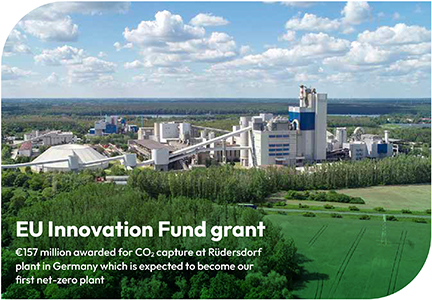
• Awarded €157 million EU Innovation Fund grant for CO2 capture at Rüdersdorf plant in Germany which is expected to become our first net-zero plant
|
• Raised our net promoter score to 74, setting another industry benchmark and maintaining our alignment with other well-regarded customer-oriented companies which further emphasizes our customer centricity focus
• Ranked #1 by the World Benchmarking Alliance among 91 companies in hard-to-abate industries including steel and aluminum, achieving the highest climate transition score
• Reduced our cement Scope 1- and 2-specific CO2 emissions by 15% and 18%, respectively, a reduction that would have taken us 16 years to achieve historically1,3 |
Our achievements are accomplished alongside our prioritized commitment to health and safety. As we continue striving to achieve zero injuries, we remain a positive industry benchmark in safety standards. In 2024, our employee lost time injury (LTI) frequency rate was 0.6,2 and we had zero LTI incidents across 96% of our global operations. These results provide both motivation and clear evidence that our continuous improvement commitment is producing positive outcomes, yet we will not be satisfied until we achieve zero injuries across all our operations.
As we execute our daily operations safely, we have an unwavering focus to deliver superior customer experience that helps our customers succeed, contributes to building stronger communities, and is a powerful differentiator for Cemex. In 2024, we set a record net promoter score (NPS) of 74. For the past four years, our NPS has been above the industry benchmark in customer satisfaction for business-to-business companies. Leveraging digital solutions as powerful enablers, we further accelerated seamless customer experiences and order adoptions through Cemex Go, our global flagship omnichannel platform. To create momentum for complete digital adoption among our customers, we launched the Cemex Go Acceleration Program in the U.S. region, which resulted in increased order adoption rates of 60%. We are proud to maintain our industry leadership as the only end-to-end solution in the quote-to-cash process, and we plan to expand the Acceleration Program to all regions in 2025. Additionally, we were the first in the industry to develop a sales assistant powered by Generative Artificial Intelligence. This allowed us to provide even more personalized solutions to customers while simultaneously offering us deeper insights to anticipate future needs. |
A Significant Year in Sustainability
In 2024, we continued to achieve aggressive decarbonization targets toward a net-zero future. Through our Future in Action global climate action program, we remain a benchmark for industry’s efforts to profitably decarbonizing operations, optimizing the use of natural resources and alternative materials, expanding initiatives across the entire value chain, promoting nature conservation, and ensuring that our activities have an increasingly positive social impact.
We were recognized as the industry’s top-scoring company in the World Benchmarking Alliance’s (WBA) 2024 Climate and Energy Benchmark.
Amidst 91 of the world’s most influential aluminum, cement, and steel companies which were measured based on their emission targets and transition to a lower-carbon future, Cemex achieved the highest score in the overall ranking after the WBA assessed the company’s climate performance using industry-specific Accelerate Climate Transition (ACT) methodologies, as well as social and just transition indicators.
1 Compared to our 2020 baseline. 2 LTI is 0.5 when considering the full-year performance level, including the periods of responsibility for discontinued operations. 3. Like-for-like, excluding discontinued operations. | |||
 | ||||||
| Contents | ||
| Our Company | ||
| ● Letter to Our Stakeholders | ||
| Cemex Overview | ||
| Noteworthy Recognitions | ||
| Financial & Sustainability Highlights | ||
| Our Sustainability Targets | ||
| Our Strategy | ||
| Financial Performance | ||
| Environmental Excellence | ||
| Stakeholder Engagement | ||
| Governance | ||
| Appendix | ||
| 5 Cemex 2024 Integrated Report | ||
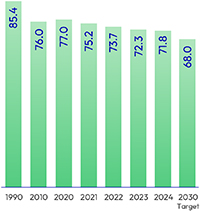
| This year, we reduced our Scope 1 CO2 emissions by more than 2%, while maintaining our 37% utilization of alternative fuels with biomass content and further reducing our clinker factor to 71.8%. These achievements demonstrate that accomplishing great things is possible through industry-supportive advocacy and policies. In Europe, where stable frameworks exist, our pace of profitable decarbonization continues to lead the industry. In fact, our alternative fuel usage in Europe set an industry benchmark where it exceeded 75% in the U.K., Germany, and the Czech Republic, and it even reached 95% in Poland.
We also were awarded the prestigious Net-Zero Industries Award by Mission Innovation for our revolutionary clinker decarbonization process using concentrated solar power in partnership with cleantech company Synhelion, which is also one of our venture capital investments.
In Germany, we are working to make our Rüdersdorf plant our first and flagship plant in our carbon capture, utilization, and storage (CCUS) strategy. Achieving neutrality requires further exploration of new technologies, and this plant was selected in 2024 to receive €157 million from the European Union Innovation Fund to capture 1.3 million metric tons of CO2 per year making it Cemex’s first carbon-neutral cement plant in the world by 2030.
For our decarbonization efforts to succeed, we must transform customer demand for accelerated adoption of sustainable products. Our Vertua® low-carbon products have gained rapid customer acceptance, with low-carbon cement now accounting | for 63% of our consolidated cement volumes and low-carbon concrete accounting for 55% of total concrete sales. Customer acceptance for both Vertua® products is running well ahead of our 2025 target of greater than 50%. Our Vertua® products are widely used along with other products and solutions in notable global projects, including construction of one of the tallest skyscrapers in Miami, the development of new infrastructure for NASA in Florida, the Aquatics Centre and other venues for the Summer 2024 Olympic Games in Paris, a new power plant in Dubai, and the Bogotá Metro in Colombia, among others.
As we take comprehensive actions to lead the transition toward a circular economy by eliminating waste, circulating materials at their highest value, and promoting the restoration of natural resources, we are instilling circularity principles across our operations. Through our regenerative use of construction, demolition, and excavation materials (CDEM) as well as municipal and industrial waste, our industry can be a powerful contributor to a circular economy. For context, the world produces about 11 billion tons of waste annually, of which about 35% is CDEM and 55% is municipal and industrial waste. Rather than landfilling this waste, our industry could potentially repurpose about 35% of it as alternative fuels, aggregates, and other materials in our productions processes if supporting codes and regulations are broadly allowed for this possibility. Regenera, our global waste management business, continued leveraging our global expertise in using industrial waste and byproducts as sustainable substitutes in production processes where supporting regulations exist. In 2024, we managed 27 million tons of waste and byproducts, which is roughly equivalent to the municipal waste produced |
| ||||
| annually in the U.K. In Germany, we acquired a majority stake in the circularity business of the HEIM Group with the annual capacity to process 800,000 tons of material. Regenera will convert this material into aggregates for reuse in concrete production, ultimately reintegrating them into the construction value chain. In addition to its recycling capabilities, this circularity business operates the first plant to permanently store biogenic CO2 in recycled mineral waste in Germany. Additionally, we became partners in The Ellen MacArthur Foundation, the world’s leading circular economy network. Integrating waste materials as raw materials and alternative fuels in production processes is a powerful enabler to lower our carbon footprint and address global challenges such as biodiversity loss. | To ensure our operations have a positive impact on nature and society, we continued our work to optimize water usage and to reduce freshwater withdrawals while also minimizing our impact on air quality and enhancing the biodiversity in and around our quarries. In several cities in Mexico, for example, we are producing 100% of our concrete using water that is not suitable for human or agricultural consumption. At the national level, 60% of our concrete production utilizes this same practice, which is being further replicated in other global areas. | |||||
| Contents | ||
| Our Company | ||
| ● Letter to Our Stakeholders | ||
| Cemex Overview | ||
| Noteworthy Recognitions | ||
| Financial & Sustainability Highlights | ||
| Our Sustainability Targets | ||
| Our Strategy | ||
| Financial Performance | ||
| Environmental Excellence | ||
| Stakeholder Engagement | ||
| Governance | ||
| Appendix | ||
| 6 Cemex 2024 Integrated Report | ||
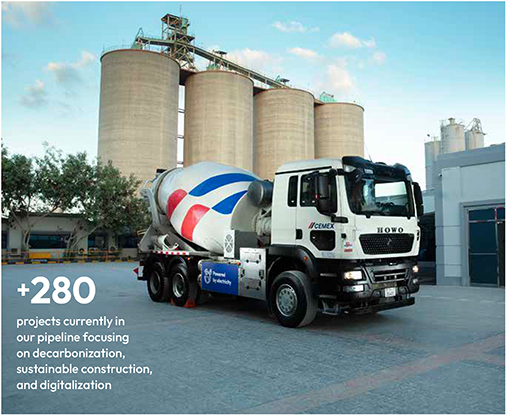
| Such innovative efforts are in our DNA, and we continued our research and development efforts with our portfolio of more than 100 projects designed to help us achieve our climate goals. We collaborate with organizations to develop, source, and scale innovative solutions that will accelerate our transition to a carbon-neutral future. We currently have 280 projects in our pipeline focusing on decarbonization, sustainable construction, and digitalization. Cemex Ventures continues to develop strategic business opportunities through collaboration, partnership, and investment in disruptive | companies, and has become one of the top investors, opinion leaders, and key contributors in the construction industry’s entrepreneurial ecosystem.
Accelerating regulations and policies to further advance climate action globally is critical to achieve our goals. We continue to collaborate with industry associations and other partners to help drive and sustain these necessary changes for a net-zero world. Our CEO continued to serve as president of the Global Cement and Concrete Association (GCCA) this year, and Cemex held nearly 200 | leadership roles in global industry groups. As we are nearly midway in this decade to deliver, public-private collaboration is paramount, now more than ever, to unlock the industry’s full potential in a carbon-neutral society.
At Cemex, we also recognize the power of going beyond traditional social responsibility in support of our climate action goals. Through collaboration, we scale our social impact contributions to promote a sustainable future for our local communities and facilitate a just transition to a low-carbon economy. Leveraging our business strengths, we make significant contributions to society through our social responsibility program and our social investments. This year, we positively impacted nearly 30 million community partners across our operations. As we make a positive and lasting difference in the communities where we operate, we also empower communities to prepare for, respond to, and recover from challenges while promoting long-term sustainability. While 2024 saw significant climate-related disasters, we trained approximately 8,000 people in emergency preparedness, executed four employee-driven giving campaigns following hurricanes and flooding in the U.S., Mexico, and Spain, and trained more than 18,000 people in road safety.
Ultimately, we have made significant progress toward our ambitious 2030 goals and remain on track to become a net-zero carbon emissions company by 2050.
| A New Era of Sustainable Growth
The strategic, operational, and financial pillars of Cemex are solid. Now with a financially strong foundation, we have adjusted our global structure and strategy to achieve a higher growth rate. We remain steadfast in our dedication to execute our strategy to deliver this growth as well as continued profitable progress on our decarbonization pathway. Our ability to successfully navigate the headwinds of 2024 is underscored by our robust and consistent performance. As Cemex transitions its leadership in 2025, we remain firmly committed to you, our stakeholders, to continue the great work we have done to keep this company at the forefront of the building materials industry and create even more lasting value for you. We are excited about this new era. On behalf of Cemex’s Board of Directors, our management team, and our employees, we thank you for your continued confidence in Cemex.
Sincerely,
Rogelio Zambrano Lozano
Chairman, Board of Directors
Fernando A. González
Chief Executive Officer | |||
|
| ||||||
| Contents | ||
| Our Company | ||
| Letter to Our Stakeholders | ||
| ● Cemex Overview | ||
| Noteworthy Recognitions | ||
| Financial & Sustainability Highlights | ||
| Our Sustainability Targets | ||
| Our Strategy | ||
| Financial Performance | ||
| Environmental Excellence | ||
| Stakeholder Engagement | ||
| Governance | ||
| Appendix | ||
| 7 Cemex 2024 Integrated Report | ||
| Contents | ||
| Our Company | ||
| Letter to Our Stakeholders | ||
| ● Cemex Overview | ||
| Noteworthy Recognitions | ||
| Financial & Sustainability Highlights | ||
| Our Sustainability Targets | ||
| Our Strategy | ||
| Financial Performance | ||
| Environmental Excellence | ||
| Stakeholder Engagement | ||
| Governance | ||
| Appendix | ||
| 8 Cemex 2024 Integrated Report | ||
| Our Business | Our Global Footprint | |||
|
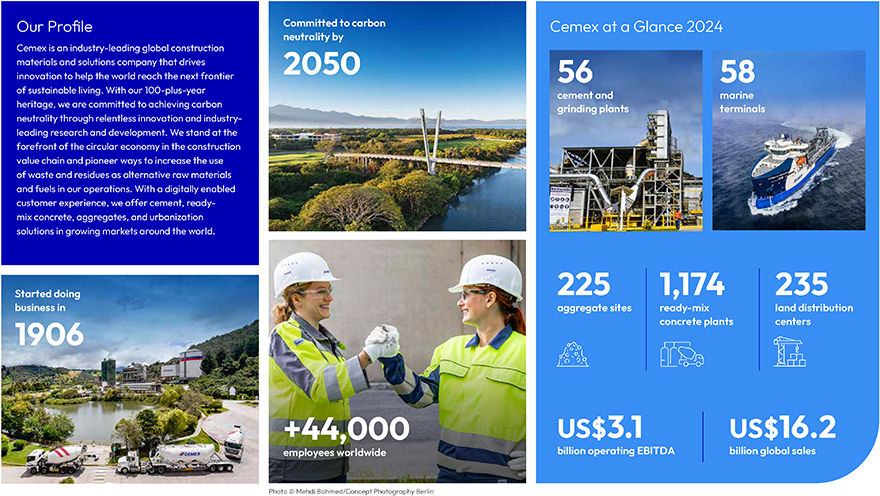
Cement – A binding agent, when mixed with aggregates and water, produces either ready-mix concrete or mortar.
|  | |||
| 56 cement and grinding plants | 81 million metric tons installed production capacity | |||
|
Ready-Mix Concrete – A combination of cement, aggregates, admixtures, and water.
| ||||
| 1,174 plants | 44 million cubic meters of annual sales volume | |||
|
Aggregates – Inert granular materials, such as stone, sand, and gravel, obtained through land-based resources or dredging marine deposits.
| ||||
| 225 sites | 136 million tons of annual sales volume | |||
|
Urbanization Solutions – Complementary solutions designed to meet the opportunities of sustainable urbanization through performance materials, industrialized construction, waste management, and other related services.
| ||||
| Contents | ||
| Our Company | ||
| Letter to Our Stakeholders | ||
| Cemex Overview | ||
| ● Noteworthy Recognitions | ||
| Financial & Sustainability Highlights | ||
| Our Sustainability Targets | ||
| Our Strategy | ||
| Financial Performance | ||
| Environmental Excellence | ||
| Stakeholder Engagement | ||
| Governance | ||
| Appendix | ||
| 9 Cemex 2024 Integrated Report | ||
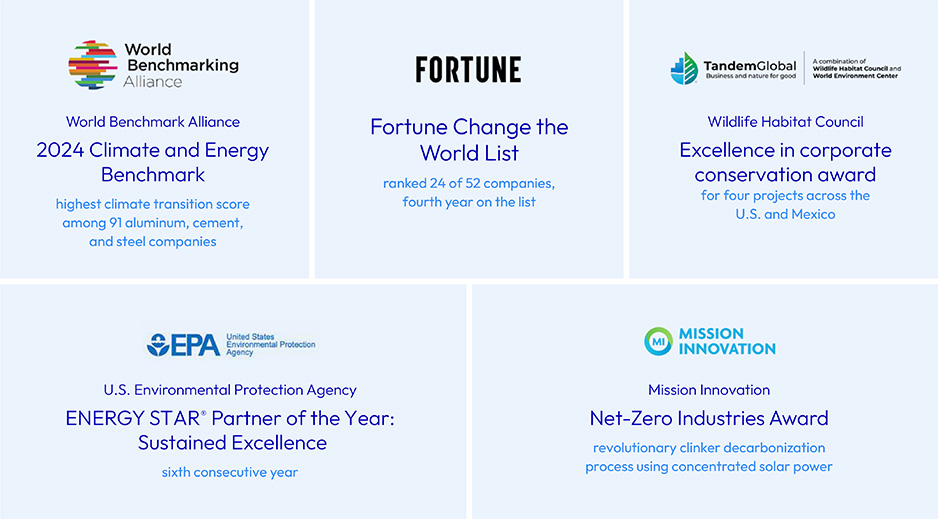
Since our humble beginnings in the early 1900s, Cemex has led the way
in accelerating a sustainable world. We are proud to be recognized externally
for our commitments toward the next frontier of sustainable living.
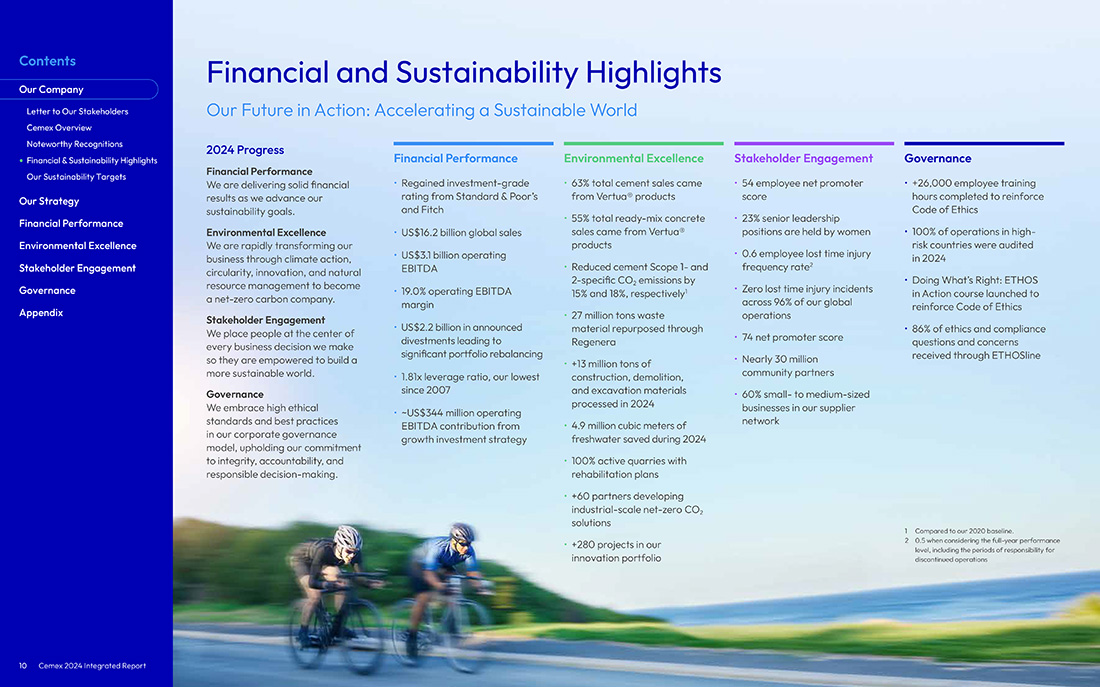
Contents Our Company Letter to Our Stakeholders Cemex Overview Noteworthy Recognitions Financial & Sustainability Highlights Our Sustainability Targets Our Strategy Financial Performance Environmental Excellence Stakeholder Engagement Governance Appendix Financial and Sustainability Highlights Our Future in Action: Accelerating a Sustainable World 2024 Progress Financial Performance We are delivering solid financial results as we advance our sustainability goals. Environmental Excellence We are rapidly transforming our business through climate action, circularity, innovation, and natural resource management to become a net-zero carbon company. Stakeholder Engagement We place people at the center of every business decision we make so they are empowered to build a more sustainable world. Governance We embrace high ethical standards and best practices in our corporate governance model, upholding our commitment to integrity, accountability, and responsible decision-making. Financial Performance Environmental Excellence Stakeholder Engagement Governance Regained investment-grade rating from Standard & Poor’s and Fitch US$16.2 billion global sales US$3.1 billion operating EBITDA 19.0% operating EBITDA margin US$2.2 billion in announced divestments leading to significant portfolio rebalancing 1.81x leverage ratio, our lowest since 2007 ~US$344 million operating EBITDA contribution from growth investment strategy 63% total cement sales came from Vertua® products 55% total ready-mix concrete sales came from Vertua® products Reduced cement Scope 1- and 2-specific CO2 emissions by 15% and 18%, respectively1 27 million tons waste material repurposed through Regenera +13 million tons of construction, demolition, and excavation materials processed in 2024 4.9 million cubic meters of freshwater saved during 2024 100% active quarries with rehabilitation plans +60 partners developing industrial-scale net-zero CO2 solutions +280 projects in our innovation portfolio 54 employee net promoter score 23% senior leadership positions are held by women 0.6 employee lost time injury frequency rate2 Zero lost time injury incidents across 96% of our global operations 74 net promoter score Nearly 30 million community partners 60% small- to medium-sized businesses in our supplier network +26,000 employee training hours completed to reinforce Code of Ethics 100% of operations in highrisk countries were audited in 2024 Doing What’s Right: ETHOS in Action course launched to reinforce Code of Ethics 86% of ethics and compliance questions and concerns received through ETHOSline 1 Compared to our 2020 baseline. 2 0.5 when considering the full-year performance level, including the periods of responsibility for discontinued operations
| Contents | ||
| Our Company | ||
| Letter to Our Stakeholders | ||
| Cemex Overview | ||
| Noteworthy Recognitions | ||
| Financial & Sustainability Highlights | ||
| ● Our Sustainability Targets | ||
| Our Strategy | ||
| Financial Performance | ||
| Environmental Excellence | ||
| Stakeholder Engagement | ||
| Governance | ||
| Appendix | ||
| 11 Cemex 2024 Integrated Report | ||
| The United Nations Sustainable Development
1 2024 figures do not include discontinued operations. | Focus Area | Key Performance Indicator | 20241 | 2030 Target | Link to priority SDGs | |||||
|
| ||||||||||
| Health and Safety | Employee fatalities (No.)
| 1 | 0 | 9, 11 | ||||||
|
| ||||||||||
|
Employee lost time injuries (LTI) frequency rate
| 0.6 | 0 | 9, 11 | |||||||
|
| ||||||||||
| Customer Centricity | Net promoter score (NPS) | 74 | 70 | 9 | ||||||
|
| ||||||||||
| Climate Action |
Scope 1 specific net CO2 emissions per ton of cementitious product (kgCO2/cementitious)2
| 526 | <430 | 9, 11, 13 | ||||||
|
| ||||||||||
|
Clinker factor (cementitious) (%)
| 71.8 | 68 | 9, 11, 13 | |||||||
|
| ||||||||||
|
Alternative fuels rate (%)
| 37 | 55 | 9, 11, 13 | |||||||
|
| ||||||||||
|
Scope 2-specific CO2 emissions per ton of cementitious product (kgCO2/cementitious)
| 44.7 | 24 | 9, 11, 13 | |||||||
|
| ||||||||||
| Circular Economy |
Total waste-derived sources managed (million tons)
| 27 | 41 | 9, 11, 12 | ||||||
|
| ||||||||||
| Water |
Implementation of water action plans in sites located in water-stressed areas (%)3
| 40 | 100 | 12 | ||||||
|
| ||||||||||
|
Reduction in specific freshwater withdrawal in cementitious (%)
| 9.9 | 20 | 12 | |||||||
|
| ||||||||||
|
Reduction in specific freshwater withdrawal in aggregates (%)
| 1.2 | 15 | 12 | |||||||
|
| ||||||||||
|
Reduction in specific freshwater withdrawal in concrete (%)
| 16.9 | 10 | 12 | |||||||
|
| ||||||||||
| Biodiversity |
Quarry rehabilitation plans, biodiversity action plans, and third-party certification (%)4
| 89 | 100 | 11, 13 | ||||||
|
| ||||||||||
|
Third-party certification on critical sites (%)5
| 84 | 100 | 11, 13 | |||||||
|
| ||||||||||
| Air Emissions |
Reduction of PM emissions per ton of clinker vs. 2005 (%)
| 88 | 95 | 12 | ||||||
|
| ||||||||||
|
Reduction of NOx emissions per ton of clinker vs. 2005 (%)
| 39 | 47 | 12 | |||||||
|
| ||||||||||
|
Reduction of SOx emissions per ton of clinker vs. 2005 (%)
| 54 | 67 | 12 | |||||||
|
| ||||||||||
| Communities |
Community engagement plans in priority sites (%)
| 99 | 100 | 9, 11 | ||||||
|
| ||||||||||
|
Community partners (million people)6
| 29.7 | 30 | 11 | |||||||
|
| ||||||||||
| Employee Experience |
Employee net promoter score (eNPS)
| 54 | ≥43 | 9, 11 | ||||||
|
| ||||||||||
|
Voluntary turnover (%)7
| 11 | <10 | 9 | |||||||
|
| ||||||||||
| Suppliers | Sustainability assessment of critical suppliers by an independent third party (% spend) | 82 | 90 | 9, 11, 12, 13 | ||||||
|
| ||||||||||
| Ethics and Compliance | Implementation of Ethics and Compliance Continuous Improvement Program (%) | 100 | 100 | 9 | ||||||
|
| ||||||||||
| Sustainable Finance | Debt and other instruments linked to sustainability (%) | 54 | 85 | 9, 11, 12, 13 | ||||||
|
| ||||||||||
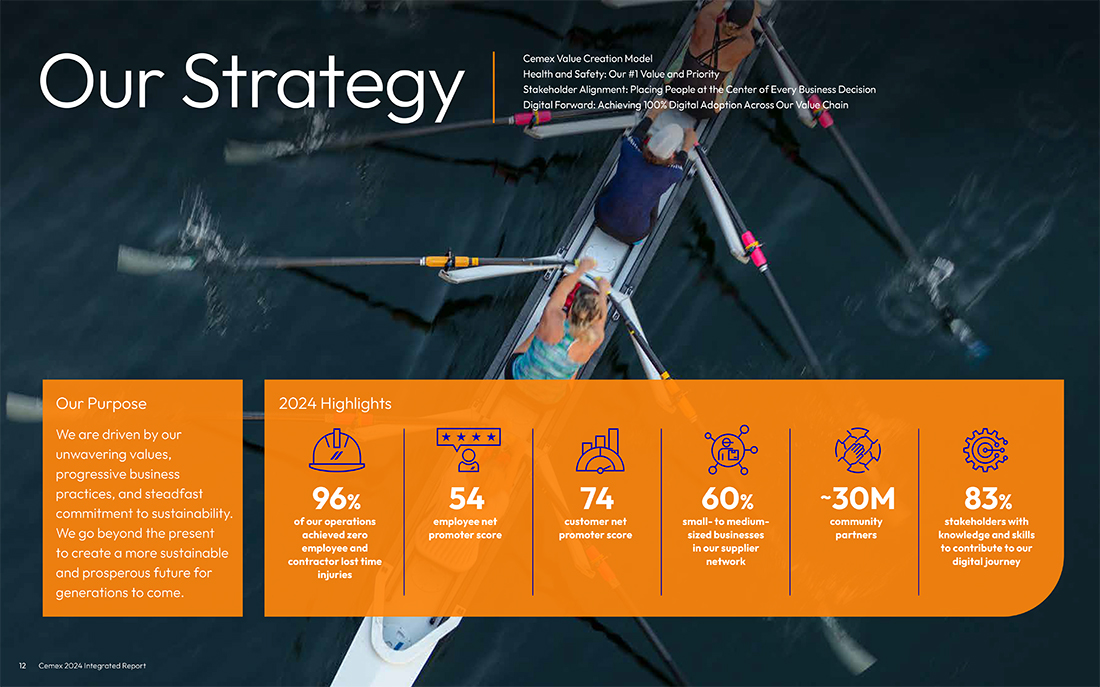
Our Strategy Cemex Value Creation Model Health and Safety: Our #1 Value and Priority Stakeholder Alignment: Placing People at the Center of Every Business Decision Digital Forward: Achieving 100% Digital Adoption Across Our Value Chain

Priority SDGs We prioritize United Nations Sustainable Development Goals (SDGs) related to our business strategy, provide the greatest opportunity to leverage our essential portfolio of products, create profitable shared value, and contribute to the UN’s Sustainable Development Agenda.
| Contents | ||
| Our Company | ||
| Our Strategy | ||
| Cemex Value Creation Model | ||
| ● Health and Safety: Our #1 Value and Priority | ||
| Stakeholder Alignment: Placing People at the Center of Every Business Decision | ||
| Digital Forward: Achieving 100% Digital Adoption Across Our Value Chain | ||
| Financial Performance | ||
| Environmental Excellence | ||
| Stakeholder Engagement | ||
| Governance | ||
| Appendix | ||
| 14 Cemex 2024 Integrated Report | ||
Our #1 Value and Priority
Our Approach: Health and Safety is our #1 value and priority and a
moral imperative for our company. Whether an employee, contractor,
supplier, or community member, we strive for everyone to return
safely to their family.
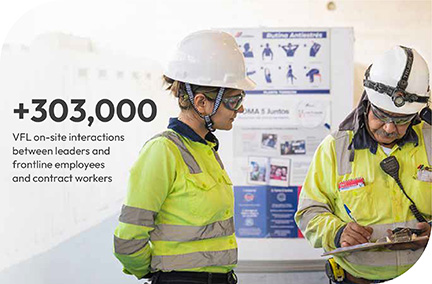
| SDGs: We believe that a strong health and safety culture directly contributes to SDG 8 and supports SDG 9 by promoting responsible industrialization, resilience, and innovation. It also aligns with SDG 11 by establishing safe workplaces that enhance the overall well-being of urban areas and human settlements. | Health and Safety Operations Through standardized controls and procedures, we monitor our health and safety progress in the countries where we operate. Our working groups supervise, report on performance, and share best practices across the company through a coordinated, consistent, and collaborative approach: | Visible Felt Leadership Program Strengthening health and safety leadership skills is an integral part of our talent management approach. Our Visible Felt Leadership (VFL) program was developed as a face-to-face training for leaders, aimed at helping them lead by example with frontline employees and contractors using a constant, consistent, and positive | approach. The course, now available online, covers improved safety communication, leadership engagement, and proactive safety culture practices. In 2024, the online training became available in Cemex’s eight core languages. Over the past decade, our VFL program has consistently delivered benefits like heightened safety awareness and enhanced safety culture. | |||
| Our Health and Safety Culture Starts at the Top
At Cemex, we know developing a health and safety culture requires visible commitment from leaders. We also know clear expectations, rigorous management policies, training, talent development, collaboration, and best-practice sharing are key components of a long-standing pledge to health and safety.
For us, it starts with our chief executive officer, who oversees our health and safety strategy and performance, which our Board of Directors regularly reviews. Every year, our Sustainability, Climate Action, Social Impact, and Diversity Committee discusses action plans and evaluates health and safety risks. Weekly health and safety performance and monthly results recaps keep our country, regional, and corporate leaders updated on our progress. | • Health and Safety Functional Network. This is the network of trained health and safety specialists that the company has across all our operations to help ensure that our health and safety management system is effectively implemented.
• Global Health and Safety Council. This council includes regional health and safety leaders as well as members of the corporate health and safety team to review improvements or changes for implementation globally in any of our management system elements.
• Global Health Forum. A group of internal experts leading initiatives to share health best practices and help other employees and contractors adopt healthier lifestyles. |
| ||||
| Contents | ||
| Our Company | ||
| Our Strategy | ||
| Cemex Value Creation Model | ||
| ● Health and Safety: Our #1 Value and Priority | ||
| Stakeholder Alignment: Placing People at the Center of Every Business Decision | ||
| Digital Forward: Achieving 100% Digital Adoption Across Our Value Chain | ||
| Financial Performance | ||
| Environmental Excellence | ||
| Stakeholder Engagement | ||
| Governance | ||
| Appendix | ||
| 15 Cemex 2024 Integrated Report | ||
| S P O T L I G H T : V I S I B L E F E L T L E A D E R S H I P
| ||
| Leading With Care: How Cemex Shapes |
| Joel, an executive leader at Cemex, knows the ins and outs of the concrete business. With more than 25 years of experience at various concrete companies, he has encountered many organizations that claim to prioritize health and safety. However, it wasn’t until the job at Cemex nearly 10 years ago that he truly felt a difference.
“From day one, there was something distinct about Cemex. It was clear that health and safety were ingrained in the culture.”
What Joel sensed was the power of Visible Felt Leadership (VFL), a training program at Cemex that encourages leaders to be actively present and engaged with their teams to foster a strong culture of health and safety. Over the years, the VFL training has grown, positively impacting lives across the organization.
“I’ve observed employees adopt safe driving principles inside and outside of working hours and successfully manage medical emergencies thanks to the CPR training provided.”
Even though Joel is now in a sales role, he maintains the VFL mindset, noting that health and safety practices should be followed across the organization. To be effective in VFL, Joel firmly believes that leaders must come from a place of genuine care and concern for their employees.
|
“When I talk to my sales clients about wearing their hard hats or setting up their medical ID on their phones, it changes the entire dynamic. It shows that we care beyond selling our products—it demonstrates we are partners in their safety and well-being.”
For Joel, it is evident that VFL isn’t just a company initiative—it’s an attitude that fosters a culture where safety and well-being come first.
“It really is about the people. I believe there is a right way and a wrong way to approach people about health and safety. You never know what’s going on in a person’s life. Encouragement and positive reinforcement are key. When we care for one another, we foster an environment where everyone feels valued, supported, and empowered to make the best choices in all areas of their lives.” |
| Health and Safety Leadership Development Process This year we enhanced our health and safety leadership development approach with a new process for operations leaders, making it accessible across all regions worldwide. From senior managers to frontline supervisors, leaders are encouraged to engage in one-on-one conversations with the person they report to, exchanging views and gaining feedback about their safety performance strengths and opportunities prior to creating individual development plans that are measured throughout the year. The process is designed to cascade level by level, and more than 1,000 operations leaders completed the process in 2024. | +1,000 operations leaders completing the new health and safety leadership development process |
| | ||
| Cemex University: Health and Safety Academy | ||
| Completion of the Cemex University Health and Safety Academy is a requirement for executives, line managers, and plant and corporate office supervisors. This program strives to achieve a comprehensive understanding of responsibilities and accountability, reinforcing our health and safety culture and practices within our teams. Regular refreshers are conducted as needed to maintain and enhance this commitment. | ||
| +5,500 participants in | Topics covered in the courses include:
• Health and Safety Leadership
• Importance of People, Processes, and Facilities to Manage Our Health and Safety Management System (HSMS)
• Incidents’ Root-Cause Analysis
• Key Elements for Supervisors to Manage Operations According to Our HSMS
• Becoming Proficient in Our HSMS
| |
| Contents | ||
| Our Company | ||
| Our Strategy | ||
| Cemex Value Creation Model | ||
| ● Health and Safety: Our #1 Value and Priority | ||
| Stakeholder Alignment: Placing People at the Center of Every Business Decision | ||
| Digital Forward: Achieving 100% Digital Adoption Across Our Value Chain | ||
| Financial Performance | ||
| Environmental Excellence | ||
| Stakeholder Engagement | ||
| Governance | ||
| Appendix | ||
| 16 Cemex 2024 Integrated Report | ||
Global Health and Safety Policy and Procedures
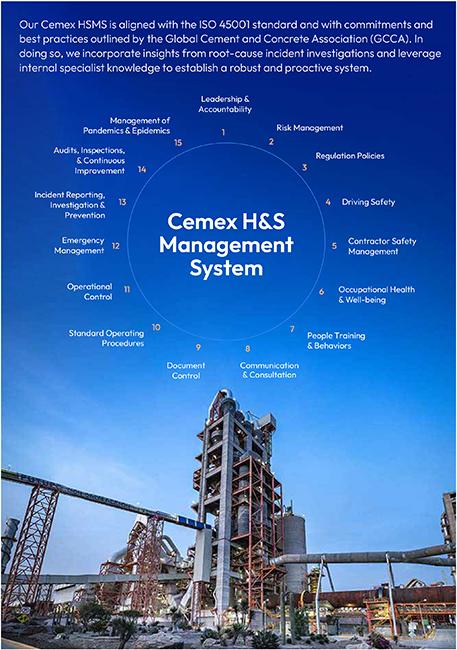
The foundation for our health and safety commitment, and the cornerstone of our Health and Safety Management System (HSMS), is our Global Health and Safety Policy, which establishes clear expectations for all levels within our organization and is applied across all our operations. Our global procedures include guidelines to investigate work-related injuries, occupational diseases, and incidents so we can learn from them and develop actions to mitigate future recurrences and replicate these learnings across all our sites. Root-cause analysis of injuries and occupational health cases currently helps us learn from experience, yet we want to do more. We are tracking new predictive safety indicators designed to monitor and measure the effectiveness of our initiatives, identify hotspots, and develop preventive actions.
Cemex Health and Safety
Management System
Our HSMS empowers our leaders to implement a successful health and safety strategy and adequately allocate resources to training programs across our operations. Our operations managers utilize our HSMS for annual self-assessments and for developing annual health and safety improvement plans for their teams. The system defines performance requirements and goals in accordance with local regulations, helping us assess potential risks and plan mitigation measures. Communication tools are embedded in the system, allowing us to share best practices with our operations employees and contractors.
Cemex’s operational sites include facilities that may consist of multiple locations rather than being confined to a single location.
Underpinned by a strong emphasis on leadership and accountability, Cemex management is dedicated to making health and safety our overriding priority. The company’s management also oversees the planning, implementation, monitoring, and review of control measures aimed at eliminating hazards or minimizing risks to our workforce and those affected by our business activities.
Every Cemex site has the HSMS in place, and most of our cement sites are certified to ISO standard 45001. This international standard sets the criteria for an occupational health and safety management system and provides a framework for organizations to identify, manage, and continually improve their health and safety performance. This standard helps us establish a systematic approach to occupational health and safety and fosters employee well-being.
| | Learn more about our Health and Safety Policy on our website. |
Global Corporate Governance Audits
Our annual corporate governance audit program evaluates an average of 40 global operational sites each year, with comprehensive coverage across all countries within a three-year cycle. The primary objective is to conduct an independent assessment of compliance within our HSMS, providing valuable feedback and improvement recommendations.
The HSMS also undergoes regular audits through the Corporate Governance Health and Safety Audits program. This global program conducts cross-regional audits in multiple local operations annually, enabling continuous improvement and best-practice sharing on health and safety topics across our operations.
| Contents | ||
| Our Company | ||
| Our Strategy | ||
| Cemex Value Creation Model | ||
| ● Health and Safety: Our #1 Value and Priority | ||
| Stakeholder Alignment: Placing People at the Center of Every Business Decision | ||
| Digital Forward: Achieving 100% Digital Adoption Across Our Value Chain | ||
| Financial Performance | ||
| Environmental Excellence | ||
| Stakeholder Engagement | ||
| Governance | ||
| Appendix | ||
| 17 Cemex 2024 Integrated Report | ||
| Contractor Health and Safety Verification System Our health and safety culture extends to contractors, including on-site contractors, underscoring our top priority. The Cemex Contractor Health and Safety Verification Program seeks contractors’ adherence to rigorous health and safety standards, mandates that contractors receive proper training, and requires relevant accreditations for contractors working within Cemex operations. Executed globally in collaboration with specialized firms, we require all business units to fulfill the program’s objectives.
Contractors are not permitted to work on our premises when they fall short of verification. This allows for a thorough and stringent approach to health and safety standards.
Health and Safety Excellence We proudly honor top-performing operational sites and employees who exemplify our health and safety culture. Through our annual Global Cemex Awards, we recognize excellence in categories like Zero4Life, Contractor Management, Fit4Life, and Best and Most Improved Business Sectors. We are also recognized externally for our strong commitment to health and safety. | Our Zero4Life Commitment: Zero Injuries Across Our Business
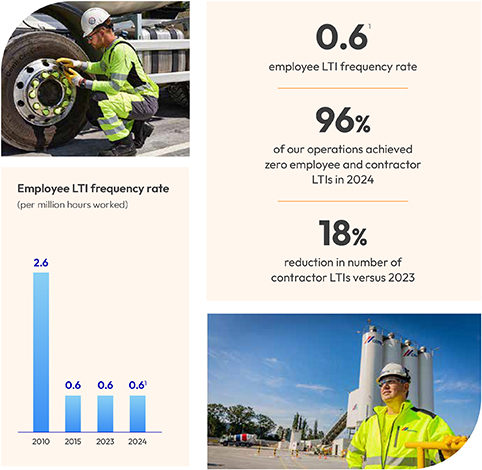
We are committed to achieving zero injuries and continue to be a positive industry benchmark in safety standards. In 2024, our employee lost time injury (LTI) frequency rate was 0.6,1 and we had a 18% reduction in contractor LTIs versus 2023. We had zero LTI incidents across 96% of our global operations. These results provide both motivation and clear evidence that our continuous commitment is producing positive outcomes, yet we will not be satisfied until we achieve zero injuries across all our operations.
Cemex is a positive safety benchmark for a global company in our industry.2
1 LTI is 0.5 when considering the full-year performance level, including the periods of responsibility for discontinued operations. 2 Based on an internal analysis using publicly available information on companies within the global cement and concrete industry. |
External Recognition Highlights Our Commitment to Safe, Healthy Workplace
In 2024, we received external validation of our strong health and safety culture with 49 awards and 44 recognitions granted by governments, organizations, and industry associations. We are honored to be acknowledged across all our regions and health and safety categories.
Cámara Nacional del Cemento (CANACEM)
Awards for innovative health and safety projects and for achieving zero lost time injuries at various cement plants, Mexico
Fédération Internationale de l’Automobile (FIA)
FIA Americas Award - Mobility for road safety initiatives, Colombia
Portland Cement Association
Chairman’s Safety Performance Award, U.S.
Safety Performance at Longmont Lyons, CO, and Clinchfield, GA, plants
Health and Safety Awards in Europe
• Leader of Safety Golden Award, Central Institute for Labour Protection - National Research Institute (CIOP-PIB), Poland
• Safety Grand Prix, Hrvatska Udruga Menadžera Sigurnosti, Croatia
• First place in the Occupational Safety Competition for our Rüdersdorf and Eisenhüttenstadt plants, VDZ (Verein Deutscher Zementwerk e. V.), Germany
|
| Contents | ||
| Our Company | ||
| Our Strategy | ||
| Cemex Value Creation Model | ||
| ● Health and Safety: Our #1 Value and Priority | ||
| Stakeholder Alignment: Placing People at the Center of Every Business Decision | ||
| Digital Forward: Achieving 100% Digital Adoption Across Our Value Chain | ||
| Financial Performance | ||
| Environmental Excellence | ||
| Stakeholder Engagement | ||
| Governance | ||
| Appendix | ||
| 18 Cemex 2024 Integrated Report | ||
| Our Programs, Campaigns Keep Health and Safety Top of Mind
We have a wide range of programs that start with integrating health and safety into all operational levels and are framed by our global policy and management system. We monitor leading and lagging indicators, implement regional and local initiatives, and adopt best practices, all in the spirit of continuous improvement.
| ||||||
| Let’s Do It Campaign This year we launched our global Zero4Life Let’s Do It awareness campaign designed to reach everyone in our organization. The campaign launched with a video from our chief executive officer, signifying its importance and reminding our people that safety is a shared responsibility. Our regions cascaded the campaign and helped identify additional safety measures, enabling us to identify strategic action plans across all regions with targeted initiatives specific to certain operations.
Take 5 Together Program Our global Take 5 Together program actively promotes a take care of each other culture, encouraging employees and contractors to intervene when they observe a colleague taking a risk. These collaborative, proactive, and positive peer-to-peer interactions breed trust among co-workers, help people return home safe to their families, and reinforce that everyone should be a safety leader. On average, each worker engages in around six of these interactions monthly. We already | have nearly 70% of employees actively participating in the program, showcasing our widespread commitment to a safe working environment and practices, and we continue to promote the importance of everyone participating. The program also includes comprehensive training across all operations, embedding a pre-task personal risk assessment for safer work practices.
Cemex Citizen, SCA&C Our South and Central America and the Caribbean (SCA&C) region onboards and tutors employees, contractors, and those new to their roles during their first 60 days on the job through its Cemex Citizen program. The goal is to give participants the confidence and resources they need to make safety-conscious decisions and act independently. Classroom learning, job shadowing, mentorship, and on-the-job verification of adherence to safety standards are all part of the program. Upon final evaluation, participants graduate and receive their white helmet, symbolizing safety proficiency in their role.
Health and Safety Training Center, Mexico Our Mexico Safety Training Center immerses middle managers in realistic health and safety scenarios, combining theoretical knowledge with innovative, practical application to cultivate a robust safety culture. The training focuses on 12 Safety Essentials and provides lessons on high-risk work, road safety, and emergency protocols. |
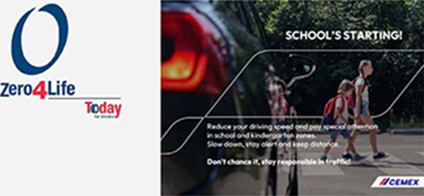
Zero4Life Today for Drivers, EMEA As part of our ongoing efforts to address road safety risks, our Europe, Middle East, and Asia (EMEA) region developed a tailored program for employee and contracted truck drivers. This three-hour facilitator-led program fosters an incident-free mindset and strengthens a culture of safety first. The program is discussion-based, featuring real-life testimonies to enhance engagement and learning. To date, we have reached nearly 7,000 drivers across the region.
| ||||
|
Drive to Excel, U.S. This driver training enhances safety, operational efficiency, and customer satisfaction among ready-mix drivers. It empowers drivers to assess risks, avoid hazards, and optimize performance through defensive driving techniques and operational best practices.
Back to Basics is a refresher training for experienced ready-mix drivers, reinforcing fundamental safety principles and operational procedures aligned with Drive to Excel. Through a combination of classroom instruction and hands-on field exercises, drivers refresh their knowledge, tackle local operational challenges, and enhance safety for themselves, their colleagues, and the public. With these comprehensive training modules, Drive to Excel fosters a stronger safety culture, improves productivity, and increases driver retention. | ||||||
| Contents | ||
| Our Company | ||
| Our Strategy | ||
| Cemex Value Creation Model | ||
| ● Health and Safety: Our #1 Value and Priority | ||
| Stakeholder Alignment: Placing People at the Center of Every Business Decision | ||
| Digital Forward: Achieving 100% Digital Adoption Across Our Value Chain | ||
| Financial Performance | ||
| Environmental Excellence | ||
| Stakeholder Engagement | ||
| Governance | ||
| Appendix | ||
| 19 Cemex 2024 Integrated Report | ||
|
Vulnerable Road Users Initiatives Just as we adopt innovative approaches to safety for our drivers and contractors, we are doing the same for motorcyclists, cyclists, pedestrians, and other vulnerable road users. Using our knowledge, we collaborate with educational institutions, traffic authorities, community groups, and civil society organizations on awareness campaigns focused on road safety, regulation compliance, and accident prevention. In 2024, our most experienced Cemex employees taught key safety requirements and the importance of road safety basics to more than 50,000 community members while explaining the safety features of our vehicles.
• Colombia. Vulnerable road users and stakeholders participated in our Together on the Road awareness campaign in 2024. This initiative extended to motorcyclists from leading delivery companies, fostering alliances with government entities, motorcycle manufacturers, and transportation companies. Going beyond training, our trucks are equipped with vehicle sensors, camera systems, mobile apps, and GPS tracking, crucial elements in safeguarding vulnerable road users. These features aim to exceed local legislative requirements, exemplifying our dedication to exceeding safety standards.
• EMEA. In all the countries where we operate in Europe, Asia, and Africa, we regularly hold events with members of the public to raise awareness about the safety of vulnerable road users. During these events, we show the safety equipment devices on our trucks and explain the drivers’ perspective.
• Mexico. In 21 cities across the country, 24 sessions of Bike School were held, in which Cemex truck drivers gained awareness, from a cyclist’s perspective, the rules to follow on the road and recommendations to keep them safe.
• U.S. Events were held in six cities where many members of the public participated. They were informed about Cemex’s strategies to improve road safety on public roads.
|
Technology Advances Our Zero4Life Goal
We continued to leverage technology this year, including Artificial Intelligence (AI), mobile and digital solutions, and telematics to help us reduce health and safety incidents at our operational sites and in how we transport materials. We are advancing our use of AI, including virtual reality training in real and controlled environments, drone flights to anticipate and mitigate risks, safety assistance systems, and telematics data.
Global Health and Safety Dashboard
Technology drives our global dashboard, which includes key leading and lagging indicators for health and safety management. Used by all countries and updated daily, the dashboard correlates leading and lagging indicators, identifies incident-free anniversaries, highlights main opportunity areas, shows progress of corporate audits and site inspections, and guides development of improvement plans.
I4 Safety
Our new i4 Safety program uses cameras at our sites to monitor unsafe behaviors, giving a real-time warning to the person engaging in the unsafe behavior and texting the local supervisor so they can immediately respond. The program was piloted this year in four regions—Mexico, SCA&C, EMEA, and the U.S. across five sites—and it included cement plants, logistics operations, aggregates, and block and ready-mix locations. Based on the successful results, we are planning to implement i4 Safety in more strategically selected sites in 2025.
Near Miss/Hazard Alert System
Cemex continues its decades-long practice of actively involving employees and contractors in controlling risk and preventing incidents. Our Near Miss/Hazard Alert System is a tool that advises management of potential health and safety risks by those who see them firsthand. Our Intelex App allows for near-miss and hazards to be reported, as well as other safety process reports—anytime, anywhere—enabling prompt reactions to prevent injuries. For offline workers, we’ve introduced an additional mobile Zero4Life solution and anticipate it will provide the same capability to capture near misses and hazard alerts.
Mobile and Digital
Our mobile and digital solutions allow our workers to use their mobile devices to register safety procedures before starting any task or to capture near misses, unsafe conditions, or unsafe acts. We strive to continue implementing these solutions in all countries where we operate.
|
Regions Embrace Technology to Improve Health and Safety
Telematics, Mexico. Telematics data provides real-time information about trucks and drivers’ conditions. Linked to our transportation control tower in Mexico, geofencing technologies and telematic data provide information about driver fatigue and distractions, speeding, route deviations, and vehicle maintenance. By the end of 2024, this real-time data was available for 100% of our company-owned vehicles, 97% of contractor vehicles in Mexico’s supply chain area (without unions), and almost all Cemex-owned light vehicles.
Safety Assistance Systems, EMEA. Cemex is reinforcing its commitment to health and safety across its European admixture facilities with the installation of innovative safety assistance systems. The technology includes a reverse assist camera for forklift trucks, detecting pedestrians and automatically reducing speed in case of danger. This safety guard system also projects warnings at building gates, enhancing awareness for pedestrians and other forklift operators. Following successful trials in Germany, implementation commenced in the U.K. and Israel, with plans for a broader rollout in the future.
Drone Usage, Mexico. Our Mexico operations continue to use drones to enhance site safety, road safety, and training. This initiative prevents worker exposure to high-risk tasks like working at heights by enabling inspections of roofs and tall structures. It also aids in identifying road safety risks, offering an aerial perspective on dangerous routes or truck access before material delivery. Utilizing aerial footage of operations and vehicle maneuvers enhances worker training for safer task execution, mitigating potential incidents.
|
| Contents | ||
| Our Company | ||
| Our Strategy | ||
| Cemex Value Creation Model | ||
| ● Health and Safety: Our #1 Value and Priority | ||
| Stakeholder Alignment: Placing People at the Center of Every Business Decision | ||
| Digital Forward: Achieving 100% Digital Adoption Across Our Value Chain | ||
| Financial Performance | ||
| Environmental Excellence | ||
| Stakeholder Engagement | ||
| Governance | ||
| Appendix | ||
| 20 Cemex 2024 Integrated Report | ||
| Our Holistic Approach to Well-Being: Enriching Quality of Life
Our Global Well-Being model was created to facilitate an enhanced quality of life for our employees inside and outside of work. Designed around four pillars, we built a tool to identify gaps, develop programs and activities, and monitor progress. We are also proactive at sending monthly, targeted messages on well-being topics and offering events and activities that support our employees’ well-being journey.
| Health Essentials. Through this global health initiative, we aim to reduce health risks and encourage employees to live a healthy lifestyle on and off the job. The initiative features easy-to-understand materials on 12 occupational and preventive health topics. Areas such as Lung Power and Safeguard Your Back address occupational risks, while topics like Healthy Heart and Vaccines promote a healthier lifestyle and aim to reduce the number of days lost due to illness.
Mental Health Network. Our Mexico region addresses the overall well-being of our employees by focusing on the prevention, management, and care of mental health while creating a supportive workplace that raises awareness of its importance. The network provides tools like Cemex University training, a helpline, specialized care for severe traumatic events, and dedicated spaces that offer employees a place to disconnect with calming music, meditation tools, and puzzles.
Cuéntame Mental Health Platform. Cuéntame (Tell Me) is our emotional wellness program designed for education, prevention, and early intervention of mental health issues in our Mexico region. Offering three components—awareness programs, a digital support platform, and insurance coverage—the program aims to promote a mentally healthy and psychologically safe environment that allows employees to speak freely about mental health. | Well-Being Cup. The SCA&C region’s Well-Being Cup raises awareness about life, health, and well-being through healthy lifestyle learning opportunities. Its purpose is to inspire and empower teams across the region to choose a healthier future. Reaching all 11 countries in the SCA&C region, the initiative has 600 participants who compete in group and individual sports challenges on digital platforms and in the plants, learn about nutrition through cooking workshops, and participate in mental health seminars. To date, the program has resulted in a reduced absenteeism across the region.
|
| Contents | ||
| Our Company | ||
| Our Strategy | ||
| Cemex Value Creation Model | ||
| Health and Safety: Our #1 Value and Priority | ||
| ● Stakeholder Alignment: Placing People at the Center of Every Business Decision | ||
| Digital Forward: Achieving 100% Digital Adoption Across Our Value Chain | ||
| Financial Performance | ||
| Environmental Excellence | ||
| Stakeholder Engagement | ||
| Governance | ||
| Appendix | ||
| 21 Cemex 2024 Integrated Report | ||
Placing People at the Center of Every Business Decision
Our Approach: Across stakeholder groups, we identify risks,
listen, and co-create solutions that are of value to Cemex
and our entire ecosystem.
Stakeholder Alignment Ensures
Accountability, Meaningful Outcomes
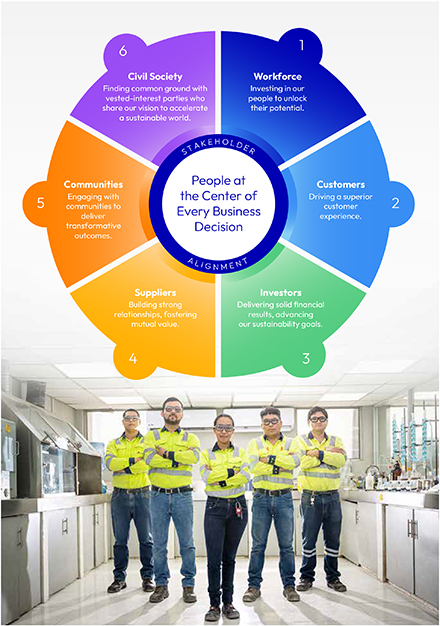
We have accelerated our stakeholder alignment efforts to have consistent, robust, and integrated engagement processes across all stakeholder groups. We start by actively listening to diverse voices throughout our global communities, which helps us identify and prioritize opportunities that contribute to the next frontier of sustainable living. We then collaborate and engage with those who have a vested interest in our business and who share our ambition to accelerate a just transition to digital and green economies. Collectively, we transform challenges into profound opportunities that best serve humanity and create positive change.
The effectiveness of our stakeholder actions is systematically tracked through performance indicators, stakeholder feedback, and continuous communication. Our goal is to engage with stakeholders’ key interests, manage risks and opportunities, set a clear direction to ensure accountability, and deliver long-term shared value and meaningful outcomes for our company and the communities where we operate.
Honesty, respect, and integrity are
the hallmarks of our meaningful
stakeholder relationships.
| Contents | ||
| Our Company | ||
| Our Strategy | ||
| Cemex Value Creation Model | ||
| Health and Safety: Our #1 Value and Priority | ||
| Stakeholder Alignment: Placing People at the Center of Every Business Decision | ||
| ● Digital Forward: Achieving 100% Digital Adoption Across Our Value Chain | ||
| Financial Performance | ||
| Environmental Excellence | ||
| Stakeholder Engagement | ||
| Governance | ||
| Appendix | ||
| 22 Cemex 2024 Integrated Report | ||
Achieving 100% Digital Adoption Across Our
Value Chain
Our Approach: We are accelerating our digital transformation by leveraging technologies to evolve business processes, provide superior customer experience, and increase business value for Cemex.
 | SDGs: Our strong commitment to helping our customers succeed and providing a superior experience contributes to SDG 8, and our determination to build sustainable cities and communities contributes to our priority SDGs 9 and 11. |
| Where Our Digital Journey Began
Our digital transformation journey began in our commercial process with Cemex Go. As our global flagship omnichannel platform, Cemex Go provides a consistent digital-first commercial experience for the customer. By integrating our online store, salesforce, and service centers, we showcased the potential digital technologies have in transforming business models and enhancing customer experience. The result this year was higher technology adoption rates, and, ultimately, a customer net promoter score of 74, considered a superior satisfaction level in our industry.1 Digital became a game changer for us.
Global Program Extends Our Digital Transformation
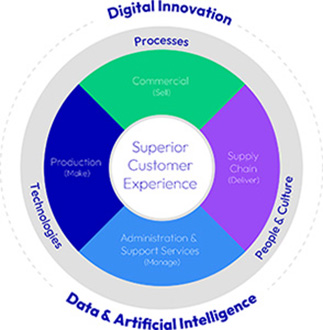
We have taken the next step in our digital journey by implementing Digital Forward across our organization. This global program extends our transformation to all core business processes in the company, including commercial, supply chain, production, and administration. Now, all employees within Cemex are involved in our digital transformation, whether they’re making our product, selling it, delivering it, or supporting our core business processes.
1 Retently 2024 NPS Benchmarks for B2B companies. | Digital Forward Framework Building organizational and technology-based capabilities allows us to continuously improve our customer experience. We have integrated four core processes into our Digital Forward framework:
• Enabling a Digital-First Commercial Experience. Improve how customers interact with Cemex, offering self-service capabilities across the customer journey and transforming every customer-facing role into a digital promoter. Cemex is dedicated to becoming a 100% digital organization and has created the Cemex Go Acceleration program to achieve complete digital adoption among customers. | • Operating an Integrated Supply Chain. Leverage system integrations and artificial intelligence, provide real-time visibility, and deliver end-to-end value that enables a flexible and resilient supply chain.
• Digitalizing Our Operations. Transform our production processes using cutting-edge technologies to drive efficiency, productivity, and sustainability.
• Scaling Administration and Support Services. Broaden availability of business data and leverage automation for internal transactions, exception handling, and reports delivery. |
| Contents | ||
| Our Company | ||
| Our Strategy | ||
| Cemex Value Creation Model | ||
| Health and Safety: Our #1 Value and Priority | ||
| Stakeholder Alignment: Placing People at the Center of Every Business Decision | ||
| ● Digital Forward: Achieving 100% Digital Adoption Across Our Value Chain | ||
| Financial Performance | ||
| Environmental Excellence | ||
| Stakeholder Engagement | ||
| Governance | ||
| Appendix | ||
| 23 Cemex 2024 Integrated Report | ||
| Digital Forward Enablers In the dynamic landscape of today’s business environment, embracing digital transformation is paramount to maintaining a competitive edge. We are making this possible through our three enablers designed to foster a culture of adaptability, continuous learning, and technological progress within our organization.
Promoting Innovation and New Technologies. We embrace the evolution of processes and practices, recognizing that adaptability is key to success. We are strengthening our open digital innovation ecosystem, searching for startups with practical uses of digital technologies and new business models that may improve productivity and enhance our value proposition.
Empowering Data and AI-Driven Decisions. We pursue data democratization across the organization, turning data into valuable assets and generating value from them. We are focused on creating a robust data infrastructure, advanced analytics capabilities, and machine learning algorithms to turn data into actionable insights.
Augmenting Our People Capabilities. We foster a culture of continuous learning, collaboration, and digital knowledge, propelling our organization forward. We encourage knowledge sharing and skill exchange across areas, striving to equip our workforce to navigate the digital transformation.
In 2025, we will perform a Digital Maturity Assessment to identify gaps in current practices, improve our company’s digitalization, and drive our business transformation forward. |
Digital Forward Culture After extensive research, we defined key behaviors outlining our expectations for employees within a digital culture. These behaviors reflect our commitment to customer centricity, data-driven decision-making, innovation and continuous learning, and agile collaboration. When demonstrating these attributes, our employees make greater contributions to innovation, operational excellence, and the effective utilization of technology as a strategic enabler for transformation.
|
Initiatives Build Culture, Create Champions
Open Dialogue Event
In 2024, we deployed our Digital Forward initiative globally through an Open Dialogue event that reached more than 2,500 live-stream connections and almost 200 people attending in person. Led by our organization’s top leadership, the forum defined key elements of the digital culture we are building and explained how everyone can contribute to our digital transformation. To continue raising awareness, we are engaging employees through internal channels and have reached more than 4,000 to date.
Digital Movers
Across our business, we are accelerating the use of digital technology and preparing our employees to be digital champions. Integrating our systems allows us to work in new ways, enabling our employees to address more value-added thinking and activities.
To advance our transformation, we launched our first cohort of Digital Movers this year with an immersive learning program experience. Our goal: Create digital champions throughout our company globally to influence the use of digital solutions to address business challenges.
| ||||||
| 89% employees who believe Cemex provides technological tools and infrastructure to enhance their efficiency and effectiveness at work1 | 83% employees with knowledge and skills to contribute to Cemex’s digital journey1 | |||||||
|
1 Participant feedback from Digital Forward Essentials course. | ||||||||
Financial Performance Financial Highlights Continuously Advancing Toward Our Strategic Priorities Sustainable Finance Consolidated Results
| Contents | ||
| Our Company | ||
| Our Strategy | ||
| Financial Performance | ||
| ● 2024 Financial Highlights | ||
| Continuously Advancing Toward Our Strategic Priorities | ||
| Sustainable Finance | ||
| Consolidated Results | ||
| Environmental Excellence | ||
| Stakeholder Engagement | ||
| Governance | ||
| Appendix | ||
| 25 Cemex 2024 Integrated Report | ||
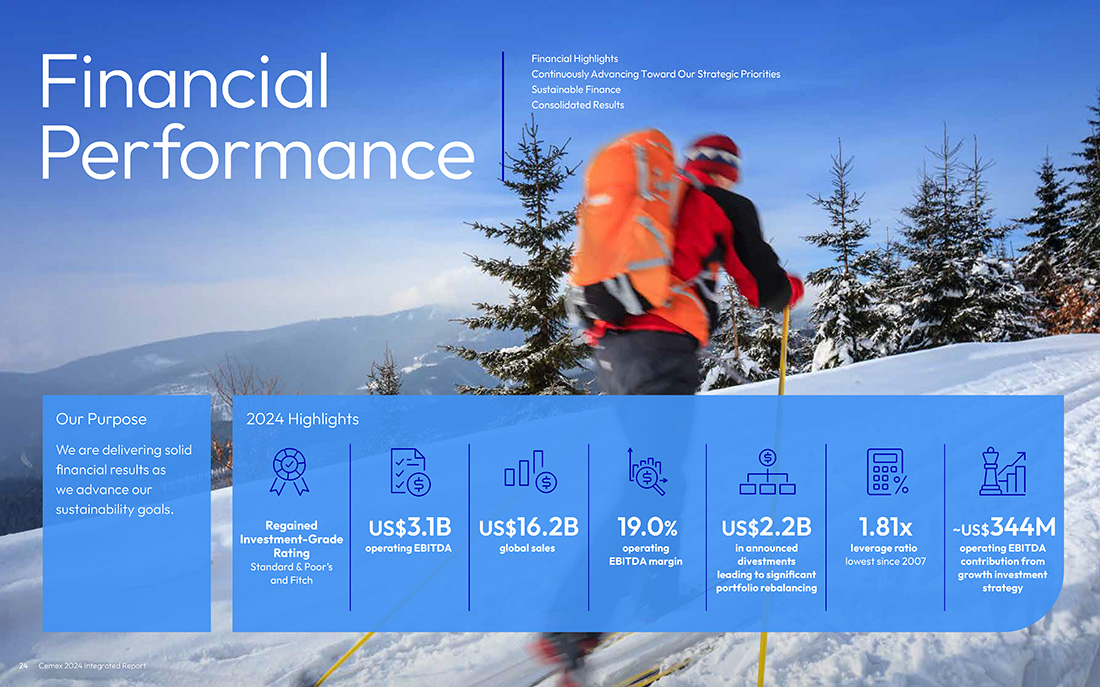
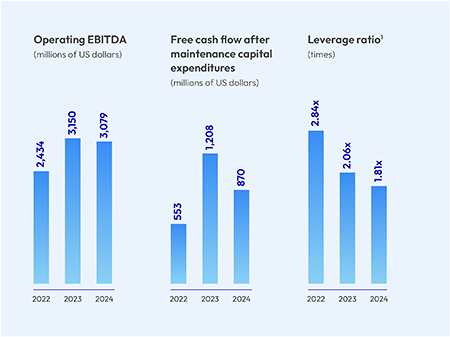
2024 represents a pivotal year in the corporate transformation we envisioned in 2020. Our leverage ratio stood at 1.81 times1, its lowest level since the outbreak of the global financial crisis, while achieving our long-running goal of recovering our investment-grade rating. Our free cash flow after maintenance capital expenditures was the highest since 2017, adjusting for the extraordinary payment of the tax fine in Spain.
In a muted volume environment, we focused our attention on costs and pricing, as well as on optimizing production with increases in operating efficiency in key markets. With US$2.2 billion in announced divestitures, we significantly rebalanced our portfolio toward developed markets with more consistent and attractive growth potential.
With the restoration of our financial health and several years of progress on our growth strategy, we took the first step on a shareholder return policy with the announcement of a progressive and sustainable dividend program in March 2024.
Net income for the year was a record level in recent history, driven
by a lower effective tax rate and gains from asset divestments.
| (in millions of U.S. dollars, except per-ADS amounts) | 20242 | 20232 | Var. (%) | |||||||||
| Sales | 16,200 | 16,554 | (2 | %) | ||||||||
| Operating earnings before other expenses, net | 1,828 | 1,959 | (7 | %) | ||||||||
| Operating EBITDA | 3,079 | 3,150 | (2 | %) | ||||||||
| Controlling interest net income | 939 | 182 | 415 | % | ||||||||
| Controlling interest basic earnings per ADS3 | 0.64 | 0.13 | 392 | % | ||||||||
| Controlling interest basic earnings per ADS from continuing operations3 | 0.61 | 0.07 | 788 | % | ||||||||
| Controlling interest basic earnings per ADS from discontinued operations3 | 0.03 | 0.06 | (43 | %) | ||||||||
| Free cash flow after maintenance capital expenditures | 870 | 1,208 | (28 | %) | ||||||||
| Total assets | 27,299 | 28,433 | (4 | %) | ||||||||
| Total debt plus leases4 | 6,700 | 7,486 | (10 | %) | ||||||||
| Total stockholders’ equity | 12,477 | 12,116 | 3 | % | ||||||||
| 1 | Calculated in accordance with Cemex’s contractual obligations under its main bank debt agreements. |
| 2 | Under IFRS, Cemex translates the financial statements of foreign subsidiaries using exchange rates at the reporting date for the statements of financial position and the exchange rates at the end of each month for the income statement. |
| 3 | Based on an average of 1,469 and 1,470 million American Depositary Shares (ADS) for 2024 and 2023, respectively. For purposes of this report, average ADSs outstanding equals the total number of Series A shares and Series B shares outstanding as if they were all held in ADS form. |
| 4 | Includes lease contracts as per IFRS. |
| Contents | ||
| Our Company | ||
| Our Strategy | ||
| Financial Performance | ||
| 2024 Financial Highlights | ||
| ● Continuously Advancing Toward Our Strategic Priorities | ||
| Sustainable Finance | ||
| Consolidated Results | ||
| Environmental Excellence | ||
| Stakeholder Engagement | ||
| Governance | ||
| Appendix | ||
| 26 Cemex 2024 Integrated Report | ||
Strategic Priorities and 2024 Achievements
| Metric | Our Approach | Our 2024 Achievements | ||||
| Improve profitability and free cash flow generation
| Improve profitability through our pricing strategy, cost containment efforts, and production efficiency enhancement.
Enhance free cash flow generation after maintenance capital expenditures to continue executing our growth investment strategy, further deleveraging, and return cash to our shareholders. | • After an exceptional 2023, we posted the second-strongest sales and operating EBITDA in 2024.
• In 2024, despite a muted volume environment, we focused our efforts on costs as well as optimizing production with increases in operating efficiency in key markets.
• Operating EBITDA margin stood flat at 19%, mostly driven by our resilient pricing strategy and cost efficiency measures.
• We also achieved the highest free cash flow after maintenance since 2017, adjusting for the extraordinary payment of the Spanish tax fine.
| ||||
|
| ||||||
| Optimize our portfolio for growth
| Streamline our portfolio, focusing on the U.S., Europe, and Mexico through strategic divestments, particularly in selected emerging markets.
Continue executing our growth investment strategy, geared toward the U.S., Europe, and Mexico, through attractive bolt-on and margin enhancement investment opportunities.
Focus on growing and developing our Aggregates, Cement, and Urbanization Solutions businesses mainly in the U.S. market.
Develop Urbanization Solutions as a core business.
| • With US$2.2 billion in announced divestitures, we significantly rebalanced our portfolio toward developed markets with more consistent growth potential.
• Approximately 90% of our operating EBITDA is now generated in the U.S., Europe, and Mexico.
• Since 2020, we have completed investments worth US$1.5 billion under our growth investment pipeline, which contributed US$344 million to consolidated operating EBITDA in 2024.
• Our Urbanization Solutions business grew 4% on a like-to-like basis. | ||||
| 1 | Calculated in accordance with Cemex’s contractual obligations under its main bank debt agreements. |
| Contents | ||
| Our Company | ||
| Our Strategy | ||
| Financial Performance | ||
| 2024 Financial Highlights | ||
| ● Continuously Advancing Toward Our Strategic Priorities | ||
| Sustainable Finance | ||
| Consolidated Results | ||
| Environmental Excellence | ||
| Stakeholder Engagement | ||
| Governance | ||
| Appendix | ||
| 27 Cemex 2024 Integrated Report | ||
| Return cash to shareholders
| Continue working on shareholder return initiatives that include a progressive dividend program and opportunistic share buybacks. | • With the restoration of our financial health and several years of progress on our growth strategy, we took the first step on shareholder return with the announcement of a US$120 million progressive and sustainable dividend program in March 2024.
• For 2025, the company is proposing at Cemex’s Annual Ordinary General Shareholders Meeting an increase in our dividend payment and approving potential share buybacks of up to US$500 million.
| ||||
| Maintain a strong capital structure and investment-grade rating
| Leverage ratio well within investment-grade rating parameters, while maintaining a strong liquidity position. | • Standard & Poor’s and Fitch global scale credit rating at BBB-, achieving investment-grade rating during the year.
• Leverage ratio at 1.81x, the lowest since the global financial crisis, as measured under our main debt agreements.
• Targeting a 1.5x leverage ratio in the medium-term to be well within BBB credit rating metrics.
• Ample liquidity, with committed revolving credit facilities of approximately US$2.3 billion.
• Healthy debt maturity profile.
| ||||
| Advance sustainability agenda
| Goal of a 31% reduction in net CO2 emissions by 2030 vs. 2020 baseline
Recognizing sustainability as a competitive advantage, we continue advancing toward our 2030 carbon-reduction goal and the company’s vision to be a net-zero CO2 company by 2050. | • Another year of accelerated progress in decarbonization with a 2.4% and 8.1% like-to-like decline in our cement Scope 1- and 2-specific CO2 emissions, respectively.
• As a result of our Future in Action program launched in 2020, our cement Scope 1- and 2-specific CO2 emissions have declined by 15% and 18% respectively, a pace that would have previously taken us 16 years to achieve.
• A Cemex-led consortium was selected to receive €157 million from the EU Innovation Fund for carbon capture at our Rüdersdorf plant in Germany.
| ||||
| Contents | ||
| Our Company | ||
| Our Strategy | ||
| Financial Performance | ||
| 2024 Financial Highlights | ||
| Continuously Advancing Toward Our Strategic Priorities | ||
| ● Sustainable Finance | ||
| Consolidated Results | ||
| Environmental Excellence | ||
| Stakeholder Engagement | ||
| Governance | ||
| Appendix | ||
| 28 Cemex 2024 Integrated Report | ||
For Cemex, sustainable finance is a core element of the company’s overall financial strategy. It is a catalyst and a key lever, mobilizing capital to accelerate our decarbonization journey and turning abstract goals into concrete targets and, ultimately, contributing to a lower-carbon and more resource-efficient economy.
By aligning our funding needs with our sustainability goals, we aim for our financial activities to be fully integrated with our commitment to sustainability, allowing access to specialized sustainable capital sources and optimizing our cost of capital.
In 2021, Cemex released its Sustainability-Linked Financing Framework, one of the most comprehensive in the building materials sector, enhancing alignment between corporate sustainability commitments and financing strategy. This framework outlines principles for issuing various sustainability-linked financing instruments, including bonds, private placements, loans, and derivatives. In 2022, Cemex launched its Green Financing Framework, which facilitates the issuance of bonds, loans, and other debt-like instruments for eligible green projects. Both frameworks were updated in 2023 to support our more ambitious decarbonization goals, validated by the Science Based Targets initiative under their 1.5°C scenario, the most ambitious pathway defined for the cement industry.
In particular, this latest update of Cemex’s Green Financing Framework expands eligibility criteria to incorporate innovative projects such as carbon capture, utilization, and storage technology.
In 2024, Cemex reopened and placed its peso-denominated sustainability-linked long-term notes for a nominal amount of MXN$5.5 billion. The reopening and placement of the notes involved two series: Cemex 23L for MXN$2 billion with a 2.6-year tenor at a floating rate of TIIE 28 + 0.45%, and Cemex 23-2L for MXN$3.5 billion with a 6.6-year tenor at a coupon of 11.48%.
Additionally, the refinancing of our Euro sustainability-linked syndicated bank facility was completed, which consists of a €450 million term loan and a €300 million committed revolving credit facility. By the end of 2024, all our securitization programs are now aligned to our 2023 Sustainability-Linked Financing Framework.

| Contents | ||
| Our Company | ||
| Our Strategy | ||
| Financial Performance | ||
| 2024 Financial Highlights | ||
| Continuously Advancing Toward | ||
| Our Strategic Priorities | ||
| Sustainable Finance | ||
| ● Consolidated Results | ||
| Environmental Excellence | ||
| Stakeholder Engagement | ||
| Governance | ||
| Appendix | ||
| 29 Cemex 2024 Integrated Report | ||
Following is a review of the 2024 operational results and the financial condition of the company:
Consolidated sales in 2024 reached US$16.2 billion, a decrease of 1% on a like-to-like basis. Higher prices were offset by lower volumes in our markets.
Cost of sales, as a percentage of sales, increased by 0.1 percentage point to 66.4% in 2024 mainly driven by higher fixed costs, along with a decrease in sales. However, we continued to experience energy tailwinds, particularly in fuels for cement production.
Operating expenses, as a percentage of sales, increased by 0.4 percentage point to 22.3% in 2024.
Operating EBITDA declined 1% on a like-to-like basis, reaching US$3.08 billion. In a muted volume environment, we focused our attention on pricing, costs, and optimizing production with increases in operating efficiency in key markets. With prices more than offsetting costs, a slight decline is attributed to volume dynamics.
Operating EBITDA margin in 2024 was flat year over year at 19.0%. All regions, with the exception of EMEA, experienced margin expansion.
We reported a controlling interest net income of US$939 million in 2024, a record level in recent history and an increase of 415% on a year-over-year basis, driven by a lower effective tax rate and gains from asset divestments.
Total debt plus leases decreased by 10%, or US$786 million, to US$6.7 billion at the end of 2024.
| Global Operations |
|
|
| |||||||||||||||||||
| (in millions of U.S. dollars) | ||||||||||||||||||||||
| Business Unit | Sales4 | Operating Earnings Before Other Expenses, Net | Operating EBITDA | Total Assets5 | ||||||||||||||||||
|
Mexico
| 4,881 | 1,268 | 1,475 | 4,155 | ||||||||||||||||||
|
United States
| 5,194 | 517 | 1,031 | 12,985 | ||||||||||||||||||
|
Europe, Middle East, and Africa1
| 4,631 | 330 | 637 | 5,440 | ||||||||||||||||||
|
South, Central America, and the Caribbean2
| 1,244 | 154 | 234 | 1,980 | ||||||||||||||||||
|
Others and intercompany eliminations3
| 250 | (441) | (298) | 2,739 | ||||||||||||||||||
|
Consolidated amounts
| 16,200 | 1,828 | 3,079 | 27,299 | ||||||||||||||||||
| 1 | Includes operations in the United Kingdom, France, Germany, Poland, Spain, Israel, Czech Republic, Croatia, Egypt, and the United Arab Emirates. |
| 2 | Includes operations in Colombia, Panama, Caribbean TCL, Puerto Rico, Nicaragua, Jamaica, and the Caribbean. |
| 3 | Includes minor subsidiaries with different lines of business. |
| 4 | Sales before eliminations of intragroup transactions. |
| 5 | Includes equity-accounted investees. Additionally, others and intercompany eliminations includes assets held for sale of our operations in the Dominican Republic. |
See note 4.3 in our 2024 audited consolidated financial statements on page 146 of this report.
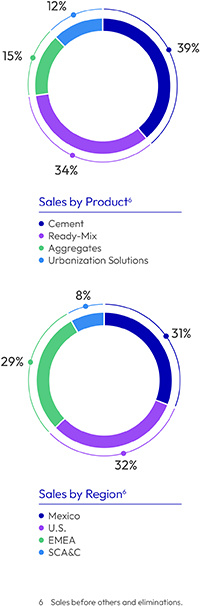
| Contents | ||
| Our Company | ||
| Our Strategy | ||
| Financial Performance | ||
| 2024 Financial Highlights | ||
| Continuously Advancing Toward | ||
| Our Strategic Priorities | ||
| Sustainable Finance | ||
| ● Consolidated Results | ||
| Environmental Excellence | ||
| Stakeholder Engagement | ||
| Governance | ||
| Appendix | ||
| 30 Cemex 2024 Integrated Report | ||
Mexico
Sales in Mexico increased 1% on a like-to-like basis to US$4.9 billion, and operating EBITDA increased 3% year over year to US$1.5 billion. The depreciation of the Mexican peso resulted in an operating EBITDA impact of $52 million in 2024.
Volume demand in Mexico had two speeds in 2024, growing in the first half and then declining in the second half post-election. In 2024, our cement volumes decreased by 1%, while our ready-mix concrete and aggregates volumes were flat.
United States
Our U.S. operations’ sales decreased by 3% to US$5.2 billion, while operating EBITDA decreased by 1% to US$1 billion due to extreme weather events, estimating an impact of US$38 million in our operating EBITDA during the year. Our U.S. operations’ domestic gray cement, ready-mix concrete and aggregates volumes decreased by 6%, 10%, and 1%, respectively, in 2024.
Importantly, even with lower volumes, full-year operating EBITDA was relatively stable, while margins expanded due to cost optimization efforts and lower fuel prices. Maintenance investments paid off, with a higher operational efficiency that allowed us to substitute more profitable domestic production for imports.
Europe, Middle East, and Africa
During 2024, sales decreased 2% on a like-to-like basis to US$4.6 billion, while operating EBITDA decreased by 3% to US$637 million. Our regional domestic gray cement volumes were flat, while our ready-mix concrete and aggregates volumes decreased by 6% and 4%, respectively.
Our European operations experienced a continued improvement during the second half of the year. Eastern Europe continued benefiting from EU-funded infrastructure spending, while Western Europe showed signs of recovery against an easier comparison base.
On climate action, our operations in Europe continued delivering record levels of decarbonization and are now very close to reaching both the European Cement Association’s and Cemex’s consolidated 2030 CO2 emissions target.
In the Middle East and Africa, operating EBITDA improved at the end of the year due to better pricing dynamics in Egypt and increased construction activity in Israel.
South, Central America,
and the Caribbean
During 2024, sales were flat, while operating EBITDA increased by 2% on a like-to-like basis. Our operations in the region once again delivered positive results in 2024 amidst a challenging demand backdrop, with growth in operating EBITDA led by positive pricing dynamics. Cement and ready-mix concrete volumes declined 2% and 5%, respectively.
The formal sector continues driving demand in the region with large infrastructure projects such as the Bogota Metro in Colombia, in which Cemex has been awarded more than 80% of total volumes, and the fourth bridge over the canal in Panama.
Global Trading1
In 2024, we traded around 11 million tons of cementitious and non-cementitious (other) materials, in more than 60 countries, including around 7 million tons of cement and clinker and around 3 million tons of cementitious and other materials. Additionally, we traded approximately 2 million tons of certain primary fuels. This information does not include discontinued operations. Our trading network enables us to maximize the capacity utilization of our facilities worldwide while reducing our exposure to the inherent cyclicality of the cement industry. We are generally able to distribute excess capacity to regions around the world where there is demand. In addition, we believe that our worldwide network of strategically located marine terminals allows us to coordinate maritime logistics on a global basis and minimize transportation expenses. Our trading operations also enable us to explore new markets without significant initial capital expenditure.
Freight rates, which account for a large share of the total import supply cost, have been subject to significant volatility in recent years. However, our trading operations have obtained significant savings by contracting maritime transportation in due time and by using our own and chartered fleets, which transported around 74% of the traded volume of certain primary fuels, cement, and clinker during 2024.
In addition, we provide freight service to third parties, which allows us to generate additional revenues.
Other Information
During 2024 and 2023, in the countries in which we operate, we paid in cash a total amount of taxes of US$878 million and US$515 million, respectively.
During 2024, we received a total of European Union Allowances (EUAs) of 5,402,630 (5,800,617 in 2023) and UK Allowances (UKAs) of 845,036 (845,037 in 2023).
As of December 31, 2024, Cemex has already achieved a 47% reduction in CO2 emissions versus its 1990 baseline across all of Cemex’s cement plants in Europe. Cemex is the first company in its sector to set industry-leading climate targets for its operations in Europe, which align directly with the EU’s aspiration of 55% CO2 reduction by 2030. Cemex has also committed to become a net-zero CO2 company by 2050. CO2 reduction goals, innovative technologies, and considerable capital investments have to be deployed. Since the EU emissions training system (ETS) began in 2005, over US$510 million of investments in Europe are either already executed or planned in the next years to support our CO2 reduction objectives. These investments include, but are not limited to, the general process switch from fossil fuels to lower-carbon alternatives, becoming more efficient in the use of energy, sourcing alternative raw materials that contribute to reducing overall emissions or clinker factor, developing and actively promoting lower-carbon products, and the recent deployment of groundbreaking hydrogen technology in all Cemex’s European kilns. Cemex is also working closely with alliances to develop industrial-scale technologies toward its goal of a net-zero carbon future. Strong and clear regulations such as the EU Emissions Trading System and Carbon Border Adjustment Mechanism give companies like Cemex the confidence and certainty to enable these investments.
| 1 | Excludes discontinued operations in the |

Environmental Excellence Future in Action: Achieving Decarbonization Targets Toward a Net-Zero Future Sustainable Products and Solutions: Expanding the Sustainability Features of Our Products Decarbonizing Our Operations: Moving Rapidly to Achieve Our Ambitious Goals Circular Economy: Repurposing Materials to Minimize Our Environmental Impact Water, Biodiversity, and Air Quality: Building a Nature-Positive Future Innovation and Partnerships: Catalyzing Innovation Across Our Business and Industry Promoting a Green Economy: Using Our Voices to Accelerate Action in Our Industry Social Commitment: Accelerating Our Responsibilities for a Just Transition
| Contents | ||
| Our Company | ||
| Our Strategy | ||
| Financial Performance | ||
| Environmental Excellence | ||
| ● Future in Action: Achieving Decarbonization Targets Toward a Net-Zero Future | ||
| Sustainable Products and Solutions: Expanding the Sustainability Features of Our Products | ||
| Decarbonizing Our Operations: Moving Rapidly to Achieve Our Ambitious Goals | ||
| Circular Economy: Repurposing Materials to Minimize Our Environmental Impact | ||
| Water, Biodiversity, and Air Quality: Building a Nature-Positive Future | ||
| Innovation and Partnerships: Catalyzing Innovation Across Our Business and Industry | ||
| Promoting a Green Economy: Using Our Voices to Accelerate Action in Our Industry | ||
| Social Commitment: Accelerating Our Responsibilities for a Just Transition | ||
| Stakeholder Engagement | ||
| Governance | ||
| Appendix | ||
| 32 Cemex 2024 Integrated Report | ||
| Contents | ||
| Our Company | ||
| Our Strategy | ||
| Financial Performance | ||
| Environmental Excellence | ||
| ● Future in Action: Achieving Decarbonization Targets Toward a Net-Zero Future | ||
| Sustainable Products and Solutions: Expanding the Sustainability Features of Our Products | ||
| Decarbonizing Our Operations: Moving Rapidly to Achieve Our Ambitious Goals | ||
| Circular Economy: Repurposing Materials to Minimize Our Environmental Impact | ||
| Water, Biodiversity, and Air Quality: Building a Nature-Positive Future | ||
| Innovation and Partnerships: Catalyzing Innovation Across Our Business and Industry | ||
| Promoting a Green Economy: Using Our Voices to Accelerate Action in Our Industry | ||
| Social Commitment: Accelerating Our Responsibilities for a Just Transition | ||
| Stakeholder Engagement | ||
| Governance | ||
| Appendix | ||
| 33 Cemex 2024 Integrated Report | ||
Key Pillars in Our Future in Action Program (continued)
 | 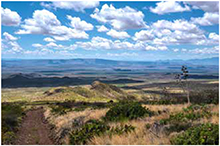 | 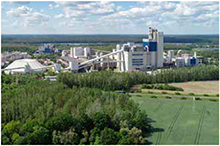 | 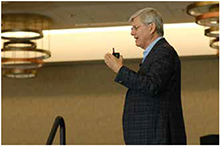 | |||
| Circular Economy | Water, Biodiversity, and Air Quality | Innovation and Partnerships | Promoting a Green Economy | |||
| We are expanding the repurposing of our three main waste streams to secure alternative fuels and raw materials, as well as create value through waste management.
Since the launch of our Regenera business in 2023, we’ve repurposed nearly 58 million tons of municipal and industrial waste; construction, excavation, and demolition materials; and by-products like fly ash and slag from other industries.
| We’re optimizing our water usage and reducing our freshwater withdrawal while enhancing biodiversity in our quarries and minimizing our impacts on air quality.
We prioritize sites with the highest water-related and biodiversity risks. Water action plans are in place in 40% of our extremely high and high water-stressed zones. Rehabilitation plans are developed for 100% of our quarries. We monitor 100% of our clinker production through continuous emission monitoring systems (CEMS) to assess any effects on air quality.
| We have an open innovation platform to identify and develop new technologies, establish strategic partnerships, and work on innovative solutions needed to reach net-zero CO2 emissions across our company by 2050.
Cemex was the first in the cement industry to produce clinker using solar energy and the first to successfully turn CO2 into carbon nanomaterials directly from flue gases. In 2024, our Rüdersdorf plant in Germany was awarded a grant to develop a full-scale carbon capture and storage project to help us deploy this important CO2 abatement technology at scale.
| We advocate for frameworks that can help accelerate and enhance the decarbonization of the cement industry.
We support policies that align with circular economy principles, promote the use of lower-carbon products, establish market-based carbon-pricing mechanisms, facilitate investments in clean electricity, and channel public funding for scaling up new technologies.
| |||
| Contents | ||
| Our Company | ||
| Our Strategy | ||
| Financial Performance | ||
| Environmental Excellence | ||
| ● Future in Action: Achieving Decarbonization Targets Toward a Net-Zero Future | ||
| Sustainable Products and Solutions: Expanding the Sustainability Features of Our Products | ||
| Decarbonizing Our Operations: Moving Rapidly to Achieve Our Ambitious Goals | ||
| Circular Economy: Repurposing Materials to Minimize Our Environmental Impact | ||
| Water, Biodiversity, and Air Quality: Building a Nature-Positive Future | ||
| Innovation and Partnerships: Catalyzing Innovation Across Our Business and Industry | ||
| Promoting a Green Economy: Using Our Voices to Accelerate Action in Our Industry | ||
| Social Commitment: Accelerating Our Responsibilities for a Just Transition | ||
| Stakeholder Engagement | ||
| Governance | ||
| Appendix | ||
| 34 Cemex 2024 Integrated Report | ||
Validating Our Future in Action Goals
Cemex is among the first companies in the global cement industry to validate its 2030 and 2050 decarbonization goals through the Science Based Targets initiative (SBTi) for alignment under a 1.5°C scenario, with the 1.5°C scenario, the most ambitious for the cement industry. This validation includes Scope 1, 2, and 3 emission targets, allowing us to align with the Paris Agreement objectives.
|
|
| |||||
| Cement, Other Businesses, and Value Chain 2030 Targets | 2050 Net-Zero CO2 Transition | |||||
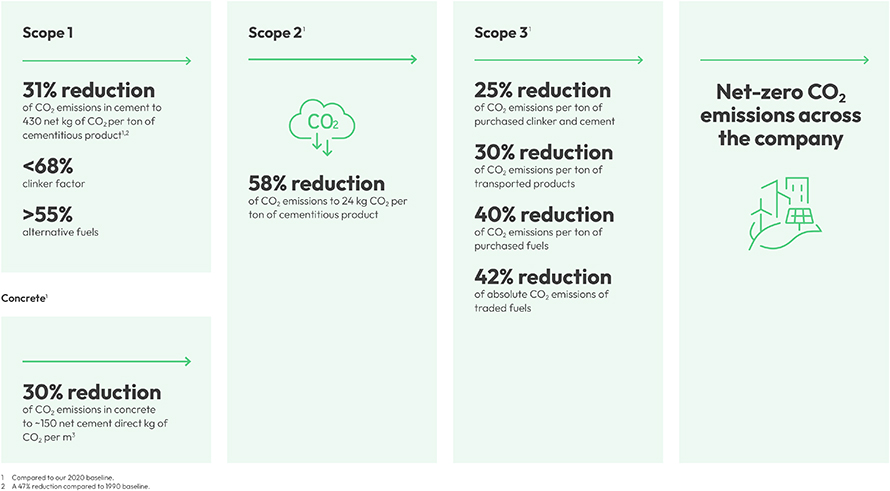
| Contents | ||
| Our Company | ||
| Our Strategy | ||
| Financial Performance | ||
| Environmental Excellence | ||
| Future in Action: Achieving Decarbonization Targets Toward a Net-Zero Future | ||
| ● Sustainable Products and Solutions: Expanding the Sustainability Features of Our Products | ||
| Decarbonizing Our Operations: Moving Rapidly to Achieve Our Ambitious Goals | ||
| Circular Economy: Repurposing Materials to Minimize Our Environmental Impact | ||
| Water, Biodiversity, and Air Quality: Building a Nature-Positive Future | ||
| Innovation and Partnerships: Catalyzing Innovation Across Our Business and Industry | ||
| Promoting a Green Economy: Using Our Voices to Accelerate Action in Our Industry | ||
| Social Commitment: Accelerating Our Responsibilities for a Just Transition | ||
| Stakeholder Engagement | ||
| Governance | ||
| Appendix | ||
| 35 Cemex 2024 Integrated Report | ||
Solutions: Expanding the Sustainability Features of Our Products
Our Approach: We continuously work to improve the sustainability features of our products and solutions, seeking to address building needs that lead to a carbon-neutral, sustainable, and circular future.
| As part of our Future in Action program, we offer a comprehensive product portfolio featuring lower-carbon and other sustainable attributes. These offerings aim to support a reduction in the carbon footprint of construction projects, and we promote their adoption through our sales force and customer education programs and tools.
Cemex’s Vertua® brand products feature a sustainability fact label, the first in the industry, which details the product’s performance across a range of sustainable attributes.
|
VERTUA® PRODUCTS KEY PERFORMANCE INDICATORS
63% of cement sales ahead of our 2025 target of 50%
55% of concrete sales ahead of our 2025 target of 50%
43% brand awareness among customers of our Vertua® products, which continues to grow
|
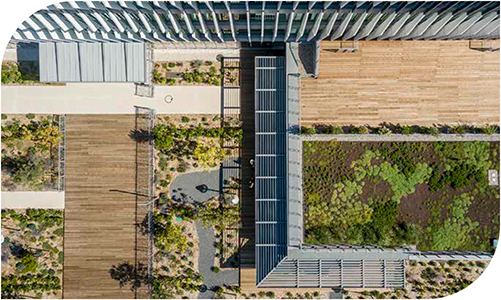
Vertua® Product Portfolio Offers Validated
Sustainable Attributes
We were the first in the industry to offer a net-zero CO2 concrete solution, Vertua® products. Also, we became the first in our industry to provide third-party validated environmental impact information globally for all core products in our main markets. In 2024, Vertua® products accounted for 63% of our total cement sales and 55% of our total concrete sales.
Today, our Vertua® portfolio of products also features products with extended attributes such as water conservation, design optimization, energy efficiency, and recycled materials.
These products aim to support our customers in meeting their net-zero targets, carbon obligations, and sustainability requirements and certifications, while helping us achieve our
2050 net-zero CO2 goal.
Cemex Vertua® Product Portfolio With Sustainable Attributes
| Vertua® Lower Carbon | Vertua® Energy Efficiency | Vertua® Water Conservation | Vertua® Recycled Materials | Vertua® Design Optimization | ||||
| Lower CO2 footprint | Improved thermal efficiency | Smart water management and usage | Reduced raw material usage | Efficiency in design and construction | ||||
| Products & Solutions | ||||||||
| Vertua® Concrete Classic, Plus, and Ultra; Vertua® Cement Plus, Ultra, and Supreme; Evolution ECO; Vialow; Ready Block Zero | Insularis® Porofoam® | Pervia® Hidratium® | Resilia® | |||||
| Contents | ||
| Our Company | ||
| Our Strategy | ||
| Financial Performance | ||
| Environmental Excellence | ||
| Future in Action: Achieving Decarbonization Targets Toward a Net-Zero Future | ||
| ● Sustainable Products and Solutions: Expanding the Sustainability Features of Our Products | ||
| Decarbonizing Our Operations: Moving Rapidly to Achieve Our Ambitious Goals | ||
| Circular Economy: Repurposing Materials to Minimize Our Environmental Impact | ||
| Water, Biodiversity, and Air Quality: Building a Nature-Positive Future | ||
| Innovation and Partnerships: Catalyzing Innovation Across Our Business and Industry | ||
| Promoting a Green Economy: Using Our Voices to Accelerate Action in Our Industry | ||
| Social Commitment: Accelerating Our Responsibilities for a Just Transition | ||
| Stakeholder Engagement | ||
| Governance | ||
| Appendix | ||
| 36 Cemex 2024 Integrated Report | ||
Industry-First Sustainability Fact Label
Cemex provides a fact label for products under the Vertua® brand, which details the product’s sustainability attributes. Each attribute is explained to provide consumers with context on the product’s benefits.
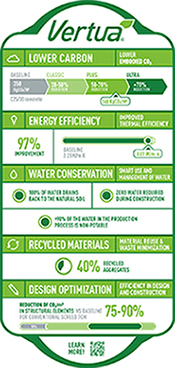
Environmental Impact Information Provides Transparency
We provide meaningful product environmental impact information for greater transparency. Cemex is the first company in the industry to provide the life-cycle environmental impact information, including CO2 emissions for our core products across our main markets. In 2024, this information was provided for 100% of our cement products and 88% of our ready-mix products. This disclosure is customized by location and is useful for architects, engineers, contractors, and customers looking for sustainable construction or green certifications. Our environmental impact information is presented in two ways:
| • | Environmental product declarations. |
This provides real-time environmental data on the Global Warming Potential and other relevant environmental impacts, such as acidification, abiotic depletion, and eutrophication, among others.
| • | CO2 carbon footprint. This measurement tool calculates in detail the environmental footprint of a product in a particular location, providing a much higher degree of accuracy than other carbon calculator tools currently available. |
In 2024, we provided life-cycle environmental impact information for 100% of our cement products and 88% of our ready-mix products.
Building Sustainable Product Knowledge
Building Information Modeling
Our suite of free-to-use building information modeling (BIM) tools helps advance the use of our portfolio of products with sustainable attributes. Available both online and through our BIM plug-in for Autodesk Revit, a 3D building design and planning software, the tools allow architects, engineers, and construction professionals to model a building or house using Cemex products with sustainable attributes. The tools show how much material will be required and compare products to determine which is best for a project and its sustainability goals. In 2024, our BIM tools were deployed in the U.K., France, Germany, Poland, Mexico, and Colombia with close to 1,500 registered users.
 See See | how we’re educating our global sales force to become partners in sustainable construction with our customers. |
| Learn | how we’re expanding customer awareness of our products with sustainable attributes. |
| Explore | our BIM tools that help model buildings and houses using our portfolio of products with sustainable attributes. |
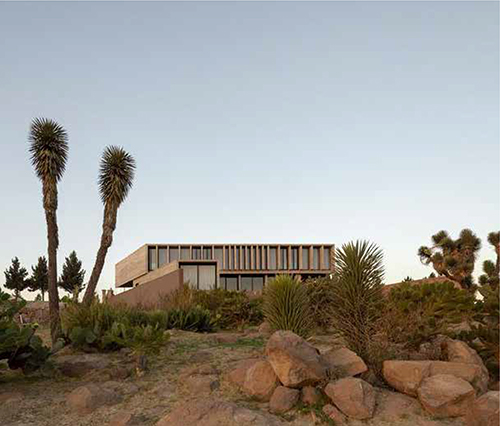
| Contents | ||
| Our Company | ||
| Our Strategy | ||
| Financial Performance | ||
| Environmental Excellence | ||
| Future in Action: Achieving Decarbonization Targets Toward a Net-Zero Future | ||
| ● Sustainable Products and Solutions: Expanding the Sustainability Features of Our Products | ||
| Decarbonizing Our Operations: Moving Rapidly to Achieve Our Ambitious Goals | ||
| Circular Economy: Repurposing Materials to Minimize Our Environmental Impact | ||
| Water, Biodiversity, and Air Quality: Building a Nature-Positive Future | ||
| Innovation and Partnerships: Catalyzing Innovation Across Our Business and Industry | ||
| Promoting a Green Economy: Using Our Voices to Accelerate Action in Our Industry | ||
| Social Commitment: Accelerating Our Responsibilities for a Just Transition | ||
| Stakeholder Engagement | ||
| Governance | ||
| Appendix | ||
| 37 Cemex 2024 Integrated Report | ||
| Cemex Products in Action Concrete’s durability and longer life cycle make it the ideal building material for lasting and reliable structures. With sustainable attributes available, such as resilience, thermal efficiency, and recyclability, concrete is the most-used man-made material in the world and is second only to water as the world’s most consumed resource as it has no substitutes. We are proud to highlight some of the projects around the globe using our products. | ||||||
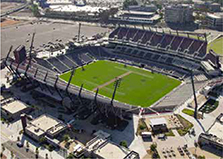 | 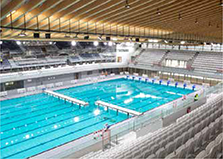 | 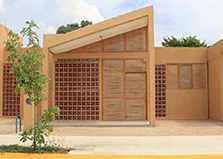 | 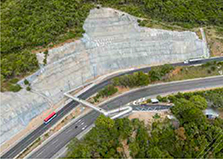 | |||
| Photo courtesy of Concesionaria Vía Sumapaz | ||||||
| Snapdragon Stadium, U.S. | Olympic Aquatic Centre, France | Salina Cruz Building Project, Mexico | Ruta 40 Bogotá-Girardot Project, Colombia | |||
| Cemex supplied Vertua® lower-carbon concrete for the construction of a new 35,000-seat, multiuse facility for San Diego State University in San Diego, CA. The stadium, designed to be Leadership in Energy and Environmental Design (LEED) Gold certified, serves as the home for the university’s Aztec Division 1 football program and the San Diego Wave of the National Women’s Soccer League. | Cemex provided specialized concrete solutions to build a state-of-the-art swimming facility at Saint-Denis, France, designed for both world-class competitions and community use. This work also included the construction of a pedestrian bridge. The project used Vertua® concrete with the lower-carbon attribute, along with a range of specialized concrete mixes, such as those containing recycled aggregates, as well as civil engineering, architectural, self-placing, and high-performance concretes. Over 50 unique concrete mixes were used to meet the facility’s need for durability, aesthetic appeal, and compatibility with the chlorinated swimming pool environment. | Cemex created a turnkey residential building project in Salina Cruz, Oaxaca, as a solution for the relocation of families in the old Salina Cruz, Oaxaca, airport. The project used Vertua® pigmented concrete to build the facility on land that was previously used as an airport. | Cemex built a road in the Ruta 40 Bogotá-Girardot project along one of Colombia’s most vital transportation corridors. The project, which spans 145 km with approximately 100 km of road ditches, used more than 150,000 m3 of materials. Sustainable features include the use of recycled polyethylene terephthalate (PET)-based macrofibers and 20% fly ash in the concrete mix, along with Vertua® Optimized by Design products to meet customer needs. | |||
| Contents | ||
| Our Company | ||
| Our Strategy | ||
| Financial Performance | ||
| Environmental Excellence | ||
| Future in Action: Achieving Decarbonization Targets Toward a Net-Zero Future | ||
| Sustainable Products and Solutions: Expanding the Sustainability Features of Our Products | ||
| ● Decarbonizing Our Operations: Moving Rapidly to Achieve Our Ambitious Goals | ||
| Circular Economy: Repurposing Materials to Minimize Our Environmental Impact | ||
| Water, Biodiversity, and Air Quality: Building a Nature-Positive Future | ||
| Innovation and Partnerships: Catalyzing Innovation Across Our Business and Industry | ||
| Promoting a Green Economy: Using Our Voices to Accelerate Action in Our Industry | ||
| Social Commitment: Accelerating Our Responsibilities for a Just Transition | ||
| Stakeholder Engagement | ||
| Governance | ||
| Appendix | ||
| 38 Cemex 2024 Integrated Report | ||
Moving Rapidly to Achieve Our Ambitious Goals
Our Approach: In the short term, we are fast-tracking proven technologies in our operations, allowing for a significant reduction of our carbon emissions in a profitable manner.
| Cemex Accelerates Decarbonization Efforts | ||
| We are implementing several measures to enhance our operations’ sustainability practices:
• using alternative fuels with high biomass content
• reducing clinker factor content in our cementitious products | • utilizing decarbonated raw materials to lower process emissions
• improving heat and electricity efficiency
• increasing our reliance on clean electricity sources | |
| Specific Net CO2 Emissions | Scope 1, 2, 3 Emissions | |
| (kg CO2/ton of cementitious product) | (percentage) | |
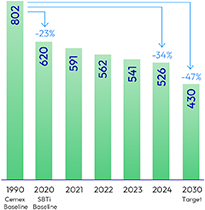 | 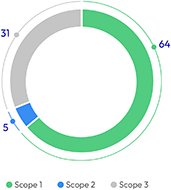 | |
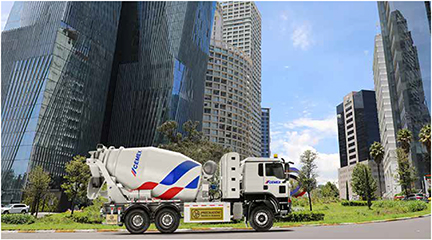
|
Our record performance continues in 2024:
• In 2024, we reduced our Scope 1-specific net CO2 emissions per ton of cement by 15 kg compared to 2023, and we have reached a 15% reduction since 2020.
• We continue to set historical company records for alternative fuel use at 37% and clinker factor at 71.8%.
• Our Scope 2 emissions have improved significantly, being reduced to 44.7 kg CO2 per ton of cementitious, and our clean electricity consumption was 34%.
• In our Scope 3 emissions, we reduced our purchased fuels intensity for cement plants by 15% as compared to 2020.
We are delivering significant CO2 reductions in the short term by implementing proven technologies across our operations in a profitable manner. |
DECARBONIZATION KEY INDICATORS
Leading the Cement Industry in Decarbonization
reducing Scope 1- and 2-specific net CO2 emissions per ton of cement by 15% and 18%, respectively, since the launch of our Future in Action program, a pace that previously would have taken 16 years to accomplish
Breaking Barriers in Clinker Factor
achieved a company record in clinker factor of 71.8% in 2024
Increasing Our Alternative Fuels Consumption
reducing our overall fuel consumption by reaching an alternative fuels rate of 37% in 2024
| |
| Contents | ||
| Our Company | ||
| Our Strategy | ||
| Financial Performance | ||
| Environmental Excellence | ||
| Future in Action: Achieving Decarbonization Targets Toward a Net-Zero Future | ||
| Sustainable Products and Solutions: Expanding the Sustainability Features of Our Products | ||
| ● Decarbonizing Our Operations: Moving Rapidly to Achieve Our Ambitious Goals | ||
| Circular Economy: Repurposing Materials to Minimize Our Environmental Impact | ||
| Water, Biodiversity, and Air Quality: Building a Nature-Positive Future | ||
| Innovation and Partnerships: Catalyzing Innovation Across Our Business and Industry | ||
| Promoting a Green Economy: Using Our Voices to Accelerate Action in Our Industry | ||
| Social Commitment: Accelerating Our Responsibilities for a Just Transition | ||
| Stakeholder Engagement | ||
| Governance | ||
| Appendix | ||
| 39 Cemex 2024 Integrated Report | ||
Scope 1: Cemex Makes Gains in Key Areas
Key levers that have helped us significantly advance in our decarbonization targets and reduce our CO2 emissions:
| • | increasing the use of alternative fuels with high biomass content rather than conventional fossil fuels |
| • | reducing clinker factor content in our cementitious products |
| • | increasing the use of decarbonated raw materials in clinker production |
| • | optimizing thermal efficiency in our kilns |
| • | decarbonizing our global vehicle fleet |
Alternative Fuels With High Biomass Content
Cemex works to replace fossil fuels with alternative fuels like biomass and industrial and municipal waste to power our kilns and use waste products effectively. In 2024, alternative fuels constituted 37% of our fuel mix. We prioritize the use of alternative fuels with a high biomass content, as these fuels have already removed and absorbed CO2 from the atmosphere and, when used as a fuel, have a neutral impact on our gross emissions. In 2024, biomass content was close to 15% of our total fuel mix.
Alternative Fuels Across Geographies
By using alternative fuels to power our kilns, we are reducing our reliance on carbon-intensive fossil fuels while supporting our communities in waste management. This also helps prevent municipal, commercial, and industrial waste from going into landfills so their recoverable energy may be utilized. The most common alternative fuels are refuse-derived fuel (RDF), agricultural waste, tire-derived fuel (TDF), and alternative liquid fuels.
U.K. At our Rugby cement plant, a new and more reliable feed system and the incorporation of tires into our fuel mix resulted in the plant reaching record alternative fuel consumption of 85%.
Egypt. At our Assiut cement plant, our team built an in-house dryer and separator to improve the quality and feed rate of alternative fuels, enabling record alternative fuels consumption. The plant increased its alternative fuel substitution rate by 5%–10% (depending on the fuel mix) in 2024 while increasing thermal efficiency by 2%–5% and reducing CO2 emissions by 2%.
Croatia. Located in an area with strict regulations that limit the plant to use only biomass materials, our Sveti Juraj cement plant expanded its supply chain to increase the availability of wood chips, a sustainable biomass, as an alternative fuel source. The successful supply chain development maximized the capabilities of the plant’s alternative fuels feed system, enabling it to increase its alternative fuel usage from 3% to 24% for the first time in its history.
2050 Net-Zero Transition
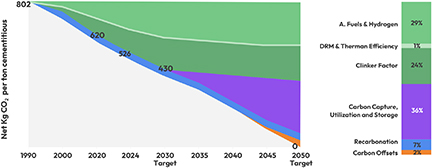
Panama. Our Calzada Larga plant increased its alternative fuel and biomass rates to 33% by boosting the consumption of RDF, TDF, and rice husks available in the country. This achievement was the result of a joint effort between supply development and consumption optimization at the operation site.
Czech Republic. After investing approximately US$6 million to modernize its EcoWaste Energy facility that supplies RFD, our Prachovice cement plant increased both the reliability and quality of its alternative fuel supply while eliminating its dependency on third-party suppliers.
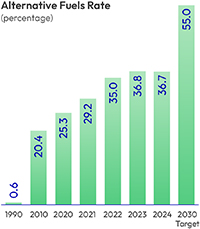
| Contents | ||
| Our Company | ||
| Our Strategy | ||
| Financial Performance | ||
| Environmental Excellence | ||
| Future in Action: Achieving Decarbonization Targets Toward a Net-Zero Future | ||
| Sustainable Products and Solutions: Expanding the Sustainability Features of Our Products | ||
| ● Decarbonizing Our Operations: Moving Rapidly to Achieve Our Ambitious Goals | ||
| Circular Economy: Repurposing Materials to Minimize Our Environmental Impact | ||
| Water, Biodiversity, and Air Quality: Building a Nature-Positive Future | ||
| Innovation and Partnerships: Catalyzing Innovation Across Our Business and Industry | ||
| Promoting a Green Economy: Using Our Voices to Accelerate Action in Our Industry | ||
| Social Commitment: Accelerating Our Responsibilities for a Just Transition | ||
| Stakeholder Engagement | ||
| Governance | ||
| Appendix | ||
| 40 Cemex 2024 Integrated Report | ||
| Clinker Factor Clinker is the key component of cement, produced by calcining together limestone, clay, and other materials in a rotary kiln at high temperatures. For clinker factor optimization, we use byproducts from other industries, like blast furnace slag and fly ash, as alternatives to clinker while maintaining product quality and durability.
We continue to make groundbreaking progress in optimizing our clinker factor by achieving our lowest historical clinker factor of 71.8% in 2024.
The successful results achieved and new initiatives to further reduce our clinker factor include: | 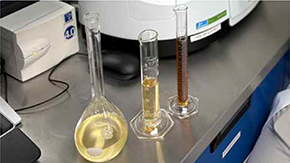 | 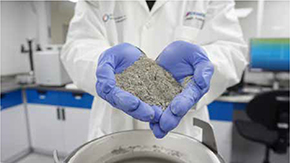 | ||
| Integral Cement One of the main levers in reducing our clinker factor is the use of integral cement, which uses powerful admixtures that help reduce the clinker factor by more than 5%. In 2024, the U.S. region achieved a remarkable overall integral cement production of 34%, well above the 2023 average production of 22%. | Clinker Micronization This ultra-fine grinding process improves cement properties by optimizing particle size distribution, which reduces clinker factor by up to 50%. In 2024, three of our plants executed plant upgrades and seven plants began defining the cement at lab-scale. | |||
| Clinker Factor (percentage)
|
Calcined Clays This is a lower-carbon alternative material compared with traditional clinker. After showing good performance in laboratory tests, we are conducting industrial trials using calcined clays in different plants in all regions. |
Mechanically Activated Clays This process enhances the chemical reactivity of materials by applying mechanical energy. This energy transfer produces a random arrangement of molecules (amorphization) in the material, leading to enhanced cementitious activity and agglomeration of particles, reducing the impact on water demand, and improving cement performance. | ||
| Contents | ||
| Our Company | ||
| Our Strategy | ||
| Financial Performance | ||
| Environmental Excellence | ||
| Future in Action: Achieving Decarbonization Targets Toward a Net-Zero Future | ||
| Sustainable Products and Solutions: Expanding the Sustainability Features of Our Products | ||
| ● Decarbonizing Our Operations: Moving Rapidly to Achieve Our Ambitious Goals | ||
| Circular Economy: Repurposing Materials to Minimize Our Environmental Impact | ||
| Water, Biodiversity, and Air Quality: Building a Nature-Positive Future | ||
| Innovation and Partnerships: Catalyzing Innovation Across Our Business and Industry | ||
| Promoting a Green Economy: Using Our Voices to Accelerate Action in Our Industry | ||
| Social Commitment: Accelerating Our Responsibilities for a Just Transition | ||
| Stakeholder Engagement | ||
| Governance | ||
| Appendix | ||
| 41 Cemex 2024 Integrated Report | ||
Decarbonated Raw Materials
Decarbonated raw materials, used to make raw meal for producing clinker, contain calcium oxide and lead to lower CO2 emissions when heated than when using calcium carbonate. In 2024, we used 4.1% of decarbonated raw materials in our raw mix across our global operations, which is equivalent to avoiding the emission of more than 626,000 tons of CO2. Compared to 2023, we registered an increase of 8% in the consumption rate of decarbonated raw materials across our operations, with our European operations achieving close to 11% of decarbonated raw material use, positioning this region at the forefront of CO2 emissions reduction in our global operations. In Croatia, we demonstrated outstanding performance, with plants in Sveti Juraj and Sveti Kajo achieving 80 kg of CO2 avoided per ton of clinker, representing an 18% substitution in raw meal. Additionally, our plant in Alicante, Spain, surpassed 100 kg of CO2 avoided per ton of clinker, demonstrating 22% substitution in raw meal.
Thermal Efficiency
Cemex has developed low-temperature and low-CO2 clinkers for more than 20 years, successfully producing novel clinkers with a
10%–20% lower CO2 footprint.
Maximizing thermal efficiency directly translates to reduced fuel consumption, lower production costs, and significantly decreased carbon emissions, making it a key factor in sustainable cement manufacturing.
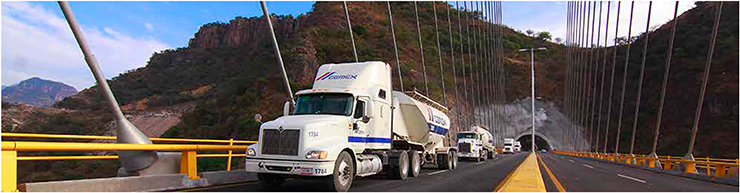
Driving Down Our Own Fleet’s Emissions
As one of the largest ready-mix concrete companies in the world, reducing our transport emissions is vital to addressing climate change, reducing our CO2 footprint, and achieving our 2050 net-zero target. We are focusing on several key areas, including the use of lower-carbon trucks and renewable fuels containing both diesel and natural gas. We’re also retrofitting our trucks with hybrid and zero-emission features and scaling up our use of zero-emission technologies, including battery electric, fuel cell, and hydrogen.
We are an early adopter of low- and zero-emissions equipment, such as lower-CO2 cement discharge systems in the U.K., electric mixer trucks in Germany, and compressed natural gas (CNG) mixer trucks in Mexico and the U.S.
As part of our efforts in 2024 to decarbonize our fleet and switch toward cleaner transport, we operated with:
| • | 25 fully electric trucks in Europe, Middle East, and the Americas |
| • | 600-plus CNG-powered trucks in Mexico and the U.S. |
| • | 800-plus on-highway and off-road units using renewable diesel in the U.S. |
| • | first test takeoff of hybrid-electric power in Mexico |
Renewable Fuels. The use of renewable fuels, such as renewable diesel, biogas, and biofuels, continues to be the primary means for reducing our fleet emissions. These renewable fuels are fully compatible with our current fleet and, when used at full concentration, can reduce up to 90% of the carbon footprint from transportation. In the U.S., our California operations are leading this effort, with renewable diesel fuel powering 76% of our fleet. We are also working on short- and long-term agreements to further expand its usage. In 2024, 18% of our own transport fleet in France was equipped to use B100 biodiesel, offering a 60% reduction in greenhouse gas emissions.
Natural Gas, Hybrid Technologies. We expect our Mexico, U.S., and SCA&C (South and Central America and the Caribbean) operations to continue growing their CNG fleet. In Mexico, 19% of our mixer trucks are powered by CNG. Hybrid technologies are being developed for power takeoff applications. These greatly reduce greenhouse gas emissions by powering external equipment and auxiliary functions using a battery-electric motor without relying on the vehicle’s combustion engine.
In 2024, we reduced our fleet’s CO2 emissions by 5% compared to 2023.
Zero-Emissions Solutions. An early adopter of fully electric trucks in Europe, the Middle East, and Mexico, we’re working with original equipment manufacturers (OEMs) to make electric mixers economically feasible. We have also deployed more than 1,400 hybrid or zero-emissions vehicles in our sales fleet, mostly in Europe.
Fleet Digitalization and Data Management.
Cemex is using technology to better configure machines, manage fleet aging, reduce fuel burn, and improve fleet utilization.
Electromobility Solutions. While fully electric heavy-duty trucks are not yet widely available on an industrial scale, Cemex is actively collaborating with OEMs to advance net-zero transportation technologies.
Carbon Emissions From Concrete Production
To reinforce our goal to fully decarbonize all business lines by 2050, we have established a target for 2030 to achieve a 30% reduction in net CO2 emissions of the cement used to produce a cubic meter of concrete compared to our 2020 baseline. By 2024, we achieved a 20% reduction from 2020 levels, representing a 44 kg of CO2 per m3 reduction, primarily through enhancements to our ready-mix composition, maintaining the strength and performance our markets expect.
| Contents | ||
| Our Company | ||
| Our Strategy | ||
| Financial Performance | ||
| Environmental Excellence | ||
| Future in Action: Achieving Decarbonization Targets Toward a Net-Zero Future | ||
| Sustainable Products and Solutions: Expanding the Sustainability Features of Our Products | ||
| ● Decarbonizing Our Operations: Moving Rapidly to Achieve Our Ambitious Goals | ||
| Circular Economy: Repurposing Materials to Minimize Our Environmental Impact | ||
| Water, Biodiversity, and Air Quality: Building a Nature-Positive Future | ||
| Innovation and Partnerships: Catalyzing Innovation Across Our Business and Industry | ||
| Promoting a Green Economy: Using Our Voices to Accelerate Action in Our Industry | ||
| Social Commitment: Accelerating Our Responsibilities for a Just Transition | ||
| Stakeholder Engagement | ||
| Governance | ||
| Appendix | ||
| 42 Cemex 2024 Integrated Report | ||
Scope 2: Cemex Reduces
Its Electricity Emissions
In 2024, we decreased our Scope 2-specific emissions using several main initiatives to reach our goals:
| • | energy-efficiency improvements |
| • | on-site project development, mainly with solar and waste-heat recovery, through power purchase agreements (PPAs) and our own capital investments |
| • | agreements with developers and utilities for renewable supply from off-site renewable sources, including hydro, wind, and solar |
Our 2030 target, as validated by the Science Based Targets initiative (SBTi) under the 1.5°C scenario, is to reduce our Scope 2 emissions by 58% from our 2020 baseline so that we would be emitting no more than 24 kg CO2 per ton of cementitious material. As of December 2024, our Scope 2-specific emissions were reduced by 18% compared to our 2020 baseline.
In EMEA, 341 of our sites had an energy management system verified to ISO 50001 in 2024. This represents more than 50% of our operations and 100% of our cement operations in the region.
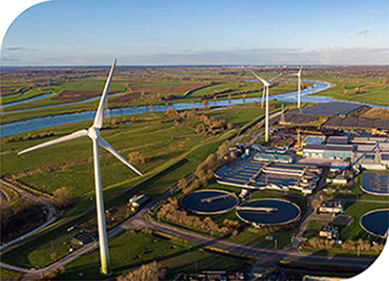
Copyright © 2020 Maarten Zeehandelaar/Shutterstock
Relevant Clean Electricity
Initiatives in 2024
| • | U.S. Cemex’s South Florida operations subscribed to nearly 10 megawatts of solar energy capacity—equivalent to the annual average energy consumption of nearly 2,000 homes—through Florida Power & Light Company’s Solar Together® program. Also, during 2024, Cemex’s Clinchfield cement plant in Georgia signed an agreement to purchase solar energy, which is expected to offset about 10,000 metric tons of indirect CO2 emissions per year, accelerating the company’s 2030 Scope 2 goal of reducing indirect electricity CO2 emissions in cement operations by 58% from a 2020 baseline. |
| • | Mexico. Emissions in Mexico decreased by 20% compared to the previous year due to a rebalancing of our supply portfolio. |
| • | SCA&C Through the purchase of Renewable Energy Certificates, Nicaragua reached 100% clean electricity consumption in 2024. In Colombia, Cemex entered into a renewable power purchase agreement that supplies 5% of our cement plants’ consumption. In 2024, Cemex also signed a five-year agreement to purchase clean electricity starting in 2026 that will cover around 30% of the electric power required at Colombia cement plants. |
| • | EMEA. In Germany, Cemex commissioned a waste-heat recovery system at its Rüdersdorf plant to reduce energy consumption, improve process efficiency, lower operating costs, and decrease CO2 emissions. In Poland, we have reached an agreement to develop on-site solar projects to supply electricity to our Chelm, Rudniki, and Gdynia cement plants and several other ready-mix concrete plants in the future. |
|
U.S. EPA ENERGY STAR® Partner of the Year for Sixth Consecutive Year
In 2024, Cemex was recognized by the U.S. Environmental Protection Agency (EPA) as a 2024 ENERGY STAR® Partner of the Year for the sixth consecutive year. This award for Sustained Excellence in Energy Management underscores our unyielding commitment to energy efficiency, sustainability, and environmental stewardship in our operations across the U.S.
Notable projects contributing to Cemex’s ENERGY STAR Partner of the Year achievement include sourcing 100% renewable electricity at our Demopolis, AL, cement plant; launching more than 30 thermal and electrical efficiency upgrade projects; replacing dozens of ready-mix trucks and transport tractors with low-emission, CNG vehicles; and replacing three diesel-powered locomotives with near-zero-emissions locomotives, among other projects.
|
| Contents | ||
| Our Company | ||
| Our Strategy | ||
| Financial Performance | ||
| Environmental Excellence | ||
| Future in Action: Achieving Decarbonization Targets Toward a Net-Zero Future | ||
| Sustainable Products and Solutions: Expanding the Sustainability Features of Our Products | ||
| ● Decarbonizing Our Operations: Moving Rapidly to Achieve Our Ambitious Goals | ||
| Circular Economy: Repurposing Materials to Minimize Our Environmental Impact | ||
| Water, Biodiversity, and Air Quality: Building a Nature-Positive Future | ||
| Innovation and Partnerships: Catalyzing Innovation Across Our Business and Industry | ||
| Promoting a Green Economy: Using Our Voices to Accelerate Action in Our Industry | ||
| Social Commitment: Accelerating Our Responsibilities for a Just Transition | ||
| Stakeholder Engagement | ||
| Governance | ||
| Appendix | ||
| 43 Cemex 2024 Integrated Report | ||
|
Scope 3: Ambitious Goals Build Upon Successful Progress
We have established ambitious Scope 3 goals, building upon our 2020 baseline, to further drive our commitment to sustainability. These include a 25% reduction in CO2 emissions per ton of purchased clinker and cement, 30% per ton of transported product, 40% reduction in Scope 3 emissions per ton of purchased fuels, and 42% reduction in absolute Scope 3 emissions from the use of traded fuels. These targets reflect our dedication to reducing our environmental impact across our value chain and aligning with global efforts to combat climate change.
All targets have been validated by SBTi using a 2020 baseline as a reference year. |
Emissions in Third-Party Transportation Services
Cemex is partnering with EcoTransit World to monitor CO2 emissions from distribution services. Through this unified global effort, we aim to reduce emissions by enhancing logistics efficiency and promoting lower-carbon fuels while promoting transparency and inspiring industry-wide action.
Performance in 2024
| |||||||||||||||||||
| 2020 (baseline)
| 2022
| 2023
| 2024
| |||||||||||||||||
|
Purchased clinker and cement (Kg CO2/ton) |
|
850 |
|
|
853 |
|
|
845 |
|
|
819 |
| ||||||||
| Purchased fuels (Kg CO2/ton) |
|
255 |
|
|
222 |
|
|
207 |
|
|
205 |
| ||||||||
| Traded fuels (tons CO2) |
|
5,730,384 |
|
|
3,906,030 |
|
|
3,598,559 |
|
|
1,980,527 |
| ||||||||
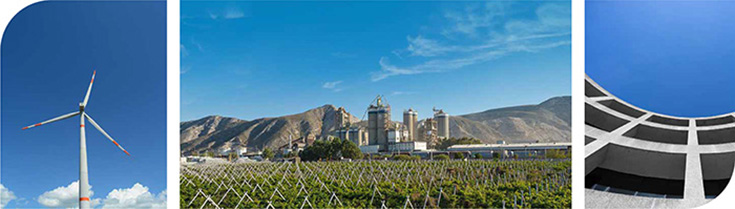
| Contents | ||
| Our Company | ||
| Our Strategy | ||
| Financial Performance | ||
| Environmental Excellence | ||
| Future in Action: Achieving Decarbonization Targets Toward a Net-Zero Future | ||
| Sustainable Products and Solutions: Expanding the Sustainability Features of Our Products | ||
| Decarbonizing Our Operations: Moving Rapidly to Achieve Our Ambitious Goals | ||
| ● Circular Economy: Repurposing Materials to Minimize Our Environmental Impact | ||
| Water, Biodiversity, and Air Quality: Building a Nature-Positive Future | ||
| Innovation and Partnerships: Catalyzing Innovation Across Our Business and Industry | ||
| Promoting a Green Economy: Using Our Voices to Accelerate Action in Our Industry | ||
| Social Commitment: Accelerating Our Responsibilities for a Just Transition | ||
| Stakeholder Engagement | ||
| Governance | ||
| Appendix | ||
| 44 Cemex 2024 Integrated Report | ||
Repurposing Materials
to Minimize Our
Environmental Impact
Our Approach: We are taking comprehensive actions to lead the transition toward a circular economy by promoting the preservation of natural resources through recycling materials to maximize their value and reduce waste by design.
Instilling Circularity Principles Across Our Operations
Under this model, we’re working to decouple growth and value generation from the consumption of finite resources. We offer services to manage and sort discarded materials, substitute fossil fuels in our operations with alternative materials, produce high-quality products that repurpose industry by-products, and partner with circularity leaders to advance circular solutions.
We are evolving our manufacturing processes to recycle construction, demolition, and excavation materials (CDEM) as aggregates and raw materials, replacing fossil fuels with waste-derived fuels to power our operations. We are also designing products that incorporate other industries’ by-products and waste-derived resources, reducing our reliance on virgin materials.
In 2024, Cemex repurposed 27 million tons of waste, which is roughly equivalent to the municipal waste produced annually in the U.K. These 27 million tons are mainly external waste and by-products from other industries and cities. By recycling and repurposing these materials, Cemex reduces its reliance on virgin materials and diverts waste from reaching landfills, rivers, and oceans, which helps avoid damage to the environment. By 2030, we aim to increase the amount of waste and by-products we repurpose by more than 50%.
 | Integrating waste materials as fuels and raw materials is a powerful strategy to reduce our carbon footprint and tackle global challenges such as CO2 emissions and biodiversity loss. |
Circularity by Design
The circular economy is a system designed to keep materials from becoming waste.
In a circular economy, products and materials are kept in circulation through processes like maintenance, reuse, refurbishment, remanufacturing, recycling, and composting, all while supporting nature’s regeneration.
The circular economy tackles climate change and other global challenges, like biodiversity loss, waste, and pollution, by reducing the need for finite natural resources.
Committed to Circularity
| Transform | ® | Construction, Demolition, and Excavation Materials (CDEM) | ||
| • Demolished concrete, blocks, bricks and returned concrete | ||||
| Circulate | ® | By-products | ||
| • Alternative Raw Materials | ||||
| • Decarbonated raw materials | ||||
| Recover | ® | Municipal & Industrial Waste | ||
| • Alternative fuels | ||||
|
| ||||||
| KEY INDICATORS
| ||||||
| 27 Million Tons
of waste repurposed through Regenera | +140 Centers Worldwide
where we receive and transform waste
| +13 Million Tons
of construction, demolition, and excavation materials processed in 2024 | ||||
|
Cemex Partners With Ellen MacArthur Foundation to Accelerate Circular Economy Efforts
In 2024, we proudly announced our partnership with the Ellen MacArthur Foundation, the world’s leading circular economy network, which aims to work with ambitious, like-minded organizations globally. As a part of the foundation’s Circular Leaders Group for the Built Environment, Cemex strives to continue adopting and expanding circular economy principles into the cement supply chain through our Regenera business while leveraging science-based research, advocacy, and coalition-building initiatives to drive circularity forward in the building materials industry.
|
| Contents | ||
| Our Company | ||
| Our Strategy | ||
| Financial Performance | ||
| Environmental Excellence | ||
| Future in Action: Achieving Decarbonization Targets Toward a Net-Zero Future | ||
| Sustainable Products and Solutions: Expanding the Sustainability Features of Our Products | ||
| Decarbonizing Our Operations: Moving Rapidly to Achieve Our Ambitious Goals | ||
| ● Circular Economy: Repurposing Materials to Minimize Our Environmental Impact | ||
| Water, Biodiversity, and Air Quality: Building a Nature-Positive Future | ||
| Innovation and Partnerships: Catalyzing Innovation Across Our Business and Industry | ||
| Promoting a Green Economy: Using Our Voices to Accelerate Action in Our Industry | ||
| Social Commitment: Accelerating Our Responsibilities for a Just Transition | ||
| Stakeholder Engagement | ||
| Governance | ||
| Appendix | ||
| 45 Cemex 2024 Integrated Report | ||
| Benefits of a Circular Economy | ||||||||
 | Reduces demand for virgin raw materials |  | Preserves nature and biodiversity | |||||
 | Decreases carbon emissions |  | Improves resource efficiency | |||||
 | Avoids methane emissions from landfills |  | Creates new business opportunities | |||||
Enabling a Circular Future
With over 20 years of experience in waste management, Cemex launched Regenera in 2023 to provide circularity solutions, including the reception, management, recycling, and co-processing of waste materials. Today, Regenera manages waste materials in more than 140 facilities worldwide. The facilities are strategically located near major cities, allowing Cemex to leverage its global expertise and infrastructure to offer a wide range of tailored services to municipalities and industrial customers.
Cemex has a strong position in the building materials industry to become a collaborative enabler and facilitate the use of valuable resources within a circular economy.
Regenera successfully addresses waste challenges by forming alliances with local governments and engaging key stakeholders in the circular economy. Through this collaboration, we repurpose diverse end-of-life materials, recover recyclables for reuse, and establish closed-loop systems between industries. This approach fosters sustainable economic growth and scalability while extending the benefits of a circular economy beyond Cemex.
Through Regenera, Cemex demonstrates its commitment to promoting the transition toward a sustainable future and a circular economy that prioritizes waste reduction, material reuse, and reduced reliance on nonrenewable resources.
Municipal and Industrial Waste
Every year, society generates more than 2 billion tons of waste worldwide. Most municipal and industrial waste is disposed of in landfills. This leads to soil and water pollution and creates methane, which is up to 80 times more environmentally harmful than carbon dioxide.
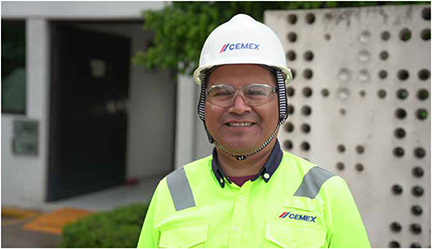
| In 2024, we repurposed an amount of waste equivalent to 30% of Mexico City’s municipal solid waste. Additionally, we continue our efforts in Queretaro, with the goal of making it the first zero-waste-to-landfill city in Mexico. Central to this initiative is the Broquers plant, which is owned and managed by Regenera. Since Regenera launched operations in the city two years ago, the plant has nearly tripled its capacity and now processes close to 300,000 tons of waste annually which accounts for 90% of the waste collected by the municipality.
We also expanded our footprint with two new Regenera plants: one in Puebla, in collaboration with PASA and the Puebla local government, and another in Mexico City, in collaboration with a local government facility. Our total of five materials and industrial waste material sites enable circularity for other industries and communities. |
The Regenera Seal: A Cultural Transformation and Commitment to Circularity
We developed the Regenera Seal to signal the transition of our operations into zero-waste-to-landfill facilities. Our seal promotes a circularity mindset across the organization. At the same time, our framework seeks to implement innovative strategies as we aim to extend resource use along the value chain and eliminate waste from the system.
In July 2024, our Calzada Larga cement plant in Panama was distinguished with the Regenera Seal at the Platinum level, becoming the first operation to achieve the framework’s highest level of recognition. In 2024, eight other facilities—seven in the SCA&C region and one in the U.K.—achieved zero-waste-to-landfill status and earned the Regenera Seal.
|
|
| Contents | ||
| Our Company | ||
| Our Strategy | ||
| Financial Performance | ||
| Environmental Excellence | ||
| Future in Action: Achieving Decarbonization Targets Toward a Net-Zero Future | ||
| Sustainable Products and Solutions: Expanding the Sustainability Features of Our Products | ||
| Decarbonizing Our Operations: Moving Rapidly to Achieve Our Ambitious Goals | ||
| ● Circular Economy: Repurposing Materials to Minimize Our Environmental Impact | ||
| Water, Biodiversity, and Air Quality: Building a Nature-Positive Future | ||
| Innovation and Partnerships: Catalyzing Innovation Across Our Business and Industry | ||
| Promoting a Green Economy: Using Our Voices to Accelerate Action in Our Industry | ||
| Social Commitment: Accelerating Our Responsibilities for a Just Transition | ||
| Stakeholder Engagement | ||
| Governance | ||
| Appendix | ||
| 46 Cemex 2024 Integrated Report | ||
Construction, Demolition, and Excavation Materials
Construction, Demolition, and Excavation Materials (CDEM) are highly relevant due to their environmental, economic, and societal benefits. They decrease the demand for virgin resources, lowering energy consumption and greenhouse gas emissions associated with their extraction and production. Additionally, this practice supports sustainable construction by driving innovation in material reuse and helping move toward a circular economy, ultimately contributing to a more sustainable and environmentally responsible construction industry.
As a leading provider of construction materials, Cemex capitalizes on its Regenera business to continue expanding the use of CDEM and providing solutions through the use of recycled materials as aggregates or repurposed for land rehabilitation. We work together with public and private partners to establish a strong value chain and framework needed to increase the use of recycled aggregates.
In 2024, we recovered more than 13 million tons of CDEM—a 28% increase compared to 2023. We also successfully reintroduced approximately 11% of managed CDEM materials into the market, transforming them into recycled aggregates for road base applications and ready-mix concrete production.
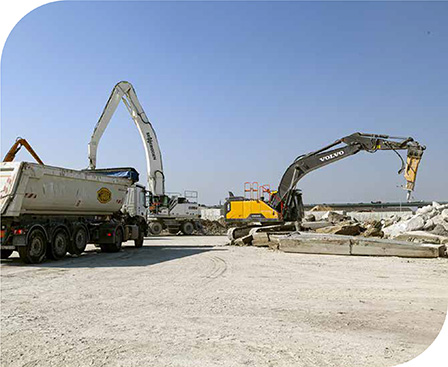
Transforming CDEM into useful commodities happens at different scales, from reprocessing remnant concrete to receiving and recycling excavation materials from significant infrastructure projects.
U.K. In 2024, we received over 1 million tons of tunneling spoil from the HS2 project, Britain’s new high-speed railway connecting London to Birmingham, England. We demonstrated how the construction industry can effectively manage infrastructure waste by repurposing it for land restoration, filling two quarry voids.
Germany. In 2024, we acquired a majority stake in RC-Baustoffe Berlin from the HEIM Group, enabling facilities to process and distribute recycled aggregates in Germany. The recycling facility can process up to 800,000 tons of materials per year, which Regenera will turn into repurposed aggregates for concrete production. In addition, RC-Baustoffe Berlin operates the first plant to permanently store biogenic CO2 in recycled mineral waste in Germany.
Since the launch of Regenera, we have redefined our approach to waste, viewing it as an innovative resource that reduces our reliance on finite materials. This shift enables us to produce sustainable products, positioning us as key enablers of a more sustainable future.
Industrial By-Products
We value waste by-products from other industrial processes as alternative raw materials. This helps our partners reduce waste in their operations and enables Cemex to preserve natural resources and reduce its CO2 footprint. Together we can protect the environment and contribute to a more sustainable future.
In 2024, we replaced more than 9 million tons of raw materials with alternative by-products and waste from other industries. In the cement and ready-mix production process, we replaced some clinker with by-products, including fly ash and slags, as cement substitutes.
In our operations, we aim to maximize the reuse of cement kiln dust in the production loop. When this process is not possible, we make efforts to repurpose this by-product for alternative uses such as soil or road stabilization, fertilizer enhancement, or de-icing agent for roads. Additionally, we have crafted our Isocycle additive that enables us to transform waste concrete into a value-added material which can be reintroduced into the value chain. Since 2023, we have been improving our waste categorization, including hazardous and nonhazardous materials, and strengthening our measurement systems to make them more robust and precise.
| Contents | ||
| Our Company | ||
| Our Strategy | ||
| Financial Performance | ||
| Environmental Excellence | ||
| Future in Action: Achieving Decarbonization Targets Toward a Net-Zero Future | ||
| Sustainable Products and Solutions: Expanding the Sustainability Features of Our Products | ||
| Decarbonizing Our Operations: Moving Rapidly to Achieve Our Ambitious Goals | ||
| Circular Economy: Repurposing Materials to Minimize Our Environmental Impact | ||
| ● Water, Biodiversity, and Air Quality: Building a Nature-Positive Future | ||
| Innovation and Partnerships: Catalyzing Innovation Across Our Business and Industry | ||
| Promoting a Green Economy: Using Our Voices to Accelerate Action in Our Industry | ||
| Social Commitment: Accelerating Our Responsibilities for a Just Transition | ||
| Stakeholder Engagement | ||
| Governance | ||
| Appendix | ||
| 47 Cemex 2024 Integrated Report | ||
Water, Biodiversity, and Air Quality:
Building a Nature-Positive Future
Our Approach: At Cemex, we aim for our operations to have a positive impact on nature and society. We work to optimize our water usage, reduce freshwater withdrawals, and enhance biodiversity in and around our quarries while also minimizing our impacts on air quality.
Our nature strategy encompasses water, biodiversity conservation, and regeneration initiatives, as well as air quality enhancement.
|
KEY INDICATORS | ||
| 4.9 Million Cubic Meters | ||
| freshwater saved during 2024 | ||
| 58% | 100% | |
| of our active quarries with habitat mapping | clinker production with continuous emissions monitoring systems to monitor major air emissions | |
Protecting Humanity’s Most Precious Resource: Water
Water is a finite and essential resource for life, ecosystems, and economic development. It is also a key ingredient to make concrete and a basic element in our manufacturing process. To reduce our water usage and alleviate strain on local water resources, we are transitioning to alternative water sources, developing water system maintenance routines, installing water recycling systems, and monitoring discharge quality, particularly at sites with the highest water-related risks.
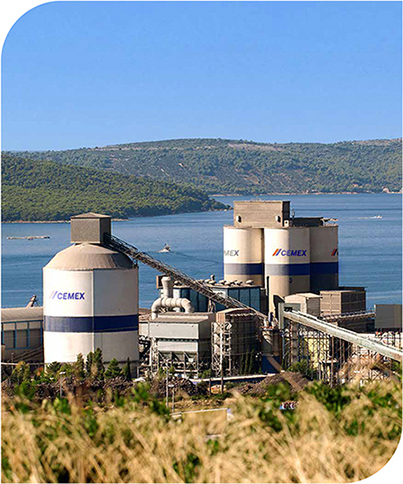
| Contents | ||
| Our Company | ||
| Our Strategy | ||
| Financial Performance | ||
| Environmental Excellence | ||
| Future in Action: Achieving Decarbonization Targets Toward a Net-Zero Future | ||
| Sustainable Products and Solutions: Expanding the Sustainability Features of Our Products | ||
| Decarbonizing Our Operations: Moving Rapidly to Achieve Our Ambitious Goals | ||
| Circular Economy: Repurposing Materials to Minimize Our Environmental Impact | ||
| ● Water, Biodiversity, and Air Quality: Building a Nature-Positive Future | ||
| Innovation and Partnerships: Catalyzing Innovation Across Our Business and Industry | ||
| Promoting a Green Economy: Using Our Voices to Accelerate Action in Our Industry | ||
| Social Commitment: Accelerating Our Responsibilities for a Just Transition | ||
| Stakeholder Engagement | ||
| Governance | ||
| Appendix | ||
| 48 Cemex 2024 Integrated Report | ||
Water Action Plans
Cemex has developed water action plans (WAPs) to enhance water management and conservation across our global operations, particularly in water-stressed areas. These plans offer a customized set of response actions to manage water effectively and mitigate specific water risks for each community based on recommendations from the Water Risk Filter tool from the World Wildlife Fund. Our plans take into consideration a Water Stress Map Assessment conducted with the Aqueduct tool from the World Resources Institute, which analyzed the water stress level of 1,500-plus cement, ready-mix, and aggregates sites. Cemex is committed to implementing WAPs in 100% of its sites located in high-water stress areas by 2030. In 2024, 40% of our operations located in water-stressed zones, comprising sites in extremely high and high water-stressed zones, have implemented WAPs.
 | Water Awareness and Internal Capacity
Increase the knowledge, the context of hydric stress, and understand the potential risks and opportunities. Water policy defined, water stress studies carried out and future scenarios analysis is done.
| |
|
| ||
 | Operations, Performance, Measurement and Management
Implement and follow the theoretical knowledge of Cemex’s internal procedures and international guidelines through practical examples on all our operations. Measurement standardization and performance templates.
| |
|
| ||
 | Internal Efficiency and Cemex Solutions
Share and understand Cemex’s best practices compiled globally and analyze replicability.
| |
|
| ||
 | Value Chain Engagement
Engage with the value chain and share the share the relevance of their participation in Cemex’s water footprint. Supplier program, mapping and prioritization, and continuous improvement.
| |
|
| ||
 | Stakeholder Engagement
Increase the knowledge of the water problem that communities face and how to deal with it from a proactive approach.
|
Freshwater Withdrawal Reduction, Non-Freshwater Use
We are on track to meet our 2030 freshwater withdrawal reduction targets, which include a 20% reduction in freshwater withdrawal for cement, 10% reduction for ready-mix concrete, and 15% reduction for aggregates versus our 2021 baseline. To achieve these targets, we are working on gradually increasing the use of non-freshwater, such as alternative water from treatment plants and other industries (e.g., bottling and beverages) and rainwater we are able to collect or recover.
|
|
Freshwater Use by the Numbers in 2024
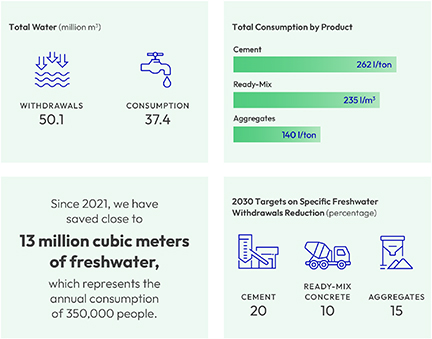
|
| ||
|
Working with leading sustainability consulting firm Environmental Resources Management (ERM), Cemex has developed a global zero freshwater and zero discharge framework and an associated measurement protocol. In 2024, we launched our internal Zero Freshwater Certification program based on this protocol. This internal certification requires a site to either use zero freshwater or have zero discharge, comply with local regulations, and adhere to company policies. Since the program’s launch, 12 sites worldwide, including cement and ready-mix operations, have completed this verification with other operations working toward this goal.
• Mexico. In 2024, 185 facilities out of 217—or 85% of our plants nationwide—utilize alternative water.
• Colombia. At our Santa Rosa cement plant, more than 90% of the water required for cement production originates from non-freshwater sources, including rainwater, recycling systems, and zero water discharges.
|
| Contents | ||
| Our Company | ||
| Our Strategy | ||
| Financial Performance | ||
| Environmental Excellence | ||
| Future in Action: Achieving Decarbonization Targets Toward a Net-Zero Future | ||
| Sustainable Products and Solutions: Expanding the Sustainability Features of Our Products | ||
| Decarbonizing Our Operations: Moving Rapidly to Achieve Our Ambitious Goals | ||
| Circular Economy: Repurposing Materials to Minimize Our Environmental Impact | ||
| ● Water, Biodiversity, and Air Quality: Building a Nature-Positive Future | ||
| Innovation and Partnerships: Catalyzing Innovation Across Our Business and Industry | ||
| Promoting a Green Economy: Using Our Voices to Accelerate Action in Our Industry | ||
| Social Commitment: Accelerating Our Responsibilities for a Just Transition | ||
| Stakeholder Engagement | ||
| Governance | ||
| Appendix | ||
| 49 Cemex 2024 Integrated Report | ||
Enhancing Our Biodiversity Approach
to Achieve a Nature-Positive Future
As part of our nature strategy, we are committed to enhancing biodiversity within and around our quarries. We are also developing local biodiversity action plans (BAPs) to provide us with comprehensive guidance on being responsible stewards of our natural habitats.
All our biodiversity efforts and policies align with the Kunming-Montreal Global Biodiversity Framework agreement and the Global Cement and Concrete Association (GCCA) sustainability guidelines.
Additionally, we continue habitat mapping, quarry rehabilitation, and integration of circular principles across our operations to reduce our reliance on natural resource extraction and advance our efforts to becoming nature positive.
Quarry Rehabilitation Plans
Quarry rehabilitation is a crucial process to restore and enhance the natural environment after quarrying activities have taken place. It begins with an initial site assessment, followed by the development and implementation of a biodiversity management plan, and concludes with performance measurement and reporting. As of 2024, 100% of all active Cemex quarries have rehabilitation plans in place.
|
|
Impact Assessment
Before starting any earthwork, we carry out an environmental impact analysis to map potential risks and extraction possibilities.
| |
 |
Avoidance and Minimization of Impact
We aim to carry out activities with the least potential risk to avoid or minimize impact; for example, stopping extraction where biodiversity is especially high.
| |
 |
Restoration / Rehabilitation
During and after extraction activities in the quarries, we implement a rehabilitation plan. The goal is to help restore the ecosystem services to where they were before extraction, through indigenous vegetation and the creation of reservations.
| |
|
|
Compensation
Lastly, for any part of the impact area that could not be restored or rehabilitated, compensation is sought with a biodiversity action plan.
|

Biodiversity Action Plan
Cemex’s biodiversity action plans (BAPs) are designed to guide our sites in developing practical steps and processes to conserve and promote valuable habitats, species, and ecosystem services. Our BAPs focus on enhancing biodiversity management near high-biodiversity-value areas defined as high priority. As of 2024, 43 of the 51 sites located in high-priority-biodiversity-value areas have implemented a BAP which is in line to achieve our 2030 goal of having BAPs in place in 100% of active sites identified as high priority.
 | Prerequisites
Compliance with legal and other requirements Preliminary desktop assessment Identify available resources (financial and others).
| |
 | Stakeholders Mapping and Engagement
Identify and analyze. Engage with key stakeholders.
| |
 | Partners
Engage ecological experts and partners. Efforts to engage with BirdLife local partner.
| |
 | Development of the Biodiversity Baseline
Baseline survey of biodiversity and impact assessment and consolidate and share resulting data.
| |
 | Prioritization
Prioritize species, vegetation communities, and ecosystem services. | |
 | Action Plan Objectives and Targets
Establish objectives, targets, actions, and deadlines. Allocate resources and responsibilities and set appropriate monitoring tools.
| |
 | Implementation
Appoint a biodiversity leader, align actions with internal procedures, and involve stakeholders and partners.
| |
 | Monitoring and Evaluation
Follow up implementation and budget, compare performance with baseline, and maintain communication with stakeholders.
| |
 | Reporting
Identify whom to report and how. Start with internal communication, and report data externally. | |
| Contents | ||
| Our Company | ||
| Our Strategy | ||
| Financial Performance | ||
| Environmental Excellence | ||
| Future in Action: Achieving Decarbonization Targets Toward a Net-Zero Future | ||
| Sustainable Products and Solutions: Expanding the Sustainability Features of Our Products | ||
| Decarbonizing Our Operations: Moving Rapidly to Achieve Our Ambitious Goals | ||
| Circular Economy: Repurposing Materials to Minimize Our Environmental Impact | ||
| ● Water, Biodiversity, and Air Quality: Building a Nature-Positive Future | ||
| Innovation and Partnerships: Catalyzing Innovation Across Our Business and Industry | ||
| Promoting a Green Economy: Using Our Voices to Accelerate Action in Our Industry | ||
| Social Commitment: Accelerating Our Responsibilities for a Just Transition | ||
| Stakeholder Engagement | ||
| Governance | ||
| Appendix | ||
| 50 Cemex 2024 Integrated Report | ||
Third-Party Certifications
Our strategic approach extends beyond our BAPs near high-priority-biodiversity areas as we pursue third-party certifications to validate our conservation efforts at sites outside these locations. Our conservation activities bring our employees and communities together in wildlife enhancement campaigns. Also, our initiatives raise awareness of how our industry can operate while minimizing its impact on biodiversity and supporting the integrity of natural habitats.
We currently have 36 sites in seven countries with third-party conservation certifications. These certifications are issued by leading environmental organizations such as the Wildlife Habitat Council, Ecocert, Texan by Nature, and Croatia’s Ministry of Environment and Energy, among others.
Aiming for Nature Positivity
We continue to define nature-positive baselines for all our operations with plans to demonstrate relevant progress by 2030. We are working toward restoring ecosystems to help nature recover in all our quarries by 2050.
To establish a baseline to measure our progress toward a nature-positive strategy, we began habitat mapping in the U.S., Mexico, Europe, Middle East, and Africa (EMEA), and South and Central America and the Caribbean (SCA&C) regions. As of 2024, 58% of our sites had conducted habitat mapping.
Our Efforts in Habitat Mapping and Restoration, Species Conservation During 2024
U.S. The Cemex Nature Center, a 13-hectare space in New Braunfels, TX, features biodiversity conservation initiatives and serves as a community educational space. In 2024, about 1,500 guests visited the site, and we have donated 1,800 kg of produce from its vegetable garden to local food banks.
Mexico. Located in the heart of La Huasteca Potosina in San Luis, Mexico, a former clay quarry is now a conservation and education site showcasing a highly biodiverse area that is home to hundreds of animals and plant species. We transformed the site into a safe space for passing species as we monitor populations and promote natural habitat conservation through partnerships and education programs.
EMEA
| • | France. Progress in mapping our 32 quarries to develop a nature-positive baseline for habitats and species. |
| • | Germany. Our Rüdersdorf quarry surveyed unique biotopes in detail, mapping a large number of different habitats found on-site. |
| • | U.K. At our Halkyn quarry in North Wales, we are piloting a program to understand the impact of a nature-positive approach. |
| • | U.K. The Chalk Grasslands is part of our Kensworth Quarry, which supplies raw feed to our Rugby cement plant. In collaboration with the local wildlife trust and Royal Society for the Protection of Birds, we planted specially selected wildflower seeds to attract butterflies, identified as a species of importance under Section 41 of the Natural Environment and Rural |
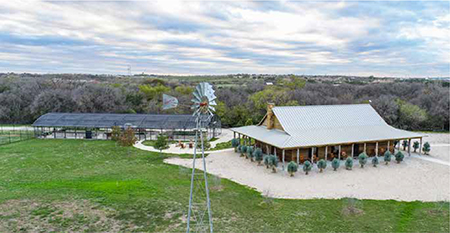
Communities Act. Additionally, Herdwick sheep graze these grasslands during autumn to preserve their quality.
| • | Poland. At our Latosówka quarry, ornithologists conducted eight field inspections, identifying a total of 62 bird species, including 46 confirmed or likely breeders. |
| • | Czech Republic. As part of its site expansion plans, the Prachovice cement plant assessed its quarry’s impact on biodiversity and determined that its existing operations have minimal effects on the surrounding environment. In many cases, we also found that the site supports protected or rare species. Research indicated that the woodland edge created by the quarry serves as an important feeding area for bats roosting in nearby woods and caves. Based on these insights, the expansion plan will preserve exposed cliff faces and access to underground caves, as well as 7.5 hectares of native woodland and scrub. Large areas will be left to naturally regenerate, and the restoration will include the creation of a lake and wetlands. |
| • | Croatia. In 2024, we conducted research to develop a biodiversity baseline for our site’s BAP. As part of this research, cameras were installed at three locations in the site’s complex topography of dense bushes and Mediterranean forest and ponds. It captured photos of many mammals, including wild boars, badgers, foxes, golden jackals, and stone martens. |
SCA&C
| • | Colombia. In 2010, Cemex donated approximately 2,000 hectares of land to the Chingaza National Nature Park in central Colombia. The land was previously an aggregates quarry that operated for 50 years and contributed to the economic and social development of nearby communities. The donation of this land to the country’s park service marked the final step in the quarry’s restoration plan. Today, the park provides drinking water to nearly 11 million people and is home to rare plant and animal species. |
| Contents | ||
| Our Company | ||
| Our Strategy | ||
| Financial Performance | ||
| Environmental Excellence | ||
| Future in Action: Achieving Decarbonization Targets Toward a Net-Zero Future | ||
| Sustainable Products and Solutions: Expanding the Sustainability Features of Our Products | ||
| Decarbonizing Our Operations: Moving Rapidly to Achieve Our Ambitious Goals | ||
| Circular Economy: Repurposing Materials to Minimize Our Environmental Impact | ||
| ● Water, Biodiversity, and Air Quality: Building a Nature-Positive Future | ||
| Innovation and Partnerships: Catalyzing Innovation Across Our Business and Industry | ||
| Promoting a Green Economy: Using Our Voices to Accelerate Action in Our Industry | ||
| Social Commitment: Accelerating Our Responsibilities for a Just Transition | ||
| Stakeholder Engagement | ||
| Governance | ||
| Appendix | ||
| 51 Cemex 2024 Integrated Report | ||

El Carmen Nature Reserve: Habitat Restoration and Species Conservation
Cemex manages a fully dedicated nature conservation reserve that is not linked to any of its quarries or mining operations. For every hectare of global active operations, we manage seven hectares of conservation land in El Carmen Nature Reserve, a private cross-border conservation area in Mexico and the U.S. It hosts five different ecosystems and habitats to diverse species of plants, birds, mammals, reptiles, and amphibians in more than 130,000 hectares (the size of Houston, TX, or Mexico City). It is the cement industry’s largest nature reserve dedicated to rewilding.
Since acquiring the land 25 years ago, we have tackled land overuse and degradation caused by livestock breeding, successfully restoring over 30,000 hectares of native grasslands to date. Since 2016, El Carmen has been designated Gold Certified by the Wildlife Habitat Council, the highest category granted.
Additionally, El Carmen serves a social purpose. In March 2024, it hosted the first Academy of Prescribed Burns for Women in Latin America. Brigade members from various Mexican states and institutions related to fire management participated in these controlled burn exercises. A total of 64 people attended, including representatives from institutions such as the Mexican Fund for the Conservation of Nature, National Commission of Protected Natural Areas, and National Forestry Commission of Mexico, as well as three guests from Big Bend National Park.
Wildlife Habitat Council
Recognizes Cemex
Conservation Projects
The Wildlife Habitat Council (WHC) awarded four Cemex projects across the U.S. and Mexico for excellence in corporate conservation during the 2024 WHC Conservation Conference. These projects highlight our positive impact on nature through conservation, restoration, and enhancement, as well as our commitment to making a positive and lasting impact on communities worldwide.
| • | Mexico. We received recognition for two projects, one for environmental education for students at the limestone and clay sites in Tamuín and another for desert habitat restoration at Cerro Jardín, Xoyatla, and Coayuca in Atotonilco. |
| • | U.S. We were honored for two training programs: environmental training at Cemex’s operations in Alabama and a formal environmental education program at Cemex’s quarry operations in Center Hill, Florida. |

Cemex’s Latest Conservation Book Series Focuses on Rewilding
In 2024, we released the 31st edition of our Cemex Nature Book Series. Rewilding is an extraordinary book that takes readers on a captivating journey through the lens of renowned photographers, exploring the concept of rewilding and its crucial role in conservation.
The edition features a powerful collection of images that capture the reintroduction of keystone species, the revival of native flora, and the restoration of biodiversity in areas affected by human activity, on land and in the ocean, underscoring nature’s resilience when given the opportunity to recover.
Since 1993, Cemex has published a new book every year for its global audiences and to reinforce its commitment toward promoting a culture of biodiversity conservation. This year’s volume is published in collaboration with SeaLegacy and Re:wild, organizations focused on protecting and restoring biodiversity around the world.
| | Learn more about Cemex’s new conservation book, Rewilding. |
| Contents | ||
| Our Company | ||
| Our Strategy | ||
| Financial Performance | ||
| Environmental Excellence | ||
| Future in Action: Achieving Decarbonization Targets Toward a Net-Zero Future | ||
| Sustainable Products and Solutions: Expanding the Sustainability Features of Our Products | ||
| Decarbonizing Our Operations: Moving Rapidly to Achieve Our Ambitious Goals | ||
| Circular Economy: Repurposing Materials to Minimize Our Environmental Impact | ||
| ● Water, Biodiversity, and Air Quality: Building a Nature-Positive Future | ||
| Innovation and Partnerships: Catalyzing Innovation Across Our Business and Industry | ||
| Promoting a Green Economy: Using Our Voices to Accelerate Action in Our Industry | ||
| Social Commitment: Accelerating Our Responsibilities for a Just Transition | ||
| Stakeholder Engagement | ||
| Governance | ||
| Appendix | ||
| 52 Cemex 2024 Integrated Report | ||

25 YEARS IN THE MAKING:
A LOOK AT EL CARMEN NATURE RESERVE
| 25 Years Cemex ownership, stewardship of El Carmen rewilding effort
130,000 Hectares size of Houston, TX, or Mexico City
| 30,000 Hectares native grasslands restored
+70 mammal species recovered or reintroduced, including white tail deer, javelina, mule deer, black bear, pronghorn antelope, bighorn sheep
| +50 reptile, amphibian species
117 American bison successfully reintroduced
Largest black bear population in Mexico
|
S P O T L I G H T : E L C A R M E N N A T U R E R E S E R V E
Celebrating 25 Years: Wasteland
Becomes Wildlife Haven
Jonas, a biologist with Cemex, remembers when the land of the El Carmen Reserve was wholly degraded, overgrazed by sheep and goats, and stripped of its natural beauty and vegetation. His description: “It was a wasteland.”
Then, 25 years ago, Cemex began its intervention to restore the reserve, and Jonas couldn’t believe the transformation. The barren land became a wildlife haven for flora, fauna, and a host of animals, including the bighorn sheep, American bison, and the majestic black bear.
Starting his work with Cemex as a student in 1996, the return of animals and the restoration of the land’s delicate ecosystem have been among Jonas’s most significant sources of personal and professional joy.
Jonas played a crucial role in monitoring the land’s recovery so the reintroduced species could thrive in their renewed habitat. His research and fieldwork guided conservation strategies toward a balanced and self-sustaining ecosystem.
“I recall seeing the animals roam freely in their natural habitat—running through the grasslands, basking in the sun, and joyfully playing in the snow. An indescribable feeling fell over me as I watched the animals in their natural habitat. It was like nothing I had ever witnessed before.”
| | Learn more about El Carmen Nature Reserve. |
Jonas says everything about the transformation of the El Carmen Nature Reserve has been impactful, but watching the resurgence of the black bear population was particularly remarkable.
Once completely absent from the region, the black bear returned, using the El Carmen reserve as a biological corridor connected with Big Bend National Park in Texas. Reestablishing this vital passageway allows species to migrate and thrive once more.
As the restoration of the El Carmen Nature Reserve continues, Jonas envisions a future where the land flourishes beyond what was once thought possible–where vegetation is thoroughly restored, animal diversity increases, and the delicate ecosystem is fully balanced. The greatest challenge moving forward? Ensuring that progress continues.
“Seeing how far we have come, I have no doubt that El Carmen will remain a sanctuary–for wildlife, for nature, and for generations to come. I’m proud to work for a company that is committed to transforming the land, benefiting the surrounding communities, the region, and the world.”
| Contents | ||
| Our Company | ||
| Our Strategy | ||
| Financial Performance | ||
| Environmental Excellence | ||
| Future in Action: Achieving Decarbonization Targets Toward a Net-Zero Future | ||
| Sustainable Products and Solutions: Expanding the Sustainability Features of Our Products | ||
| Decarbonizing Our Operations: Moving Rapidly to Achieve Our Ambitious Goals | ||
| Circular Economy: Repurposing Materials to Minimize Our Environmental Impact | ||
| ● Water, Biodiversity, and Air Quality: Building a Nature-Positive Future | ||
| Innovation and Partnerships: Catalyzing Innovation Across Our Business and Industry | ||
| Promoting a Green Economy: Using Our Voices to Accelerate Action in Our Industry | ||
| Social Commitment: Accelerating Our Responsibilities for a Just Transition | ||
| Stakeholder Engagement | ||
| Governance | ||
| Appendix | ||
| 53 Cemex 2024 Integrated Report | ||
Reducing Emissions to Improve Air Quality
Cemex is investing in technologies to monitor and reduce air emissions in our processes. In 2024, 100% of our clinker production was subject to continuous emission monitoring systems (CEMS), for our major emissions, including particulate matter (PM), sulfur oxide (SOx), and nitrogen oxide (NOx), regardless of whether it is required by state or local regulations. Besides allowing our operators to monitor major air emissions in kilns, the information gathered is used to analyze trends and action points and to share best practices. Minor emissions are also monitored in our kilns, with the frequency required by GCCA protocol.
Emissions Abatement by the Numbers
Major air emissions—PM, SOx, and NOx—are released as part of the cement manufacturing process. Minor air emissions—volatile organic compounds, dioxins and furans, and other heavy metals—are released in small quantities.
Progress Toward Our 2030 Air Emissions Reduction Targets:
| 88% | 54% | 39% | ||
| decrease of PM emissions | reduction in SOx emissions | reduction in NOx emissions | ||
| compared to our 2005 | compared to our 2005 | compared to our 2005 | ||
| baseline. 2030 target: 95% | baseline. 2030 target: 67% | baseline. 2030 target: 47% |
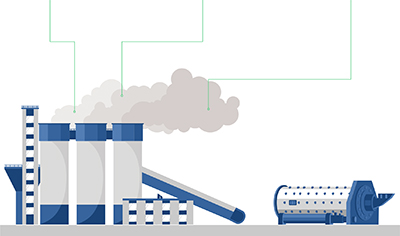
Environmental Stewardship Includes Compliance Standards
Cemex Environmental Management System
Our risk-based Environmental Management System (EMS) systematically audits internal compliance with our environmental policy across all our global operations and through our three businesses, cement, ready-mix, and aggregates. Our EMS is aligned with global environmental standards, such as ISO 14001 and the EU Eco-Management and Audit Scheme, allowing us to achieve ISO 14001 certification in 80% of our cement sites. In 2024, we implemented EMS in 93% of our businesses.
Environmental and Social Performance Management
Our EMS integrates environmental performance, impact assessment, stakeholder engagement, and response to events with input from a range of subject matter experts. Our Environmental and Social Incident Reporting process enables our global sites to maintain open communication with the communities where we operate and have a proactive approach to incident response. It also serves as a grievance mechanism to register complaints from external stakeholders.
Environmental and Social Incident Reporting Framework
Our standardized framework recognizes and registers incidents in three categories according to their severity: major, moderate, and minor. 2024 marked the sixth consecutive year during which no major (Category 1) environmental and social events were registered.
Dialogue and Engagement. We work to maintain open communication channels with our neighbors, law enforcement officials, public agencies, and other stakeholders.
| • | Rapid Response. Global, regional, and local rapid response teams are trained to address environmental and social impact events and hold annual emergency drills according to contingency plans at each of our sites. |
| • | Continuous Improvement. We consistently record events at every level of our business to identify recurring root causes, implementing and sharing corrective actions with our stakeholders. |
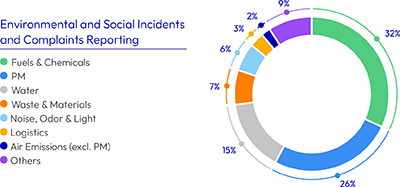
| Contents | ||
| Our Company | ||
| Our Strategy | ||
| Financial Performance | ||
| Environmental Excellence | ||
| Future in Action: Achieving Decarbonization Targets Toward a Net-Zero Future | ||
| Sustainable Products and Solutions: Expanding the Sustainability Features of Our Products | ||
| Decarbonizing Our Operations: Moving Rapidly to Achieve Our Ambitious Goals | ||
| Circular Economy: Repurposing Materials to Minimize Our Environmental Impact | ||
| Water, Biodiversity, and Air Quality: Building a Nature-Positive Future | ||
| ● Innovation and Partnerships: Catalyzing Innovation Across Our Business and Industry | ||
| Promoting a Green Economy: Using Our Voices to Accelerate Action in Our Industry | ||
| Social Commitment: Accelerating Our Responsibilities for a Just Transition | ||
| Stakeholder Engagement | ||
| Governance | ||
| Appendix | ||
| 54 Cemex 2024 Integrated Report | ||
Catalyzing Innovation Across Our Business and Industry
Our Approach: We collaborate with organizations to develop, source, and scale innovative solutions that will accelerate our transition to a carbon-neutral future.
A key to unlocking true carbon neutrality is discovering and scaling new technologies that can mitigate, capture, store, or use carbon. Through our Future in Action program, we seek to accelerate the deployment and development of carbon capture, utilization, and storage (CCUS) projects and invest in breakthrough proven technologies that are at the forefront of carbon mitigation to lower our CO2 footprint and deliver our ultimate goal of being net-zero by 2050.
We constantly seek innovative solutions by sourcing new technologies through Cemex Ventures, our venture capital unit, and our Global Research and Development facility, our Global Operations and Technical facility, along with partnerships and collaborations with institutions across the public and private sectors.
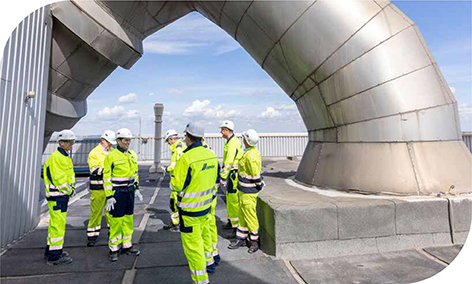
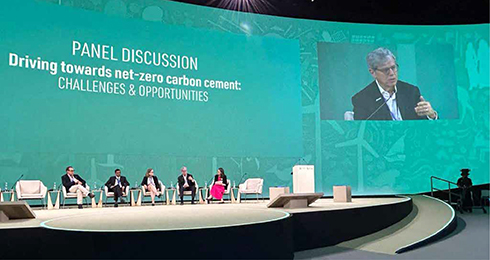
KEY INDICATORS
+60 Partners
working with like-
minded organizations
to develop industrial-scale
net-zero CO2 solutions
+2,400 Ideas
record number of internal
proposals for initiatives—
third consecutive year
to receive over 1,000
+280 Projects
current innovation portfolio
focused on decarbonization
of operations, sustainable
construction, and digitalization of
our business, among others
How We Innovate
We have open innovation and smart innovation processes as we seek to deliver exceptional value to our customers. Our venture capital unit sources innovative technologies and helps companies accelerate their growth. Our global research and development facility develops in-house technologies to reach net-zero CO2 emissions across our company by 2050.
Cemex Ventures
Cemex Ventures is our open innovation and venture capital unit that develops strategic business opportunities through collaboration, partnership, and investment in disruptive companies. Working with key contributors in the construction industry’s entrepreneurial ecosystem, this unit has 23 start-ups in its portfolio and is responsible for the world’s largest Construction Startup Competition, an annual event, with an average of 500 start-ups participating each year.
| Contents | ||
| Our Company | ||
| Our Strategy | ||
| Financial Performance | ||
| Environmental Excellence | ||
| Future in Action: Achieving Decarbonization Targets Toward a Net-Zero Future | ||
| Sustainable Products and Solutions: Expanding the Sustainability Features of Our Products | ||
| Decarbonizing Our Operations: Moving Rapidly to Achieve Our Ambitious Goals | ||
| Circular Economy: Repurposing Materials to Minimize Our Environmental Impact | ||
| Water, Biodiversity, and Air Quality: Building a Nature-Positive Future | ||
| ● Innovation and Partnerships: Catalyzing Innovation Across Our Business and Industry | ||
| Promoting a Green Economy: Using Our Voices to Accelerate Action in Our Industry | ||
| Social Commitment: Accelerating Our Responsibilities for a Just Transition | ||
| Stakeholder Engagement | ||
| Governance | ||
| Appendix | ||
| 55 Cemex 2024 Integrated Report | ||
Leaplab Acceleration Program
Cemex Ventures Leaplab is our exclusive acceleration program to help expedite the growth of high-potential start-ups in four market-driven opportunity areas: green construction, enhanced productivity, construction supply chain, and future of construction. We provide strategic services and use our resources and network of experts to collaborate with high-potential start-ups to address critical challenges facing our company.
Since establishing Leaplab, Cemex has supported 10 start-ups from the U.K., Spain, Israel, Colombia, Mexico, Chile, the U.S., and Austria. Real-scale pilots have been executed in 15 countries across all our business lines. Entrepreneurs are supported by a team of 200 internal and external venture capital, entrepreneurship, and construction experts who serve as mentors, pilot leaders, and expert speakers.
| | Learn more about Cemex Ventures. |

Research and Development
Cemex has a multidisciplinary team focused on developing cutting-edge, cost-effective, and sustainable technologies that meet performance requirements. Our Global Research and Development team in Switzerland brings together science and engineering experts with diverse backgrounds to innovate and collaboratively develop products, techniques, and technologies that push the boundaries of sustainable construction.
Reaching Net-Zero CO2 Emissions
We are working to reduce the CO2 footprint of our cement and concrete by exploring alternative fuel sources and integrating innovative construction chemicals and alternative supplementary cementitious materials.
Solar Radiation
Cemex continues its partnership with Synhelion to harness the power of solar radiation to fuel cement kilns, eliminating the need for other energy sources. Synhelion technology captures 100% of process carbon emissions, which can be stored or utilized as feedstock for fuel production and enables cement manufacturing to achieve a net-zero emissions level. In 2024, Cemex and Synhelion advanced plans to scale the technology by building a solar-driven industrial-scale pilot cement plant near Madrid, Spain.
Clinker Micronization
Clinker micronization is a process of ultrafine grinding of clinker to enhance its reactivity, allowing us to optimize the clinker content in our cements. Implementing this technology will require adjustments in our cement production process, enabling us to prioritize operations based on market demand, cement types, available supplementary cementitious materials, equipment considerations, and potential clinker factor optimization.
Currently, we are performing tests in Spain, Croatia, the U.S., and Mexico. By optimizing our cement and materials with this initiative, we would not only enhance our performance but also significantly lower our overall carbon footprint.
Cemex Recognized at
COP29 for Solar Clinker Breakthrough
We were awarded the Net-Zero Industries Award by Mission Innovation at a ceremony during COP29 in Baku, Azerbaijan, for our revolutionary clinker decarbonization process using concentrated solar power in partnership with cleantech company Synhelion.
Mission Innovation is a global initiative to catalyze action and investment in research, development, and demonstration to make clean energy affordable, attractive, and accessible to all in this decade. Its Net-Zero Industries Award recognizes and celebrates outstanding innovations in industrial decarbonization; it spotlights the people and projects revolutionizing energy-intensive industries and driving substantial reductions in greenhouse gas emissions.
 | Learn more about this groundbreaking partnership. |

| Contents | ||
| Our Company | ||
| Our Strategy | ||
| Financial Performance | ||
| Environmental Excellence | ||
| Future in Action: Achieving Decarbonization Targets Toward a Net-Zero Future | ||
| Sustainable Products and Solutions: Expanding the Sustainability Features of Our Products | ||
| Decarbonizing Our Operations: Moving Rapidly to Achieve Our Ambitious Goals | ||
| Circular Economy: Repurposing Materials to Minimize Our Environmental Impact | ||
| Water, Biodiversity, and Air Quality: Building a Nature-Positive Future | ||
| ● Innovation and Partnerships: Catalyzing Innovation Across Our Business and Industry | ||
| Promoting a Green Economy: Using Our Voices to Accelerate Action in Our Industry | ||
| Social Commitment: Accelerating Our Responsibilities for a Just Transition | ||
| Stakeholder Engagement | ||
| Governance | ||
| Appendix | ||
| 56 Cemex 2024 Integrated Report | ||
Hydrogen
Cemex is working with HiiROC, a pioneering British hydrogen company, to initiate an industrial-scale hydrogen deployment at our Rugby cement plant in the U.K. As a low-carbon energy source within the construction industry’s decarbonization road map, hydrogen offers significant potential to reduce the sector’s reliance on fossil fuels and lower CO2 emissions. This venture marks a significant milestone for Cemex as it represents the first large-scale strategic project plan aimed at further lowering our carbon emissions in cement production.
Additionally, Cemex is part of the HYIELD consortium, which was awarded a €10 million grant from the European Union to develop a waste-to-hydrogen demonstration plant. Led by the Clean Hydrogen Partnership, the demonstration plant will be trialed at Cemex’s cement plant in Alcanar, Spain. The plant is expected to process 2,000 tons of waste and produce nearly 400 tons of hydrogen through water electrolysis for different industry uses such as clean fuels, fertilizer production, and others.

Alternative Fuels
CLYNGAS is an innovative project, funded by the EU’s Innovation Fund, intended to replace part of the fuel used to manufacture clinker with a high-value gas obtained through the gasification process of waste and by-products from other industries. The project, being implemented at Cemex’s cement plant in Alicante, Spain, replaces some of the fossil fuels used to avoid around 5.5% of greenhouse gas emissions, while guaranteeing a stable process and high-quality production.
CCUS
Cemex is currently involved in the development of large-scale CCUS projects in Europe and the U.S., along with several pilots and emerging CCUS technologies designed to improve and accelerate decarbonization.
Large-scale CCUS projects for Cemex’s facilities in Alicante and Alcanar, Spain, and Sveti Juraj, Croatia, were granted the Strategic Technologies for Europe Platform (STEP) Seal. This selective quality label providing visibility to attract public and private investors in projects that align with the STEP’s objectives, such as those contributing to clean and resource-efficient technologies. Only 64 projects, in addition to funded projects, received this designation out of a total of 337 projects submitted in 2024.
During 2024, in collaboration with the U.S. Department of Energy’s Office of Fossil Energy and Carbon Management and the University of Illinois Urbana-Champaign Net-Zero Center of Excellence, we submitted an application to host Phase 1 of a cement carbon capture center at our Knoxville, TN, cement plant. Cemex convened a strong consortium of cement and lime companies, national laboratories, universities, and other carbon capture test centers to host the proposed facility. It will be the fourth such test center in the world and the only center dedicated to the cement industry.
Carbon Nanomaterials
Cemex was the first company in the cement industry to successfully turn CO2 into carbon nanomaterials directly from flue gases—a potential game changer in decarbonizing cement production. Cemex achieved promising lab results with a carbon conversion rate of 70%. During 2024, a cement plant in Spain was selected for a pilot, which is currently in the final stages of construction. The proposed technology can turn CO2 emissions into value-added products, including high-tech materials such as nanofibers, nanotubes, graphene, and carbon black.
While Cemex is working hard to decarbonize using
existing technology (reduce before capture), an
important component of our Future in Action program
is to develop and deploy breakthrough decarbonization
solutions for our industry to reach net-zero.
EU Innovation Fund
Supports Major CCUS
Project at Cemex
Rüdersdorf Plant
In 2024, a consortium formed by Cemex and Linde, a leading global industrial gases and engineering company, was granted €157 million from the EU Innovation Fund for the development of a CCUS project that is expected to capture 1.3 million metric tons of CO2 per year from Cemex Rüdersdorf’s cement plant, ultimately decarbonizing the site by 2030.
Cemex’s largest CCUS project to date will deploy Linde’s pioneering HISORP® technology for the first time in a unique state-of-the-art cryogenic-adsorptive process that captures CO2 from the exhaust gas directly at the emission source. The raw CO2 is then compressed and liquefied so that it meets the purity requirements for subsequent sequestration. Finally, the liquid CO2 product will be transported by rail to an intermediate CO2 hub and shipped to an offshore storage site in the North Sea for permanent storage.
| Contents | ||
| Our Company | ||
| Our Strategy | ||
| Financial Performance | ||
| Environmental Excellence | ||
| Future in Action: Achieving Decarbonization Targets Toward a Net-Zero Future | ||
| Sustainable Products and Solutions: Expanding the Sustainability Features of Our Products | ||
| Decarbonizing Our Operations: Moving Rapidly to Achieve Our Ambitious Goals | ||
| Circular Economy: Repurposing Materials to Minimize Our Environmental Impact | ||
| Water, Biodiversity, and Air Quality: Building a Nature-Positive Future | ||
| ● Innovation and Partnerships: Catalyzing Innovation Across Our Business and Industry | ||
| Promoting a Green Economy: Using Our Voices to Accelerate Action in Our Industry | ||
| Social Commitment: Accelerating Our Responsibilities for a Just Transition | ||
| Stakeholder Engagement | ||
| Governance | ||
| Appendix | ||
| 57 Cemex 2024 Integrated Report | ||
CCUS Partnerships
Cemex has several partnerships to develop and scale next-generation CCUS technologies. To fast-track development, in 2024 Cemex started an internal decarbonization fund to support pilot projects to de-risk and scale up selected technologies. This fund will help shorten the timeline for development usually associated with public funding. Cemex is also testing novel technologies through publicly funded programs.
Clean Energy Transition Partnership
Cemex is part of the DRIVE consortium through the Clean Energy Transition Partnership. DRIVE (Deep Removal of CO2 and Innovative Electrification Concepts) aims to provide electrochemical solutions for CO2 capture and developing technologies for deep removal of CO2. Selected technologies using electrochemical regeneration of solvents will be tested at our plant in Prachovice, Czech Republic, as we look for new ways to cost effectively lower the residual emissions associated with CO2 capture.
RTI International and SLB
Cemex is partnering with nonprofit research institute RTI International, global technology company SLB, and Oak Ridge National Laboratory for a project to install a 1 TPD carbon capture pilot plant at its Victorville, CA, cement plant using RTI’s solvent and two new intensified absorbers. The goal of the project, which was awarded a US$5 million grant from the U.S. Department of Energy, is to increase efficiencies and value in Cemex’s overall building material fabrication process while significantly reducing its CO2 footprint.
In another partnership with RTI, SLB, and others, Cemex is performing the engineering design of a carbon capture plant at the company’s Balcones cement plant in New Braunfels, TX, to capture 95% of CO2 emissions from both kilns at the site. The front-end engineering design (FEED) study is funded by the U.S. Department of Energy. It will determine and assess the overall costs of the integration of a 670,000-ton CO2 per year commercial-scale carbon capture system into the manufacturing process.
KC8
As part of a minority investment in Australian company KC8 Technologies by Cemex Ventures, Cemex is collaborating to scale up KC8’s UNO MK3 carbon capture technology through a 100 TPD plant FEED study, a mandatory step prior to a potential commercial installation. This carbon capture technology allows for separation of CO2 from flue gases via a chemical separation through a solid potassium carbonate.
Carbon BioCapture
Cemex is working with U.S.-based company Carbon BioCapture to build a pilot plant in our Huichapan cement plant in Mexico to study a biomass solution for carbon capture using an algae reproduction and CO2 capture system. The project will provide technological benefits by introducing biomass as a fuel for cement kilns, showcasing a carbon circularity model. It also will provide subsequent use of biomass in potential high-value products, such as fertilizers, livestock feed, biofuels, and other bio-chemicals.
Carbon Clean
Since 2020, Cemex has worked with Carbon Clean, a provider of innovative carbon capture technologies headquartered in the U.K., who developed Cyclone CC, an innovative amine-based capture technology. As we look for new ways to deploy solvent-based technologies for capture in the cement industry, Cemex is exploring the deployment of a 10 TPD Cyclone CC pilot at a cement plant. The plant will use a breakthrough combination of two technologies: Carbon Clean’s proprietary amine solvent and rotating packed beds.
CryoPur
Cemex is working with French company CryoPur to test a patented innovative cryogenic capture technology to mitigate emissions from cement operations. The technology allows for physical separation of CO2 from flue gases via cryogenic methods. This technology can be used to produce high-purity CO2, which is critical to achieving strict storage specifications. The innovative technology will be piloted at Cemex’s Rudniki plant in Poland.
Northwestern University
Cemex, in partnership with Northwestern University, has developed a solution to store CO2 in concrete using a carbonated water-based solution. This process sequesters up to 45% of CO2 without compromising the concrete’s strength.
UNAM-TEC Consortium for Research, Technology Transfer, and Entrepreneurship
Cemex maintains research and collaboration agreements with Universidad Nacional Autónoma de México (UNAM) and Instituto Tecnológico y de Estudios Superiores de Monterrey (ITESM) focused on innovative applications of captured CO2 from our cement production process. These partnerships, besides supporting our decarbonization road map, foster closer ties between industry and academia.
Enabling Sustainable Construction
Cemex conceives and develops new technologies, materials, and processes, striving to deliver unique, integrated, and cost-effective solutions that are sustainable, high performance, and market driven. We aim to push the boundaries of sustainable construction with forward-looking concepts and approaches that seek to emphasize positive environmental impacts.

| Contents | ||
| Our Company | ||
| Our Strategy | ||
| Financial Performance | ||
| Environmental Excellence | ||
| Future in Action: Achieving Decarbonization Targets Toward a Net-Zero Future | ||
| Sustainable Products and Solutions: Expanding the Sustainability Features of Our Products | ||
| Decarbonizing Our Operations: Moving Rapidly to Achieve Our Ambitious Goals | ||
| Circular Economy: Repurposing Materials to Minimize Our Environmental Impact | ||
| Water, Biodiversity, and Air Quality: Building a Nature-Positive Future | ||
| ● Innovation and Partnerships: Catalyzing Innovation Across Our Business and Industry | ||
| Promoting a Green Economy: Using Our Voices to Accelerate Action in Our Industry | ||
| Social Commitment: Accelerating Our Responsibilities for a Just Transition | ||
| Stakeholder Engagement | ||
| Governance | ||
| Appendix | ||
| 58 Cemex 2024 Integrated Report | ||
Casas Betania Project
Cemex’s digital manufacturing technique, Morphing, was used to complete a residential complex in Barcelona, Spain. Morphing uses computer advances and Cemex’s Insularis® technology to produce complex, non-repetitive building materials with thermal insulation properties cost effectively. The project, which features three single-family homes on the same lot, each one with a private area and a common garden, is expected to reduce CO2 emissions by 90% a year and provide annual energy savings of 89%. It uses 85% recyclable or reusable materials and saves 80% on rainwater irrigation.
Félix Candela Mini Pavilion in Geneva
To showcase the potential and flexibility of Cemex Resilia® product and its use in designing and building thin-shell structures, Cemex built a mini pavilion as part of an exhibition to honor the legacy of architect Félix Candela in August 2024 in Geneva, Switzerland. Using Cemex’s D.fab folding technique, the 1:5-scale replica of Candela’s 1962 Botanical Garden Pavilion in Oslo, Norway, was transported and assembled on-site in less than 24 hours and can be dismantled and reassembled as needed.
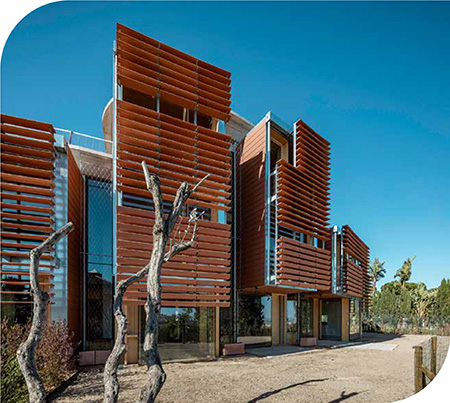
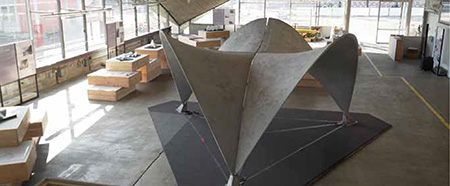
|
Transforming Our Business With Digital Solutions
We continually invest in and develop innovative digital solutions that leverage AI tools to improve customer experiences and help develop more efficient projects. | ||
| Building Information Modelling Recognizing the growing importance of digitalization and its impact on our customers and stakeholders, Cemex is adopting building information modeling (BIM) technology for the construction industry. We have successfully developed and launched a unique platform in a BIM environment that enables architects, engineers, and builders to enhance their workflows with a variety of features that promote the use of innovative materials for more sustainable projects. BIM is central to strategies aimed at increasing construction project efficiency and guaranteeing best-in-class construction data management. Cemex has implemented its BIM platform in Colombia, Mexico, the U.K., France, Germany, and Poland and continues to expand it into new markets. | AI Solutions
• Introid. Cemex has piloted this advanced computer vision and AI solution to improve safety and productivity in manufacturing in Mexico, with applications in ready-mix, cement, and a Regenera waste management site.
• Verusen. This AI-driven software for automating spare parts and MRO inventory management is being piloted across all cement plants in the South and Central America and the Caribbean (SCA&C) region to evaluate its ability to optimize inventory replenishment.
• Mixteresting. Cemex is testing this AI-powered platform for optimizing concrete mix designs in three ready-mix plants in Germany to validate faster development of efficient, cost-effective, and low-CO2 concrete mixes.
• Waterplan. This AI-powered water risk management platform is being tested across all our cement, ready-mix, and aggregate sites in the SCA&C region, as well as in our cement sites in Mexico, to monitor and mitigate water risks at corporate and local levels.
| |
| Contents | ||
| Our Company | ||
| Our Strategy | ||
| Financial Performance | ||
| Environmental Excellence | ||
| Future in Action: Achieving Decarbonization Targets Toward a Net-Zero Future | ||
| Sustainable Products and Solutions: Expanding the Sustainability Features of Our Products | ||
| Decarbonizing Our Operations: Moving Rapidly to Achieve Our Ambitious Goals | ||
| Circular Economy: Repurposing Materials to Minimize Our Environmental Impact | ||
| Water, Biodiversity, and Air Quality: Building a Nature-Positive Future | ||
| Innovation and Partnerships: Catalyzing Innovation Across Our Business and Industry | ||
| ● Promoting a Green Economy: Using Our Voices to Accelerate Action in Our Industry | ||
| Social Commitment: Accelerating Our Responsibilities for a Just Transition | ||
| Stakeholder Engagement | ||
| Governance | ||
| Appendix | ||
| 59 Cemex 2024 Integrated Report | ||
Using Our Voices to Accelerate
Action in Our Industry
Our Approach: We advocate for the establishment of stable regulatory environments and frameworks that foster and accelerate our industry’s decarbonization.
Collaboration Accelerates Our Carbon-Neutral Future
Cemex believes that climate change is one of the biggest challenges of our time and supports actions that align with the Paris Agreement commitments and fulfill the United Nations Sustainable Development Goals (SDGs) on climate action. A key component of achieving our climate action targets and ambition to become a net-zero company by 2050 is promoting public policies that enable the decarbonization of the cement and concrete industry.
Close collaboration across industry stakeholders is crucial for accelerating the adoption of climate-focused frameworks. That’s why we actively work with industry peers and external trade associations to advance our priorities in circular economy and waste management, lower-carbon products, carbon pricing, clean electricity, and government funding to enable the transition to a carbon-neutral future.
| KEY ACCOMPLISHMENTS | ||
| Uniting Industry Leaders and Policymakers During 2024’s Climate Week in New York City, Cemex brought together world-renowned leaders on circularity to discuss challenges and opportunities in the building sector. | Promoting Industry Change As part of our industry coalition advocacy, Cemex supported U.S. legislation that promotes research and development of advanced technologies to improve efficiency in cement and concrete production. | |
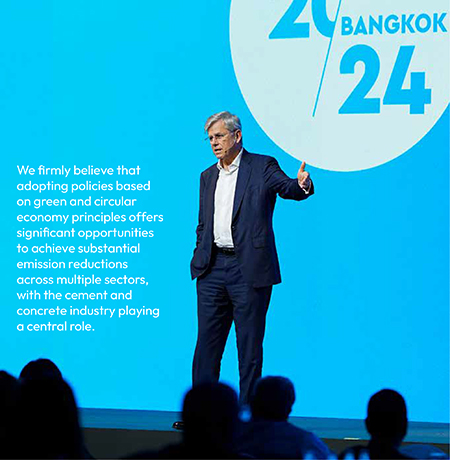
|
Global Cement and Concrete Association’s Path to Decarbonization
The Global Cement and Concrete Association’s (GCCA) detailed road map was the first net-zero commitment of any of the heavy industries and sets out the detailed pathways, levers, and milestones required to achieve this ambitious target. Together, the industry is committed to accelerating the shift to carbon-neutral cement and concrete by cutting CO2 emissions by 20% per ton of cement and 25% per m3 of concrete by 2030 and full decarbonization by 2050.
In 2024, GCCA published its annual Cement Industry Net Zero Progress Report, highlighting decarbonization progress and underlining the industry’s commitment to building a sustainable future. Since the 1990 baseline, the industry has achieved a 23% emissions reduction in CO2 per ton of cement and is on track to deliver carbon capture, utilization, and storage technology at industrial scale by 2030.
|
| Contents | ||
| Our Company | ||
| Our Strategy | ||
| Financial Performance | ||
| Environmental Excellence | ||
| Future in Action: Achieving Decarbonization Targets Toward a Net-Zero Future | ||
| Sustainable Products and Solutions: Expanding the Sustainability Features of Our Products | ||
| Decarbonizing Our Operations: Moving Rapidly to Achieve Our Ambitious Goals | ||
| Circular Economy: Repurposing Materials to Minimize Our Environmental Impact | ||
| Water, Biodiversity, and Air Quality: Building a Nature-Positive Future | ||
| Innovation and Partnerships: Catalyzing Innovation Across Our Business and Industry | ||
| ● Promoting a Green Economy: Using Our Voices to Accelerate Action in Our Industry | ||
| Social Commitment: Accelerating Our Responsibilities for a Just Transition | ||
| Stakeholder Engagement | ||
| Governance | ||
| Appendix | ||
| 60 Cemex 2024 Integrated Report | ||
GCCA Leadership
Cemex is a founding member of the GCCA, a global industry platform established to facilitate sustainable development of the cement and concrete sectors. In 2024, our chief executive officer, Fernando A. González, entered his second term as GCCA’s president with a pressing agenda to accelerate decarbonization within our industry. Before his recent election, he served as vice president since 2018. He has prioritized collaborating closely with governments and industry to evolve regulatory frameworks that promote a more circular, lower-carbon economy. Describing this period as “the decade to deliver,” he has urged public and private sectors to work together developing the regulatory ecosystem our industry requires to reach its full potential as a contributor to a carbon-neutral society.
“To fully unlock our industry’s decarbonization efforts in this crucial decade to deliver, we urgently need effective policy support across a range of levers. When policymakers provide the right market conditions and policy enablers, significant CO2 reductions are achievable.”
– Fernando A. González, CEO of Cemex and GCCA President
As we are almost halfway through the decade, now more than ever, it is critical to continue focusing on transforming regulations, policies, and frameworks to support the transition to a carbon-neutral, green, and circular economy. This includes:
| • | encouraging regulations that promote the use of municipal and industrial waste as sustainable alternative fuels for cement kilns, as well as using construction, demolition, and excavation materials as recycled raw inputs |
| • | promoting building codes and norms that allow the extensive adoption of lower-carbon cement and concrete products |
| • | establishing market-driven carbon pricing mechanisms that incentivize decarbonization and investment in carbon reduction technologies |
| • | seeking funding and alliances to develop new technologies that reduce carbon emissions in the cement manufacturing process and accelerate the development and scaling of carbon capture, utilization, and storage (CCUS) technologies |
Our Advocacy at Work
Achieving a sustainable future requires strong partnerships and collaborations across our global stakeholder network: Industry peers, suppliers, customers, policymakers and regulators, non-governmental organizations, and communities. Using our leadership positions, we continue deepening and strengthening these relationships, engaging others to help us move our sustainability agenda forward.
| | ||
First Movers Coalition
Cemex is a founding member of the World Economic Forum’s First Movers Coalition designed to drive demand for zero-carbon technologies. We actively participate in the organization’s Transportation Subcommittee and vigorously promote efforts to decarbonize our industry’s fleets. In 2024, we focused on key areas to address transportation emissions, including expanding our use of renewable diesel, gas, and biofuels in the U.S.; purchasing additional fully electric mixer trucks in Europe, Mexico, and the Middle East; and digitalizing our fleet to optimize cargo and reduce emissions.
United Nations Ecosystem
We have been a signatory of the UN Global Compact since 2004. In 2024, we continued our commitment to the UN’s SDGs.
In 2024:
| • | Our CEO, Fernando A. González, participated in the Climate Ambition Summit at the UN General Assembly in New York, advocating for accelerating net-zero progress. |
| • | During Climate Week in New York, Cemex united global experts for a panel discussion on circularity in the built environment. Conversations centered on how to craft a vision for the concrete industry based on circular economy principles and ways to accelerate the development of road maps for cement plants to transition toward lower-carbon production. |
| • | Cemex was represented in a COP29 panel discussion at the Industrial Transition Accelerator, a key initiative aimed at mobilizing significant investment to rapidly decarbonize heavy industries, such as cement, steel, and chemicals. The initiative is bringing together governments, businesses, and financial institutions to accelerate the transition to clean energy projects and technologies within these sectors, essentially pushing for large-scale investment in green industrial plants to achieve substantial emission reductions. Also, during COP29, Cemex spoke on a panel to share insights on enabling and accelerating the decarbonization of hard-to-abate industries in emerging markets. |
| • | Our chief financial officer, Maher Al-Haffar, was the spotlight speaker for the CFO Coalition for the SDGs, a pioneering U.N. initiative that unites finance leaders to drive sustainable development and mobilize private capital toward achieving SDGs. He also spoke at the Leaders Summit 2024, the UN Global Compact’s dynamic daylong conference dedicated to providing the tools, network, knowledge, and inspiration needed to scale the impact of private sector contributions to the 2030 Agenda for Sustainable Development. |
| • | We participated in a roundtable discussion at CLG Europe entitled “Unlocking Industrial Electrification: Driving Public and Private Action.” |
| • | Cemex participated in a panel discussion at the Leaders on Purpose Summit presented as part of UN’s Transformational Governance, where we emphasized the importance of business integrity as a driver for change. |
| • | Cemex was an active participant at COP16 in Colombia, the world’s largest biodiversity summit. |
| • | Cemex served on the UN-Habitat Roundtable (United Nations Human Settlements Programme) on “Decarbonizing the Built Environment” during the High-Level Political Forum on Sustainable Development. |
| | As part of our commitment to transparency and thought leadership, we continue to publish company position papers on crucial climate action areas. These documents, available on our website, provide insights into our strategic approach and advocacy efforts. |
| Contents | ||
| Our Company | ||
| Our Strategy | ||
| Financial Performance | ||
| Environmental Excellence | ||
| Future in Action: Achieving Decarbonization Targets Toward a Net-Zero Future | ||
| Sustainable Products and Solutions: Expanding the Sustainability Features of Our Products | ||
| Decarbonizing Our Operations: Moving Rapidly to Achieve Our Ambitious Goals | ||
| Circular Economy: Repurposing Materials to Minimize Our Environmental Impact | ||
| Water, Biodiversity, and Air Quality: Building a Nature-Positive Future | ||
| Innovation and Partnerships: Catalyzing Innovation Across Our Business and Industry | ||
| ● Promoting a Green Economy: Using Our Voices to Accelerate Action in Our Industry | ||
| Social Commitment: Accelerating Our Responsibilities for a Just Transition | ||
| Stakeholder Engagement | ||
| Governance | ||
| Appendix | ||
| 61 Cemex 2024 Integrated Report | ||
Emissions Trading System in Mexico
Cemex participates in Mexico’s emissions trading system advisory committee, the Comité Consultivo del Sistema de Comercio de Emisiones (COCOSCE). This industry group brings together the federal public administration, the private sector, civil society, and academia for technical consultation, guidance, participation, and advice on emissions trading.
European Union’s Carbon Border Adjustment Mechanism (CBAM) Continues to Take Shape
As requirements of the European Union’s Carbon Border Adjustment Mechanism continue to evolve for implementation in 2026, Cemex remains an active leader for industry associations and policymakers to help ensure the program formally launches on a level playing field. The aim is to align with the plan’s objective to reduce carbon emissions, put a fair price on the carbon emitted during the production of carbon-intensive goods imported into the EU, and encourage cleaner production of these goods through a methodology for calculating embedded emissions according to the Paris Agreement and the EU Fit for 55 package.
Advisory Roles Take Effect in Europe
As active advisors on EU climate initiatives and supporters of the U.K.’s green transition, we have promoted captured CO2 as a tradable commodity. We emphasize recognizing biogenic CO2 from sustainable sources as carbon neutral and ensuring CO2’s value chain accountability. We also advise on the U.K. CCUS regulation, contributing to the Net-Zero Council to aid in decarbonizing cement manufacturing, and aligning with the U.K.’s net-zero goals. As part of Our Nature Coalition, we support the EU Nature Restoration Law to mitigate climate change and improve biodiversity through nature restoration.
U.S. State and Federal Grants
Cemex participates in multiple government-sponsored sustainability initiatives in the U.S., securing funding from state and federal programs to deploy several lower-emission vehicles. During 2024, the company added into service a lower-emission locomotive at our New Braunfels, TX, plant. Funding for the locomotive was part of a US$13 million grant from the Texas Emission Reduction Plan that added another three lower-emission locomotives and two off-road trucks for our cement and aggregate sites in New Braunfels and Katy, TX, in 2023.
Looking ahead, Cemex will continue its commitment to protecting air quality by deploying additional equipment in 2025. A US$2 million grant from the U.S. Environmental Protection Agency’s Diesel Emissions Reduction Act Program will allow for two lower-emission locomotives to enter Cemex’s service in Miami and Jacksonville, FL, in summer 2025.
|
Cemex Trade Association Climate Advocacy Review
We are committed to working closely with our trade associations in alignment with our climate action advocacy priorities and the goals of the Paris Agreement. Most recently, we evaluated our trade associations and found we agree with the main advocacy positions of the relevant global, regional, and local associations of the cement industry. Our findings are published in the Cemex Trade Association Climate Advocacy Review.
| ||||
|
| | Learn more about our Trade Association Climate
| ||
| Contents | ||
| Our Company | ||
| Our Strategy | ||
| Financial Performance | ||
| Environmental Excellence | ||
| Future in Action: Achieving Decarbonization Targets Toward a Net-Zero Future | ||
| Sustainable Products and Solutions: Expanding the Sustainability Features of Our Products | ||
| Decarbonizing Our Operations: Moving Rapidly to Achieve Our Ambitious Goals | ||
| Circular Economy: Repurposing Materials to Minimize Our Environmental Impact | ||
| Water, Biodiversity, and Air Quality: Building a Nature-Positive Future | ||
| Innovation and Partnerships: Catalyzing Innovation Across Our Business and Industry | ||
| ● Promoting a Green Economy: Using Our Voices to Accelerate Action in Our Industry | ||
| Social Commitment: Accelerating Our Responsibilities for a Just Transition | ||
| Stakeholder Engagement | ||
| Governance | ||
| Appendix | ||
| 62 Cemex 2024 Integrated Report | ||
We Advocate to Accelerate Climate Action
We believe industry collaborations are essential to accelerate the development of climate action worldwide. We are active members with leadership positions in global, national, and regional industry associations where we operate. Our engagement and leadership give us a platform to advocate and educate, alongside other companies in our industry, on important topics like promoting the use of concrete as an essential material for sustainable construction.
Partnerships and Collaborations
|
| Business Ambition for 1.5°C: Cemex signed this commitment led by the We Mean Business Coalition.
| |
|
| Race to Zero Campaign: Cemex joined the United Nations Climate Change Race to Zero campaign to rally leadership, support, and mobilization of net-zero commitments.
| |
 | First Movers Coalition: Cemex is one of 35 founding members of this World Economic Forum coalition where members have committed to zero emissions by 2030 in 30% of their heavy-duty on-highway transport purchase.
| |
|
| CFO Coalition for the SDGs: Cemex is a founding member of this UN initiative, aimed at attracting more capital to SDGs. | |
 | Corporate Leaders Group Europe: Cemex participates in this organization convened by the University of Cambridge Institute for Sustainability Leadership and the Green Growth Partnership. This enables us to demonstrate leadership in sustainability, engage in policy advocacy, collaborate with peers, drive innovation, engage with stakeholders, and build internal capacity for sustainable business practices.
| |
|
| We Mean Business Coalition: Cemex supports the work of this global nonprofit working with the world’s most influential businesses to take action on climate change. | |
 | Mission Possible Partnership: Cemex and the Mission Possible Partnership, along with the Bezos Earth Fund, are collaborating to conduct an analysis of the potential of decarbonization levers at Cemex’s Balcones cement plant in Texas. This analysis aims to accelerate Cemex’s commitment to achieving net-zero CO2 emissions by 2050.
| |
|
| Science Based Targets initiative: Cemex’s ambitious 2030 climate targets have been validated by this corporate climate action organization, the foremost authority on science-based climate action goals.
| |
|
| Ellen MacArthur Foundation Global: Cemex partners with the Foundation, the world’s leading circular economy network, to accelerate circular economy efforts in the built environment.
| |
|
| Task Force on Climate-Related Financial Disclosures: As a supporter of TCFD, Cemex has adopted its recommendations for climate-related disclosures since 2019.
| |
 | Climate Action 100 Plus: Cemex supports this investor-led initiative intended for companies to achieve clear commitments to cut emissions, improve governance, and strengthen climate-related financial disclosures and transition plans in order to create long-term shareholder value | |
| Contents | ||
| Our Company | ||
| Our Strategy | ||
| Financial Performance | ||
| Environmental Excellence | ||
| Future in Action: Achieving Decarbonization Targets Toward a Net-Zero Future | ||
| Sustainable Products and Solutions: Expanding the Sustainability Features of Our Products | ||
| Decarbonizing Our Operations: Moving Rapidly to Achieve Our Ambitious Goals | ||
| Circular Economy: Repurposing Materials to Minimize Our Environmental Impact | ||
| Water, Biodiversity, and Air Quality: Building a Nature-Positive Future | ||
| Innovation and Partnerships: Catalyzing Innovation Across Our Business and Industry | ||
| ● Promoting a Green Economy: Using Our Voices to Accelerate Action in Our Industry | ||
| Social Commitment: Accelerating Our Responsibilities for a Just Transition | ||
| Stakeholder Engagement | ||
| Governance | ||
| Appendix | ||
| 63 Cemex 2024 Integrated Report | ||
| Memberships and Industry Associations
| ||
|
| GCCA: Cemex’s chief executive officer, Fernando A. González, is in his second year as president and has served the organization since 2018 as vice president. His Decade to Deliver agenda aims to accelerate decarbonization within our industry.
| |
|
| Cembureau: Cemex is part of the senior advisory group of the European Cement Association (Cembureau), lending its technical expertise and advocacy to help share the industry’s views on issues and policy development.
| |
|
| Portland Cement Association (PCA): Cemex serves in numerous leadership positions for the association, the premier policy, research, education, and market intelligence organization serving U.S. cement manufacturers.
| |
|
| Cámara Nacional del Cemento (CANACEM) in Mexico: Cemex is an active member, holding many leadership positions and collaborating with industry peers to advocate and contribute to the sustainable development of the cement industry in the country.
| |
|
| Federación Interamericana del Cemento (FICEM): This Latin American organization represents the interests of the cement industry in Latin America and the Caribbean. We contribute to advocacy efforts, provide technical support, and engage in sustainability initiatives on behalf of the organization and our industry.
| |
 | UN Global Compact: Cemex has been a signatory since 2004. We support collaborative efforts to accelerate sustainability progress: CFO Coalition for SDGs, Just Transition Think Lab, Transformational Governance, Guiding Principles on Business and Human Rights, Women’s Empowerment Principles, and Target Gender Equality Accelerator.
| |
|
| World Economic Forum: Cemex serves in various working groups and is a founding member of the First Movers Coalition, where it is addressing pressing global challenges. | |
|
| Alliance of CEO Climate Leaders: Cemex Chief Executive Officer Fernando A González is a member of this global community of CEOs committed to raising bold climate ambition and accelerating the net-zero transition by setting science-based targets, disclosing emissions, and catalyzing decarbonization and partnerships across global value chains.
| |
|
| World Green Building Council: Being part of this organization and the U.S. Green Building Council aligns with Cemex’s commitment to sustainability, innovation, and responsible business practices, while also providing opportunities for collaboration, advocacy, and market recognition in the green building sector.
| |
|
| Mineral Products Association Cement (MPA): Cemex is a member of this trade and research organization representing the U.K. cement industry. | |
| Contents | ||
| Our Company | ||
| Our Strategy | ||
| Financial Performance | ||
| Environmental Excellence | ||
| Future in Action: Achieving Decarbonization Targets Toward a Net-Zero Future | ||
| Sustainable Products and Solutions: Expanding the Sustainability Features of Our Products | ||
| Decarbonizing Our Operations: Moving Rapidly to Achieve Our Ambitious Goals | ||
| Circular Economy: Repurposing Materials to Minimize Our Environmental Impact | ||
| Water, Biodiversity, and Air Quality: Building a Nature-Positive Future | ||
| Innovation and Partnerships: Catalyzing Innovation Across Our Business and Industry | ||
| Promoting a Green Economy: Using Our Voices to Accelerate Action in Our Industry | ||
| ● Social Commitment: Accelerating Our Responsibilities for a Just Transition | ||
| Stakeholder Engagement | ||
| Governance | ||
| Appendix | ||
| 64 Cemex 2024 Integrated Report | ||
Accelerating Our Responsibilities
for a Just Transition
Our Approach: We aim for our stakeholders to actively participate in this transformative journey to a low-carbon economy.
Our Future in Action climate action road map is based on innovation, collaboration, and social inclusion, and it fortifies our commitment to an equitable and just transition. Our commitment to sustainability has long been an integral part of Cemex’s business strategy, integrating smoothly with the principles of a just transition. This commitment involves transparent and ethical decision-making, proactive identification and management of transition-related impacts across our value chain, continuous engagement with our diverse stakeholder groups, participative design of inclusive policies, and business practices that extend beyond achieving company objectives.
Our focus pursues the well-being of our employees, communities, customers, and supply chain, including vulnerable groups such as youth, indigenous communities, and women.
As the world shifts to a low-carbon economy, we recognize a just transition as an important component of our ongoing work within our climate action road map. We pursue a just transition through participative engagement with our diverse stakeholders, innovation, investment in training, and key alliances and partnerships to foster skills through access to green jobs, retention, upskilling, reskilling, and redeployment as we transition to net zero.
Our Workforce. We empower workers through upskilling, reskilling, and creating new job opportunities within a circular economy. Through robust processes enriched by listening mechanisms, we identify areas for improvement in capabilities, leadership, performance, and overall employee experience. This feedback informs the creation of transition plans that foster continuous workforce development and promote an inclusive and equitable transition. Our dedication to workforce development is evidenced through a spectrum of initiatives, including comprehensive development programs, innovative training platforms such as Cemex University, scholarships, and more.
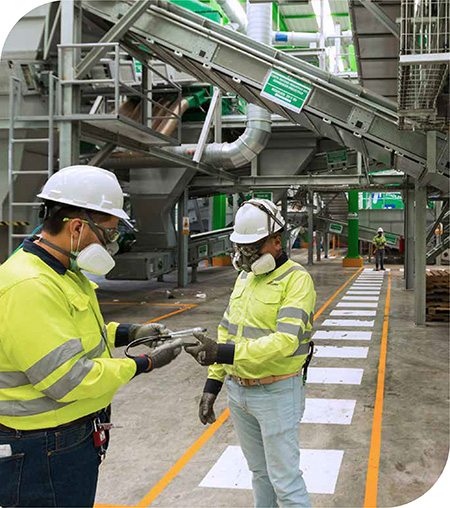
| Contents | ||
| Our Company | ||
| Our Strategy | ||
| Financial Performance | ||
| Environmental Excellence | ||
| Future in Action: Achieving Decarbonization Targets Toward a Net-Zero Future | ||
| Sustainable Products and Solutions: Expanding the Sustainability Features of Our Products | ||
| Decarbonizing Our Operations: Moving Rapidly to Achieve Our Ambitious Goals | ||
| Circular Economy: Repurposing Materials to Minimize Our Environmental Impact | ||
| Water, Biodiversity, and Air Quality: Building a Nature-Positive Future | ||
| Innovation and Partnerships: Catalyzing Innovation Across Our Business and Industry | ||
| Promoting a Green Economy: Using Our Voices to Accelerate Action in Our Industry | ||
| ● Social Commitment: Accelerating Our Responsibilities for a Just Transition | ||
| Stakeholder Engagement | ||
| Governance | ||
| Appendix | ||
| 65 Cemex 2024 Integrated Report | ||
| S P O T L I G H T : S O C I A L C O M M I T M E N T
|
Regenera Creates Opportunities,
Drives Sustainability
For many, a job is simply a means to an end—a paycheck to cover expenses and a little more. But for Juan, a safety supervisor at Cemex, a job means much more. It represents stability, confidence in the future, and an enhanced quality of life.
Before joining Cemex, Juan took recyclables to a waste facility in Mexico City operated by Regenera Waste Management. This Cemex division converts waste and industrial by-products into alternatives to fossil fuels and natural raw materials. Through Cemex’s partnership with the plant, Juan was offered full-time employment as part of the company’s just transition initiative, which benefits employees and communities in the journey toward sustainability.
Juan’s entry-level Cemex role gave him access to benefits, safety training, personal protective equipment, and career advancement programs—things he knew nothing about in a previous job as a solid waste collector. Not long after joining Cemex, Juan was promoted to safety supervisor, ensuring the safety of activities related to transforming waste into alternative fuels.
“It’s been the best work experience I’ve had. Cemex gave me an incredible opportunity, pushing me to be a better person.”
Working at Cemex has given Juan a greater appreciation for sustainability. Learning how Cemex has reduced its CO2 emissions by utilizing alternative fuels, planting trees, and engaging in other initiatives has highlighted the importance of caring for the environment. Inspired by lessons on the job, it has also led to eco-friendly practices at home, such as reducing energy and water consumption and teaching the next generation the importance of waste separation to prevent pollution.
“It’s satisfying to know that my work contributes to environmental protection and benefits my community. I feel like I’m making a real difference.”
Juan aspires to become a coordinator someday. Thanks to Cemex’s support and encouragement, this goal is within reach.
“With Cemex, I’ve discovered more than just a job—I’ve paved a path to the future. As I continue to learn and grow, new opportunities will arise, and I’m eager for what’s on the horizon.”
Our Communities. Our commitment to people extends beyond our workforce to communities and local economies. We actively engage in initiatives aimed at promoting employability in a net-zero economy. Collaborations with governmental bodies, evidenced through partnerships in the regions where we operate, showcase our dedication to fostering skills crucial for the future.
We provide digital skills programs to equip individuals with newfound economic opportunities and potential for social mobility. These programs go beyond technical skills to include training in essential social and life skills that contribute to long-term job retention.
Our Suppliers. Cemex values the integral role of local small and medium enterprises in our supply chain, comprising 60% of our partners. As a United Nations (UN) Global Compact Sustainable Supplier Impact Program leader, we support suppliers to identify and address sustainability gaps, fortify our supply chain, and foster a broader commitment to a fair and sustainable future. Looking ahead, we remain committed to exploring new avenues to support our partners in their sustainable journey.
We aim to maximize the positive impacts of our shift to a net-zero economy in line with the Paris Agreement, the International Labor Organization’s Guidelines for a Just Transition, and respecting labor and human rights, as outlined in our climate action road map. We remain committed to the UN Global Compact’s Forward Faster initiative, accelerating private sector action to deliver on the Sustainable Development Goals.
| | Take a closer look at the actions we continue to take to achieve a just transition in our published Position Paper. |
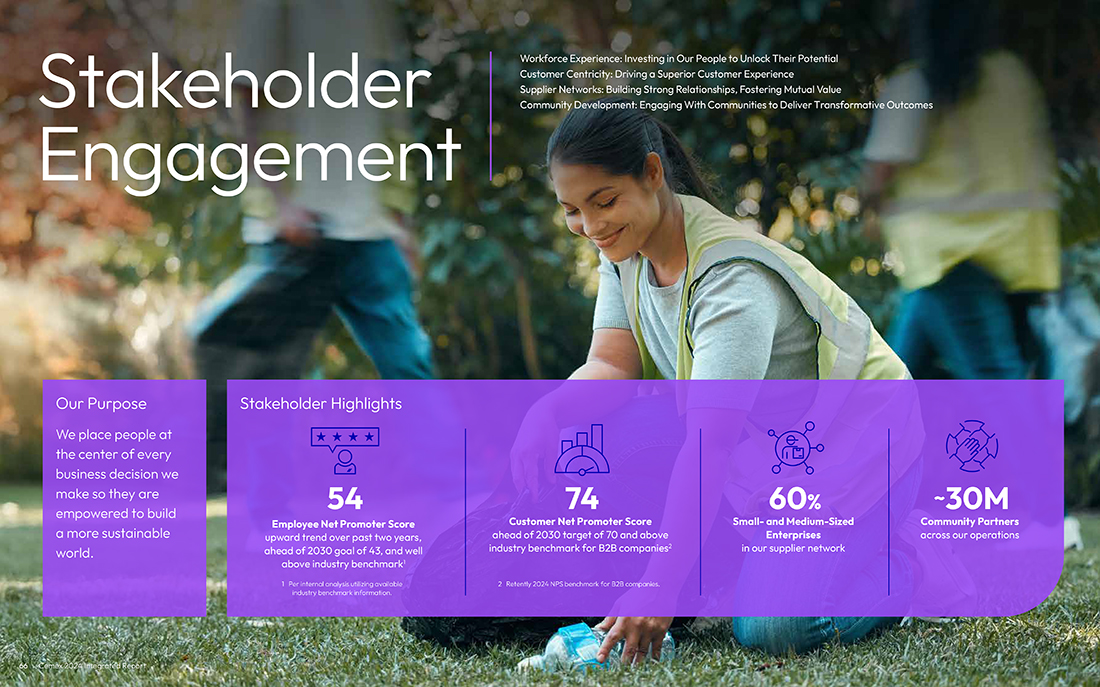
Stakeholder Engagement Workforce Experience: Investing in Our People to Unlock Their Potential Customer Centricity: Driving a Superior Customer Experience Supplier Networks: Building Strong Relationships, Fostering Mutual Value Community Development: Engaging With Communities to Deliver Transformative Outcomes Our Purpose We place people at the center of every business decision we make so they are empowered to build a more sustainable world. Stakeholder Highlights 54 Employee Net Promoter Score upward trend over past two years, ahead of 2030 goal of 43, and well above industry benchmark1 1 Per internal analysis utilizing available industry benchmark information. 74 Customer Net Promoter Score ahead of 2030 target of 70 and above industry benchmark for B2B companies2 2 Retently 2024 NPS benchmark for B2B companies. 60% Small- and Medium-Sized Enterprises in our supplier network ~30M Community Partners across our operations 66 Cemex 2024 Integrated Report
| Contents | ||
| Our Company | ||
| Our Strategy | ||
| Financial Performance | ||
| Environmental Excellence | ||
| Stakeholder Engagement | ||
| ● Workforce Experience: Investing in Our People to Unlock Their Potential | ||
| Customer Centricity: Driving a Superior Customer Experience | ||
| Supplier Networks: Building Strong Relationships, Fostering Mutual Value | ||
| Community Development: Engaging With Communities to Deliver Transformative Outcomes | ||
| Governance | ||
| Appendix | ||
| 67 Cemex 2024 Integrated Report | ||
Investing in Our People
to Unlock Their Potential
Our Approach: At Cemex, we invest in unlocking the full potential of our workforce. We aim to cultivate a diverse, engaged, and loyal global team enabled and capable of participating in our digital transformation and our transition toward a sustainable economy.
SDGs:
Our efforts to provide our employees with competitive compensation and a safe, healthy, and respectful work environment directly contribute to SDGs 5 and 8, as well as our priority SDG 9, as we aim to establish a workplace that can withstand challenges, adapt to changes, and contribute positively to the industry and broader society over the long term.
Human Rights:
Cemex is committed to respecting internationally recognized human rights of employees by fostering a safe, inclusive, and equitable workplace, including but not limited to the right to safe and healthy working conditions; the right to fair wages, working hours, and employment practices; the right to nondiscrimination; and the right to data privacy.
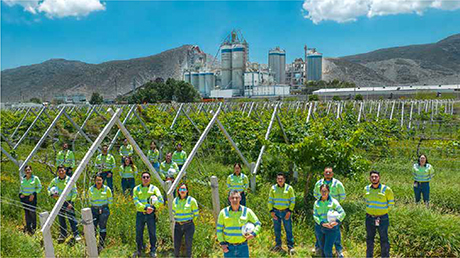
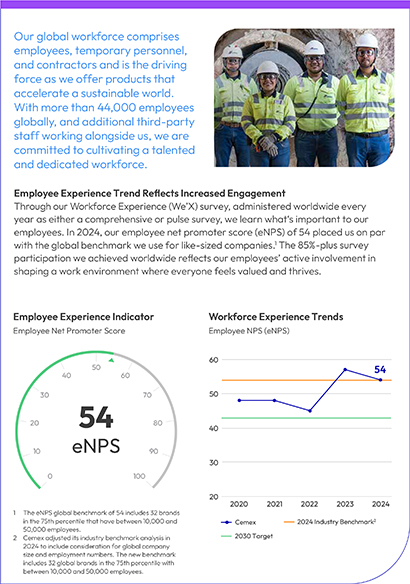
Our global workforce comprises employees, temporary personnel, and contractors and is the driving force as we offer products that accelerate a sustainable world. With more than 44,000 employees globally, and additional third-party staff working alongside us, we are committed to cultivating a talented and dedicated workforce. Employee Experience Trend Reflects Increased Engagement Through our Workforce Experience (We’X) survey, administered worldwide every year as either a comprehensive or pulse survey, we learn what‘s important to our employees. In 2024, our employee net promoter score (eNPS) of 54 placed us on par with the global benchmark we use for like-sized companies.1 The 85%-plus survey participation we achieved worldwide reflects our employees’ active involvement in shaping a work environment where everyone feels valued and thrives. Employee Experience Indicator Employee Net Promoter Score Workforce Experience Trends Employee NPS (eNPS) The eNPS global benchmark of 54 includes 32 brands in the 75th percentile that have between 10,000 and 50,000 employees. Cemex adjusted its industry benchmark analysis in 2024 to include consideration for global company size and employment numbers. The new benchmark includes 32 global brands in the 75th percentile with between 10,000 and 50,000 employees. 67 Cemex 2024 Integrated Report
| Contents | ||
| Our Company | ||
| Our Strategy | ||
| Financial Performance | ||
| Environmental Excellence | ||
| Stakeholder Engagement | ||
| ● Workforce Experience: Investing in Our People to Unlock Their Potential | ||
| Customer Centricity: Driving a Superior Customer Experience | ||
| Supplier Networks: Building Strong Relationships, Fostering Mutual Value | ||
| Community Development: Engaging With Communities to Deliver Transformative Outcomes | ||
| Governance | ||
| Appendix | ||
| 68 Cemex 2024 Integrated Report | ||
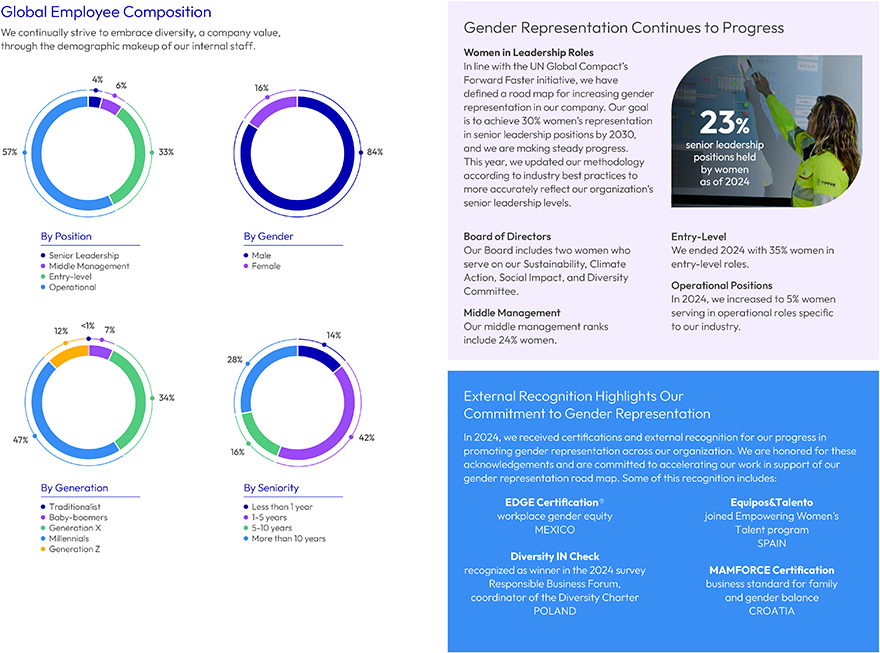
Global Employee Composition We continually strive to embrace diversity, a company value, through the demographic makeup of our internal staff. 4% 6% 16% 57% 33% 84% By Position By Gender Senior Leadership Male Middle Management Female Entry-level Operational <1% 12% 7% 14% 28% 34% 47% 42% 16% By Generation By Seniority Traditionalist Less than 1 year Baby-boomers 1-5 years Generation X 5-10 years Millennials More than 10 years Generation Z Gender Representation Continues to Progress Women in Leadership Roles In line with the UN Global Compact’s Forward Faster initiative, we have defined a road map for increasing gender representation in our company. Our goal is to achieve 30% women’s representation in senior leadership positions by 2030, and we are making steady progress. This year, we updated our methodology according to industry best practices to more accurately reflect our organization’s senior leadership levels. Board of Directors Our Board includes two women who serve on our Sustainability, Climate Action, Social Impact, and Diversity Committee. Middle Management Our middle management ranks include 24% women. 23% senior leadership positions held by women as of 2024 Entry-Level We ended 2024 with 35% women in entry-level roles. Operational Positions In 2024, we increased to 5% women serving in operational roles specific to our industry. External Recognition Highlights Our Commitment to Gender Representation In 2024, we received certifications and external recognition for our progress in promoting gender representation across our organization. We are honored for these acknowledgements and are committed to accelerating our work in support of our gender representation road map. Some of this recognition includes: EDGE Certification® workplace gender equity MEXICO Diversity IN Check recognized as winner in the 2024 survey Responsible Business Forum, coordinator of the Diversity Charter POLAND Equipos&Talento joined Empowering Women’s Talent program SPAIN MAMFORCE Certification business standard for family and gender balance CROATIA
| Contents | ||
| Our Company | ||
| Our Strategy | ||
| Financial Performance | ||
| Environmental Excellence | ||
| Stakeholder Engagement | ||
| ● Workforce Experience: Investing in Our People to Unlock Their Potential | ||
| Customer Centricity: Driving a Superior Customer Experience | ||
| Supplier Networks: Building Strong Relationships, Fostering Mutual Value | ||
| Community Development: Engaging With Communities to Deliver Transformative Outcomes | ||
| Governance | ||
| Appendix | ||
| 69 Cemex 2024 Integrated Report | ||
Lean In Circles
To further create a culture of belonging, we launched a global network pilot alongside our affinity groups this year. This initiative brought together 56 women in small employee-led groups called Lean In Circles designed to support and empower women in their personal and professional growth. These circles focused on themes such as career empowerment for working mothers and leadership fundamentals for all women following a six-month thematic curriculum from the U.S.-based nonprofit organization Lean In. For our initial pilot, results were outstanding: 75% of participants said their participation helped them grow professionally, and 90% felt they grew personally. Based on this success, we now have Lean In Circles in all regions with more than 350 participants.
75%
Lean In Circle pilot participants
who said they grew professionally
90%
Lean In Circle pilot participants
who felt they grew personally
Construrama Network
As a company, we support women’s participation in the construction industry to close the gender occupational gap, and our employees share this passion. We are leading the way by leveraging the Construrama network, the largest construction materials distribution network in Mexico and Latin America.
Launched in 2017 by Cemex, Mujer Construrama encourages the exchange of ideas and experiences for advancing women’s talent and leadership in the construction industry. Today, it’s one of the region’s most important annual summits to promote business growth strategies and management and to recognize and celebrate women’s participation in the construction industry.
“They inject us with positivity and a great desire to grow further. They also recognize us as empowered businesswomen. We really contribute to making our professional goals come true.”
– Mujer Construrama Summit participant
| 30% | +330 | 90% | ||||
| of the 2,300-plus | women who joined the | Mujer Construrama | ||||
| Construrama points | Mujer Construrama | Summit participants | ||||
| of sale in Mexico led or | Summit in 2024 | who would recommend | ||||
| co-led by a woman | the event to colleagues | |||||
| or friends |
S P O T L I G H T : L E A N I N C I R C L E S

Peer Groups Empower Female Leaders
to Break Barriers, Build Connections
When Yolmar, a Cemex project manager, learned about Lean In Circles, small peer groups designed to support and empower women in their professional and personal growth, she was intrigued.
With 35 years of leadership across the oil and gas and cement industries, she had a firm grasp of some of the challenges women face in male-dominated fields. She thought the Lean In Circles offered through Cemex would allow her to connect with other women to share and learn from one another to further their careers.
“It’s essential for women to feel supported and learn from someone who has gone through similar situations. The Lean In Circles offer a safe space to ask for guidance.”
Yolmar says the Leadership Fundamentals Circle, designed for women to discuss and sharpen their leadership abilities, helped her hone her active listening skills and made her more aware of her biases.
“The Lean In videos were enlightening, making me aware of some of my biases and how to think differently.”
Her participation in the Lean In program inspired her to embrace diversity. As a result, she joined Cemex’s DEI committee where she helps foster stronger connections across Cemex, reaching beyond email exchanges and meeting colleagues she may not have interacted with otherwise.
As a seasoned leader and mentor, Yolmar has made it her mission to help more women at Cemex step into leadership positions. She believes the Lean In Circles are instrumental in this process.
“Cemex Lean In Circles has given me valuable tools to push for real change and encourage women to reach their full potential.”
| Contents | ||
| Our Company | ||
| Our Strategy | ||
| Financial Performance | ||
| Environmental Excellence | ||
| Stakeholder Engagement | ||
| ● Workforce Experience: Investing in Our People to Unlock Their Potential | ||
| Customer Centricity: Driving a Superior Customer Experience | ||
| Supplier Networks: Building Strong Relationships, Fostering Mutual Value | ||
| Community Development: Engaging With Communities to Deliver Transformative Outcomes | ||
| Governance | ||
| Appendix | ||
| 70 Cemex 2024 Integrated Report | ||
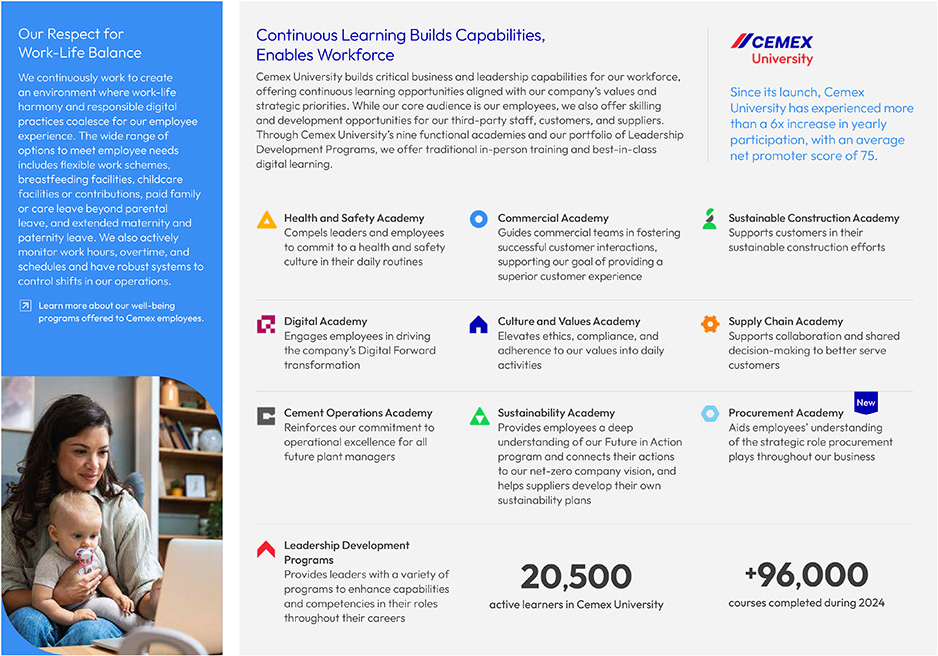
Our Respect for Work-Life Balance We continuously work to create an environment where work-life harmony and responsible digital practices coalesce for our employee experience. The wide range of options to meet employee needs includes flexible work schemes, breastfeeding facilities, childcare facilities or contributions, paid family or care leave beyond parental leave, and extended maternity and paternity leave. We also actively monitor work hours, overtime, and schedules and have robust systems to control shifts in our operations. ? Learn more about our well-being programs offered to Cemex employees. Continuous Learning Builds Capabilities, Enables Workforce Cemex University builds critical business and leadership capabilities for our workforce, offering continuous learning opportunities aligned with our company’s values and strategic priorities. While our core audience is our employees, we also offer skilling and development opportunities for our third-party staff, customers, and suppliers. Through Cemex University’s nine functional academies and our portfolio of Leadership Development Programs, we offer traditional in-person training and best-in-class digital learning. Since its launch, Cemex University has experienced more than a 6x increase in yearly participation, with an average net promoter score of 75. Health and Safety Academy Commercial Academy Sustainable Construction Academy Compels leaders and employees Guides commercial teams in fostering Supports customers in their to commit to a health and safety successful customer interactions, sustainable construction efforts culture in their daily routines supporting our goal of providing a superior customer experience Digital Academy Culture and Values Academy Supply Chain Academy Engages employees in driving Elevates ethics, compliance, and Supports collaboration and shared the company’s Digital Forward adherence to our values into daily decision-making to better serve transformation activities customers New Cement Operations Academy Sustainability Academy Procurement Academy Reinforces our commitment to Provides employees a deep Aids employees’ understanding operational excellence for all understanding of our Future in Action of the strategic role procurement future plant managers program and connects their actions plays throughout our business to our net-zero company vision, and helps suppliers develop their own sustainability plans Leadership Development Provides Programs leaders with a variety of 20,500 +96,000 programs to enhance capabilities and competencies in their roles active learners in Cemex University courses completed during 2024 throughout their careers
| Contents | ||
| Our Company | ||
| Our Strategy | ||
| Financial Performance | ||
| Environmental Excellence | ||
| Stakeholder Engagement | ||
| ● Workforce Experience: Investing in Our People to Unlock Their Potential | ||
| Customer Centricity: Driving a Superior Customer Experience | ||
| Supplier Networks: Building Strong Relationships, Fostering Mutual Value | ||
| Community Development: Engaging With Communities to Deliver Transformative Outcomes | ||
| Governance | ||
| Appendix | ||
| 71 Cemex 2024 Integrated Report | ||
| Leadership Development Model |
Just as our business has evolved, so has the focus of our leadership development model. This year, we made updates to further energize and empower our teams, mobilize the organization, and continue generating company value. We’ve artfully aligned capability-building programs and supporting behaviors with Cemex’s strategic business priorities to address current challenges and focus areas within the company.
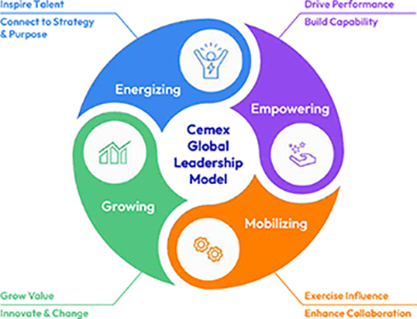
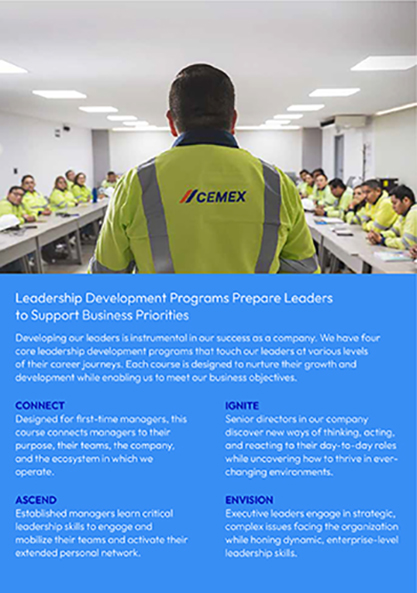
| Contents | ||
| Our Company | ||
| Our Strategy | ||
| Financial Performance | ||
| Environmental Excellence | ||
| Stakeholder Engagement | ||
| ● Workforce Experience: Investing in Our People to Unlock Their Potential | ||
| Customer Centricity: Driving a Superior Customer Experience | ||
| Supplier Networks: Building Strong Relationships, Fostering Mutual Value | ||
| Community Development: Engaging With Communities to Deliver Transformative Outcomes | ||
| Governance | ||
| Appendix | ||
| 72 Cemex 2024 Integrated Report | ||
Digital Movers Program
This year we launched the Digital Movers program to advance our Digital Forward transformation. Our goal is to create digital champions throughout our business areas and geographies to influence the use of digital solutions and enable our employees to address business challenges.
Developed in collaboration with Emeritus, MIT xPRO, and Imperial College London, the eight-month learning journey teaches critical-thinking skills, systems architecture, AI, innovation, and more. The first cohort of 54 employees participated in online self-learning, live sessions, a five-day residency, and a team project that was pitched to executives for sponsorship consideration. Future plans include a second cohort of Digital Mover champions, sponsorship of select projects, and digital strategy sessions for our executive team.

S P O T L I G H T : D I G I T A L M O V E R S
Participants of Innovative Learning Program Pioneer the Future of Cemex
The genesis of Digital Movers, a hybrid learning program to enhance employees’ digital knowledge and skills, came as Cemex sought to accelerate its Digital Forward transformation. Designed to foster a culture of innovation, participants become digital champions who can influence Cemex’s continued growth by leveraging the energy and power of digital.
As its participants can attest, the program is more than just a professional development initiative. It catalyzes change and reimagines the business, leveraging technology such as artificial intelligence to remain competitive.
The program’s alumni view themselves as “pioneers,” creating a path for the company’s future, influencing its direction, and generating value where it counts the most. The following interviews with
participants reflect common themes on the meaning of becoming a digital champion within the company:
Agents of Change
“Digital Movers is about fostering the digital movement and becoming a change agent for Cemex.”
“It is a movement driven by energy, collaboration, and a shared purpose.”
Thinking Creatively
“When you create new things, you become more agile in your daily job and tasks, and by doing so together, we can reach the company’s goals.”
“The Digital Movers program showed me that we need to be innovative and create solutions to help the company progress to the next level.”
New Networks of Co-Workers
“Even though I may not be an expert in a specific area, I know where to seek help and whom to ask for support. Digital Movers encourages us to depend on one another to achieve results.”
“I think it has helped a lot with networking. Getting to know all these amazing and talented people working together to transform Cemex has been rewarding.”
As Digital Movers, these leaders are not only adapting to change—they are driving it, inspiring it, and positioning Cemex at the forefront of the industry. With each new cohort, the program continues to cultivate a strong community of forward-thinking professionals eager to lead the company into a new era of digital excellence.
|
Cemex University Receives Accolade for Best Compliance Training
The ETHOS: Doing the Right Thing courses at Cemex University are designed to integrate ethics and compliance into the daily work of employees. These courses are part of Cemex’s institutional program, ETHOS, which aims to embrace top-tier standards of corporate behavior and promote actions that strengthen a culture of integrity. This is the seventh Brandon Hall GroupTM Human Capital Management award received by Cemex.
2024 HCM Excellence Award®, Gold ETHOS: Doing The Right Thing series Best Compliance Training
|
|
Micro-Learning Pilot To engage our deskless employees, we piloted a micro-learning platform this year with more than 750 hourly workers in Mexico. This online learning course covered ethics topics, including key ETHOS messages, which were well received by learners. We will continue to explore innovative technologies to enhance employee connections and a continuous learning culture.
|
| Contents | ||
| Our Company | ||
| Our Strategy | ||
| Financial Performance | ||
| Environmental Excellence | ||
| Stakeholder Engagement | ||
| ● Workforce Experience: Investing in Our People to Unlock Their Potential | ||
| Customer Centricity: Driving a Superior Customer Experience | ||
| Supplier Networks: Building Strong Relationships, Fostering Mutual Value | ||
| Community Development: Engaging With Communities to Deliver Transformative Outcomes | ||
| Governance | ||
| Appendix | ||
| 73 Cemex 2024 Integrated Report | ||
Talent Development Reinforces Our Sustainability Goals
With our Future in Action program as the foundation, we continue to align our organizational design, tie a portion of variable compensation to the achievement of our CO2 emissions reduction goals, and promote sustainability training. This propels us toward our environmental objectives, serves as a powerful engagement tool, and fosters a shared commitment as we transition toward a sustainable economy.
Organizational Design
Our robust organizational design supports our sustainability goals across the company. Our operating and technical teams have adopted specific road maps, initiatives, and processes that support our Future in Action program. As we continue to evolve and enhance our structure, we also accelerate actions that help us meet our climate targets.
Executive Variable Compensation
Our Executive Variable Compensation program includes a CO2 emissions component related to our ambitious carbon reduction goals. More than 4,400 executives, which represents more than 10% of our global employees, are eligible for this program. We continue to make progress in achieving our net-zero emissions goal.
While regional objectives vary, executing in support of our CO2 targets carries a weighting of +10% or -10% in annual executive variable compensation. Annual executive variable compensation is determined based on overall business performance and individual performance management outcomes, which includes achievement of goals and adherence to our values.
Competitive Compensation,
Benefits Packages
We believe that our competitive compensation and benefits packages are key contributors to a superior employee experience. Every two years we evaluate our local competitiveness, inside and outside our industry, in the markets where we operate. Our learnings help us detect areas of opportunity, like trends in specialized roles, provide benchmarks to ensure we remain competitive, and allow us to close gaps during our annual salary review process.
Our benefits programs include health and wellness, financial and retirement, time off and leave, and work-life balance schemes, such as flexible working hours. We constantly monitor and review our benefits offerings to ensure we meet the needs of our employees.
|
Talent Management Our talent management cycle has a set of three interconnected processes: Performance management, talent review, and succession management. Working in concert, these processes maximize our organization’s performance potential. They also help us make informed decisions on staffing choices, participation in leadership development programs, and potential challenges or gaps in our global talent needs. Serving as our guide, these processes lead us toward effective and forward-thinking initiatives while fostering continuous talent development. | ||||||
 | Performance Management. Our Performance Management Process cascades goals to the organization, starting with the CEO, aiming to ensure that individual and team goals align with our company values and priorities. We use a 360-degree evaluation, a comprehensive feedback process, where supervisors and employees engage in a performance assessment to discuss what they achieved, complemented with multiple perspectives on how they achieved it, based on our six corporate values. Our continuous feedback loop empowers our employees and supervisors to discuss, set, and evaluate performance goals collectively. These collaborative discussions foster personal and professional growth aligned with our evolving organizational needs. | |||||
 | Talent Review. Our Talent Review Process relies on insights gathered from our performance management results. This process encourages an equitable and thorough evaluation of employees using two criteria: Performance and promotion readiness. Leaders engage in employee discussions and calibration with peers, listening to different perspectives and defining development plans. This approach provides supervisors with a holistic evaluation of their team members, which is then shared individually during feedback sessions, promoting a culture of continuous improvement. | |||||
 | Succession Management. Succession Management leverages insights from the talent review conversations and enables us to build a talented pool of leaders with functional skills and business understanding to successfully implement our strategy. One of our main objectives is to identify and develop people with the potential to fill leadership positions. We strive to offer them opportunities to build experience and capabilities while strengthening our talent pipeline. This allows employees to meet career development expectations, challenges them with new professional development opportunities, and prepares them for future roles.
| |||||
| Contents | ||
| Our Company | ||
| Our Strategy | ||
| Financial Performance | ||
| Environmental Excellence | ||
| Stakeholder Engagement | ||
| ● Workforce Experience: Investing in Our People to Unlock Their Potential | ||
| Customer Centricity: Driving a Superior Customer Experience | ||
| Supplier Networks: Building Strong Relationships, Fostering Mutual Value | ||
| Community Development: Engaging With Communities to Deliver Transformative Outcomes | ||
| Governance | ||
| Appendix | ||
| 74 Cemex 2024 Integrated Report | ||
Embracing Diversity:
One of Our Essential Cultural Drivers
We continually strive to create an inclusive and respectful workplace that values diverse teams encompassing a broad range of characteristics, including gender identity, age, race, religion, disabilities, and beyond.1 Our diverse teams help foster an environment that encourages various perspectives, backgrounds, and life experiences.
DEI Framework
Our updated DEI framework places our program goals at the center to guide alignment with common goals and help to maintain a diverse, equitable, and inclusive workplace.
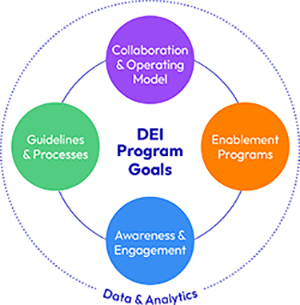
| 1 | For a comprehensive list, please refer to our Global Workplace Diversity, Equity & Inclusion Policy. |
86%
employees feel they belong
at Cemex
2024 We’X Survey
81%
employees agree everyone can succeed
to their full potential, no matter who
they are or where they come from
2024 We’X Survey
| Collaboration and Operating Model Governance of our DEI framework includes an essential structure and oversight to facilitate the effective implementation of each component. For us, DEI is a collective responsibility that starts with leadership, striving for our values to resonate throughout the organization. Our governance model fosters an inclusive culture, advocating for equal opportunities, and upholding accountability across all organizational levels. |
While our DEI strategy operates globally, our initiatives are tailored to meet local needs across our operations. More than 100 executives from every region actively participate in local diversity committees. Their responsibility is to collaboratively design local initiatives that address specific challenges and align with existing DEI practices. | |||||
|
| ||||||
| Contents | ||
| Our Company | ||
| Our Strategy | ||
| Financial Performance | ||
| Environmental Excellence | ||
| Stakeholder Engagement | ||
| ● Workforce Experience: Investing in Our People to Unlock Their Potential | ||
| Customer Centricity: Driving a Superior Customer Experience | ||
| Supplier Networks: Building Strong Relationships, Fostering Mutual Value | ||
| Community Development: Engaging With Communities to Deliver Transformative Outcomes | ||
| Governance | ||
| Appendix | ||
| 75 Cemex 2024 Integrated Report | ||
Guidelines and Processes
Cemex is committed to providing nondiscriminatory recruitment processes, facilities, and services to meet accessibility requirements globally and locally. Our established global policies, processes, and platforms sustain this commitment and are available internally and externally in our Policy Center and the DEI section of the Cemex website. We also provide visibility to internal and external applicants for open positions at any of our locations through our website’s Global Job Site section.
| • | Policies and Guidelines. Our global policies and guidelines on DEI include the following: Global Workplace Diversity, Equity, and Inclusion Policy; Global Workplace Non-Discrimination, Non-Harassment, Non-Bullying, and Non-Retaliation Policy; Global Guidelines on Work Leaves for Cemex Employees; Flexible Work Schemes Global Policy; and our Global Recruitment Policy. |
| • | Processes. To support our ongoing efforts and commitment to DEI, we have implemented several processes to ensure that our strategy is effectively executed, including unbiased recruitment, succession planning, and equal pay assessment. |
|
Enabling a Culture That Embraces Diversity
| ||
| Embracing diversity runs deep throughout our organization starting with our Board of Directors. To date, more than 9,300 employees have been trained on DEI topics. We also offer inclusivity training for employees through Cemex University. Our inclusive courses include: | ||
| Board Readiness Our Board readiness program strives for everyone at Cemex, including our Board members, to be aligned with our values and aspirations.
Inclusive Leadership Course As of 2024, more than 4,000 people managers have participated in this tailor-made in-house program to create awareness of inclusion in the workplace while teaching leadership styles.
Global Leadership Development Programs These flagship programs aim to develop our future leaders and incorporate DEI concepts and conversations to foster a profound reflection.
| Unconscious Bias Training Unconscious bias training for managers builds awareness and provides tools to eliminate potential discriminatory behaviors. Nearly 900 employees completed the training in 2024, with more than 7,500 employees trained since 2019.
Cemex University Culture & Values Academy This academy helps employees learn about Cemex and how we practice our values, ethics, diversity, and compliance. More than 15,400 employees completed over 35,700 courses during 2024. | |
Enablement Programs
Cemex strongly encourages managers to build their leadership capabilities and provides ongoing employee development opportunities. The company also emphasizes compliance with its policies and local regulations, and when necessary, requests employees to attend essential training sessions with written confirmation of participation. The identification of employees in need of training is managed internally. Additionally, audits to verify policy compliance may be conducted, aligning with our commitment to fostering an inclusive and respectful workplace.
Awareness and Engagement
| • | Listening to Our Workforce. Our Workforce Experience (We’X) Survey includes a subset of items that provide valuable feedback to measure our progress and opportunities for improvement. |
| • | UN Global Compact Women’s Empowerment Principles. We are signatories to the UN Global Compact Women’s Empowerment Principles, a guidepost to promote women’s empowerment in the workplace, marketplace, and community. Participating provides valuable insights into the gaps we need to address to continue advancing our DEI framework and reinforce our commitment to promoting equality and representation within our company. We also continue to be signatories to the UNGC’s Forward Faster gender chapter. |
Accelerating Impact
Tracking progress on our DEI actions enhances our decision-making and holds us accountable for achieving our desired impacts.
| • | Unbiased Recruitment Processes. Our structured recruitment processes help us eliminate bias and select candidates based solely on their qualifications and skills. |
| • | Equal-Pay Assessment. This year, in collaboration with our third-party provider Korn Ferry, we conducted a gender pay analysis. Results confirm Cemex’s pay equity falls within the normal variance range for large employee populations and aligns with our commitment to equitable pay across our markets. As part of our ongoing compensation management processes, we make necessary adjustments to correct unintended pay discrepancies and ensure market competitiveness. We will continue to monitor and report on our processes and analyses periodically to uphold our goal of compensating our employees equitably based on their accountabilities, skills, experience, performance, and geographical location. |
| • | Benchmarking Our Progress. We collaborate with third parties aiming to uphold the highest DEI standards. As part of our efforts, we’ve participated in McKinsey’s Women Matter program in several regions and have gained a broader perspective on potential actions to accelerate change within our company. |
| Contents | ||
| Our Company | ||
| Our Strategy | ||
| Financial Performance | ||
| Environmental Excellence | ||
| Stakeholder Engagement | ||
| Workforce Experience: Investing in Our People to Unlock Their Potential | ||
| ● Customer Centricity: Driving a Superior Customer Experience | ||
| Supplier Networks: Building Strong Relationships, Fostering Mutual Value | ||
| Community Development: Engaging With Communities to Deliver Transformative Outcomes | ||
| Governance | ||
| Appendix | ||
| 76 Cemex 2024 Integrated Report | ||
Driving a Superior Customer Experience
Our Approach: We have an unwavering focus on delivering a superior customer experience that helps our customers reach their goals and is a powerful differentiator for our company.
SDGs:
Our strong commitment to supporting our customers’ success and providing a superior experience aligns with SDG 8, and our determination to build sustainable cities and communities contributes to our priority SDGs 9 and 11.
Human Rights:
Cemex is committed to respecting human rights across its business relationships and is dedicated to identifying, assessing, responding, remediating, and monitoring human rights, responding to risks and potential adverse impacts resulting from Cemex’s business activities, operations, and relationships. We expect and require third parties with whom we do business to comply with our Human Rights Policy and respect internationally recognized human rights and standards.
Voice of the Customer Program Guides Our Actions
Our commitment to continuous improvement in customer experiences is driven by our Voice of the Customer Program, which serves as the cornerstone of our approach. By engaging in rich discussions, actively
listening, and gathering insights through customer relationship and transactional surveys, we address customer challenges with the support of regional multidisciplinary Service Committees.
We are also accelerating digital solutions to provide our customers with a more seamless way of connecting with us. Whether it’s through our Smart Service Centers, commercial advisors, or Cemex Go, we strive to give customers consistent experiences, answers, offers, and product availability across the channel of their preference.
Customer Journey Experience
Our Customer Journey Experience (CJE) program further deepens our understanding of the customer experience by enabling employees to walk in their customers’ shoes, observing, listening, and experiencing the moments of the customer journey with greatest opportunity for improvement. This immersive exploration uncovers critical insights, helping us prioritize and implement initiatives that enhance both customer and employee experiences. As of 2024, over 2,800 employees have participated in the program.
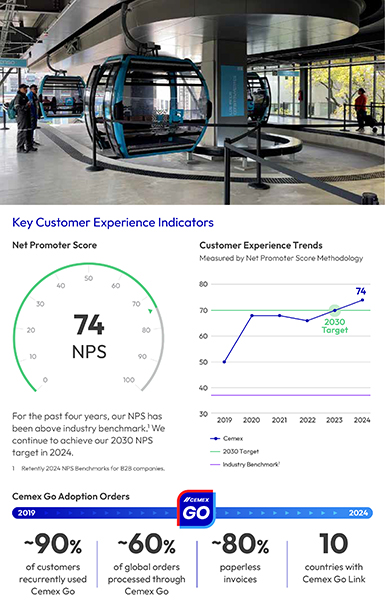
| Contents | ||
| Our Company | ||
| Our Strategy | ||
| Financial Performance | ||
| Environmental Excellence | ||
| Stakeholder Engagement | ||
| Workforce Experience: Investing in Our People to Unlock Their Potential | ||
| ● Customer Centricity: Driving a Superior Customer Experience | ||
| Supplier Networks: Building Strong Relationships, Fostering Mutual Value | ||
| Community Development: Engaging With Communities to Deliver Transformative Outcomes | ||
| Governance | ||
| Appendix | ||
| 77 Cemex 2024 Integrated Report | ||
We take the pulse of our customers’ sentiments about sustainable construction as part of Cemex’s customer relationship survey. We incorporate this feedback into our action plans of the Future in Action program, enabling us to take concrete steps toward addressing our customer needs.
Enhanced Knowledge Enriches Customer Experience
Continuous learning is a hallmark of our employees’ growth and development, and our technical teams are no exception. We reinforce a customer-centric mindset across our technical teams worldwide while also cultivating our customers’ knowledge of sustainable construction. By having this win-win approach, we aim to accelerate our contribution to building a sustainable world.
Early Engagement Initiative
Our extensive experience in the building materials industry has shown that integrating our solutions in the early stages of a project significantly enhances its sustainability, efficiency, and performance. To maximize these efforts, we continuously enhance our teams’ expertise through the Early Engagement initiative, which provides technical and functional training sessions and best practice sharing across all regions. This program lets us build significant relationships with a broad network of construction professionals, allowing us to position our technically advanced value propositions and products and solutions with sustainable attributes at a critical stage in the project design. We also reinforce our commercial teams’ knowledge of green building standards, enabling them to guide customers in applying for green certifications like LEED, BREEAM, EDGE, and DGNB.*
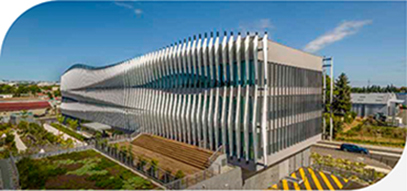 |
|
Cemex University Commercial Academy: Boosting Knowledge of Sustainable Construction
Leap Sales Program Our commercial teams worldwide have access to a comprehensive learning program to help them become trusted advisors. The program provides a tailored learning experience for our commercial advisors and managers, helping us further align our teams with our customer-centric mindset. To complement their training, they also have access to five specialized master classes on sustainable construction carefully curated by our team of experts, providing our teams with the needed tools to be up to speed on sustainable construction and how our Vertua® portfolio of products and solutions with sustainable attributes fit in this landscape.
In 2024, we released two new master classes in all regions, completing the rollout of the program. Nearly 2,000 advisors and managers have participated in this continuous learning program since 2021.
Concrete Solutions for Sustainable Construction This is the first free, open enrollment course developed by Cemex University and its commercial team for construction professionals. The training helps increase knowledge and understanding of how our products and solutions with sustainable attributes can help our customers achieve their sustainability goals. By the end of 2024, over 750 participants from the U.K., Mexico, Colombia, and Spain enrolled in the course. Our plans include extending the availability to Nicaragua and the U.S., where continued education credits will be offered for those who meet the completion criteria.
|
| Contents | ||
| Our Company | ||
| Our Strategy | ||
| Financial Performance | ||
| Environmental Excellence | ||
| Stakeholder Engagement | ||
| Workforce Experience: Investing in Our People to Unlock Their Potential | ||
| ● Customer Centricity: Driving a Superior Customer Experience | ||
| Supplier Networks: Building Strong Relationships, Fostering Mutual Value | ||
| Community Development: Engaging With Communities to Deliver Transformative Outcomes | ||
| Governance | ||
| Appendix | ||
| 78 Cemex 2024 Integrated Report | ||
Digital Solutions:
Key to Superior Customer Experience
Digital is a powerful enabler of the superior customer experience we aim to deliver. Our goal is to surround our customers with a seamless, omnichannel way to do business with us. This means providing the same experience, answers, offers, and product availability across channels while maintaining personalized human connections. To accomplish this, we continue to automate transactional interactions with our clients, enabling us to focus on higher value customer activities.
A superior customer experience is at the heart of our global Digital Forward initiative. We began our digital journey with our commercial business, aiming to create a seamless customer experience. We are building a culture where every employee is a digital promoter, with our Digital Movers propelling this transformation.

|
|
Cemex Go Ecosystem
Cemex Go is our global flagship omnichannel platform. It integrates our online store/app, salesforce, and service centers to provide a consistent digital-first customer experience regardless of channel. As a company that prioritizes offering robust digital solutions in the construction materials industry, we strive to maintain our leadership position with our end-to-end solution in the quote-to-cash process, available in most of our operations. | |||||
| |  |  | ||||
| Ready-Mix Go. This innovative mobile platform empowers customers to take full control of their ready-mix order journey. It offers a seamless experience through advanced features such as online order placing or modification with instant availability validation, e-signature capabilities for tickets, immediate access to electronic proof of delivery, and real-time tracking of the order. | Professional and Self-Builders Virtual Store Front. Our virtual store front (VSF) delivers a full ready-mix experience for contractors and self-builders through a simple and fast e-commerce platform. Features of the platform guide them to select the right concrete products, place orders, and pay online using cash or card, all in half the time. This allows us to continue expanding our footprint in key markets while seeking higher profitability per order. Currently, the VSF is available in Mexico, the U.S., the U.K., and Colombia.
| E-Commerce Solutions. Construrama.com is boosting our Construrama system, one of the largest building materials distribution networks in Mexico. Today, more than 2.8 million online users purchase more than 54,000 product variations via website or app.
| ||||
| |  |  | ||||
| Cemex Go Link. This interface allows customers to interact directly with our systems via digital platforms and application programming interfaces (APIs). By allowing systems to communicate with each other, Cemex Go Link helps customers from all geographies reduce operating costs, optimize internal processes, and automate tasks such as orders, invoices, and payments. | Artificial Intelligence. Artificial Intelligence (AI) optimizes our commercial team’s efforts and transforms customer service across touchpoints, streamlining transactions for a seamless user experience. Analytics decode customer interactions, proposing service enhancements, while an AI-driven visibility app enables personalized conversations by identifying customers and providing contextual information. Intelligent routing boosts productivity, directing customers to suitable agents. Beyond service, AI drives our dynamic pricing engine, adjusting prices in real-time based on market conditions. At the forefront of our commitment, AI delivers personalized, efficient, and data-driven solutions. Future aspirations include using AI to assist customers with order forecasting.
| Going Paperless. Cemex’s paperless strategy enhances productivity and saves resources by encouraging the digitalization of internal and customer processes. As of 2024, approximately 80% of our invoices were delivered digitally, putting us on track to ultimately become paperless.
| ||||
| Contents | ||
| Our Company | ||
| Our Strategy | ||
| Financial Performance | ||
| Environmental Excellence | ||
| Stakeholder Engagement | ||
| Workforce Experience: Investing in Our People to Unlock Their Potential | ||
| ● Customer Centricity: Driving a Superior Customer Experience | ||
| Supplier Networks: Building Strong Relationships, Fostering Mutual Value | ||
| Community Development: Engaging With Communities to Deliver Transformative Outcomes | ||
| Governance | ||
| Appendix | ||
| 79 Cemex 2024 Integrated Report | ||
S P O T L I G H T : R C O N S T R U C T I O N
| Cemex Go App Unique in Industry
Accurate and speedy concrete orders are a tap away on the Cemex Go app. Project managers place their order, receive confirmation within minutes, and can track estimated time of arrival. |
| |
“I use Cemex Go in my day-to-day business. I like the ability to track and manage the pour from the field. It’s unique in the industry and makes things easier for us. Definitely sets Cemex apart from the competitors.”
– U.S. region customer on Cemex Go User experience
Cemex Go Acceleration Program
To create momentum for complete digital adoption among our customers, we launched the Cemex Go Acceleration Program in 2023 with a pilot in Houston. In 2024, we extended the pilot to customers from other markets and business lines in the U.S., such as the Phoenix and Southern California areas and the U.K. This year we achieved 75% of digital orders adoption from our pilot customers with automation levels above 50%, with plans to expand in more markets in 2025.
Smart Service Centers
We are also strengthening our Service Centers by standardizing our model and upgrading our technology. This year, we set a special focus on professionalizing our quality and workforce management practices and rolling out a new customer visibility platform in the U.S. and the U.K. that gives agents real-time customer information as calls come in. Agents now have an immediate view of the customer’s profile so they can react more quickly. These optimizations help streamline our processes and further professionalize our service in the eyes of the customer, while continuously improving the experience our agents provide.
Customer Relationship Management
Cemex Go Customer Relationship Management (CRM) is our commercial advisors’ main digital tool that helps them manage customer relationships more efficiently and systematically, currently available in multiple geographies. This year, our commercial teams advised our customers better on our service delivery through data-driven sales forecasting and cross-selling.
Quoting Management
We continue making significant strides in enhancing the digitalization and automation of our quoting process and price integration to improve customer and employee experiences. Our efforts are focused on tailoring the quoting experience to meet the diverse needs and purchasing behaviors of our customers. For those who occasionally purchase from us, we offer convenience. For frequent buyers seeking the best market price, we provide transparency. For project-based customers, we deliver offers that best fit their project specifications and budget. Our goal is to make the quoting experience timely, accurate, and transparent across all our purchasing platforms, becoming a driver for sustainable growth and long-term value.
Excellent Customer Experiences Recognized, Rewarded
Memorable Moments
Started in Mexico, this regional initiative encourages employees to form meaningful relationships with internal and external clients by creating memorable moments in their daily activities. Whether it’s celebrating a birthday or an important milestone, this initiative
fosters a mindset that every interaction with a customer is an opportunity to create a memorable experience. Cemex recognizes Ambassadors of Memorable Moments as those who offer exceptional experiences aligned with our customer-centric culture.
Customer Experience Day
This year’s fourth global Customer Experience Day celebration united employees from across our regions to learn how digitalizing our core processes delivers superior customer experiences. Going beyond the day’s celebration, we continued to share insights and case studies from external speakers to illustrate digitalization best practices. This Cemex tradition has brought together over 8,500 employees from across our regions over the years.
Superior Customer Experience Awards
We continue to recognize employees who provide outstanding customer experiences through our Superior Customer Experience Awards. This global awards program unites colleagues from all our geographies and incentivizes best practices to continuously improve our customer experience. Since its inception in 2019, more than 1,300 customer-centric implemented initiatives have been brought forward, showcasing the organization’s immense focus on improving our customer experience. More than 300 teams participated this year, with two remarkable projects recognized for their role in digitalization: The Cemex Go Cement Connections implementation in the U.S. and process recommendations of our MIX3R value propositions in Trinidad and Tobago.
| Contents | ||
| Our Company | ||
| Our Strategy | ||
| Financial Performance | ||
| Environmental Excellence | ||
| Stakeholder Engagement | ||
| Workforce Experience: Investing in Our People to Unlock Their Potential | ||
| Customer Centricity: Driving a Superior Customer Experience | ||
| ● Supplier Networks: Building Strong Relationships, Fostering Mutual Value | ||
| Community Development: Engaging With Communities to Deliver Transformative Outcomes | ||
| Governance | ||
| Appendix | ||
| 80 Cemex 2024 Integrated Report | ||
Building Strong Relationships, Fostering Mutual Value
Our Approach: We build strong and responsible relationships with our suppliers based on trust, respect, and mutual value.
SDGs:
Our work with our suppliers toward fostering continuous innovation and sustainable practices supports SDG 8 in addition to our priority SDGs 9, 11, and 13.
Human Rights:
Cemex is committed to respecting human rights across its operations and supply chain and is dedicated to identifying, assessing, responding to, remediating, and monitoring human rights risks and impacts resulting from Cemex’s business activities, operations, and relationships. We expect all third parties we do business with to comply with our Human Rights Policy and respect internationally recognized human rights and standards.
We strive to develop trusting relationships with our suppliers by providing clear and precise requirements, fostering innovation and sustainable practices, promoting fair relationships, and practicing open and clear communication.
Supplier Relationships Align With Our Principles, Policies, and Values
Suppliers’ Code of Ethics and Conduct
We manage our supplier relations in accordance with applicable laws and regulations while fostering a culture of integrity, honesty, respect, transparency, and open communication. Our principles and values are designed to promote an understanding of our policies and code of ethics and conduct, which all suppliers must follow. To comply with our registration process, suppliers must acknowledge fundamental policies that guide how they do business with us:
| • | Code of Conduct When Doing Business With Us, embedded in our membership and commitment to the Global Cement and Concrete Association (GCCA) |
| • | Code of Ethics and Business Conduct, which includes our Human Rights Policy |
| • | Global Anti-Corruption Policy |
| • | Global Anti-Money Laundering Policy |
| | Learn more about our supplier policies. |
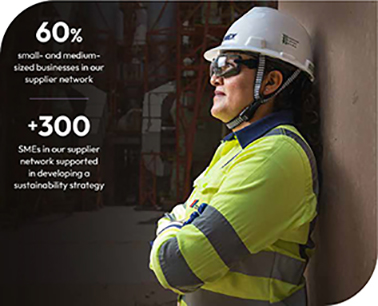
|
Contractor Health and Safety Verification Program
Our suppliers must adhere to Cemex’s Contractor Health and Safety Verification Program. These rigorous health and safety standards include proper training and relevant accreditations. Contractors are not permitted to work on our premises when they fall short of verification.
|
Small- and Medium-Sized Enterprises We rely heavily on local small- and medium-sized enterprises (SMEs) and believe that companies in our industry should prioritize supporting these businesses within their supply chain. Our dedication to SMEs provides them with a deep understanding of their role in sustainable development and helps them navigate business challenges, such as limited capital and technological expertise, confidently. This fortifies our supply chain and promotes a just transition to a carbon-neutral economy. Our collaborative approach underscores our dedication to sustainable construction, strengthens our supply chain resilience, and helps these businesses comply with evolving sustainability standards. | |||||||||
| | Learn more about our Contractor Health and Safety Verification Program and compliance. | |||||||||
| Contents | ||
| Our Company | ||
| Our Strategy | ||
| Financial Performance | ||
| Environmental Excellence | ||
| Stakeholder Engagement | ||
| Workforce Experience: Investing in Our People to Unlock Their Potential | ||
| Customer Centricity: Driving a Superior Customer Experience | ||
| ● Supplier Networks: Building Strong Relationships, Fostering Mutual Value | ||
| Community Development: Engaging With Communities to Deliver Transformative Outcomes | ||
| Governance | ||
| Appendix | ||
| 81 Cemex 2024 Integrated Report | ||
S P O T L I G H T : S L A B T E C H N O L O G I E S
Cementing a Stronger Future With Cemex’s
SME Program
When Enrique Rivera Jimenez founded Monterrey-based Slab Technologies 15 years ago, his vision was to become a leader in creating strong, durable foundations and structures for construction projects.
Like many small business owners, Enrique faced several challenges that prevented him from unlocking his company’s full potential. These included entering a competitive market without an established brand, securing capital, and maintaining a steady cash flow.
Despite these obstacles, Enrique was determined to succeed. He had the skills, the drive, and a committed team to bring Slab Technologies to the forefront of the industry; he just needed some extra support.
When Cemex chose Slab Technologies to participate in its “Sponsor a Small- and Medium-Sized Enterprise (SME)” initiative, Enrique jumped at the opportunity. Launched in 2023, the program is a collaboration among Cemex, the Chamber of the Transformation Industry of Nuevo León (CAINTRA), and the EGADE Business School of Tecnológico de Monterrey. Its goal is to promote the growth and competitiveness of SMEs to enhance the supplier network and foster local innovation in collaboration with Cemex.
As a long-time supplier of Cemex, Enrique was familiar with its strong reputation and knew that participating in the initiative could help Slab Technologies evolve to meet ever-changing marketplace demands.
“After participating in the SME program, our team better understands the supply chain and is now positioned to deliver more than a transactional service but an experience to our clients,” said Enrique. “The SME program equipped us with the skills to identify customer needs and determine how we can best support them with innovative solutions.”
Participating in the program also helped Slab Technologies establish more structured and efficient workflows, enabling it to provide faster service to its clients. Additionally, it helped the business gain market share while sharpening its financial acumen. As a result of its participation, Slab Technologies experienced a 34% increase in orders with Cemex.
Armed with tools and support, Enrique is now confidently leading his business into a future full of growth and potential. With a stronger foundation for development, the company is well-positioned to expand its market presence, innovate new solutions, and strengthen client relationships.
“Thanks to the support of the Cemex SME program, we’ve strengthened our business operations and vision for the future. Slab Technologies is better equipped to innovate, grow, and create lasting value for our clients,” said Enrique.

Sustainable Development Program for Suppliers
Building on our 2023 successful results from the UNGC Sustainable Supplier Impact Program, in 2024 we created our own Sustainable Development Program for Suppliers. It covers key environmental, social, governance, and sustainable finance topics. During 2024, more than 300 SMEs from our Mexico and SCA&C regions participated in the pilot, tripling participation from the UNGC Sustainable Supplier Impact Program last year.
We plan to integrate this program into our Supplier Portal and provide ongoing training to help more SMEs develop sustainability strategies in their businesses. Our commitment to “leave no one behind” is reshaping our supply chain, moving Cemex beyond mere transactional supplier relationships to deeper, more collaborative connections that drive mutual growth.
| | Learn more about our Sustainable Development Course for suppliers. |
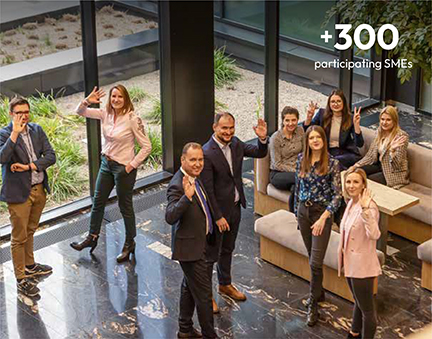
| Contents | ||
| Our Company | ||
| Our Strategy | ||
| Financial Performance | ||
| Environmental Excellence | ||
| Stakeholder Engagement | ||
| Workforce Experience: Investing in Our People to Unlock Their Potential | ||
| Customer Centricity: Driving a Superior Customer Experience | ||
| ● Supplier Networks: Building Strong Relationships, Fostering Mutual Value | ||
| Community Development: Engaging With Communities to Deliver Transformative Outcomes | ||
| Governance | ||
| Appendix | ||
| 82 Cemex 2024 Integrated Report | ||
Procurement Transformation Adapts, Evolves, and Transforms
Our Procurement team is reimagining its role by adopting disruptive technologies that challenge conventional approaches, improve operations, and create new sources of value. A core goal of our transformation is to enhance our suppliers’ experience by streamlining processes, improving communication, and fostering a collaborative ecosystem that benefits all stakeholders. By leveraging digital technologies, we are reducing inefficiencies, delays, and manual errors in supplier onboarding, communication, and transaction processes. The result? Long-term relationships with suppliers, an ecosystem that fosters innovation, and a reliable, competitive supply base that sets us apart in the market.
|
|
Digital Negotiation Portal
The Digital Negotiation Portal is our online open bidding process and a gateway for new suppliers to join Cemex’s supplier network. By providing a transparent and competitive platform, we level the playing field and create opportunities for valuable partnerships, ensuring fair access to business opportunities for all participants.
During 2024, we added more than 5,000 suppliers to our network, enhancing trust, diversifying our supplier base, driving innovation, and strengthening our overall ecosystem. For existing suppliers, the portal fosters healthy competition and encourages continuous improvement, contributing to a more dynamic and collaborative network.
|
Cemex Suppliers’ Portal: A One-Stop Shop
Cemex’s new Suppliers’ Portal, a key initiative driving our procurement transformation, was piloted this year with 100 suppliers in Mexico. The pilot demonstrated the value of a single point of contact that gives suppliers visibility to purchase orders, invoicing, business opportunities, and issue resolution.
Based on positive feedback from pilot participants, we are evaluating options for scaling the portal globally to deliver a more consistent, enhanced supplier experience. Once fully implemented, the portal will simplify how suppliers do business with us, strengthening our relationships while ensuring efficiency and transparency.
Our Suppliers’ Portal pilot demonstrated the value of a single point of contact that allows suppliers to manage all interactions across every department within Cemex. Providing full visibility into a supplier’s status, the portal aims to increase transparency, improve efficiency, and foster seamless collaboration.
AI and Automation
Our Procurement Center of Excellence continues using AI tools globally to cleanse, harmonize, and classify historical purchasing data, driving innovation and continuous improvement. We continue automating transactional tasks and redefining procurement tactics, processes, people skills, and support systems to reduce workloads and enable our talent to focus on high-value activities.
Supplier Sustainability Assessment Drives Proactive Measures
Critical Supplier Sustainability
Our 2030 target of conducting a sustainability assessment on 90% of our critical suppliers continues to drive proactive measures. In partnership with a third-party firm, we engage our critical suppliers in a sustainability assessment aligned with ISO 26000 guidelines. Covering social, environmental, health and safety, business ethics, stakeholder relationships, and financial performance standards, the assessment fosters a comprehensive review of a supplier’s sustainability risk profile.
Cemex is presented with a detailed report of findings, conclusions, and a proposed action plan to address any identified gaps. This evaluation is integrated into each supplier’s scorecard and periodically updated to prioritize those showcasing progress in their sustainability practices.
We continue our efforts to include all noncritical suppliers in a sustainability self-assessment. Using our self-assessment tool, we invite interested parties to learn how they can adopt more robust sustainability practices. We are currently charting the next steps to foster sustainability across our entire supplier network.
Our critical suppliers are those whose goods or services are essential to the continuity of our operations and have a significant annual spend. Any disruption in their supply might significantly impact production, service delivery, or business performance. These suppliers typically provide key material, specialized services, or unique capabilities that are not easily replaceable or have limited alternatives in the market.
Critical Supplier
Sustainability Assessment
(% of critical suppliers
spend under our company’s
procurement scope)
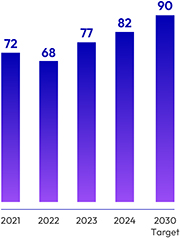
| Contents | ||
| Our Company | ||
| Our Strategy | ||
| Financial Performance | ||
| Environmental Excellence | ||
| Stakeholder Engagement | ||
| Workforce Experience: Investing in Our People to Unlock Their Potential | ||
| Customer Centricity: Driving a Superior Customer Experience | ||
| Supplier Networks: Building Strong Relationships, Fostering Mutual Value | ||
| ● Community Development: Engaging With Communities to Deliver Transformative Outcomes | ||
| Governance | ||
| Appendix | ||
| 83 Cemex 2024 Integrated Report | ||
Engaging With Communities to Deliver Transformative Outcomes
Our Approach: We actively engage with local communities to understand the impacts, risks, and opportunities of our activities on the environment and society and co-create initiatives that are inclusive and forward-thinking.
SDGs:
Our Social Impact Strategy advances Cemex’s priority SDGs — 9, 11, 12, and 13. Through collaboration, we seek to scale our contributions, promoting a sustainable future for communities and facilitating a just transition to a low-carbon economy.
Human Rights:
Cemex is committed to respecting the human rights of communities and groups, including vulnerable or marginalized communities, such as indigenous people, and children. We have a community engagement process and an institutional platform for receiving grievances (ETHOSline), allowing stakeholders to raise their concerns related to Cemex’s activities and operations. Grievances received through our community engagement process are documented and addressed through Cemex’s Social and Environmental Incidents Platform.
Social Initiatives Drive Long-Term Value, Community Resilience
At Cemex, we know that driving systemic change and delivering transformative outcomes is what accelerates a sustainable world. That’s why we continue to reshape our social impact program to advance community resilience and support a just transition to digital and green economies.
Leveraging our business strengths, we make significant contributions to society through targeted community programs and investment. First, our social responsibility program leverages our strengths to address the impacts of our operations and enhance quality of life in our neighboring communities. Second, our social investments are geared toward building resilience and long-term sustainable impact in the cities where we operate.
Moving forward, we aim to continue strengthening our commitment to both people and planet across all our business activities. Guided by global standards, we strive to install and maintain robust processes seeking transparency, accountability, and measurable performance across our operations. Over the coming years, we plan to extend our frameworks for environmental stewardship and social equity. This approach aims to create shared value while addressing the challenges of today and the opportunities of tomorrow, driving positive change for our business and stakeholders.
By 2030, our goal is for more than 120 of our sites across geographies and business lines, including all cement plants, to be ready to provide assurance of our social responsibility practices.
Community Partners
This year we positively impacted nearly 30 million community partners across our operations.
Priority Sites Action Plans
Cemex is committed to operating 100% of its priority sites at the highest standards while adhering to applicable regulations. Due to their size, investment road map, and proximity to urban areas, these priority sites must become standard-bearers of our commitment to planet and society.
Across our organization, we are leading the way with action plans that address social and environmental impacts and improve living conditions in our neighboring communities. Plans are underway to conduct a gap assessment to better understand opportunities at our regional sites.
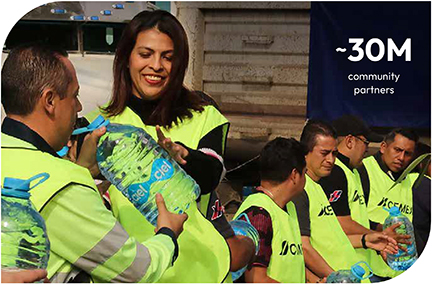
| Contents | ||
| Our Company | ||
| Our Strategy | ||
| Financial Performance | ||
| Environmental Excellence | ||
| Stakeholder Engagement | ||
| Workforce Experience: Investing in Our People to Unlock Their Potential | ||
| Customer Centricity: Driving a Superior Customer Experience | ||
| Supplier Networks: Building Strong Relationships, Fostering Mutual Value | ||
| ● Community Development: Engaging With Communities to Deliver Transformative Outcomes | ||
| Governance | ||
| Appendix | ||
| 84 Cemex 2024 Integrated Report | ||
Cemex Community Engagement Process
Our Community Engagement Process involves dynamic collaboration with the communities where we operate, and is structured to identify and manage risks and impacts from our operations in our priority sites.1 Developed in alignment with ISO 26000 standard, our dedicated Community Engagement Committees, composed of cross-functional teams, supervise and implement this process.
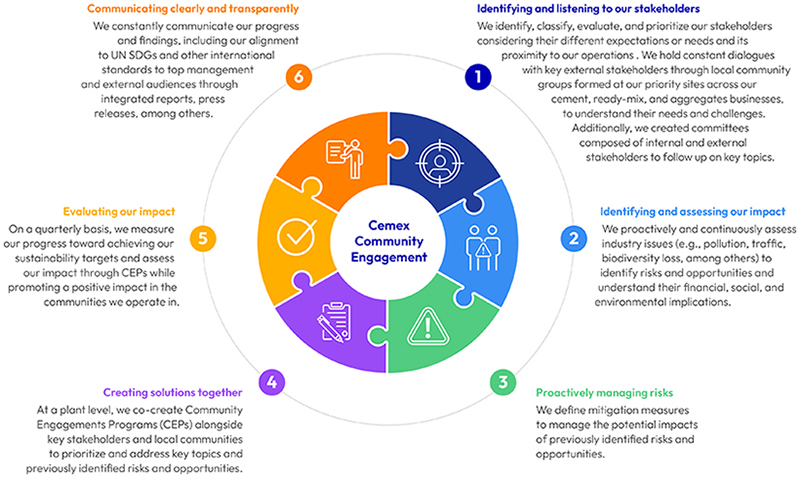
| 1 | Priority sites are defined by their size, investment road map, and proximity to urban areas. |
| Contents | ||
| Our Company | ||
| Our Strategy | ||
| Financial Performance | ||
| Environmental Excellence | ||
| Stakeholder Engagement | ||
| Workforce Experience: Investing in Our People to Unlock Their Potential | ||
| Customer Centricity: Driving a Superior Customer Experience | ||
| Supplier Networks: Building Strong Relationships, Fostering Mutual Value | ||
| ● Community Development: Engaging With Communities to Deliver Transformative Outcomes | ||
| Governance | ||
| Appendix | ||
| 85 Cemex 2024 Integrated Report | ||
Social Responsibility: Our Unique Strengths Facilitate Enhanced Quality of Life
Our social responsibility programs actively connect us with communities through dialogue and co-creation. We extend opportunities for our neighboring communities to understand our business and how it generates value for society, and we prioritize opening opportunities for quality employment, health and safety, and participation in the circular economy.
Community Engagement Programs
We prioritize community engagement by fostering open communication channels and promoting active stakeholder participation. In our regions across the globe, we hold frequent, formal dialogues with our neighboring communities through local community groups, which have proven key in building mutual trust and effective action. These efforts are integral to identifying and assessing material impacts, risks, and opportunities that originate from or are connected to our strategy and business models and inform and enable adaptation to address community needs. By understanding community expectations, we strengthen relationships between our business operations and our responsibility to drive long-term value and resilience for all stakeholders.
Throughout our operations, we aim to lead the way in sharing our knowledge and commitment to sustainability.

Circular World. Cemex’s Circular World educational program creates awareness with schoolchildren about understanding and contributing to sustainable development through circular economy and responsible lifestyles.
Mallorca Educational Environmental Program. Cemex has been collaborating with the environmental group Grup d’Amics en Defensa del Medi Ambient (GADMA) since 2005, aiming to promote the protection of ecosystems and the cultural heritage of Mallorca. This educational environmental program has led to a wide range of initiatives and educational campaigns, primarily focused on young children.

Cemex Morata Summer Camp. This educational initiative began in 2016 and uniquely combines language learning with environmental education, immersing participants in English while teaching them about sustainability and local ecosystems. This dual focus provides students from the Lucas Arribas school in Morata de Jalón, Spain, with improved language skills and fosters ecological awareness from a young age, encouraging children to understand their role in environmental stewardship.
Well-Being Community Outreach. As part of our community outreach, our teams organize local cycling and running events to promote a healthy lifestyle. This aligns with our emphasis on health and safety, which is our #1 priority and value.
| | Learn more about our holistic approach to well-being. |
Promoting Employability. We engage with our communities to promote employability. Our Regenera business demonstrates this commitment by partnering with communities on creative solutions to transform waste. To date, we have created more than 1,300 new jobs in waste management with a sustainability focus.
| | Learn more about our social commitment to circularity. |
| Contents | ||
| Our Company | ||
| Our Strategy | ||
| Financial Performance | ||
| Environmental Excellence | ||
| Stakeholder Engagement | ||
| Workforce Experience: Investing in Our People to Unlock Their Potential | ||
| Customer Centricity: Driving a Superior Customer Experience | ||
| Supplier Networks: Building Strong Relationships, Fostering Mutual Value | ||
| ● Community Development: Engaging With Communities to Deliver Transformative Outcomes | ||
| Governance | ||
| Appendix | ||
| 86 Cemex 2024 Integrated Report | ||
Global Volunteering
At Cemex, we recognize that our actions today shape a better tomorrow. Embracing environmental sustainability and social responsibility, we aim for positive change on issues where we can make meaningful contributions. Our employees contribute their time and talents to impactful volunteer experiences, guided by our Global Volunteering Guidelines.
|
Cemex Volunteers in Action
France. Cemex runners and their families participated in La Grande Course du Grand Paris and supported Emmaüs Solidarité’s fight against poverty and exclusion.
U.K. Cemex cyclists traversed more than 400 miles over five days to raise money for Sense, an organization that creates a more inclusive and accessible workplace for people living with complex disabilities.
U.K. In collaboration with Solent Careers Hub, Cemex U.K. hosted an event at St Mary’s Stadium in Southampton to provide career guidance opportunities for four local schools and two colleges. Students enjoyed tours around Cemex’s dredger ship, wharf, and ready-mix plant.
Mexico. Employees dedicated their time and skills to initiatives supporting our Future in Action goals. They participated in a clean-up campaign in partnership with Regenera, collecting waste from public spaces across the country. On the Mexican peninsula, the initiative brought together more than 80 volunteers, who collected over 500 kg of waste. Some of the recovered materials were sorted and co-processed as alternative fuel at the Mérida Plant. | 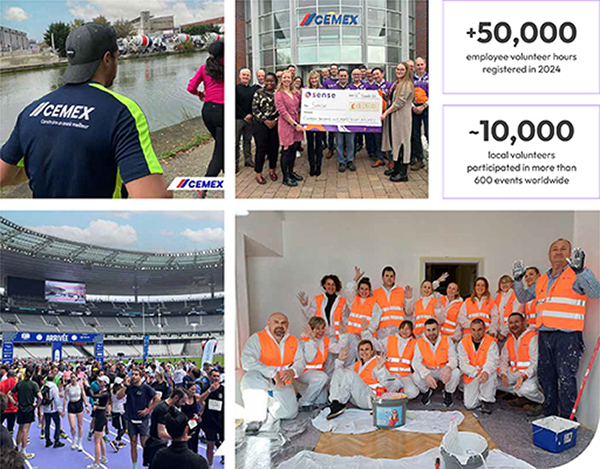 |
| Contents | ||
| Our Company | ||
| Our Strategy | ||
| Financial Performance | ||
| Environmental Excellence | ||
| Stakeholder Engagement | ||
| Workforce Experience: Investing in Our People to Unlock Their Potential | ||
| Customer Centricity: Driving a Superior Customer Experience | ||
| Supplier Networks: Building Strong Relationships, Fostering Mutual Value | ||
| ● Community Development: Engaging With Communities to Deliver Transformative Outcomes | ||
| Governance | ||
| Appendix | ||
| 87 Cemex 2024 Integrated Report | ||
Global Action Plans
Seeking a comprehensive approach to stakeholder engagement and impact management, our action plans encompass a range of tailored measures to address material issues. These include preventive, mitigation, and remediation actions. For actual material impacts, we have established clear mechanisms to enable remedy, including grievance and collaborative resolution initiatives. Beyond mitigation and remediation, we actively pursue initiatives designed to deliver positive outcomes, such as skilling programs and investments in local infrastructure.
Resilient Communities. Building resilient communities is core to our social impact approach. Guided by the United Nations Office for Disaster Risk Reduction (UNDRR) framework, our resilience work is designed to empower communities to prepare for, respond to, and recover from challenges while promoting long-term sustainability. We leverage the UNDRR’s 10 Essentials for Making Cities Resilient, addressing critical steps for building and maintaining resilient cities, outlining strategic focus areas, and identifying key actions.

| | Learn more about how Cemex builds resilient communities. |
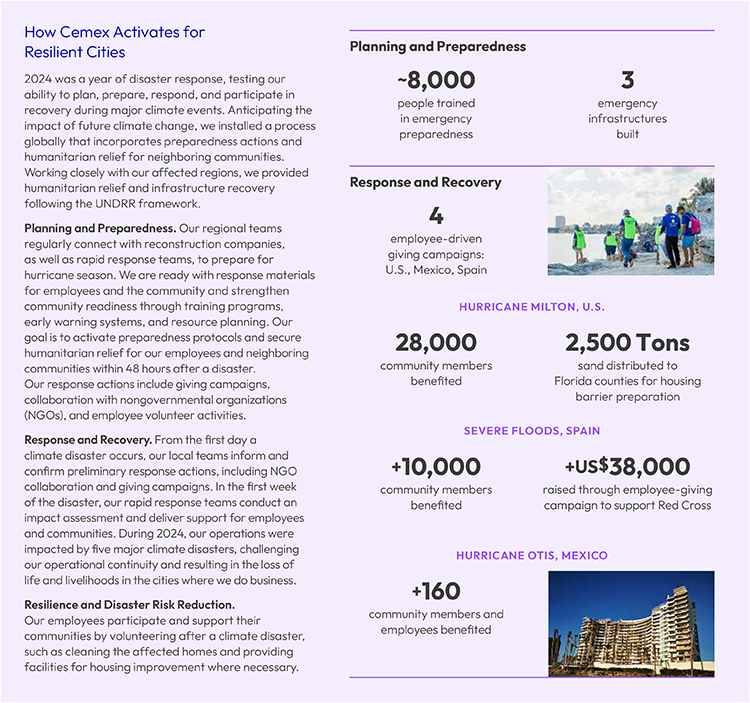
How Cemex Activates for Resilient Cities 2024 was a year of disaster response, testing our ability to plan, prepare, respond, and participate in recovery during major climate events. Anticipating the impact of future climate change, we installed a process globally that incorporates preparedness actions and humanitarian relief for neighboring communities. Working closely with our affected regions, we provided humanitarian relief and infrastructure recovery following the UNDRR framework. Planning and Preparedness. Our regional teams regularly connect with reconstruction companies, as well as rapid response teams, to prepare for hurricane season. We are ready with response materials for employees and the community and strengthen community readiness through training programs, early warning systems, and resource planning. Our goal is to activate preparedness protocols and secure humanitarian relief for our employees and neighboring communities within 48 hours after a disaster. Our response actions include giving campaigns, collaboration with nongovernmental organizations (NGOs), and employee volunteer activities. Response and Recovery. From the first day a climate disaster occurs, our local teams inform and confirm preliminary response actions, including NGO collaboration and giving campaigns. In the first week of the disaster, our rapid response teams conduct an impact assessment and deliver support for employees and communities. During 2024, our operations were impacted by five major climate disasters, challenging our operational continuity and resulting in the loss of life and livelihoods in the cities where we do business. Resilience and Disaster Risk Reduction. Our employees participate and support their communities by volunteering after a climate disaster, such as cleaning the affected homes and providing facilities for housing improvement where necessary. Planning and Preparedness ~8,000 people trained in emergency preparedness 3 emergency infrastructures built Response and Recovery 4 employee-driven giving campaigns: U.S., Mexico, Spain HURRICANE MILTON, U. S . 28,000 2,500 Tons community members sand distributed to benefited Florida counties for housing barrier preparation HURRICAN MILTON, U. S . 28,000 2,500 Tons community members sand distributed to benefited Florida counties for housing barrier preparation SEVERE FLOODS, SPAIN +10,000 +US$38,000 community members raised through employee-giving benefited campaign to support Red Cross HURRICANE OTIS, MEXICO +160 community members and employees benefited 87 Cemex 2024 Integrated Report
| Contents | ||
| Our Company | ||
| Our Strategy | ||
| Financial Performance | ||
| Environmental Excellence | ||
| Stakeholder Engagement | ||
| Workforce Experience: Investing in Our People to Unlock Their Potential | ||
| Customer Centricity: Driving a Superior Customer Experience | ||
| Supplier Networks: Building Strong Relationships, Fostering Mutual Value | ||
| ● Community Development: Engaging With Communities to Deliver Transformative Outcomes | ||
| Governance | ||
| Appendix | ||
| 88 Cemex 2024 Integrated Report | ||
Road Safety. Working with educational institutions, traffic authorities, community groups, and civil society organizations, we implement awareness campaigns on road safety, regulation compliance, and accident prevention. Cemex employees teach defensive driving and the importance of road safety to members of these communities while explaining the safety features of our vehicles.
|
+18,000
people trained in road safety
|
|
12
road safety physical
interventions implemented
|
| • | Spain. Since 2017, Cemex has led road safety education in Majorca through the PLEASE platform, which focuses on vulnerable cyclists. The program promotes coexistence, respect, and road safety awareness by actively involving road users, authorities, and associations in dialogues and debates. |
| • | Mexico. Mission Zero Strategy involves a public platform offering comprehensive road safety training, empowering the community with essential skills. As of December 2024, 79,500 individuals have benefited. |
| | Learn more about our health and safety efforts. |
| Social Investments Create Positive Impacts With Lasting Value | ||
| At Cemex, we recognize the power of going beyond traditional social responsibility. We align our social investments with our core expertise and business strengths to deliver positive impacts that create lasting value. This approach enables us to focus on long-term, transformative outcomes that not only support communities but also amplify our ability to innovate and lead in our industry. Through partnerships, shared knowledge, and targeted investments, we are embedding social impact into our strategic vision, creating a future where business success and societal progress are inextricably linked.
|
Circular Economy: VeryNile, Egypt
VeryNile is a local initiative in Qursaya, Egypt, focused on preserving the Nile River through waste collection while also providing local working opportunities. Understanding the initiative’s importance, Cemex collaborated with VeryNile to expand its operations to the cities of Assiut and Sohag, increased Qursaya’s operational capacity to handle the 575 tons of waste collected, and created 360 jobs, providing stable sources of income for the Qursaya population. As of this year, Cemex co-processed 460 tons of nonrecyclable waste collected by VeryNile as alternative fuel in our Assiut plant.
Cemex volunteers also help educate surrounding communities on the importance of waste management to preserve the Nile River. With all efforts combined, VeryNile provides work opportunities for the people of Qursaya Island, health and safety training, and direct employment in the circular economy to more than 10% of local anglers, both men and women, complementing their income by up to 30%. | |
| Employability: Digital Accelerator Program, Mexico | ||
| Cemex was among 12 founding companies and academic institutions of the Monterrey Digital Hub. In 2024, we launched the Digital Accelerator Program in partnership with the Hub and Data Rebels. Our objective is to enhance participants’ annual income by securing better job opportunities through the competitive skills they acquire during the program.
| ||
| The 16-week foundational and specialized training in Python translation is designed specifically for a cohort of 25 young individuals. In our first year, 84% of participants graduated, 58% obtained employment that grants a living wage within four months after graduation, and the program achieved 45% gender parity. By transitioning to digital jobs with higher demand and competitive salaries, we estimate that young workers could increase their income by up to 30%.
| ||
| Contents | ||
| Our Company | ||
| Our Strategy | ||
| Financial Performance | ||
| Environmental Excellence | ||
| Stakeholder Engagement | ||
| Workforce Experience: Investing in Our People to Unlock Their Potential | ||
| Customer Centricity: Driving a Superior Customer Experience | ||
| Supplier Networks: Building Strong Relationships, Fostering Mutual Value | ||
| ● Community Development: Engaging With Communities to Deliver Transformative Outcomes | ||
| Governance | ||
| Appendix | ||
| 89 Cemex 2024 Integrated Report | ||
S P O T L I G H T : V E R Y N I L E
Upcycling Project Provides Purpose for Workers,
Transforms Community
| Five years ago, Om Kamal’s life dramatically changed. After taking a job at an upcycling workshop as part of the VeryNile project, an initiative supported by Cemex to clean and protect the Nile River, Om Kamal gained a stable income and a fresh sense of purpose. No longer limited to household responsibilities, Om Kamal was building a better future while positively impacting the environment by transforming waste from the river, such as plastic, into valuable products, like pouches and other useful household items.
“We all have a newfound appreciation for caring for the environment. Before, people threw trash in the river without a second thought. Now, the river is a bit cleaner. Being involved in the VeryNile project has also expanded my social circles and network of friends,” she said.
When Cemex began its collaboration with VeryNile, an initiative backed by the Ministry of Environment in Egypt that develops eco-friendly solutions to remove inorganic waste from the Nile River, Om Kamal was one of four individuals working in the upcycling workshop. Today, that number has increased to 35 workers, reflecting the project’s growth and development.
|
Through the initiative, she has witnessed firsthand how the VeryNile project has transformed life on and off the island of Qursaya, which she calls home. Cemex volunteers have embraced these efforts to promote environmental awareness and protect the Nile River.
The VeryNile waste removal efforts have also had a positive economic impact on the island, creating 360 new jobs. For example, anglers now have dual sources of income: Fishing and collecting waste.
“The project has opened many doors and created opportunities for everyone on the island. People who once had nothing now have the means to build homes for their families.”
Looking ahead, she hopes that VeryNile’s long-term impact will lead to even broader community engagement, reduced pollution, and a cleaner Nile for future generations.
| |
| Contents | ||
| Our Company | ||
| Our Strategy | ||
| Financial Performance | ||
| Environmental Excellence | ||
| Stakeholder Engagement | ||
| Workforce Experience: Investing in Our People to Unlock Their Potential | ||
| Customer Centricity: Driving a Superior Customer Experience | ||
| Supplier Networks: Building Strong Relationships, Fostering Mutual Value | ||
| ● Community Development: Engaging With Communities to Deliver Transformative Outcomes | ||
| Governance | ||
| Appendix | ||
| 90 Cemex 2024 Integrated Report | ||
Built Environment
Improving the built environment is a cornerstone of our social investments and creates healthier and safer environments for people in our communities. As we continue our journey to net zero, our progress in developing building materials with sustainable attributes positions us well to build more resilient cities for our communities.
Patrimonio Hoy, Mexico
For 26 years, Patrimonio Hoy (PH) has been our flagship social program, providing access to microfinancing, technical advice, maintenance solutions, and high-quality building materials to low-income families in Mexico. The program offers different payment schemes that adapt to the financial and construction needs of benefited families, enabling them to improve their homes and livelihoods.
This year, we launched APP Patrimonio Hoy, an app and chatbot that gives PH partners visibility to all their project’s information digitally, streamlining and personalizing their experience. More than 50% of PH partners have downloaded the app.
We also initiated a voluntary fundraising campaign among our Cemex Mexico employees, matching each Mexican peso donated, to provide additional resources for our PH partners.
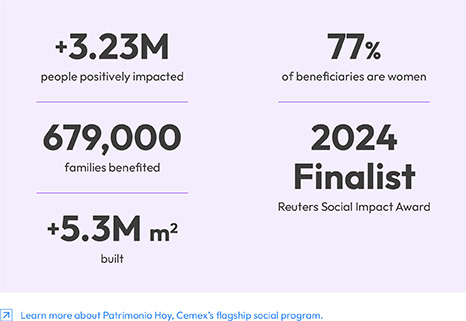
| S P O T L I G H T : P A T R I M O N I O H O Y
|
Social Program Enables Primary Caregiver
to Build Home, Peace of Mind
For nearly 20 years, Maggie, a hardworking primary caregiver from Tuxtla Gutiérrez, Chiapas, rented a small wooden house to keep a roof over her family’s heads. But she longed for a more resilient, permanent home for herself and her six children. In 2014, after learning about Cemex’s Patrimonio Hoy social program, her dream started to take shape. The program, which improves homes in communities across Mexico, changes the trajectory of millions of people like Maggie who live in inadequate housing.
According to Mexican government data, 33 million people reside in homes built below minimum standards for resilience, often lacking access to clean water or sanitation. Through Patrimonio Hoy, Maggie received the technical assistance needed to transition from renting to owning her own resilient home.
“As a renter, you don’t have much stability,” she said. “I finally felt financially free owning my own home.”
The program also gave her access to an architect who made her vision a reality.
“I had a clear idea of the home I wanted to create for my family, and the Patrimonio Hoy program made it possible.”
Built with durable materials to withstand severe weather, including strong winds, the home offered refuge to Maggie and her family. It also drastically improved her family’s health by reducing exposure to dust and other irritants. More importantly, Maggie can now leave a legacy of security and comfort for her children and future generations.
Reflecting on her journey, she recalls how visible the Patrimonio Hoy team was throughout the process and how reassuring it was to have face-to-face contact with people interested in her future. She encourages anyone contemplating the Patrimonio Hoy program to join.
“They walked beside me every step of the way, so I felt confident in making decisions regarding homeownership. It’s about so much more than building homes—it’s about building confidence, stability, and peace of mind.”
| Contents | ||
| Our Company | ||
| Our Strategy | ||
| Financial Performance | ||
| Environmental Excellence | ||
| Stakeholder Engagement | ||
| Workforce Experience: Investing in Our People to Unlock Their Potential | ||
| Customer Centricity: Driving a Superior Customer Experience | ||
| Supplier Networks: Building Strong Relationships, Fostering Mutual Value | ||
| ● Community Development: Engaging With Communities to Deliver Transformative Outcomes | ||
| Governance | ||
| Appendix | ||
| 91 Cemex 2024 Integrated Report | ||
Clean Cookstoves, Mexico
In Mexico, more than 28 million people cook using traditional wood-burning stoves, which produce high levels of emissions inside their homes. Cemex’s Clean Cookstoves program replaces inefficient, open, wood-burning stoves with cookstoves that efficiently concentrate heat in a protected concrete compartment and reduce smoke emissions by up to 99%. This reduces cooking and firewood collection time and minimizes the risk of burns and diseases associated with smoke exposure. To date, more than 97,000 people have been provided with Clean Cookstoves.
Habitat for Humanity 100,000 Floors, Colombia
This year, Cemex joined the “100,000 Floors to Play On” initiative alongside Habitat for Humanity and the Inter-American Cement Federation. This initiative aims to replace
100,000 dirt floors with concrete in homes across Latin America and the Caribbean by 2028, providing improvements in hygiene, indoor air quality, and energy efficiency.
Cemex is supporting the project in Colombia through its Dignified Floor program, which has provided families with materials and technical support to improve home flooring for the past 25 years.
Sustainable Construction, U.S.
Cemex has partnered with SEEED (Socially Equal Energy Efficient Development), a community-based nonprofit organization in Knoxville, TN, to address poverty for young adults through career readiness, environmental education, and community engagement. The program uses a comprehensive, multipronged approach that leverages and expands upon existing workforce development programs, sustainable housing, and specialized training programs. Its impact is far-reaching:
| • | Career Readiness equips young adults with essential life, job, and placement skills. |
| • | Solar-Powered Homes builds solar-powered, sustainably designed homes for low-income families at below-market rates, helping them achieve approximately US$75,000 in equity upon ownership, which builds generational wealth. |
| • | Green Construction Boot Camp offers training in conventional and sustainable construction methods, so students gain professional skills while contributing to the financial future of families in their communities. |
|
|
| Learn how our Sustainable Development Program for Suppliers helps us address sustainability and fortifies our supply chain.
|
Resilience
| Cemex strives to build sustainable, resilient communities through social investments that complement our climate action program.
• Botanical Garden, Egypt
Despite the warm climate, southern Egypt’s first botanical garden has become a popular spot for the community to gather, explore, and enjoy the beauty of diverse plants. Using the expertise of Assiut University professors, Cemex brought this garden to life as part of the football stadium, which is adjacent to our Assiut plant. Through the university’s insights into landscape design and plant selection, the garden has flourished and now attracts about 75,000 visitors annually.
• Solar Panels, Croatia
This year, the Environmental Protection and Energy Efficiency Fund awarded Cemex Croatia contracts for three projects in energy production from renewable sources, co-financed by the EU’s Modernisation Fund. Cemex is building new solar power plants at the Sveti Juraj cement plant in Kaštel Sućurac, the Sveti Kajo cement plant in Solin, and the Podsused production facility in Zagreb. The first, on the rooftop of a local football club, supports local schools and sports clubs in adopting renewable energy. | 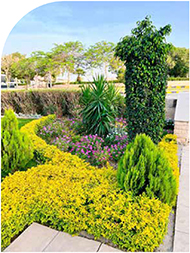 | |
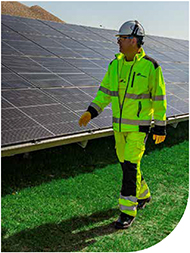 |
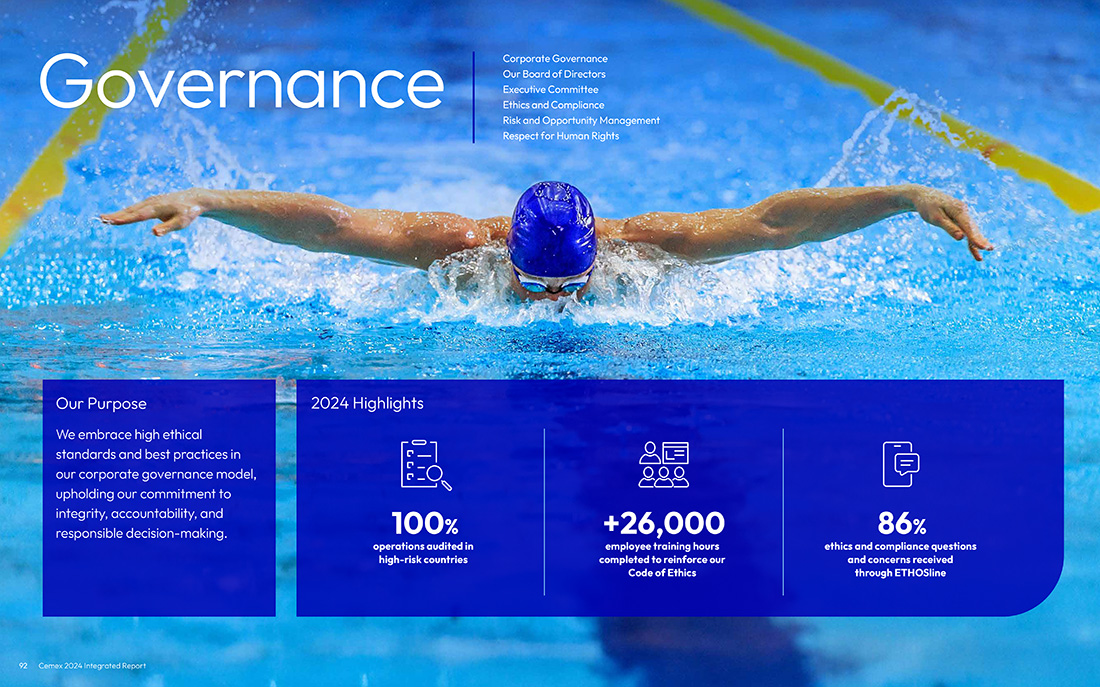
Governance Corporate Governance Our Board of Directors Executive Committee Ethics and Compliance Risk and Opportunity Management Respect for Human Rights Our Purpose We embrace high ethical standards and best practices in our corporate governance model, upholding our commitment to integrity, accountability, and responsible decision-making. 2024 Highlights 100% operations audited in high-risk countries +26,000 employee training hours completed to reinforce our Code of Ethics 86% ethics and compliance questions and concerns received through ETHOSline
| Contents | ||
| Our Company | ||
| Our Strategy | ||
| Financial Performance | ||
| Environmental Excellence | ||
| Stakeholder Engagement | ||
| Governance | ||
| ● Corporate Governance | ||
| Our Board of Directors | ||
| Executive Committee | ||
| Ethics and Compliance | ||
| Risk and Opportunity Management | ||
| Respect for Human Rights | ||
| Appendix | ||
| 93 Cemex 2024 Integrated Report | ||
Our corporate governance model sets the framework to act with integrity.
We are guided by our values, progressive business practices, and sustainability commitments. Sustainability is embedded in our business, including our corporate governance practices. As a result, we maintain high ethical standards and follow best practices in our corporate governance model which is designed to go beyond basic compliance with laws and regulations. Our aim is to achieve a superior performance that fosters strong, sustained economic growth while seeking to uphold a high level of integrity.
At Cemex, we have different channels through which stakeholders’ interests are considered, addressed, and reflected in our governance system. This system is designed to appropriately and efficiently manage and operate our company with the intention of fulfilling our corporate strategy and living up to our values and aspirations.
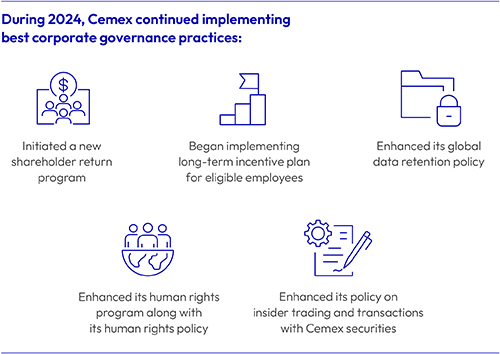
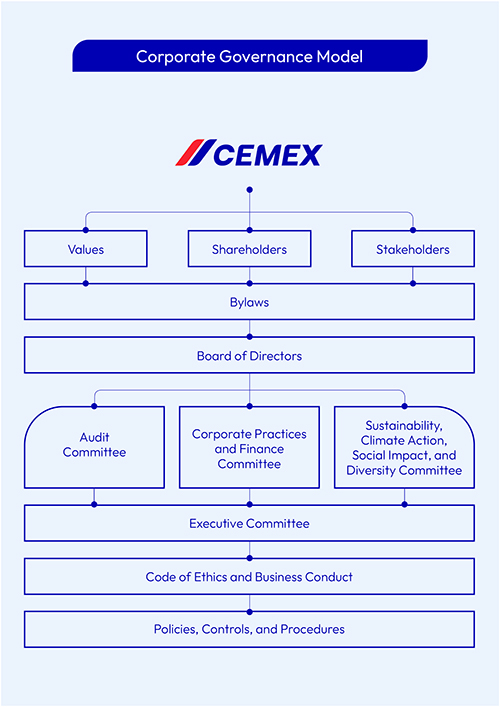
| Contents | ||
| Our Company | ||
| Our Strategy | ||
| Financial Performance | ||
| Environmental Excellence | ||
| Stakeholder Engagement | ||
| Governance | ||
| Corporate Governance | ||
| ● Our Board of Directors | ||
| Executive Committee | ||
| Ethics and Compliance | ||
| Risk and Opportunity Management | ||
| Respect for Human Rights | ||
| Appendix | ||
| 94 Cemex 2024 Integrated Report | ||
Within our governance system, our Board of Directors is primarily responsible for approving our corporate strategy and supervising the company’s overall operations. In doing so, our Board of Directors takes into account laws and regulations, best practices and guidelines, stakeholder interests, society’s values and ideals, global and local trends, risks and opportunities, and circumstances that the company must address. Additionally, our Board of Directors guides the company through the development, implementation, and oversight of compliance with company mandates, guidelines, policies, controls, and procedures. Specific functions also include reporting to shareholders on the general state of the company, supervising the performance of our CEO, monitoring the main risks the company faces, and approving information and communication policies.
To carry out these responsibilities effectively, our Board of Directors adheres to best practices and maintains an optimal structure. Corporate governance practices related to our Board of Directors include:
| • | Distinct roles for the Chairman of the Board of Directors and CEO |
| • | Establishment of a Sustainability, Climate Action, Social Impact, and Diversity Board Committee |
| • | Individual elections for our Board and Board Committee members |
| • | Enhancement of diversity on our Board of Directors by increasing the representation of independent, female, and international directors |
| • | Formalization of self and cross evaluations among Board of Directors members |
Cemex’s Board of Directors is compensated in a fixed manner based on participation in board meetings. The compensation of our Board of Directors is approved each year at Cemex’s Ordinary General Shareholders’ Meeting. Before the annual shareholders meeting held on March 22, 2024, shareholders had approved compensation of US$24,9161 per board meeting attended and US$6,0011 per committee meeting attended. At the annual shareholders meeting held on March 22, 2024, these amounts were increased to US$26,0921 per board meeting attended and US$6,2891 per committee meeting attended, respectively. The actual amount paid for board and committee meetings attended in 2024 was approximately US$1.9 million1.
In the upcoming years, we expect to implement additional initiatives such as formalizing director selection criteria (including for independent directors), establishing tenure limits, and implementing overboarding restrictions, among other improvements.
In 2024, our Board of Directors was chaired by Rogelio Zambrano and was composed of 13 highly qualified directors appointed by our shareholders, 10 (77%) of whom qualified as independent directors according to criteria specified in Mexican law. In addition, two members of our Board of Directors’ Audit Committee met the requirements of a financial expert as defined by the Sarbanes-Oxley Act of 2002 (SOX). In addition, 46% of our board members brought significant expertise in the construction and building materials industry, with strong representation of this expertise across our board committees.

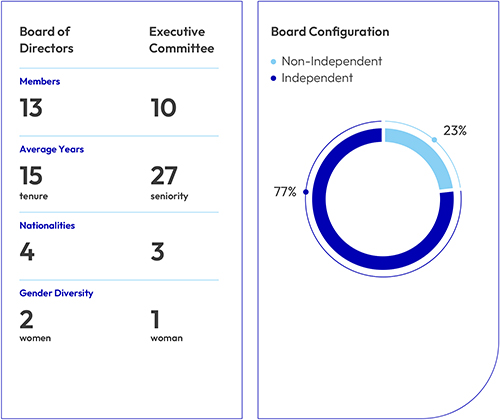
1 Based on an exchange rate of $20.83 Mexican pesos to $1.00 US Dollar.
| Contents | ||
| Our Company | ||
| Our Strategy | ||
| Financial Performance | ||
| Environmental Excellence | ||
| Stakeholder Engagement | ||
| Governance | ||
| Corporate Governance | ||
| ● Our Board of Directors | ||
| Executive Committee | ||
| Ethics and Compliance | ||
| Risk and Opportunity Management | ||
| Respect for Human Rights | ||
| Appendix | ||
| 95 Cemex 2024 Integrated Report | ||
Also, in 2024, our Board of Directors met five times to report on a wide range of relevant issues, including progress on our corporate strategy, the state of our governance system, compensation and nomination-related matters, sustainability-related concerns, shareholder return initiatives and financial results, reporting, and strategy, with average board meeting attendance of approximately 98%.
Certain matters dealt with during 2024 by our Board of Directors include, but are not limited to:
| • | Review of activities and recommendations of the Audit Committee of Cemex’s Board of Directors, the Corporate Practices and Finance Committee of Cemex’s Board of Directors, and the Sustainability, Climate Action, Social Impact and Diversity Committee of Cemex’s Board of Directors; |
| • | Review and authorization of the financial statements for the fourth quarter of 2023, for the year ended on December 31, 2023, and for the first, second, and third quarters of 2024, as well as the results and analysis of the most relevant performance indicators; |
| • | Review of the budget and financial plan for 2024; |
| • | Review of the economic outlook; |
| • | Review of the 2023 results for Cemex’s five strategic priorities; |
| • | Review and authorization of several financial transactions, donations, acquisitions of securities representing the capital stock of Cemex in compliance with the measures regarding equity thresholds in Cemex set forth in the bylaws, and transactions with related parties and involving conflicts of interest; |
| • | Review and approval of several policies and programs, including those on human rights issues, transactions with derivative financial instruments, and changes to the Insider Trading and Transactions with Cemex Securities Policy; |
| • | Review and approval of the agenda for the Ordinary General Shareholders Meeting held on March 22, 2024, including the reports and other information presented in said meeting; |
| • | Review of innovation, research and development, digitalization, talent management, and energy strategies, among others; |
| • | Appointment of the external auditor and its budget for the 2024-2025 period; |
| • | Review of the relevant aspects of the operations and valuation of Cemex’s shares; |
| • | Review of succession planning, resulting in the recent announcement of a new Chief Executive Officer and other senior level organizational changes; |
| • | Review of Cemex’s sustainability model and the latest results of our Future in Action program; |
| • | Follow-up on comments from the Corporate Finance Division of the U.S. Securities and Exchange Commission (SEC) regarding the 2022 annual report filed on Form 20-F; |
| • | Review and analysis of accounting provisions and impact on cash flow resulting from tax proceedings in Spain; |
| • | Review of the most relevant aspects of the operations in several geographies; and |
| • | Review of the risk agenda of Cemex and its subsidiaries. |
Our company has embarked on a corporate governance evolution, continuously striving for our Board of Directors to abide by best practices and maintain an optimal structure. As part of these efforts, since 2014 and throughout the years, we have made and continue to make important corporate governance enhancements at a board level. We have separated the roles of Chairman and CEO and created the Board of Directors’ Sustainability, Climate Action, Social Impact, and Diversity Committee (formerly named the Sustainability Committee), whose responsibilities have been broadened to include sustainability, social impact, and diversity and inclusion matters. We also changed the election for our Board and Board Committee members from a group slate to an individual basis and increased diversity on the Board by increasing the representation of independent, female, and international directors. Additionally, out of the 10 members of the Board of Directors in place when we began our corporate governance evolution in 2014, only 4 remain on the Board of Directors as of year-end 2024, having appointed 9 new Directors since then.
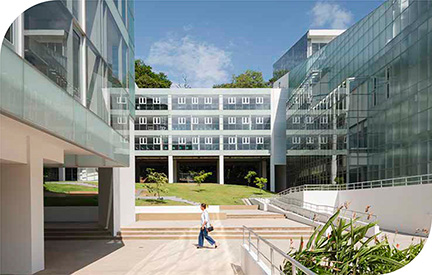
| Contents | ||
| Our Company | ||
| Our Strategy | ||
| Financial Performance | ||
| Environmental Excellence | ||
| Stakeholder Engagement | ||
| Governance | ||
| Corporate Governance | ||
| ● Our Board of Directors | ||
| Executive Committee | ||
| Ethics and Compliance | ||
| Risk and Opportunity Management | ||
| Respect for Human Rights | ||
| Appendix | ||
| 96 Cemex 2024 Integrated Report | ||
In addition, in 2023, the Board of Directors’ evaluation process was enhanced, formalized, and transitioned to an annual exercise, which was also executed in 2024. This comprehensive review includes an evaluation of the Board as a whole, as well as a self-assessment by each Board member, to determine whether the Board and its Committees operate effectively during the calendar year. The evaluation covers various aspects, such as the composition and structure of the Board, including the balance between independent and non-independent members, and the skillset and experience of each member. It also assesses the Board’s overall effectiveness and operations, including the adequacy of information provided for discussions, the clarity and presentation of meeting agendas, the frequency and timing of meetings, and whether sufficient
preparation time is given. Additionally, the evaluation reviews the performance and operations of the Board and its Committees, including the Audit Committee, Corporate Practices and Finance Committee, and Sustainability, Climate Action, Social Impact, and Diversity Committee. Each Board member also conducts a self-assessment of their individual performance, addressing areas such as confidentiality obligations, meeting preparation, participation, time commitment, and other responsibilities.
Our commitment to further improve and strengthen our corporate governance practices is also reflected in our robust policies and processes for managing conflicts of interest and related person transactions, aimed at upholding transparency and accountability throughout the company. Our policy on Conflicts of Interest reaffirms our position that all

members of the Cemex Group (including our CEO, Executive Committee, and Board of Directors) shall always act in accordance with Cemex’s best interests and generally prohibits the Cemex Group from entering into transactions and/or negotiations where a conflict of interest exists. Employees are required to self-report any actual, potential, or apparent conflict of interest in our global reporting process and digital platform. All reports are evaluated and authorized, if applicable, by a multidisciplinary team as well as the employee’s supervisor. In some cases, this evaluation and, if applicable, authorization is done at the Cemex Board of Directors level. In addition to the conflict of interest process, under our policy and procedures with respect to related person transactions, we also carry out a related party transaction review which seeks to comply with our bylaws, applicable regulations, and market practices to report and review any transactions with related persons and is applicable to all Cemex operations worldwide.
Our practices aim to promote gender representation within our Board of Directors and executive roles. We have a Global Workplace Diversity, Equity, and Inclusion policy that seeks to enrich the workplace by upholding principles of diversity, equity, and inclusion. This policy, which applies to the Board of Directors, also specifies that these principles must be considered when proposing candidates for election to the Board. Additionally, as part of our succession planning for management positions, every executive is required to include a woman in their succession plan. Furthermore, as a Mexican-listed company, we adhere to regulatory requirements regarding gender quotas, as applicable.
|
We have a Global Workplace Diversity, Equity, and Inclusion policy that seeks to enrich the workplace by upholding principles of diversity, equity, and inclusion. This policy, which applies to the Board of Directors, also specifies that these principles must be considered when proposing candidates for election to the Board.
|
| Contents | ||
| Our Company | ||
| Our Strategy | ||
| Financial Performance | ||
| Environmental Excellence | ||
| Stakeholder Engagement | ||
| Governance | ||
| Corporate Governance | ||
| ● Our Board of Directors | ||
| Executive Committee | ||
| Ethics and Compliance | ||
| Risk and Opportunity Management | ||
| Respect for Human Rights | ||
| Appendix | ||
| 97 Cemex 2024 Integrated Report | ||
Our Board Members
Rogelio Zambrano Lozano (68)
Role within Cemex’s Board of Directors:
Executive Chairman.
Tenure on Cemex’s Board of Directors:
Member since 1987 and Executive Chairman since 2014.
Other Current Roles: Mr. Zambrano Lozano is an alternate member of the board of directors of Banco Santander México, S.A., Institución de Banca Múltiple, Grupo Financiero Santander México, a member of the Regional Council of Banco de México (Mexico’s central bank), a member of the Consejo Mexicano de Negocios, and a member of the board of trustees of the Instituto Tecnológico y de Estudios Superiores de Monterrey, as well as a visiting professor at this same university.
Experience: Mr. Zambrano Lozano was President of the Finance Committee of Cemex’s Board of Directors from 2009 until March 2015.
Mr. Zambrano Lozano has been involved in the construction and building materials industries for over 40 years, as well as in various entrepreneurship matters in Mexico and the United States, after founding and serving as co-chief executive officer of Carza, S.A.P.I. de C.V., a leading real estate development company. With his vast experience and proven leadership, since his appointment as Chairman of Cemex’s Board of Directors, Mr. Zambrano Lozano has been responsible for guiding Cemex’s global business strategy, particularly focusing on strengthening best corporate
governance practices, based on a commitment to create lasting value for all Cemex’s stakeholders. Mr. Zambrano Lozano supports various non-profit organizations related to education, health and entrepreneurship.
Education: Mr. Zambrano Lozano holds a B.S. degree in Industrial and Systems Engineering from the Instituto Tecnológico y de Estudios Superiores de Monterrey, and an MBA from the Wharton Business School of the University of Pennsylvania.
Fernando A. González Olivieri (70)
Tenure on Cemex’s Board of Directors:
Since 2015.
Board Membership at Listed Entities:
Mr. González Olivieri is a member of the board of directors of GCC, S.A.B. de C.V. (formerly Grupo Cementos de Chihuahua, S.A.B. de C.V.) and Axtel, S.A.B. de C.V., both Mexican corporations listed in Mexico.
Experience at Cemex and Other Relevant Experience: Mr. González Olivieri joined Cemex in 1989 and held various positions in the Strategic Planning, Business Development and Human Resources departments through 1998. From 1998 through 2009, Mr. González Olivieri led various regions of Cemex, including South America, Central America, and the Caribbean (SCA&C), Europe, Asia and Oceania. He was appointed as Cemex’s Executive Vice President of Planning and Development in May 2009, and he was appointed Cemex’s Chief Financial Officer in 2011. Mr. González Olivieri held these positions until he was named Chief
Executive Officer in 2014. In 2023, he was named President of the Global Cement and Concrete Association.
With his comprehensive knowledge of Cemex’s organization and the markets where it operates around the world, Mr. González Olivieri brings to Cemex’s Board of Directors and Senior Management a unique global perspective and innovative leadership, that directly contributes to formulating and implementing a results-oriented business strategy. With over 30 years of direct involvement in top management positions, and a detailed understanding of Cemex’s four main businesses (cement production, ready-mix concrete, aggregates and Urbanization Solutions), he has given particular attention to constantly improving Cemex’s Health and Safety policies, and to implementing a sustainability strategy aimed at achieving Net Zero Carbon growth and development. Mr. González Olivieri is a member of the board of trustees of Tecmilenio University, which forms part of the Instituto Tecnológico y de Estudios Superiores de Monterrey.
Education: Mr. Gonzalez holds a B.A. degree in Business Administration, and an MBA from the Instituto Tecnológico y de Estudios Superiores de Monterrey.
Armando J. García Segovia (72)
Tenure on Cemex’s Board of Directors:
Since 1983.
Tenure on Cemex’s Sustainability, Climate Action, Social Impact, and Diversity Committee: Since 2014, and President since 2014.
Board Membership at Listed Entities:
Mr. García Segovia is a member of the board of directors of Promotora de Hoteles Norte 19, S.A.B. de C.V.
(formerly Hoteles City Express, S.A.B. de C.V.) and an independent member of the board of directors of GCC, S.A.B. de C.V. (formerly Grupo Cementos de Chihuahua, S.A.B. de C.V.), both of which are listed corporations in Mexico.
Other Current Roles: Mr. García Segovia is a member of the board of directors of Innovación y Conveniencia, S.A. de C.V., PYOSA Industrias, S.A.P.I. de C.V. (both Mexican non-public corporations) and Universidad de Monterrey, A.C. He is a member of the Consejo de Participación Ciudadana de Parques y Vida Silvestre de Nuevo León, a non-profit entity with a sustainability agenda. Mr. García Segovia is the founder and chairman of the board of directors of Comenzar de Nuevo, A.C., a non-profit organization focused on the treatment, education, prevention, and research of eating behavior disorders and related diseases. Mr. García Segovia also serves as honorary consul in Monterrey of the Kingdom of Denmark.
Experience: Mr. García Segovia worked at Cydsa, S.A.B. de C.V. (a Mexican listed corporation) and Conek, S.A. de C.V. (a Mexican non-public corporation). From 1985 to 2010, he held several positions at Cemex, including Director of Operations and Strategic Planning, Corporate Services, and Business Development, as well as Executive Vice President of Development, Technology, Energy and Sustainability. He was also vice president of the Mexican Employers’ Association (COPARMEX), chairman of the Private Sector Commission for Sustainable Development Studies (CESPEDES), member of the board of directors of the World Environmental Center (a nonprofit organization), and vice president of the Patronato del Museo de la Fauna y Ciencias Naturales, A.B.P.
| Contents | ||
| Our Company | ||
| Our Strategy | ||
| Financial Performance | ||
| Environmental Excellence | ||
| Stakeholder Engagement | ||
| Governance | ||
| Corporate Governance | ||
| ● Our Board of Directors | ||
| Executive Committee | ||
| Ethics and Compliance | ||
| Risk and Opportunity Management | ||
| Respect for Human Rights | ||
| Appendix | ||
| 98 Cemex 2024 Integrated Report | ||
Mr. García Segovia brings to Cemex’s Board of Directors a broad knowledge of the technical and production aspects of the global building-materials industry, along with a deep commitment to sustainability, climate action and nature conservancy, that provides valuable leadership to Cemex’s sustainability and climate action strategy, a core component to Cemex’s long-term value creation objective.
Education: Mr. García Segovia holds a B.S. degree in Mechanical Engineering and Administration from the Instituto Tecnológico y de Estudios Superiores de Monterrey, and an MBA from the University of Texas.
Rodolfo García Muriel (79)
Tenure on Cemex’s Board of Directors:
Since 1985.
Tenure on Cemex’s Corporate Practices and Finance Committee: Since 2015.
Other Current Roles: Mr. García Muriel is the chief executive officer of Compañía Industrial de Parras, S.A. de C.V., chairman of the board of directors of Grupo Romacarel, S.A.P.I de C.V., (both are non-public corporations), and a member of the regional board of directors of Grupo Financiero Citibanamex (a non-public corporation).
Experience: Mr. García Muriel was a member of the Audit Committee of Cemex’s Board of Directors from 2016 until March 2023 and the Finance Committee of Cemex’s Board of Directors from 2009 until March 2015.
Mr. García Muriel is a Mexican business leader with decades of experience and an outstanding record as founder, director, and president of major companies in the manufacturing, construction, transport, and communications industries. His vast
business experience brings to Cemex’s Board of Directors useful knowledge in critical areas such as logistics and manufacturing as well as macroeconomic and market trends.
Education: Mr. García Muriel holds a B.S. degree in Electric Mechanical Engineering from the Universidad Iberoamericana and completed specialized programs in Business Administration at both Harvard University, and the Anderson School of the University of California in Los Angeles.
Francisco Javier Fernández Carbajal (69)
Tenure on Cemex’s Board of Directors:
Since 2012.
Tenure on Cemex’s Audit Committee:
Since 2015.
Tenure on Cemex’s Corporate Practices and Finance Committee: Member since 2015 and President since 2019.
Board Membership at Listed Entities:
Mr. Fernández Carbajal is a member of the board of directors of Alfa, S.A.B. de C.V. (a listed corporation in Mexico) and VISA, Inc. (a New York Stock Exchange (“NYSE”) listed corporation), as well as an alternate member of the board of directors of Fomento Económico Mexicano, S.A.B. de C.V. (a corporation listed in Mexico and on the NYSE).
Other Current Roles: Mr. Fernández Carbajal is the chief executive officer of Servicios Administrativos Contry, S.A. de C.V. (a Mexican non-public corporation).
Experience: Previously, Mr. Fernández Carbajal held positions Grupo Financiero BBVA México S.A. de C.V., including deputy president of strategic planning, president of systems and operations, chief financial officer, and chief executive officer.
With a business career of more than 40 years and in-depth knowledge of specialized areas like payment systems and complex financial services worldwide, Mr. Fernández Carbajal brings to Cemex’s Board of Directors relevant insights in strategic planning and risk management, as well as in essential business functions, including financial reporting and competitive compensation mechanisms, which are fundamental to attracting and retaining talent.
Education: Mr. Fernández Carbajal holds a B.S. degree in Electric Mechanical Engineering from the Instituto Tecnológico y de Estudios Superiores de Monterrey, and an MBA from the Harvard Business School.
David Martínez Guzmán (67)
Tenure on Cemex’s Board of Directors:
Since 2015.
Board Membership at Listed Entities: Mr. Martínez Guzmán serves on the board of directors of Alfa, S.A.B. de C.V. and Vitro, S.A.B. de C.V., both of which are listed corporations in Mexico, and Sabadell Bank, a listed corporation in Spain.
Other Current Roles: Mr. Martínez Guzmán is the founder and principal of Fintech Advisory Inc., as well as managing director of its London subsidiary, Fintech Advisory, Ltd., and member of the board of directors of ICA Tenedora, S.A. de C.V.
Experience: Mr. Martínez Guzmán is the principal of Fintech Advisory Inc., which he founded in 1987. From 1984 to 1986, Mr. Martínez Guzmán worked as vice president, Latin America Sovereign Restructuring unit of Citibank, N.A. in New York, where he helped coordinate the 1984 Argentina Financing Plan.
Since founding Fintech, Mr. Martínez Guzmán has participated, at times as the largest creditor, in most of the sovereign debt restructurings around the world, historically approaching sovereign restructurings with a collaborative approach to governments. Mr. Martínez Guzman also has a strong track record of successful involvement in corporate restructurings and debt exchanges, most often working with companies to ensure long-term viability and business continuity as a value recovering proposition. More recently, Mr. Martínez Guzmán has allocated a significant portion of Fintech’s position to private equity investments, successfully investing across multiple jurisdictions in Latin America, Asia, and Europe, and across a wide range of sectors, including telecom and media, utilities, industrials, infrastructure, construction, oil and gas, and financial institutions.
Mr. Martínez Guzmán brings a renowned worldwide expertise in the financial sector and global markets to Cemex’s Board of Directors, providing significant guidance on Cemex’s proactive financial management for deleveraging and improving the credit rating, as well as Cemex’s sustainable growth strategy.
Education: Mr. Martínez Guzmán holds a B.S. degree in Mechanical and Electrical Engineering from the Universidad Nacional Autónoma de México (UNAM), a B.A. degree in Philosophy from the Universitas Gregoriana in Rome, Italy, and an MBA from Harvard Business School.
| Contents | ||
| Our Company | ||
| Our Strategy | ||
| Financial Performance | ||
| Environmental Excellence | ||
| Stakeholder Engagement | ||
| Governance | ||
| Corporate Governance | ||
| ● Our Board of Directors | ||
| Executive Committee | ||
| Ethics and Compliance | ||
| Risk and Opportunity Management | ||
| Respect for Human Rights | ||
| Appendix | ||
| 99 Cemex 2024 Integrated Report | ||
Armando Garza Sada (67)
Tenure on Cemex’s Board of Directors:
Since 2015.
Board Membership at Listed Entities: Mr. Garza Sada is a member of the board of directors of Alfa, S.A.B. de C.V., a listed corporation in Mexico with presence in 25 countries, and a business portfolio that includes petrochemicals, refrigerated food, and energy. He is also a member of the board of directors of Alpek, S.A.B. de C.V., Nemak, S.A.B. de C.V., Axtel, S.A.B. de C.V., El Puerto de Liverpool, S.A.B. de C.V., and Grupo Lamosa, S.A.B. de C.V., all of which are listed corporations in Mexico.
Other Current Roles: Mr. Garza Sada is an alternate member of the board of directors of Grupo Financiero BBVA México, S.A. de C.V. (a private financial institution).
Experience: Mr. Garza Sada’s decades of experience at the highest corporate level in top-ranked companies provides Cemex’s Board of Directors with a unique insight on the global economic landscape, and a hands-on experience to best align Cemex’s business strategy with its day-to-day operations.
Education: Mr. Garza Sada holds a B.S. degree in Industrial Engineering from the Massachusetts Institute of Technology and an MBA from Stanford University.
Everardo Elizondo Almaguer (81)
Tenure on Cemex’s Board of Directors:
Since 2016.
Tenure on Cemex’s Audit Committee:
Member since 2018 and President since 2019.
Board Membership at Listed Entities: Mr. Elizondo Almaguer is a member of the board of directors of Compañía Minera Autlán, S.A.B. de C.V., and of Gruma,
S.A.B. de C.V., all of which are listed corporations in Mexico.
Other Current Roles: Mr. Elizondo Almaguer is a professor of Macroeconomics at EGADE Business School of the Instituto Tecnológico y de Estudios Superiores de Monterrey and at the School of Economics of the Universidad Autónoma de Nuevo León (UANL). He is also a member of the board of directors of Afore XXI-Banorte, S.A. and Rassini, S.A.P.I. de C.V. (both are non-public corporations).
Experience: Mr. Elizondo Almaguer qualifies as a “financial expert” for purposes related to the Sarbanes-Oxley Act (“SOX”).
Mr. Elizondo Almaguer served as deputy governor of the Banco de México (Mexico’s central bank) from 1998 to 2008. Before that, he was the director for Economic Studies at Alfa, S.A.B. de C.V. (a Mexican listed company), and at Grupo Financiero BBVA México S.A. de C.V. (a private financial institution). He founded and was the director of the Graduate School of Economics of the Universidad Autónoma de Nuevo León.
With a distinguished professional career as a financial analyst, exemplary public official and academic scholar, Mr. Elizondo Almaguer is a financial expert and brings to Cemex’s Board of Directors extensive knowledge of the financial system and the international macroeconomic environment, providing insights to ensure Cemex’s full observance of best corporate practices, and identify new business opportunities.
Education: Mr. Elizondo Almaguer holds a B.A. degree in Economics from the Universidad Autónoma de Nuevo León, a Master’s in Economics from
the University of Wisconsin-Madison, a certificate from Harvard University’s
International Tax Program and an Honoris Causa Doctorate from the Universidad Autónoma de Nuevo León.
Marcelo Zambrano Lozano (69)
Tenure on Cemex’s Board of Directors:
Since 2017.
Tenure on Cemex’s Sustainability, Climate Action, Social Impact, and Diversity Committee: Since 2017.
Board Membership at Listed Entities:
Mr. Zambrano Lozano is a member of the technical committee of one of Go Proyectos, S.A. de C.V.’s development trusts, known by its ticker symbol as CARZACK 18, which is listed in Mexico.
Other Current Roles: Mr. Zambrano Lozano is a founding partner and executive chairman of the board of directors of Carza, S.A.P.I. de C.V., a recognized real estate development non-public corporation in the residential, commercial, and industrial sectors. Additionally, Mr. Zambrano Lozano is also a founding partner and member of the board of directors of Proyectos Industriales Carza (PIC), a company dedicated to the construction, sale, and rental of subdivisions and industrial spaces. He is a member of the board of directors of Grupo Vigia, S.A. de C.V. (a Mexican non-public corporation dedicated to distribution of gas, fuel, and other oil derivatives) and GreenPaper (Productora de Papel, S.A. de C.V.). a Mexican non-public corporation dedicated to the fabrication and distribution of paper. He is also a member of the general board of Universidad de Monterrey, A.C.
Experience: Mr. Zambrano Lozano’s ample knowledge of the real estate and construction industries in Mexico and the United States provides Cemex’s Board of Directors with an insightful view of major trends shaping the sector globally, particularly in key areas such as logistics and supply-chain development, thus helping Cemex to anticipate the evolving needs of its customers in the aforementioned markets.
Education: Mr. Zambrano Lozano holds a B.A. degree in Marketing from the Instituto Tecnológico y de Estudios Superiores de Monterrey.
Ramiro Gerardo Villarreal Morales (77)
Tenure on Cemex’s Board of Directors:
Since 2017.
Tenure on Cemex’s Corporate Practices and Finance Committee: Since 2024.
Board Membership at Listed Entities:
Mr. Villarreal Morales is a member of the board of directors of Andean Precious Metals, a company listed on the Toronto Stock Exchange. He is also a member of the board of directors, the audit committee and the corporate practices committee of Vinte Viviendas Integrales, S.A.B. de C.V., and a member of the board of directors and alternate member of the audit and corporate practices committee of GCC, S.A.B. de C.V. (formerly Grupo Cementos de Chihuahua, S.A.B. de C.V.), two public corporations listed in Mexico.
Other Current Roles: Mr. Villarreal Morales is a member of the advisory board of Arendal (a non-public corporation in the construction industry).
| Contents | ||
| Our Company | ||
| Our Strategy | ||
| Financial Performance | ||
| Environmental Excellence | ||
| Stakeholder Engagement | ||
| Governance | ||
| Corporate Governance | ||
| ● Our Board of Directors | ||
| Executive Committee | ||
| Ethics and Compliance | ||
| Risk and Opportunity Management | ||
| Respect for Human Rights | ||
| Appendix | ||
| 100 Cemex 2024 Integrated Report | ||
Experience: Mr. Villarreal Morales joined Cemex in 1987 as General Legal Director, and subsequently served in various positions, including Executive Vice President of Legal and Advisor to the Chairman of Cemex’s Board of Directors and the Chief Executive Officer until December 2017.
Previously, he served on the board of directors of Banco Bancrea, S.A., Institución de Banca Múltiple, a Mexican bank, and as deputy managing director of the regional bank division of Banpaís, where he was responsible for the operation of the bank’s 121 branches, the trust and legal departments.
Until February 2012, he was the secretary of the board of directors of Enseñanza e
Investigación Superior, A.C., a non-profit managed by the Instituto Tecnológico y de Estudios Superiores de Monterrey.
He served as Secretary of Cemex’s Board of Directors from 1995 to March 30, 2017.
With over 50 years of professional experience in different countries where Cemex has operations and in Cemex’s governing bodies, in the banking and financial sector, and as a member of the audit committee of other listed companies, Mr. Villarreal Morales qualifies as a “financial expert” for purposes related to the Sarbanes-Oxley Act, and provides Cemex’s Board of Directors with key guidance on regulatory and legal matters, as well as international financial transactions and financial and accounting compliance, helping to ensure strict observance of all applicable laws and relevant accounting standards and principles.
Education: Mr. Villarreal Morales holds a B.A. degree in Law from the Universidad Autónoma de Nuevo León, and a Master’s in Finance from the University of Wisconsin-Madison.
Gabriel Jaramillo Sanint (75)
Tenure on Cemex’s Board of Directors:
Since 2018.
Tenure on Cemex’s Audit Committee:
Since 2023.
Board Membership at Listed Entities:
Mr. Jaramillo Sanint is a member of the board of directors of Minerva Foods, a listed corporation in Brazil.
Other Current Roles: Mr. Jaramillo Sanint is the founder and director of a sustainable economic development program in the Orinoco Basin in Colombia. He is also a member of the board of directors of Centro Hospitalario Tatama (Colombia) (a non-profit organization), Medicines for Malaria Ventures (a non-profit organization) based in Geneva, Switzerland, and Banco BTG Pactual, Colombia and of Aliar, S.A. (an agro-industrial company dedicated to pig farming).
Experience: Previously, Mr. Jaramillo Sanint served as chairman of the board of directors and chief executive officer of Santander USA (formerly Sovereign Bank), Banco Santander Brasil, and Banco Santander Colombia, and as CEO of Citibank Mexico, and Citibank Colombia. Since retiring, he has focused on health-related philanthropic work, leading the transformation of the Global Fund to Fight AIDS, Tuberculosis and Malaria, which raised $13 billion from 2017 to 2020.
From October 2012 to April 2018, he was a member of the board of directors and president of the audit committee of Cemex Latam Holdings, S.A., a company listed on the Colombian Securities Exchange at the time.
With an outstanding career of more than 35 years in South America, Mexico and the United States, Mr. Jaramillo Sanint not only brings to Cemex’s Board of Directors extensive experience in complex financial matters, but also in sustainability, health and safety, as well as corporate social responsibility, a pillar of Cemex’s global strategy to achieve sustainable growth and create lasting value.
Education: Mr. Jaramillo Sanint holds a B.A. degree in Marketing and an MBA from California State University. In 2015, Mr. Jaramillo Sanint received honorary degrees from the Universidad Autónoma de Manizales in Colombia and Northeastern University.
Isabel María Aguilera Navarro (64)
Tenure on Cemex’s Board of Directors:
Since 2019.
Tenure on Cemex’s Sustainability, Climate Action, Social Impact, and Diversity Committee: Since 2023.
Board Membership at Listed Entities: Mrs. Aguilera Navarro is a member of the board of directors of Oryzon Genomics, S.A., a listed corporation in Spain.
Other Current Roles: Mrs. Aguilera Navarro is an independent consultant and executive in residence at the Esade Business School in Barcelona. She is a member of the board of directors of the Spanish multinational state-owned entity Canal de Isabel II, which manages the water supply infrastructure of Madrid, Spain and has operations in South America. She is also a member of the board of directors of Making Science, a company listed on the BME Growth market.
Experience: Mrs. Aguilera Navarro was president of General Electric Spain and Portugal from 2008 to 2009, general manager of Google Inc. (now Alphabet) Spain and Portugal from 2006 to 2008, operations director of NH Hotel Group, S.A. from May 2002 to June 2005, and general director of Dell Computer Corporation for Spain, Italy and Portugal from March 1997 to May 2002. She has also served as an advisor to various Spanish non-profit organizations, including the Instituto de Empresa, and the Asociación para el Progreso de la Gestión. She was a member of the advisory board of Farmaindustria, Ikor, and Pelayo Mutua de Seguros, and a business entrepreneur from 2009 to 2012 at Twindocs International. Previously, she was a board member of Indra, Banco BMN, Aegón Seguros, Banca Farmafactoring S.p.A., Hightech Payment System S.A., Lar España, and Clínica Baviera.
With her experience in multinational corporations in Europe, Mrs. Aguilera Navarro brings to Cemex’s Board of Directors guidance on the overall global business landscape and an informed view on innovation, entrepreneurship, technological and digitalization issues, from customer-centric platforms to organizational processes and essential corporate functions, a key element of Cemex’s digital strategy. In addition, she brings important insights in urban planning and a critical customer influencer, architects.
| Contents | ||
| Our Company | ||
| Our Strategy | ||
| Financial Performance | ||
| Environmental Excellence | ||
| Stakeholder Engagement | ||
| Governance | ||
| Corporate Governance | ||
| ● Our Board of Directors | ||
| Executive Committee | ||
| Ethics and Compliance | ||
| Risk and Opportunity Management | ||
| Respect for Human Rights | ||
| Appendix | ||
| 101 Cemex 2024 Integrated Report | ||
Education: Mrs. Aguilera Navarro holds a B.A. degree in Architecture and Urban Planning from the Escuela Técnica Superior de Arquitectura de Sevilla (ETSA), an MBA from the IE Business School, a Program for Management Development (PMD) from the IESE Business School, and has a Specialization Diploma in the Metaverse from The Valley Digital Business School in Madrid and a Diploma in Museum Management from ELBS School. Likewise, she completed the Environmental, Social and Governance (ESG) and Corporate Finance for Board Members modules at the Esade Business School in Barcelona.
María de Lourdes Melgar Palacios (62)
Tenure on Cemex’s Board of Directors:
Since 2023.
Tenure on Cemex’s Sustainability, Climate Action, Social Impact, and Diversity Committee: Since 2023.
Board Membership at Listed Entities:
Dr. Melgar Palacios is a member of the board of directors of Smurfit Westrock Group PLC, an Irish conglomerate incorporated in Ireland, listed in the NYSE and the London Stock Exchange (“LSE”). Prior to the merger with Westrock, from 2020 to July 2024, she was a member of the board of directors of Smurfit Kappa Group PLC.
Other Current Roles: Dr. Melgar Palacios is a member of the board of directors of Banco Santander México, S.A., Institución de Banca Múltiple, Grupo Financiero Santander México. She is a researcher affiliated with the Center of Collective Intelligence at the Massachusetts Institute of Technology and nonresident researcher at the Baker Institute Center for Energy Studies. She is a member of the board of directors
of Mount Holyoke College (academic institution). Additionally, she is a member of the board of directors of the following non-profit organizations: Global Energy Alliance for People and Planet, the Natural Resource Governance Institute, and Chapter Zero Mexico. Dr. Melgar Palacios is a member of the International Women’s Forum, having chaired the Mexican Local Forum from 2016 to 2018.
Experience: From 1994 to 1996, Dr. Melgar Palacios was Director of Economic Relations with Central America and the Caribbean, and from 1996 to 1997, Counselor at the Permanent Mission of Mexico in the Organization of American States. From 1997 to 2005, she was a career member of the Mexican Foreign Service. From 1998 to 2002, she served as the general director of the International Affairs of the Ministry of Energy, having participated in the strategy and negotiation to stabilize the international oil market, and led the energy sector in the Continental Shelf Delimitation Treaty with the United States in the Western Gulf of Mexico (Doughnut Hole). From 2005 to 2007, she served as Minister at the Mexican permanent mission to the Organization for Economic Co-Operation and Development (OECD), overseeing the coordination of various topics and representing Mexico in meetings regarding matters such as corporate governance, anticorruption, sustainable development, among others. Subsequently, during the process of design, negotiation and implementation of the Energy Reform of 2013, she served as Undersecretary of Electricity from December 2012 to February 2014 and as Undersecretary of Hydrocarbons from February 2014 to July 2016, at the
Ministry of Energy of Mexico. Dr. Melgar Palacios also held the Robert E. Wilhelm chair at the Massachusetts Institute of Technology.
Her academic and professional experience, as well as her experience in nonprofit organizations and matters related to energy, sustainability, climate action, and corporate governance, provides Cemex’s Board of Directors with a unique perspective on said matters, all of which are key components for Cemex’s future.
Education: Dr. Melgar Palacios holds a B.A. in International Relations and Comparative Literature from Mount Holyoke College and studied at the Paris Institute of Political Studies (Sciences Po). She completed diplomatic studies at the Instituto Matías Romero de Estudios Diplomáticos, graduating as a member of the 1997 class of the Mexican Foreign Service. She also holds a Master’s and a PhD in Political Science with a specialization in Political Economy, both from the Massachusetts Institute of Technology.
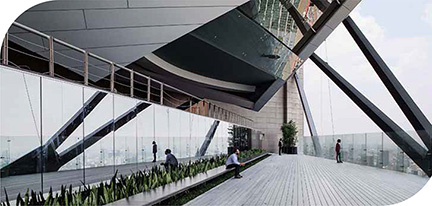
| Contents | ||
| Our Company | ||
| Our Strategy | ||
| Financial Performance | ||
| Environmental Excellence | ||
| Stakeholder Engagement | ||
| Governance | ||
| Corporate Governance | ||
| ● Our Board of Directors | ||
| Executive Committee | ||
| Ethics and Compliance | ||
| Risk and Opportunity Management | ||
| Respect for Human Rights | ||
| Appendix | ||
| 102 Cemex 2024 Integrated Report | ||
Board of Directors Skills Matrix
The following table is a summary of the skills and experience that our Board of Directors’ members contribute to Cemex, encompassing both general and ESG-related aspects.
Each year, Cemex, assisted by external advisors, prepares a questionnaire that all Board members must complete regarding their biographies, skills, and expertise. Once the questionnaires are completed, Cemex’s Legal area reviews and confirms the information using publicly available information. The biographies, skills, and expertise information is then sent to the Chairman and Secretary of the Board of Directors and the company’s CEO before the information is disclosed.
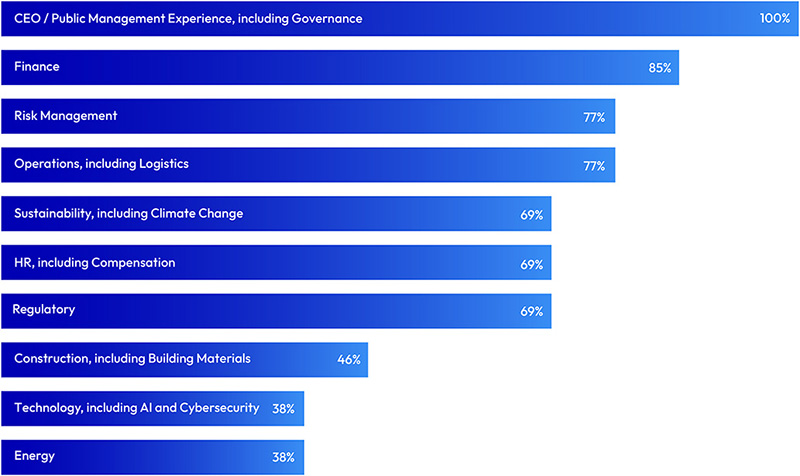
| | For a full list of skills, please refer to the full Board of Directors Skills Matrix on page 226 of this report. |
| Contents | ||
| Our Company | ||
| Our Strategy | ||
| Financial Performance | ||
| Environmental Excellence | ||
| Stakeholder Engagement | ||
| Governance | ||
| Corporate Governance | ||
| ● Our Board of Directors | ||
| Executive Committee | ||
| Ethics and Compliance | ||
| Risk and Opportunity Management | ||
| Respect for Human Rights | ||
| Appendix | ||
| 103 Cemex 2024 Integrated Report | ||
Board Committees
In performing its functions, our Board of Directors is aided by three committees with specialized areas of expertise. These Committees provide counseling and advice and may handle specific tasks on our Board of Directors’ agenda.
The members of our Audit Committee, Corporate Practices and Finance Committee, and Sustainability, Climate Action, Social Impact, and Diversity Committee are appointed by our shareholders. For the full description of each of the Board Committee responsibilities, please refer to our annual report on Form 20-F located at our website at www.cemex.com.

| Audit Committee |
Everardo Elizondo Almaguer – President Gabriel Jaramillo Sanint
Francisco Javier Fernández Carbajal
In accordance with Mexican law and our company’s bylaws, all members of the Audit Committee, including its president, must be independent directors. In addition, as a company listed on the NYSE, Cemex is required to have Audit Committee members with significant financial expertise. As of 2024, the president of our Audit Committee met the qualifications of a “financial expert” as defined by SOX. For detailed information on the skillset of our Audit Committee, please refer to the Board of Directors Skill Matrix on page 226 of this report.
During 2024, the Audit Committee met five times with meeting attendance of 100%.
To aid our Board of Directors in overseeing the main risks to which Cemex is exposed, the Audit Committee periodically reviews an Operational Risk Assessment that focuses on identifying those areas where deficiencies in our controls exist or are more likely to exist, their potential financial impact and the probability of the adverse impact materializing. The Audit Committee members provide guidance on managing these financial and compliance-related risks, aligning with Cemex’s overall risk management strategy.
Responsibilities:
| • | Evaluating internal controls and procedures and identifying deficiencies; |
| • | Dictating corrective and preventive measures in response to breaches of operational and accounting guidelines and policies; |
| • | Evaluating the performance of external auditors and analyzing the reports, opinions, and other information issued by such external auditors; |
| • | Reviewing financial statements; |
| • | Informing the Board of Directors of the state of the company’s internal controls, internal audit, and accounting systems, including any breaches detected; |
| • | Supporting the Board of Directors in producing different reports submitted to the shareholders; |
| • | Assessing the effects of any modifications to the accounting policies approved during any fiscal year; |
| • | Supervising complaints raised by employees, third parties, and other stakeholders to report ethical, corruption, and/or compliance matters utilizing confidential methods and other whistleblowing mechanisms; |
| • | Ensuring compliance by the Chief Executive Officer with the resolutions adopted by the shareholders and Board of Directors; and |
| • | Analyzing the risks identified by independent auditors, and the accounting, internal control, and process assessment areas. |
Certain matters dealt with during 2024:
| • | Follow-up of the SEC inquiries regarding the 2022 annual report filed on Form 20-F; |
| • | Review and analysis of the accounting provisions and impact on the cash flow resulting from the tax proceedings in Spain; |
| • | Review of cybersecurity and artificial intelligence information, risks, and internal controls; |
| • | Determination of the non-applicability of the Minimum Tax in the United States of America; and |
| • | Review of the most relevant transactions and matters during the 2024 calendar year. |
| Contents | ||
| Our Company | ||
| Our Strategy | ||
| Financial Performance | ||
| Environmental Excellence | ||
| Stakeholder Engagement | ||
| Governance | ||
| Corporate Governance | ||
| ● Our Board of Directors | ||
| Executive Committee | ||
| Ethics and Compliance | ||
| Risk and Opportunity Management | ||
| Respect for Human Rights | ||
| Appendix | ||
| 104 Cemex 2024 Integrated Report | ||
| Corporate Practices and Finance Committee |
Francisco Javier Fernández Carbajal – President
Rodolfo García Muriel
Ramiro Gerardo Villarreal Morales
In accordance with Mexican law and our company’s bylaws, all members of the Corporate Practices and Finance Committee, including its president, must be independent directors. During 2024, the Corporate Practices and Finance Committee met four times with meeting attendance of 100%. For detailed information on the skillset of our Corporate Practices and Finance Committee, please refer to the Board of Directors Skill Matrix on page 226 of this report.
To aid our Board of Directors in overseeing the main risks to which Cemex is exposed, the Corporate Practices and Finance Committee reviews and discusses Cemex’s Risk and Opportunity Agenda at least once a year. This Global Risk Agenda outlines key risks and opportunities that may impact the company’s strategic priorities across the short term (1 year), medium-term (1-5 years), and long-term (5+ years). This agenda considers risks at country, regional, and corporate levels, including, but not limited to:
| • | Financial risks (FX, interest rates, refinancing, liquidity) |
| • | Economic risks |
| • | Political and geological risks |
| • | Business planning risks (M&As, acquisitions/divestments, growth strategy) |
| • | Competitive dynamics (market share, pricing) |
| • | Regulatory and compliance risks |
| • | Legal risks |
| • | Sustainability risks (climate, human rights, environmental, social, and governance) |
| • | Supply chain risks |
| • | Cybersecurity risks |
The Committee members are responsible for providing insights and direction on managing these risks and opportunities, as well as overseeing the effectiveness of Cemex’s risk management system.
Responsibilities:
| • | Performing the role of a nomination and compensation committee, mainly by evaluating the hiring, firing, and compensation of our Chief Executive Officer and Chairman of the Board of Directors and reviewing the hiring and compensation policies for our executive officers; |
| • | Reviewing related party transactions, any conflicts of interest, and unusual or material transactions; |
| • | Reviewing different policies, including those regarding the use of corporate assets; |
| • | Evaluating financial plans, merger and acquisition opportunities, and waivers granted to directors, senior management, and certain other persons to participate in and benefit from corporate opportunities; and |
| • | Reviewing the financial strategy and its implementation. |
Certain matters dealt with during 2024:
| • | Review of the 2024 budget and the 2024 financial plan proposed to Cemex’s Board of Directors; |
| • | Review of the annual and variable compensation of Cemex’s Chairman of the Board of Directors and Cemex’s Chief Executive Officer for the year 2024, as well as the variable compensation of senior managers and different business units; |
| • | Review of pension fund status and evaluation; |
| • | Review of the litigation relating to the fines imposed by the tax authorities in Spain; |
| • | Review of proposals on donations, related party transactions, conflict of interest, authorizations to acquire equity securities representing Cemex’s capital stock in compliance with the measures regarding equity thresholds in Cemex set forth in the bylaws, derivative transactions, the self-evaluation and peer evaluation procedure of Cemex’s Board of Directors and the changes to the Insider Trading and Transactions with Cemex Securities Policy; |
| • | Review of 2024 growth strategy, quarterly results and financial transactions; |
| • | A Cemex Group senior talent management review and evaluation; and |
| • | Review of the Global Risk Agenda for the period 2024-2025. |
| Contents | ||
| Our Company | ||
| Our Strategy | ||
| Financial Performance | ||
| Environmental Excellence | ||
| Stakeholder Engagement | ||
| Governance | ||
| Corporate Governance | ||
| ● Our Board of Directors | ||
| Executive Committee | ||
| Ethics and Compliance | ||
| Risk and Opportunity Management | ||
| Respect for Human Rights | ||
| Appendix | ||
| 105 Cemex 2024 Integrated Report | ||
| Sustainability, Climate Action, Social Impact, and Diversity Committee |
Armando J. García Segovia – President
Marcelo Zambrano Lozano
Isabel María Aguilera Navarro
María de Lourdes Melgar Palacios
During 2024, the Sustainability, Climate Action, Social Impact, and Diversity Committee met four times with meeting attendance of approximately 94%. For detailed information on the skillset of our Sustainability, Climate Action, Social Impact, and Diversity Committee, please refer to the Board of Directors Skill Matrix on page 226 of this report.
The Sustainability, Climate Action, Social Impact and Diversity Committee reviews and discusses Cemex’s Sustainability Risk and Opportunity Agenda at least once a year. This Sustainability Risk and Opportunity Agenda identifies key sustainability-related risks and opportunities that could impact Cemex’s sustainability priorities, including but not limited to our Future in Action and social impact strategies, over the short-term (1 year), medium-term (1-5 years), and long-term (5+ years). This agenda considers environmental, social, and governance (ESG) concerns at the local, regional, and corporate levels, covering a broad range of risks, including, but not limited to:
| • | Environmental risks: Air emissions (including CO2), water availability and cost, sustainability regulations. |
| • | Social risks: Community relationships, business ethics, human rights, health and safety, talent attraction and retention. |
| • | Governance and operational risks: ESG disclosure, public sustainability targets, cybersecurity, availability and cost of traditional and alternative energy sources, natural disasters, and sustainability-related products and solutions. |
The Committee members are responsible for providing insights and direction on managing these sustainability risks and opportunities, seeking alignment with Cemex’s overall risk management strategy.
Responsibilities:
| • | Overseeing sustainability, social impact, and diversity policies, strategies, goals, and programs; |
| • | Supporting and overseeing the implementation of our Human Rights program, including our Human Rights policy; |
| • | Evaluating the effectiveness of sustainability and climate action, social impact, and diversity programs, goals, and initiatives; |
| • | Identifying the main risks concerning sustainability-related matters (including human rights) and overseeing mitigation actions; |
| • | Providing assistance to the Chief Executive Officer and senior management team regarding the strategic direction on sustainability and social responsibilities model; and |
| • | Providing assistance to the Corporate Practices and Finance Committee as needed on diversity matters. |
Certain matters dealt with during 2024:
| • | Review of Cemex’s 2023 Integrated Report structure, content, and overall performance, presented in March 2024; |
| • | Review of key sustainability performance indicators (e.g., climate action, health and safety, water and biodiversity, circular economy, and social impact), of benchmarking with industry peers, and of Cemex’s ESG rankings and ratings; |
| • | Discussion of the sustainability strategy in the U.S. and SCA&C regions; |
| • | Review of the 2024-2025 sustainability risk agenda and Cemex’s Future in Action program’s six pillars; |
| • | Review of the progress in achieving Cemex’s sustainability objectives for 2025 and 2030; |
| • | Inclusion in the financial statements of notes related to Cemex’s climate action, as well as on CO2 emissions and sustainable financing; |
| • | Review of the results of Cemex’s employee satisfaction surveys; |
| • | Review of the communication strategy in sustainability issues; |
| • | Analysis of alternatives to promote the access of women to Cemex’s workforce; and |
| • | Review and recommendation for approval of the enhanced Human Rights policy published in 2024, effective January 1, 2025. |
| Contents | ||
| Our Company | ||
| Our Strategy | ||
| Financial Performance | ||
| Environmental Excellence | ||
| Stakeholder Engagement | ||
| Governance | ||
| Corporate Governance | ||
| Our Board of Directors | ||
| ● Executive Committee | ||
| Ethics and Compliance | ||
| Risk and Opportunity Management | ||
| Respect for Human Rights | ||
| Appendix | ||
| 106 Cemex 2024 Integrated Report | ||
Our CEO and members of our Executive Committee execute our strategy and oversee the day-to-day operations of our company and constantly interact with our Board of Directors and certain stakeholders.
Fernando A. González (70)
Chief Executive Officer (since 2014)
Since joining Cemex in 1989, Fernando A. González has held various positions in the Strategic Planning, Business Development, and Human Resources departments through 1998. From 1998 through 2009, Mr. González led various regions of Cemex, including SCA&C, Europe, Asia, and Oceania. He was appointed as Cemex’s Executive Vice President of Planning and Development in May 2009, and he was appointed Cemex’s Chief Financial Officer in 2011. Mr. González held these positions until he was named Chief Executive Officer in 2014. He was named President of the Global Cement and Concrete Association in 2023 and is a member of the Board of Directors of Cemex, GCC, S.A.B. de C.V. and of Axtel, S.A.B. de C.V. He is a member of the Board of Trustees of Tecmilenio University, which forms part of the Instituto Tecnológico y de Estudios Superiores de Monterrey. Mr. González holds a BA degree in Business Administration and an MBA from the Instituto Tecnológico y de Estudios Superiores de Monterrey.
Maher Al-Haffar (66)
Executive Vice President of Finance and Administration and
Chief Financial Officer (CFO)
(since 2020)
Maher Al-Haffar joined Cemex in 2000 and has held several executive positions, including Managing Director of Finance, Head of Investor Relations, and most recently, Executive Vice President of Investor Relations, Corporate Communications, and Public Affairs. In his current position, he heads the areas of Finance, Controllership, Treasury, Insurance & Risk Management, Legal, Procurement & Trading, and Global Enterprise Services. Additionally, he is a member of the UN Global Compact CFO Coalition for the SDGs, NYSE Advisory Board, and before joining Cemex, he spent nineteen years with Citicorp Securities Inc. and with Santander Investment Securities as an investment banker and capital markets professional. He holds a BS degree in Economics from the University of Texas and a Master’s degree in International Relations and Finance from Georgetown University.
| Contents | ||
| Our Company | ||
| Our Strategy | ||
| Financial Performance | ||
| Environmental Excellence | ||
| Stakeholder Engagement | ||
| Governance | ||
| Corporate Governance | ||
| Our Board of Directors | ||
| ● Executive Committee | ||
| Ethics and Compliance | ||
| Risk and Opportunity Management | ||
| Respect for Human Rights | ||
| Appendix | ||
| 107 Cemex 2024 Integrated Report | ||
Mauricio Doehner (50)
Executive Vice President of Corporate Affairs, Enterprise Risk Management and Social Impact (since 2021)
Mauricio Doehner joined Cemex in 1996 and has held several executive positions in areas such as Strategic Planning and Enterprise Risk Management for Europe, Asia, the Middle East, South America and Mexico, and most recently Executive Vice President of Corporate Affairs and Enterprise Risk Management. Additionally, he has also worked in the public sector within the office of the Mexican Presidency. Mr. Doehner was president of the Mexican National Cement Chamber (Cámara Nacional del Cemento) between 2017 and 2019, Vice President of the Transformation Industry Chamber (CAINTRA – Cámara de la Industria de Transformación) between 2012 and 2013. He’s currently Vice President of Social Responsibility and Vertebration of the Mexican Employers Confederation (COPARMEX – Confederación Patronal de la República Mexicana), and member of the board of directors of Vista Oil & Gas, S.A.B. de C.V., Instituto Tecnológico y de Estudios Superiores de Monterrey’s Escuela de Ciencias Sociales y Gobierno (formerly EGAP), Trust for the Americas, and Museo de Arte Contemporáneo de Monterrey, A.C. He holds a BA degree in Economics from the Instituto Tecnológico y de Estudios Superiores de Monterrey, holds an MBA from Instituto Panamericano de Alta Dirección de Empresas (IPADE) and IESE Business School of the University of Navarra in Madrid, and a Master’s in Public Administration from Harvard University.

Jesús González (59)
President of Cemex South, Central America and the Caribbean (since 2019)
Jesús González joined Cemex in 1998 and has held several senior positions, including Corporate Director of Strategic Planning, Vice President of Strategic Planning in Cemex USA, President of Cemex Central America, President of Cemex UK and, more recently, Executive Vice President of Sustainability and Operations Development. He holds a BS in Naval Engineering and an M.Sc. in Naval Engineering, both from the Polytechnic University of Madrid, as well as an MBA from IESE—University of Navarra, Barcelona.
José Antonio González (54)
Executive Vice President of Strategic Planning and Business Development (since 2020)
José Antonio González joined Cemex in 1998 and has held executive positions in the Finance, Strategic Planning, and Corporate Communications and Public Affairs areas, including, most recently, Executive Vice President of Finance and Administration (CFO). Additionally, Mr. González is a member of the board of directors of GCC and is an alternate director of the board of directors of Axtel, S.A.B. de C.V. He holds a BS degree in Industrial Engineering from the Instituto Tecnológico y de Estudios Superiores de Monterrey and an MBA from Stanford University.

Luis Hernández (61)
Executive Vice President of Digital and Organization Development (since 2020)
Luis Hernández joined Cemex in 1996 and has held senior management positions in Strategic Planning and Human Resources. In his current position, he heads the areas of Organization and Human Resources, Information Technology, Digital Innovation, as well as Cemex Ventures. He holds a BS degree in Civil Engineering from the Instituto Tecnológico y de Estudios Superiores de Monterrey, a Master’s degree in Civil Engineering, and an MBA from the University of Texas at Austin.
| Contents | ||
| Our Company | ||
| Our Strategy | ||
| Financial Performance | ||
| Environmental Excellence | ||
| Stakeholder Engagement | ||
| Governance | ||
| Corporate Governance | ||
| Our Board of Directors | ||
| ● Executive Committee | ||
| Ethics and Compliance | ||
| Risk and Opportunity Management | ||
| Respect for Human Rights | ||
| Appendix | ||
| 108 Cemex 2024 Integrated Report | ||
Sergio Menéndez (54)
President of Cemex Europe, Middle East, Africa & Asia (since 2020)
Sergio Menéndez joined Cemex in 1993 and has held several executive positions, including Director of Planning and Logistics in Asia, Corporate Director of Commercial Development, President of Cemex Philippines, Vice President of Strategic Planning for the Europe, Middle East, Africa, and Asia region, President of Cemex Egypt, Vice President of Infrastructure Segment and Government Sales in Mexico, and most recently, as Vice President of Distribution Segment Sales in Mexico. He holds a BS degree in Industrial Engineering from the Instituto Tecnológico y de Estudios Superiores de Monterrey and an MBA from Stanford University.
Jaime Muguiro (56)
President of Cemex USA (since 2019)
Jaime Muguiro joined Cemex in 1996 and has held several executive positions in the Strategic Planning, Business Development, Ready-Mix Concrete, Aggregates, and Human Resources areas. He headed Cemex’s operations in Egypt, our former Mediterranean region, and, more recently, our operations in the South, Central America, and the Caribbean region. He holds a BA degree in Management from San Pablo CEU University in Spain, a Law degree from the Universidad Complutense de Madrid, and an MBA from the Massachusetts Institute of Technology.

Ricardo Naya (52)
President of Cemex Mexico (since 2019)
Ricardo Naya joined Cemex in 1996 and has held several executive positions, including Vice President of Strategic Planning for the South, Central America and the Caribbean region, Vice President of Strategic Planning for the Europe, Middle East, Africa and Asia region, President of Cemex Poland and the Czech Republic, Vice President of Strategic Planning for the United States, Vice President of Commercial and Marketing in Mexico, Vice President of Distribution Segment Sales in Mexico, and most recently, President of Cemex Colombia. He holds a BA degree in Economics from the Instituto Tecnológico y de Estudios Superiores de Monterrey de Monterrey and an MBA from the Massachusetts Institute of Technology.

Louisa (Lucy) P. Rodriguez (65)
Executive Vice President of Investor Relations, Corporate Communications and Public Affairs (since 2021)
Lucy Rodriguez joined Cemex in 2006 and has held several executive positions, including Head of Investor Relations. She has over 25 years of experience in international finance and capital markets. Prior to Cemex, Ms. Rodríguez spent 15 years at Citibank and Santander where she was a capital markets professional in Emerging Markets and held various senior management roles. Additionally, she is a member of the board of directors of BDT & MSD Investment Corp, a $4 billion private credit fund in the U.S. In her early career, she also worked for KPMG, and she was previously a Certified Public Accountant. She holds a BA degree in Economics from Trinity College (Hartford, CT.), an MBA from New York University, and a Master’s from Columbia University School of International and Public Affairs.
| Contents | ||
| Our Company | ||
| Our Strategy | ||
| Financial Performance | ||
| Environmental Excellence | ||
| Stakeholder Engagement | ||
| Governance | ||
| Corporate Governance | ||
| Our Board of Directors | ||
| ● Executive Committee | ||
| Ethics and Compliance | ||
| Risk and Opportunity Management | ||
| Respect for Human Rights | ||
| Appendix | ||
| 109 Cemex 2024 Integrated Report | ||
Executive Compensation
In 2024, we paid an aggregate amount of US$48 million in compensation to the members of our Board of Directors and our senior management, of which US$31 million were paid as base compensation and cash-based performance bonuses, including pension and post-employment benefits, and US$17 million corresponded to stock-based long-term compensation. Members of our Board of Directors are compensated in a fixed amount based on participation in meetings of our Board of Directors, which is approved each year at our Ordinary General Shareholders Meeting. The Chairman of our Board of Directors is compensated in a similar manner as our senior management.
The following table discloses the amount of compensation paid to our Senior Management for the years ended December 31, 2024, 2023, and 2022:
| Year | Average Total Compensation paid to our Senior Management (1) (2) | Average Adjusted paid to our Senior | Consolidated Net Income (Loss) (Millions of Dollars) | Most significant financial measure | ||||
| 2024 | 3.7 million | 4.6 million | 960 | CVA | ||||
| 2023 | 5.0 million | 7.6 million | 199 | CVA | ||||
| 2022 | 3.1 million | 3.4 million | 885 | CVA | ||||
| 1 | Our Senior Management includes our Executive Committee members, our Vice President of Comptrollership and our Senior Vice President of Legal. |
| 2 | The amount of “Average Total Compensation paid to our Senior Management” includes paid salary, bonuses, stock awards, (including, but not limited to, our Key Value Positions Plan (“KVP Plan”) and the Performance Plan, as defined below), our Variable Compensation Plan (“VCP”), and other compensation benefits. |
| 3 | The “Average Adjusted Compensation paid to our Senior Management” is the Average Total Compensation paid to our Senior Management, adjusted to consider the addition or subtraction, as applicable, of equity award value as follows: (i) for awards granted in the covered fiscal year which are outstanding and unvested at year end, the fair value as of the end of the applicable year; (ii) for awards granted in prior fiscal years that are outstanding and unvested at the end of the applicable year, the amount equal to the change in fair value as of the end of the applicable year (from the end of the prior year); (iii) for awards granted in the applicable year that vest in the year of the grant, the fair value as of the vesting date; and (iv) for awards granted in prior years that vest during the applicable year, the amount equal to the change in fair value as of the vesting date (from the end of the year). |
To calculate the correlation between the compensation paid to our Senior Management and Cemex, S.A.B. de C.V.’s performance for the year ended December 31, 2024, we used the following financial and other measures: (i) cash value added (CVA); (ii) total shareholder return; and (iii) our CO2 Emissions Component (as defined below). For the years ended December 31, 2024, 2023 and 2022, CVA was the most significant financial measure that we used to determine the compensation paid to our Senior Management.
Variable Compensation Plan
The Variable Compensation Plan available to our employees takes into account their individual performance, as well as metrics that consider their business unit’s, regional and consolidated global results as compared to the company’s specific annual target goals, including certain health and safety and sustainability-related factors.
Since 2022, our Variable Compensation Plan includes a new CO2 Emissions Component related to carbon reduction goals that could have an impact ranging from -10% to +10% in the total cash payout of the annual Variable Compensation Plan. Furthermore, in March 2022, we expanded our Variable Compensation Plan to cover more than 4,400 executives. During 2024, the variable compensation payment to employees was US$130.5 million. Following 2023’s results, the percentage of variable compensation paid in 2024 was 198.8% of target variable compensation.

| Contents | ||
| Our Company | ||
| Our Strategy | ||
| Financial Performance | ||
| Environmental Excellence | ||
| Stakeholder Engagement | ||
| Governance | ||
| Corporate Governance | ||
| Our Board of Directors | ||
| ● Executive Committee | ||
| Ethics and Compliance | ||
| Risk and Opportunity Management | ||
| Respect for Human Rights | ||
| Appendix | ||
| 110 Cemex 2024 Integrated Report | ||
Restricted Stock Incentive Plan
Our employees receive stock-based compensation generally by being allocated a specific number of restricted equity securities as variable compensation to be vested over a four-year period. We have 3 compensation programs that conform to our Restricted Stock Incentive Plan: (1) the Ordinary Plan, whose annual award is calculated based on the result of the gross annual guaranteed compensation of the participants in dollars as of May 31 of each calendar year, times a management factor that ranges from 12% to 24%, divided by the last 90-day average closing price in dollars of Cemex’s CPOs or ADSs, as applicable, as of June 30 of such calendar year; (2) the Key Value Positions Plan (KVP Plan), which includes executives in key-value positions and whose annual award is based on the result of the variable cash compensation bonus in dollars paid in the prior year to these participants and divided by the last 90-day average closing price in dollars of CPOs or ADSs, as applicable, as of April 15 of each calendar year; and (3) the Performance Plan, a long-term performance plan with compensation based on Cemex’s total shareholder return versus peer groups and vesting occurring at the end of 3 years in a single 100% block.
In 2024, we began implementing the amendments made to our Restricted Stock Incentive Plan in 2023, which allowed for the granting and vesting of awards in ADSs, among other matters. All other terms and conditions of the Restricted Stock Incentive Plan remain substantially unchanged.
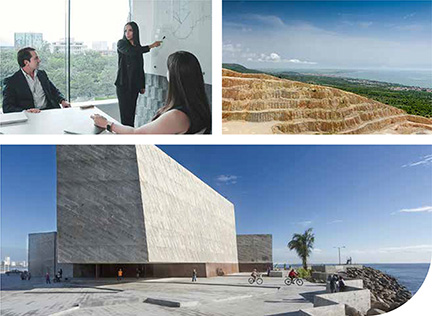
Extraordinary Management Grant
Our Extraordinary Management Grant is a retention program offered at the Company’s sole discretion to a selected number of employees that do not participate in the Ordinary Plan, KVP, or the Performance Plan. Under the Extraordinary Management Grant, vesting occurs at the end of 3 years in a single 100% block, at which time the resulting number of CPOs or ADSs, as applicable, become unrestricted immediately. Since the Extraordinary Management Grant came into effect in 2022 and there is a 3-year vesting period, as of December 31, 2024, no CPOs have vested under the Extraordinary Management Grant.
Compensation of Cemex, S.A.B. de C.V.’s Chief Executive Officer and Senior Management
The base salary of the Chairman of our Board of Directors is 27% fixed and 73% variable. Our executive compensation structure is reviewed every 2 years by an external firm specializing in multinational risk management, insurance brokerage, and advisory. The total compensation (including fixed and variable compensation) of the Chairman of our Board of Directors and Chief Executive Officer is approved every year by the Corporate Practices and Finance Committee of our Board of Directors, which is integrated by 3 independent Board members.
Compensation of Cemex, S.A.B. de C.V.’s Chief Executive Officer
and Senior Management(1)
| Full Year 2024-Chief Executive Officer | % | |||
| Salary | 17 | |||
| Short-Term Performance Bonus (Cash) | 18 | |||
| Long-Term Performance Bonus (Restricted Stock) | 37 | |||
| Long-Term Performance Shares | 28 | |||
| 100 | ||||
| Full Year 2024-Senior Management | % | |||
| Salary | 37 | |||
| Short-Term Performance Bonus (Cash) | 23 | |||
| Long-Term Performance Bonus (Restricted Stock) | 22 | |||
| Long-Term Performance Shares | 18 | |||
| 100 | ||||
| 1 | For purposes of this table, information regarding our Senior Management does not include data pertaining to our Chief Executive Officer. |
| Contents | ||
| Our Company | ||
| Our Strategy | ||
| Financial Performance | ||
| Environmental Excellence | ||
| Stakeholder Engagement | ||
| Governance | ||
| Corporate Governance | ||
| Our Board of Directors | ||
| Executive Committee | ||
| ● Ethics and Compliance | ||
| Risk and Opportunity Management | ||
| Respect for Human Rights | ||
| Appendix | ||
| 111 Cemex 2024 Integrated Report | ||
Commitment to Compliance
At Cemex, we are committed to conducting our business in compliance with applicable laws, regulations, and corporate policies, controls and procedures, while upholding the highest ethical standards. These principles are embedded in our Code of Ethics and Business Conduct (Our Code), which employees are required to ratify periodically. Additionally, employees must acknowledge and certify their participation in annual training sessions and pathways for anti-corruption and other mandatory compliance topics.
Cemex’s commitment to compliance is clearly communicated by our company’s leadership. Our values and ethical standards are conveyed throughout our organization through communication campaigns, training programs, Our Code, other corporate policies, controls and procedures, and through internal meetings.
Additionally, one of our core values is to Act with Integrity. Act with Integrity is a must in our day-to-day interactions, as it is crucial for Cemex’s sustained success in fostering a workplace environment in which our people can thrive. Our value of Acting with Integrity is even included as one of the six core competencies that are taken into consideration in employee performance evaluations, which are linked to our executive variable compensation.
Global Compliance Program
Our governance best practices include robust global compliance, audit, and training programs, as well as initiatives on ethical business dealings and conflicts of interest, among other related matters. Cemex’s Global Compliance Program incorporates risk analysis, due diligence and third-party risk management, trainings, legal audits and investigations, and global communication campaigns at all levels of our organization.
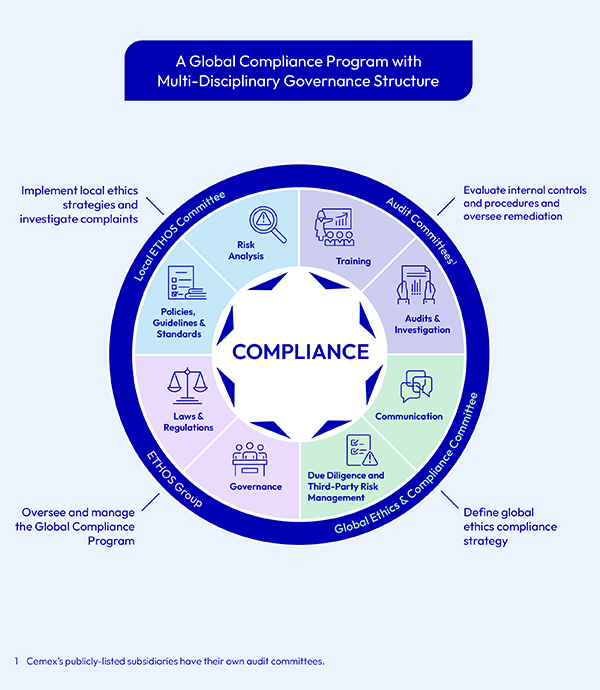
| Contents | ||
| Our Company | ||
| Our Strategy | ||
| Financial Performance | ||
| Environmental Excellence | ||
| Stakeholder Engagement | ||
| Governance | ||
| Corporate Governance | ||
| Our Board of Directors | ||
| Executive Committee | ||
| ● Ethics and Compliance | ||
| Risk and Opportunity Management | ||
| Respect for Human Rights | ||
| Appendix | ||
| 112 Cemex 2024 Integrated Report | ||
In particular, the general Ethics and Compliance structure is as follows:
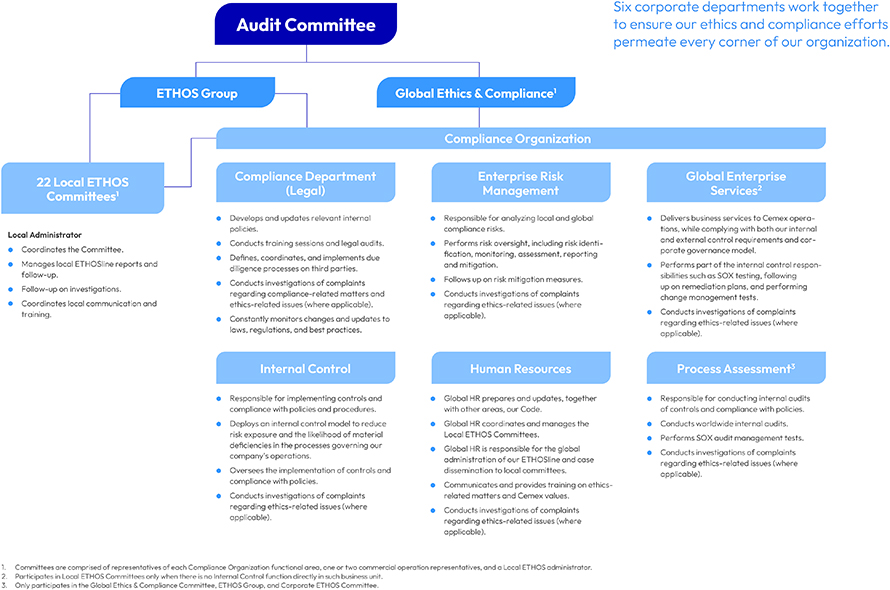
| Contents | ||
| Our Company | ||
| Our Strategy | ||
| Financial Performance | ||
| Environmental Excellence | ||
| Stakeholder Engagement | ||
| Governance | ||
| Corporate Governance | ||
| Our Board of Directors | ||
| Executive Committee | ||
| ● Ethics and Compliance | ||
| Risk and Opportunity Management | ||
| Respect for Human Rights | ||
| Appendix | ||
| 113 Cemex 2024 Integrated Report | ||
Main Matters Covered by Our Global Ethics
and Compliance Program
We have policies, controls, procedures, guidelines, and processes, including due diligence and third-party risk management frameworks, that assist us with topics such as:
Third Parties: reviewing third parties with whom we do business. Cemex places a high priority on verifying that third parties we do business with are reputable and are aligned with our values.
Conflicts of Interest: having oversight that employees are acting in accordance with Cemex’s best interests.
Related Person Transactions: reviewing related party transactions seeking to comply with applicable regulations and market practices, while also reporting and evaluating any transactions with related persons.
Insider Trading: we have implemented a framework regulating the use of Cemex’s material non-public information in accordance with applicable securities laws and regulations. In addition, we issue quiet period notices to relevant employees during sensitive times to further reinforce our rules around insider trading.
Antitrust Compliance: Cemex is committed to conducting our business in accordance with the principle of fair trade and competition in the countries where we operate.
Data Protection and Privacy: we comply with applicable legal requirements in relation to personal data and the rights of data subjects.
| | To learn more about our policies, please visit our website |
Employees across all our operations participated in one or more ethics and compliance training sessions during 2024.
| Anti-Corruption and Anti-Money Laundering: we emphasize a zero-tolerance stance on bribery and corruption, as well as on money laundering.
International Trade Compliance and Sanction Programs: we follow the applicable trade control, economic sanctions, and anti-boycott laws wherever we operate. We incorporate sanctions screening into our due diligence procedures to avoid any transactions or dealings with blacklisted individuals or entities, or those included in sanctioned programs or based in, or operating in, sanctioned countries. |
|
| Contents | ||
| Our Company | ||
| Our Strategy | ||
| Financial Performance | ||
| Environmental Excellence | ||
| Stakeholder Engagement | ||
| Governance | ||
| Corporate Governance | ||
| Our Board of Directors | ||
| Executive Committee | ||
| ● Ethics and Compliance | ||
| Risk and Opportunity Management | ||
| Respect for Human Rights | ||
| Appendix | ||
| 114 Cemex 2024 Integrated Report | ||
Training on Business Ethics
and Compliance Principles
Cemex’s business ethics and compliance principles are continuously reinforced with employees through trainings, compliance sessions, communications, and self-reporting requirements.
In 2024, we launched a new course called Doing What’s Right: ETHOS in Action, a 1.5-hour training course that reinforces the values and standards of our Code of Ethics. This training course covers issues such as how to manage ethical questions in supplier relations, verbal harassment, and health and safety scenarios. Additionally, it covers conflicts of interest, provided tools for ethical decision-making and manager training, and offered a general view of our ETHOS program. Employees are encouraged to use our ETHOSline to confidentially address ethical concerns.
Cemex employees are required to participate in multiple training programs on an annual basis, which may include several ethics and compliance training sessions, as well as the completion of various Cemex University pathways. These training sessions are delivered both online and through instructor-led formats. Ethics training is conducted by the corporate, regional or local Human Resources departments, while Compliance training is led by the corporate, regional or local Legal departments. Depending on the course, certain sessions are mandatory for employees in specific departments or areas.
2024 Ethics and Compliance Related Programs
| Cemex Employees | Externals | TOTAL (Employees + Externals) | ||||||||||||||||||||||||||||||
| TOPIC | Number of Employees Trained1 | Total Training Hours | Number of Externals | Total Training | Number of Individuals | Total Training Hours | ||||||||||||||||||||||||||
| Ethics3 | 3,697 | 4,867 | 24 | 238 | 3,721 | 5,105 | ||||||||||||||||||||||||||
| Compliance4 | 4,866* | 7,742* | 306 | 335 | 5,172 | 8,077 | ||||||||||||||||||||||||||
| Cemex University Pathways | ||||||||||||||||||||||||||||||||
| Anti-Corruption | 1,063 | 797 | 2 | 2 | 1,065 | 799 | ||||||||||||||||||||||||||
| Antitrust | 2,856 | 5,712 | 15 | 30 | 2,871 | 5,742 | ||||||||||||||||||||||||||
| Data Retention | 477 | 159 | 19 | 6 | 496 | 165 | ||||||||||||||||||||||||||
| Data Privacy | 9 | 3 | 1 | 0 | 10 | 3 | ||||||||||||||||||||||||||
| Doing What’s Right: ETHOS in Action | 10,617 | 15,926 | 155 | 233 | 10,772 | 16,158 | ||||||||||||||||||||||||||
| ETHOS: Do the Right Thing Part 1 | 2,008 | 2,008 | 145 | 145 | 2,153 | 2,153 | ||||||||||||||||||||||||||
| ETHOS: Do the Right Thing Part 2 | 2,670 | 2,670 | 123 | 123 | 2,793 | 2,793 | ||||||||||||||||||||||||||
| Our Values | 472 | 94.4 | 1 | 0.2 | 473 | 95 | ||||||||||||||||||||||||||
| Sanctions, Export Controls and Anti-Boycott Laws | 7,460 | 4,973 | 24 | 16 | 7,484 | 4,989 | ||||||||||||||||||||||||||
| Sexual Harassment | 368 | 247 | 6 | 6 | 374 | 253 | ||||||||||||||||||||||||||
| Takeoff (Onboarding for new hires) | 3,300 | 825 | 247 | 61.75 | 3,547 | 887 | ||||||||||||||||||||||||||
| Understanding Confidentiality | 112 | 112 | 7 | 7 | 119 | 119 | ||||||||||||||||||||||||||
| Unconscious Bias | 806 | 2,418 | 57 | 171 | 863 | 2,589 | ||||||||||||||||||||||||||
| 1 | There are no duplicate counts of employees and externals within Ethics, Compliance, and Cemex University Pathways individually. However, there may be duplicates between these three categories, as some employees and externals are required to complete multiple training sessions from these categories throughout the year. Employees from divested operations (Guatemala, Philippines, Dominican Republic, and Haiti) are not included. |
| 2 | Externals include any users with an @ext.cemex.com email address, any user with non-institutional emails, and/or third parties such as suppliers, service providers, among others. |
| 3 | Ethics topics include Cemex values, conflicts of interest, diversity and inclusion, fraud, leadership development, non-discrimination, non-harassment, non-bullying, non-retaliation, cybersecurity, among others. |
| 4 | Compliance topics include anti-corruption, anti-money laundering, antitrust, confidential information, conflict minerals, contracts, data privacy, data retention, due diligence processes, greenwashing, human rights, insider trading, labor regulations, non-retaliation, sanctions programs, export controls, anti-boycott laws, among others. |
| * | For purposes of this table, this number includes 74 employees of one of our subsidiaries in Mexico that had not been accounted for in previous years. |
| Contents | ||
| Our Company | ||
| Our Strategy | ||
| Financial Performance | ||
| Environmental Excellence | ||
| Stakeholder Engagement | ||
| Governance | ||
| Corporate Governance | ||
| Our Board of Directors | ||
| Executive Committee | ||
| ● Ethics and Compliance | ||
| Risk and Opportunity Management | ||
| Respect for Human Rights | ||
| Appendix | ||
| 115 Cemex 2024 Integrated Report | ||
Reporting and Investigations
ETHOSline is our main intake channel, accounting for 86% of the reports we receive. At Cemex, we prioritize a trusted reporting system for ethics and compliance concerns. Employees, stakeholders, or third parties can raise issues via our online portal, email, phone line, or other reporting channels, including local and global committees. We strongly encourage reporting and maintain a strict no-retaliation policy for those who report in good faith.
ETHOSline is our institutional reporting mechanism, accessible through our website, mobile devices, or our intranet, that is open and free for anyone to use. This secure, confidential, and independent platform is available 24 hours a day, seven days a week, to both employees and the general public, including our third parties, to report any allegations of misconduct anonymously or confidentially. To secure confidentiality, ETHOSline runs on a platform provided by NAVEX Global, a third-party expert on ethics and compliance reporting. Certain reports go directly to the company’s internal audit area, which directly reports to Cemex’s Board of Directors’ Audit Committee, comprised exclusively of independent board members.
To achieve impartial, credible, fair, and consistent results, our ETHOS governing bodies must abide by our ETHOS manuals which provide directives and guidelines on how to properly manage reports, complaints, and inquiries received through ETHOSline, with the purpose of guaranteeing an effective end-to-end process. In 2024, 171 executives, who are members of our ETHOS governing bodies, received training on global ethical trends and investigation procedures.
As of January 8, 2025, a total of 1,189 cases were reported through our official channels for the year 2024, of which approximately 86% were received through ETHOSline, approximately 8% were received through local committees, and less than 2% were received through our Global Ethics and Compliance Committee. Out of those cases, 997 were closed by the end of 2024, of which 35% were substantiated. As a result of the investigations, 72 employees were dismissed, 22 employees received remedial training, 169 employees were subject to disciplinary action, 11 vendors were prohibited from working with Cemex and 7 vendors were subjected to remedial measures. Additionally, 23 internal processes and policies were reviewed and updated. We also resolved 96 inquiries through our official channels.
Furthermore, we have a process to safeguard whistleblowers from retaliation. This process includes providing individual follow-up to whistleblowers after the submission and resolution of cases through surveys. Additionally, for employee reporters, we assess changes in their employment status after reporting.
In 2024, we emphasized the importance of our ETHOSline channel by providing employees with transparent progress summaries throughout the year, including, but not limited to, investigation outcomes. This effort reinforced our commitment to accountability.
Additionally, in 2024, Cemex emphasized four key topics in ethics such as non-retaliation, how to navigate pressure in the workplace, as well as our progress throughout the year. We also piloted our first ETHOS Week in our corporate offices and Mexico regional headquarters. During this week, we emphasized topics such as Conflict of Interest, our reporting channels, and gave further training to managers in navigating their team’s ethical concerns. This impacted 1,500 employees who participated in the live activities and 8,500 employees who received the invitation to participate remotely.
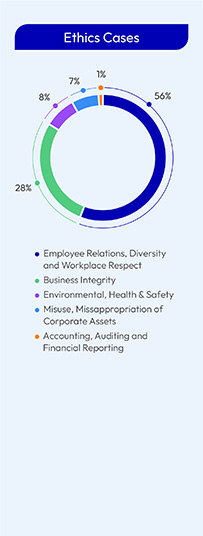
| Contents | ||
| Our Company | ||
| Our Strategy | ||
| Financial Performance | ||
| Environmental Excellence | ||
| Stakeholder Engagement | ||
| Governance | ||
| Corporate Governance | ||
| Our Board of Directors | ||
| Executive Committee | ||
| ● Ethics and Compliance | ||
| Risk and Opportunity Management | ||
| Respect for Human Rights | ||
| Appendix | ||
| 116 Cemex 2024 Integrated Report | ||
Internal Legal Audits
Our internal legal audits serve as another means to evaluate and verify the knowledge and compliance of Cemex’s relevant policies by certain key employees. The ultimate purpose of this exercise is to identify areas of opportunity to continuously improve and enhance our compliance policies and procedures. In 2024, 631 internal legal audits were conducted, both in-person and remotely, in 26 countries, with a particular focus on familiarity with our ETHOS Program, anti-corruption, anti-money laundering, antitrust, sanctions programs, export controls and anti-boycott laws, insider trading, handling Cemex’s confidential information, data retention, data privacy, conflicts of interest, third party due diligence, human rights, and conflict minerals. We conducted audits to certain key employees in 100% of the countries where we operate which are considered high-risk, meeting our 2025 target ahead of plan.
100%
operations audited in high-risk
countries, achieving our
2025 target ahead of plan
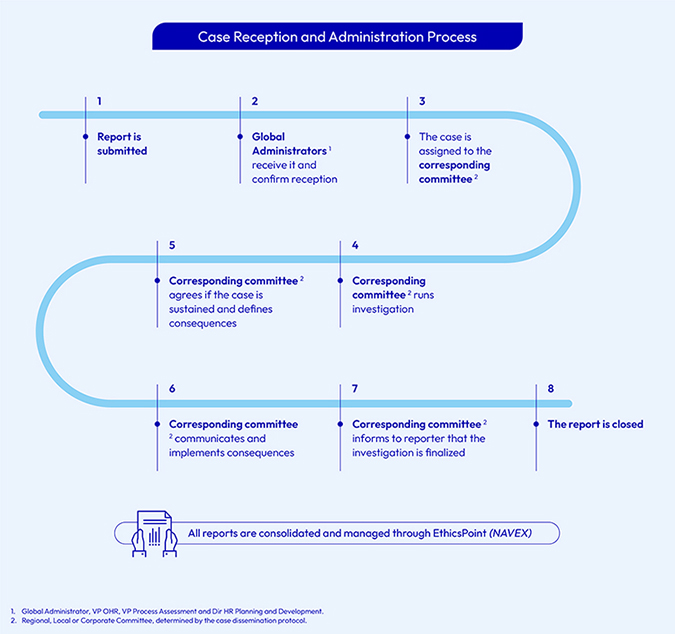
| Contents | ||
| Our Company | ||
| Our Strategy | ||
| Financial Performance | ||
| Environmental Excellence | ||
| Stakeholder Engagement | ||
| Governance | ||
| Corporate Governance | ||
| Our Board of Directors | ||
| Executive Committee | ||
| Ethics and Compliance | ||
| ● Risk and Opportunity Management | ||
| Respect for Human Rights | ||
| Appendix | ||
| 117 Cemex 2024 Integrated Report | ||
Management
Cemex operates in a rapidly changing business environment that exposes the company to risks and opportunities that could impact the achievement of its strategic priorities.
Risk & Opportunity
Management System
Cemex has an Enterprise Risk Management (“ERM”) system established throughout the organization with global policies and procedures designed to anticipate and manage the main risks and opportunities that could affect our business. Our ERM system is a combination of bottom-up and top-down strategies to support better-informed decision making and risk management strategy at all levels of the organization.
Sustainability risks and opportunities, including those related to climate change, are managed within the ERM system.
Risk & Opportunity Governance
Our Board of Directors, through the corresponding Board Committees, provides strategic guidance and oversight into risk and opportunity management by regularly discussing the enterprise risk and opportunity agenda and reviewing the effectiveness of our risk and opportunity management system enforced by our Risk Management Committee. Additionally,
our Board of Directors provide guidance on industry-specific risks and sustainability matters, including but not limited to human rights and climate-related risks and opportunities.
The Risk Management Committee, which is composed of the Executive Committee members at a global level, reviews Cemex’s risk exposure at least twice a year through discussion of enterprise risk and opportunity agenda.
Additionally, our risk management governance adheres to a three lines of defense framework. In the first line, process owners are responsible for risk and opportunity management in their day-to-day activities. Cemex’s risk management-related areas and bodies including but not limited to ERM, Internal Control, Financial Risk Management, and ETHOS and Compliance represent the second line of defense by developing policies, processes and controls for risk management. Finally, in the third line of defense, internal and external audits evaluate the effectiveness of our risk management processes and controls.
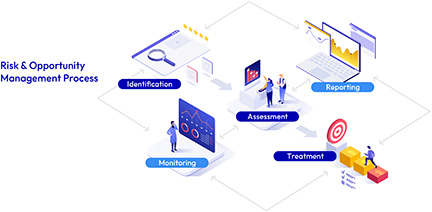
Risk & Opportunity Management Process
Our risk and opportunity agenda, developed at country, regional, and global levels, results from a comprehensive ERM process that identifies and manages different types of risks, trends, emerging concerns, and opportunities that could impact Cemex’s strategic priorities in the short, medium, and long term.
The ERM Process consists of five phases:
Identification - Following a bottom-up and a top-down strategy, we employ risk interviews, online risk surveys, risk workshops, and external experts’ insights, among other techniques, to identify events that could impact Cemex in the short, medium, or long term.
Assessment - Risks and opportunities are evaluated and prioritized employing qualitative and quantitative methods to determine their potential impact and likelihood of materialization in a specific timeframe.
Treatment - We define a risk owner as responsible for the treatment of a particular risk, and ERM representatives follow up on risk treatment actions, in some cases acting as coordinators of ad-hoc task forces focused to mitigate specific risks or capitalize on identified opportunities.
Reporting - Main risks and opportunities are integrated into the enterprise risk and opportunity agenda, which is discussed by senior management at global, regional, and country levels. Relevant changes in the status of identified risks, opportunities and treatment measures are promptly communicated to decision makers through several reports.
Monitoring - We constantly monitor the business environment in which we operate to effectively report risks and opportunities to decision-makers.
| Contents | ||
| Our Company | ||
| Our Strategy | ||
| Financial Performance | ||
| Environmental Excellence | ||
| Stakeholder Engagement | ||
| Governance | ||
| Corporate Governance | ||
| Our Board of Directors | ||
| Executive Committee | ||
| Ethics and Compliance | ||
| ● Risk and Opportunity Management | ||
| Respect for Human Rights | ||
| Appendix | ||
| 118 Cemex 2024 Integrated Report | ||
Our risk and opportunity management processes adhere to best practices from the ISO 31000, ISO 22301, and ISO 22361 standards for risk management, business continuity and crisis management, as well as to the Business Continuity Institute guidelines. Additionally, our ERM team includes professionals accredited on ISO 31000 and ISO 31010 techniques, members of the Risk Management Society, and individuals who belong to other international risk management networks.
Risk Appetite and Tolerance
Risk appetite is the amount of risk Cemex is willing to accept to achieve its objectives. It considers a scale of three levels: averse, minimum, and cautious. Cemex is adverse to certain risk implications, such as those relating to health and safety or compliance, without exceptions.
Risk tolerance is the level of variation from the risk appetite that Cemex is willing to accept to achieve its objectives. The Board of Directors, following recommendation from its respective committees, is responsible for determining Cemex’s risk appetite and tolerance with the support of Cemex’s Risk Management Committee.
Business Continuity & Crisis Management Program
Our Business Continuity & Crisis Management (“BC&CM”) program is fundamental to the ERM system. The BC&CM program enables a proactive and effective risk management response during disruptive events by assisting business units safeguard lives, act responsibly, and recover business promptly. In doing so, the program aims to protect personnel, support stakeholders, and safeguard reputation while reducing the cost of disruptions, and other legal and financial exposures.
The program includes training, protocols, tools, and drills aligned with our company values and is managed by local Rapid Response Teams (“RRTs”) deployed across our business units and, if required, escalated to country or functional areas, regional or global RRT.
RRTs are trained multidisciplinary teams responsible for monitoring, communicating, activating, coordinating, and delegating the execution of event-driven, stakeholder-driven, or process-driven protocols, as well as timely objective-driven decisions.
In 2024, the BC&CM program enabled us to support business units in monitoring, managing, and responding to disruptive natural events such as hurricanes and floods in Mexico, the U.S., SCA&C, and EMEA regions. Approximately 300 managers in 17 different countries were trained as part of Rapid Response Teams.
Main Strategic Risks and Mitigation Strategies
The following is a brief description of some of the principal risks and uncertainties faced by Cemex and our corresponding mitigation strategies at the time of compilation of this report. These risks and uncertainties are listed and prioritized based on their overall risk rating, which is based on their estimated probability (likelihood of the risk materializing) and impact (qualitative/quantitative consequences for Cemex if the risk materializes). As of the end of 2024, we anticipate that new risks and uncertainties may emerge or materialize in 2025 and beyond due to changes in markets, business dynamics, regulatory environments, and other factors. Additionally, the risks outlined here may become of lesser or greater importance over time.
 | Uncertain Economic | |
| Conditions |
 | Impact on Strategic Priorities: EG, I | |
| Risk Appetite: Cautious | ||
| Impact on Supply Chain: Upstream, | ||
| Own Operations, Downstream | ||
Description
Our industry, businesses, and markets are significantly influenced by global, regional, and national economic conditions. The rapidly evolving global macroeconomic landscape continues to present uncertainties. Potential economic risks include persistent inflationary pressures, high interest rates, potential for trade and supply chain disruptions, economic slowdown, monetary policies aimed at reducing inflation, policy divergence among major economies, domestic policy uncertainty related to newly elected governments, escalation in tariffs worldwide, increased economic protectionism, fiscal deficits, shifts in public spending, energy and food price shocks, foreign exchange volatility, rising living costs, cybersecurity threats, the unregulated growth of cryptocurrencies and artificial intelligence, and the impact of climate change on economic stability and growth. These factors can substantially alter the expected economic growth and demand for construction and building materials.
Potential Impact
Market contraction, lower sales, increased input and operational cost, tightening of financial markets, foreign exchange volatility, among others, all of which could materially and adversely impact our business, financial condition, liquidity, and results of operations.
Mitigation Strategies
| • | Enhance EBITDA growth and margin through strong pricing and increased sales from Vertua products and Urbanization Solutions. |
| • | Deliver superior customer experience enabled by digital technologies and Cemex Go. |
| • | Compete based on quality, client segmentation, and higher value proposition. |
| • | Execute portfolio rebalancing strategy, optimize our portfolio for growth, accelerate bolt-on and margin enhancement projects. |
| • | Maintain strict cost discipline. |
| • | Execute financial strategy. |
Impact on Strategic Priorities:
| HS | Health & Safety |
| CC | Customer Centricity |
| EG | EBITDA Growth |
| I | Innovation |
| S | Sustainability |
| Contents | ||
| Our Company | ||
| Our Strategy | ||
| Financial Performance | ||
| Environmental Excellence | ||
| Stakeholder Engagement | ||
| Governance | ||
| Corporate Governance | ||
| Our Board of Directors | ||
| Executive Committee | ||
| Ethics and Compliance | ||
| ● Risk and Opportunity Management | ||
| Respect for Human Rights | ||
| Appendix | ||
| 119 Cemex 2024 Integrated Report | ||
 | Changes in Competitive Landscape |
| | Impact on Strategic Objectives: CC, EG | |
| Risk Appetite: Cautious | ||
| Impact on Supply Chain: Operations, | ||
| Downstream | ||
Description
The markets in which we operate remain highly competitive and are served by a variety of established companies with recognized brand names. New production capacities, corporate restructurings, increasing imports, new market entrants, rising inflation and logistics costs, aggressive pricing strategies by competitors, mergers and acquisitions, and industry consolidation, among others, have caused and may continue to cause supply-demand imbalances and affect the competitive landscape. Additionally, a potential decline in demand for cement, ready-mix concrete, aggregates, and other materials and solutions, including urbanization solutions, could affect market dynamics.
Potential Impact
Failure to compete effectively may affect our price and volume strategy and the results of our operations. We may lose substantial market share, our sales could decline or grow at a slower rate, the valuation of our stock may be affected, and our pricing and margin enhancement efforts could be hindered, any of which could adversely impact our business, financial condition, liquidity, and the results of our operations.
Mitigation Strategies
| • | Deliver superior customer experience enabled by digital technologies and Cemex Go. |
| • | Compete based on quality, client segmentation and higher value proposition. |
| • | Grow EBITDA through margin enhancement, pricing discipline, and our customer centric commercial strategy. |
| • | Execute portfolio rebalancing strategy, optimize our portfolio for growth, accelerate bolt-on and margin enhancement projects. |
| • | Focus on production efficiency to reduce costs and increase volumes. |
 | Political Uncertainty |
| | Impact on Strategic Priorities: HS, CC, EG | |
| Risk appetite: Cautious | ||
| Impact on supply chain: Upstream, Own | ||
| Operations, Downstream | ||
Description
We are subject to the political, social, and economic environment of the countries where we operate. Changes in federal or national government and the political party in control of the legislature in any of the countries where we operate could result in changes to the countries’ economic, political, or social conditions, and in changes to laws, regulations and public policies, affecting areas such as international trade, foreign affairs, manufacturing and investment. These changes may contribute to economic uncertainty or adverse business conditions. Globally, in 2024 the political risk was heightened by elections in more than 60 countries; presidential, legislative, state, and local elections took place in some of our main markets including Mexico and the U.S. In 2025, presidential, parliamentary, and state elections are expected in some of our markets, including Mexico, some countries in the EMEA and the SCA&C region. Additionally, we cannot exclude the possibility of future snap elections.
Potential Impact
Political uncertainty, economic slowdown or recession, social instability, business disruption, increased costs, imposition of new regulations and/or taxes, instability of business landscape, negative impact on governability and rule of law, public policy uncertainty, delay to obtain or renew permits, among other events have the potential to materially and adversely impact our people, business, financial condition, liquidity, and the results of our operations.
Mitigation Strategies
| • | Execute tailor-made public affairs strategy per country. |
| • | Cooperate and engage with governments, regulators, and legislators through business associations. |
| • | Implement business continuity plans and RRTs to safeguard the lives of our people and minimize business disruption. |
| • | Monitor political, geopolitical, and social events and prepare for risk scenarios. |
 | Unexpected escalation of a geopolitical conflict
|
| | Impact on Strategic Priorities: H&S, CC, EG | |
| Risk appetite: Cautious | ||
| Impact on supply chain: Upstream, Own | ||
| Operations, Downstream | ||
Description
As a global company, Cemex is wary of specific geopolitical tensions that could have a sudden escalation, affecting the lives of our employees and business results. The development of previous and new geopolitical conflicts, such as Russia’s invasion of Ukraine, the ongoing conflicts in the Middle East, and recent developments involving the fall of the Syrian government
may impact our markets, business results, and financial conditions. In addition, tensions between China and Taiwan, as well as maritime tensions between China and Southeast Asian nations regarding claims in the South China Sea are constantly evolving. Tensions between the U.S. and some countries could exacerbate, including trade tensions with China, the European Union, Canada, Mexico and other trade partners, tensions over migration from Mexico, as well as tensions regarding military spending with Europe, NATO in general, concerning Ukraine support, among others.
Potential Impact
Geopolitical conflict (especially if sudden) could impact our people, business continuity, and supply chains and materially and adversely affect our people, reputation, business, financial condition, liquidity, and the results of our operations.
Mitigation Strategies
| • | Implement business continuity plans and RRTs to safeguard the lives of our people and minimize operational disruption. |
| • | Monitor political, geopolitical, and social events and prepare for risk scenarios. |
| • | Ensure supply chain resilience. |
| Contents | ||
| Our Company | ||
| Our Strategy | ||
| Financial Performance | ||
| Environmental Excellence | ||
| Stakeholder Engagement | ||
| Governance | ||
| Corporate Governance | ||
| Our Board of Directors | ||
| Executive Committee | ||
| Ethics and Compliance | ||
| ● Risk and Opportunity Management | ||
| Respect for Human Rights | ||
| Appendix | ||
| 120 Cemex 2024 Integrated Report | ||
 | Difficulties in materializing benefits of assets divestment and/or investment strategy |
| Impact on Strategic Objectives: CC, EG, S, I |
| Risk Appetite: Cautious |
| Impact on Supply Chain: Upstream, Operations, |
| Downstream |
Our portfolio rebalancing efforts are part of our strategic priorities and are expected to include bolt-on investments, divestments and acquisitions in different geographies. Our ability to materialize the expected benefits from any investments, divestments, acquisitions, joint ventures, or partnerships depends on our ability to allocate funds and integrate acquired operations in a timely and effective manner, among other factors. We cannot guarantee that we will be successful in executing divestments, allocating funds from such divestments, identifying or acquiring suitable assets, or that the terms under which we may divest, acquire or enter into joint ventures would be favorable to us, nor that we will be able to find suitable buyers for our divestments, targets for our acquisitions or partners for our joint ventures. We may also fail to achieve any anticipated return, cost saving or other benefit from any investment, divestment, acquisition or joint venture.
Potential Impact
Failure to realize the expected benefits from any investments, divestments or acquisitions could limit our ability to meet our strategic goals and, consequently, our business, financial condition, liquidity, and operational results could be materially and adversely affected.
Mitigation Strategies
| • | Thorough analysis of portfolio rebalancing strategy as well of potential partners. |
| • | Implement a robust due diligence process with the participation of a multidisciplinary team. |
| • | Execute a detailed roadmap to divest assets or integrate new operations and materialize expected synergies. |
| • | Reinforce our M&A talent. |
 |
Climate-Related Risks |
| Impact on Strategic Priorities: HS, CC, EG, S |
| Risk appetite: Cautious |
| Impact on supply chain: Upstream, |
| Downstream, Operations |
Description
The effects of climate change have increased in severity and intensity throughout the years. As with 2023, 2024 was the hottest year recorded. Additionally, the increase in temperatures in 2024 surpassed the 1.5°C threshold set by the Paris Agreement. This situation poses short-, medium- and long-term climate risks for our business environment.
Cemex assesses climate risks following the TCFD framework and divides them into two main categories. Physical Risks: which refer to potential weather events that could directly affect our assets and operations, and Transition Risks: which refer to the potential impacts of moving into a low-carbon economy.
To better assess, quantify, and report climate-related risks and opportunities under different global average-temperature increase scenarios, since 2023, we have engaged with Risilience, an enterprise risk management specialist that uses technology pioneered by the Centre for Risk Studies at the University of Cambridge Judge Business School. This technology allowed us to develop a digital twin of our operations to model impacts for both our Physical and Transition risks.
The pilot project of 2023 focused on the physical risks of 20 of our most relevant facilities and locations. In 2024, we expanded the assessment to incorporate all our key assets from our cement, ready-mix and aggregates business (+1,500 assets). All scenarios taken into account are developed under five emission scenarios and Shared Socioeconomic Pathways (“SSP”) defined by the Intergovernmental Panel on Climate Change (IPCC): Paris Ambition (SSP1-1.9), Paris Agreement (SSP1-2.6), Stated policy (SSP2- 4.5), Current policy (SSP3-7.0), and No policy (SSP5-8.5). Risks are measured and assessed considering short-, medium- and long-term time horizons.
These pathways define possible future emission scenarios with different narratives that explore how society, demographics, and economics will affect greenhouse gas emissions, and resultant radiative forcing and temperature rise across the globe. Scenarios are derived from the Shared Socioeconomic Pathways (SSPs) combined with the Representative Concentration Pathways (RCPs), which form the basis of the Sixth Assessment Report (AR6) from the Intergovernmental Panel on Climate Change (IPCC).
| | For detailed results on our Climate-Related risks and opportunities assessment, please refer to our TCFD report on pages 252-269 of this report |
Transition Risks:
We have identified 4 transition risk areas which apply to Cemex and our industry as a whole.
| • | Policy |
| • | Technology |
| • | Market |
| • | Reputation |
Policy
Description
Cemex is subject to a growing number of CO2 regulations aiming to incentivize CO2 emissions reduction. In jurisdictions with carbon regulations in place, such regulations often manage CO2 pricing in the form of cap-and-trade systems, particularly in Europe and some states in the U.S. In other geographies, such as Mexico, new or stricter CO2 regulations are expected to come into effect in the near future, under discussion or development, and could imply a higher CO2 cost for Cemex in the short- and medium-term, for example, in the form of emission trading systems or CO2 taxes. Unclear CO2 regulations could result in double regulation. For example, an entity may be subject to a cap-and-trade scheme as well as an emissions tax, which may have inconsistent or overlapping policy objectives. Likewise, the unequal application of a CO2 pricing mechanism between local and foreign producers could cause competitive disadvantages. On the other hand, government policies that incentivize the use of alternative technologies to reduce CO2 emissions (e.g., circular economy practices) are not advancing at the required pace or at the same pace in all geographies in which we operate, which may slow down the reduction of CO2 emissions.
| Contents | ||
| Our Company | ||
| Our Strategy | ||
| Financial Performance | ||
| Environmental Excellence | ||
| Stakeholder Engagement | ||
| Governance | ||
| Corporate Governance | ||
| Our Board of Directors | ||
| Executive Committee | ||
| Ethics and Compliance | ||
| ● Risk and Opportunity Management | ||
| Respect for Human Rights | ||
| Appendix | ||
| 121 Cemex 2024 Integrated Report | ||
Potential Impact
Increased costs resulting from regulation, pricing pressure exerted by imports from countries with less stringent CO2 regulations, substantial penalties in case of non-compliance with laws and regulations, and non-achievement of our carbon emission reduction or other climate-related targets may all have a material adverse effect on our business, financial condition, and results of operations.
Technology
Description
Development and scale up of technologies are essential to reduce CO2 emissions to meet our 2050 Net-Zero CO2 emissions across the value chain by 2050, certain sustainability-related key performance indicators included in our financing arrangements, and the limits of any cap-and-trade systems to which Cemex is subject. Some of the technologies to reduce CO2 emissions still need to be proved in terms of technical feasibility, viability, and scalability. In addition, the development of breakthrough technologies requires intensive capital expenditures. The process to secure government funding is highly competitive and economic or regulatory incentives to develop and prove these technologies are not available in all geographies. The failure to effectively select, develop and roll-out, or/ and invest in, any necessary technologies, as well as the lack or late implementation of these new technologies, could lead Cemex to fail in achieving its 2050 Net-Zero CO2 emissions goal and the limits of any cap-and-trade systems to which Cemex is subject, as well as cause Cemex to fail to comply with the sustainability-related key performance indicators contained in its financial arrangements, and meet stakeholders expectations. Furthermore, deficient or delayed development or scale up of certain sustainability-related technologies may
limit the range of eligible projects to which the proceeds of certain financings may be destined and/or may cause the application of proceeds to be less effective than originally anticipated. We have established aggressive sustainability/climate change related goals and programs, which may increase our operational costs. Additionally, failure to meet these goals could damage our business and reputation, decrease the demand for our goods and services, and/or increase our cost of capital under our sustainability-linked financing agreements.
Potential Impact
High capital investment in research and development, and the deployment of new and alternative technologies. Potential write-offs and early retirement of existing assets, deficient capital allocation, reduced demand for our products and services, substantial penalties and/or an increase in our cost of capital, reputation damage, stakeholder activism and a material adverse effect on our business, financial condition, and results of operations.
Markets
Description
More stringent construction and energy efficiency standards are likely to foster the development of new lower-carbon products and construction solutions. As consumer expectations continue to evolve, there is a risk that Cemex does not meet future market expectations in the form of new or alternative lower-carbon products and solutions. On the other side, the lack of regulatory incentives or regulations promoting the use of lower carbon products could fail to incentivize their adoption as customers could not be willing to pay the cost resulting from the necessary investment to transition to a low-carbon industry which could also compromise our roadmap to net zero by 2050. As industry participants
embark on decarbonizing strategies, the competition for raw materials with lower carbon footprint increases, which exerts pressure on their price and availability.
Potential Impact
Reduced demand for our products and solutions, increased production costs due to more competition for lower carbon or alternative raw materials, increased capital expenses to adjust our production processes and technology to incorporate lower carbon or alternative raw materials, and/ or renewable energy, reputation damage, stakeholder activism, among other things, which could have a material adverse effect on our business, financial condition, liquidity, and results of operations.
Reputation
Description
According to the GCCA, the cement industry is the source of about 5% - 8% of the world’s CO2 emissions. Cement could be perceived as a relevant contributor to CO2 global emissions. Negative company reputation or stigmatization of our industry related to CO2 and stakeholder activism could have a negative impact on our stakeholders’ preferences regarding Cemex, which in turn could potentially affect the demand for our products and solutions, our ability to attract and retain talent, capital availability or cost, and business continuity.
Potential Impact
Negative disposition towards Cemex and the cement industry could reduce the demand for our products and solutions, difficult our ability to attract and retain talent, reduce capital availability and/or increase our cost of capital, increase stakeholder’s activism, and disrupt our business operations. All these events could have a material adverse effect on our business, financial condition, liquidity, and results of operations.
Mitigation Strategies for the outlined Transition Risks (Policy, Technology, Markets and Reputation)
| • | Participate actively in decarbonizing the construction materials industry through the definition of ambitious CO2 emission reduction targets and the execution of our Future in Action program. |
Physical risks (acute and chronic)
Description
Climate change will intensify the severity and frequency of natural disasters already experienced in most geographies and bring new environmental changes that will impact people’s lives and economic activities. Our operations and business are exposed to the event-driven acute physical risks and the chronic physical risks associated with longer-term shifts in climate patterns.
The Risilience analysis highlighted the acute and chronic physical risks that could impact our business considering potential future climate scenarios (the range of emission pathways highlighted previously) using Risilience’s Climate Hazard Atlas. This Atlas presents a suite of global maps to assess the likelihood of the occurrence of climate-related extreme events, including heatwaves, freeze events, droughts, coastal, flash and riverine floods, temperate and tropical windstorms. These relate to extreme weather events as well as long-term environmental changes. The Climate Hazard Atlas defines the likelihood or frequency of extreme weather events for the present day using recent historical observations, as well as various climate models to project until 2050. For each type of hazard, individual ‘events’ are specified based on a set of defined criteria and thresholds, which represent various magnitudes of the hazard.
| Contents | ||
| Our Company | ||
| Our Strategy | ||
| Financial Performance | ||
| Environmental Excellence | ||
| Stakeholder Engagement | ||
| Governance | ||
| Corporate Governance | ||
| Our Board of Directors | ||
| Executive Committee | ||
| Ethics and Compliance | ||
| ● Risk and Opportunity Management | ||
| Respect for Human Rights | ||
| Appendix | ||
| 122 Cemex 2024 Integrated Report | ||
To better understand our exposure to Physical risks, a Key Facility Disruption Risk model was used, which quantifies the operational disruption and damage to physical assets and critical locations according to the forecast changes in environmental conditions in the different geographies in which we operate.
Results suggest that drought/water stress and heatwaves represent the most material risks to revenue across our operations and have the highest increase in probability due to climate change. Additional findings indicate that flash floods and riverine floods have the higher potential to impact and damage our assets, mainly in the US, Mexico and the Caribbean. Likewise, some of our operations in Mexico, US and Europe could be exposed to water stress due to their geographic location.
Potential Impact
Asset damage, business disruption, loss of sales, cost increase and even reputation damage or possible litigation. The decrease in sales volume caused by physical hazard events is usually counterbalanced by the increase in the demand for our products and solutions during the reconstruction phases. Chronic physical risks could result also in supply chain disruptions as it was the case of shipping capacity restrictions in the Panama Canal due to low water levels. Supply chain disruptions could have a negative impact on the product delivery time and the cost to serve our markets.
Mitigation strategies
| • | Identify, quantify and manage climate risks through a comprehensive risk management strategy. |
| • | Adhere to crisis management and business continuity plans in place. |
| • | Review and adjust insurance policies to cover the most exposed assets as much as possible. |
| • | Set 2030 targets on freshwater withdrawal reduction by shifting to non-freshwater and implement Water Action Plans (“WAPs”) which include a customized set of response actions to mitigate water risks. |
 | Regulatory and Compliance Requirements, including sustainability regulations |
| Impact on Strategic Priorities: HS, CC, EG, S |
| Risk appetite: Averse |
| Impact on supply chain: Upstream, |
| Own Operations, Downstream |
Description
As a global company, Cemex is subject to the laws and regulations of the countries where we operate. Some of these laws and regulations include, but are not limited to, areas such as anti-corruption, anti-bribery, anti-money laundering, antitrust, anti-boycott, economic sanctions, trade embargoes, export controls, information security, mining, transportation, taxes, among others. Furthermore, we are involved in various significant regulatory matters and legal proceedings, including tax, antitrust and other proceedings which depend on the application and interpretation of law by local and national government authorities. For more information, please refer to the Regulatory Matters and Legal Proceedings section of our annual report on Form 20-F.
We are also subject to an increasing number of environmental (e.g., CO2, air emissions, circular economy and waste management, biodiversity, water), social (e.g. labor, human rights, diversity) and governance laws and regulations in each of the jurisdictions in which we operate. Sustainability performance, in general, is also under increased scrutiny from
stakeholders and society at large. The lack of clarity of some of these new legislative developments, as well as inconsistent and conflicting frameworks and standards may result in compliance challenges, increased operational costs, and potential legal or reputational risks for our business.
Potential Impact
Any non-compliance or non-adherence to laws and regulations, or any significant delay in adapting to changes may result in potential cost increases, investigations, fines, and penalties, restrictions on production facilities, among others, which could have a material adverse effect on our reputation, business, financial condition, liquidity, and results of operations.
Additionally, these laws and regulations expose Cemex to the risk of reputation damage, loss of customers, difficulty in retaining and attracting talent, social activism, new mandatory operational and disclosure requirements, among other things.
Mitigation Strategies
| • | Monitor and comply with applicable local, state, and federal laws and regulations. |
| • | Execute Cemex’s sustainability strategy which includes its Future in Action Program. |
| • | Monitor and comply with sustainability laws and regulations, seeking adherence to the highest sustainability standards and practices. |
| • | Enhance and enforce our Ethics and Compliance program, which addresses antitrust, antibribery, health and safety, international sanctions, human rights, confidentiality, conflicts of interest, financial controls, and third-party risk management, among other matters. |
| • | Improve internal controls through continuous internal audits and other methods. |
| • | Continue the operation of our sustainability-related committees: Global ESG Committee, Regional and Country Sustainability Committees, Ethos Committee, Human Rights Global Committee, among others. |
| • | Board oversight and guidance on sustainability risk and opportunity management through the discussion of the ESG Risk & Opportunity Agenda by the Board’s Sustainability, Climate Action, Social Impact, and Diversity Committee. |
| • | Set accounting reserves for legal proceedings when it is probable that they will be adversely resolved. |
 | Financial Risks |
| Impact on Strategic Priorities: EG, CC, I |
| Risk appetite: Minimum |
| Impact on supply chain: Upstream, |
| Own Operations, Downstream |
Description
As a global company we are exposed to financial risks, including but not limited to failure to refinance debt and financial obligations, failure to comply with maturities, foreign exchange volatility, changing interest rates, debt and other financial obligations servicing failure, liquidity conditions, refinancing terms, credit ratings, counterparty risks, debt level adjustments, and possible non-compliance with covenants and restrictions, among others.
| Contents | ||
| Our Company | ||
| Our Strategy | ||
| Financial Performance | ||
| Environmental Excellence | ||
| Stakeholder Engagement | ||
| Governance | ||
| Corporate Governance | ||
| Our Board of Directors | ||
| Executive Committee | ||
| Ethics and Compliance | ||
| ● Risk and Opportunity Management | ||
| Respect for Human Rights | ||
| Appendix | ||
| 123 Cemex 2024 Integrated Report | ||
Potential Impact
All these risks have the capacity to affect, among other things, our capacity to generate cash to service our debt and to comply with covenants and restrictions, our outstanding indebtedness, the cost to service our debt, our liquidity, our consolidated reported results, our credit rating, our solvency, our ability to satisfy our commercial obligations and our capacity to access funds or capital and therefore execute some of our strategic priorities, among others. All these events could materially and adversely affect our business, financial condition, liquidity, and results of operations.
Mitigation Strategies
| • | Strengthen our capital structure. |
| • | Execute liability management strategy; extend and diversify funding sources. |
| • | Continue with our leverage reduction. |
| • | Maintain a strong liquidity profile. |
| • | Implement foreign exchange, interest rate and energy hedging strategy. |
 | Energy Price Volatility Including Alternative Fuels |
| Impact on Strategic Priorities: CC, EG, S |
| Risk appetite: Minimum |
| Impact on supply chain: Upstream, |
| Own Operations, Downstream |
Description
Electricity and fuel costs represent an important part of our overall production cost structure. The price and availability of electricity and fuels are generally subject to market volatility and, therefore, may impact our costs. We are exposed to potentially higher energy prices and fuel costs (e.g., coal, gas, and fuel oil prices)
and, in some regions, uncertain energy supply availability due to several factors, including, but not limited to a slowdown of the global economy, geopolitical tensions, escalating conflict and wars. Governments in some countries where we operate are in the process of modifying certain energy market regulations, imposing tariffs, reducing energy subsidies, introducing clean energy obligations, or imposing new taxes or policies. Our commitment to the energy transition by increasing the use of cleaner energy sources, including renewable electricity and alternative fuels, may limit our flexibility to use established energy sources and fuels that may be more cost-effective and could require more capital expenditure and investment than planned. Conversely, if our efforts to increase the use of alternative fuels are unsuccessful, due to their limited availability, price volatility, reduced availability of long-term contracts, or otherwise, we would be required to use traditional fuels, which may increase our energy and fuel costs. In addition, transition to a net-zero economy has increased the competition for renewable electricity projects. All these factors may result in difficulties to achieve the targets we have set in our Future in Action program and certain key performance indicators provided for in our sustainability-linked financing arrangements, which, among other adverse effects, would damage our reputation and increase our cost of capital. This may result in a material adverse effect on our business, financial condition, liquidity, and results of operations.
Potential Impact
Increased production costs, energy supply disruption causing reduced materials production, increases in capital spending and investment, delay in achieving clean energy goals, and impact on operating
results. Our pricing strategy aims to transfer energy cost increases to our customers, but if the strategy does not penetrate at the rate we expect, it has the potential to impact our sales volumes. If we are unable to comply with sustainability-linked financing arrangements, it can result in damage to our reputation and increase our cost of capital. All of this could have a material adverse effect on our business, financial condition, liquidity, and results of operations.
Mitigation Strategies
| • | Negotiate energy contracts to provide certainty on future energy cost, including entering into long-term renewable supply contracts for energy and fuels that provide cleaner energy. |
| • | Increase use of alternative fuels. |
| • | Develop processes and products to reduce heat consumption in our kilns and optimize power consumption. |
| • | Execute hedging for coal, diesel, electricity, and natural gas in the financial markets to reduce volatility. |
 | Lower Availability or Increased Cost of Raw Materials |
| Impact on Strategic Priorities: CC, EG, S |
| Risk appetite: Minimum |
| Impact on supply chain: Upstream, |
| Own Operations, Downstream |
Description
We still use certain by-products of industrial processes produced by third parties, such as pet-coke, fly ash, slag, and synthetic gypsum, among others, as well as natural resources such as aggregates, limestone, water, and other materials. While we are not dependent on any supplier and we
actively seek to secure the supply of our required materials, products, and resources through long-term renewable contracts and framework agreements, short-term contracts are entered into in certain countries where we operate to guarantee our required supply of materials.
Potential Impact
Should existing suppliers cease operations, or reduce, or eliminate the production of these by-products and materials, or should any suppliers for any reason not be able to deliver contractual quantities to us, or should laws and/or regulations in any region or country limit access to these materials, our sourcing costs could increase significantly or require us to find alternative sources. These type of events could have a material adverse effect on our business, financial condition, and results of operations. In particular, scarcity and quality of natural resources (such as water and aggregates reserves) in some of the countries where we operate could have a material adverse effect on our operations, costs and results of operations.
Mitigation Strategies
| • | Enter long-term renewable contracts for the supply of the required materials. |
| • | Monitor global aggregates, limestone, and natural resources reserves, identify critical levels, and secure reserves in attractive markets. |
| • | Monitor and anticipate permitting processes and regulations. |
| Contents | ||
| Our Company | ||
| Our Strategy | ||
| Financial Performance | ||
| Environmental Excellence | ||
| Stakeholder Engagement | ||
| Governance | ||
| Corporate Governance | ||
| Our Board of Directors | ||
| Executive Committee | ||
| Ethics and Compliance | ||
| ● Risk and Opportunity Management | ||
| Respect for Human Rights | ||
| Appendix | ||
| 124 Cemex 2024 Integrated Report | ||
 | Cyberthreats and Information Technology Risks |
|
Risk Appetite: Averse Impact on Supply Chain: Upstream, Downstream, Operations |
Description
We increasingly rely on a variety of information technology, cloud services, and automated operating systems to manage and support our operations. Our systems and technologies (as well as those provided by third parties), including but not limited to our platforms such as Cemex Go, may be vulnerable to intrusion, disruption, or damage caused by circumstances beyond our control, e.g., physical or electronic break-ins, power outages, natural disasters, computer system or network failures, security breaches, computer viruses and cyber-attacks, including malicious codes, worms, ransomware, phishing, denial of service attacks and unauthorized access.
In 2024, there was a global rise in security threats, including phishing, social engineering, smishing, ransomware campaigns, AI-powered attacks, and supply chain attacks. While we have invested in data protection and information security measures to mitigate these risks, we cannot guarantee that such efforts will prevent system failures or security breaches, which could materially and adversely affect our financial condition, results of operations, and liquidity.
Furthermore, as we continue to advance our digital transformation initiatives, we expect a deeper integration of digital technologies into our operations. However, these integration efforts and the engagement of additional technology service providers and systems in our operations could increase our exposure to these risks. The ongoing digitalization of global supply chains introduces new risks, given their growing reliance on technology and third parties.
Potential Impact
Some cybersecurity incidents could cause operational disruptions, failure to serve our clients, leaks of information, among others. These events could negatively impact our financials and reputation, and/or make us subject to regulatory fines that would damage our relationships with employees, customers, and suppliers. All of this could have a material adverse impact on our business, financial condition, and results of operations.
Mitigation Strategies
| • | Adhere to Information Security Policies and implement and enhance cybersecurity controls and processes. |
| • | Increase awareness on cybersecurity culture among employees and third parties through incident response playbooks and drills. |
| • | Continuously enhance insurance coverage for cybersecurity incidents. |
| • | Renew, modify, and upgrade required systems and technologies. |
| • | Renew the ISO 27001 certification on production plants for information security management. |
 | Operational Disruption Due to Different Interests from Stakeholders |
| Risk appetite: Cautious Impact on supply chain: Upstream, Own Operations, Downstream |
Description
Although we make significant efforts to maintain good long-term relationships with the communities, governments, and other stakeholders in the geographies where we operate, there can be no assurance that the mentioned stakeholders will not have different, or at times conflicting, perceptions, interpretations, interests or objectives from ours. These conflicting points of view have been more common with respect to environmental and social issues. Despite agreement on the importance of addressing climate change, our industry is usually perceived as more polluting than others. Human rights are also a source of potential allegations. Different interests from stakeholders have led them to implement public actions, protests or campaigns against our industry or company.
Potential Impact
Stakeholders with different or conflicting interests could result in delays in legal or administrative proceedings, stakeholder activism, negative media coverage, asset damage, business disruption as well as in requests for the government to revoke or deny our concessions, licenses, or other permits. Any such events could impact our people, could affect our business continuity or reputation, or could have a material adverse impact on our business, financial condition, and results of operations.
Mitigation Strategies
| • | Implement proactive stakeholder engagement plans. |
| • | Cooperate and engage with governments, regulators, and legislators through business associations to focus on providing solutions for key government priorities (e.g. Regenera, our global waste management business, as a solution for contributing to a more circular society). |
| • | Implement Business Continuity and Crisis Management plans to safeguard the lives of our people and minimize operational disruption. |
| • | Publicize our grievance mechanisms to increase stakeholder awareness and accessibility. |
 | Health and Safety Risks |
| Risk Appetite: Averse Impact on Supply Chain: Downstream, Operations |
Description
Activities in our business that are not executed responsibly might be dangerous and lead to injury, illness, or even fatality to our employees, third parties, and contractors. In a similar way, accidents might end up damaging our people, property or communities.
Potential Impact
Any given accident that occurs within our facilities or as a result of our operations, could cause both operative disruptions and/or legal and regulatory consequences. Additionally, we may also be required to assume costs and liabilities to compensate affected personnel or repair or replace damaged property. This could materially and adversely affect our reputation, business, liquidity, and results of operations.
| Contents | ||
| Our Company | ||
| Our Strategy | ||
| Financial Performance | ||
| Environmental Excellence | ||
| Stakeholder Engagement | ||
| Governance | ||
| Corporate Governance | ||
| Our Board of Directors | ||
| Executive Committee | ||
| Ethics and Compliance | ||
| ● Risk and Opportunity Management | ||
| Respect for Human Rights | ||
| Appendix | ||
| 125 Cemex 2024 Integrated Report | ||
Mitigation Strategies
| • | Aim for zero recordable injuries, job-related illnesses, preventable vehicular incidents, and environmental events. |
| • | Prioritize the safety of our people (employees, contractors, and the communities). |
| • | Reinforce Health and Safety Protocols (Behaviors that Save Lives, Pandemic Endurance & Rapid Response Teams). |
| • | Adhere to high health and safety standards, monitor, prepare, and comply with health and safety recommendations. |
 | Labor Relations, Talent Attraction and Retention |
Impact on Strategic Priorities: HS, CC, EG, I, S
Risk appetite: Cautious
Impact on supply chain: Own Operations
Description
Attracting and retaining a specialized workforce, effectively planning leadership succession, and evolving to adapt to changing workplace demands and environments across our operations are key elements to ensure we achieve our strategic priorities. Labor shortages, tight labor markets, wage inflation, labor activism and unrest, failure to maintain satisfactory labor relations and changes in work environment expectations are some sources of risk that could negatively impact our talent management and labor-related efforts. As digitalization and innovation rapidly advance and new generations enter the workplace, the construction and building materials industry could be perceived as less attractive than other industries or require talent with specific technical skills that are hard to acquire for key positions.
Potential Impact
Failure to effectively attract and retain talent, labor activism and unrest, and failure to maintain satisfactory labor relations could materially and adversely impact our business, financial performance and result of operations and compromise the achievement of our strategic priorities.
Mitigation Strategies
| • | Evolve Cemex’s culture, policies, and procedures to new work environments. |
| • | Enhance our talent management process. |
| • | Continue improving key initiatives (e.g. Workforce Experience and Rewards and Incentives Programs) seeking the attraction and retention of target groups. |
| • | Proactively renew collective bargaining agreements. |
 | Emergence of a Pandemic, Epidemic, or any Other Public Health Threat |
| Risk Appetite: Minimum Impact on supply chain: Upstream, Downstream, Operations |
Description
The emergence of a pandemic or epidemic, or any other public health threat that is easily spread, severe, difficult to contain, and long-lasting, may affect our business environment as well as the lives and health of our people and members of the communities where we operate.
Potential Impact
Some of a pandemic’s effects include, but are not limited to loss of life, temporary restrictions on production facilities, labor shortages, supply chain disruptions,
inflationary costs, slowdown in economic and construction activity, financial markets volatility, among others. These effects may have a material adverse impact on our business, financial condition, liquidity, and results of operations.
Mitigation Strategies
| • | Adhere to our health and safety protocols to protect the health and safety of our people. |
| • | Implement Business Continuity and Crisis Management plans to safeguard the lives of our people and minimize operational disruption. |
| • | Enhance customer experience through proven e-commerce platforms and distribution network. |
| • | Aid members of the communities where we operate in dealing with the health threat. |
 | Industry Disruptions by Emerging Technologies or Alternative Solutions |
| Risk Appetite: Cautious Impact on supply chain: Upstream, Downstream, Operations |
Description
Our building materials industry is in constant evolution as new technologies, processes, materials, players, and solutions are introduced at different stages of the value chain aiming to increase its efficiency. While we have developed or are developing new technologies, businesses, partnerships, materials, products and solutions, through our Research & Development, Cemex Ventures, Urbanization Solutions, and Sustainability operations, other industry innovations from
internal or external players, including but not limited to digitalization, AI, automatization, new construction methods, new products, product substitutes, materials, manufacturing processes, sustainable practices, or other emerging technologies or solutions could potentially impact the industry’s competitive landscape, the building materials value chain, and our capacity to compete.
Potential Impact
Failure to timely identify industry innovations or disruptors and adapt our business model to effectively adopt new technology and resources required to stay on top of our industry’s evolution could affect our capacity to compete and have a material adverse effect on our business, financial condition, liquidity, and results of operations.
Mitigation Strategies
| • | Continue to improve our R&D strategy related to new materials, products, technologies and sustainability. |
| • | Detect, develop, and commercialize disruptive, revolutionary, and sustainable construction projects through Cemex Ventures. |
| • | Promote internal and external innovation through our Smart Innovation Program and partnership with innovative and sustainable companies. |
| • | Deliver superior customer experience enabled by digital technologies (e.g. Cemex Go) |
| • | Enhance our digital technology strategy (e.g. Digital Commercial Strategy, CX 4.0 Operations, Working Smarter). |
| Contents | ||
| Our Company | ||
| Our Strategy | ||
| Financial Performance | ||
| Environmental Excellence | ||
| Stakeholder Engagement | ||
| Governance | ||
| Corporate Governance | ||
| Our Board of Directors | ||
| Executive Committee | ||
| Ethics and Compliance | ||
| ● Risk and Opportunity Management | ||
| Respect for Human Rights | ||
| Appendix | ||
| 126 Cemex 2024 Integrated Report | ||
 | Just Transition: Addressing the Potential Impacts from our Decarbonization Activities |
| Risk appetite: Cautious Impact on supply chain: Upstream, Own Operations, Downstream |
Description
As we transition towards a low-carbon economy, it is important to identify and address the impacts arising from our activities in the shift toward net-zero. The actions required for a just transition involve adapting the economy in a fair and inclusive way, creating decent work opportunities, and leaving no one behind.
To achieve this, we aim to continue implementing our sustainability practices, proactively identify and manage the impacts related to our net-zero transition, improve engagement with stakeholders affected by our transition activities, and develop transition plans that mitigate negative impacts and maximize positive ones.
Key focus areas in our transition plans include creating and ensuring access to decent jobs, retraining, reskilling, and upskilling.
However, we face significant obstacles, such as a lack of regulatory clarity marked by inconsistencies and frequent changes. Small and medium-sized enterprises (SMEs) within our value chain may not be ready to allocate the necessary resources to ensure a just transition. Geographic and sectoral inequalities present another challenge, as not all regions and economic sectors are equally prepared for the transition.
Potential Impact
If we fail to integrate the Just Transition guidelines into our climate change strategy, we risk non-compliance with standards and requirements, which may result in potential legal or reputational risks for our business, as well on adverse impacts on our sustainability performance. Additionally, the growing attention from ratings agencies assessing companies’ adherence to Just Transition principles highlights the importance of these commitments. Their evaluations, which focus on engagement efforts and action plans, are crucial in shaping our market positioning and transparency.
In leading sustainability markets, adopting and ensuring a Just Transition is essential for securing funds and grants for decarbonization technology projects. Without appropriate measures and incentives from policymakers and governments, the adoption of sustainable practices across the value chain could be significantly delayed. This delay would particularly affect SMEs, whose participation is critical to achieving the Paris Agreement goals and aligning with Just Transition guidelines that seek for a fair and inclusive transition for all.
Neglecting sustainable practices within our value chain may create skill and capacity gaps necessary for key activities in our net-zero transition. Such oversight could also forfeit opportunities to generate positive outcomes, such as promoting quality and green job creation.
Treatment Strategies
| • | Collaborate with relevant organizations such as BSR and the UN Global Compact to incorporate Just Transition principles into our commitments and processes. |
| • | Develop an understanding of what a Just Transition means for Cemex and raise awareness among internal and external stakeholders through a clear commitment and positioning. |
| • | Integrate the concept of a Just Transition into stakeholder engagement processes, impacts, risks and opportunities identification and management, ensuring they inform the development of our transition plans. |
| • | Develop transition plans with a clear focus on creating green and quality jobs, reskilling and upskilling for our key stakeholders. |
| • | Inform SMEs about integrating sustainable practices that align with the requirements and standards for participating in a low-carbon economy, such as through our UNGC supply chain program. |
 | Inadequate implementation and use of AI |
Impact on Strategic Objectives: CC, EG, I
Risk Appetite: Cautious
Impact on Supply Chain: Upstream,
Downstream, Operations
Description
While artificial intelligence (AI) technology has been around us and evolving for decades, there has been a rapid expansion in what AI systems can do and, in recent years, generative AI is being woven more and more into our everyday lives and shaping the future across nearly every
industry. AI technology advancements are changing how companies operate and how humans interact; from chatbots to engage with customers and employees in human-sounding ways, or models that optimize how marketing, controllership, legal, manufacturing, supply chain and logistics processes are managed, to enable researchers and developers to better understand large amounts of data and ease complex engineering development processes. These advancements will likely enhance the overall business processes efficiency. However, risks remain, as the rapid evolution and widespread adoption of these systems surpass the development of regulatory frameworks and standards needed for secure implementation. Governments are still discussing and developing these regulatory frameworks, and companies and organizations are in the process of implementing them.
Risks arise in several ways, and probably, as of the date of this report, some of them remain unknown. If the data from AI technology is of low quality, biased, unrepresentative or inappropriate, it creates risks to the accuracy and reliability of model outputs, which may result in reputation risks.
The use of AI can also expose us to compliance and legal risks with respect to existing laws and regulations, particularly regarding data protection and privacy. Public institutions must ensure the adequate implementation of regulations as they are key for the safe and effective deployment of AI technologies across all industries. Failure to do so could undermine fair competition and affect intellectual property rights.
Large amounts of data required to train AI applications can also create information security risks. Web-based AI applications substantially increase the risks of employees
| Contents | ||
| Our Company | ||
| Our Strategy | ||
| Financial Performance | ||
| Environmental Excellence | ||
| Stakeholder Engagement | ||
| Governance | ||
| Corporate Governance | ||
| Our Board of Directors | ||
| Executive Committee | ||
| Ethics and Compliance | ||
| ● Risk and Opportunity Management | ||
| Respect for Human Rights | ||
| Appendix | ||
| 127 Cemex 2024 Integrated Report | ||
submitting sensitive or proprietary data. Cyberthreats by adversarial actors to access AI models or alter data could have negative business consequences as conventional cybersecurity controls do not adequately address these new forms of AI risk.
Misuse of AI models represent another risk. AI models could be misused to create and spread falsified information and influence electoral campaigns, stoke division, exacerbate polarization, and create social chaos which in turn could endanger political systems, economic markets and global security and stability. Uncertainty and risk increase as breakthroughs in AI outpace governance efforts.
Potential Impact
As AI continues to improve quickly and becomes exponentially more capable, failure from policy makers, governments, authorities, and companies to develop and implement adequate frameworks, standards, procedures, and controls to integrate it in a secure and controlled environment, could create numerous potential risks, including data privacy, compliance, legal, ethical, reputation and security risks. Misuse of AI could also have a negative impact on the political, economic and social environments. All these events could have negative economic, legal, and reputation consequences and in turn materially and adversely impact our business, financial performance and results of operations.
Treatment Strategies
| • | Enable the safe and controlled use of AI platforms and continuous training for employees |
| • | Monitor AI technology developments and comply with regulatory frameworks. |
| • | Foster partnerships and collaborations and investing in AI research and development. |
| • | Strengthen risk prevention and cybersecurity culture among employees and third parties. |
 | Geoeconomic confrontation could impact growth prospects and reshape global business landscape |
| Risk Appetite: Cautious Impact on Supply Chain: Upstream, Own Operations, Downstream |
Description:
Geopolitical fragmentation, increasing confrontation between global powers, economic pressures and autonomy as governments’ main priorities (e.g. U.S., China, European Union members) could lead to the use of economic warfare and increasing state intervention (e.g. end of trade agreements, protectionist measures including trade tariffs, limits in the use of financial system, economic sanctions, export controls, migration constraints) as levers to build self-sufficiency and sovereignty from rival powers, but could also be deployed offensively to become more competitive than other countries. Protectionist measures could highlight security vulnerabilities posed by economic, trade, financial, technological and labor interdependence between globally integrated economies.
The deployment of economic policies to meet geopolitical goals risks a vicious and escalating cycle of distrust and decoupling, resulting in a minor growth regarding resilience and productivity.
Increasing governments’ confrontation could reshape, deprioritize or weaken international agreements or cooperation in a sustainability agenda or in multilateral trade agreements, creating a more complex and uncertain business landscape.
Potential Impact
Heightened geoeconomic wars or confrontation with the use of protectionist measures could lead to increased prices, inflation levels and cost of living, as well as to reduced prospects for economic growth. Protectionist measures and barriers to global trade could also have a negative impact on labor availability, supply chains and even on innovation processes (e.g. due to the lack of technology, manpower or components needed). Private companies could lose confidence to invest in other countries, as new protectionist measures potentially emerge and as countries confrontations could scale. Changes in international agreements may create economic uncertainties for companies and organisms that have invested and planned to achieve long-term commitments (e.g. Paris Agreement). Even though initial effects of retaliatory economic policies are expected to hurt countries or industries involved, spillover effects will likely impact other countries and industries. The possible deprioritization of global commitments like a sustainability agenda by some countries could lead to a slowdown in the adoption of regulatory frameworks or practices required for sustainable initiatives, which could challenge our capacity to achieve our sustainability commitments and impact
our reputation. All these events have the capacity to materially and adversely affect our business results, operations, and financial conditions.
Mitigation Strategies
| • | Monitor geoeconomic interactions among countries and prepare for risk scenarios. |
| • | Ensure supply chain resilience. |
| • | Implement cost containment initiatives. |
| • | Cooperate and engage with governments, regulators, and other players through business and/or trade associations. |
| • | Execute financial strategy. |
| Contents | ||
| Our Company | ||
| Our Strategy | ||
| Financial Performance | ||
| Environmental Excellence | ||
| Stakeholder Engagement | ||
| Governance | ||
| Corporate Governance | ||
| Our Board of Directors | ||
| Executive Committee | ||
| Ethics and Compliance | ||
| Risk and Opportunity Management | ||
| ● Respect for Human Rights | ||
| Appendix | ||
| 128 Cemex 2024 Integrated Report | ||
Respect for Human Rights Is Embedded in Our Business
Human rights are universal, inalienable, and fundamental rights inherent to all human beings. We strive to reinforce our respect for human rights through our core value of Acting With Integrity to embed it in the way we do business.
Our Aspiration
Respect for human rights is fundamental to being a responsible and ethical business. At Cemex, we support our operations to respect universal human rights principles, and we actively advocate for sustainable practices within the cement industry.
Our Commitment
Cemex is a signatory to the UN Global Compact and strives to respect the principles and values of the International Bill of Human Rights and the International Labour Organization’s Declaration on Fundamental Principles and Rights at Work. Also, as signatories of the UN Global Compact, we seek to align with the UN Guiding Principles on Business and Human Rights, and we annually submit communication on our alignment progress.
 | Cemex places great importance on the insights and concerns of stakeholders |
Upholding Our Human Rights Commitments
Cemex Policies
Our policies facilitate the implementation and safeguarding of our human rights commitments. We expect our employees, suppliers, contractors, and other business partners to consistently abide by applicable policies and procedures wherever we operate. We seek to engage with third parties who are able to meet our human rights principles and practices.
| | Learn more about our policies with human rights components. |
Cemex Management Systems and Processes
At the Cemex Group, human rights are considered within our existing risk management approach and third-party due diligence process, reflecting our commitment to respecting human rights across our supply chain and business relationships. To uphold this commitment, we have established several evaluation processes for third parties, including supplier sustainability assessments, contractor health and safety verification programs, among others. We continue to make progress in developing and implementing preventive measures to mitigate adverse human rights impacts in our operations, primarily focusing on the salient human rights issues identified through our Human Rights Self-Assessment.
| | Learn more about our evaluation processes. |
Cemex’s Human Rights Commitment Timeline
| 2004 |
Cemex became a signatory member of the UN Global Compact (UNGC).
| 2014 |
Cemex released its first Human Rights Policy Statement.
| 2017
|
Cemex implemented its Human Rights Compliance Assessment in 30 countries to identify human rights risks.
| 2018 |
Cemex issued its Global Workplace Diversity and Inclusion Policy, enhanced its Code of Ethics and Business Conduct, and updated its Human Rights Policy Statement.
Cemex became a participant of the UNGC.
| 2019 |
Cemex updated its Supplier Code of Conduct When Doing Business With Us.
| 2020 |
Cemex released its Dynamic Work Schemes Global Guideline, its Diversity and Inclusion Position Paper, and its Global Policy for Third Parties.
| 2021 |
Cemex released its Global Digital Citizenship Guideline and launched its Pride Month Global Campaign.
| 2022 |
Cemex created the Global Human Rights Taskforce and completed a benchmark against industry best practices and a gap analysis against certain EU regulations.
| 2023 |
Cemex enhanced its Human Rights Due Diligence process, enhanced and updated its Human Rights Self-Assessment (previously named Human Rights Compliance Assessment), and made it available in 100% of all countries where we operate. Cemex designed its Human Rights Risk Assessment process.
| 2024 |
Cemex updated its Human Rights Policy to align with evolving standards and incorporate new processes developed during 2023, taking effect on January 1, of 2025.
| Contents | ||
| Our Company | ||
| Our Strategy | ||
| Financial Performance | ||
| Environmental Excellence | ||
| Stakeholder Engagement | ||
| Governance | ||
| Corporate Governance | ||
| Our Board of Directors | ||
| Executive Committee | ||
| Ethics and Compliance | ||
| Risk and Opportunity Management | ||
| ● Respect for Human Rights | ||
| Appendix | ||
| 129 Cemex 2024 Integrated Report | ||
Our Actions
As we work to achieve our aspirations, we focus on establishing robust monitoring and risk-identification practices. Our commitment includes efforts to engage with stakeholders through dialogues designed to identify and address concerns.
Cemex places great importance on the insights and concerns of stakeholders, including employees, local communities, customers, suppliers, and investors. We believe cultivating meaningful dialogue with these stakeholders is essential to understanding their perspectives, addressing concerns, and fostering enduring, sustainable relationships.
Our Human Rights Policy
In 2024, we continued building on the progress made in 2023. Our efforts focused on reviewing and strengthening our human rights program and seeking alignment with evolving legal standards, directives, and current best practices. As part of these efforts, we significantly enhanced and updated our Human Rights Policy.
Published in 2024 and taking effect at the beginning of 2025, the revised policy establishes a new framework and processes for evaluating both Cemex’s own operations and the third parties we engage with concerning human rights, while also enhancing our existing human rights processes. Under this new policy, our Board of Directors and its Sustainability, Climate Action, Social Impact, and Diversity
Committee are responsible for supporting and overseeing the implementation of the Human Rights program, including the policy itself. Additionally, our Human Rights Global Committee, composed of Cemex leaders from relevant functional areas, is responsible for managing, interpreting, and implementing the policy. This committee may also develop and execute strategies and solutions to promote compliance with the policy. Continuous improvement and effectiveness of action plans are monitored through self-assessments and/or risk assessments conducted on a regular basis. The Human Rights Global Committee reports the results at least once a year to the Cemex Board of Directors and its Sustainability, Climate Action, Social Impact, and Diversity Committee.
Our Human Rights Due Diligence Approach
We continue to work on improving our Human Rights Due Diligence (HRDD) approach, working toward aligning with international guidelines and standards, such as the UN Guiding Principles on Business and Human Rights and the Organisation for Economic Co-operation and Development (OECD) Due Diligence Guidance for Responsible Business Conduct. We continue to embed these guidelines and standards in all company areas and work on monitoring abidance throughout our operations and our value chain.
Our HRDD aims to incorporate a human rights risk management system that embeds our policy commitment and enables us to identify, assess, respond to, remediate, monitor, and communicate human rights risks and impacts resulting from our operations, activities, and relationships.
Our HRDD is designed to focus on five main key elements:

| 1. | Embed: Incorporating our commitments into our governance, practices, policies, guidelines, and processes. |
| 2. | Identify and Assess: Identifying human rights and the rights-holders who may be adversely affected by our operations, activities, and relationships. Analyzing identified risks and adverse impacts in accordance with their corresponding level of risk or adverse impact. |
| 3. | Respond and Remediate: Developing and implementing measures to address and mitigate human rights risks and prevent or remedy adverse impacts. |
| 4. | Monitor: Regularly monitoring and reviewing the effectiveness of our human rights program processes, measures, and actions. |
| 5. | Communicate: Disclosing information regarding human rights to comply with legal requirements and raising awareness of our human rights program and HRDD approach among employees, business units, and other stakeholders. We intend to report on our approach and efforts in respecting human rights and procuring communication with internal and external stakeholders. |
We have not identified significant adverse findings related to Cemex on the Business and Human Rights Resource Centre portal, a global platform that tracks human rights concerns across all industries and regions.
| Contents | ||
| Our Company | ||
| Our Strategy | ||
| Financial Performance | ||
| Environmental Excellence | ||
| Stakeholder Engagement | ||
| Governance | ||
| Corporate Governance | ||
| Our Board of Directors | ||
| Executive Committee | ||
| Ethics and Compliance | ||
| Risk and Opportunity Management | ||
| ● Respect for Human Rights | ||
| Appendix | ||
| 130 Cemex 2024 Integrated Report | ||
Cemex ranked #1 among heavy industry peers in the 2024 World Benchmarking Alliance rankings, which assess corporate performance on sustainability and human rights through an Accelerate Climate Transition assessment and a social assessment that includes Core Social and Just Transition Indicators.

Human Rights Self-Assessment
Our Human Rights Self-Assessment (HRSA) allows us to identify and map human rights risks across our operations and countries where we operate through a comprehensive questionnaire that addresses human rights practices.
The HRSA includes 72 questions on 17 human rights dimensions. Survey inquiries reflect best practices on human rights and are aligned with the UNGC’s Guiding Principles. Participants are internal stakeholders who answer inquiries by ranking Cemex’s compliance with each statement to the best of their knowledge as high, medium-high, medium, medium-low, low, or by indicating a lack of knowledge on the topic.
Based on HRSA results, additional assessments are available to help develop mitigation action plans. Our operations in countries classified as “high-risk” under our internal methodology may be required to conduct assessments more frequently to better track human rights risks and mitigation efforts.
The HRSA questionnaire covers key topics for internal stakeholders to consider when responding, including:
| • Health and safety
• Working hours
• Wages
• Leave
• Employment status
• Non-harassment
• Privacy | • Land and property
• Security arrangements
• Community engagement
• Product stewardship
• Human rights awareness | • Association and bargaining
• Forced labor
• Child labor
• Discrimination
• Sustainability |
Human Rights Risk Assessment
In addition to our HRSA, our Human Rights Risk Assessments (HRRAs) consist of additional and subsequent evaluations for locations that resulted in a “high risk” classification as per human rights risk indexes and HRSA results. The HRRAs support us in further exploring risk situations and better understanding the origin of the identified risks through engagements with relevant stakeholders. The ultimate objective of our HRRAs is to design adequate measures to mitigate and address any potential human rights risk.
ETHOSline is Cemex’s official global grievance program. It is available to all our stakeholders and linked to all our management systems.
| | See our Governance > Ethics & Compliance section on page 111 of this report for more information. |
Salient Human Rights Issues
Through our human rights due diligence process and assessments conducted in the countries where we operate, we have identified those human rights that are most at risk of severe negative impact due to Cemex’s activities of business relationships and that require prioritized efforts. In the past, identified salient human rights issues have been primarily employee-focused, with key risks associated with the following areas:
| • | Work-life balance |
| • | Data privacy |
| • | Security arrangements |
| • | Community engagement |
| • | Human rights awareness |
These areas represent focal points where we must concentrate our efforts to address and mitigate potential human rights challenges. Our management systems and processes enable us to prioritize mitigation actions, allocate resources efficiently, and assess key performance indicators (KPIs) internally, facilitating transparent reporting on our progress.
Cemex remains committed to identifying its salient human rights issues. To do so, we seek to focus on the most severe potential negative impacts on human rights by considering the gravity of the said impact on the human right, the scope of individuals potentially affected, and the ease with which said individuals could be restored to their enjoyment of the right. We continue working to enhance our approach to identifying and addressing these issues.
| | Learn more about our policies and processes with human rights components on pages 131-132 of this report. |
We are committed to continue strengthening our approach to respecting Human Rights. To achieve this, we have outlined the following steps we plan to undertake in coming years:
| • | Creating specialized human rights training designed to strengthen risk mitigation; |
| • | Implementing HRRAs to a broader scope of countries where we operate; |
| • | Issuing our Human Rights Guidelines and train employees; and |
| • | Developing targets to monitor our progress in human rights, particularly in relation to the Salient Issues that are most material to our business. |
Human Rights Training for Board of Directors
Respecting and promoting human rights is a company commitment that starts at the top with our Cemex Essentials course for our Board of Directors. This resource provides insights into commitments, strategies, priorities, processes, and outcomes, including our progress on human rights. The course curriculum includes our Human Rights Commitment, human rights due diligence process, policies and steps, and additional human rights learning resources. This voluntary training course generates awareness among our Board Members on how Cemex operationalizes the UN Guiding Principles and implements its human rights due diligence.
| Contents | ||
| Our Company | ||
| Our Strategy | ||
| Financial Performance | ||
| Environmental Excellence | ||
| Stakeholder Engagement | ||
| Governance | ||
| Corporate Governance | ||
| Our Board of Directors | ||
| Executive Committee | ||
| Ethics and Compliance | ||
| Risk and Opportunity Management | ||
| ● Respect for Human Rights | ||
| Appendix | ||
| 131 Cemex 2024 Integrated Report | ||
Human Rights: Our Policies and Processes
Cemex Policies and Guidelines
Our policies enable us to implement and safeguard our human rights commitments. We expect our employees, suppliers, contractors, and other business partners to consistently abide by applicable policies and procedures wherever we operate. We strive to engage with third parties who are able to meet our human rights principles and practices.
| Cemex Global Policy | Human Rights Components and/or Practices | |
| Human Rights Policy | • We seek to respect internationally recognized human rights and standards, including those in the International Bill of Human Rights and the International Labor Organization’s Declaration on Fundamental Principles and Rights at Work. Compliance with this policy is mandatory for Cemex employees, directors, and officers. Cemex expects third parties with whom it does business to uphold the principles of the policy and respect internationally recognized human rights and standards. The policy also includes a description of our Human Rights Due Diligence approach to procure the identification, assessment, response, remediation, and monitoring of human rights risks and impacts, as applicable. | |
| Social Impact Policy | • We seek to foster social accountability and sustainability by considering the probable consequences of our commitments to stakeholders, including employees, third parties, communities, and the environment.
• Our policy sets clear objectives, indicators for social impact assessment, and guidelines for ethical conduct and corporate social responsibility, including the Community Engagement Management process. | |
| Health and Safety Policy | • We aim to provide a safe workplace for employees and contractors by adhering to company policies, the Health and Safety Management System, and applicable local laws. We strive to achieve zero injuries by fostering a positive health and safety culture, whereby individuals look after the health and safety of each other. The policy includes the Health and Safety Management System among its key components. | |
| Public Affairs and Stakeholder Engagement Policy | • We strive to build mutually beneficial relationships with our stakeholders and communities.
• We are committed to engaging our stakeholders in an ongoing and transparent way.
• We seek to create value for society through our core business activities. | |
| Code of Ethics and Business Conduct | • We encourage our Board of Directors and employees, as well as third parties, such as customers, suppliers, and contractors, to act with integrity and uphold our values.
• Our Code of Ethics and Business Conduct promotes that our employees act with integrity, honesty, and transparency in their dealings with third parties, colleagues, and other stakeholders. Our Code also establishes respect for and support of the protection of internationally proclaimed human rights principles. | |
| Code of Conduct When Doing Business With Us | • We aim for our suppliers to abide by workers’ freedom of association and non-retaliation rights to not use any work that is performed under threat of penalty, including forced overtime, human trafficking, debt bondage, forced prison labor, slavery, or servitude, to provide a safe and healthy workplace for employees and contractors, to uphold fair and decent working conditions, to avoid the employment of children below the legal minimum age, and to make no distinctions on grounds of discrimination. | |
| Global Policy for Third Parties | • Our Global Policy for Third Parties sets out principles and guidelines we expect third parties to abide by, as well as the general provisions on the due diligence procedures that third parties are required to undergo to conduct business with Cemex. | |
| Global Workplace Diversity, Equity, and Inclusion Policy | • We aim to foster an encouraging environment for individual growth, where personal talent and merit are always recognized, diversity is valued, and equity and inclusiveness are promoted.
• Our Global Workplace Diversity, Equity, and Inclusion Policy establishes principles and commitments with the objective of enriching the workplace by enforcing diversity, equity, and inclusion.
• We intend for third parties with whom we have a commercial relationship to also comply with the principles and standards reflected in our policy. | |
| Contents | ||
| Our Company | ||
| Our Strategy | ||
| Financial Performance | ||
| Environmental Excellence | ||
| Stakeholder Engagement | ||
| Governance | ||
| Corporate Governance | ||
| Our Board of Directors | ||
| Executive Committee | ||
| Ethics and Compliance | ||
| Risk and Opportunity Management | ||
| ● Respect for Human Rights | ||
| Appendix | ||
| 132 Cemex 2024 Integrated Report | ||
| Cemex Global Policy | Human Rights Components and/or Practices | |
| Global Workplace Nondiscrimination, Non-Harassment, Non- Bullying and Non- Retaliation Policy | • We expect Cemex employees and applicable third parties to be treated with dignity, respect, and freedom from discrimination, harassment, retaliation, and bullying in all work-related circumstances. Third parties in commercial relationships with us are also required to adhere to this policy and its principles. | |
| Environmental Policy | • We actively pursue a pollution prevention policy, aiming to apply the best available techniques to minimize operational impact.
• We strive to comply with company policies, procedures, and applicable local laws and regulations.
• We seek to maximize our energy and resource efficiency, lowering carbon intensity, and reducing emissions by managing energy use, water consumption, and waste generation.
• Responsible land management within our operations aims to protect ecosystems and biodiversity, contributing to nature conservation.
• We seek to provide training with the objective of appropriately managing the environmental aspects of our operations. | |
| Water Policy | • We are committed to minimizing our impact on water resources across three key aspects: resource availability, quality, and ecosystem integrity. | |
| Biodiversity Policy | • We strive to integrate biodiversity initiatives seamlessly into our business model, considering the identification, assessment, and management of biodiversity values in our decision-making processes and management systems throughout the lifecycles of sites. | |
| Global Personal Data Protection Policy | • We strive to comply with all applicable laws protecting the personal data of customers, suppliers, business partners, and employees, as well as general accepted principles on data protection.
• We believe that processing personal data should always be made for lawful purposes.
• Data subjects are entitled to a reasonable expectation of privacy in the processing of their data. | |
| Global Anti-Corruption Policy | • This global policy applies to all Cemex directors, officers, and employees, regardless of where they reside or conduct business; Cemex subsidiaries, affiliates, and third-party relationships over which Cemex has control, including joint ventures; and, all agents, consultants, business partners, and other third-party representatives when they act on Cemex’s behalf.
• We seek to comply with applicable anti-corruption laws. | |
| Salient Human Rights and Action Plans We have previously identified salient human rights issues, as established in page 130 of this report.
Cemex is committed to identifying its salient human rights issues. To accomplish this, we seek to focus on the most severe potential negative impacts on human rights by considering the gravity of a said impact on the human right, the scope of individuals potentially affected, and the ease with which said individuals could be restored to their enjoyment of the right. We continue our efforts to identify our salient human rights issues. |
Some of the types of human rights risks that Cemex may face in its business activities and supply chains include, but are not limited to:
• Working conditions in our operations and our supply chain
• Security-related violations
• Dust and other emissions
• Climate change and its impacts
• Water contamination and scarcity
• Welfare at work |
|
|
Appendix Selected Consolidated Financial Information Financial Information Non-Financial Information Scope and Boundaries of This Report Cemex’s Materiality Assessment Stakeholder Engagement Governance EU Taxonomy GRI Content Index International Sustainability Standards Board (ISSB) Sustainability Accounting Standards Board Response (SASB) Task Force on Climate-related Financial Disclosure Response (TCFD) Terms We Use Cautionary Statement Regarding Forward-Looking Statements Investor, Contact and Feedback Information
| Contents | ||
| Our Company | ||
| Our Strategy | ||
| Financial Performance | ||
| Environmental Excellence | ||
| Stakeholder Engagement | ||
| Governance | ||
| Appendix | ||
| ● Selected Consolidated Financial Information | ||
| Financial Information | ||
| Non-Financial Information | ||
| Scope and Boundaries of This Report | ||
| Cemex’s Materiality Assessment | ||
| Stakeholder Engagement | ||
| Governance | ||
| EU Taxonomy | ||
| GRI Content Index | ||
| International Sustainability Standards Board (ISSB) | ||
| Sustainability Accounting Standards Board Response (SASB) | ||
| Task Force on Climate-related Financial Disclosure Response (TCFD) | ||
| Terms We Use | ||
| Cautionary Statement Regarding Forward-Looking Statements | ||
| Investor, Contact and Feedback Information | ||
| 134 Cemex 2024 Integrated Report | ||
Our Performance in Detail
Selected Consolidated Financial Information
Cemex, S.A.B. de C.V. and Subsidiaries
Millions of Dollars, except ADSs and per-ADS amounts
| Operating Results (1) | 2022 | 2023 | 2024 | |||||||||
| Revenue | 14,706 | 16,554 | 16,200 | |||||||||
| Cost of sales (2) | (10,221 | ) | (10,979 | ) | (10,761 | ) | ||||||
| Gross profit | 4,485 | 5,575 | 5,439 | |||||||||
| Operating expenses | (3,124 | ) | (3,616 | ) | (3,611 | ) | ||||||
| Operating earnings before other expenses, net | 1,361 | 1,959 | 1,828 | |||||||||
| Other expenses, net | (488 | ) | (211 | ) | (7 | ) | ||||||
| Financial expense | (505 | ) | (539 | ) | (555 | ) | ||||||
| Financial income and other items, net (3) | 172 | 16 | (379 | ) | ||||||||
| Earnings before income taxes | 570 | 1,323 | 980 | |||||||||
| Discontinued operations (1) | 483 | 80 | 47 | |||||||||
| Non-controlling interest net income (4) | 27 | 17 | 21 | |||||||||
| Controlling interest net income | 858 | 182 | 939 | |||||||||
| Millions of average ADSs outstanding (5,6,7) | 1,478 | 1,470 | 1,469 | |||||||||
| Controlling interest basic earnings per ADS (5,6,7) | 0.58 | 0.13 | 0.64 | |||||||||
| Controlling interest basic earnings per ADS from continuing operations (5,6,7) | 0.25 | 0.07 | 0.61 | |||||||||
| Controlling interest basic earnings per ADS from discontinued operations (5,6,7) | 0.33 | 0.06 | 0.03 | |||||||||
| Dividends per ADS (5,6,7,8) | n.a. | n.a. | 0.08 | |||||||||
| Statement of Financial Position Information | 2022 | 2023 | 2024 | |||||||||
| Cash and cash equivalents | 495 | 624 | 864 | |||||||||
| Assets held for sale and other current assets | 183 | 191 | 370 | |||||||||
| Property, machinery and equipment, net and assets for the right-of-use, net (10) | 11,284 | 12,466 | 11,240 | |||||||||
| Total assets | 26,447 | 28,433 | 27,299 | |||||||||
| Liabilities directly related to assets held for sale | – | – | 91 | |||||||||
| Current debt and other financial obligations (11) | 987 | 975 | 1,116 | |||||||||
| Non-current debt and other financial obligations (11) | 7,838 | 7,189 | 6,242 | |||||||||
| Total liabilities | 15,538 | 16,317 | 14,822 | |||||||||
| Non-controlling interest | 408 | 352 | 301 | |||||||||
| Total controlling interest (4) | 10,501 | 11,764 | 12,176 | |||||||||
| Total stockholders’ equity | 10,909 | 12,116 | 12,477 | |||||||||
| Book value per ADS (5,6) | 7.11 | 8.00 | 8.29 | |||||||||
| Other Financial Data (1) | 2022 | 2023 | 2024 | |||||||||
| Operating margin | 9.3 | % | 11.8 | % | 11.3 | % | ||||||
| Operating EBITDA margin (9) | 16.6 | % | 19.0 | % | 19.0 | % | ||||||
| Operating EBITDA (9) | 2,433 | 3,150 | 3,079 | |||||||||
| Free cash flow after maintenance capital expenditures (9) | 553 | 1,208 | 870 | |||||||||
| Contents | ||
| Our Company | ||
| Our Strategy | ||
| Financial Performance | ||
| Environmental Excellence | ||
| Stakeholder Engagement | ||
| Governance | ||
| Appendix | ||
| ● Selected Consolidated Financial Information | ||
| Financial Information | ||
| Non-Financial Information | ||
| Scope and Boundaries of This Report | ||
| Cemex’s Materiality Assessment | ||
| Stakeholder Engagement | ||
| Governance | ||
| EU Taxonomy | ||
| GRI Content Index | ||
| International Sustainability Standards Board (ISSB) | ||
| Sustainability Accounting Standards Board Response (SASB) | ||
| Task Force on Climate-related Financial Disclosure Response (TCFD) | ||
| Terms We Use | ||
| Cautionary Statement Regarding Forward-Looking Statements | ||
| Investor, Contact and Feedback Information | ||
| 135 Cemex 2024 Integrated Report | ||
| Selected Consolidated Financial Information (continued)
|
|
Notes to Selected Consolidated Financial Information:
| 1) | Considering the disposal of entire reportable operating segments as well as the sale of significant businesses, Cemex’s statement of operations present in the single line item of “Discontinued operations,” the results of: a) the operations in the Philippines for the period from January 1 to December 2, 2024 and the years 2023 and 2022; b) the operations in Guatemala for the period from January 1 to September 10, 2024 and the years 2023 and 2022; c) the operations in the Dominican Republic for the years 2024, 2023 and 2022; d) Neoris’ operations for the period from January 1 to October 25, 2022 and; e) the operations in Costa Rica and El Salvador for the period from January 1 to August 31, 2022. (See note 4.2 in our 2024 consolidated financial statements included elsewhere in this annual report). |
| 2) | Cost of sales includes depreciation, amortization and depletion of assets involved in the production, expenses related to storage in production plants, freight expenses of raw material in plants and delivery expenses of Cemex’s ready-mix concrete business. |
| 3) | Financial income and other items, net, includes foreign exchange results, financial income, results from financial instruments, net, interest cost of defined benefit liabilities, net, effects of amortized cost on assets and liabilities, and others. |
| 4) | In 2022, controlling interest includes $994 million, and in 2023 and 2024, includes $1,986 million of aggregate notional amount of subordinated notes issued by Cemex. For accounting purposes, these subordinated notes were included within stockholders’ equity. (See note 21.2 in our 2024 consolidated financial statements included elsewhere in this annual report). |
| 5) | Cemex, S.A.B. de C.V.’s CPOs are listed on the Mexican Stock Exchange. Cemex, S.A.B. de C.V.’s ADSs, each of which currently represents ten CPOs, are listed on the New York Stock Exchange (“NYSE”). In the Consolidated Financial Statements, earnings per share are presented on a per-share basis. (See notes 21.1 and 23 in our 2024 consolidated financial statements included elsewhere in this annual report). |
| 6) | In 2022, 2023 and 2024, the number of ADSs outstanding, stated in millions of ADSs, represents: (i) the total average amount of ADS equivalent units outstanding of each year and; (ii) excludes the total number of ADS equivalents issued by Cemex and owned by its subsidiaries. |
| 7) | For purposes of the selected financial information for the periods ended December 31, 2022 through 2024, the controlling interest basic earnings per ADS amounts were determined by considering the average amount of balance number of ADS equivalent units outstanding during each year. |
| 8) | Dividends declared at each year’s annual stockholders’ meeting for each period are reflected as dividends for the preceding year. We did not declare dividends for fiscal years 2022 and 2023, a cash dividend of $120 million was declared for fiscal year 2024. (See note 21.1 in our 2024 consolidated financial statements included elsewhere in this annual report). |
| 9) | Please refer to page 270 for the definition of terms. |
| 10) | In 2022, 2023 and 2024 excludes assets held for sale. In addition, in 2024 excludes assets in the Dominican Republic. (See notes 4.2 and 13 in our 2024 consolidated financial statements included elsewhere in this annual report). |
| 11) | Other financial obligations include: a) lease contracts; and b) liabilities secured with accounts receivables. (See notes 15.4, 17.2 and 29.4 in our 2024 consolidated financial statements included elsewhere in this annual report). |
| Contents | ||
| Our Company | ||
| Our Strategy | ||
| Financial Performance | ||
| Environmental Excellence | ||
| Stakeholder Engagement | ||
| Governance | ||
| Appendix | ||
| Selected Consolidated Financial Information | ||
| ● Financial Information | ||
| Non-Financial Information | ||
| Scope and Boundaries of This Report | ||
| Cemex’s Materiality Assessment | ||
| Stakeholder Engagement | ||
| Governance | ||
| EU Taxonomy | ||
| GRI Content Index | ||
| International Sustainability Standards Board (ISSB) | ||
| Sustainability Accounting Standards Board Response (SASB) | ||
| Task Force on Climate-related Financial Disclosure Response (TCFD) | ||
| Terms We Use | ||
| Cautionary Statement Regarding Forward-Looking Statements | ||
| Investor, Contact and Feedback Information | ||
| 136 Cemex 2024 Integrated Report | ||
| Income
Cemex, S.A.B. de C.V. and Subsidiaries
|
| Years ended December 31, | ||||||||||||||
| Notes | 2024 | 2023 | 2022 | |||||||||||
| Revenues | 3 | $ | 16,200 | 16,554 | 14,706 | |||||||||
| Cost of sales | 5 | (10,761 | ) | (10,979 | ) | (10,221 | ) | |||||||
| Gross profit | 5,439 | 5,575 | 4,485 | |||||||||||
| Operating expenses | 6 | (3,611 | ) | (3,616 | ) | (3,124 | ) | |||||||
| Operating earnings before other expenses, net | 2 | 1,828 | 1,959 | 1,361 | ||||||||||
| Other expenses, net | 7 | (7 | ) | (211 | ) | (488 | ) | |||||||
| Operating earnings | 1,821 | 1,748 | 873 | |||||||||||
| Financial expense | 8.1, 17 | (555 | ) | (539 | ) | (505 | ) | |||||||
| Financial income and other items, net | 8.2 | (379 | ) | 16 | 172 | |||||||||
| Share of profit of equity accounted investments | 14.1 | 93 | 98 | 30 | ||||||||||
| Earnings before income tax | 980 | 1,323 | 570 | |||||||||||
| Income tax | 20 | (67 | ) | (1,204 | ) | (168 | ) | |||||||
| Net income from continuing operations | 913 | 119 | 402 | |||||||||||
| Discontinued operations | 4.2 | 47 | 80 | 483 | ||||||||||
| CONSOLIDATED NET INCOME | 960 | 199 | 885 | |||||||||||
| Non-controlling interest net income | 21 | 17 | 27 | |||||||||||
| CONTROLLING INTEREST NET INCOME | $ | 939 | 182 | 858 | ||||||||||
| Basic earnings per share | 23 | $ | 0.0217 | 0.0042 | 0.0197 | |||||||||
| Basic earnings per share from continuing operations | 23 | $ | 0.0206 | 0.0023 | 0.0086 | |||||||||
| Diluted earnings per share | 23 | $ | 0.0213 | 0.0041 | 0.0193 | |||||||||
| Diluted earnings per share from continuing operations | 23 | $ | 0.0202 | 0.0023 | 0.0085 | |||||||||
The accompanying notes are part of these consolidated financial statements.
| Contents | ||
| Our Company | ||
| Our Strategy | ||
| Financial Performance | ||
| Environmental Excellence | ||
| Stakeholder Engagement | ||
| Governance | ||
| Appendix | ||
| Selected Consolidated Financial Information | ||
| ● Financial Information | ||
| Non-Financial Information | ||
| Scope and Boundaries of This Report | ||
| Cemex’s Materiality Assessment | ||
| Stakeholder Engagement | ||
| Governance | ||
| EU Taxonomy | ||
| GRI Content Index | ||
| International Sustainability Standards Board (ISSB) | ||
| Sustainability Accounting Standards Board Response (SASB) | ||
| Task Force on Climate-related Financial Disclosure Response (TCFD) | ||
| Terms We Use | ||
| Cautionary Statement Regarding Forward-Looking Statements | ||
| Investor, Contact and Feedback Information | ||
| 137 Cemex 2024 Integrated Report | ||
|
Consolidated Statements of Comprehensive Income
Cemex, S.A.B. de C.V. and Subsidiaries (Millions of U.S. Dollars)
|
| Years ended December 31, | ||||||||||||||||
| Notes | 2024 | 2023 | 2022 | |||||||||||||
| CONSOLIDATED NET INCOME | $ | 960 | 199 | 885 | ||||||||||||
| Items that will not be reclassified subsequently to the statement of income | ||||||||||||||||
| Net actuarial gains (losses) from remeasurements of defined benefit pension plans | 19 | 74 | (45 | ) | 176 | |||||||||||
| Effects from strategic equity investments | 14.2 | 1 | (2 | ) | (9) | |||||||||||
| Income tax benefit (expense) recognized directly in other comprehensive income | 20 | (11) | 5 | (32) | ||||||||||||
| 64 | (42 | ) | 135 | |||||||||||||
| Items that are or may be reclassified subsequently to the statement of income | ||||||||||||||||
| Results from derivative financial instruments designated as cash flow hedges | 17.4 | (140) | (7 | ) | 80 | |||||||||||
| Currency translation results of foreign subsidiaries | 21.2 | (206) | 255 | (326) | ||||||||||||
| Income tax benefit recognized directly in other comprehensive income | 20 | (37) | 1 | 18 | ||||||||||||
| (383) | 249 | (228) | ||||||||||||||
| Total items of other comprehensive income (loss), net | (319) | 207 | (93) | |||||||||||||
| CONSOLIDATED COMPREHENSIVE INCOME | 641 | 406 | 792 | |||||||||||||
| Non-controlling interest comprehensive income (loss) | (31) | 31 | (36) | |||||||||||||
| CONTROLLING INTEREST COMPREHENSIVE INCOME | $ | 672 | 375 | 828 | ||||||||||||
The accompanying notes are part of these consolidated financial statements.
| Contents | ||
| Our Company | ||
| Our Strategy | ||
| Financial Performance | ||
| Environmental Excellence | ||
| Stakeholder Engagement | ||
| Governance | ||
| Appendix | ||
| Selected Consolidated Financial Information | ||
| ● Financial Information | ||
| Non-Financial Information | ||
| Scope and Boundaries of This Report | ||
| Cemex’s Materiality Assessment | ||
| Stakeholder Engagement | ||
| Governance | ||
| EU Taxonomy | ||
| GRI Content Index | ||
| International Sustainability Standards Board (ISSB) | ||
| Sustainability Accounting Standards Board Response (SASB) | ||
| Task Force on Climate-related Financial Disclosure Response (TCFD) | ||
| Terms We Use | ||
| Cautionary Statement Regarding Forward-Looking Statements | ||
| Investor, Contact and Feedback Information | ||
| 138 Cemex 2024 Integrated Report | ||
| Consolidated Statements of Financial Position
Cemex, S.A.B. de C.V. and Subsidiaries (Millions of U.S. Dollars) |
| |
| As of December 31, | ||||||||||||||||||
| Notes | 2024 | 2023 | ||||||||||||||||
| ASSETS | ||||||||||||||||||
| CURRENT ASSETS | ||||||||||||||||||
| Cash and cash equivalents | 9 | $ | 864 | 624 | ||||||||||||||
| Trade accounts receivable | 10 | 1,582 | 1,751 | |||||||||||||||
| Other accounts receivable | 11 | 715 | 650 | |||||||||||||||
| Inventories | 12 | 1,485 | 1,789 | |||||||||||||||
| Assets held for sale and other current assets | 13 |
| 370 |
|
| 191 |
| |||||||||||
| Total current assets | $ | 5,016 |
|
| 5,005 |
| ||||||||||||
| NON-CURRENT ASSETS | ||||||||||||||||||
| Investments in associates and joint ventures | 14.1 | 753 | 729 | |||||||||||||||
| Other investments and non-current accounts receivable | 14.2 | 256 | 340 | |||||||||||||||
| Property, machinery and equipment, net and assets for the right-of-use, net | 15 | 11,240 | 12,466 | |||||||||||||||
| Goodwill and intangible assets, net | 16 | 9,361 | 9,530 | |||||||||||||||
| Deferred income tax assets | 20.2 |
| 673 |
|
| 363 |
| |||||||||||
| Total non-current assets |
| 22,283 |
|
| 23,428 |
| ||||||||||||
| TOTAL ASSETS | $ | 27,299 |
|
| 28,433 |
| ||||||||||||
| LIABILITIES AND STOCKHOLDERS’ EQUITY | ||||||||||||||||||
| CURRENT LIABILITIES | ||||||||||||||||||
| Current debt | 17.1 | 189 | 25 | |||||||||||||||
| Other current financial obligations | 17.2 | 927 | 950 | |||||||||||||||
| Trade accounts payable | 18.1 | 3,090 | 3,109 | |||||||||||||||
| Income tax payable | 20.4 | 469 | 1,082 | |||||||||||||||
| Other current liabilities | 18.2 | 1,326 | 1,620 | |||||||||||||||
| Liabilities related to assets held for sale | 13 |
| 91 |
|
| — |
| |||||||||||
| Total current liabilities | $ | 6,092 |
|
| 6,786 |
| ||||||||||||
| NON-CURRENT LIABILITIES | ||||||||||||||||||
| Non-current debt | 17.1 | 5,340 | 6,203 | |||||||||||||||
| Other non-current financial obligations | 17.2 | 902 | 986 | |||||||||||||||
| Pensions and other post-employment benefits | 19 | 559 | 735 | |||||||||||||||
| Deferred income tax liabilities | 20.2 | 548 | 443 | |||||||||||||||
| Other non-current liabilities | 18.3 |
| 1,381 |
|
| 1,164 |
| |||||||||||
| Total non-current liabilities |
| 8,730 |
|
| 9,531 |
| ||||||||||||
| TOTAL LIABILITIES | $ | 14,822 |
|
| 16,317 |
| ||||||||||||
| STOCKHOLDERS’ EQUITY | ||||||||||||||||||
| Controlling interest: | ||||||||||||||||||
| Common stock and additional paid-in capital | 21.1 | 7,699 | 7,699 | |||||||||||||||
| Other equity reserves and subordinated notes | 21.2 | (770 | ) | (363 | ) | |||||||||||||
| Retained earnings | 21.3 |
| 5,247 |
|
| 4,428 |
| |||||||||||
| Total controlling interest | 12,176 | 11,764 | ||||||||||||||||
| Non-controlling interest | 21.4 | 301 | 352 | |||||||||||||||
| TOTAL STOCKHOLDERS’ EQUITY |
| 12,477 |
|
| 12,116 |
| ||||||||||||
| TOTAL LIABILITIES AND STOCKHOLDERS’ EQUITY | $ | 27,299 |
|
| 28,433 |
| ||||||||||||
The accompanying notes are part of these consolidated financial statements.
| Contents | ||
| Our Company | ||
| Our Strategy | ||
| Financial Performance | ||
| Environmental Excellence | ||
| Stakeholder Engagement | ||
| Governance | ||
| Appendix | ||
| Selected Consolidated Financial Information | ||
| ● Financial Information | ||
| Non-Financial Information | ||
| Scope and Boundaries of This Report | ||
| Cemex’s Materiality Assessment | ||
| Stakeholder Engagement | ||
| Governance | ||
| EU Taxonomy | ||
| GRI Content Index | ||
| International Sustainability Standards Board (ISSB) | ||
| Sustainability Accounting Standards Board Response (SASB) | ||
| Task Force on Climate-related Financial Disclosure Response (TCFD) | ||
| Terms We Use | ||
| Cautionary Statement Regarding Forward-Looking Statements | ||
| Investor, Contact and Feedback Information | ||
| 139 Cemex 2024 Integrated Report | ||
| Consolidated Statements of Cash Flows
Cemex, S.A.B. de C.V. and Subsidiaries (Millions of U.S. Dollars) |
| |
| Years ended December 31, | ||||||||||||||||
| Notes | 2024 | 2023 | 2022 | |||||||||||||
| OPERATING ACTIVITIES | ||||||||||||||||
| Consolidated net income | $ | 960 | 199 | 885 | ||||||||||||
| Discontinued operations | 47 | 80 | 483 | |||||||||||||
| Net income from continuing operations | 913 | 119 | 402 | |||||||||||||
| Adjustments for: | ||||||||||||||||
| Depreciation and amortization of assets | 5, 6 | 1,250 | 1,190 | 1,072 | ||||||||||||
| Impairment losses of longed-lived assets | 7 | 122 | 43 | 442 | ||||||||||||
| Share of profit of equity accounted investments | 14.1 | (93 | ) | (98 | ) | (30 | ) | |||||||||
| Results on sale of associates, fixed assets and others | (172 | ) | (41 | ) | (120 | ) | ||||||||||
| Financial expense, financial income and other financial items, net | 934 | 523 | 333 | |||||||||||||
| Income taxes | 20 | 67 | 1,204 | 168 | ||||||||||||
| Decrease (increase) in working capital, excluding income taxes | 231 | 192 | (390 | ) | ||||||||||||
| Cash flows provided by operating activities from continuing operations | 3,252 | 3,132 | 1,877 | |||||||||||||
| Interest paid | (621 | ) | (549 | ) | (493 | ) | ||||||||||
| Income taxes paid | 20.4 | (878 | ) | (515 | ) | (136 | ) | |||||||||
| Net cash flows provided by operating activities from continuing operations | 1,753 | 2,068 | 1,248 | |||||||||||||
| Net cash flows provided by operating activities from discontinued operations | 141 | 154 | 120 | |||||||||||||
| Net cash flows provided by operating activities after interest and income taxes | 1,894 | 2,222 | 1,368 | |||||||||||||
| INVESTING ACTIVITIES | ||||||||||||||||
| Investment in property, machinery and equipment, net | 15 | (1,000 | ) | (865 | ) | (755 | ) | |||||||||
| Investment in intangible assets, net | 16.1 | (296 | ) | (207 | ) | (151 | ) | |||||||||
| Disposal (acquisition) of subsidiaries and associates, net | 4, 14.1 | 1,020 | (189 | ) | 341 | |||||||||||
| Non-current assets and others, net | 35 | 22 | (14 | ) | ||||||||||||
| Cash flows used in investing activities from continuing operations | (241 | ) | (1,239 | ) | (579 | ) | ||||||||||
| Net cash flows used in investing activities from discontinued operations | (87 | ) | (83 | ) | (61 | ) | ||||||||||
| Net cash flows used in investing activities | (328 | ) | (1,322 | ) | (640 | ) | ||||||||||
| FINANCING ACTIVITIES | ||||||||||||||||
| Proceeds from new debt instruments | 17.1 | 5,048 | 2,938 | 2,006 | ||||||||||||
| Debt repayments | 17.1 | (5,497 | ) | (3,840 | ) | (2,420 | ) | |||||||||
| Issuance of subordinated notes | 21.2 | — | 992 | — | ||||||||||||
| Other financial obligations, net | 17.2 | (292 | ) | (274 | ) | (197 | ) | |||||||||
| Own shares repurchase program | 21.1 | — | — | (111 | ) | |||||||||||
| Dividends paid | 21.1 | (90 | ) | — | — | |||||||||||
| Shares in trust for future deliveries under share-based compensation | 22 | (52 | ) | (45 | ) | (36 | ) | |||||||||
| Changes in non-controlling interests | 21.4 | (2 | ) | (62 | ) | (14 | ) | |||||||||
| Derivative financial instruments | 17.4 | (37 | ) | (189 | ) | 34 | ||||||||||
| Coupons on subordinated notes | 21.2, 21.4 | (143 | ) | (120 | ) | (51 | ) | |||||||||
| Non-current liabilities, net | (188 | ) | (101 | ) | (172 | ) | ||||||||||
| Net cash flows used in financing activities | (1,253 | ) | (701 | ) | (961 | ) | ||||||||||
| Increase (decrease) in cash and cash equivalents from continuing operations | 259 | 128 | (292 | ) | ||||||||||||
| Increase in cash and cash equivalents from discontinued operations | 54 | 71 | 59 | |||||||||||||
| Foreign currency translation effect on cash | (73 | ) | (70 | ) | 115 | |||||||||||
| Cash and cash equivalents at beginning of period | 624 | 495 | 613 | |||||||||||||
| CASH AND CASH EQUIVALENTS AT END OF PERIOD | 9 | $ | 864 | 624 | 495 | |||||||||||
| Changes in working capital, excluding income taxes: | ||||||||||||||||
| Trade accounts receivable | $ | 56 | (27 | ) | (208 | ) | ||||||||||
| Other accounts receivable and other assets | (45 | ) | 21 | (23 | ) | |||||||||||
| Inventories | 196 | 68 | (464 | ) | ||||||||||||
| Trade accounts payable | 159 | (45 | ) | 290 | ||||||||||||
| Other accounts payable and accrued expenses | (135 | ) | 175 | 15 | ||||||||||||
| Decrease (increase) in working capital, excluding income taxes | $ | 231 | 192 | (390 | ) | |||||||||||
The accompanying notes are part of these consolidated financial statements.
| Contents | ||
| Our Company | ||
| Our Strategy | ||
| Financial Performance | ||
| Environmental Excellence | ||
| Stakeholder Engagement | ||
| Governance | ||
| Appendix | ||
| Selected Consolidated Financial Information | ||
| ● Financial Information | ||
| Non-Financial Information | ||
| Scope and Boundaries of This Report | ||
| Cemex’s Materiality Assessment | ||
| Stakeholder Engagement | ||
| Governance | ||
| EU Taxonomy | ||
| GRI Content Index | ||
| International Sustainability Standards Board (ISSB) | ||
| Sustainability Accounting Standards Board Response (SASB) | ||
| Task Force on Climate-related Financial Disclosure Response (TCFD) | ||
| Terms We Use | ||
| Cautionary Statement Regarding Forward-Looking Statements | ||
| Investor, Contact and Feedback Information | ||
| 140 Cemex 2024 Integrated Report | ||
Statements of Changes in Stockholders’ Equity
Cemex, S.A.B. de C.V. and Subsidiaries
For the years ended December 31, 2024, 2023 and 2022
(Millions of U.S. Dollars)
| Notes | Common stock | Additional paid-in capital | Other equity reserves and subordinated notes | Retained earnings | Total controlling interest | Non- interest | Total stockholders’ equity | |||||||||||||||||||||||||
| Balance as of December 31, 2021 | $ | 318 | 7,492 | (1,371 | ) | 3,388 | 9,827 | 444 | 10,271 | |||||||||||||||||||||||
| Net income for the period | — | — | — | 858 | 858 | 27 | 885 | |||||||||||||||||||||||||
| Other comprehensive loss for the period | — | — | (30 | ) | — | (30 | ) | (63 | ) | (93 | ) | |||||||||||||||||||||
| Total of other comprehensive income (loss) for the period | 21.2 | — | — | (30 | ) | 858 | 828 | (36 | ) | 792 | ||||||||||||||||||||||
| Own shares purchased under shares repurchase program | 21.1 | — | — | (111 | ) | — | (111 | ) | — | (111 | ) | |||||||||||||||||||||
| Shares in trust for future deliveries under share-based compensation | 22 | — | — | (36 | ) | — | (36 | ) | — | (36 | ) | |||||||||||||||||||||
| Share-based compensation | 22 | — | — | 47 | — | 47 | — | 47 | ||||||||||||||||||||||||
| Coupons accrued on subordinated notes | 21.2 | — | — | (54 | ) | — | (54 | ) | — | (54 | ) | |||||||||||||||||||||
| Balance as of December 31, 2022 | 318 | 7,492 | (1,555 | ) | 4,246 | 10,501 | 408 | 10,909 | ||||||||||||||||||||||||
| Net income for the period | — | — | — | 182 | 182 | 17 | 199 | |||||||||||||||||||||||||
| Other comprehensive income for the period | — | — | 193 | — | 193 | 14 | 207 | |||||||||||||||||||||||||
| Total of other comprehensive income for the period | 21.2 | — | — | 193 | 182 | 375 | 31 | 406 | ||||||||||||||||||||||||
| Cancellation of own shares by shareholders’ resolution | 21.1 | — | (111 | ) | 111 | — | — | — | — | |||||||||||||||||||||||
| Shares in trust for future deliveries under share-based compensation | 22 | — | — | (45 | ) | — | (45 | ) | — | (45 | ) | |||||||||||||||||||||
| Issuance of subordinated notes | 21.2 | — | — | 992 | — | 992 | — | 992 | ||||||||||||||||||||||||
| Changes in non-controlling interest | 21.4 | — | — | — | — | — | (87 | ) | (87 | ) | ||||||||||||||||||||||
| Share-based compensation | 22 | — | — | 61 | — | 61 | — | 61 | ||||||||||||||||||||||||
| Coupons accrued on subordinated notes | 21.2 | — | — | (120 | ) | — | (120 | ) | — | (120 | ) | |||||||||||||||||||||
| Balance as of December 31, 2023 | 318 | 7,381 | (363 | ) | 4,428 | 11,764 | 352 | 12,116 | ||||||||||||||||||||||||
| Net income for the period | — | — | — | 939 | 939 | 21 | 960 | |||||||||||||||||||||||||
| Other comprehensive income for the period | — | — | (267 | ) | — | (267 | ) | (52 | ) | (319 | ) | |||||||||||||||||||||
| Total of other comprehensive income for the period | 21.2 | — | — | (267 | ) | 939 | 672 | (31 | ) | 641 | ||||||||||||||||||||||
| Dividends declared | 21.1 | — | — | — | (120 | ) | (120 | ) | — | (120 | ) | |||||||||||||||||||||
| Shares in trust for future deliveries under share-based compensation | 22 | — | — | (52 | ) | — | (52 | ) | — | (52 | ) | |||||||||||||||||||||
| Changes in non-controlling interest | 21.4 | — | — | — | — | — | (20 | ) | (20 | ) | ||||||||||||||||||||||
| Share-based compensation | 22 | — | — | 55 | — | 55 | — | 55 | ||||||||||||||||||||||||
| Coupons accrued on subordinated notes | 21.2 | — | — | (143 | ) | — | (143 | ) | — | (143 | ) | |||||||||||||||||||||
| Balance as of December 31, 2024 | $ | 318 | 7,381 | (770 | ) | 5,247 | 12,176 | 301 | 12,477 | |||||||||||||||||||||||
The accompanying notes are part of these consolidated financial statements.
| Contents | ||
| Our Company | ||
| Our Strategy | ||
| Financial Performance | ||
| Environmental Excellence | ||
| Stakeholder Engagement | ||
| Governance | ||
| Appendix | ||
| Selected Consolidated Financial Information | ||
| ● Financial Information | ||
| Non-Financial Information | ||
| Scope and Boundaries of This Report | ||
| Cemex’s Materiality Assessment | ||
| Stakeholder Engagement | ||
| Governance | ||
| EU Taxonomy | ||
| GRI Content Index | ||
| International Sustainability Standards Board (ISSB) | ||
| Sustainability Accounting Standards Board Response (SASB) | ||
| Task Force on Climate-related Financial Disclosure Response (TCFD) | ||
| Terms We Use | ||
| Cautionary Statement Regarding Forward-Looking Statements | ||
| Investor, Contact and Feedback Information | ||
| 141 Cemex 2024 Integrated Report | ||
| Notes to the Consolidated Financial Statements
Cemex, S.A.B. de C.V. and Subsidiaries |
|
|
| 1) | Description of Business |
Cemex, S.A.B. de C.V., originated in 1906, is a publicly traded variable stock corporation (Sociedad Anónima Bursátil de Capital Variable) organized under the laws of Mexico, and is the parent company of entities whose main activities are oriented to the construction industry, through the production, marketing, sale and distribution of cement, ready-mix concrete, aggregates, urbanization solutions and other construction materials and services. In addition, Cemex, S.A.B. de C.V. performs significant business and operational activities in Mexico.
The shares of Cemex, S.A.B. de C.V. are listed on the Mexican Stock Exchange (“MSE”) as Ordinary Participation Certificates (“CPOs”) (Certificados de Participación Ordinaria) under the symbol “CemexCPO.” Each CPO represents two series “A” shares and one series “B” share of the common stock of Cemex, S.A.B. de C.V. In addition, Cemex, S.A.B. de C.V.’s shares are listed on the New York Stock Exchange (“NYSE”) as American Depositary Shares (“ADSs”) under the symbol “CX.” Each ADS represents ten CPOs.
The terms “Cemex, S.A.B. de C.V.” and/or the “Parent Company” used in these accompanying notes to the financial statements refer to Cemex, S.A.B. de C.V. without its consolidated subsidiaries. The terms the “Company” or “Cemex” refer to Cemex, S.A.B. de C.V. together with its consolidated subsidiaries.
The issuance of these consolidated financial statements was authorized by the Board of Directors of the Parent Company on February 5, 2025 considering the favorable recommendation of its Audit Committee. These financial statements will be submitted for approval to the annual general ordinary shareholders’ meeting of the Parent Company on March 25, 2025.
| 2) | Basis of Presentation and Disclosure |
The consolidated financial statements as of December 31, 2024 and 2023 and for the years ended December 31, 2024, 2023 and 2022, were prepared in accordance with IFRS Accounting Standards (“IFRS”) as issued by the International Accounting Standards Board (“IASB”).
Note 29 includes Cemex’s material accounting policies. Accounting policy information is material if, when considered together with other information included in an entity’s financial statements, it can be reasonably expected to influence decisions that the primary users of general-purpose financial statements make on the basis of those financial statements.
Presentation currency and definition of terms
The consolidated financial statements and the accompanying notes are presented in Dollars of the United States of America (the “United States”), except when specific reference is made to a different currency. When reference is made to “U.S. Dollar,” “Dollar,” “Dollars” or “$” it means Dollars of the United States. All amounts in the financial statements and the accompanying notes are stated in millions, except when references are made to earnings per share and/or prices per share. When reference is made to “Ps” or “Pesos,” it means Mexican Pesos. When reference is made to “€” or “Euros,” it means the currency in circulation in a considerable number of European Union (“EU”) countries. When reference is made to “£” or “Pounds,” it means British Pounds sterling. Previously reported Dollar amounts of prior years are restated when the underlying transactions in other currencies remain unsettled using the closing exchange rates as of the reporting date. Amounts reported in Dollars should not be construed as representations that such amounts represented those Dollars or could be converted into Dollars at the rates indicated.
Amounts disclosed in the notes in connection with outstanding tax and/or legal proceedings (notes 20.4 and 25), which are originated in jurisdictions where currencies are different from the Dollar, are presented in Dollar equivalents as of the closing of the most recent year presented. Consequently, without any change in the original currency, such Dollar amounts will fluctuate over time due to changes in exchange rates.
Discontinued operations (note 4.2)
Cemex reports as discontinued operations the disposal of entire geographical reportable operating segments regardless of size, the sale of a considerable portion of a significant reportable operating segment, as well as the sale of a major line of business. The statements of income and the statements of cash flows of prior periods were represented to consider the effects of additional discontinued operations occurred in 2024.
| Contents | ||
| Our Company | ||
| Our Strategy | ||
| Financial Performance | ||
| Environmental Excellence | ||
| Stakeholder Engagement | ||
| Governance | ||
| Appendix | ||
| Selected Consolidated Financial Information | ||
| ● Financial Information | ||
| Non-Financial Information | ||
| Scope and Boundaries of This Report | ||
| Cemex’s Materiality Assessment | ||
| Stakeholder Engagement | ||
| Governance | ||
| EU Taxonomy | ||
| GRI Content Index | ||
| International Sustainability Standards Board (ISSB) | ||
| Sustainability Accounting Standards Board Response (SASB) | ||
| Task Force on Climate-related Financial Disclosure Response (TCFD) | ||
| Terms We Use | ||
| Cautionary Statement Regarding Forward-Looking Statements | ||
| Investor, Contact and Feedback Information | ||
| 142 Cemex 2024 Integrated Report | ||
| Notes to the Consolidated Financial Statements |
Statements of income
Cemex includes the line item titled “Operating earnings before other expenses, net” considering that it is a subtotal relevant for the determination of Cemex’s “Operating EBITDA” (Operating earnings before other expenses, net plus depreciation and amortization) as described below in this note. The line item of “Operating earnings before other expenses, net” allows for easy reconciliation of the amount in these financial statements under IFRS to the non-IFRS measure of Operating EBITDA by adding back depreciation and amortization. The line item “Other expenses, net” consists primarily of revenues and expenses not directly related to Cemex’s main activities or which are of a non-recurring nature, including impairment losses of long-lived assets, results on disposal of assets, as well as restructuring costs, among others (note 7). Under IFRS, the inclusion of certain subtotals such as “Operating earnings before other expenses, net” and the display of the statement of income vary significantly by industry and company according to specific needs.
Although Operating EBITDA is not a measure of operating performance, an alternative to cash flows or a measure of financial position under IFRS, Operating EBITDA is the financial measure used by Cemex’s chief executive officer to review operating performance and profitability, for decision-making purposes and to allocate resources. Moreover, Operating EBITDA is a measure used by Cemex’s creditors to review its capacity to internally fund capital expenditures, to service or incur debt and to comply with financial covenants under its financing agreements. Cemex presents “Operating EBITDA” in notes 4.3 (Selected financial information by reportable segment and line of business) and 17.1 (Financial instruments–Financial covenants). Cemex’s Operating EBITDA may not be comparable to other similarly titled measures of other companies.
Statements of cash flows
The statements of cash flows exclude the following transactions that did not represent sources or uses of cash:
Financing activities:
| • | In 2024, 2023 and 2022, the increases in other financing obligations in connection with lease contracts negotiated during the year for $290, $341 and $296, respectively (note 17.2); |
| • | In 2024, the portion of dividends declared during the year that is still payable as of December 31, 2024 for $30 (notes 21.1 and 21.3); and |
Investing activities:
| • | In 2024, 2023 and 2022, in connection with the leases negotiated during the year, the increases in assets for the right-of-use related to lease contracts for $290, $341 and $296, respectively (note 15.2). |
Newly issued IFRS adopted in 2024
Beginning January 1, 2024, Cemex adopted IFRS amendments that did not result in any material impact on its results of operation or financial position, and which are explained as follows:
| Standard | Main topic | |
| Amendments to IAS 7, Statement of Cash Flows and IFRS 7, Financial Instruments: Disclosures – Supplier Finance Arrangements | The amendments require disclosure of supplier finance arrangements and their effects on an entity’s liabilities, cash flows and exposure to liquidity risk. As a result of the adoption of the amendments to IAS 7 and IFRS 7, the Company provides new disclosures for trade accounts payable under supplier finance arrangements in note 18.1. | |
| Amendment to IAS 1 – Presentation of Financial Statement | Clarifies the requirements to be applied in classifying liabilities as current and non-current for non-current liabilities that are subject to covenants within 12 months after the reporting period. The adoption of the amendments to IAS 1 did not impact Cemex’s financial statements. | |
| Amendments to IFRS 16, Leases – Lease Liability in a Sale and Leaseback | The amendments mention that on initial recognition, the seller-lessee would include variable payments when it measures a lease liability arising from a sale-and-leaseback transaction. In addition, the amendments establish that the seller-lessee could not recognize gains or losses relating to the right of use it retains after initial recognition. There are no sale and leaseback transactions during the reported periods. | |
| Contents | ||
| Our Company | ||
| Our Strategy | ||
| Financial Performance | ||
| Environmental Excellence | ||
| Stakeholder Engagement | ||
| Governance | ||
| Appendix | ||
| Selected Consolidated Financial Information | ||
| ● Financial Information | ||
| Non-Financial Information | ||
| Scope and Boundaries of This Report | ||
| Cemex’s Materiality Assessment | ||
| Stakeholder Engagement | ||
| Governance | ||
| EU Taxonomy | ||
| GRI Content Index | ||
| International Sustainability Standards Board (ISSB) | ||
| Sustainability Accounting Standards Board Response (SASB) | ||
| Task Force on Climate-related Financial Disclosure Response (TCFD) | ||
| Terms We Use | ||
| Cautionary Statement Regarding Forward-Looking Statements | ||
| Investor, Contact and Feedback Information | ||
| 143 Cemex 2024 Integrated Report | ||
| Notes to the Consolidated Financial Statements |
| 3) | Revenues |
Cemex’s revenues are mainly originated from the sale and distribution of cement, ready-mix concrete, aggregates and other construction materials and services, including urbanization solutions, and are recognized at a point in time or over time in the amount of the price, before tax on sales, expected to be received for goods and services supplied due to ordinary activities, as contractual performance obligations are fulfilled, and control of goods and services passes to the customer. Cemex grants credit for terms ranging generally from 15 to 90 days depending on the type and risk of each customer. For the years ended December 31, 2024, 2023 and 2022, revenues were as follows:
| 2024 | 2023 | 2022 | ||||||||||
| From the sale of goods associated to Cemex’s main activities 1 | $ | 15,732 | 16,103 | 14,293 | ||||||||
| From maritime trade and the sale of other goods and services 2 | 468 | 451 | 413 | |||||||||
| $ | 16,200 | 16,554 | 14,706 | |||||||||
| 1 | During the reported periods, revenues recognized over time under construction contracts were not significant. |
| 2 | Refers mainly to trade maritime transactions of cement and clinker carried by Cemex’s trading unit, among other minor revenues generated by subsidiaries not individually significant operating in different lines of business. |
Information of revenues by reportable segment and line of business for the years 2024, 2023 and 2022 is presented in note 4.3.
As of December 31, 2024 and 2023, amounts receivable for progress billings and advances received from customers of construction contracts were not significant. Moreover, for the years 2024, 2023 and 2022, revenues and costs related to construction contracts in progress were not significant.
Certain promotions and/or discounts and rebates offered as part of the sale transaction, result in that a portion of the transaction price should be allocated to such commercial incentives as separate performance obligations, recognized as contract liabilities with customers, and deferred to the statement of income during the period in which the incentive is exercised by the customer or until it expires. For the years ended December 31, 2024, 2023 and 2022 changes in the balance of contract liabilities with customers were as follows:
| 2024 | 2023 | 2022 | ||||||||||
| Opening balance of contract liabilities with customers | $ | 384 | 293 | 257 | ||||||||
| Increase during the period for new transactions | 476 | 801 | 1,083 | |||||||||
| Decrease during the period for exercise or expiration of incentives | (576 | ) | (717 | ) | (1,045 | ) | ||||||
| Currency translation effects | (15 | ) | 7 | (2 | ) | |||||||
| Closing balance of contract liabilities with customers | $ | 269 | 384 | 293 | ||||||||
For the years 2024, 2023 and 2022, any costs capitalized as contract fulfillment assets and released over the contract life according to IFRS 15, Revenues from contracts with customers were not significant.
| Contents | ||
| Our Company | ||
| Our Strategy | ||
| Financial Performance | ||
| Environmental Excellence | ||
| Stakeholder Engagement | ||
| Governance | ||
| Appendix | ||
| Selected Consolidated Financial Information | ||
| ● Financial Information | ||
| Non-Financial Information | ||
| Scope and Boundaries of This Report | ||
| Cemex’s Materiality Assessment | ||
| Stakeholder Engagement | ||
| Governance | ||
| EU Taxonomy | ||
| GRI Content Index | ||
| International Sustainability Standards Board (ISSB) | ||
| Sustainability Accounting Standards Board Response (SASB) | ||
| Task Force on Climate-related Financial Disclosure Response (TCFD) | ||
| Terms We Use | ||
| Cautionary Statement Regarding Forward-Looking Statements | ||
| Investor, Contact and Feedback Information | ||
| 144 Cemex 2024 Integrated Report | ||
| Notes to the Consolidated Financial Statements |
| 4) | Business Combinations, Divestitures and Discontinued Operations and Selected Financial Information by Reportable Segment and Line of Business |
| 4.1) | Business Combinations |
On September 3, 2024, Cemex acquired from the HEIM Group in Germany for a price of $4 a 51% controlling interest in RC-Baustoffe Berlin GmbH & Co. KG (“RC-Baustoffe Berlin”), a Berlin-based recycling company that processes mineral construction, demolition, excavation materials and operates one plant to permanently store biogenic CO2 in recycled mineral waste. The acquired recycling facility should process up to 0.4 million tons of materials per year to turn into repurposed aggregates for concrete production, reintroducing them into the construction value chain. In connection with the excess of the purchase price and the fair value of the net assets acquired, Cemex determined goodwill of $5.
On November 1, 2023, Cemex completed in Germany the acquisition of a 100% controlling interest in Kiesel, a mortars and adhesives technological leader in the construction industry that serves the German, French, Polish, and Czech markets, consisting of a production facility and five distribution locations for a total consideration of $13. Cemex determined goodwill of $5.
On May 11, 2023, Cemex completed the asset acquisition of Atlantic Minerals Limited in Newfoundland and Labrador, Canada, consisting mainly of an aggregates quarry and maritime port operations for a price of $75. With this investment, Cemex secured a long-term aggregates reserve for its operations in Florida and the east coast of the United States, as well as a source for chemical-grade stone serving broader base of customers. Cemex did not determine goodwill.
On January 30, 2023, for a price of $13, Cemex acquired a 51% controlling interest in Israel-based SHTANG Recycle LTD (“SHTANG”), a construction demolition and excavation waste recycling company. The acquisition is aligned with the strategy of strengthening Cemex’s business in developed markets through bolt-on acquisitions in businesses with strong circular and sustainable attributes. SHTANG holds a 13-year license to build and operate the facility. The state-of-the-art facility should be processing 600,000 tons of waste annually. The facility’s production is used as raw materials for aggregate production, reintegrating them into the construction value chain. Cemex determined goodwill of $3.
On July 11, 2022, Cemex completed the acquisition of a 53% controlling interest in the German aggregates company ProStein for a total consideration of $21. The investment expands Cemex’s aggregates business in the region and the estimated life of aggregates reserves in Central Europe for at least 25 years. The majority stake in ProStein’s assets adds a full range of fine and hardstone aggregates to Cemex’s aggregates portfolio. In addition to supplying the greater Berlin area, the additional capacity should supply several urban centers in Poland and the Czech Republic. ProStein’s assets include six active hardstone plants and six CDEW recovery sites. Cemex did not determine goodwill. On December 30, 2024, a sale option of the owners of the remaining 47% was activated in two tranches, a 21% in 2025 and a 26% in 2026, consequently, Cemex recognized a current liability of $8 and a non-current liability of $10 and cancelled the non-controlling interest in consolidated equity.
The following table presents the combined condensed fair value information of the assets acquired and liabilities assumed that were integrated into Cemex in connection with the acquisition of RC-Baustoffe Berlin in 2024 and of Kiesel, Atlantic Minerals and SHTANG in 2023.
| 2024 | 2023 | |||||||
| Current assets | $ | 2 | 30 | |||||
| Property, machinery and equipment | 8 | 89 | ||||||
| Other non-current assets and goodwill | 5 | 25 | ||||||
| Total assets | 15 | 144 | ||||||
| Current liabilities | 1 | 17 | ||||||
| Non-current liabilities | 9 | 19 | ||||||
| Total liabilities | 10 | 36 | ||||||
| Net assets acquired | $ | 5 | 108 | |||||
| Contents | ||
| Our Company | ||
| Our Strategy | ||
| Financial Performance | ||
| Environmental Excellence | ||
| Stakeholder Engagement | ||
| Governance | ||
| Appendix | ||
| Selected Consolidated Financial Information | ||
| ● Financial Information | ||
| Non-Financial Information | ||
| Scope and Boundaries of This Report | ||
| Cemex’s Materiality Assessment | ||
| Stakeholder Engagement | ||
| Governance | ||
| EU Taxonomy | ||
| GRI Content Index | ||
| International Sustainability Standards Board (ISSB) | ||
| Sustainability Accounting Standards Board Response (SASB) | ||
| Task Force on Climate-related Financial Disclosure Response (TCFD) | ||
| Terms We Use | ||
| Cautionary Statement Regarding Forward-Looking Statements | ||
| Investor, Contact and Feedback Information | ||
| 145 Cemex 2024 Integrated Report | ||
| Notes to the Consolidated Financial Statements |
| 4.2) | Divestitures and Discontinued Operations |
On December 2, 2024, considering separate agreements with each counterparty and the satisfaction of closing conditions, which included the approval by the Philippine Competition Commission and the fulfillment of other requirements by the purchasers to the shareholders of Cemex Holdings Philippines, Inc. (“CHP”), including the non-controlling interest owned by third parties in CHP, Cemex concluded the sale of its operations and assets in the Philippines to DACON Corporation, DMCI Holdings, Inc. and Semirara Mining & Power Corporation, for a total consideration related to the Cemex’s controlling interest of $798 including the sale of minority investments in land ownership and mineral extraction activities, as well as debt assumed by the purchaser. The divested assets mainly consisted of two cement plants with an installed capacity of around 5.7 million metric tons per year, six marine distributions terminals and 18 land distribution centers, among other assets and investments in extracting entities. For the period from January 1 to December 2, 2024 and for the years ended December 31, 2023 and 2022, Cemex’s operations in the Philippines are reported in the statements of income, net of income tax, in the single line item “Discontinued operations,” including in 2024 a loss on sale of $119, net of the reclassification of foreign currency translation effects accrued in equity until the date of loss of control and goodwill cancellation of $79.
On November 1, 2024, Cemex sold its non-controlling interest of 34.8% in Neoris N.V. (“Neoris”) (note 14.1) to EPAM Systems, Inc. for a total of $215 resulting in a gain of $139 recognized within Other expenses, net. Neoris operates in the digital solutions sector and, after the sale, remains a services supplier for Cemex. Previously, on October 25, 2022, Cemex sold to Advent International a 65% controlling interest in Neoris for a total of $119 and retained such non-controlling interest of 34.8%. The remaining non-controlling interest was remeasured at fair value upon loss of control, was subsequently accounted for under the equity method and was presented within the line item “Investments in associates and joint ventures.” Neoris’ results for the period from January 1 to October 25, 2022 are reported in the statements of income, net of income tax, in the single line item “Discontinued operations,” including in 2022 a gain on sale of $117, net of the reclassification of foreign currency translation effects accrued in equity until the date of loss of control.
On September 10, 2024, Cemex sold its operations in Guatemala to a subsidiary of Holcim Ltd, for a total consideration of $212. The divested assets mainly consist of one grinding mill with an installed capacity of around 0.6 million metric tons per year, three ready mix plants and five distribution centers. For the period from January 1 to September 10, 2024 and for the years ended December 31, 2023 and 2022, Cemex’s operations in Guatemala are reported in the statements of income, net of income tax, in the single line item “Discontinued operations,” including in 2024 a gain on sale of $163, net of the reclassification of foreign currency translation effects accrued in equity until the date of loss of control.
On August 5, 2024, Cemex announced an agreement with Cementos Progreso Holdings, S.L. and its strategic partners, for the sale of its operations in the Dominican Republic, for a total consideration of $950, subject to final adjustments. The assets for divestment mainly consist of one cement plant in the Dominican Republic with two integrated production lines and related cement, concrete, aggregates and marine terminal assets. As of December 31, 2024, Cemex’s assets and liabilities in the Dominican Republic are presented in the line items “Assets held for sale” and “Liabilities related to assets held for sale,” respectively (note 13). For the years ended December 31, 2024, 2023 and 2022, Cemex’s operations in the Dominican Republic are reported in Cemex’s income statements, net of income tax, in the single line item “Discontinued operations.” See note 28 for subsequent events related to this disposal.
On August 31, 2022, through subsidiaries, Cemex concluded the sale with affiliates of Cementos Progreso Holdings, S.L. of its entire operations in Costa Rica and El Salvador for a total of $325, related to Cemex’s aggregate controlling interest. The assets sold consisted of one cement plant, one grinding station, seven ready-mix plants, one aggregates quarry, one distribution center in Costa Rica and one distribution center in El Salvador. Cemex’s results of these operations for the period from January 1 to August 31, 2022 are reported in the statements of income, net of income tax, in the single line item “Discontinued operations,” including in 2022 a gain on sale of $240 which includes the reclassification of foreign currency translation effects accrued in equity until the disposal date.
| Contents | ||
| Our Company | ||
| Our Strategy | ||
| Financial Performance | ||
| Environmental Excellence | ||
| Stakeholder Engagement | ||
| Governance | ||
| Appendix | ||
| Selected Consolidated Financial Information | ||
| ● Financial Information | ||
| Non-Financial Information | ||
| Scope and Boundaries of This Report | ||
| Cemex’s Materiality Assessment | ||
| Stakeholder Engagement | ||
| Governance | ||
| EU Taxonomy | ||
| GRI Content Index | ||
| International Sustainability Standards Board (ISSB) | ||
| Sustainability Accounting Standards Board Response (SASB) | ||
| Task Force on Climate-related Financial Disclosure Response (TCFD) | ||
| Terms We Use | ||
| Cautionary Statement Regarding Forward-Looking Statements | ||
| Investor, Contact and Feedback Information | ||
| 146 Cemex 2024 Integrated Report | ||
| Notes to the Consolidated Financial Statements |
The following table presents combined condensed information of the statement of financial position of the operations held for sale in the Dominican Republic as of December 31, 2024, and as of the date of sale in 2024 of Guatemala and the Philippines.
| 2024 | ||||
| Current assets | $ | 326 | ||
| Property, machinery and equipment | 733 | |||
| Other non-current assets and goodwill | 161 | |||
| Total assets | 1,220 | |||
| Current liabilities | 291 | |||
| Non-current liabilities | 113 | |||
| Total liabilities | 404 | |||
| Net assets sold or held for sale | $ | 816 | ||
The following table presents condensed combined information of the statements of income of: a) the operations in the Philippines for the period from January 1 to December 2, 2024 and the years 2023 and 2022; b) the operations in Guatemala for the period from January 1 to September 10, 2024 and the years 2023 and 2022; c) the operations in the Dominican Republic for the years 2024, 2023 and 2022; d) Neoris’ operations for the period from January 1 to October 25, 2022; and e) the operations in Costa Rica and El Salvador for the period from January 1 to August 31, 2022.
| 2024 | 2023 | 2022 | ||||||||||
| Revenues | $ | 737 | 833 | 1,127 | ||||||||
| Cost of sales, operating expenses and other expenses, net | (633) | (732) | (882) | |||||||||
| Financial expenses, net, and others | 9 | 25 | (22) | |||||||||
| Earnings before income tax | 113 | 126 | 223 | |||||||||
| Income tax | (109) | (46) | (44) | |||||||||
| Result of discontinued operations | 4 | 80 | 179 | |||||||||
| Net disposal result | 43 | — | 304 | |||||||||
| Net result of discontinued operations | $ | 47 | 80 | 483 | ||||||||
| 4.3) | Selected Financial Information by Reportable Segment and Line of Business |
Reportable segments
The Company’s operating segments represent the components of Cemex that engage in business activities from which Cemex earns revenues and incurs expenses, whose operating results are reviewed by Cemex’s Chief Executive Officer (“CEO”) and senior management to make decisions about resources to be allocated to the segments and assess their performance, and for which discrete financial information is available. A reportable segment represents an operating segment or an aggregation of operating segments considering certain thresholds, under which entities must report separately any operating segments which account for 10% or more of combined revenues, both internal and external, 10% or more of combined net profit or loss, depending on the individual result of the operating segment, and/or 10% or more of the combined assets of all operating segments. In addition, despite the described 10% threshold not being met individually, entities must report as many individual operating segments as needed to cover at least 75% of the entity’s revenue. Cemex operates by geography and line of business. Cemex discloses its segment information presenting 12 reportable segments. After discontinued operations, Cemex’s operations are organized in four regions, each under the supervision of a regional president, as follows: 1) Mexico, comprised of one operating and reportable segment, 2) United States, comprised of one operating and reportable segment, 3) Europe, Middle East and Africa (“EMEA”), comprised of 10 operating segments, of which four were aggregated into a single reportable operating segment as described below, and 4) South, Central America and the Caribbean (“SCA&C”), comprised of 10 operating segments, of which six were aggregated into two reportable operating segments as described below.
The material accounting policies applied to determine the financial information by reportable segment are consistent with those described in note 29.
| Contents | ||
| Our Company | ||
| Our Strategy | ||
| Financial Performance | ||
| Environmental Excellence | ||
| Stakeholder Engagement | ||
| Governance | ||
| Appendix | ||
| Selected Consolidated Financial Information | ||
| ● Financial Information | ||
| Non-Financial Information | ||
| Scope and Boundaries of This Report | ||
| Cemex’s Materiality Assessment | ||
| Stakeholder Engagement | ||
| Governance | ||
| EU Taxonomy | ||
| GRI Content Index | ||
| International Sustainability Standards Board (ISSB) | ||
| Sustainability Accounting Standards Board Response (SASB) | ||
| Task Force on Climate-related Financial Disclosure Response (TCFD) | ||
| Terms We Use | ||
| Cautionary Statement Regarding Forward-Looking Statements | ||
| Investor, Contact and Feedback Information | ||
| 147 Cemex 2024 Integrated Report | ||
| Notes to the Consolidated Financial Statements |
Aggregation criteria
Considering materiality, as well as similar regional and/or economic characteristics, such as: (a) the nature of the products and services, all related to construction materials and the construction industry, (b) the nature of the production processes, which are the same for cement, ready-mix concrete, aggregates and urbanization solutions across geographies, (c) the type of customers for their products or services, in all cases construction materials distributors and wholesalers, governments and big construction firms, and (d) the methods used to distribute their products or provide their services, which are very similar among the Company’s geographies using both third-party transportation for cement and aggregates and our own mixers fleet for ready-mix, certain operating segments have been aggregated and presented as single reportable segments. These reportable segments are as follows: a) the “Rest of EMEA” reportable segment refers to Cemex’s operating segments in the Czech Republic, Croatia, Egypt and the United Arab Emirates; b) the “Rest of SCA&C” reportable segment refers to Cemex’s operating segments in Puerto Rico, Nicaragua, Jamaica and the Caribbean, excluding the operations of Trinidad Cement Limited (“TCL”); and c) the “Caribbean TCL” reportable segment refers to the operating segments of TCL and subsidiaries in Trinidad and Tobago, Jamaica, Guyana and Barbados. The line item “Other activities,” included to reconcile the total of reportable segments with the consolidated amounts from continuing operations, refers to the following combined transactions: 1) cement trade maritime operations, 2) the non-operating transactions of the Parent Company, other corporate entities and finance subsidiaries, and 3) other minor subsidiaries with different lines of business.
Selected information of the consolidated statements of income by reportable segment for the years 2024, 2023 and 2022, excluding the share of profits of equity accounted investments by reportable segment that is included in note 14.1, was as follows:
| 2024 | Sales (including intragroup transactions) | Less: Intragroup transactions | External revenues | Operating EBITDA | Less: Depreciation and amortization | Operating earnings before other expenses, net | Other expenses, | Financial expense | Financial income and other items, net | |||||||||||||||||||||||||||||
| Mexico | $ | 4,881 | (136) | 4,745 | 1,475 | 207 | 1,268 | (26 | ) | (38) | (269) | |||||||||||||||||||||||||||
| United States | 5,194 | — | 5,194 | 1,031 | 514 | 517 | (4 | ) | (74) | (33) | ||||||||||||||||||||||||||||
| EMEA | ||||||||||||||||||||||||||||||||||||||
| United Kingdom | 953 | — | 953 | 186 | 91 | 95 | (6 | ) | (14) | 15 | ||||||||||||||||||||||||||||
| France | 756 | — | 756 | 34 | 42 | (8 | ) | (56 | ) | (16) | 1 | |||||||||||||||||||||||||||
| Germany | 476 | (52) | 424 | 23 | 34 | (11 | ) | 2 | (3) | (5) | ||||||||||||||||||||||||||||
| Poland | 543 | (1) | 542 | 100 | 27 | 73 | (1 | ) | (3) | — | ||||||||||||||||||||||||||||
| Spain | 455 | (46) | 409 | 60 | 29 | 31 | (13 | ) | (4) | (1) | ||||||||||||||||||||||||||||
| Israel | 724 | — | 724 | 79 | 37 | 42 | (1 | ) | (8) | 1 | ||||||||||||||||||||||||||||
| Rest of EMEA | 784 | — | 784 | 155 | 47 | 108 | (8 | ) | (7) | (5) | ||||||||||||||||||||||||||||
| SCA&C | ||||||||||||||||||||||||||||||||||||||
| Colombia 1 | 468 | (2) | 466 | 65 | 27 | 38 | (11 | ) | (4) | (15) | ||||||||||||||||||||||||||||
| Panama 1 | 148 | (23) | 125 | 29 | 17 | 12 | (2 | ) | (1) | — | ||||||||||||||||||||||||||||
| Caribbean TCL 2 | 330 | (21) | 309 | 87 | 20 | 67 | (18 | ) | (3) | (4) | ||||||||||||||||||||||||||||
| Rest of SCA&C 1 | 302 | (1) | 301 | 54 | 16 | 38 | (5 | ) | (2) | — | ||||||||||||||||||||||||||||
| Reportable segments | 15,732 | 3,378 | 1,108 | 2,270 | (149 | ) | (177 | ) | (315 | ) | ||||||||||||||||||||||||||||
| Other activities 3 | 468 | (300 | ) | 142 | (442 | ) | 142 | (378 | ) | (64 | ) | |||||||||||||||||||||||||||
| Consolidated | $ | 16,200 | 3,078 | 1,250 | 1,828 | (7 | ) | (555 | ) | (379 | ) | |||||||||||||||||||||||||||
| Contents | ||
| Our Company | ||
| Our Strategy | ||
| Financial Performance | ||
| Environmental Excellence | ||
| Stakeholder Engagement | ||
| Governance | ||
| Appendix | ||
| Selected Consolidated Financial Information | ||
| ● Financial Information | ||
| Non-Financial Information | ||
| Scope and Boundaries of This Report | ||
| Cemex’s Materiality Assessment | ||
| Stakeholder Engagement | ||
| Governance | ||
| EU Taxonomy | ||
| GRI Content Index | ||
| International Sustainability Standards Board (ISSB) | ||
| Sustainability Accounting Standards Board Response (SASB) | ||
| Task Force on Climate-related Financial Disclosure Response (TCFD) | ||
| Terms We Use | ||
| Cautionary Statement Regarding Forward-Looking Statements | ||
| Investor, Contact and Feedback Information | ||
| 148 Cemex 2024 Integrated Report | ||
| Notes to the Consolidated Financial Statements |
| 2023 | Sales (including intragroup transactions) | Less: Intragroup transactions | External revenues | Operating EBITDA | Less: Depreciation and amortization | Operating earnings before other expenses, net | Other expenses, | Financial expense | Financial income and other items, net | |||||||||||||||||||||||||||||
| Mexico | $ | 5,060 | (205) | 4,855 | 1,488 | 221 | 1,267 | (59) | (39) | 105 | ||||||||||||||||||||||||||||
| United States | 5,338 | — | 5,338 | 1,040 | 483 | 557 | (31) | (75) | (30) | |||||||||||||||||||||||||||||
| EMEA | ||||||||||||||||||||||||||||||||||||||
| United Kingdom | 992 | — | 992 | 193 | 72 | 121 | (6) | (14) | (17) | |||||||||||||||||||||||||||||
| France | 842 | — | 842 | 53 | 54 | (1 | ) | (39) | (15) | (1) | ||||||||||||||||||||||||||||
| Germany | 497 | (50) | 447 | 37 | 32 | 5 | (3) | (2) | (5) | |||||||||||||||||||||||||||||
| Poland | 467 | (1) | 466 | 72 | 24 | 48 | 1 | (2) | 2 | |||||||||||||||||||||||||||||
| Spain | 449 | (38) | 411 | 71 | 31 | 40 | 3 | (2) | 1 | |||||||||||||||||||||||||||||
| Israel | 794 | — | 794 | 90 | 33 | 57 | 5 | (6) | 1 | |||||||||||||||||||||||||||||
| Rest of EMEA | 770 | (4) | 766 | 147 | 48 | 99 | (7) | (6) | (6) | |||||||||||||||||||||||||||||
| SCA&C | ||||||||||||||||||||||||||||||||||||||
| Colombia 1 | 458 | — | 458 | 62 | 25 | 37 | (19) | (6) | (1) | |||||||||||||||||||||||||||||
| Panama 1 | 158 | (26) | 132 | 35 | 17 | 18 | (2) | — | — | |||||||||||||||||||||||||||||
| Caribbean TCL 2 | 329 | (12) | 317 | 78 | 20 | 58 | (17) | (2) | (2) | |||||||||||||||||||||||||||||
| Rest of SCA&C 1 | 285 | — | 285 | 54 | 11 | 43 | (10) | (1) | 1 | |||||||||||||||||||||||||||||
| Reportable segments | 16,103 | 3,420 | 1,071 | 2,349 | (184) | (170) | 48 | |||||||||||||||||||||||||||||||
| Other activities 3 | 451 | (271 | ) | 119 | (390 | ) | (27) | (369) | (32) | |||||||||||||||||||||||||||||
| Consolidated | $ | 16,554 | 3,149 | 1,190 | 1,959 | (211) | (539) | 16 | ||||||||||||||||||||||||||||||
| 2022 | Sales (including intragroup transactions) | Less: Intragroup transactions | External revenues | Operating EBITDA | Less: Depreciation and amortization | Operating earnings before other expenses, net | Other expenses, | Financial expense | Financial income and other items, net | |||||||||||||||||||||||||||||
| Mexico | $ | 3,842 | (200) | 3,642 | 1,133 | 172 | 961 | (69) | (28) | 32 | ||||||||||||||||||||||||||||
| United States | 5,038 | (4) | 5,034 | 762 | 455 | 307 | (205) | (55) | (21) | |||||||||||||||||||||||||||||
| EMEA | ||||||||||||||||||||||||||||||||||||||
| United Kingdom | 982 | — | 982 | 195 | 60 | 135 | (8) | (8) | (8) | |||||||||||||||||||||||||||||
| France | 781 | — | 781 | 63 | 50 | 13 | 1 | (10) | 2 | |||||||||||||||||||||||||||||
| Germany | 485 | (46) | 439 | 40 | 28 | 12 | 2 | (2) | (3) | |||||||||||||||||||||||||||||
| Poland | 419 | (4) | 415 | 64 | 22 | 42 | 1 | (2) | 4 | |||||||||||||||||||||||||||||
| Spain | 382 | (36) | 346 | 6 | 28 | (22 | ) | (113) | (2) | 2 | ||||||||||||||||||||||||||||
| Israel | 840 | — | 840 | 112 | 46 | 66 | 5 | (4) | — | |||||||||||||||||||||||||||||
| Rest of EMEA | 707 | (1) | 706 | 116 | 55 | 61 | (10) | (4) | 2 | |||||||||||||||||||||||||||||
| SCA&C | ||||||||||||||||||||||||||||||||||||||
| Colombia 1 | 429 | — | 429 | 61 | 24 | 37 | 12 | (7) | 22 | |||||||||||||||||||||||||||||
| Panama 1 | 149 | (34) | 115 | 28 | 16 | 12 | (2) | — | — | |||||||||||||||||||||||||||||
| Caribbean TCL 2 | 302 | (8) | 294 | 74 | 17 | 57 | (19) | (4) | (1) | |||||||||||||||||||||||||||||
| Rest of SCA&C 1 | 271 | (1) | 270 | 53 | 11 | 42 | (2) | (2) | (5) | |||||||||||||||||||||||||||||
| Reportable segments | 14,293 | 2,707 | 984 | 1,723 | (407) | (128) | 26 | |||||||||||||||||||||||||||||||
| Other activities 3 | 413 | (274 | ) | 88 | (362 | ) | (81) | (377) | 146 | |||||||||||||||||||||||||||||
| Consolidated | $ | 14,706 | 2,433 | 1,072 | 1,361 | (488) | (505) | 172 | ||||||||||||||||||||||||||||||
| 1 | Until June 2023, after the conclusion of a tender offer and delisting process, Cemex Latam Holdings, S.A. (“CLH”), a company incorporated in Spain, traded its ordinary shares on the Colombian Stock Exchange. CLH is the indirect holding company of Cemex’s operations in Colombia, Panama, Nicaragua and, until September 10, 2024, of the operations in Guatemala and, until August 31, 2022, of the operations in Costa Rica and El Salvador. As of December 31, 2024 and 2023, there was a non-controlling interest in CLH of 0.16% and 0.50%, respectively (note 21.4). |
| 2 | The shares of TCL trade on the Trinidad and Tobago Stock Exchange. As of December 31, 2024 and 2023, there was a non-controlling interest in TCL of 30.17% of its ordinary shares in both years (note 21.4). |
| 3 | In regards of external revenues, refers mainly to trade maritime transactions of cement and clinker carried by Cemex’s trading unit and, in the rest of the captions, refers to Cemex’s corporate activities. |
| Contents | ||
| Our Company | ||
| Our Strategy | ||
| Financial Performance | ||
| Environmental Excellence | ||
| Stakeholder Engagement | ||
| Governance | ||
| Appendix | ||
| Selected Consolidated Financial Information | ||
| ● Financial Information | ||
| Non-Financial Information | ||
| Scope and Boundaries of This Report | ||
| Cemex’s Materiality Assessment | ||
| Stakeholder Engagement | ||
| Governance | ||
| EU Taxonomy | ||
| GRI Content Index | ||
| International Sustainability Standards Board (ISSB) | ||
| Sustainability Accounting Standards Board Response (SASB) | ||
| Task Force on Climate-related Financial Disclosure Response (TCFD) | ||
| Terms We Use | ||
| Cautionary Statement Regarding Forward-Looking Statements | ||
| Investor, Contact and Feedback Information | ||
| 149 Cemex 2024 Integrated Report | ||
| Notes to the Consolidated Financial Statements |
Selected information of the consolidated statements of financial position by reportable segment
As of December 31, 2024 and 2023, the selected statement of financial position information by reportable segment was as follows:
| 2024 | Associates and joint ventures | Other segment assets | Total assets | Total liabilities | Net assets by segment | Capital expenditures 1 | ||||||||||||||||||||
| Mexico | $ | — | 4,155 | 4,155 | 1,693 | 2,462 | 315 | |||||||||||||||||||
| United States | 285 | 12,700 | 12,985 | 2,903 | 10,082 | 486 | ||||||||||||||||||||
| EMEA | ||||||||||||||||||||||||||
| United Kingdom | 6 | 1,386 | 1,392 | 848 | 544 | 65 | ||||||||||||||||||||
| France | 38 | 820 | 858 | 412 | 446 | 52 | ||||||||||||||||||||
| Germany | 3 | 487 | 490 | 279 | 211 | 36 | ||||||||||||||||||||
| Poland | — | 426 | 426 | 138 | 288 | 38 | ||||||||||||||||||||
| Spain | — | 637 | 637 | 234 | 403 | 41 | ||||||||||||||||||||
| Israel | — | 895 | 895 | 540 | 355 | 57 | ||||||||||||||||||||
| Rest of EMEA | 10 | 732 | 742 | 316 | 426 | 79 | ||||||||||||||||||||
| SCA&C | ||||||||||||||||||||||||||
| Colombia | — | 954 | 954 | 280 | 674 | 105 | ||||||||||||||||||||
| Panama | — | 281 | 281 | 73 | 208 | 13 | ||||||||||||||||||||
| Caribbean TCL | — | 511 | 511 | 238 | 273 | 50 | ||||||||||||||||||||
| Rest of SCA&C | — | 234 | 234 | 85 | 149 | 21 | ||||||||||||||||||||
| Reportable segments | 342 | 24,218 | 24,560 | 8,039 | 16,521 | 1,358 | ||||||||||||||||||||
| Other activities | 411 | 2,063 | 2,474 | 6,692 | (4,218 | ) | 22 | |||||||||||||||||||
| Assets held for sale | — | 265 | 265 | 91 | 174 | — | ||||||||||||||||||||
| Consolidated | $ | 753 | 26,546 | 27,299 | 14,822 | 12,477 | 1,380 | |||||||||||||||||||
| 2023 | Associates and joint ventures | Other segment assets | Total assets | Total liabilities | Net assets by segment | Capital expenditures 1 | ||||||||||||||||||||
| Mexico | $ | — | 5,381 | 5,381 | 2,052 | 3,329 | 264 | |||||||||||||||||||
| United States | 216 | 12,782 | 12,998 | 2,770 | 10,228 | 521 | ||||||||||||||||||||
| EMEA | ||||||||||||||||||||||||||
| United Kingdom | 6 | 1,484 | 1,490 | 960 | 530 | 107 | ||||||||||||||||||||
| France | 41 | 922 | 963 | 467 | 496 | 44 | ||||||||||||||||||||
| Germany | 3 | 506 | 509 | 289 | 220 | 47 | ||||||||||||||||||||
| Poland | — | 415 | 415 | 153 | 262 | 44 | ||||||||||||||||||||
| Spain | — | 666 | 666 | 212 | 454 | 38 | ||||||||||||||||||||
| Philippines | — | 795 | 795 | 135 | 660 | 85 | ||||||||||||||||||||
| Israel | — | 808 | 808 | 507 | 301 | 41 | ||||||||||||||||||||
| Rest of EMEA | 11 | 852 | 863 | 329 | 534 | 75 | ||||||||||||||||||||
| SCA&C | ||||||||||||||||||||||||||
| Colombia | — | 1,007 | 1,007 | 308 | 699 | 76 | ||||||||||||||||||||
| Panama | — | 292 | 292 | 78 | 214 | 13 | ||||||||||||||||||||
| Caribbean TCL | — | 478 | 478 | 207 | 271 | 18 | ||||||||||||||||||||
| Dominican Republic | — | 233 | 233 | 95 | 138 | 16 | ||||||||||||||||||||
| Rest of SCA&C | — | 280 | 280 | 111 | 169 | 25 | ||||||||||||||||||||
| Reportable segments | 277 | 26,901 | 27,178 | 8,673 | 18,505 | 1,414 | ||||||||||||||||||||
| Other activities | 452 | 754 | 1,206 | 7,644 | (6,438) | 3 | ||||||||||||||||||||
| Assets held for sale | — | 49 | 49 | — | 49 | — | ||||||||||||||||||||
| Consolidated | $ | 729 | 27,704 | 28,433 | 16,317 | 12,116 | 1,417 | |||||||||||||||||||
| 1 | Capital expenditures represent: a) the purchases of property, machinery and equipment, b) stripping costs, as well as c) assets for the right-of-use incurred during the respective period (notes 15.1 and 15.2) and exclude increases in assets related to asset retirement obligations (note 18.3). |
| Contents | ||
| Our Company | ||
| Our Strategy | ||
| Financial Performance | ||
| Environmental Excellence | ||
| Stakeholder Engagement | ||
| Governance | ||
| Appendix | ||
| Selected Consolidated Financial Information | ||
| ● Financial Information | ||
| Non-Financial Information | ||
| Scope and Boundaries of This Report | ||
| Cemex’s Materiality Assessment | ||
| Stakeholder Engagement | ||
| Governance | ||
| EU Taxonomy | ||
| GRI Content Index | ||
| International Sustainability Standards Board (ISSB) | ||
| Sustainability Accounting Standards Board Response (SASB) | ||
| Task Force on Climate-related Financial Disclosure Response (TCFD) | ||
| Terms We Use | ||
| Cautionary Statement Regarding Forward-Looking Statements | ||
| Investor, Contact and Feedback Information | ||
| 150 Cemex 2024 Integrated Report | ||
| Notes to the Consolidated Financial Statements |
Revenue information by line of business and reportable segment
The Company’s main activities are oriented to the construction industry, mainly through the production, marketing, sale and distribution of cement, ready-mix concrete, aggregates, urbanization solutions and other construction materials and services. Revenues including intragroup transactions and external customers by line of business and reportable segment for the years ended December 31, 2024, 2023 and 2022, were as follows:
| 2024 | Cement | Concrete | Aggregates | Urbanization solutions | Others | Eliminations | External revenues | |||||||||||||||||||||||||||||||||||||||||||||||
| Mexico | $ | 3,207 | 1,434 | 393 | 1,077 | 10 | (1,376 | ) | 4,745 | |||||||||||||||||||||||||||||||||||||||||||||
| United States | 1,905 | 2,905 | 1,374 | 658 | 1 | (1,649 | ) | 5,194 | ||||||||||||||||||||||||||||||||||||||||||||||
| EMEA | ||||||||||||||||||||||||||||||||||||||||||||||||||||||
| United Kingdom | 285 | 292 | 379 | 208 | 24 | (235 | ) | 953 | ||||||||||||||||||||||||||||||||||||||||||||||
| France | — | 568 | 339 | 17 | — | (168 | ) | 756 | ||||||||||||||||||||||||||||||||||||||||||||||
| Germany | 210 | 141 | 84 | 67 | 54 | (132 | ) | 424 | ||||||||||||||||||||||||||||||||||||||||||||||
| Poland | 381 | 197 | 52 | 8 | 1 | (97 | ) | 542 | ||||||||||||||||||||||||||||||||||||||||||||||
| Spain | 325 | 117 | 45 | 27 | — | (105 | ) | 409 | ||||||||||||||||||||||||||||||||||||||||||||||
| Israel | — | 592 | 190 | 113 | — | (171 | ) | 724 | ||||||||||||||||||||||||||||||||||||||||||||||
| Rest of EMEA | 540 | 318 | 57 | 18 | 19 | (168 | ) | 784 | ||||||||||||||||||||||||||||||||||||||||||||||
| SCA&C | ||||||||||||||||||||||||||||||||||||||||||||||||||||||
| Colombia | 318 | 178 | 50 | 56 | 24 | (160 | ) | 466 | ||||||||||||||||||||||||||||||||||||||||||||||
| Panama | 112 | 33 | 8 | 15 | 4 | (47 | ) | 125 | ||||||||||||||||||||||||||||||||||||||||||||||
| Caribbean TCL | 316 | 5 | 9 | 1 | 3 | (25 | ) | 309 | ||||||||||||||||||||||||||||||||||||||||||||||
| Rest of SCA&C | 269 | 9 | 5 | 25 | 1 | (8 | ) | 301 | ||||||||||||||||||||||||||||||||||||||||||||||
| Reportable segments | 7,868 | 6,789 | 2,985 | 2,290 | 141 | (4,341 | ) | 15,732 | ||||||||||||||||||||||||||||||||||||||||||||||
| Other activities | — | — | — | — | 468 | — | 468 | |||||||||||||||||||||||||||||||||||||||||||||||
| Consolidated | $ | 16,200 | ||||||||||||||||||||||||||||||||||||||||||||||||||||
| 2023 | Cement | Concrete | Aggregates | Urbanization solutions | Others | Eliminations | External revenues | |||||||||||||||||||||||||||||||||||||||||||||||
| Mexico | $ | 3,378 | 1,397 | 399 | 1,163 | 13 | (1,495 | ) | 4,855 | |||||||||||||||||||||||||||||||||||||||||||||
| United States | 1,988 | 3,070 | 1,347 | 694 | 14 | (1,775 | ) | 5,338 | ||||||||||||||||||||||||||||||||||||||||||||||
| EMEA | ||||||||||||||||||||||||||||||||||||||||||||||||||||||
| United Kingdom | 315 | 344 | 376 | 201 | 22 | (266 | ) | 992 | ||||||||||||||||||||||||||||||||||||||||||||||
| France | — | 656 | 356 | 17 | — | (187 | ) | 842 | ||||||||||||||||||||||||||||||||||||||||||||||
| Germany | 227 | 171 | 91 | 38 | 62 | (142 | ) | 447 | ||||||||||||||||||||||||||||||||||||||||||||||
| Poland | 331 | 169 | 44 | 6 | — | (84 | ) | 466 | ||||||||||||||||||||||||||||||||||||||||||||||
| Spain | 326 | 119 | 41 | 25 | — | (100 | ) | 411 | ||||||||||||||||||||||||||||||||||||||||||||||
| Israel | — | 662 | 200 | 116 | 2 | (186 | ) | 794 | ||||||||||||||||||||||||||||||||||||||||||||||
| Rest of EMEA | 551 | 288 | 52 | 17 | 23 | (165 | ) | 766 | ||||||||||||||||||||||||||||||||||||||||||||||
| SCA&C | ||||||||||||||||||||||||||||||||||||||||||||||||||||||
| Colombia | 316 | 163 | 48 | 54 | 22 | (145 | ) | 458 | ||||||||||||||||||||||||||||||||||||||||||||||
| Panama | 128 | 30 | 9 | 12 | 4 | (51 | ) | 132 | ||||||||||||||||||||||||||||||||||||||||||||||
| Caribbean TCL | 316 | 5 | 8 | 1 | 4 | (17 | ) | 317 | ||||||||||||||||||||||||||||||||||||||||||||||
| Rest of SCA&C | 253 | 9 | 5 | 25 | 1 | (8 | ) | 285 | ||||||||||||||||||||||||||||||||||||||||||||||
| Reportable segments | 8,129 | 7,083 | 2,976 | 2,369 | 167 | (4,621 | ) | 16,103 | ||||||||||||||||||||||||||||||||||||||||||||||
| Other activities | — | — | — | — | 451 | — | 451 | |||||||||||||||||||||||||||||||||||||||||||||||
| Consolidated | $ | 16,554 | ||||||||||||||||||||||||||||||||||||||||||||||||||||
| Contents | ||
| Our Company | ||
| Our Strategy | ||
| Financial Performance | ||
| Environmental Excellence | ||
| Stakeholder Engagement | ||
| Governance | ||
| Appendix | ||
| Selected Consolidated Financial Information | ||
| ● Financial Information | ||
| Non-Financial Information | ||
| Scope and Boundaries of This Report | ||
| Cemex’s Materiality Assessment | ||
| Stakeholder Engagement | ||
| Governance | ||
| EU Taxonomy | ||
| GRI Content Index | ||
| International Sustainability Standards Board (ISSB) | ||
| Sustainability Accounting Standards Board Response (SASB) | ||
| Task Force on Climate-related Financial Disclosure Response (TCFD) | ||
| Terms We Use | ||
| Cautionary Statement Regarding Forward-Looking Statements | ||
| Investor, Contact and Feedback Information | ||
| 151 Cemex 2024 Integrated Report | ||
| Notes to the Consolidated Financial Statements |
| 2022 | Cement | Concrete | Aggregates | Urbanization solutions | Others | Eliminations | External revenues | |||||||||||||||||||||||||||||||||||||||||||||
| Mexico | $ | 2,663 | 925 | 261 | 843 | 14 | (1,064 | ) | 3,642 | |||||||||||||||||||||||||||||||||||||||||||
| United States | 2,017 | 2,871 | 1,202 | 697 | 12 | (1,765 | ) | 5,034 | ||||||||||||||||||||||||||||||||||||||||||||
| EMEA | ||||||||||||||||||||||||||||||||||||||||||||||||||||
| United Kingdom | 312 | 329 | 371 | 206 | 27 | (263 | ) | 982 | ||||||||||||||||||||||||||||||||||||||||||||
| France | — | 622 | 332 | 15 | — | (188 | ) | 781 | ||||||||||||||||||||||||||||||||||||||||||||
| Germany | 220 | 186 | 81 | 32 | 71 | (151 | ) | 439 | ||||||||||||||||||||||||||||||||||||||||||||
| Poland | 282 | 160 | 41 | 4 | 1 | (73 | ) | 415 | ||||||||||||||||||||||||||||||||||||||||||||
| Spain | 281 | 99 | 34 | 25 | — | (93 | ) | 346 | ||||||||||||||||||||||||||||||||||||||||||||
| Israel | — | 718 | 213 | 97 | 21 | (209 | ) | 840 | ||||||||||||||||||||||||||||||||||||||||||||
| Rest of EMEA | 504 | 260 | 48 | 18 | 26 | (150 | ) | 706 | ||||||||||||||||||||||||||||||||||||||||||||
| SCA&C | ||||||||||||||||||||||||||||||||||||||||||||||||||||
| Colombia | 296 | 137 | 40 | 62 | 19 | (125 | ) | 429 | ||||||||||||||||||||||||||||||||||||||||||||
| Panama | 119 | 27 | 7 | 13 | 2 | (53 | ) | 115 | ||||||||||||||||||||||||||||||||||||||||||||
| Caribbean TCL | 297 | 4 | 6 | 2 | 5 | (20 | ) | 294 | ||||||||||||||||||||||||||||||||||||||||||||
| Rest of SCA&C | 245 | 9 | 3 | 19 | 1 | (7 | ) | 270 | ||||||||||||||||||||||||||||||||||||||||||||
| Reportable segments | 7,236 | 6,347 | 2,639 | 2,033 | 199 | (4,161 | ) | 14,293 | ||||||||||||||||||||||||||||||||||||||||||||
| Other activities | — | — | — | — | 413 | — | 413 | |||||||||||||||||||||||||||||||||||||||||||||
| Consolidated | $ | 14,706 | ||||||||||||||||||||||||||||||||||||||||||||||||||
| 5) | Cost of Sales |
Represents the production cost of inventories at the moment of sale and includes depreciation, amortization and depletion of assets involved in production, expenses related to storage in production plants, freight expenses of raw material in plants and delivery expenses of Cemex’s ready-mix concrete business.
The detail of the consolidated cost of sales by nature for the years 2024, 2023 and 2022 is as follows:
| 2024 | 2023 | 2022 | ||||||||||
| Raw materials and goods for resale | $ | 4,994 | 5,228 | 4,885 | ||||||||
| Payroll | 1,798 | 1,711 | 1,452 | |||||||||
| Electricity, fuels and other services | 1,457 | 1,593 | 1,439 | |||||||||
| Depreciation and amortization | 1,023 | 985 | 894 | |||||||||
| Maintenance, repairs and supplies | 959 | 918 | 770 | |||||||||
| Transportation costs | 527 | 456 | 661 | |||||||||
| Other production costs and change in inventory | 3 | 88 | 120 | |||||||||
| $ | 10,761 | 10,979 | 10,221 | |||||||||
| Contents | ||
| Our Company | ||
| Our Strategy | ||
| Financial Performance | ||
| Environmental Excellence | ||
| Stakeholder Engagement | ||
| Governance | ||
| Appendix | ||
| Selected Consolidated Financial Information | ||
| ● Financial Information | ||
| Non-Financial Information | ||
| Scope and Boundaries of This Report | ||
| Cemex’s Materiality Assessment | ||
| Stakeholder Engagement | ||
| Governance | ||
| EU Taxonomy | ||
| GRI Content Index | ||
| International Sustainability Standards Board (ISSB) | ||
| Sustainability Accounting Standards Board Response (SASB) | ||
| Task Force on Climate-related Financial Disclosure Response (TCFD) | ||
| Terms We Use | ||
| Cautionary Statement Regarding Forward-Looking Statements | ||
| Investor, Contact and Feedback Information | ||
| 152 Cemex 2024 Integrated Report | ||
| Notes to the Consolidated Financial Statements |
| 6) | Operating Expenses |
Administrative and selling expenses represent the expenses associated with personnel, services and equipment, including depreciation and amortization, related to managerial and back-office activities of the Company’s management, as well as selling activities, respectively. Distribution and logistics expenses refer to expenses of storage at points of sales, including depreciation and amortization, as well as freight expenses of finished products between plants and points of sale and freight expenses between points of sales and the customers’ facilities.
Consolidated operating expenses by function during 2024, 2023 and 2022 are as follows:
| 2024 | 2023 | 2022 | ||||||||||
| Administrative expenses 1, 2 | $ | 1,336 | 1,354 | 1,046 | ||||||||
| Selling expenses 2 | 438 | 393 | 344 | |||||||||
| Administrative and selling expenses | 1,774 | 1,747 | 1,390 | |||||||||
| Distribution and logistics expenses | 1,837 | 1,869 | 1,734 | |||||||||
| Operating expenses | $ | 3,611 | 3,616 | 3,124 | ||||||||
| 1 | All significant research and development activities are executed by several internal areas of Cemex as part of their daily activities. In 2024, 2023 and 2022, the total combined expenses of these departments recognized within administrative expenses were $59, $55, and $42, respectively. |
| 2 | In 2024, 2023 and 2022, administrative expenses include depreciation and amortization of $173, $161 and $138, respectively, and selling expenses include depreciation and amortization of $54 in 2024, $44 in 2023 and $40 in 2022. |
Consolidated operating expenses during 2024, 2023 and 2022 by nature are as follows:
| 2024 | 2023 | 2022 | ||||||||||
| Transportation costs | $ | 1,667 | 1,715 | 1,592 | ||||||||
| Payroll | 1,125 | 1,096 | 935 | |||||||||
| Professional legal, accounting and advisory services | 274 | 277 | 185 | |||||||||
| Depreciation and amortization | 227 | 205 | 178 | |||||||||
| Maintenance, repairs and supplies | 111 | 98 | 83 | |||||||||
| Office supplies, utilities and rental expenses | 80 | 85 | 71 | |||||||||
| Expected credit losses | 15 | 11 | 9 | |||||||||
| Other operating expenses | 112 | 129 | 71 | |||||||||
| $ | 3,611 | 3,616 | 3,124 | |||||||||
| 7) | Other Expenses, Net |
The detail of the caption “Other expenses, net” for the years 2024, 2023 and 2022 is as follows:
| 2024 | 2023 | 2022 | ||||||||||
| Impairment losses (notes 15.1, 16.1 and 16.2) | $ | (122) | (43 | ) | (442) | |||||||
| Results from the sale of assets and others 1 | 125 | (166 | ) | (26) | ||||||||
| Restructuring costs 2 | (10) | (2 | ) | (20) | ||||||||
| $ | (7) | (211 | ) | (488) | ||||||||
| 1 | In 2024, includes a gain of $139 related to the sale of Cemex’s 34.8% equity interest in Neoris. In 2024, 2023 and 2022, includes expenses of $9, $3 and $1, respectively, in connection with property damage related to natural disasters (note 24.3). In addition, in 2022 includes a gain of $48 resulting from the remeasurement at fair value of Cemex’s previous controlling interest in Neoris after the loss of control. |
| 2 | Restructuring costs mainly refer to severance payments and expenses related to the definitive closing of operating sites. |
| Contents | ||
| Our Company | ||
| Our Strategy | ||
| Financial Performance | ||
| Environmental Excellence | ||
| Stakeholder Engagement | ||
| Governance | ||
| Appendix | ||
| Selected Consolidated Financial Information | ||
| ● Financial Information | ||
| Non-Financial Information | ||
| Scope and Boundaries of This Report | ||
| Cemex’s Materiality Assessment | ||
| Stakeholder Engagement | ||
| Governance | ||
| EU Taxonomy | ||
| GRI Content Index | ||
| International Sustainability Standards Board (ISSB) | ||
| Sustainability Accounting Standards Board Response (SASB) | ||
| Task Force on Climate-related Financial Disclosure Response (TCFD) | ||
| Terms We Use | ||
| Cautionary Statement Regarding Forward-Looking Statements | ||
| Investor, Contact and Feedback Information | ||
| 153 Cemex 2024 Integrated Report | ||
| Notes to the Consolidated Financial Statements |
| 8) | Financial Items |
| 8.1) | Financial Expense |
Consolidated financial expenses represent the interest on Cemex’s debt instruments measured using the effective interest rate and, in 2024, 2023 and 2022, include $74, $70 and $62 of interest expense related to lease contracts (notes 15.2 and 17.2).
| 8.2) | Financial Income and Other Items, Net |
The detail of financial income and other items, net in 2024, 2023 and 2022 was as follows:
| 2024 | 2023 | 2022 | ||||||||||
| Foreign exchange results | $ | (353) | 130 | 96 | ||||||||
| Financial income | 36 | 37 | 25 | |||||||||
| Results from financial instruments, net (notes 14.2 and 17.4) | (4) | (65 | ) | 99 | ||||||||
| Net interest cost of defined benefit liabilities (note 19) | (40) | (44 | ) | (28) | ||||||||
| Effects of amortized cost on assets and liabilities | (53) | (42 | ) | (32) | ||||||||
| Others | 35 | — | 12 | |||||||||
| $ | (379) | 16 | 172 | |||||||||
| 9) | Cash and Cash Equivalents |
The balance in this caption is comprised of available amounts of cash and cash equivalents, represented by low-risk, highly liquid short-term investments readily convertible into known amounts of cash, including overnight investments, which yield fixed returns and have maturities of less than three months from the investment date. These fixed-income investments are recorded at cost plus accrued interest. Accrued interest is included in the statement of income as part of “Financial income and other items, net.”
As of December 31, 2024 and 2023, consolidated cash and cash equivalents consisted of:
| 2024 | 2023 | |||||||
| Cash and bank accounts | $ | 330 | 363 | |||||
| Fixed-income securities and other cash equivalents | 534 | 261 | ||||||
| $ | 864 | 624 | ||||||
| 10) | Trade Accounts Receivable |
As of December 31, 2024 and 2023, consolidated trade accounts receivable consisted of:
| 2024 | 2023 | |||||||
| Trade accounts receivable | $ | 1,659 | 1,841 | |||||
| Allowances for expected credit losses | (77) | (90) | ||||||
| $ | 1,582 | 1,751 | ||||||
As of December 31, 2024 and 2023, trade accounts receivable include receivables of $755 and $848, respectively, sold in several countries under outstanding trade accounts receivable securitization programs and/or factoring programs with recourse, in which generally, Cemex effectively does not surrender full control or the majority of risks and rewards associated with the trade accounts receivable sold. Therefore, the trade accounts receivable sold were not derecognized from the statement of financial position and the funded amounts to Cemex as of December 31, 2024 and 2023 of $658 and $678, respectively, were recognized within the line item of “Other financial obligations” (note 17.2).
The discount granted to the acquirers of the trade accounts receivable is recorded as financial expense and amounted to $52 in 2024, $52 in 2023 and $24 in 2022. Cemex’s securitization programs are usually negotiated for periods of one to two years and are usually renewed at their maturity.
| Contents | ||
| Our Company | ||
| Our Strategy | ||
| Financial Performance | ||
| Environmental Excellence | ||
| Stakeholder Engagement | ||
| Governance | ||
| Appendix | ||
| Selected Consolidated Financial Information | ||
| ● Financial Information | ||
| Non-Financial Information | ||
| Scope and Boundaries of This Report | ||
| Cemex’s Materiality Assessment | ||
| Stakeholder Engagement | ||
| Governance | ||
| EU Taxonomy | ||
| GRI Content Index | ||
| International Sustainability Standards Board (ISSB) | ||
| Sustainability Accounting Standards Board Response (SASB) | ||
| Task Force on Climate-related Financial Disclosure Response (TCFD) | ||
| Terms We Use | ||
| Cautionary Statement Regarding Forward-Looking Statements | ||
| Investor, Contact and Feedback Information | ||
| 154 Cemex 2024 Integrated Report | ||
| Notes to the Consolidated Financial Statements |
Additionally, as of December 31, 2024, there are trade accounts receivable sold under factoring programs that qualify for derecognition for $54 which, considering that Cemex surrendered control and the majority of risks and rewards associated with the amount sold, the balance was derecognized from the statement of financial position
As of December 31, 2024, the balances of trade accounts receivable and the allowance for Expected Credit Losses (“ECL”) were as follows:
| Accounts receivable | ECL allowance | ECL average rate | ||||||||||
| Mexico | $ | 332 | 29 | 8.7% | ||||||||
| United States | 542 | 8 | 1.5% | |||||||||
| EMEA | 701 | 34 | 4.9% | |||||||||
| SCA&C | 72 | 6 | 8.3% | |||||||||
| Others | 12 | — | — | |||||||||
| $ | 1,659 | 77 | ||||||||||
Changes in the allowance for ECL in 2024, 2023 and 2022, were as follows:
| 2024 | 2023 | 2022 | ||||||||||
| Allowances for expected credit losses at beginning of period | $ | 90 | 91 | 101 | ||||||||
| Charged to selling expenses | 15 | 11 | 9 | |||||||||
| Deductions | (17) | (15 | ) | (21) | ||||||||
| Reclassification to assets held for sale | (6) | — | — | |||||||||
| Foreign currency translation effects | (5) | 3 | 2 | |||||||||
| Allowances for expected credit losses at end of period | $ | 77 | 90 | 91 | ||||||||
| 11) | Other Accounts Receivable |
As of December 31, 2024 and 2023, consolidated other accounts receivable consisted of:
| 2024 | 2023 | |||||||
| Advances of income taxes and refundable taxes | $ | 494 | 472 | |||||
| Non-trade accounts receivable 1 | 87 | 102 | ||||||
| Current portion of assets from valuation of derivative financial instruments | 64 | 6 | ||||||
| Interest and notes receivable | 56 | 54 | ||||||
| Loans to employees and others | 14 | 16 | ||||||
| $ | 715 | 650 | ||||||
| 1 | Non-trade accounts receivable are mainly attributable to the sale of assets. |
| Contents | ||
| Our Company | ||
| Our Strategy | ||
| Financial Performance | ||
| Environmental Excellence | ||
| Stakeholder Engagement | ||
| Governance | ||
| Appendix | ||
| Selected Consolidated Financial Information | ||
| ● Financial Information | ||
| Non-Financial Information | ||
| Scope and Boundaries of This Report | ||
| Cemex’s Materiality Assessment | ||
| Stakeholder Engagement | ||
| Governance | ||
| EU Taxonomy | ||
| GRI Content Index | ||
| International Sustainability Standards Board (ISSB) | ||
| Sustainability Accounting Standards Board Response (SASB) | ||
| Task Force on Climate-related Financial Disclosure Response (TCFD) | ||
| Terms We Use | ||
| Cautionary Statement Regarding Forward-Looking Statements | ||
| Investor, Contact and Feedback Information | ||
| 155 Cemex 2024 Integrated Report | ||
| Notes to the Consolidated Financial Statements |
| 12) | Inventories |
Inventories are valued using the lower of cost or net realizable value. The weighted average cost of inventories includes expenditures incurred in acquiring the inventories, production or conversion costs and other costs incurred in bringing them to their existing location and condition. Inventory balances are subject to impairment. When an impairment situation arises, the related inventory is adjusted to its net realizable value against “Cost of sales.” Advances to suppliers of inventory are presented as part of other current assets.
As of December 31, 2024 and 2023, the consolidated balances of inventories were summarized as follows:
| 2024 | 2023 | |||||||
| Finished goods | $ | 392 | 461 | |||||
| Materials and spare parts | 383 | 537 | ||||||
| Raw materials | 377 | 370 | ||||||
| Work-in-process | 266 | 330 | ||||||
| Inventory in transit | 67 | 91 | ||||||
| $ | 1,485 | 1,789 | ||||||
For the years ended December 31, 2024, 2023 and 2022, Cemex recognized within “Cost of sales” in the statements of income, inventory impairment losses of $7, $7 and $10, respectively.
| 13) | Assets Held for Sale and Other Current Assets |
As of December 31, 2024 and 2023, assets held for sale and other current assets were detailed as follows:
| 2024 | 2023 | |||||||
| Assets held for sale | $ | 265 | 49 | |||||
| Other current assets | 105 | 142 | ||||||
| $ | 370 | 191 | ||||||
As of December 31, 2024 and 2023, other current assets presented above are mainly comprised of advance payments to inventory suppliers.
As of December 31, 2024 and 2023, the caption of assets held for sale in the table above, which are measured at the lower of their estimated realizable value, less costs to sell, and their carrying amounts, as well as liabilities directly related with such assets are detailed as follows:
| 2024 | 2023 | |||||||||||||||||||||||
| Assets | Liabilities | Net Assets | Assets | Liabilities | Net Assets | |||||||||||||||||||
| Dominican Republic (note 4.2) | $ | 229 | 91 | 138 | $ | — | — | — | ||||||||||||||||
| Other assets held for sale | 36 | — | 36 | 49 | — | 49 | ||||||||||||||||||
| $ | 265 | 91 | 174 | $ | 49 | — | 49 | |||||||||||||||||
| Contents | ||
| Our Company | ||
| Our Strategy | ||
| Financial Performance | ||
| Environmental Excellence | ||
| Stakeholder Engagement | ||
| Governance | ||
| Appendix | ||
| Selected Consolidated Financial Information | ||
| ● Financial Information | ||
| Non-Financial Information | ||
| Scope and Boundaries of This Report | ||
| Cemex’s Materiality Assessment | ||
| Stakeholder Engagement | ||
| Governance | ||
| EU Taxonomy | ||
| GRI Content Index | ||
| International Sustainability Standards Board (ISSB) | ||
| Sustainability Accounting Standards Board Response (SASB) | ||
| Task Force on Climate-related Financial Disclosure Response (TCFD) | ||
| Terms We Use | ||
| Cautionary Statement Regarding Forward-Looking Statements | ||
| Investor, Contact and Feedback Information | ||
| 156 Cemex 2024 Integrated Report | ||
| Notes to the Consolidated Financial Statements |
| 14) | Investments in Associates and Joint Ventures, Other Investments and Non-Current Accounts Receivable |
| 14.1) | Investments in Associates and Joint Ventures |
As of December 31, 2024 and 2023, the investments in common shares of associates and joint ventures, which are accounted under the equity method, were as follows:
| Associates | Activity | Country | % | 2024 | 2023 | |||||||||
| Camcem, S.A. de C.V. | Cement | Mexico | 40.1 | $ | 393 | 364 | ||||||||
| Concrete Supply Co. LLC | Concrete | United States | 40.0 | 111 | 103 | |||||||||
| Lehigh White Cement Company | Cement | United States | 36.8 | 85 | 83 | |||||||||
| Couch Aggregates, LLC 1 | Aggregates | United States | 49.0 | 55 | — | |||||||||
| Neoris N.V. 2 | Technology | The Netherlands | 34.8 | — | 69 | |||||||||
| Joint ventures | ||||||||||||||
| Société d’Exploitation de Carrières | Aggregates | France | 50.0 | 23 | 24 | |||||||||
| Société Méridionale de Carrières | Aggregates | France | 33.3 | 12 | 13 | |||||||||
| Other companies | — | — | — | 74 | 73 | |||||||||
| $ | 753 | 729 | ||||||||||||
| Out of which: | ||||||||||||||
| Acquisition cost | $ | 388 | 330 | |||||||||||
| Equity method recognition | 365 | 399 | ||||||||||||
| 1 | On July 12, 2024, Cemex acquired a non-controlling interest in a newly formed entity which specializes in aggregates production and marine distribution in the Mid-South region of the United States and operates seven aggregate pits and four marine terminals. This transaction is part of Cemex’s ongoing strategy to accelerate growth and expand its aggregates business in the country, increasing Cemex’s presence in this growing market. |
| 2 | On November 1, 2024, Cemex sold its 34.8% equity interest in Neoris (note 4.2) |
The combined condensed statements of financial position of associates and joint ventures as of December 31, 2024 and 2023 are set forth below:
| 2024 | 2023 | |||||||
| Current assets | $ | 1,755 | 1,761 | |||||
| Non-current assets | 2,108 | 1,877 | ||||||
| Total assets 1 | 3,863 | 3,638 | ||||||
| Current liabilities | 492 | 468 | ||||||
| Non-current liabilities | 859 | 850 | ||||||
| Total liabilities 1 | 1,351 | 1,318 | ||||||
| Total net assets | $ | 2,512 | 2,320 | |||||
| 1 | Out of total assets in 2024 and 2023 of the table above, Camcem, S.A. de C.V. (“Camcem”), holding company of GCC, S.A.B. de C.V., represented 78% and 76%, respectively. In addition, out of total liabilities, Camcem represented 79% in 2024 and 77% in 2023. |
Combined selected information of the statements of income of associates and joint ventures in 2024, 2023 and 2022 is set forth below:
| 2024 | 2023 | 2022 | ||||||||||
| Revenues | $ | 2,098 | 2,410 | 2,319 | ||||||||
| Operating earnings | 440 | 535 | 398 | |||||||||
| Income before income tax | 320 | 394 | 268 | |||||||||
| Net income 1 | 211 | 268 | 186 | |||||||||
| 1 | Out of net income in the table above, caption that Cemex accounts under the equity method, Camcem represented 68% in 2024, 59% in 2023 and 53% in 2022. |
| Contents | ||
| Our Company | ||
| Our Strategy | ||
| Financial Performance | ||
| Environmental Excellence | ||
| Stakeholder Engagement | ||
| Governance | ||
| Appendix | ||
| Selected Consolidated Financial Information | ||
| ● Financial Information | ||
| Non-Financial Information | ||
| Scope and Boundaries of This Report | ||
| Cemex’s Materiality Assessment | ||
| Stakeholder Engagement | ||
| Governance | ||
| EU Taxonomy | ||
| GRI Content Index | ||
| International Sustainability Standards Board (ISSB) | ||
| Sustainability Accounting Standards Board Response (SASB) | ||
| Task Force on Climate-related Financial Disclosure Response (TCFD) | ||
| Terms We Use | ||
| Cautionary Statement Regarding Forward-Looking Statements | ||
| Investor, Contact and Feedback Information | ||
| 157 Cemex 2024 Integrated Report | ||
| Notes to the Consolidated Financial Statements |
The share of associates and joint ventures by reportable segment in the statements of income for 2024, 2023 and 2022 are detailed as follows:
| 2024 | 2023 | 2022 | ||||||||||
| Mexico | $ | 68 | 65 | 39 | ||||||||
| United States | 17 | 21 | 17 | |||||||||
| EMEA | 8 | 10 | 8 | |||||||||
| Corporate and others | — | 2 | (34 | ) | ||||||||
| $ | 93 | 98 | 30 | |||||||||
As of December 31, 2024 and 2023, Cemex did not have written put options for the acquisition of associates and joint ventures.
| 14.2) | Other Investments and Non-Current Accounts Receivable |
As of December 31, 2024 and 2023, consolidated other investments and non-current accounts receivable were summarized as follows:
| 2024 | 2023 | |||||||
| Non-current accounts receivable 1 | $ | 191 | 272 | |||||
| Non-current portion of assets from valuation of derivative financial instruments (note 17.4) | 60 | 64 | ||||||
| Investments in strategic equity securities | 4 | 3 | ||||||
| Investments at fair value through the statements of income | 1 | 1 | ||||||
| $ | 256 | 340 | ||||||
| 1 | Includes, among other items: a) accounts receivable from equity investments and joint ventures of $44 in 2024 and $78 in 2023, b) advances to suppliers of fixed assets of $28 in 2024 and $41 in 2023, c) employee prepaid compensation of $11 in 2024 and $8 in 2023 and, d) warranty deposits of $11 in 2024 and $24 in 2023. |
| 15) | Property, Machinery and Equipment, Net and Assets for the Right-Of-Use, Net |
As of December 31, 2024 and 2023, property, machinery and equipment, net and assets for the right-of-use, net were summarized as follows:
| 2024 | 2023 | |||||||
| Property, machinery and equipment, net | $ | 10,152 | 11,272 | |||||
| Assets for the right-of-use, net | 1,088 | 1,194 | ||||||
| $ | 11,240 | 12,466 | ||||||
| 15.1) | Property, Machinery and Equipment, Net |
As of December 31, 2024, the average useful lives by category of fixed assets, which are reviewed at each reporting date, were as follows:
| Years | ||||
| Administrative buildings | 31 | |||
| Industrial buildings | 25 | |||
| Machinery and equipment in plant | 17 | |||
| Ready-mix trucks and motor vehicles | 11 | |||
| Office equipment and other assets | 7 | |||
As of December 31, 2024, to the best of its knowledge, management considers that its commitments and actions in relation to climate change currently do not affect the estimated average useful lives of its property, machinery and equipment described above (note 24.3).
| Contents | ||
| Our Company | ||
| Our Strategy | ||
| Financial Performance | ||
| Environmental Excellence | ||
| Stakeholder Engagement | ||
| Governance | ||
| Appendix | ||
| Selected Consolidated Financial Information | ||
| ● Financial Information | ||
| Non-Financial Information | ||
| Scope and Boundaries of This Report | ||
| Cemex’s Materiality Assessment | ||
| Stakeholder Engagement | ||
| Governance | ||
| EU Taxonomy | ||
| GRI Content Index | ||
| International Sustainability Standards Board (ISSB) | ||
| Sustainability Accounting Standards Board Response (SASB) | ||
| Task Force on Climate-related Financial Disclosure Response (TCFD) | ||
| Terms We Use | ||
| Cautionary Statement Regarding Forward-Looking Statements | ||
| Investor, Contact and Feedback Information | ||
| 158 Cemex 2024 Integrated Report | ||
| Notes to the Consolidated Financial Statements |
As of December 31, 2024 and 2023, consolidated property, machinery and equipment, net and the changes in this line item during 2024 and 2023, were as follows:
| 2024 | ||||||||||||||||||||
| Land and mineral reserves | Building | Machinery and equipment | Construction in progress 2 | Total | ||||||||||||||||
| Cost at beginning of period | $ | 5,295 | 2,636 | 12,702 | 1,931 | 22,564 | ||||||||||||||
| Accumulated depreciation and depletion | (1,495 | ) | (1,657 | ) | (8,140 | ) | — | (11,292 | ) | |||||||||||
| Net book value at beginning of period | 3,800 | 979 | 4,562 | 1,931 | 11,272 | |||||||||||||||
| Capital expenditures | 65 | 99 | 695 | 182 | 1,041 | |||||||||||||||
| Stripping costs 1 | 49 | — | — | — | 49 | |||||||||||||||
| Total capital expenditures | 114 | 99 | 695 | 182 | 1,090 | |||||||||||||||
| Ordinary sales 3 | (42 | ) | (4 | ) | (44 | ) | — | (90 | ) | |||||||||||
| Divestitures and reclassifications 4 | (67 | ) | (62 | ) | (205 | ) | (359 | ) | (693 | ) | ||||||||||
| Business combinations (note 4.1) | — | — | 2 | — | 2 | |||||||||||||||
| Depreciation and depletion for the period | (34 | ) | (33 | ) | (738 | ) | — | (805 | ) | |||||||||||
| Impairment losses (note 7) | (36 | ) | (26 | ) | (60 | ) | — | (122 | ) | |||||||||||
| Asset retirement obligations (note 18.3) | — | 15 | 48 | — | 63 | |||||||||||||||
| Foreign currency translation effects | (244 | ) | (77 | ) | 112 | (356 | ) | (565 | ) | |||||||||||
| Cost at end of period | 5,120 | 2,426 | 11,962 | 1,398 | 20,906 | |||||||||||||||
| Accumulated depreciation and depletion | (1,629 | ) | (1,535 | ) | (7,590 | ) | — | (10,754 | ) | |||||||||||
| Net book value at end of period | $ | 3,491 | 891 | 4,372 | 1,398 | 10,152 | ||||||||||||||
| Contents | ||
| Our Company | ||
| Our Strategy | ||
| Financial Performance | ||
| Environmental Excellence | ||
| Stakeholder Engagement | ||
| Governance | ||
| Appendix | ||
| Selected Consolidated Financial Information | ||
| ● Financial Information | ||
| Non-Financial Information | ||
| Scope and Boundaries of This Report | ||
| Cemex’s Materiality Assessment | ||
| Stakeholder Engagement | ||
| Governance | ||
| EU Taxonomy | ||
| GRI Content Index | ||
| International Sustainability Standards Board (ISSB) | ||
| Sustainability Accounting Standards Board Response (SASB) | ||
| Task Force on Climate-related Financial Disclosure Response (TCFD) | ||
| Terms We Use | ||
| Cautionary Statement Regarding Forward-Looking Statements | ||
| Investor, Contact and Feedback Information | ||
| 159 Cemex 2024 Integrated Report | ||
| Notes to the Consolidated Financial Statements |
| 2023 | ||||||||||||||||||||
| Land and mineral reserves | Building | Machinery and equipment | Construction in progress 2 | Total | ||||||||||||||||
| Cost at beginning of period | $ | 4,843 | 2,342 | 11,663 | 1,668 | 20,516 | ||||||||||||||
| Accumulated depreciation and depletion | (1,337 | ) | (1,513 | ) | (7,510 | ) | — | (10,360 | ) | |||||||||||
| Net book value at beginning of period | 3,506 | 829 | 4,153 | 1,668 | 10,156 | |||||||||||||||
| Capital expenditures | 33 | 86 | 720 | 200 | 1,039 | |||||||||||||||
| Stripping costs 1 | 37 | — | — | — | 37 | |||||||||||||||
| Total capital expenditures | 70 | 86 | 720 | 200 | 1,076 | |||||||||||||||
| Ordinary sales 3 | (31 | ) | (2 | ) | (75 | ) | — | (108 | ) | |||||||||||
| Business combinations (note 4.1) | 13 | 4 | 22 | — | 39 | |||||||||||||||
| Depreciation and depletion for the period | (140 | ) | (74 | ) | (628 | ) | — | (842 | ) | |||||||||||
| Impairment losses (note 7) | (16 | ) | (2 | ) | (18 | ) | — | (36 | ) | |||||||||||
| Asset retirement obligations (note 18.3) | — | 20 | 44 | — | 64 | |||||||||||||||
| Foreign currency translation effects | 398 | 118 | 344 | 63 | 923 | |||||||||||||||
| Cost at end of period | 5,295 | 2,636 | 12,702 | 1,931 | 22,564 | |||||||||||||||
| Accumulated depreciation and depletion | (1,495 | ) | (1,657 | ) | (8,140 | ) | — | (11,292 | ) | |||||||||||
| Net book value at end of period | $ | 3,800 | 979 | 4,562 | 1,931 | 11,272 | ||||||||||||||
| 1 | All waste removal costs or stripping costs incurred in the operative phase of surface mines to access the mineral reserves are recognized as part of their carrying amount. The capitalized amounts are subsequently amortized over the expected useful life of exposed ore body based on the units-of-production method. |
| 2 | As of December 31, 2024, in connection with the cement plant located in the municipality of Maceo in Colombia (the “Maceo Plant”) with an annual capacity of 1.3 million tons of cement, Cemex is performing the last infrastructure works required at the Maceo Plant to initiate commercial operations during 2025, including the access road to the plant, among others. There are also several ongoing processes for the proper operation of the assets and other legal proceedings (note 25.3). As of December 31, 2024, the carrying amount of the Maceo Plant is for an amount in Colombian Pesos equivalent to $335. |
| 3 | In 2024 includes sales of non-strategic fixed assets in the United States and the United Kingdom for $69 and $7, respectively, among others. In 2023 includes sales of non-strategic fixed assets in the United States and France for $23 and $16, respectively, among others. |
| 4 | In 2024 includes the reclassification to assets held for sale of the Dominican Republic operations for $115, as well as the divestiture of the operations in the Philippines and Guatemala for $542 and $36, respectively (note 4.2). |
During the years ended December 31, 2024, 2023 and 2022 impairment losses of fixed assets by operating segment are as follows:
| 2024 | 2023 | 2022 | ||||||||||
| France | $ | 45 | 6 | — | ||||||||
| United States | 24 | 3 | 26 | |||||||||
| Caribbean TCL | 16 | 7 | 14 | |||||||||
| Spain | 15 | 2 | 23 | |||||||||
| United Kingdom | 9 | 5 | 10 | |||||||||
| Others | 13 | 13 | 4 | |||||||||
| $ | 122 | 36 | 77 | |||||||||
In connection with the impairment losses presented in the table above, recognized within the line item of “Other expenses, net” (notes 7 and 29.5).
| Contents | ||
| Our Company | ||
| Our Strategy | ||
| Financial Performance | ||
| Environmental Excellence | ||
| Stakeholder Engagement | ||
| Governance | ||
| Appendix | ||
| Selected Consolidated Financial Information | ||
| ● Financial Information | ||
| Non-Financial Information | ||
| Scope and Boundaries of This Report | ||
| Cemex’s Materiality Assessment | ||
| Stakeholder Engagement | ||
| Governance | ||
| EU Taxonomy | ||
| GRI Content Index | ||
| International Sustainability Standards Board (ISSB) | ||
| Sustainability Accounting Standards Board Response (SASB) | ||
| Task Force on Climate-related Financial Disclosure Response (TCFD) | ||
| Terms We Use | ||
| Cautionary Statement Regarding Forward-Looking Statements | ||
| Investor, Contact and Feedback Information | ||
| 160 Cemex 2024 Integrated Report | ||
| Notes to the Consolidated Financial Statements |
The impairment losses of fixed assets recognized in 2024, 2023 and 2022 relate mainly to: a) closing and/or reduction of operations resulting from adjusting the supply to current demand conditions; b) a change of operating model of certain assets; c) material decrease in real estate prices; and d) inactivity over long periods. In addition, during 2022, certain impairment losses were associated also with some negative effects of the COVID-19 Pandemic initiated in 2020, as a result of which, Cemex closed certain assets that will remain closed for the foreseeable future in relation to the estimated sales volumes and the Company’s ability to supply demand by achieving efficiencies in other operating assets. During 2024, 2023 and 2022 there were no reversal of impairment charges recognized in prior years.
| 15.2) | Assets for the Right-of-Use, Net |
As of December 31, 2024 and 2023, consolidated assets for the right-of-use, net and the changes in this caption during 2024 and 2023, were as follows:
| 2024 | ||||||||||||||||||||
| Land | Buildings | Machinery and equipment | Others | Total | ||||||||||||||||
| Assets for the right-of-use at beginning of period | $ | 476 | 356 | 1,722 | 58 | 2,612 | ||||||||||||||
| Accumulated depreciation | (155 | ) | (234 | ) | (985 | ) | (44 | ) | (1,418 | ) | ||||||||||
| Net book value at beginning of period | 321 | 122 | 737 | 14 | 1,194 | |||||||||||||||
| Additions of new leases | 24 | 76 | 171 | 19 | 290 | |||||||||||||||
| Cancellations and remeasurements, net | (22 | ) | (2 | ) | (16 | ) | (2 | ) | (42 | ) | ||||||||||
| Divestitures and reclassifications (note 4.2) | (34 | ) | (3 | ) | (4 | ) | — | (41 | ) | |||||||||||
| Business combinations (note 4.1) | 6 | — | — | — | 6 | |||||||||||||||
| Depreciation | (34 | ) | (36 | ) | (177 | ) | (13 | ) | (260 | ) | ||||||||||
| Foreign currency translation effects | (16 | ) | 18 | (67 | ) | 6 | (59 | ) | ||||||||||||
| Assets for the right-of-use at end of period | 456 | 365 | 1,571 | 69 | 2,461 | |||||||||||||||
| Accumulated depreciation | (211 | ) | (190 | ) | (927 | ) | (45 | ) | (1,373 | ) | ||||||||||
| Net book value at end of period | $ | 245 | 175 | 644 | 24 | 1,088 | ||||||||||||||
| 2023 | ||||||||||||||||||||
| Land | Buildings | Machinery and equipment | Others | Total | ||||||||||||||||
| Assets for the right-of-use at beginning of period | $ | 439 | 335 | 1,570 | 55 | 2,399 | ||||||||||||||
| Accumulated depreciation | (142 | ) | (203 | ) | (894 | ) | (32 | ) | (1,271 | ) | ||||||||||
| Net book value at beginning of period | 297 | 132 | 676 | 23 | 1,128 | |||||||||||||||
| Additions of new leases | 36 | 9 | 284 | 12 | 341 | |||||||||||||||
| Cancellations and remeasurements, net | (10 | ) | (4 | ) | (14 | ) | (1 | ) | (29 | ) | ||||||||||
| Depreciation | (14 | ) | (32 | ) | (135 | ) | (12 | ) | (193 | ) | ||||||||||
| Foreign currency translation effects | 12 | 17 | (74 | ) | (8 | ) | (53 | ) | ||||||||||||
| Assets for the right-of-use at end of period | 476 | 356 | 1,722 | 58 | 2,612 | |||||||||||||||
| Accumulated depreciation | (155 | ) | (234 | ) | (985 | ) | (44 | ) | (1,418 | ) | ||||||||||
| Net book value at end of period | $ | 321 | 122 | 737 | 14 | 1,194 | ||||||||||||||
For the years ended December 31, 2024, 2023 and 2022, the combined rental expense related with short-term leases, leases of low-value assets and variable lease payments were $128, $135 and $106, respectively, and were recognized in cost of sales and operating expenses, as applicable. During the reported periods, Cemex did not have any material revenue from sub-leasing activities.
| Contents | ||
| Our Company | ||
| Our Strategy | ||
| Financial Performance | ||
| Environmental Excellence | ||
| Stakeholder Engagement | ||
| Governance | ||
| Appendix | ||
| Selected Consolidated Financial Information | ||
| ● Financial Information | ||
| Non-Financial Information | ||
| Scope and Boundaries of This Report | ||
| Cemex’s Materiality Assessment | ||
| Stakeholder Engagement | ||
| Governance | ||
| EU Taxonomy | ||
| GRI Content Index | ||
| International Sustainability Standards Board (ISSB) | ||
| Sustainability Accounting Standards Board Response (SASB) | ||
| Task Force on Climate-related Financial Disclosure Response (TCFD) | ||
| Terms We Use | ||
| Cautionary Statement Regarding Forward-Looking Statements | ||
| Investor, Contact and Feedback Information | ||
| 161 Cemex 2024 Integrated Report | ||
| Notes to the Consolidated Financial Statements |
| 16) | Goodwill and Intangible Assets, Net |
| 16.1) | Balances and Changes During the Period |
As of December 31, 2024 and 2023, consolidated goodwill, intangible assets and deferred charges were summarized as follows:
| 2024 | 2023 | |||||||||||||||||||||||||||
| Cost | Accumulated amortization | Carrying amount |
| Cost | Accumulated amortization | Carrying amount | ||||||||||||||||||||||
| Intangible assets of indefinite useful life: | ||||||||||||||||||||||||||||
| Goodwill | $ | 7,441 | — | 7,441 | $ | 7,674 | — | 7,674 | ||||||||||||||||||||
| Intangible assets of definite useful life: | ||||||||||||||||||||||||||||
| Extraction rights | 1,796 | (506 | ) | 1,290 | 1,768 | (479 | ) | 1,289 | ||||||||||||||||||||
| Internally developed software | 1,137 | (734 | ) | 403 | 973 | (639 | ) | 334 | ||||||||||||||||||||
| Customer relationships | — | — | — | 196 | (196 | ) | — | |||||||||||||||||||||
| Mining projects | 49 | (8 | ) | 41 | 47 | (7 | ) | 40 | ||||||||||||||||||||
| Industrial property and trademarks | 29 | (17 | ) | 12 | 32 | (16 | ) | 16 | ||||||||||||||||||||
| Other intangible assets | 390 | (216 | ) | 174 | 357 | (180 | ) | 177 | ||||||||||||||||||||
| $ | 10,842 | (1,481 | ) | 9,361 | $ | 11,047 | (1,517 | ) | 9,530 | |||||||||||||||||||
Changes in consolidated goodwill for the years ended December 31, 2024 and 2023, were as follows:
|
2024 | 2023 | |||||||
| Balance at beginning of period | $ | 7,674 | 7,538 | |||||
| Divestitures and reclassifications (note 4.2) | (92 | ) | — | |||||
| Business combinations (note 4.1) | 5 | 8 | ||||||
| Foreign currency translation effects | (146 | ) | 128 | |||||
| Balance at end of period | $ | 7,441 | 7,674 | |||||
Changes in intangible assets of definite life in 2024 and 2023, were as follows:
| 2024 | ||||||||||||||||||||||||
| Extraction rights | Internally developed software 1 | Mining projects | Industrial property and trademarks | Others | Total | |||||||||||||||||||
| Balance at beginning of period | $ | 1,289 | 334 | 40 | 16 | 177 | 1,856 | |||||||||||||||||
| Amortization for the period | (47 | ) | (103 | ) | (1 | ) | (1 | ) | (33 | ) | (185 | ) | ||||||||||||
| Additions (disposals), net 1 | 55 | 188 | 3 | (2 | ) | 52 | 296 | |||||||||||||||||
| Foreign currency translation effects | (7 | ) | (16 | ) | (1 | ) | (1 | ) | (22 | ) | (47 | ) | ||||||||||||
| Balance at the end of period | $ | 1,290 | 403 | 41 | 12 | 174 | 1,920 | |||||||||||||||||
| 2023 | ||||||||||||||||||||||||
| Extraction rights | Internally developed software 1 | Mining projects | Industrial property and trademarks | Others | Total | |||||||||||||||||||
| Balance at beginning of period | $ | 1,277 | 286 | 33 | 17 | 142 | 1,755 | |||||||||||||||||
| Amortization for the period | (42 | ) | (91 | ) | (1 | ) | (1 | ) | (20 | ) | (155 | ) | ||||||||||||
| Impairment (note 7) | (7 | ) | — | — | — | — | (7 | ) | ||||||||||||||||
| Additions (disposals), net 1 | 2 | 148 | 7 | 2 | 48 | 207 | ||||||||||||||||||
| Business combinations | 26 | — | — | — | — | 26 | ||||||||||||||||||
| Foreign currency translation effects | 33 | (9 | ) | 1 | (2 | ) | 7 | 30 | ||||||||||||||||
| Balance at the end of period | $ | 1,289 | 334 | 40 | 16 | 177 | 1,856 | |||||||||||||||||
| 1 | Includes the capitalized direct costs incurred in the development stage of internal-use software, such as professional fees, direct labor and related travel expenses. The capitalized amounts are amortized to the statement of income over a period ranging from 3 to 5 years. |
| Contents | ||
| Our Company | ||
| Our Strategy | ||
| Financial Performance | ||
| Environmental Excellence | ||
| Stakeholder Engagement | ||
| Governance | ||
| Appendix | ||
| Selected Consolidated Financial Information | ||
| ● Financial Information | ||
| Non-Financial Information | ||
| Scope and Boundaries of This Report | ||
| Cemex’s Materiality Assessment | ||
| Stakeholder Engagement | ||
| Governance | ||
| EU Taxonomy | ||
| GRI Content Index | ||
| International Sustainability Standards Board (ISSB) | ||
| Sustainability Accounting Standards Board Response (SASB) | ||
| Task Force on Climate-related Financial Disclosure Response (TCFD) | ||
| Terms We Use | ||
| Cautionary Statement Regarding Forward-Looking Statements | ||
| Investor, Contact and Feedback Information | ||
| 162 Cemex 2024 Integrated Report | ||
| Notes to the Consolidated Financial Statements |
| 16.2) | Analysis of Goodwill Impairment |
Cemex mandatorily analyses the possible impairment of goodwill at least once a year during the last quarter, or additionally, on any interim date when impairment indicators exist, by means of determining the value in use of its groups of Cash Generating Units (“CGUs”) to which goodwill balances have been allocated. The value in use represents the discounted cash flow projections of each CGU for the next five years plus a terminal value using risk adjusted discount rates.
In 2024, Cemex did not determine goodwill impairment losses, considering that in most cases, Cemex’s cash flows projections by reportable operating segment to which goodwill balances have been allocated slightly improved as compared to 2023, mainly due to reductions in the applicable discount rates, which on weighted average decreased 70 basis points (0.7%) against 2023, while the generation of Operating EBITDA is generally expected to remain flat considering geopolitical uncertainty among other factors.
In 2023, Cemex did not determine goodwill impairment losses considering the increase in the Company’s projected cash flows linked to the improved generation of Operating EBITDA against 2022 in the majority of the reportable operating segments to which goodwill balances have been allocated and the positive outlook at the time for the following years, partly offset by the general increase in the applicable discount rates as compared to 2022, which on average increased 120 basis points or 1.2%.
In 2022, as part of the mandatory impairment tests during the fourth quarter, Cemex recognized within “Other expenses, net” (note 7), non-cash goodwill impairment losses for an aggregate amount of $365, of which, $273 related to the operating segment in the United States and $92 related to the operating segment in Spain. In both cases, the book value of the operating segments exceeded their corresponding value in use. The impairment losses in 2022 were mainly related to the significant increase in the discount rates as compared to 2021 and the resulting significant decrease in the Company’s projected cash flows in these segments considering the global high inflationary environment at the time, which increased the risk-free rates, and the material increase in the funding cost observed in the industry during the period. These negative effects more than offset the expected improvements in the estimated Operating EBITDA generation in both the United States and Spain.
As of December 31, 2024 and 2023, goodwill balances allocated by operating segment, net of cumulative impairment adjustments, were as follows:
|
2024 | 2023 | |||||||
| Mexico | $ | 359 | 441 | |||||
| United States | 6,176 | 6,176 | ||||||
| EMEA | ||||||||
| United Kingdom | 259 | 264 | ||||||
| France | 194 | 207 | ||||||
| Spain | 55 | 59 | ||||||
| Philippines 1 | — | 82 | ||||||
| Rest of EMEA 2 | 50 | 50 | ||||||
| SCA&C | ||||||||
| Colombia | 220 | 254 | ||||||
| Caribbean TCL | 83 | 83 | ||||||
| Rest of SCA&C 3 | 45 | 58 | ||||||
| $ | 7,441 | 7,674 | ||||||
| 1 | In December 2024, Cemex sold its operations and assets in the Philippines (note 4.2). |
| 2 | This caption refers to the operating segments in Israel, the Czech Republic, Egypt and Germany. |
| 3 | This caption refers to the operating segments in the Caribbean and Panama. In 2024, goodwill associated with the Company’s operations in the Dominican Republic of $13 was reclassified to “Assets held for sale” (note 4.2). |
| Contents | ||
| Our Company | ||
| Our Strategy | ||
| Financial Performance | ||
| Environmental Excellence | ||
| Stakeholder Engagement | ||
| Governance | ||
| Appendix | ||
| Selected Consolidated Financial Information | ||
| ● Financial Information | ||
| Non-Financial Information | ||
| Scope and Boundaries of This Report | ||
| Cemex’s Materiality Assessment | ||
| Stakeholder Engagement | ||
| Governance | ||
| EU Taxonomy | ||
| GRI Content Index | ||
| International Sustainability Standards Board (ISSB) | ||
| Sustainability Accounting Standards Board Response (SASB) | ||
| Task Force on Climate-related Financial Disclosure Response (TCFD) | ||
| Terms We Use | ||
| Cautionary Statement Regarding Forward-Looking Statements | ||
| Investor, Contact and Feedback Information | ||
| 163 Cemex 2024 Integrated Report | ||
| Notes to the Consolidated Financial Statements |
As of December 31, 2024, 2023 and 2022, Cemex’s pre-tax discount rates and long-term growth rates used to determine the discounted cash flows in the group of CGUs with the main goodwill balances were as follows:
| Discount rates | Long-term growth rates 1 | |||||||||||||||||||||||||||
| Groups of CGUs | 2024 | 2023 | 2022 | 2024 | 2023 | 2022 | ||||||||||||||||||||||
| United States | 9.4% | 10.1% | 9.1% | 2.1% | 2.0% | 2.0% | ||||||||||||||||||||||
| United Kingdom | 9.7% | 10.4% | 9.1% | 1.3% | 1.5% | 1.5% | ||||||||||||||||||||||
| France | 9.8% | 10.4% | 9.2% | 1.3% | 1.5% | 1.4% | ||||||||||||||||||||||
| Spain | 9.8% | 10.7% | 9.4% | 1.6% | 1.6% | 1.7% | ||||||||||||||||||||||
| Mexico | 10.9% | 11.6% | 10.3% | 0.5% | 1.0% | 1.1% | ||||||||||||||||||||||
| Colombia | 12.1% | 12.7% | 10.9% | 3.0% | 3.3% | 3.3% | ||||||||||||||||||||||
| Range of rates in other countries | 9.6% – 12.8% | 10.3% – 14.7% | 9.3% – 13.9% | 0.7% – 4.0% | 1.1% – 4.0% | 1.5% – 4.5% | ||||||||||||||||||||||
| 1 | Cemex’s long-term growth rates are generally based on projections issued by the International Monetary Fund (“IMF”) as maximum benchmarks but may be adjusted downwards based on industry specific expectations. |
As of December 31, 2024, the discount rates used by Cemex in its cash flows projections to determine the value in use of its operating segments (group of CGUs) to which goodwill was allocated, decreased by a weighted average of 0.7% as compared to 2023, mainly considering the decrease in the risk-free rate which changed from 4.79% in 2023 to 4.25% in 2024 and the reduction in the funding cost that changed from 6.7% in 2023 to 5.3% in 2024, net of the decrease in the weight of debt which changed from 22.5% in 2023 to 21.1% in 2024 and the slight reduction in the public comparable companies’ stock volatility (“Beta”) which changed from 1.07 in 2023 to 1.05 in 2024. These reductions were partially offset by the increase in the market premium which changed from 5.9% in 2023 to 6.0% in 2024. These financial assumptions will be revised upwards or downwards again in the future.
As of December 31, 2023, the discount rates used by Cemex in its cash flows projections to determine the value in use of its operating segments to which goodwill was allocated, increased by a weighted average of 1.2% as compared to 2022, mainly considering the increase in the risk-free rate which changed from 3.58% in 2022 to 4.79% in 2023 and the reduction in the weight of debt which changed from 27% in 2022 to 22.5% in 2023. This was partially offset by the reduction in the Beta which changed from 1.08 in 2022 to 1.07 in 2023. In 2023, the funding cost remained unchanged at 6.7% as compared to 2022, as well as other assumptions that remained relatively flat in 2023 as compared to 2022.
As of December 31, 2022, the discount rates used by Cemex in its cash flows projections to determine the value in use of its operating segments to which goodwill was allocated, increased by a weighted average of 2.0% as compared to 2021, mainly considering the increase in the risk-free rate which changed from 1.82% in 2021 to 3.58% in 2022, the increase in the funding cost which changed from 4.1% in 2021 to 6.7% in 2022 and the average increase of 1.7% in the cost of equity in 2022. The other variables remained relatively flat.
In connection with the aforementioned discount rates and long-term growth, Cemex verified the reasonableness of its conclusions using sensitivity analyses to changes in assumptions, affecting the value in use of all groups of CGUs with an independent reasonably possible increase of 1% in the pre-tax discount rate, an independent possible decrease of 1% in the long-term growth rate, as well as using multiples of Operating EBITDA, by means of which, Cemex determined a weighted-average multiple of Operating EBITDA to enterprise value observed in recent mergers and acquisitions in the industry. The average multiple was then applied to a stabilized amount of Operating EBITDA and the result was compared to the corresponding carrying amount for each group of CGUs to which goodwill had been allocated. Cemex considered an average Operating EBITDA multiple of 9.7 times in 2024 obtained from its recent divestment transactions.
| Contents | ||
| Our Company | ||
| Our Strategy | ||
| Financial Performance | ||
| Environmental Excellence | ||
| Stakeholder Engagement | ||
| Governance | ||
| Appendix | ||
| Selected Consolidated Financial Information | ||
| ● Financial Information | ||
| Non-Financial Information | ||
| Scope and Boundaries of This Report | ||
| Cemex’s Materiality Assessment | ||
| Stakeholder Engagement | ||
| Governance | ||
| EU Taxonomy | ||
| GRI Content Index | ||
| International Sustainability Standards Board (ISSB) | ||
| Sustainability Accounting Standards Board Response (SASB) | ||
| Task Force on Climate-related Financial Disclosure Response (TCFD) | ||
| Terms We Use | ||
| Cautionary Statement Regarding Forward-Looking Statements | ||
| Investor, Contact and Feedback Information | ||
| 164 Cemex 2024 Integrated Report | ||
| Notes to the Consolidated Financial Statements |
In relation to the economic assumptions used by the Company described above, the additional impairment losses that would have resulted from the sensitivity analyses derived from independent changes in each of the relevant assumptions, as well as the average multiple of Operating EBITDA, in those operating segments that presented relative impairment risk as of December 31, 2024, are as follows:
| Impairment effects from the sensitivity analyses to changes in assumptions as of December 31, 2024 | ||||||||||||||||
| Operating segment | Impairment losses recognized | Discount rate +1% | Long-term growth rate –1% | Multiples Operating EBITDA 9.7x | ||||||||||||
| United States | $ | — | 509 | 213 | — | |||||||||||
| Colombia | $ | — | 49 | 23 | — | |||||||||||
As of December 31, 2024, the factors considered by the Company’s management that could cause the hypothetical scenario of the previous sensitivity analyses of discount rates in the United States and Colombia, an independent increase of 450 bps (4.5%) in the Company’s funding cost observed as of December 31, 2024 of 5.3% or, an independent increase in the risk-free rate of 125 bps to reach 5.5%. Nonetheless, such assumptions did not seem reasonable as of December 31, 2024 in an environment with inflation receding and consequently with interest rates decreasing. Cemex continually monitors the evolution of the groups of CGUs to which goodwill has been allocated that have presented relative goodwill impairment risk in any of the reported periods and if the relevant economic variables and the related value in use would be negatively affected, it may result in goodwill impairment losses in the future.
Impairment tests are significantly sensitive to the estimation of future prices of Cemex’s products, the development of operating expenses, local and international economic trends in the construction industry, the long-term growth expectations in the different markets, as well as the discount rates and the growth rates in perpetuity applied. For purposes of estimating future prices, Cemex uses, to the extent available, historical data; plus the expected increase or decrease according to information issued by trusted external sources, such as national construction or cement producer chambers and/or in governmental economic expectations. Operating expenses are normally measured as a constant proportion of revenues, following experience. However, such operating expenses are also reviewed considering external information sources in respect of inputs that behave according to international prices, such as oil and gas. Cemex uses specific pre-tax discount rates for each group of CGUs to which goodwill is allocated, which are applied to discount pre-tax cash flows. The amounts of estimated undiscounted cash flows are significantly sensitive to the growth rate in perpetuity applied. The higher the growth rate in perpetuity applied, the higher the amount of undiscounted future cash flows by group of CGUs obtained. Moreover, the amounts of discounted estimated future cash flows are significantly sensitive to the weighted average cost of capital (discount rate) applied. The higher the discount rate applied, the lower the amount of discounted estimated future cash flows by group of CGUs obtained.
| Contents | ||
| Our Company | ||
| Our Strategy | ||
| Financial Performance | ||
| Environmental Excellence | ||
| Stakeholder Engagement | ||
| Governance | ||
| Appendix | ||
| Selected Consolidated Financial Information | ||
| ● Financial Information | ||
| Non-Financial Information | ||
| Scope and Boundaries of This Report | ||
| Cemex’s Materiality Assessment | ||
| Stakeholder Engagement | ||
| Governance | ||
| EU Taxonomy | ||
| GRI Content Index | ||
| International Sustainability Standards Board (ISSB) | ||
| Sustainability Accounting Standards Board Response (SASB) | ||
| Task Force on Climate-related Financial Disclosure Response (TCFD) | ||
| Terms We Use | ||
| Cautionary Statement Regarding Forward-Looking Statements | ||
| Investor, Contact and Feedback Information | ||
| 165 Cemex 2024 Integrated Report | ||
| Notes to the Consolidated Financial Statements |
| 17) | Financial Instruments |
| 17.1) | Current and Non-Current Debt |
As of December 31, 2024 and 2023, Cemex’s consolidated debt summarized by interest rates and currencies, was as follows:
| 2024 | 2023 | |||||||||||||||||||||||||||
| Current | Non-current | Total 1, 2 | Current | Non-current | Total 1, 2 | |||||||||||||||||||||||
| Floating rate debt | $ 23 | 1,305 | 1,328 | $ 13 | 1,968 | 1,981 | ||||||||||||||||||||||
| Fixed rate debt | 166 | 4,035 | 4,201 | 12 | 4,235 | 4,247 | ||||||||||||||||||||||
| $ 189 | 5,340 | 5,529 | $ 25 | 6,203 | 6,228 | |||||||||||||||||||||||
| Effective rate 3 | ||||||||||||||||||||||||||||
| Floating rate | 5.1% | 6.0% | 6.4% | 7.1% | ||||||||||||||||||||||||
| Fixed rate | 7.3% | 4.6% | 4.4% | 5.0% | ||||||||||||||||||||||||
| 2024 | 2023 | |||||||||||||||||||||||||||||||||||
| Currency | Current | Non-current | Total | Effective rate 3 | Current | Non-current | Total | Effective rate 3 | ||||||||||||||||||||||||||||
| Dollars | $ | 161 | 3,595 | 3,756 | 5.1 | % | $ | 1 | 4,348 | 4,349 | 5.5 | % | ||||||||||||||||||||||||
| Euros | 2 | 876 | 878 | 3.9 | % | 9 | 990 | 999 | 4.2 | % | ||||||||||||||||||||||||||
| Pesos | — | 842 | 842 | 11.2 | % | — | 704 | 704 | 12.0 | % | ||||||||||||||||||||||||||
| Philippine Pesos | — | — | — | — | 11 | 112 | 123 | 7.1 | % | |||||||||||||||||||||||||||
| Other currencies | 26 | 27 | 53 | 5.4 | % | 4 | 49 | 53 | 4.5 | % | ||||||||||||||||||||||||||
| $ | 189 | 5,340 | 5,529 | $ | 25 | 6,203 | 6,228 | |||||||||||||||||||||||||||||
| 1 | As of December 31, 2024 and 2023, from the total debt of $5,529 and $6,228, respectively, 95% and 94% was held in the Parent Company and 5% and 6% in subsidiaries of the Parent Company, respectively. |
| 2 | As of December 31, 2024 and 2023, cumulative discounts, fees and other direct costs incurred in Cemex’s outstanding debt borrowings and the issuance of notes payable (jointly “Issuance Costs”) for $29 and $47, respectively, are presented reducing debt balances and are amortized to financial expense over the maturity of the related debt instruments under the effective interest rate method. |
| 3 | In 2024 and 2023, represents the weighted-average effective interest rate of the related debt agreements determined at the end of each period. |
As of December 31, 2024 and 2023, Cemex’s consolidated debt summarized by type of instrument, was as follows:
| 2024 | Current | Non-current | 2023 | Current | Non-current | |||||||||||||||
| Bank loans | Bank loans | |||||||||||||||||||
| Lines of credit, 2025 to 2026 | $ | 11 | 81 | Lines of credit, 2024 to 2025 | $ | 10 | 202 | |||||||||||||
| Syndicated loans, 2026 to 2029 | — | 1,731 | Syndicated loans, 2025 to 2028 | — | 2,476 | |||||||||||||||
| 11 | 1,812 | 10 | 2,678 | |||||||||||||||||
| Notes payable | Notes payable | |||||||||||||||||||
| Medium-term notes, 2025 to 2031 | 150 | 3,538 | Medium-term notes, 2026 to 2031 | — | 3,508 | |||||||||||||||
| Other notes payable, 2025 to 2027 | 6 | 12 | Other notes payable, 2024 to 2027 | 5 | 27 | |||||||||||||||
| 156 | 3,550 | 5 | 3,535 | |||||||||||||||||
| Total bank loans and notes payable | 167 | 5,362 | Total bank loans and notes payable | 15 | 6,213 | |||||||||||||||
| Current maturities | 22 | (22 | ) | Current maturities | 10 | (10 | ) | |||||||||||||
| $ | 189 | 5,340 | $ | 25 | 6,203 | |||||||||||||||
| Contents | ||
| Our Company | ||
| Our Strategy | ||
| Financial Performance | ||
| Environmental Excellence | ||
| Stakeholder Engagement | ||
| Governance | ||
| Appendix | ||
| Selected Consolidated Financial Information | ||
| ● Financial Information | ||
| Non-Financial Information | ||
| Scope and Boundaries of This Report | ||
| Cemex’s Materiality Assessment | ||
| Stakeholder Engagement | ||
| Governance | ||
| EU Taxonomy | ||
| GRI Content Index | ||
| International Sustainability Standards Board (ISSB) | ||
| Sustainability Accounting Standards Board Response (SASB) | ||
| Task Force on Climate-related Financial Disclosure Response (TCFD) | ||
| Terms We Use | ||
| Cautionary Statement Regarding Forward-Looking Statements | ||
| Investor, Contact and Feedback Information | ||
| 166 Cemex 2024 Integrated Report | ||
| Notes to the Consolidated Financial Statements |
Changes in consolidated debt for the years ended December 31, 2024, 2023 and 2022 were as follows:
| 2024 | 2023 | 2022 | ||||||||||
| Debt at beginning of year | $ | 6,228 | 6,971 | 7,379 | ||||||||
| Proceeds from new debt instruments | 5,048 | 2,938 | 2,006 | |||||||||
| Debt repayments | (5,497) | (3,840) | (2,420) | |||||||||
| Foreign currency translation and accretion effects | (250) | 159 | 6 | |||||||||
| Debt at end of year | $ | 5,529 | 6,228 | 6,971 | ||||||||
As a result of transactions incurred during the reported periods to issue, refinance, replace and/or repurchase existing debt instruments, as applicable, Cemex paid transactional costs, including premiums and/or redemption costs (jointly the “Transactional Costs”) for aggregate amounts of $22 in 2024, $72 in 2023 and $51 in 2022. Of these Transactional Costs, $9 in 2024, $16 in 2023 and $4 in 2022, corresponding to new debt instruments or the refinancing of existing debt, adjusted the carrying amount of the related debt instruments and are amortized over the remaining term of each instrument, while $56 in 2023 and $47 in 2022 of such Transactional Costs, associated with the extinguished portion of the related debt, were recognized each period in the caption “Financial income and other items, net.” In addition, Transactional Costs pending for amortization related to extinguished debt instruments of $2 in 2024, $12 in 2023 and $6 in 2022 were also recognized within “Financial income and other items, net.”
As of December 31, 2024 and 2023, non-current notes payable for $3,550 and $3,535, respectively, were detailed as follows:
| Description
| Date of
| Issuer 1
| Currency
| Principal amount
| Rate
| Maturity
| Redeemed $ | Outstanding $ | 2024
| 2023
| ||||||||||||||||||||||||||||||
| 2023 CEBURES variable rate 3 | 05/Oct/23 | Cemex, S.A.B. de C.V. | Peso | 3,000 | TIIE+.45 | % | 01/Oct/26 | — | 144 | $ | 144 | 59 | ||||||||||||||||||||||||||||
| 2023 CEBURES fixed rate 3 | 05/Oct/23 | Cemex, S.A.B. de C.V. | Peso | 8,500 | 11.480 | % | 26/Sep/30 | — | 408 | 411 | 292 | |||||||||||||||||||||||||||||
| July 2031 Notes 4 | 12/Jan/21 | Cemex, S.A.B. de C.V. | Dollar | 1,750 | 3.875 | % | 11/Jul/31 | (642 | ) | 1,108 | 1,104 | 1,102 | ||||||||||||||||||||||||||||
| September 2030 Notes 4 | 17/Sep/20 | Cemex, S.A.B. de C.V. | Dollar | 1,000 | 5.2 | % | 17/Sep/30 | (283 | ) | 717 | 715 | 714 | ||||||||||||||||||||||||||||
| November 2029 Notes 4 | 19/Nov/19 | Cemex, S.A.B. de C.V. | Dollar | 1,000 | 5.45 | % | 19/Nov/29 | (247 | ) | 753 | 750 | 749 | ||||||||||||||||||||||||||||
| March 2026 Notes 4 | 19/Mar/19 | Cemex, S.A.B. de C.V. | Euro | 400 | 3.125 | % | 19/Mar/26 | — | 414 | 414 | 441 | |||||||||||||||||||||||||||||
| July 2025 Notes | 01/Apr/03 | Cemex Materials LLC | Dollar | 150 | 7.70 | % | 21/Jul/25 | — | 150 | — | 151 | |||||||||||||||||||||||||||||
| Other notes payable | 12 | 27 | ||||||||||||||||||||||||||||||||||||||
| $ | 3,550 | 3,535 | ||||||||||||||||||||||||||||||||||||||
| 1 | As of December 31, 2024, except for the July 2025 Notes and other notes payable, these issuances are fully and unconditionally guaranteed by Cemex Concretos, S.A. de C.V., Cemex Operaciones México, S.A. de C.V., Cemex Innovation Holding Ltd. and Cemex Corp. The July 2025 Notes are fully and unconditionally guaranteed by Cemex Corp. |
| 2 | Presented net of all notes repurchased by Cemex. As of December 31, 2024, all repurchased notes have been canceled. |
| 3 | On February 16, 2024, Cemex reopened and placed an additional principal amount of Ps5,500 of its sustainability-linked long-term notes (Certificados Bursátiles de Largo Plazo or the “2023 CEBURES”) issued in 2023. The reopening closed on February 20, 2024 and consisted of two tranches: the first of Ps2,000 at a floating annual interest rate of TIIE 28 plus 0.45%, and the second of Ps3,500 at a fixed annual interest rate of 11.48%. In connection with these issuances in 2024 and 2023, Cemex negotiated interest rate and currency derivative instruments to synthetically change the financial risks profile of these issuances from the Peso to the Dollar (note 17.4). |
| 4 | During 2022, pursuant to tender offers and other market transactions, Cemex partially repurchased several series of its notes for an aggregate notional amount of $1,172. The difference between the amount paid for such notes and the notional amount redeemed, net of transactional costs, generated a repurchase gain of $104, recognized in the line item “Financial income and other items, net.” |
| Contents | ||
| Our Company | ||
| Our Strategy | ||
| Financial Performance | ||
| Environmental Excellence | ||
| Stakeholder Engagement | ||
| Governance | ||
| Appendix | ||
| Selected Consolidated Financial Information | ||
| ● Financial Information | ||
| Non-Financial Information | ||
| Scope and Boundaries of This Report | ||
| Cemex’s Materiality Assessment | ||
| Stakeholder Engagement | ||
| Governance | ||
| EU Taxonomy | ||
| GRI Content Index | ||
| International Sustainability Standards Board (ISSB) | ||
| Sustainability Accounting Standards Board Response (SASB) | ||
| Task Force on Climate-related Financial Disclosure Response (TCFD) | ||
| Terms We Use | ||
| Cautionary Statement Regarding Forward-Looking Statements | ||
| Investor, Contact and Feedback Information | ||
| 167 Cemex 2024 Integrated Report | ||
| Notes to the Consolidated Financial Statements |
The maturities of consolidated long-term debt as of December 31, 2024, were as follows:
| Bank loans | Notes payable | Total | ||||||||||
| 2026 | $ | 275 | 565 | 840 | ||||||||
| 2027 | 694 | 4 | 698 | |||||||||
| 2028 | 694 | 2 | 696 | |||||||||
| 2029 | 93 | 750 | 843 | |||||||||
| 2030 and thereafter | 34 | 2,229 | 2,263 | |||||||||
| $ | 1,790 | 3,550 | 5,340 | |||||||||
As of December 31, 2024, Cemex had the following lines of credit, of which, the committed portion refers to the revolving credit facility under the 2023 Credit Agreement, at annual interest rates ranging between 5.25% and 6.35%, depending on the negotiated currency:
| Lines of credit | Available | |||||||
| Other lines of credit in foreign subsidiaries 1 | $ | 392 | 250 | |||||
| Other lines of credit from banks 1 | 1,009 | 1,009 | ||||||
| Revolving credit facility 2023 Credit Agreement | 2,311 | 2,311 | ||||||
| $ | 3,712 | 3,570 | ||||||
| 1 | Uncommitted amounts subject to the banks’ availability. |
Sustainability-linked and green financing
As of December 31, 2024 and 2023, Cemex’s consolidated debt of $5,529 and $6,228, respectively, included balances outstanding denominated in Dollars, Euros and Pesos under either its 2021 Sustainability-linked Financing Framework (the “2021 SLFF”) or its 2023 Sustainability-linked Financing Framework (the “2023 SLFF”, and together with the 2021 SLFF, the “SLFFs”) of $4,597 in 2024 and $4,227 in 2023, representing the Company’s debt that is linked and aligned to Cemex’s strategy of CO2 emissions reduction and its ultimate vision of a carbon-neutral economy (note 24.3).
As of December 31, 2024, the balance of debt under the SLFFs includes $4,042 of debt arising from bank loans, including the 2023 Credit Agreement described below. Under the 2023 Credit Agreement, the annual performance in respect to the metrics referenced in the 2023 SLFF may result in a total adjustment of the interest rate margin of plus or minus 5 bps1, in line with other sustainability-linked facilities from investment-grade rated borrowers.
The remainder of the debt balance under the SLFFs relates to the 2023 CEBURES. Of these, $144 or the variable rate leg is linked exclusively to one metric of the 2023 SLFF and may result in an increase of 20 bps in the nominal value at redemption. The remaining $411, or the fixed rate leg is also linked to only one metric of the 2023 SLFF and may result in a per annum increase of 25 bps to the interest rate applicable to the last four semi-annual coupon payments.
On November 8, 2021, Cemex, S.A.B. de C.V. closed a Dollar-denominated $3,250 syndicated sustainability-linked credit agreement (the “2021 Credit Agreement”), which proceeds were mainly used to fully repay its previous syndicated facilities agreement entered in 2017. The 2021 Credit Agreement was the first debt instrument issued by Cemex under the 2021 SLFF. Additionally, Cemex’s securitization programs (notes 10 and 17.2) are linked to the SLFFs, utilizing one or more metrics and may result in an annual fee payment equivalent to up to 5 bps of the total facilities amount.
2023 Credit Agreement and 2021 Credit Agreement
On October 30, 2023, Cemex refinanced its 2021 Credit Agreement (as described below), extending the maturity to 2028. The refinanced 2021 Credit Agreement (the “2023 Credit Agreement”) comprises a $1,000, 5-year amortizing term loan and a $2,000, 5-year committed revolving credit facility (“RCF”). The 2023 Credit Agreement represented a reduction of $500 in the term loan and an increase of $250 in the revolver of the 2021 Credit Agreement. The 2023 Credit Agreement, denominated exclusively in Dollars, maintained its previous interest rate margin and financial covenants, consistent with an investment-grade capital structure, which provide for a maximum ratio of Consolidated Net Debt (as defined below) to Consolidated EBITDA (as defined below) (“Consolidated Leverage Ratio”) of 3.75 times throughout the life of the loan and a minimum ratio of Consolidated EBITDA to interest expense (“Consolidated Coverage Ratio”) of 2.75 times. As of December 31, 2024 and 2023, the debt outstanding under the 2023 Credit Agreement amounted to $1,000 and $1,600, which included amounts owed under the RCF of $600 in 2023.
| 1 | The Secured Overnight Financing Rate (“SOFR”) is a measure of the cost of borrowing cash overnight collateralized by Treasury securities. As of December 31, 2024 and 2023, SOFR rate was 4.49% and 5.38%, respectively. The contraction “bps” means basis points. One hundred basis points equal 1%. |
| Contents | ||
| Our Company | ||
| Our Strategy | ||
| Financial Performance | ||
| Environmental Excellence | ||
| Stakeholder Engagement | ||
| Governance | ||
| Appendix | ||
| Selected Consolidated Financial Information | ||
| ● Financial Information | ||
| Non-Financial Information | ||
| Scope and Boundaries of This Report | ||
| Cemex’s Materiality Assessment | ||
| Stakeholder Engagement | ||
| Governance | ||
| EU Taxonomy | ||
| GRI Content Index | ||
| International Sustainability Standards Board (ISSB) | ||
| Sustainability Accounting Standards Board Response (SASB) | ||
| Task Force on Climate-related Financial Disclosure Response (TCFD) | ||
| Terms We Use | ||
| Cautionary Statement Regarding Forward-Looking Statements | ||
| Investor, Contact and Feedback Information | ||
| 168 Cemex 2024 Integrated Report | ||
| Notes to the Consolidated Financial Statements |
All tranches under the 2023 Credit Agreement include a margin over SOFR1 from 100 bps1 to 175 bps, depending on the Consolidated Leverage Ratio ranging from less than or equal to 2.25 times in the lower end to greater than 3.25 times in the higher end.
The balance of debt under the 2023 Credit Agreement, in which Cemex, S.A.B. de C.V. is the borrower, is guaranteed by Cemex Concretos, S.A. de C.V., Cemex Operaciones México, S.A. de C.V., Cemex Innovation Holding Ltd. and Cemex Corp. This guarantor structure is applicable in all senior notes of the Parent Company and the previous 2021 Credit Agreement.
The 2023 Credit Agreement contains ongoing representations, warranties, affirmative and negative covenants, including financial covenants. As of December 31, 2024 and 2023, Cemex was in compliance with all covenants contained in the 2023 Credit Agreement. Cemex cannot assure that in the future it will be able to comply with all such covenants, including any financial covenants, which non-compliance, if not remedied, could result in an event of default, which could materially and adversely affect Cemex’s business and financial condition.
Financial Covenants
Under the 2023 Credit Agreement and the 2021 Credit Agreement, as applicable depending on the reported period, at the end of each quarter for each period of four consecutive quarters, Cemex must comply with a maximum Consolidated Leverage Ratio of 3.75 times and a minimum Consolidated Coverage Ratio of 2.75 times throughout the life of the corresponding credit agreement. These financial ratios are calculated using the consolidated amounts under the terms of the agreement.
Consolidated Leverage Ratio
| • | Under the 2023 Credit Agreement and the 2021 Credit Agreement, the ratio is calculated by dividing “Consolidated Net Debt” by “Consolidated EBITDA” for the last twelve months as of the calculation date. Consolidated Net Debt equals debt, as reported in the statement of financial position, net of cash and cash equivalents, excluding any existing or future obligations under any securitization program, and any subordinated debt of Cemex, adjusted for net mark-to-market of all derivative instruments, as applicable, among other adjustments including in relation for business acquisitions or disposals. |
Consolidated EBITDA: Under the 2023 Credit Agreement and the 2021 Credit Agreement, represents Operating EBITDA for the last twelve months as of the calculation date, as adjusted for any discontinued EBITDA, and solely for the purpose of calculating the Consolidated Leverage Ratio on a pro forma basis for any material disposition and/or material acquisition.
Consolidated Coverage Ratio
| • | Under the 2023 Credit Agreement and the 2021 Credit Agreement, the ratio is calculated by dividing Consolidated EBITDA by the financial expense for the last twelve months as of the calculation date. |
As of December 31, 2024, 2023 and 2022, under the 2023 Credit Agreement and the 2021 Credit Agreement, as applicable, the main consolidated financial ratios were as follows:
| Consolidated financial ratios | Refers to the compliance limits and calculations | |||||||||||||
|
that were effective on each date
| ||||||||||||||
| 2024 | 2023 | 2022 | ||||||||||||
| Leverage ratio | Limit | <=3.75 | <=3.75 | <=3.75 | ||||||||||
| Calculation | 1.81 | 2.06 | 2.84 | |||||||||||
| Coverage ratio | Limit | >=2.75 | >=2.75 | >=2.75 | ||||||||||
| Calculation | 7.26 | 7.91 | 6.27 | |||||||||||
As a result of noncompliance with the agreed upon financial ratios or, in such event, the absence of a waiver of compliance or a negotiation thereof, after certain procedures followed upon Cemex’s lenders’ request, they may call for the acceleration of payments due under the 2023 Credit Agreement. That scenario would have a material adverse effect on Cemex’s operating results, liquidity or financial position. Cemex’s ability to comply with these ratios may be affected by economic conditions, volatility in foreign exchange rates, as well as by overall conditions in the financial and capital markets or other factors.
| Contents | ||
| Our Company | ||
| Our Strategy | ||
| Financial Performance | ||
| Environmental Excellence | ||
| Stakeholder Engagement | ||
| Governance | ||
| Appendix | ||
| Selected Consolidated Financial Information | ||
| ● Financial Information | ||
| Non-Financial Information | ||
| Scope and Boundaries of This Report | ||
| Cemex’s Materiality Assessment | ||
| Stakeholder Engagement | ||
| Governance | ||
| EU Taxonomy | ||
| GRI Content Index | ||
| International Sustainability Standards Board (ISSB) | ||
| Sustainability Accounting Standards Board Response (SASB) | ||
| Task Force on Climate-related Financial Disclosure Response (TCFD) | ||
| Terms We Use | ||
| Cautionary Statement Regarding Forward-Looking Statements | ||
| Investor, Contact and Feedback Information | ||
| 169 Cemex 2024 Integrated Report | ||
| Notes to the Consolidated Financial Statements |
Cemex will classify all of its non-current debt as current debt if: 1) as of any measurement date Cemex fails to comply with any covenants that would cause a default, including the aforementioned financial ratios; and/or 2) the cross default-clause that is part of the 2023 Credit Agreement is triggered by the provisions contained therein. Moreover, although Cemex will not classify its non-current debt as current debt in the following events, Cemex will disclose the fact if: (i) as of any date prior to a subsequent measurement date Cemex expects not to be in compliance with such financial ratios in the absence of: a) amendments and/or waivers covering the next succeeding 12 months; b) high probability that the violation will be cured during any agreed upon remediation period and be sustained for the next succeeding 12 months; and/or c) an agreement to refinance the relevant debt on a long-term basis.
| 17.2) | Other Financial Obligations |
As of December 31, 2024 and 2023, other financial obligations in the consolidated statement of financial position were detailed as follows:
| 2024 | 2023 | |||||||||||||||||||||||||||
| Current | Non-current | Total | Current | Non-current | Total | |||||||||||||||||||||||
| I. Leases | $ | 269 | 902 | 1,171 | $ | 272 | 986 | 1,258 | ||||||||||||||||||||
| II. Liabilities secured with accounts receivable | 658 | — | 658 | 678 | — | 678 | ||||||||||||||||||||||
| $ | 927 | 902 | 1,829 | $ | 950 | 986 | 1,936 | |||||||||||||||||||||
I. Leases (notes 8.1, 15.2, 24.1 and 29.4)
Cemex has several operating and administrative assets under lease contracts (note 15.2). As mentioned in note 29.4, Cemex applies the recognition exemption for short-term leases and leases of low-value assets. Changes in the balance of lease financial liabilities during 2024, 2023 and 2022 were as follows:
| 2024 | 2023 | 2022 | ||||||||||
| Lease financial liability at beginning of year | $ | 1,258 | 1,176 | 1,176 | ||||||||
| Additions from new leases | 290 | 341 | 296 | |||||||||
| Reductions from payments | (296 | ) | (256 | ) | (276) | |||||||
| Cancellations and liability remeasurements | (47 | ) | (24 | ) | 7 | |||||||
| Foreign currency translation and accretion effects | (34 | ) | 21 | (27) | ||||||||
| Lease financial liability at end of year | $ | 1,171 | 1,258 | 1,176 | ||||||||
As of December 31, 2024, the maturities of non-current lease financial liabilities are as follows:
| Total | ||||
| 2026 | $ | 203 | ||
| 2027 | 149 | |||
| 2028 | 124 | |||
| 2029 | 85 | |||
| 2030 and thereafter | 341 | |||
| $ | 902 | |||
Total cash outflows for leases in 2024, 2023 and 2022, including the interest expense portion as disclosed in note 8.1, were $371, $331 and $342, respectively. Future payments associated with these contracts are presented in note 24.1.
II. Liabilities secured with accounts receivable
As mentioned in note 10, as of December 31, 2024 and 2023, the funded amounts of trade accounts receivable sold under securitization programs and/ or factoring programs with recourse of $658 and $678, respectively, were recognized within the line item “Other financial obligations” in the statement of financial position. For the years ended December 31, 2024, 2023 and 2022, the net cash flows generated by (used in) these securitization programs were $3, $(18) and $79, respectively.
The balances of the Company’s other financial obligations associated with the programs for the sale of accounts receivable mentioned above are part of Cemex’s total obligations under the SLFFs framework mentioned before, which are linked and aligned to Cemex’s strategy of CO2 emissions reduction and its ultimate vision of a carbon-neutral economy (note 24.3).
| Contents | ||
| Our Company | ||
| Our Strategy | ||
| Financial Performance | ||
| Environmental Excellence | ||
| Stakeholder Engagement | ||
| Governance | ||
| Appendix | ||
| Selected Consolidated Financial Information | ||
| ● Financial Information | ||
| Non-Financial Information | ||
| Scope and Boundaries of This Report | ||
| Cemex’s Materiality Assessment | ||
| Stakeholder Engagement | ||
| Governance | ||
| EU Taxonomy | ||
| GRI Content Index | ||
| International Sustainability Standards Board (ISSB) | ||
| Sustainability Accounting Standards Board Response (SASB) | ||
| Task Force on Climate-related Financial Disclosure Response (TCFD) | ||
| Terms We Use | ||
| Cautionary Statement Regarding Forward-Looking Statements | ||
| Investor, Contact and Feedback Information | ||
| 170 Cemex 2024 Integrated Report | ||
| Notes to the Consolidated Financial Statements |
| 17.3) | Fair Value of Financial Instruments |
Under IFRS, fair value represents an “Exit Value” which is the price that would be received to sell an asset or paid to transfer a liability in an orderly transaction between market participants at the measurement date, considering the counterparty’s credit risk in the valuation. Exit Value is premised on the existence of a market and market participants for the specific asset or liability. When there are no market and/or market participants, IFRS establishes a fair value hierarchy that gives the highest priority to unadjusted quoted prices in active markets for identical assets or liabilities (Level 1 measurements), inputs other than quoted prices in active markets that are observable for the asset or liability, either directly or indirectly, used mainly to determine the fair value of securities, investments or loans that are not actively traded (Level 2 measurements) and the lowest priority to measurements involving significant unobservable inputs (Level 3 measurements).
Financial assets and liabilities
The book values of cash, trade accounts receivable, other accounts receivable, trade payables, other accounts payable and accrued expenses, as well as short-term debt, approximate their corresponding estimated fair values due to the revolving nature of these financial assets and liabilities in the short-term.
The estimated fair value of Cemex’s non-current debt is level 1 and level 2 and is either based on estimated market prices for such or similar instruments, considering interest rates currently available for Cemex to negotiate debt with the same maturities, or determined by discounting future cash flows using market-based interest rates currently available to Cemex.
The fair values determined by Cemex for its derivative financial instruments are level 2. There is no direct measure for the risk of Cemex or its counterparties in connection with such instruments. Therefore, the risk factors applied for Cemex’s assets and liabilities originated by the valuation of such derivatives were extrapolated from publicly available risk discounts for other public debt instruments of Cemex or its counterparties.
The estimated fair value of derivative instruments fluctuates over time and is determined by measuring the effect of future relevant economic variables according to the yield curves shown in the market as of the reporting date. These values should be analyzed in relation to the fair values of the underlying transactions and as part of Cemex’s overall exposure to fluctuations in interest rates and foreign exchange rates. The notional amounts of derivative instruments do not represent amounts of cash exchanged by the parties, and consequently, there is no direct measure of Cemex’s exposure to the use of these derivatives. The amounts exchanged are determined based on the notional amounts and other terms included in the derivative instruments.
As of December 31, 2024 and 2023, the carrying amounts of financial assets and liabilities and their respective fair values were as follows:
| 2024 | 2023 | |||||||||||||||||||
| Carrying amount | Fair value | Carrying amount | Fair value | |||||||||||||||||
| Financial assets | ||||||||||||||||||||
| Derivative financial instruments (notes 14.2 and 17.4) | $ | 60 | 60 | $ | 64 | 64 | ||||||||||||||
| Other investments and non-current accounts receivable (note 14.2) | 196 | 179 | 276 | 266 | ||||||||||||||||
| $ | 256 | 239 | $ | 340 | 330 | |||||||||||||||
| Financial liabilities | ||||||||||||||||||||
| Long-term debt (note 17.1) | $ | 5,340 | 5,145 | $ | 6,203 | 6,030 | ||||||||||||||
| Other financial obligations (note 17.2) | 902 | 898 | 986 | 919 | ||||||||||||||||
| Derivative financial instruments (notes 17.4 and 18.3) | 100 | 100 | 15 | 15 | ||||||||||||||||
| $ | 6,342 | 6,143 | $ | 7,204 | 6,964 | |||||||||||||||
| Contents | ||
| Our Company | ||
| Our Strategy | ||
| Financial Performance | ||
| Environmental Excellence | ||
| Stakeholder Engagement | ||
| Governance | ||
| Appendix | ||
| Selected Consolidated Financial Information | ||
| ● Financial Information | ||
| Non-Financial Information | ||
| Scope and Boundaries of This Report | ||
| Cemex’s Materiality Assessment | ||
| Stakeholder Engagement | ||
| Governance | ||
| EU Taxonomy | ||
| GRI Content Index | ||
| International Sustainability Standards Board (ISSB) | ||
| Sustainability Accounting Standards Board Response (SASB) | ||
| Task Force on Climate-related Financial Disclosure Response (TCFD) | ||
| Terms We Use | ||
| Cautionary Statement Regarding Forward-Looking Statements | ||
| Investor, Contact and Feedback Information | ||
| 171 Cemex 2024 Integrated Report | ||
| Notes to the Consolidated Financial Statements |
As of December 31, 2024 and 2023, assets and liabilities carried at fair value in the consolidated statements of financial position are included in the following fair value hierarchy categories (note 29.4):
| 2024 | Level 1 | Level 2 | Level 3 | Total | ||||||||||||
| Assets measured at fair value | ||||||||||||||||
| Derivative financial instruments (notes 14.2 and 17.4) | $ | — | 60 | — | 60 | |||||||||||
| Investments in strategic equity securities (note 14.2) | 4 | — | — | 4 | ||||||||||||
| Other investments at fair value through earnings (note 14.2) | — | 1 | — | 1 | ||||||||||||
| $ | 4 | 61 | — | 65 | ||||||||||||
| Liabilities measured at fair value | ||||||||||||||||
| Derivative financial instruments (notes 17.4 and 18.3) | $ | — | 100 | — | 100 | |||||||||||
| 2023 | Level 1 | Level 2 | Level 3 | Total | ||||||||||||
| Assets measured at fair value | ||||||||||||||||
| Derivative financial instruments (notes 14.2 and 17.4) | $ | — | 64 | — | 64 | |||||||||||
| Investments in strategic equity securities (note 14.2) | 3 | — | — | 3 | ||||||||||||
| Other investments at fair value through earnings (note 14.2) | — | 1 | — | 1 | ||||||||||||
| $ | 3 | 65 | — | 68 | ||||||||||||
| Liabilities measured at fair value | ||||||||||||||||
| Derivative financial instruments (notes 17.4 and 18.3) | $ | — | 15 | — | 15 | |||||||||||
| 17.4) | Derivative Financial Instruments |
During the reported periods, in compliance with the guidelines established by its Risk Management Committee, the restrictions set forth by its debt agreements and its hedging strategy (note 17.5), Cemex held derivative instruments with the objectives explained in the following paragraphs.
As of December 31, 2024 and 2023, the notional amounts and fair values of Cemex’s derivative instruments were as follows:
| 2024 | 2023 | |||||||||||||||||||
| Notional amount | Fair value | Notional amount | Fair value | |||||||||||||||||
| I. Foreign exchange forwards hedging the net investment | $ | 713 | 63 | 976 | (94) | |||||||||||||||
| II. Cross currency swaps | 658 | (100 | ) | 335 | 23 | |||||||||||||||
| III. Interest rate swaps | 600 | 14 | 750 | 30 | ||||||||||||||||
| IV. Fuel price hedging | 356 | 6 | 232 | 5 | ||||||||||||||||
| V. Foreign exchange options | 650 | 41 | 300 | 10 | ||||||||||||||||
| $ | 2,977 | 24 | 2,593 | (26) | ||||||||||||||||
The caption “Financial income and other items, net” in the statements of income includes certain gains and losses related to the recognition of changes in fair values of the derivative financial instruments during the applicable period, which represented net losses of $2 in 2024, $19 in 2023 and $5 in 2022. During the reported periods, Cemex did not have derivatives designated as fair value hedges.
| Contents | ||
| Our Company | ||
| Our Strategy | ||
| Financial Performance | ||
| Environmental Excellence | ||
| Stakeholder Engagement | ||
| Governance | ||
| Appendix | ||
| Selected Consolidated Financial Information | ||
| ● Financial Information | ||
| Non-Financial Information | ||
| Scope and Boundaries of This Report | ||
| Cemex’s Materiality Assessment | ||
| Stakeholder Engagement | ||
| Governance | ||
| EU Taxonomy | ||
| GRI Content Index | ||
| International Sustainability Standards Board (ISSB) | ||
| Sustainability Accounting Standards Board Response (SASB) | ||
| Task Force on Climate-related Financial Disclosure Response (TCFD) | ||
| Terms We Use | ||
| Cautionary Statement Regarding Forward-Looking Statements | ||
| Investor, Contact and Feedback Information | ||
| 172 Cemex 2024 Integrated Report | ||
| Notes to the Consolidated Financial Statements |
I. Net investment hedges
As of December 31, 2024 and 2023, there are Dollar/Peso foreign exchange forward contracts with target tenor ranging from 1 to 15 months for notional amounts of $492 and $518, respectively. Cemex has designated this program as a hedge of Cemex’s net investment in Pesos, pursuant to which changes in the fair market value of these instruments are recognized as part of other equity reserves. For the years 2024, 2023 and 2022, these contracts generated gains of $86 and losses of $172 and $96, respectively, which partially offset currency translation effects in each year recognized in equity generated from Cemex’s net assets denominated in Pesos. The gains generated in 2024 from these derivatives are related to the depreciation of the Peso during the year, while the losses during 2023 and 2022 were related to the appreciation of the Peso in both years.
In addition, as of December 31, 2024 and 2023, as part of Cemex’s Peso net investment hedge strategy, there are additional Dollar/Peso capped forwards, structured with option contracts, for a notional amount of $221 and $458, respectively. These capped forwards contain limits on the upside that the instrument may generate. Changes in the fair market value of such capped forward contracts are also recognized as part of other equity reserves. For the years 2024, 2023 and 2022, these contracts generated gains of $43, and losses of $54 and $2, respectively, which partially offset currency translation effects recognized in equity generated from Cemex’s net assets denominated in Pesos due to the depreciation of the Peso in 2024 and the appreciation of the Peso in 2023 and 2022.
Moreover, during the year 2022, Cemex unwound Dollar/Euro cross-currency swap contracts for a notional amount of $750, which resulted in a settlement gain of $80 in equity. Cemex designated the foreign exchange forward component of these instruments as a hedge of Cemex’s net investment in Euros and changes in fair market were recognized as part of other equity reserves, while changes in fair value of the interest rate swap component until settlement were recognized within the line item of “Financial income and other items, net,” representing gains of $8 in 2022. For the year 2022, the foreign exchange forward component generated gains of $70 recognized in equity, which partially offset currency translation losses recognized in equity generated from Cemex’s net assets denominated in Euros due to the depreciation of the Euro against the Dollar in 2022, related to the exchange of interest rates in the statement of income.
II. Cross currency swaps
As of December 31, 2024 and 2023, Cemex held cross-currency swap contracts for a notional amount of $658 and $335, respectively, in connection with the 2023 CEBURES as described in note 17.1, aiming to change the rate and currency risk profile of such 2023 CEBURES from the Peso to the Dollar. Cemex designated these contracts as cash flow hedges of interest rate payments in relation to an equivalent amount of variable and fixed interest rate debt. Changes in fair value of these contracts for the interest rate swap leg are initially recognized as part of other equity reserves and are subsequently allocated through financial expense as interest expense on the related loans is accrued in the statement of income, while changes in fair value of the currency forward leg are recognized directly in the statement of income partially offsetting the related Peso denominated debt’s foreign exchange fluctuation. For the years 2024 and 2023, changes in the fair value of these contracts generated losses of $123 and gains of $23, respectively, recognized in other comprehensive income. Moreover, during the same periods, Cemex reclassified results from equity to the line item “Financial expenses” representing income of $28 in 2024 and $5 in 2023.
III. Interest rate swaps
For accounting purposes under IFRS, Cemex designates interest rate swaps as cash flow hedges, to fix interest rate payments in relation to an equivalent amount of floating interest rate debt. As a result, changes in the fair value of these contracts are initially recognized as part of other equity reserves and are subsequently reclassified to financial expense as the interest expense of the related floating interest rate debt is accrued in the statement of income.
As of December 31, 2024 and 2023, Cemex held interest rate swaps for a notional amount of $600 and $750, respectively, with a fair market value representing assets of $14 in 2024 and $30 in 2023, negotiated in June 2018 to fix interest payments of existing bank loans bearing Dollar floating rates. For the years 2024 and 2023, changes in the fair value of these contracts generated losses of $16 and $9, respectively and for the year 2022, gains of $69, recognized in other comprehensive income. Moreover, during the same periods, Cemex reclassified results from equity to the line item “Financial expenses” representing income of $23 in 2024, $22 in 2023 and expenses of $2 in 2022.
In addition, as of December 31, 2022, Cemex held interest rate swaps for a notional of $268 negotiated to fix interest payments of existing bank loans referenced to Peso floating rates that matured in November 2023, which fair value represented an asset of $15 in 2022. For the years 2023 and 2022 until their settlement, changes in the fair value of these contracts generated losses of $15 and gains of $3, respectively, recognized in other comprehensive income. Moreover, during the same periods, Cemex recycled results from equity to the “Financial expenses” line item representing gains of $18 in 2023, and $7 in 2022.
| Contents | ||
| Our Company | ||
| Our Strategy | ||
| Financial Performance | ||
| Environmental Excellence | ||
| Stakeholder Engagement | ||
| Governance | ||
| Appendix | ||
| Selected Consolidated Financial Information | ||
| ● Financial Information | ||
| Non-Financial Information | ||
| Scope and Boundaries of This Report | ||
| Cemex’s Materiality Assessment | ||
| Stakeholder Engagement | ||
| Governance | ||
| EU Taxonomy | ||
| GRI Content Index | ||
| International Sustainability Standards Board (ISSB) | ||
| Sustainability Accounting Standards Board Response (SASB) | ||
| Task Force on Climate-related Financial Disclosure Response (TCFD) | ||
| Terms We Use | ||
| Cautionary Statement Regarding Forward-Looking Statements | ||
| Investor, Contact and Feedback Information | ||
| 173 Cemex 2024 Integrated Report | ||
| Notes to the Consolidated Financial Statements |
IV. Fuel price hedging
As of December 31, 2024 and 2023, Cemex maintained swap and option contracts negotiated to hedge the price of certain fuels in several operations, primarily diesel and gas, for aggregate notional amounts of $134 and $110, respectively, with an estimated aggregate fair value representing assets of $1 in 2024 and also in 2023. By means of these contracts, for its own consumption only, Cemex either fixed the price of these fuels, or entered into option contracts to limit the prices to be paid for these fuels, over certain volumes representing a portion of the estimated consumption of such fuels in several operations. These contracts have been designated as cash flow hedges of diesel or gas consumption, and as such, changes in fair value are recognized temporarily through other equity reserves and are recycled to operating expenses as the related fuel volumes are consumed. For the years 2024, 2023 and 2022, changes in fair value of these contracts recognized in other equity reserves represented losses of $6, $6 and $25, respectively. Moreover, during the same periods, Cemex recycled results from equity to the line items of “Cost of sales” and “Operating expenses,” as applicable, representing losses in 2024 and in 2023, of $5 and $7, respectively, and gains of $88 in 2022.
In addition, as of December 31, 2024 and 2023, Cemex held Brent oil call spreads with a notional of $150 and $122, respectively, intended economically to mitigate the exposure over a portion of the diesel cost implicit in Cemex’s distribution expense. Changes in the fair value of these contracts are recognized directly in the statement of income as part of “Financial income and other items, net” which resulted in losses of $8 in 2024 and losses of $1 in 2023.
Moreover, as of December 31, 2024, Cemex held coal call spreads with notional of $72, intended to economically mitigate the exposure over the petcoke consumption in Cemex production process. Changes in the fair value of these contracts are recognized directly in the statement of income as part of “Financial income and other items, net” which resulted in losses of $9.
V. Foreign exchange options
As of December 31, 2024 and 2023, Cemex held Dollar/Peso call spread option contracts for a notional amount of $650 and $300, respectively. Such contracts mature between January 2026 and October 2026 and were negotiated to maintain the value in Dollars over an equivalent amount of revenue generated in Pesos. Changes in the fair value of these instruments generated gains of $15 in 2024, losses of $18 in 2023 and $13 in 2022, recognized within “Financial income and other items, net” in the statement of income.
| 17.5) | Risk Management |
Enterprise risks may arise from any of the following situations: i) the potential change in the value of assets owned or reasonably anticipated to be owned, ii) the potential change in value of liabilities incurred or reasonably anticipated to be incurred, iii) the potential change in value of services provided, purchase or reasonably anticipated to be provided or purchased in the ordinary course of business, iv) the potential change in the value of assets, services, inputs, products or commodities owned, produced, manufactured, processed, merchandised, leased or sold or reasonably anticipated to be owned, produced, manufactured, processed, merchandised, leased or sold in the ordinary course of business, or v) any potential change in the value arising from interest rate or foreign exchange rate exposures arising from current or anticipated assets or liabilities.
In the ordinary course of business, Cemex is exposed to commodities risk, including the exposure from inputs such as fuel, coal, petroleum coke, carbon slags, gypsum and other industrial materials which are commonly used by Cemex in the production process, and expose Cemex to variations in prices of the underlying commodities. To manage this and other risks, such as credit risk, interest rate risk, foreign exchange risk, equity risk and liquidity risk, considering the guidelines set forth by the Parent Company’s Board of Directors, which represent Cemex’s risk management framework and that are supervised by several Committees, Cemex’s management establishes specific policies that determine strategies oriented to obtain natural hedges to the extent possible, such as avoiding customer concentration on a determined market or aligning the currencies portfolio in which Cemex incurred its debt, with those in which Cemex generates its cash flows.
As of December 31, 2024 and 2023, these strategies are sometimes complemented with the use of derivative financial instruments as mentioned in note 17.4, such as the commodity forward contracts on fuels negotiated to fix the price of these underlying commodities.
The main risk categories are mentioned below:
Credit risk
Credit risk is the risk of economic loss faced by Cemex if a customer or counterparty to a financial instrument does not meet its contractual obligations and originates mainly from trade accounts receivable. As of December 31, 2024 and 2023, the maximum exposure to credit risk is represented by the balance of financial assets. Management has developed policies for the authorization of credit to customers. Exposure to credit risk is monitored constantly according to the payment behavior of debtors. Credit is assigned on a customer-by-customer basis and is subject to assessments which consider the customers’ payment capacity, as well as past behavior regarding due dates, balances past due and delinquent accounts. In cases deemed necessary, Cemex’s management requires guarantees from its customers and financial counterparties regarding financial assets.
| Contents | ||
| Our Company | ||
| Our Strategy | ||
| Financial Performance | ||
| Environmental Excellence | ||
| Stakeholder Engagement | ||
| Governance | ||
| Appendix | ||
| Selected Consolidated Financial Information | ||
| ● Financial Information | ||
| Non-Financial Information | ||
| Scope and Boundaries of This Report | ||
| Cemex’s Materiality Assessment | ||
| Stakeholder Engagement | ||
| Governance | ||
| EU Taxonomy | ||
| GRI Content Index | ||
| International Sustainability Standards Board (ISSB) | ||
| Sustainability Accounting Standards Board Response (SASB) | ||
| Task Force on Climate-related Financial Disclosure Response (TCFD) | ||
| Terms We Use | ||
| Cautionary Statement Regarding Forward-Looking Statements | ||
| Investor, Contact and Feedback Information | ||
| 174 Cemex 2024 Integrated Report | ||
| Notes to the Consolidated Financial Statements |
The Company’s management has established a policy of low risk tolerance that analyzes the creditworthiness of each client individually before offering the general conditions of payment terms and delivery. The review includes external ratings when references are available and, in some cases, bank references. Thresholds of purchase limits are established for each client, which represent the maximum purchase amounts that require various levels of approval. Customers who do not meet the levels of solvency requirements imposed by Cemex are not granted with credit terms. As of December 31, 2024, Cemex’s best estimate of potential expected losses based on the ECL model (note 10) was $77.
Interest rate risk
Interest rate risk is the risk that a financial instrument’s fair value or future cash flows will fluctuate because of changes in market interest rates, which only affects Cemex’s results if the fixed-rate long-term debt is measured at fair value. Cemex’s fixed-rate long-term debt is carried at amortized cost and therefore is not subject to interest rate risk. Cemex’s exposure to the risk of changes in market interest rates relates primarily to its long-term debt obligations with floating interest rates, which, if such rates were to increase, may adversely affect its financing cost and the results for the period.
Additionally, there is an opportunity cost for continuing to pay a determined fixed interest rate when the market rates have decreased, and the entity may obtain improved interest rate conditions in a new loan or debt issuance. Cemex manages its interest rate risk by balancing its exposure to fixed and floating rates while attempting to reduce its interest costs. Cemex could renegotiate the conditions or repurchase the debt, particularly when the net present value (“NPV”) of the estimated future benefits from the interest rate reduction is expected to exceed the cost and commissions that would have to be paid in such renegotiation or repurchase of debt.
As of December 31, 2024 and 2023, 24% and 26%, respectively, of Cemex’s long-term debt was denominated in floating rates at a weighted-average interest rate of SOFR plus 95 basis points in 2024 and 95 basis points in 2023. These figures reflect the effect of interest rate swaps held by Cemex during 2024 and 2023. As of December 31, 2024 and 2023, if interest rates at that date had been 0.5% higher, with all other variables held constant, Cemex’s net income for 2024 and 2023 would have reduced by $14 and $14, respectively, because of higher interest expense on variable rate denominated debt. Conversely, a hypothetical 0.5% decrease in interest rates would have the opposite effect. This analysis does not include the effect of interest rate swaps held by Cemex during 2024 and 2023.
Foreign currency risk
Foreign currency risk is the risk that the fair value of future cash flows of a financial instrument will fluctuate because of changes in foreign exchange rates. Cemex’s exposure to the risk of changes in foreign exchange rates relates primarily to its operating activities. Due to its geographic diversification, Cemex’s revenues and costs are generated and settled in various countries and different currencies. For the year ended December 31, 2024, 29% of Cemex’s external revenues were generated in Mexico, 32% in the United States, 6% in the United Kingdom, 5% in France, 3% in Germany, 3% in Poland, 3% in Spain, 4% in Israel and 5% in the Rest of EMEA region, 3% in Colombia, 1% in Panama, 2% in Caribbean TCL and 2% in the Rest of SCA&C, and 2% in other activities.
Foreign exchange results incurred through monetary assets or liabilities in a currency different from its functional currency are recorded in the consolidated statements of income. Exchange fluctuations associated with foreign currency indebtedness related to the acquisition of foreign entities and exchange fluctuations in related parties’ long-term balances denominated in foreign currency that are not expected to be settled in the foreseeable future, are recognized in the statement of other comprehensive income. As of December 31, 2024, excluding from the sensitivity analysis the impact of translating the net assets denominated in currencies different from Cemex’s presentation currency, considering a hypothetical 10% strengthening of the Dollar against the Peso, with all other variables held constant, Cemex’s net income for 2024 would have decreased by $183, as a result of higher foreign exchange losses on Cemex’s Dollar-denominated net monetary liabilities held in consolidated entities with other functional currencies. Conversely, a hypothetical 10% weakening of the Dollar against the Peso would have the opposite effect.
As of December 31, 2024, 68% of Cemex’s financial debt was Dollar-denominated, 16% was Euro-denominated, 15% was Peso-denominated and 1% was in other currencies. Therefore, Cemex had a foreign currency exposure arising mainly from the Dollar-denominated debt versus the several currencies in which Cemex’s revenues are settled in most countries in which it operates. Cemex cannot guarantee that it will generate sufficient revenues in Dollars from its operations to service these obligations. As of December 31, 2024, Cemex had implemented a derivative financing hedging strategy using foreign exchange options for a notional amount of $650 to hedge the value in Dollar terms of revenues generated in Pesos to partially address this foreign currency risk (note 17.4). Complementarily, Cemex may negotiate other derivative financing hedging strategies in the future if either of its debt portfolio currency mix, interest rate mix, market conditions and/or economic expectations changes.
| Contents | ||
| Our Company | ||
| Our Strategy | ||
| Financial Performance | ||
| Environmental Excellence | ||
| Stakeholder Engagement | ||
| Governance | ||
| Appendix | ||
| Selected Consolidated Financial Information | ||
| ● Financial Information | ||
| Non-Financial Information | ||
| Scope and Boundaries of This Report | ||
| Cemex’s Materiality Assessment | ||
| Stakeholder Engagement | ||
| Governance | ||
| EU Taxonomy | ||
| GRI Content Index | ||
| International Sustainability Standards Board (ISSB) | ||
| Sustainability Accounting Standards Board Response (SASB) | ||
| Task Force on Climate-related Financial Disclosure Response (TCFD) | ||
| Terms We Use | ||
| Cautionary Statement Regarding Forward-Looking Statements | ||
| Investor, Contact and Feedback Information | ||
| 175 Cemex 2024 Integrated Report | ||
| Notes to the Consolidated Financial Statements |
As of December 31, 2024 and 2023, Cemex’s consolidated net monetary assets (liabilities) by currency are as follows:
| 2024 | ||||||||||||||||||||||||
| Mexico | United States | EMEA | SCA&C | Others1 | Total | |||||||||||||||||||
| Monetary assets | $ | 1,683 | 648 | 1,216 | 241 | 338 | 4,126 | |||||||||||||||||
| Monetary liabilities | 1,859 | 2,893 | 2,699 | 701 | 6,352 | 14,504 | ||||||||||||||||||
| Net monetary assets (liabilities) | $ | (176 | ) | (2,245 | ) | (1,483 | ) | (460 | ) | (6,014 | ) | (10,378 | ) | |||||||||||
| Out of which: | ||||||||||||||||||||||||
| Dollars | $ | (149 | ) | (2,248 | ) | (16 | ) | (24 | ) | (4,087 | ) | (6,524 | ) | |||||||||||
| Pesos | (27 | ) | — | — | — | (797 | ) | (824 | ) | |||||||||||||||
| Euros | — | — | (606 | ) | — | (1,278 | ) | (1,884 | ) | |||||||||||||||
| Pounds | — | — | (601 | ) | — | 85 | (516 | ) | ||||||||||||||||
| Other currencies | — | 3 | (260 | ) | (436 | ) | 63 | (630 | ) | |||||||||||||||
| $ | (176 | ) | (2,245 | ) | (1,483 | ) | (460 | ) | (6,014 | ) | (10,378 | ) | ||||||||||||
| 2023 | ||||||||||||||||||||||||
| Mexico | United States | EMEA | SCA&C | Others1 | Total | |||||||||||||||||||
| Monetary assets | $ | 1,627 | 651 | 1,491 | 274 | (241 | ) | 3,802 | ||||||||||||||||
| Monetary liabilities | 2,184 | 2,679 | 3,087 | 730 | 7,179 | 15,859 | ||||||||||||||||||
| Net monetary assets (liabilities) | $ | (557 | ) | (2,028 | ) | (1,596 | ) | (456 | ) | (7,420 | ) | (12,057 | ) | |||||||||||
| Out of which: | ||||||||||||||||||||||||
| Dollars | $ | (157 | ) | (2,030 | ) | (5 | ) | (61 | ) | (4,780 | ) | (7,033 | ) | |||||||||||
| Pesos | (400 | ) | — | — | — | (524 | ) | (924 | ) | |||||||||||||||
| Euros | — | — | (660 | ) | — | (1,563 | ) | (2,223 | ) | |||||||||||||||
| Pounds | — | — | (710 | ) | — | 97 | (613 | ) | ||||||||||||||||
| Other currencies | — | 2 | (221 | ) | (395 | ) | (650 | ) | (1,264 | ) | ||||||||||||||
| $ | (557 | ) | (2,028 | ) | (1,596 | ) | (456 | ) | (7,420 | ) | (12,057 | ) | ||||||||||||
| 1 | Includes the Parent Company, Cemex’s financing subsidiaries, among other entities. |
Considering that the Parent Company’s functional currency for its financial and holding company activities is the Dollar (note 29.3), foreign currency risk is associated with the translation into Dollars of subsidiaries’ net assets denominated in different currencies. When the Dollar appreciates, the value of these net assets denominated in other currencies decreases in terms of Dollars, generating negative foreign currency translation and reducing stockholders’ equity. Conversely, when the Dollar depreciates, the value of such net assets denominated in other currencies would increase in terms of Dollars generating the opposite effect. Cemex has implemented a Dollar/Peso foreign exchange forward contracts program to hedge foreign currency translation in connection with its net assets denominated in Pesos (note 17.4).
Equity risk
Equity risk is the risk that the fair value of future cash flows of a financial instrument will fluctuate in connection with changes in the market price of Cemex, S.A.B. de C.V.’s and/or third party’s shares. Under these equity derivative instruments, there is a direct relationship between the change in the fair value of the derivative and the change in price of the underlying share. All changes in the fair value of such derivative instruments, with certain exemptions for physically-only settled instruments, would be recognized in the statement of income as part of “Financial income and other items, net.” Although Cemex has negotiated equity forward contracts on its own shares and third-party shares in the past, during 2024, 2023 and 2022, Cemex did not have derivative financial instruments based on the price of the Parent Company’s shares or any third-party’s shares.
| Contents | ||
| Our Company | ||
| Our Strategy | ||
| Financial Performance | ||
| Environmental Excellence | ||
| Stakeholder Engagement | ||
| Governance | ||
| Appendix | ||
| Selected Consolidated Financial Information | ||
| ● Financial Information | ||
| Non-Financial Information | ||
| Scope and Boundaries of This Report | ||
| Cemex’s Materiality Assessment | ||
| Stakeholder Engagement | ||
| Governance | ||
| EU Taxonomy | ||
| GRI Content Index | ||
| International Sustainability Standards Board (ISSB) | ||
| Sustainability Accounting Standards Board Response (SASB) | ||
| Task Force on Climate-related Financial Disclosure Response (TCFD) | ||
| Terms We Use | ||
| Cautionary Statement Regarding Forward-Looking Statements | ||
| Investor, Contact and Feedback Information | ||
| 176 Cemex 2024 Integrated Report | ||
| Notes to the Consolidated Financial Statements |
Liquidity risk
Liquidity risk is the risk that Cemex will not have sufficient funds available to meet its obligations. In addition to cash flows provided by its operating activities, to meet Cemex’s overall liquidity needs for operations, servicing debt and funding capital expenditures and other acquisitions, Cemex relies on cost-cutting and operating improvements to optimize capacity utilization and maximize profitability, as well as borrowing under credit facilities, proceeds of debt and equity offerings, and proceeds from asset sales. Cemex is exposed to risks from changes in foreign currency exchange rates, prices and currency controls, interest rates, inflation, governmental spending, social instability and other political, economic and/or social developments in the countries in which it operates, any one of which may materially affect Cemex’s results and reduce cash from operations. The maturities of Cemex’s contractual obligations are included in note 24.1.
As of December 31, 2024, current liabilities, which included $1,116 of current debt and other financial obligations, exceed current assets by $1,076. It is noted that as part of its operating strategy implemented by management, the Company operates with a negative working capital balance. For the year ended December 31, 2024, Cemex generated net cash flows from operating activities of $1,894. The Company’s management considers that Cemex will generate sufficient cash flows from operations in the following twelve months to meet its current obligations. In addition, as of December 31, 2024, Cemex has a committed line of credit under the RCF for $2,311. As of December 31, 2024, the total amount of the RCF was available for Cemex.
| 18) | Trade Accounts Payable, other Current Liabilities and Non-Current Liabilities |
| 18.1) | Trade Accounts Payable |
Supplier Finance Agreements
To enhance its supplier’s liquidity needs, Cemex has acted as mediator with financial institutions in several countries to establish productive supply chain programs, by means of which, any supplier registered under the program may elect to sell its account receivable from Cemex to the financial institution before the receivable’s agreed payment date. Any financial cost under these programs is assumed directly by Cemex’s suppliers. The accounts payable sold by the Company’s suppliers to these financial institutions are settled by Cemex at their original agreed due dates without extending the payment date further. As of December 31, 2024 and 2023, the consolidated balances of trade payables in the statements of financial position include $999 in 2024 and $972 in 2023 of trade payables outstanding under these productive supply chain programs with an average payment term of 92 days. These programs do not involve any additional cash flow risk to Cemex.
The balance of any trade accounts payable would be classified as debt whenever the originally agreed payment terms would be extended using the aforementioned programs with the financial institutions. As of December 31, 2024 and 2023, there are no debt balances arising from trade accounts payable.
| 18.2) | Other Current Liabilities |
As of December 31, 2024 and 2023, consolidated other current liabilities were as follows:
| 2024 | 2023 | |||||||
| Other accounts payable and accrued expenses 1 | $ | 569 | 656 | |||||
| Provisions 2 | 399 | 492 | ||||||
| Contract liabilities with customers (note 3) 3 | 269 | 384 | ||||||
| Interest payable | 89 | 88 | ||||||
| $ | 1,326 | 1,620 | ||||||
| 1 | Other accounts payable and accrued expenses mainly refer to accrued fixed and variable employee benefits, insurance payments and accruals for public services. These amounts are revolving in nature and are expected to be settled and replaced by similar amounts within the next 12 months. |
| 2 | Current provisions are detailed by concept in note 18.3 below. |
| 3 | As of December 31, 2024 and 2023, contract liabilities with customers included $225 and $339, respectively, of advances received from customers, as well as in 2024 and 2023 the current portion of deferred revenues in connection with advances under long-term clinker supply agreements of $5 in both years. Note 3 includes the changes during the period of this caption. |
| Contents | ||
| Our Company | ||
| Our Strategy | ||
| Financial Performance | ||
| Environmental Excellence | ||
| Stakeholder Engagement | ||
| Governance | ||
| Appendix | ||
| Selected Consolidated Financial Information | ||
| ● Financial Information | ||
| Non-Financial Information | ||
| Scope and Boundaries of This Report | ||
| Cemex’s Materiality Assessment | ||
| Stakeholder Engagement | ||
| Governance | ||
| EU Taxonomy | ||
| GRI Content Index | ||
| International Sustainability Standards Board (ISSB) | ||
| Sustainability Accounting Standards Board Response (SASB) | ||
| Task Force on Climate-related Financial Disclosure Response (TCFD) | ||
| Terms We Use | ||
| Cautionary Statement Regarding Forward-Looking Statements | ||
| Investor, Contact and Feedback Information | ||
| 177 Cemex 2024 Integrated Report | ||
| Notes to the Consolidated Financial Statements |
| 18.3) | Other Non-Current Liabilities |
As of December 31, 2024 and 2023, consolidated other non-current liabilities were as follows:
| 2024 | 2023 | |||||||
| Asset retirement obligations 1 | $ | 563 | 470 | |||||
| Environmental liabilities 2 | 203 | 250 | ||||||
| Accruals for legal assessments and other responsibilities 3 | 95 | 100 | ||||||
| Non-current liabilities for valuation of derivative instruments | 100 | 15 | ||||||
| Other non-current liabilities and provisions 4 | 420 | 329 | ||||||
| $ | 1,381 | 1,164 | ||||||
| 1 | Provisions for asset retirement obligations include future estimated costs for demolition, cleaning and reforestation of production sites at the end of their operation, which are initially recognized against the related assets and are depreciated over their estimated useful life. |
| 2 | Environmental liabilities include future estimated costs arising from legal or constructive obligations, related to cleaning, reforestation and other remedial actions to remediate damage caused to the environment. The expected average period to settle these obligations is greater than 15 years. |
| 3 | Provisions for legal claims and other responsibilities include items related to tax contingencies. |
| 4 | As of December 31, 2024 and 2023, the balance includes deferred revenues of $17 and $22, respectively, that are amortized to the statement of income as deliverables are fulfilled over the maturity of long-term clinker supply agreements. |
Changes in consolidated non-current other liabilities plus current provisions for the years 2024 and 2023, were as follows:
| 2024 | ||||||||||||||||||||||||||||
| Asset retirement obligations | Environmental liabilities | Accruals for legal proceedings | Valuation of derivative instruments | Other liabilities and provisions | Total | 2023 | ||||||||||||||||||||||
| Balance at beginning of period | $ | 573 | 279 | 105 | 95 | 604 | 1,656 | 1,341 | ||||||||||||||||||||
| Additions or increase in estimates | 63 | 6 | 45 | 123 | 158 | 395 | 532 | |||||||||||||||||||||
| Releases or decrease in estimates | (12 | ) | (52 | ) | (41 | ) | (118 | ) | (95 | ) | (318 | ) | (314 | ) | ||||||||||||||
| Accretion expense | 38 | — | — | — | 15 | 53 | 42 | |||||||||||||||||||||
| Foreign currency translation | 26 | (5 | ) | (8 | ) | — | (19 | ) | (6 | ) | 55 | |||||||||||||||||
| Balance at end of period | $ | 688 | 228 | 101 | 100 | 663 | 1,780 | 1,656 | ||||||||||||||||||||
| Out of which: | ||||||||||||||||||||||||||||
| Current provisions | $ | 125 | 25 | 6 | — | 243 | 399 | 492 | ||||||||||||||||||||
| Other non-current liabilities | 563 | 203 | 95 | 100 | 420 | 1,381 | 1,164 | |||||||||||||||||||||
| Contents | ||
| Our Company | ||
| Our Strategy | ||
| Financial Performance | ||
| Environmental Excellence | ||
| Stakeholder Engagement | ||
| Governance | ||
| Appendix | ||
| Selected Consolidated Financial Information | ||
| ● Financial Information | ||
| Non-Financial Information | ||
| Scope and Boundaries of This Report | ||
| Cemex’s Materiality Assessment | ||
| Stakeholder Engagement | ||
| Governance | ||
| EU Taxonomy | ||
| GRI Content Index | ||
| International Sustainability Standards Board (ISSB) | ||
| Sustainability Accounting Standards Board Response (SASB) | ||
| Task Force on Climate-related Financial Disclosure Response (TCFD) | ||
| Terms We Use | ||
| Cautionary Statement Regarding Forward-Looking Statements | ||
| Investor, Contact and Feedback Information | ||
| 178 Cemex 2024 Integrated Report | ||
| Notes to the Consolidated Financial Statements |
| 19) | Pensions and Post-Employment Benefits |
Defined contribution pension plans
The consolidated costs of defined contribution plans for the years ended December 31, 2024, 2023 and 2022 were $74, $64 and $59, respectively. Cemex contributes periodically the amounts offered by the pension plan to the employee’s individual accounts, not retaining any remaining liability as of the financial statements’ date.
Defined benefit pension plans
Most of Cemex’s defined benefit plans have been closed to new participants for several years. Actuarial results related to pension and other post-employment benefits are recognized in earnings and/or in “Other comprehensive income” for the period in which they are generated, as appropriate. For the years ended December 31, 2024, 2023 and 2022, the effects of pension plans and other post-employment benefits are summarized as follows:
| Pensions | Other benefits | Total | ||||||||||||||||||||||||||||||||||||||||||
| Net period cost (income): | 2024 | 2023 | 2022 | 2024 | 2023 | 2022 | 2024 | 2023 | 2022 | |||||||||||||||||||||||||||||||||||
| Recorded in operating costs and expenses | ||||||||||||||||||||||||||||||||||||||||||||
| Service cost | $ | 7 | 6 | 7 | 4 | 4 | 4 | 11 | 10 | 11 | ||||||||||||||||||||||||||||||||||
| Past service cost | — | — | 1 | — | — | — | — | — | 1 | |||||||||||||||||||||||||||||||||||
| Settlements, curtailments and other changes | — | (9 | ) | 2 | — | (1 | ) | — | — | (10 | ) | 2 | ||||||||||||||||||||||||||||||||
| 7 | (3 | ) | 10 | 4 | 3 | 4 | 11 | — | 14 | |||||||||||||||||||||||||||||||||||
| Recorded in other financial expenses | ||||||||||||||||||||||||||||||||||||||||||||
| Net interest cost | 32 | 36 | 22 | 8 | 8 | 6 | 40 | 44 | 28 | |||||||||||||||||||||||||||||||||||
| Recorded in other comprehensive income | ||||||||||||||||||||||||||||||||||||||||||||
| Actuarial (gains) losses for the period | (75 | ) | 46 | (166 | ) | 1 | (1 | ) | (10 | ) | (74 | ) | 45 | (176 | ) | |||||||||||||||||||||||||||||
| $ | (36 | ) | 79 | (134 | ) | 13 | 10 | — | (23 | ) | 89 | (134 | ) | |||||||||||||||||||||||||||||||
As of December 31, 2024 and 2023, the reconciliation of the actuarial benefits’ obligations and pension plan assets, are presented as follows:
| Pensions | Other benefits | Total | ||||||||||||||||||||||
| 2024 | 2023 | 2024 | 2023 | 2024 | 2023 | |||||||||||||||||||
| Change in benefits obligation: | ||||||||||||||||||||||||
| Projected benefit obligation at beginning of the period | $ | 1,909 | 1,811 | 101 | 92 | 2,010 | 1,903 | |||||||||||||||||
| Service cost | 7 | 6 | 4 | 4 | 11 | 10 | ||||||||||||||||||
| Interest cost | 97 | 100 | 8 | 8 | 105 | 108 | ||||||||||||||||||
| Actuarial (gains) losses | (159 | ) | 30 | 1 | (1 | ) | (158 | ) | 29 | |||||||||||||||
| Reduction from disposal of assets | (17 | ) | 2 | — | — | (17 | ) | 2 | ||||||||||||||||
| Settlements and curtailments | — | (2 | ) | — | — | — | (2 | ) | ||||||||||||||||
| Plan amendments | — | (10 | ) | — | (1 | ) | — | (11 | ) | |||||||||||||||
| Benefits paid | (160 | ) | (122 | ) | (10 | ) | (8 | ) | (170 | ) | (130 | ) | ||||||||||||
| Foreign currency translation | (65 | ) | 94 | (12 | ) | 7 | (77 | ) | 101 | |||||||||||||||
| Projected benefit obligation at end of the period | 1,612 | 1,909 | 92 | 101 | 1,704 | 2,010 | ||||||||||||||||||
| Change in plan assets: | ||||||||||||||||||||||||
| Fair value of plan assets at beginning of the period | 1,273 | 1,207 | 2 | 1 | 1,275 | 1,208 | ||||||||||||||||||
| Return on plan assets | 65 | 64 | — | — | 65 | 64 | ||||||||||||||||||
| Actuarial losses | (84 | ) | (16 | ) | — | — | (84 | ) | (16 | ) | ||||||||||||||
| Employer contributions | 85 | 97 | 10 | 8 | 95 | 105 | ||||||||||||||||||
| Reduction from disposal of assets | (13 | ) | 1 | — | — | (13 | ) | 1 | ||||||||||||||||
| Settlements | — | (2 | ) | — | — | — | (2 | ) | ||||||||||||||||
| Benefits paid | (160 | ) | (122 | ) | (10 | ) | (8 | ) | (170 | ) | (130 | ) | ||||||||||||
| Foreign currency translation | (22 | ) | 44 | (1 | ) | 1 | (23 | ) | 45 | |||||||||||||||
| Fair value of plan assets at end of the period | 1,144 | 1,273 | 1 | 2 | 1,145 | 1,275 | ||||||||||||||||||
| Net projected liability in the statement of financial position | $ | 468 | 636 | 91 | 99 | 559 | 735 | |||||||||||||||||
| Contents | ||
| Our Company | ||
| Our Strategy | ||
| Financial Performance | ||
| Environmental Excellence | ||
| Stakeholder Engagement | ||
| Governance | ||
| Appendix | ||
| Selected Consolidated Financial Information | ||
| ● Financial Information | ||
| Non-Financial Information | ||
| Scope and Boundaries of This Report | ||
| Cemex’s Materiality Assessment | ||
| Stakeholder Engagement | ||
| Governance | ||
| EU Taxonomy | ||
| GRI Content Index | ||
| International Sustainability Standards Board (ISSB) | ||
| Sustainability Accounting Standards Board Response (SASB) | ||
| Task Force on Climate-related Financial Disclosure Response (TCFD) | ||
| Terms We Use | ||
| Cautionary Statement Regarding Forward-Looking Statements | ||
| Investor, Contact and Feedback Information | ||
| 179 Cemex 2024 Integrated Report | ||
| Notes to the Consolidated Financial Statements |
For the years 2024, 2023 and 2022, actuarial (gains) losses for the period were generated by the following main factors as follows:
| 2024 | 2023 | 2022 | ||||||||||
| Actuarial (gains) losses due to experience | $ | (26 | ) | 13 | 96 | |||||||
| Actuarial (gains) losses due to demographic assumptions | (28 | ) | (5 | ) | (2 | ) | ||||||
| Actuarial (gains) losses due to financial assumptions | (20 | ) | 37 | (270 | ) | |||||||
| $ | (74 | ) | 45 | (176 | ) | |||||||
In 2024, net actuarial gains due to financial assumptions were driven by a general increase in the discount rates applicable to the calculation of the Projected Benefit Obligation (“PBO”), mainly in the United Kingdom, Mexico and the United States, partially offset by lower returns in plan assets than estimated for a total of $84, of which $66 refers to the United Kingdom, $18 to the United States and $9 to Mexico. In addition, the actuarial gains due to experience for $26 and due to demographic assumptions of $28 were mainly generated in the United Kingdom.
In 2023, net actuarial losses due to financial assumptions were mainly driven by a decrease in the discount rates applicable to the calculation of the PBO in the United Kingdom, the United States, Germany, Colombia and Poland. Moreover, the overall net actual return on plan assets in most countries were less than the expected returns for a total of $16, of which $31 referred to the United Kingdom, partially offset by a higher performance than expected in Mexico of $12 and the United States of $8. In addition, the PBO increased by adjustments due to experience for $13, mainly in the United Kingdom and Germany.
In 2022, net actuarial gains due to financial assumptions were driven by a general increase in the discount rates applicable to the calculation of the PBO in the United Kingdom, the United States, Germany, and Mexico, partially offset by actual returns in plan assets lower than estimated for a total of $466, of which $373 referred to the United Kingdom, $52 to the United States and $19 to Mexico. In addition, the PBO increased significantly related to adjustments due to experience for $96, mainly in the United Kingdom for $77 and Germany for $13. Adjustments in demographic assumptions of $2 were not significant.
As of December 31, 2024 and 2023, based on the hierarchy of fair values, plan assets are detailed as follows:
| 2024 | 2023 | |||||||||||||||||||||||||||||||||||||||
| Level 1 | Level 2 | Level 3 | Total | Level 1 | Level 2 | Level 3 | Total | |||||||||||||||||||||||||||||||||
| Cash | $ | 25 | — | — | 25 | $ | 24 | — | — | 24 | ||||||||||||||||||||||||||||||
| Investments in corporate bonds | 237 | 46 | — | 283 | 11 | 391 | — | 402 | ||||||||||||||||||||||||||||||||
| Investments in government bonds | 339 | — | — | 339 | 114 | 209 | — | 323 | ||||||||||||||||||||||||||||||||
| Total fixed-income securities | 601 | 46 | — | 647 | 149 | 600 | — | 749 | ||||||||||||||||||||||||||||||||
| Investment in marketable securities | 127 | 73 | — | 200 | 179 | 43 | — | 222 | ||||||||||||||||||||||||||||||||
| Other investments and private funds | 44 | 32 | 222 | 298 | 70 | 33 | 201 | 304 | ||||||||||||||||||||||||||||||||
| Total variable-income securities | 171 | 105 | 222 | 498 | 249 | 76 | 201 | 526 | ||||||||||||||||||||||||||||||||
| Total plan assets | $ | 772 | 151 | 222 | 1,145 | $ | 398 | 676 | 201 | 1,275 | ||||||||||||||||||||||||||||||
The most significant assumptions used in the determination of the benefit obligation were as follows:
| 2024 | 2023 | |||||||||||||||||||||||||||||||||||
| Mexico | United States | United Kingdom | Range of rates in other countries | Mexico | United States | United Kingdom | Range of rates in other countries | |||||||||||||||||||||||||||||
| Discount rates | 11.8 | % | 5.7 | % | 5.6 | % | 3.3 | % – 9.5% | 10.5 | % | 5.2 | % | 4.7 | % | 3.1 | % – 11.0% | ||||||||||||||||||||
| Rate of return on plan assets | 11.8 | % | 5.7 | % | 5.6 | % | 3.3 | % – 9.5% | 10.5 | % | 5.2 | % | 4.7 | % | 3.1 | % – 11.0% | ||||||||||||||||||||
| Rate of salary increases | 4.5 | % | — | 3.2 | % | 2.5 | % – 7.3% | 4.5 | % | — | 3.1 | % | 2.5 | % – 7.3% | ||||||||||||||||||||||
| Contents | ||
| Our Company | ||
| Our Strategy | ||
| Financial Performance | ||
| Environmental Excellence | ||
| Stakeholder Engagement | ||
| Governance | ||
| Appendix | ||
| Selected Consolidated Financial Information | ||
| ● Financial Information | ||
| Non-Financial Information | ||
| Scope and Boundaries of This Report | ||
| Cemex’s Materiality Assessment | ||
| Stakeholder Engagement | ||
| Governance | ||
| EU Taxonomy | ||
| GRI Content Index | ||
| International Sustainability Standards Board (ISSB) | ||
| Sustainability Accounting Standards Board Response (SASB) | ||
| Task Force on Climate-related Financial Disclosure Response (TCFD) | ||
| Terms We Use | ||
| Cautionary Statement Regarding Forward-Looking Statements | ||
| Investor, Contact and Feedback Information | ||
| 180 Cemex 2024 Integrated Report | ||
| Notes to the Consolidated Financial Statements |
As of December 31, 2024, estimated payments for pensions and other post-employment benefits over the next 10 years were as follows:
| Estimated payments | ||||
| 2025 | $ | 156 | ||
| 2026 | 135 | |||
| 2027 | 133 | |||
| 2028 | 133 | |||
| 2029 – 2034 | 803 | |||
As of December 31, 2024 and 2023, the aggregate PBO for pension plans and other post-employment benefits and the plan assets by country were as follows:
| 2024 | 2023 | |||||||||||||||||||||||||||
| PBO | Assets | Deficit | PBO | Assets | Deficit | |||||||||||||||||||||||
| Mexico | $ | 200 | 30 | 170 | $ | 253 | 44 | 209 | ||||||||||||||||||||
| United States | 142 | 143 | (1 | ) | 184 | 188 | (4 | ) | ||||||||||||||||||||
| United Kingdom | 960 | 752 | 208 | 1,129 | 821 | 308 | ||||||||||||||||||||||
| Germany | 121 | 5 | 116 | 141 | 6 | 135 | ||||||||||||||||||||||
| Other countries | 281 | 215 | 66 | 303 | 216 | 87 | ||||||||||||||||||||||
| $ | 1,704 | 1,145 | 559 | $ | 2,010 | 1,275 | 735 | |||||||||||||||||||||
In some countries, Cemex has established health care benefits for retired personnel limited to a certain number of years after retirement. As of December 31, 2024 and 2023, the projected benefits obligation related to these benefits was $51 and $57, respectively, included within other benefits liability. The medical inflation rates used to determine the PBO of these benefits in 2024 and 2023 for Mexico were 8.0% and 8.0%, respectively, for Puerto Rico 7.0% in 2024 and 6.6% in 2023, for the United Kingdom were 6.7% in 2024 and 6.6% in 2023, and for TCL was a range between 5.0% and 8.0% in 2024 and 5.0% and 9.0% in 2023.
Significant settlements or curtailments related to employees’ pension benefits and other post-employment benefits during the reported periods
During 2024, there were no significant settlements or curtailments related to employees’ pension benefits and other post-employment benefits.
In 2023 as a result of an extension in the retirement age for the Company’s operations in Mexico, there was a reduction of $11 in the retirement obligations recognized against the statement of income for the period. Additionally, in France, there was a pension reform that increased the legal minimum retirement age, resulting in a total past service amendment of $1 in its pension plan recognized in the statement of income for the period.
During 2022, there were no significant settlements or curtailments related to employees’ pension benefits and other post-employment benefits.
Sensitivity analysis of pension and other post-employment benefits
As of December 31, 2024, Cemex performed sensitivity analyses on the most significant assumptions that affect the PBO, considering reasonable independent changes of plus or minus 50 basis points in each of these assumptions. The increase (decrease) that would have resulted in the PBO of pensions and other post-employment benefits are shown below:
| Pensions | Other benefits | Total | ||||||||||||||||||||||
| Assumptions: | +50 bps | -50 bps | +50 bps | -50 bps | +50 bps | -50 bps | ||||||||||||||||||
| Discount Rate Sensitivity | $ | (75 | ) | 83 | (3 | ) | 3 | (78 | ) | 86 | ||||||||||||||
| Salary Increase Rate Sensitivity | 4 | (4 | ) | 1 | (1 | ) | 5 | (5 | ) | |||||||||||||||
| Pension Increase Rate Sensitivity | 56 | (54 | ) | — | — | 56 | (54 | ) | ||||||||||||||||
| Contents | ||
| Our Company | ||
| Our Strategy | ||
| Financial Performance | ||
| Environmental Excellence | ||
| Stakeholder Engagement | ||
| Governance | ||
| Appendix | ||
| Selected Consolidated Financial Information | ||
| ● Financial Information | ||
| Non-Financial Information | ||
| Scope and Boundaries of This Report | ||
| Cemex’s Materiality Assessment | ||
| Stakeholder Engagement | ||
| Governance | ||
| EU Taxonomy | ||
| GRI Content Index | ||
| International Sustainability Standards Board (ISSB) | ||
| Sustainability Accounting Standards Board Response (SASB) | ||
| Task Force on Climate-related Financial Disclosure Response (TCFD) | ||
| Terms We Use | ||
| Cautionary Statement Regarding Forward-Looking Statements | ||
| Investor, Contact and Feedback Information | ||
| 181 Cemex 2024 Integrated Report | ||
| Notes to the Consolidated Financial Statements |
Multiemployer defined benefit pension plans
In addition to the Company’s sponsored plans, Cemex contributes to union-sponsored multiemployer retirement defined benefit pension plans (the “Multiemployer Plans”) under the terms of collective bargaining agreements for certain union employees in the United States and the United Kingdom. The Company’s main risks of participating in Multiemployer Plans are different from its single-employer plans in the following aspects:
| a) | Assets contributed to the Multiemployer Plans by one employer may be used to provide benefits to employees of other participating employers; |
| b) | If a participating employer stops contributing to the Multiemployer Plans, the unfunded obligations of the Multiemployer Plans may be borne by the remaining participating employers; and |
| c) | If Cemex chooses to stop participating in the Multiemployer Plans, the Company may be required to pay the Multiemployer Plans an amount based on the underfunded status of the Multiemployer Plans, referred to as a withdrawal liability. |
The Company’s funding arrangements, rate of contributions and funding requirements were made in accordance with the contractual multiemployer agreements. The combined amounts contributed to the Multiemployer Plans were $19 in 2024, $20 in 2023 and $21 in 2022. The Company expects to contribute $20 to the Multiemployer Plans in 2025.
Among other factors, Multiemployer Plans in the red zone (critical) are generally less than 65% funded, Multiemployer Plans in the yellow zone (endangered) are less than 80% funded and Multiemployer Plans in the green zone (neither critical and declining, critical, or endangered) are at least 80% funded. Over 99% of Cemex’s obligations and contributions under the Multiemployer Plans are related to the United States where 461 former employees are beneficiaries and where, according to data obtained from Multiemployer Plans actuary, most of the plans are considered to be in the green zone and one plan is in the yellow zone. As a result, the Company’s risk of increasing contributions is considered low. In the United Kingdom, the Multiemployer Plan, which covers only two of Cemex’s former employees, is in the green zone. In both the United States and the United Kingdom, Cemex is a small participant in the applicable Multiemployer Plans.
| 20) | Income Taxes |
| 20.1) | Income Taxes for the Period |
The amounts of income tax expense in the statements of income for 2024, 2023 and 2022 are summarized as follows:
| 2024 | 2023 | 2022 | ||||||||||
| Current income tax expense 1 | $ | 343 | 1,101 | 129 | ||||||||
| Deferred income tax (benefit) expense | (276 | ) | 103 | 39 | ||||||||
| $ | 67 | 1,204 | 168 | |||||||||
| 1 | In 2024 includes minimum taxes which were not material (note 29.10). |
| Contents | ||
| Our Company | ||
| Our Strategy | ||
| Financial Performance | ||
| Environmental Excellence | ||
| Stakeholder Engagement | ||
| Governance | ||
| Appendix | ||
| Selected Consolidated Financial Information | ||
| ● Financial Information | ||
| Non-Financial Information | ||
| Scope and Boundaries of This Report | ||
| Cemex’s Materiality Assessment | ||
| Stakeholder Engagement | ||
| Governance | ||
| EU Taxonomy | ||
| GRI Content Index | ||
| International Sustainability Standards Board (ISSB) | ||
| Sustainability Accounting Standards Board Response (SASB) | ||
| Task Force on Climate-related Financial Disclosure Response (TCFD) | ||
| Terms We Use | ||
| Cautionary Statement Regarding Forward-Looking Statements | ||
| Investor, Contact and Feedback Information | ||
| 182 Cemex 2024 Integrated Report | ||
| Notes to the Consolidated Financial Statements |
| 20.2) | Deferred Income Taxes |
As of December 31, 2024 and 2023, the main temporary differences that generated the consolidated deferred income tax assets and liabilities are presented below:
| 2024 | 2023 | |||||||
| Deferred tax assets: | ||||||||
| Tax loss carryforwards and other tax credits | $ | 446 | 445 | |||||
| Accounts payable and accrued expenses | 1,084 | 883 | ||||||
| Intangible assets, net and other | 130 | 203 | ||||||
| Total deferred tax assets, gross | 1,660 | 1,531 | ||||||
| Presentation of net position by same legal entity | (987 | ) | (1,168 | ) | ||||
| Total deferred tax asset, net in the statement of financial position | 673 | 363 | ||||||
| Deferred tax liabilities: | ||||||||
| Property, machinery and equipment and right-of-use asset, net | (1,298 | ) | (1,470 | ) | ||||
| Investments and other assets | (237 | ) | (141 | ) | ||||
| Total deferred tax liabilities, gross | (1,535 | ) | (1,611 | ) | ||||
| Presentation of net position by same legal entity | 987 | 1,168 | ||||||
| Total deferred tax liabilities, net in the statement of financial position | (548 | ) | (443 | ) | ||||
| Net deferred tax assets (liabilities) | $ | 125 | (80 | ) | ||||
| Out of which: | ||||||||
| Net deferred tax assets in Mexican entities | $ | 393 | 67 | |||||
| Net deferred tax liabilities in foreign entities | (268 | ) | (147 | ) | ||||
| Net deferred tax assets (liabilities) | $ | 125 | (80 | ) | ||||
As of December 31, 2024 and 2023, balances of the deferred tax assets and liabilities included in the statement of financial position are located in the following entities:
| 2024 | 2023 | |||||||||||||||||||||||||||
| Assets | Liabilities | Net | Assets | Liabilities | Net | |||||||||||||||||||||||
| Mexican entities | $ | 518 | (125 | ) | 393 | $ | 185 | (118 | ) | 67 | ||||||||||||||||||
| Foreign entities | 155 | (423 | ) | (268 | ) | 178 | (325 | ) | (147 | ) | ||||||||||||||||||
| $ | 673 | (548 | ) | 125 | $ | 363 | (443 | ) | (80 | ) | ||||||||||||||||||
The breakdown of changes in consolidated deferred income taxes during 2024, 2023 and 2022 was as follows:
| 2024 | 2023 | 2022 | ||||||||||
| Deferred income tax (benefit) expense in the statement of income | $ | (276 | ) | 103 | 39 | |||||||
| Deferred income tax expense (benefit) in stockholders’ equity | 57 | (6 | ) | 14 | ||||||||
| Reclassifications 1 | 14 | — | 7 | |||||||||
| Change in deferred income tax during the period | $ | (205 | ) | 97 | 60 | |||||||
| 1 | In 2024 and 2022, refers to the effects of the reclassification of balances to assets held for sale and related liabilities (note 4.2). |
| Contents | ||
| Our Company | ||
| Our Strategy | ||
| Financial Performance | ||
| Environmental Excellence | ||
| Stakeholder Engagement | ||
| Governance | ||
| Appendix | ||
| Selected Consolidated Financial Information | ||
| ● Financial Information | ||
| Non-Financial Information | ||
| Scope and Boundaries of This Report | ||
| Cemex’s Materiality Assessment | ||
| Stakeholder Engagement | ||
| Governance | ||
| EU Taxonomy | ||
| GRI Content Index | ||
| International Sustainability Standards Board (ISSB) | ||
| Sustainability Accounting Standards Board Response (SASB) | ||
| Task Force on Climate-related Financial Disclosure Response (TCFD) | ||
| Terms We Use | ||
| Cautionary Statement Regarding Forward-Looking Statements | ||
| Investor, Contact and Feedback Information | ||
| 183 Cemex 2024 Integrated Report | ||
| Notes to the Consolidated Financial Statements |
Current and/or deferred income tax relative to items of other comprehensive income during 2024, 2023 and 2022 were as follows:
| 2024 | 2023 | 2022 | ||||||||||
| Expense related to foreign exchange fluctuations from intercompany balances (note 21.2) | $ | — | 5 | — | ||||||||
| Expense (benefit) associated to actuarial results (note 21.2) | 11 | (5 | ) | 32 | ||||||||
| Expense (benefit) related to derivative financial instruments (note 17.4) | 4 | (41 | ) | (30 | ) | |||||||
| Expense from foreign currency translation and other effects | 33 | 35 | 12 | |||||||||
| $ | 48 | (6 | ) | 14 | ||||||||
As of December 31, 2024, consolidated tax loss and tax credits carryforwards expire as follows:
| Amount of carryforwards | Amount of unrecognized carryforwards | Amount of recognized carryforwards | ||||||||||
| 2025 | $ | 26 | 18 | 8 | ||||||||
| 2026 | 44 | 24 | 20 | |||||||||
| 2027 | 50 | 18 | 32 | |||||||||
| 2028 | 45 | 20 | 25 | |||||||||
| 2029 and thereafter | 6,348 | 4,668 | 1,680 | |||||||||
| $ | 6,513 | 4,748 | 1,765 | |||||||||
As of December 31, 2024, in connection with Cemex’s deferred tax loss carryforwards presented in the table above, to realize the benefits associated with such deferred tax assets that have been recognized, before their expiration, Cemex would need to generate $1,765 in consolidated pre-tax income in future periods. Based on the same forecasts of future cash flows and operating results used by Cemex’s management to allocate resources and evaluate performance in the countries in which Cemex operates, along with the implementation of feasible tax strategies, Cemex believes that it will recover the balance of its tax loss carryforwards that have been recognized before their expiration. In addition, Cemex concluded that the deferred tax liabilities considered in the analysis of recoverability of its deferred tax assets will reverse in the same period and tax jurisdiction of the related recognized deferred tax assets. Moreover, a certain amount of Cemex’s deferred tax assets refers to operating segments and tax jurisdictions in which Cemex is currently generating taxable income or in which, according to Cemex’s management cash flow projections, will generate taxable income in the relevant periods before the expiration of the deferred tax assets.
The Parent Company does not recognize a deferred income tax liability related to its investments in subsidiaries considering that Cemex controls the reversal of the temporary differences arising from these investments and management is satisfied that such temporary differences will not reverse in the foreseeable future.
| 20.3) | Reconciliation of Effective Income Tax Rate |
For the years ended December 31, 2024, 2023 and 2022, the effective consolidated income tax rates were as follows:
| 2024 | 2023 | 2022 | ||||||||||
| Earnings before income tax | $ | 980 | 1,323 | 570 | ||||||||
| Income tax expense | (67 | ) | (1,204 | ) | (168 | ) | ||||||
| Effective consolidated income tax expense rate 1, 2 | 6.8 | % | 91.0 | % | 29.5 | % | ||||||
| 1 | The average effective tax rate equals the net amount of income tax benefit or expense divided by income or loss before income taxes, as these line items are reported in the statements of income. |
| 2 | Note 29.10 includes the statutory income tax rates of the main countries in which Cemex operates. |
| Contents | ||
| Our Company | ||
| Our Strategy | ||
| Financial Performance | ||
| Environmental Excellence | ||
| Stakeholder Engagement | ||
| Governance | ||
| Appendix | ||
| Selected Consolidated Financial Information | ||
| ● Financial Information | ||
| Non-Financial Information | ||
| Scope and Boundaries of This Report | ||
| Cemex’s Materiality Assessment | ||
| Stakeholder Engagement | ||
| Governance | ||
| EU Taxonomy | ||
| GRI Content Index | ||
| International Sustainability Standards Board (ISSB) | ||
| Sustainability Accounting Standards Board Response (SASB) | ||
| Task Force on Climate-related Financial Disclosure Response (TCFD) | ||
| Terms We Use | ||
| Cautionary Statement Regarding Forward-Looking Statements | ||
| Investor, Contact and Feedback Information | ||
| 184 Cemex 2024 Integrated Report | ||
| Notes to the Consolidated Financial Statements |
Differences between the financial reporting and the corresponding tax basis of assets and liabilities and the different income tax rates and laws applicable to Cemex, among other factors, give rise to permanent differences between the statutory tax rate applicable in Mexico, and the effective tax rate presented in the consolidated statements of income, which in 2024, 2023 and 2022 were as follows:
| 2024 | 2023 | 2022 | ||||||||||||||||||||||
| % | $ | % | $ | % | $ | |||||||||||||||||||
| Mexican statutory tax rate | 30.0 | % | 294 | 30.0 | % | 397 | 30.0 | % | 171 | |||||||||||||||
| Income tax penalties in Spain (note 20.4) | — | — | 46.9 | % | 620 | — | — | |||||||||||||||||
| Difference between accounting and tax expenses, net 1 | (9.2) | % | (90) | 0.4 | % | 6 | 48.4 | % | 276 | |||||||||||||||
| Non-taxable sale of equity securities and fixed assets 2 | (10.6) | % | (104) | (1.3) | % | (17) | 4.6 | % | 26 | |||||||||||||||
| Difference between book and tax inflation | 6.1 | % | 60 | 9.1 | % | 120 | 38.1 | % | 217 | |||||||||||||||
| Differences in the income tax rates in the countries where Cemex operates 3 | 2.5 | % | 24 | 7.7 | % | 103 | (8.4) | % | (48) | |||||||||||||||
| Changes in deferred tax assets 4 | (10.1) | % | (99) | (4.3) | % | (57) | (80.7) | % | (460) | |||||||||||||||
| Changes in provisions for uncertain tax positions | 1.1 | % | 11 | 0.1 | % | 1 | (6.8) | % | (39) | |||||||||||||||
| Others | (3.0) | % | (29) | 2.4 | % | 31 | 4.3 | % | 25 | |||||||||||||||
| Effective consolidated income tax expense rate | 6.8 | % | 67 | 91.0 | % | 1,204 | 29.5 | % | 168 | |||||||||||||||
| 1 | In 2022, includes $365 related to the effects of impairment charges during the period which are basically non-deductible for tax purposes (note 7). |
| 2 | In 2024, includes $72 related to non-taxable income from the sale of shares of subsidiaries and associates during the period. |
| 3 | Refers to the effects of the differences between the statutory income tax rate in Mexico of 30% and the applicable income tax rates of each country where Cemex operates. |
| 4 | Refers to the effects in the effective income tax rate associated with changes during the period in the amount of deferred income tax assets related to Cemex’s tax loss carryforwards. |
The following table compares the line item “Changes in deferred tax assets” as presented in the table above against the changes in deferred tax assets in the statement of financial position for the years ended December 31, 2024 and 2023:
| 2024 | 2023 | |||||||||||||||||||
| Changes in the statement of financial position | Amounts in reconciliation | Changes in the statement of financial position | Amounts in reconciliation | |||||||||||||||||
| Tax loss carryforwards generated and not recognized during the year | $ | — | 89 | — | 45 | |||||||||||||||
| Derecognition related to tax loss carryforwards recognized in prior years | (100 | ) | — | (125 | ) | — | ||||||||||||||
| Recognition related to unrecognized tax loss carryforwards | 105 | (186 | ) | 12 | (105 | ) | ||||||||||||||
| Foreign currency translation and other effects | (4 | ) | (2 | ) | (3 | ) | 3 | |||||||||||||
| Changes in deferred tax assets | $ | 1 | (99 | ) | (116 | ) | (57 | ) | ||||||||||||
| Contents | ||
| Our Company | ||
| Our Strategy | ||
| Financial Performance | ||
| Environmental Excellence | ||
| Stakeholder Engagement | ||
| Governance | ||
| Appendix | ||
| Selected Consolidated Financial Information | ||
| ● Financial Information | ||
| Non-Financial Information | ||
| Scope and Boundaries of This Report | ||
| Cemex’s Materiality Assessment | ||
| Stakeholder Engagement | ||
| Governance | ||
| EU Taxonomy | ||
| GRI Content Index | ||
| International Sustainability Standards Board (ISSB) | ||
| Sustainability Accounting Standards Board Response (SASB) | ||
| Task Force on Climate-related Financial Disclosure Response (TCFD) | ||
| Terms We Use | ||
| Cautionary Statement Regarding Forward-Looking Statements | ||
| Investor, Contact and Feedback Information | ||
| 185 Cemex 2024 Integrated Report | ||
| Notes to the Consolidated Financial Statements |
| 20.4) | Uncertain Tax Positions and Significant Tax Proceedings |
Uncertain tax positions
As of December 31, 2024 and 2023, as part of current provisions and non-current other liabilities (note 18), Cemex has recognized provisions related to unrecognized tax benefits in connection with uncertain tax positions taken, in which it is deemed probable that the tax authorities would differ from the position adopted by Cemex. As of December 31, 2024, the tax returns submitted by some subsidiaries of Cemex located in several countries are under review by the respective tax authorities in the ordinary course of business. Cemex cannot anticipate if such reviews will result in new tax assessments, which would, should any arise, be appropriately disclosed and/or recognized in the financial statements. A summary of the beginning and ending balances of unrecognized tax benefits for the years ended December 31, 2024, 2023 and 2022, excluding interest and penalties, is as follows:
| 2024 | 2023 | 2022 | ||||||||||
| Balance of tax positions at beginning of the period | $ | 78 | 41 | 48 | ||||||||
| Additions for tax positions of prior periods | 5 | 34 | 5 | |||||||||
| Additions for tax positions of current period | 14 | 3 | 5 | |||||||||
| Reductions for tax positions related to prior periods and other items | (2 | ) | (1 | ) | (11 | ) | ||||||
| Settlements and reclassifications | (31 | ) | — | (4 | ) | |||||||
| Expiration of the statute of limitations | (8 | ) | (2 | ) | (2 | ) | ||||||
| Foreign currency translation effects | (5 | ) | 3 | — | ||||||||
| Balance of tax positions at end of the period | $ | 51 | 78 | 41 | ||||||||
Tax examinations can involve complex issues, and the resolution of issues may span multiple years, particularly if subject to negotiation or litigation. Although Cemex believes its estimates of the total unrecognized tax benefits are reasonable, uncertainties regarding the final determination of income tax audit settlements and any related litigation could affect the amount of total unrecognized tax benefits in future periods. It is difficult to estimate the timing and range of possible changes related to uncertain tax positions, as finalizing audits with the tax authorities may involve formal administrative and legal proceedings. Accordingly, it is not possible to reasonably estimate the expected changes to the total unrecognized tax benefits over the next 12 months, although any settlements or statute of limitations expirations may result in a significant increase or decrease in the total unrecognized tax benefits, including those positions related to tax examinations being currently conducted.
Significant tax proceedings
As of December 31, 2024, the Company’s most significant tax proceedings are as follows:
| • | On August 9, 2024, in connection with the fines imposed by the tax authorities in Spain (the “Tax Authorities”) related to the years 2006 to 2009, the Tax Authorities notified Cemex España, S.A. (“Cemex España”) of the final amount for a total of $473, initially payable no later than September 20, 2024. On September 6, 2024, Cemex España paid an amount equivalent to $284 (60% of the fines). In connection with the remaining 40% of the fines for an amount equivalent to $189, Cemex España filed before the National Court (Audiencia Nacional) a motion against the assessment issued by the Tax Authorities, claiming a right to a reduction of the remaining 40% for early payment considered by the applicable tax code in Spain. Furthermore, as a cautionary measure, on September 9, 2024, Cemex España filed an appeal with the Tribunal Económico Administrativo Central (“TEAC”) in connection with the motion mentioned before. On September 10, 2024, Cemex España paid an additional amount of $3 and, if the process over the reduction of the 40% is not resolved in Cemex’s favor, filed a request to the Tax Authorities for a postponement of payment and requested an authorization to pay the outstanding amount of the fines in installments over four years starting in April 2025. Cemex has offered to the Tax Authorities, as guarantee to cover such postponement, a surety insurance. As of December 31, 2024, the Tax Authorities have neither accepted nor denied such request. However, the processes filed before the National Court and TEAC plus the request for the postponement, have suspended the execution of the outstanding amount of the fines by the Tax Authorities. |
| • | On March 26, 2021, the Tax Authorities notified Cemex España of an assessment for income taxes in an amount equivalent to $50 as of December 31, 2024, plus late interest, derived from a tax audit process covering the tax years 2010 to 2014. This assessment was appealed before the TEAC. For the suspension of the payment of the tax assessment to be granted, Cemex España provided a payment guarantee which was approved by such tax authorities. Moreover, on November 30, 2021, the Tax Authorities notified Cemex España of a penalty for an amount equivalent to $70, derived from the tax audit process covering the same period from 2010 to 2014. This assessment was appealed before the TEAC. In December 2023, Cemex España received a partial resolution from the TEAC. On February 26, 2024, Cemex España received the provisional assessment to pay a $60 including the income tax due and the penalty. Cemex España paid the mentioned amount. As of December 31, 2024, this matter is finalized. |
| Contents | ||
| Our Company | ||
| Our Strategy | ||
| Financial Performance | ||
| Environmental Excellence | ||
| Stakeholder Engagement | ||
| Governance | ||
| Appendix | ||
| Selected Consolidated Financial Information | ||
| ● Financial Information | ||
| Non-Financial Information | ||
| Scope and Boundaries of This Report | ||
| Cemex’s Materiality Assessment | ||
| Stakeholder Engagement | ||
| Governance | ||
| EU Taxonomy | ||
| GRI Content Index | ||
| International Sustainability Standards Board (ISSB) | ||
| Sustainability Accounting Standards Board Response (SASB) | ||
| Task Force on Climate-related Financial Disclosure Response (TCFD) | ||
| Terms We Use | ||
| Cautionary Statement Regarding Forward-Looking Statements | ||
| Investor, Contact and Feedback Information | ||
| 186 Cemex 2024 Integrated Report | ||
| Notes to the Consolidated Financial Statements |
| • | In connection with the tax return for the year 2012, the Colombian Tax Authority (the “Colombian Tax Authority”) assessed an increase in the income tax payable by Cemex Colombia S.A. (“Cemex Colombia”) and imposed an inaccuracy penalty for amounts in Colombian Pesos equivalent to $28 of income tax and $28 of penalty. After several procedures and appeals, in 2021, Cemex Colombia filed an appeal in the Administrative Court of Cundinamarca. If the proceeding is adversely resolved in the final stage, Cemex Colombia must pay the amounts determined in the official settlement plus interest accrued on the amount of the income tax adjustment until the payment date. As of December 31, 2024, Cemex considers that an adverse resolution in this proceeding after the conclusion of all available defense procedures is not probable, however, it is difficult to assess with certainty the likelihood of an adverse result in the proceeding. If adversely resolved, Cemex believes this proceeding could have a material adverse impact on the operating results, liquidity or financial position of Cemex. |
| • | In connection with the tax return for the year 2011, the Colombian Tax Authority notified Cemex Colombia of a proceeding in which it rejected certain deductions and determined an increase in the income tax payable and imposed a penalty for amounts in Colombian Pesos equivalent to $19 of income tax and $19 of penalty. After several procedures and appeals, in 2020, the Colombian Tax Authority confirmed the claims of the official liquidation, and this was then appealed in the Administrative Court of Cundinamarca. If the proceeding is adversely resolved in its final stage, Cemex Colombia would have to pay the amounts determined in the official settlement plus interest accrued on the amount of the income tax adjustment until the date of payment. As of December 31, 2024, Cemex considers that an adverse resolution in this proceeding after the conclusion of all available defense procedures is not probable, however, it is difficult to assess with certainty the likelihood of an adverse result in the proceeding. If adversely resolved, Cemex believes this proceeding could have a material adverse impact on the operating results, liquidity or financial position of Cemex. |
| 21) | Stockholders’ Equity |
The consolidated financial statements are presented in Dollars based on IAS 21, The Effects of Changes in Foreign Exchange Rates (“IAS 21”), while the reporting currency of the Parent Company is the Peso. As a result, for the consolidated entity, transactions of common stock, additional paid-in capital and retained earnings are translated and accrued using historical exchange rates of the dates on which the transactions occurred. As a result, although the amounts of total non-controlling interest in the consolidated financial statements and total stockholders’ equity of the Parent Company are the same, IAS 21 methodology results in differences between line-by-line items within Cemex’s total controlling interest and the Parent Company’s total stockholders’ equity. The official stockholders’ equity for statutory purposes is that of the Parent Company as expressed in Pesos. As of December 31, 2024, the line-by-line reconciliation between Cemex’s controlling interest, as reported using the Dollar as presentation currency, and the Parent Company’s stockholders’ equity, using a convenience translation of the balances in Pesos translated using the exchange rate of 20.83 Pesos per Dollar as of December 31, 2024, is as follows:
| As of December 31, 2024 | ||||||||
| Consolidated | Parent Company | |||||||
| Common stock and additional paid-in capital 1 | $ | 7,699 | 4,958 | |||||
| Other equity reserves 1, 2 | (770 | ) | 3,149 | |||||
| Retained earnings 2 | 5,247 | 4,069 | ||||||
| Total controlling interest | $ | 12,176 | 12,176 | |||||
| 1 | The difference relates to the method of accruing Dollars using the historical exchange rates to translate each common stock and additional paid-in capital transaction denominated in Pesos to Dollars. The cumulative effect of these changes in exchange rates is recognized against other equity reserves. |
| 2 | The difference relates to the method of accruing Dollars using the exchange rates of each month during the period for statement of income purposes. The cumulative effect of these changes in exchange rates is recognized against other equity reserves. |
As of December 31, 2024 and 2023, stockholders’ equity excludes investments in CPOs of the Parent Company held by subsidiaries of $12 (20,541,277 CPOs) and $16 (20,541,277 CPOs), respectively, which were eliminated within “Other equity reserves.”
| Contents | ||
| Our Company | ||
| Our Strategy | ||
| Financial Performance | ||
| Environmental Excellence | ||
| Stakeholder Engagement | ||
| Governance | ||
| Appendix | ||
| Selected Consolidated Financial Information | ||
| ● Financial Information | ||
| Non-Financial Information | ||
| Scope and Boundaries of This Report | ||
| Cemex’s Materiality Assessment | ||
| Stakeholder Engagement | ||
| Governance | ||
| EU Taxonomy | ||
| GRI Content Index | ||
| International Sustainability Standards Board (ISSB) | ||
| Sustainability Accounting Standards Board Response (SASB) | ||
| Task Force on Climate-related Financial Disclosure Response (TCFD) | ||
| Terms We Use | ||
| Cautionary Statement Regarding Forward-Looking Statements | ||
| Investor, Contact and Feedback Information | ||
| 187 Cemex 2024 Integrated Report | ||
| Notes to the Consolidated Financial Statements |
| 21.1) | Common Stock And Additional Paid-In Capital |
As of December 31, 2024 and 2023, the breakdown of consolidated common stock and additional paid-in capital was as follows:
| 2024 | 2023 | |||||||
| Common stock | $ | 318 | 318 | |||||
| Additional paid-in capital | 7,381 | 7,381 | ||||||
| $ | 7,699 | 7,699 | ||||||
As of December 31, 2024 and 2023, the common stock of Cemex, S.A.B. de C.V. was presented as follows:
| 2024 | 2023 | |||||||||||||||
| Shares 1 | Series A 2 | Series B 2 | Series A 2 | Series B 2 | ||||||||||||
| Subscribed and paid shares | 29,016,656,496 | 14,508,328,248 | 29,016,656,496 | 14,508,328,248 | ||||||||||||
| Unissued shares authorized for executives’ stock compensation programs | 881,442,830 | 440,721,415 | 881,442,830 | 440,721,415 | ||||||||||||
| 29,898,099,326 | 14,949,049,663 | 29,898,099,326 | 14,949,049,663 | |||||||||||||
| 1 | As of December 31, 2024 and 2023, 13,068,000,000 shares correspond to the fixed portion, and 31,779,148,989 shares correspond to the variable portion, respectively. |
| 2 | Series “A” or Mexican shares must represent at least 64% of Cemex, S.A.B. de C.V.’s capital stock; Series “B” or free subscription shares must represent at most 36% of Cemex, S.A.B. de C.V.’s capital stock. |
On March 22, 2024 stockholders at the general ordinary shareholders’ meeting of Cemex, S.A.B. de C.V. approved: (a) the payment of a cash dividend for a total of $120 in four equal quarterly installments beginning in June 2024 and finalizing in March 2025; (b) setting the amount of $500 or its equivalent in Pesos as the maximum amount that during fiscal year 2024, and until the next ordinary general shareholders’ meeting of Cemex, S.A.B. de C.V. is held, Cemex, S.A.B. de C.V. may use for the acquisition of its own shares or securities representing such shares; (c) the appointment of the members of the Board of Directors, the Audit Committee, the Corporate Practices and Finance Committee and, the Sustainability, Climate Action, Social Impact and Diversity Committee; and (d) the extension of share-based long-term compensation programs in shares of Cemex, S.A.B. de C.V.’s until December 31, 2028. During 2024, there were no purchases of own shares under the outstanding share repurchase program.
On March 23, 2023, stockholders at the general ordinary shareholders’ meeting of Cemex, S.A.B. de C.V. approved: (a) setting an amount of $500 or its equivalent in Pesos, as the maximum amount of resources that during fiscal year 2023, and until the next general ordinary shareholders’ meeting is held that Cemex, S.A.B. de C.V. may use for the acquisition of its own shares or securities representing such shares; (b) authorize the Parent Company’s Board of Directors to determine the bases on which the acquisition and placement of said shares shall be instructed, designate the persons that shall make the decisions to acquire or place them, appoint those responsible for carrying out the transaction and giving the corresponding notices to the authorities; and (c) to decrease Cemex, S.A.B. de C.V.’s capital stock, in its variable part, through the cancellation of 662 million of own shares (22.1 million ADSs), which were acquired through the share repurchase program in 2022. During 2023, there were no purchases of own shares under the outstanding share repurchase program.
On March 24, 2022, stockholders at the general ordinary shareholders’ meeting of Cemex, S.A.B. de C.V. approved: (a) setting an amount of $500 or its equivalent in Pesos as the maximum amount of resources through the year 2022 and until the next general ordinary shareholders’ meeting is held that Cemex, S.A.B. de C.V. may use for the acquisition of its own shares or securities representing such shares; (b) authorize the Parent Company’s Board of Directors to determine the bases on which the acquisition and placement of any such shares shall be instructed, designate the persons that shall make the decisions to acquire or place them, appoint those responsible for carrying out the transaction and giving the corresponding notices to the authorities; and (c) designation of the members of the Board of Directors, as well as members of the Audit, Corporate Practices and Finance, and Sustainability Committees. During 2022, 662 million own shares (22.1 million ADSs) were acquired under the outstanding share repurchase program for an amount of $111.
In 2024, 2023 and 2022, Cemex, S.A.B. de C.V. did not issue shares in connection with its executive share-based compensation programs (note 22).
| Contents | ||
| Our Company | ||
| Our Strategy | ||
| Financial Performance | ||
| Environmental Excellence | ||
| Stakeholder Engagement | ||
| Governance | ||
| Appendix | ||
| Selected Consolidated Financial Information | ||
| ● Financial Information | ||
| Non-Financial Information | ||
| Scope and Boundaries of This Report | ||
| Cemex’s Materiality Assessment | ||
| Stakeholder Engagement | ||
| Governance | ||
| EU Taxonomy | ||
| GRI Content Index | ||
| International Sustainability Standards Board (ISSB) | ||
| Sustainability Accounting Standards Board Response (SASB) | ||
| Task Force on Climate-related Financial Disclosure Response (TCFD) | ||
| Terms We Use | ||
| Cautionary Statement Regarding Forward-Looking Statements | ||
| Investor, Contact and Feedback Information | ||
| 188 Cemex 2024 Integrated Report | ||
| Notes to the Consolidated Financial Statements |
| 21.2) | Other Equity Reserves and Subordinated Notes |
As of December 31, 2024 and 2023, the caption of other equity reserves and subordinated notes was integrated as follows:
| 2024 | 2023 | |||||||
| Other equity reserves | $ | (2,756 | ) | (2,349 | ) | |||
| Subordinated notes | 1,986 | 1,986 | ||||||
| $ | (770 | ) | (363 | ) | ||||
Other equity reserves
As of December 31, 2024 and 2023, other equity reserves are detailed as follows:
| 2024 | 2023 | |||||||
| Cumulative translation effect, tax effects from deferred income taxes recognized directly in equity (note 20.2) and derivative financial instruments designated as cash flow hedges | $ | (1,066 | ) | (672 | ) | |||
| Cumulative actuarial losses | (324 | ) | (398 | ) | ||||
| Cumulative coupon accrued under perpetual debentures | (1,070 | ) | (1,070 | ) | ||||
| Cumulative coupon accrued under subordinated notes | (347 | ) | (204 | ) | ||||
| Other effects | 51 | (5 | ) | |||||
| $ | (2,756 | ) | (2,349 | ) | ||||
For the years ended December 31, 2024, 2023 and 2022, the translation effects of foreign subsidiaries included in the statements of comprehensive income were as follows:
| 2024 | 2023 | 2022 | ||||||||||
| Foreign currency translation results 1 | $ | (275 | ) | 356 | (235 | ) | ||||||
| Foreign exchange fluctuations from debt 2 | 68 | (28 | ) | (23 | ) | |||||||
| Foreign exchange fluctuations from intercompany balances 3 | 1 | (73 | ) | (68 | ) | |||||||
| $ | (206 | ) | 255 | (326 | ) | |||||||
| 1 | These effects refer to the translation result of the financial statements of foreign subsidiaries and include the changes in the fair value of foreign exchange forward contracts designated as a hedge of a net investment (note 17.4). |
| 2 | Generated by foreign exchange fluctuations over a notional amount of debt in Cemex, S.A.B. de C.V., identified and designated as a hedge of the net investment in foreign subsidiaries (note 29.3). |
| 3 | Refers to foreign exchange fluctuations arising from balances with related parties in foreign currencies that are of a long-term investment nature considering that their liquidation is not anticipated in the foreseeable future and foreign exchange fluctuations over a notional amount of debt of a subsidiary of Cemex España identified and designated as a hedge of the net investment in foreign subsidiaries. |
Subordinated notes
In March 2023, the Parent Company issued $1,000 of 9.125% subordinated notes (the “2023 Subordinated Notes”). After issuance costs, the Parent Company received $992. The 2023 Subordinated Notes are aligned with the Green Financing Framework (the “GFF”) and the net proceeds obtained in the issuance should be applied to finance, in whole or in part, one or more new or existing Eligible Green Projects (“EGPs”) under its GFF’s use-of-proceeds. EGPs include those related to pollution prevention and control, renewable energy, energy efficiency, clean transportation, sustainable water and wastewater management, and eco-efficient and/or circular economy adapted products, production technologies and processes.
In June 2021, the Parent Company issued $1,000 of 5.125% subordinated notes (the “2021 Subordinated Notes”). After issuance costs, the Parent Company received $994. The net proceeds obtained were used to repurchase in full the balance then outstanding of perpetual debentures issued by subsidiaries and the repayment of debt.
| Contents | ||
| Our Company | ||
| Our Strategy | ||
| Financial Performance | ||
| Environmental Excellence | ||
| Stakeholder Engagement | ||
| Governance | ||
| Appendix | ||
| Selected Consolidated Financial Information | ||
| ● Financial Information | ||
| Non-Financial Information | ||
| Scope and Boundaries of This Report | ||
| Cemex’s Materiality Assessment | ||
| Stakeholder Engagement | ||
| Governance | ||
| EU Taxonomy | ||
| GRI Content Index | ||
| International Sustainability Standards Board (ISSB) | ||
| Sustainability Accounting Standards Board Response (SASB) | ||
| Task Force on Climate-related Financial Disclosure Response (TCFD) | ||
| Terms We Use | ||
| Cautionary Statement Regarding Forward-Looking Statements | ||
| Investor, Contact and Feedback Information | ||
| 189 Cemex 2024 Integrated Report | ||
| Notes to the Consolidated Financial Statements |
Under the 2023 Subordinated Notes and the 2021 Subordinated Notes (jointly the “Subordinated Notes”), which do not have a maturity or repayment date or mandatory redemption date, interest may be deferred indefinitely at the sole discretion of the Parent Company. In addition, the Subordinated Notes: (i) are not redeemable at the option of the holders of the Subordinated Notes (the “Noteholders”), (ii) do not have the benefit of standard debt covenants, and (iii) do not include an event of default relating to a payment or covenant default with respect to any indebtedness of Cemex. Moreover, the Parent Company is in control of the instances that may lead to the repayment of the Subordinated Notes, including Cemex’s repurchase option on the fifth anniversary of each issuance, the specific redemption events as well as those under a reorganization or bankruptcy event under the applicable laws. In the hypothetical event of liquidation of the Parent Company, the Noteholders would have a claim on any residual net assets available after all liabilities have been settled; therefore, the Noteholders have no guarantee of collecting the principal amounts of the Subordinated Notes or any deferred accrued interest, if any.
Based on the above characteristics of the Subordinated Notes, included in contractual terms that are considered to be substantive, and legal considerations, under IAS 32, Financial Instruments: Presentation (“IAS 32”), Cemex concluded that the Subordinated Notes do not meet the definition of financial liability under IAS 32, and consequently are classified in controlling interest stockholders’ equity within Other equity reserves. The classification as equity of the Subordinated Notes can be summarized as follows:
| • | As mentioned above, the Subordinated Notes do not meet the definition of financial liability considering that they include no contractual obligation: (i) to deliver cash or another financial asset to another entity; or (ii) to exchange financial assets or financial liabilities with another entity under conditions that are potentially unfavorable to the issuer. This is because: |
| • | The Noteholders have agreed to the deferral of interest and principal, given that the Parent Company has the unilateral and unconditional right to perpetually defer the payment of principal and interest; |
| • | The Parent Company controls any payments to be made to the Noteholders, including in the event of bankruptcy under either the laws of Mexico (Ley de Concursos Mercantiles) or U.S. bankruptcy laws (Chapter 11); and |
| • | The Subordinated Notes contractually evidence a residual interest in the assets of the Parent Company after deducting all of its liabilities. The only requirement to settle the Notes would be in liquidation, which is akin to an equity instrument under IAS 32. |
Coupon payments on the Subordinated Notes were included in “Other equity reserves” and amounted to $143 in 2024, $120 in 2023 and $54 in 2022.
| 21.3) | Retained Earnings |
The Parent Company’s net income for the year is subject to a 5% allocation toward a legal reserve until such reserve equals one-fifth of the common stock. As of December 31, 2024, the legal reserve amounted to $87. During 2024, as mentioned in note 21.1, the Parent Company declared dividends of $120, of which, as of December 31, 2024, the last quarterly payment of $30 remain payable.
| 21.4) | Non-Controlling |
Interest Non-controlling interest
Non-controlling interest represents the share of non-controlling stockholders in the equity and results of consolidated subsidiaries. As of December 31, 2024 and 2023, non-controlling interest in equity amounted to $301 and $352, respectively. In 2024, 2023 and 2022, non-controlling interests in consolidated net income were $21, $17 and $27, respectively. These non-controlling interests arise mainly from the following Cemex’s subsidiaries:
| • | TCL shares trade in the Trinidad and Tobago Stock Exchange. As of December 31, 2024 and 2023, there is a non-controlling interest in TCL of 30.17% of its common shares (see note 4.3 for certain relevant condensed financial information). |
| • | As of December 31, 2023, there was a non-controlling interest in CHP of 10.14% of its ordinary shares. CHP’s assets consisted primarily of Cemex’s cement manufacturing assets in the Philippines. As mentioned in note 4.2, on December 2, 2024, Cemex sold all its operations and assets in the Philippines. |
| • | Until June 2023, after the conclusion of a tender offer and delisting process, CLH, traded its ordinary shares on the Colombian Stock Exchange. CLH is the indirect holding company of Cemex’s operations in Colombia, Panama and Nicaragua, until September 10, 2024 of the operations in Guatemala and, until August 31, 2022 of the operations in Costa Rica and El Salvador. As of December 31, 2024 and 2023, there was a non-controlling interest in CLH of 0.16% and 0.50% of its ordinary shares, respectively. |
| Contents | ||
| Our Company | ||
| Our Strategy | ||
| Financial Performance | ||
| Environmental Excellence | ||
| Stakeholder Engagement | ||
| Governance | ||
| Appendix | ||
| Selected Consolidated Financial Information | ||
| ● Financial Information | ||
| Non-Financial Information | ||
| Scope and Boundaries of This Report | ||
| Cemex’s Materiality Assessment | ||
| Stakeholder Engagement | ||
| Governance | ||
| EU Taxonomy | ||
| GRI Content Index | ||
| International Sustainability Standards Board (ISSB) | ||
| Sustainability Accounting Standards Board Response (SASB) | ||
| Task Force on Climate-related Financial Disclosure Response (TCFD) | ||
| Terms We Use | ||
| Cautionary Statement Regarding Forward-Looking Statements | ||
| Investor, Contact and Feedback Information | ||
| 190 Cemex 2024 Integrated Report | ||
| Notes to the Consolidated Financial Statements |
| 22) | Executive Share-Based Compensation |
Stock-based awards granted to executives are defined as equity instruments, considering that the services received from employees are settled by delivering shares. The cost of these equity instruments represents their estimated fair value at the grant date of each plan and is recognized in the statement of income during the periods in which the executives render services and vest the exercise rights.
Cemex, S.A.B. de C.V. sponsors different long-term restricted share-based compensation programs for a wide range of executives. For eligible executives, stock-based compensation represents a fixed percentage of such executive’s annual compensation (the “Stock Bonus”). This Stock Bonus was paid in the Parent Company’s CPOs until December 31, 2023 and is paid in the Parent Company’s ADSs beginning January 1, 2024, considering certain management improvements that do not affect employees, and which number is determined on the award date by reference to the Stock Bonus amount and the stock market price of such award date (i.e., once the number of shares is determined, such number is fixed and will not change as a result of changes in the stock market price).
Under our long-term share-based compensation programs, the Company sponsors a program oriented to our top management, which is subject to internal and external performance metrics and rendering of services over a three-year period (the “Performance Plan”), and another program for key executives and key performers, which is subject only to the passage of time and rendering of services over a four-year period (the “Ordinary Plan” together with the Performance Plan, the “Share-Based Compensation Programs”). Shares awarded under the Ordinary Plan are initially restricted for sale and are proportionately released to the executives as services are rendered at the end of each year at a 25% rate over a four-year period, to the extent they remain in the Company at each settlement date. Once the executive is no longer employed by the Company, any shares awarded under the Ordinary Plan are generally forfeited. The Performance Plan, depending on their weighted achievement, may result in a final payout at the end of the third year between 0% and 200% of the target for each award. The fair value of the awards under the Performance Plan is determined by using an option pricing model.
For the years 2024, 2023 and 2022, the changes in connection with the Share-Based Compensation Programs were as follows:
| ADSs equivalents delivered (thousands) | ||||||||||||||||||||||||||||||||||||
| Plan | Target number
of ADSs
(thousands) 1 | ADS price
at award’s
date 2 | Fair value
(%) | Fair value
(millions) | 2024 | 2023 | 2022 | ADSs
Forfeited
(thousands) | ADSs
Outstanding
(thousands) 3 | |||||||||||||||||||||||||||
| Performance Plans | ||||||||||||||||||||||||||||||||||||
| 2019 | 2,303.0 | $4.4 | 130 | % | 13.2 | — | — | 3,062.8 | — | — | ||||||||||||||||||||||||||
| 2020 | 4,146.0 | $2.3 | 155 | % | 14.8 | — | 8,448.2 | — | — | — | ||||||||||||||||||||||||||
| 2021 | 1,227.2 | $8.0 | 150 | % | 14.7 | 446.3 | — | — | 780.9 | — | ||||||||||||||||||||||||||
| 2022 | 2,403.6 | $4.3 | 149 | % | 15.4 | — | — | — | — | 3,571.7 | ||||||||||||||||||||||||||
| 2023 | 2,825.4 | $6.4 | 145 | % | 26.1 | — | — | — | — | 4,094.1 | ||||||||||||||||||||||||||
| 2024 | 1,976.7 | $6.3 | 133 | % | 16.6 | — | — | — | — | 2,621.5 | ||||||||||||||||||||||||||
| Ordinary Plans | ||||||||||||||||||||||||||||||||||||
| 2019 | 8,048.2 | $4.7 | 100 | % | 37.5 | — | 42.4 | 1,521.4 | 118.3 | — | ||||||||||||||||||||||||||
| 2020 | 11,162.2 | $2.5 | 100 | % | 28.1 | — | 2,293.0 | 2,370.9 | 253.7 | — | ||||||||||||||||||||||||||
| 2021 | 5,716.6 | $7.2 | 100 | % | 41.3 | 1,210.7 | 1,442.7 | 1,465.6 | 56.6 | 4.2 | ||||||||||||||||||||||||||
| 2022 | 9,483.0 | $4.9 | 100 | % | 46.0 | 2,166.0 | 2,450.5 | 2,499.8 | 26.4 | 2,298.8 | ||||||||||||||||||||||||||
| 2023 | 6,531.9 | $5.9 | 100 | % | 38.4 | 1,582.9 | 1,765.0 | — | 48.0 | 3,136.0 | ||||||||||||||||||||||||||
| 2024 | 8,531.7 | $7.2 | 100 | % | 61.5 | 2,248.0 | — | — | — | 6,283.7 | ||||||||||||||||||||||||||
| 7,653.9 | 16,441.8 | 10,920.5 | 1,283.9 | 22,010.0 | ||||||||||||||||||||||||||||||||
| 1 | The target number of ADSs for the performance plans assume a 100% payout. |
| 2 | Average ADS price of the awards at the date of grant. |
| 3 | Until the final payout of the Performance Plans is known after the conclusion of the three-year period for each award, the number of ADSs outstanding assumes a payout considering the same percentage of fair value determined by the option pricing model. |
| Contents | ||
| Our Company | ||
| Our Strategy | ||
| Financial Performance | ||
| Environmental Excellence | ||
| Stakeholder Engagement | ||
| Governance | ||
| Appendix | ||
| Selected Consolidated Financial Information | ||
| ● Financial Information | ||
| Non-Financial Information | ||
| Scope and Boundaries of This Report | ||
| Cemex’s Materiality Assessment | ||
| Stakeholder Engagement | ||
| Governance | ||
| EU Taxonomy | ||
| GRI Content Index | ||
| International Sustainability Standards Board (ISSB) | ||
| Sustainability Accounting Standards Board Response (SASB) | ||
| Task Force on Climate-related Financial Disclosure Response (TCFD) | ||
| Terms We Use | ||
| Cautionary Statement Regarding Forward-Looking Statements | ||
| Investor, Contact and Feedback Information | ||
| 191 Cemex 2024 Integrated Report | ||
| Notes to the Consolidated Financial Statements |
The combined compensation expense related to the Share-Based Compensation Programs described above as determined considering the fair value of the awards at the date of grant in 2024, 2023 and 2022, was recognized in the operating results of each subsidiary where the executives render services against other equity reserves and amounted to $55 in 2024, $61 in 2023 and $52 in 2022. The compensation expense determined at the date of grant is not reversed when the final payout of the performance programs is lower than the estimated fair value. The required Parent Company’s ADSs delivered to the executives to meet the Company’s awards are either newly issued or purchased, at the Company’s election. For these purposes, from time to time, an external trust in which the executives are beneficiaries, may receive funding from Cemex to incur these purchases. When the Parent Company funds the executives’ trust, it recognizes a decrease in other equity reserves against cash. As of December 31, 2024, there were no options or commitments to make payments in cash to the executives based on changes in the market price of the Parent Company’s ADSs.
| 23) | Earnings Per Share |
Basic earnings per share is calculated by dividing net income attributable to ordinary equity holders of the Parent Company (the numerator) by the weighted average number of shares outstanding (the denominator) during the period. Shares that would be issued depending only on the passage of time should be included in the determination of the basic weighted average number of shares outstanding. Diluted earnings per share should reflect in both the numerator and denominator the assumption that convertible instruments are converted, that options or warrants are exercised, or that ordinary shares are issued upon the satisfaction of specified conditions, to the extent that such assumption would lead to a reduction in basic earnings per share or an increase in basic loss per share. Otherwise, the effects of potential shares are not considered because they generate anti-dilution.
The amounts considered for calculations of earnings per share in 2024, 2023 and 2022 were as follows:
| 2024 | 2023 | 2022 | ||||||||||
| Denominator (thousands of shares) | ||||||||||||
| Weighted-average number of shares outstanding – basic | 43,405,354 | 43,510,758 | 43,554,921 | |||||||||
| Effect of dilutive instruments – share-based compensation (note 22) 1 | 660,298 | 599,229 | 793,322 | |||||||||
| Weighted-average number of shares – diluted | 44,065,652 | 44,109,987 | 44,348,243 | |||||||||
| Numerator | ||||||||||||
| Net income from continuing operations | $ | 913 | 119 | 402 | ||||||||
| Less: non-controlling interest net income | 21 | 17 | 27 | |||||||||
| Controlling interest net income from continuing operations | $ | 892 | 102 | 375 | ||||||||
| Net income from discontinued operations | $ | 47 | 80 | 483 | ||||||||
| Basic earnings per share | ||||||||||||
| Controlling interest basic earnings per share | $ | 0.0217 | 0.0042 | 0.0197 | ||||||||
| Controlling interest basic earnings per share from continuing operations | 0.0206 | 0.0023 | 0.0086 | |||||||||
| Controlling interest basic earnings per share from discontinued operations | 0.0011 | 0.0018 | 0.0111 | |||||||||
| Controlling interest diluted earnings per share | ||||||||||||
| Controlling interest diluted earnings per share | $ | 0.0213 | 0.0041 | 0.0193 | ||||||||
| Controlling interest diluted earnings per share from continuing operations | 0.0202 | 0.0023 | 0.0085 | |||||||||
| Controlling interest diluted earnings per share from discontinued operations | 0.0011 | 0.0018 | 0.0109 | |||||||||
| 1 | Number of the Parent Company’s shares to be potentially issued under the Share-Based Compensation Programs, equivalent to 220.1 million CPOs or 22.01 million ADSs. |
| Contents | ||
| Our Company | ||
| Our Strategy | ||
| Financial Performance | ||
| Environmental Excellence | ||
| Stakeholder Engagement | ||
| Governance | ||
| Appendix | ||
| Selected Consolidated Financial Information | ||
| ● Financial Information | ||
| Non-Financial Information | ||
| Scope and Boundaries of This Report | ||
| Cemex’s Materiality Assessment | ||
| Stakeholder Engagement | ||
| Governance | ||
| EU Taxonomy | ||
| GRI Content Index | ||
| International Sustainability Standards Board (ISSB) | ||
| Sustainability Accounting Standards Board Response (SASB) | ||
| Task Force on Climate-related Financial Disclosure Response (TCFD) | ||
| Terms We Use | ||
| Cautionary Statement Regarding Forward-Looking Statements | ||
| Investor, Contact and Feedback Information | ||
| 192 Cemex 2024 Integrated Report | ||
| Notes to the Consolidated Financial Statements |
| 24) | Commitments |
| 24.1) | Contractual Obligations |
As of December 31, 2024, Cemex had the following contractual obligations:
| 2024 | ||||||||||||||||||||
| Obligations | Less than
1 year | 1-3 years | 3-5 years | More than
5 years | Total | |||||||||||||||
| Long-term debt | $ | 189 | 1,551 | 1,552 | 2,267 | 5,559 | ||||||||||||||
| Leases 1 | 320 | 398 | 255 | 542 | 1,515 | |||||||||||||||
| Total debt and other financial obligations 2 | 509 | 1,949 | 1,807 | 2,809 | 7,074 | |||||||||||||||
| Interest payments on debt 3 | 262 | 510 | 359 | 387 | 1,518 | |||||||||||||||
| Pension plans and other benefits 4 | 156 | 268 | 266 | 670 | 1,360 | |||||||||||||||
| Acquisition of property, plant and equipment | 293 | 174 | 2 | — | 469 | |||||||||||||||
| Purchases of services, raw materials, fuel and energy 5 | 506 | 793 | 406 | 513 | 2,218 | |||||||||||||||
| Total contractual obligations | $ | 1,726 | 3,694 | 2,840 | 4,379 | 12,639 | ||||||||||||||
| 1 | Represent nominal cash flows. As of December 31, 2024, the NPV of future payments under the Company’s lease contracts was $1,171, of which, $352 refers to payments from 1 to 3 years and $209 refers to payments from 3 to 5 years. |
| 2 | The schedule of debt payments, which includes current maturities, does not consider the effect of any refinancing of debt that may occur during the following years. In the past, Cemex has replaced its long-term obligations for others of a similar nature. |
| 3 | Estimated cash flows on floating rate denominated debt were determined using the floating interest rates in effect as of December 31, 2024. |
| 4 | Represents estimated annual payments under these benefits for the next ten years (note 19), including the estimate of new retirees during such future years. |
| 5 | Future payments for the purchase of raw materials are presented based on contractual nominal cash flows. Future nominal payments for energy were estimated for all contractual commitments based on an aggregate average expected consumption per year using the future prices of energy established in the contracts for each period. Future payments also include Cemex’s commitments for the purchase of fuel, carbon allowances and other services. |
As of December 31, 2024 and 2023, from the contractual obligations summarized in the table above, the description of the most significant contracts is as follows:
| • | In March 2024, with the intention of hedging a significant portion of Cemex’s expected deficit of emission carbon allowances (“EUAs”) under the European Union’s emissions trading system (“EU ETS”) (note 29.13), Cemex entered into physically-settled forward purchase commitments for own use in 2029 and 2030 for the acquisition of 1.8 million EUAs for an aggregate price of $157. |
| • | In October 2022, Cemex entered into a five-year agreement with Neoris beginning in 2023 for the acquisition of Information Technology (“IT”) solutions and services for an annual amount of at least $55. |
| • | In February 2022, Cemex renewed or entered into new agreements with six service providers in the fields of data processing services (back office) in finance, accounting and human resources; as well as IT infrastructure services, support and maintenance of IT applications in the countries in which Cemex operates, for a tenure of five to seven years at an average annual cost of $60. These contracts replaced the agreements Cemex maintained with IBM, which expired on August 31, 2022. |
| • | Beginning in 2016, in connection with the Ventika S.A.P.I. de C.V. and the Ventika II S.A.P.I. de C.V. wind farms (jointly “Ventikas”) located in the Mexican state of Nuevo Leon with a combined generation capacity of 252 Megawatts (“MW”), Cemex agreed to acquire a portion of the energy generated by Ventikas for its overall electricity needs in Mexico for a period of 20 years. The estimated annual cost of this agreement is $24 if Cemex receives all its energy allocation. Nonetheless, energy supply from wind is variable in nature and final amounts are determined considering the final MW per hour (“MWh”) effectively received at the agreed prices per unit. |
| • | Beginning in 2010, for its overall electricity needs in Mexico, Cemex agreed with EURUS to purchase a portion of the electric energy generated for no less than 20 years. EURUS is a wind farm with an installed capacity of 250 MW operated by ACCIONA in the Mexican state of Oaxaca. The estimated annual cost of this agreement is $77 if Cemex receives all its energy allocation. Nonetheless, energy supply from wind sources is variable in nature and final amounts will be determined considering the final MWh effectively received at the agreed prices per unit. |
| Contents | ||
| Our Company | ||
| Our Strategy | ||
| Financial Performance | ||
| Environmental Excellence | ||
| Stakeholder Engagement | ||
| Governance | ||
| Appendix | ||
| Selected Consolidated Financial Information | ||
| ● Financial Information | ||
| Non-Financial Information | ||
| Scope and Boundaries of This Report | ||
| Cemex’s Materiality Assessment | ||
| Stakeholder Engagement | ||
| Governance | ||
| EU Taxonomy | ||
| GRI Content Index | ||
| International Sustainability Standards Board (ISSB) | ||
| Sustainability Accounting Standards Board Response (SASB) | ||
| Task Force on Climate-related Financial Disclosure Response (TCFD) | ||
| Terms We Use | ||
| Cautionary Statement Regarding Forward-Looking Statements | ||
| Investor, Contact and Feedback Information | ||
| 193 Cemex 2024 Integrated Report | ||
| Notes to the Consolidated Financial Statements |
| • | Cemex maintains a commitment initiated in April 2004 to purchase the energy generated by Termoeléctrica del Golfo (“TEG”) until 2027 for its overall electricity needs in Mexico. The estimated annual cost of this agreement is $87 if Cemex receives all its energy allocation. Nonetheless, final amounts will be determined considering the final MWh effectively received at the agreed prices per unit. |
| • | In regard to the above, Cemex also committed to supply TEG and another third-party electrical energy generating plant adjacent to TEG with all fuel necessary for their operations until the year 2027, equivalent to 1.2 million tons of petroleum coke per year. Cemex covers its commitments under this agreement acquiring the volume of fuel from sources in the international markets and Mexico. |
| • | On October 24, 2018, Cemex, S.A.B. de C.V. entered into an energy financial hedge agreement in Mexico, commencing October 1, 2019 and for a period of 20 years. Through the contract, the Company fixed the MWh cost over an electric energy volume of 400 thousand MWh per year, through the payment of 25.375 Dollars per MWh of electric power in exchange for a market price. The committed price to pay will increase by 1.5% annually. The differential between the agreed price and the market price is settled monthly. Cemex considers this agreement as a hedge for a portion of its aggregate consumption of electric energy in Mexico and recognizes the result of the exchange of price differentials described previously in the statements of income as a part of the costs of energy. As a result of this contract, during 2024, 2023 and 2022, the Company received net proceeds of $5, $3 and $3, respectively. Cemex does not recognize this agreement at fair value since there is no deep market for electric power in Mexico that would effectively allow for its valuation. |
| 24.2) | Commitments from Employee Benefits |
In some countries, Cemex has self-insured health care benefits plans for its active employees, which are managed on cost-plus fee arrangements with major insurance companies or provided through health maintenance organizations. As of December 31, 2024, in particular plans, Cemex has established stop-loss limits for continued medical assistance derived from a specific cause (e.g., an automobile accident, illness, etc.) ranging for a total limit of 550 thousand Dollars. In other plans, Cemex has established stop-loss limits per employee regardless of the number of events for a total cost of 2.5 million Dollars. The contingency for Cemex if all employees qualifying for health care benefits required medical services simultaneously is significant. However, Cemex believes this scenario is remote. The amount expensed through self-insured health care benefits was $72 in 2024, $72 in 2023 and $64 in 2022.
| 24.3) | Climate Change and Commitments for the Reduction of Carbon Dioxide (“CO2”) Emissions (Unaudited) |
The cement industry releases CO2 as part of the production process, mainly during the calcination of limestone, as well as CO2 released through the use of fossil fuels in the kilns. Currently, it is estimated that the whole cement industry releases between 5% to 8% of global CO2 emissions per year. In Cemex, from an estimate of close to 50 million tons of gross CO2 emissions per year (excluding discontinued operations), 63% are directly related to the production process (Scope 1), 6% are indirect emissions from electricity consumption (Scope 2) and the remaining 31% arise from activities related to the rest of the supply chain which includes supply and transportation (Scope 3).
Cemex has an agenda of medium-term and long-term initiatives aiming at significantly reducing its CO2 emissions in order to align the Company’s efforts with the Paris Agreement objectives of limiting global warming to 1.5ºC above pre-industrial levels. Cemex has defined its medium-term and long-term targets, which are mainly: 1) 31% reduction in CO2 emissions by 2030, compared to its 2020 baseline in Scope 1 emissions (a 47% reduction compared to its 1990 baseline); 2) achieve a 58% reduction in Scope 2 emissions by 2030 compared to a 2020 baseline; 3) achieve reductions by 2030 compared to a 2020 baseline, of 25% in CO2 emissions per ton of purchased clinker and cement, 30% in transport emissions, 40% of Scope 3 emissions per ton of purchased fuels and 42% in absolute Scope 3 emissions from the use of traded fuels; and 4) reach net zero CO2 emissions across the Company by 2050. Cemex’s 2030 targets for its cement business were verified by the Science Based Targets initiative (“SBTi”) to be in line with the 1.5ºC scenario. Also, Cemex’s 2050 net-zero roadmap was validated by SBTi. SBTi, the foremost entity on science-based climate action goals, drives ambitious climate action in the private sector by enabling companies to set science-based emissions reduction targets.
To meet Cemex’s 2030 targets, the objectives have an impact that ranges from -10% to +10% in the total cash payout of the annual executive variable compensation of the Chief Executive Officer, the top senior management, and more than 4,500 employees, eligible for executive variable compensation. Moreover, Cemex has detailed yearly CO2 roadmaps developed for each cement plant which include, among other factors: a) the increasing use of alternative fuels and electricity from clean sources as well as combustion enhancers such as hydrogen, b) the increasing use of decarbonated or lower carbon raw materials and cementitious materials to reduce the clinker factor, as well as c) a roll-out of other proven CO2 reduction technologies and the investments required for their implementation.
Furthermore, to achieve the net-zero CO2 emissions target globally by 2050, Cemex is working through an open innovation platform in which it partners and collaborates with start-ups, universities, other industry players and entities from other industries along with the capabilities of Cemex’s Global Research and Development, Cemex Ventures, the corporate venture capital and open innovation unit of Cemex, and the internal “Smart Innovation” process, Cemex is developing a robust research and development portfolio of projects aimed at identifying the most promising technologies to capture, store and utilize CO2.
| Contents | ||
| Our Company | ||
| Our Strategy | ||
| Financial Performance | ||
| Environmental Excellence | ||
| Stakeholder Engagement | ||
| Governance | ||
| Appendix | ||
| Selected Consolidated Financial Information | ||
| ● Financial Information | ||
| Non-Financial Information | ||
| Scope and Boundaries of This Report | ||
| Cemex’s Materiality Assessment | ||
| Stakeholder Engagement | ||
| Governance | ||
| EU Taxonomy | ||
| GRI Content Index | ||
| International Sustainability Standards Board (ISSB) | ||
| Sustainability Accounting Standards Board Response (SASB) | ||
| Task Force on Climate-related Financial Disclosure Response (TCFD) | ||
| Terms We Use | ||
| Cautionary Statement Regarding Forward-Looking Statements | ||
| Investor, Contact and Feedback Information | ||
| 194 Cemex 2024 Integrated Report | ||
| Notes to the Consolidated Financial Statements |
These technologies should contribute beyond 2030 to fully decarbonize Cemex’s operations. To build this portfolio, Cemex is tapping into and expects to continue to tap government funding in Europe and the United States, where there are well established programs to foster innovation in the green technologies of the future. Cemex continues to pursue its strategy in the different markets where it operates.
As of the reporting date, there are no internal plans or commitments with local authorities to shut down operating assets due to climate change issues or concerns. For the years ended December 31, 2024, 2023 and 2022, the Company’s other expenses, net, in the statement of income, include expenses and losses associated with severe weather conditions of $9, $3 and $1, respectively, mainly related with hurricanes in Mexico and the United States in 2024, winter storms in the United States in 2023 and hurricane Ian in 2022. As of December 31, 2024, Cemex does not expect additional investments, expenses, or losses in connection with these events of nature.
| 25) | Legal Proceedings |
| 25.1) | Provisions Resulting From Legal Proceedings |
Cemex is involved in various significant legal proceedings, which adverse resolutions are deemed probable. As a result, certain provisions and/or losses have been recognized in the financial statements, representing the best estimate of foreseeable cash outflows. As of December 31, 2024, the details of the most significant cases are as follows:
| • | As of December 31, 2024, Cemex has environmental remediation liabilities in the United Kingdom pertaining to closed and current landfill sites for the confinement of waste, representing the NPV of the obligations for an amount in Pounds sterling equivalent to $178. Expenditure, including monitoring, installation, repair and renewal of environmental infrastructure, was assessed and quantified over a period up to 60 years from the date of closure, in which the sites have the potential to cause environmental harm. |
| • | As of December 31, 2024, Cemex has environmental remediation liabilities in the United States for $37, related to: a) the disposal of various materials in accordance with past industry practice, which might currently be categorized as hazardous substances or wastes; and b) the cleanup of sites used or operated by Cemex, including discontinued operations, regarding the disposal of hazardous substances or waste, either individually or jointly with other parties. Cemex does not believe that expenditure on these matters would exceed the amounts recorded. The ultimate cost that may be incurred to resolve these environmental issues cannot be assured until all environmental studies, investigations, remediation work and negotiations with, or litigation against, potential sources of recovery have been completed. |
| 25.2) | Contingencies From Legal Proceedings |
Cemex is involved in various legal proceedings, which have not required the recognition of accruals, considering that the probability of loss is less than probable. Nonetheless, until all stages in the procedures are exhausted in each proceeding, Cemex cannot assure the achievement of a final favorable resolution.
As of December 31, 2024, the most significant contingencies with a quantification of the potential loss, when it is determinable and would not impair the outcome of the relevant proceeding, were as follows:
| • | The European Commission has inspected Cemex’s offices in France and requested certain information relating to the business in France in the construction chemicals sector, which includes chemical admixtures and additives for use in concrete, cement and related construction products. Cemex is fully cooperating with the authorities conducting this investigation. The fact that this investigation is being conducted does not mean that the European Commission has concluded that Cemex has violated the law. As of December 31, 2024, due to the current stages of this investigation, Cemex is not able to assess the likely outcome of the investigation as it relates to us or whether it would have a material adverse impact on our results of operations, liquidity and financial condition. |
| • | Cemex’s operations in the United States received a grand jury subpoena issued by the Department of Justice (the “DOJ”) in connection with an investigation of possible antitrust law violations in the cement additives and concrete admixtures sector. Cemex is fully cooperating with the authorities conducting this investigation. The fact that this investigation is being conducted does not mean that the DOJ has concluded that Cemex has violated the law. As of December 31, 2024, due to the current stage of this investigation, we are not able to assess the likely outcome of the investigation as it relates to us or whether it would have a material adverse impact on our results of operations, liquidity and financial condition. |
| Contents | ||
| Our Company | ||
| Our Strategy | ||
| Financial Performance | ||
| Environmental Excellence | ||
| Stakeholder Engagement | ||
| Governance | ||
| Appendix | ||
| Selected Consolidated Financial Information | ||
| ● Financial Information | ||
| Non-Financial Information | ||
| Scope and Boundaries of This Report | ||
| Cemex’s Materiality Assessment | ||
| Stakeholder Engagement | ||
| Governance | ||
| EU Taxonomy | ||
| GRI Content Index | ||
| International Sustainability Standards Board (ISSB) | ||
| Sustainability Accounting Standards Board Response (SASB) | ||
| Task Force on Climate-related Financial Disclosure Response (TCFD) | ||
| Terms We Use | ||
| Cautionary Statement Regarding Forward-Looking Statements | ||
| Investor, Contact and Feedback Information | ||
| 195 Cemex 2024 Integrated Report | ||
| Notes to the Consolidated Financial Statements |
| • | In December 2016, the Parent Company received subpoenas from the SEC seeking information to determine whether there have been any violations of the U.S. Foreign Corrupt Practices Act stemming from the Maceo Project. These subpoenas do not mean that the SEC has concluded that the Parent Company or any of its affiliates violated the law. On March 12, 2018, the DOJ issued a grand jury subpoena to the Parent Company relating to its operations in Colombia and other jurisdictions. In 2020, the Company delivered all of the information and documentation that had been requested and has not received any more requests since then. The Parent Company intends to continue to cooperate fully with the SEC, the DOJ and any other investigative entity. As of December 31, 2024, the Parent Company is unable to predict the duration, scope, or outcome of either the SEC investigation or the DOJ investigation, or any other investigation that may arise, or the potential sanctions which could be borne by the Parent Company, or if such sanctions, if any, would have a material adverse impact on Cemex results of operations, liquidity or financial position. |
In addition to the legal proceedings described above in notes 25.1 and 25.2, as of December 31, 2024, Cemex is involved in various legal proceedings of lesser impact that have arisen in the ordinary course of business. These proceedings involve: 1) product warranty claims; 2) claims for environmental damages; 3) indemnification claims relating to acquisitions or divestitures; 4) claims to revoke permits and/or concessions; and 5) other diverse civil, administrative, commercial and lawless actions. Cemex considers that in those instances in which obligations have been incurred, Cemex has accrued adequate provisions to cover the related risks. Cemex believes these matters will be resolved without any significant effect on its business, financial position or results of operations. In addition, in relation to certain ongoing legal proceedings, Cemex is sometimes able to make and disclose reasonable estimates of the expected loss or range of possible loss, as well as disclose any provision accrued for such loss, but for a limited number of ongoing legal proceedings, Cemex may not be able to make a reasonable estimate of the expected loss or range of possible loss or may be able to do so but believes that disclosure of such information on a case-by-case basis would seriously prejudice Cemex’s position in the ongoing legal proceedings or any related settlement discussions. Accordingly, in these cases, Cemex has disclosed qualitative information with respect to the nature and characteristics of the contingency but has not disclosed the estimate of the range of potential loss.
| 25.3) | Other Significant Processes |
In connection with the Maceo Plant, as described in note 15.1, as of December 31, 2024, the Maceo Plant has not initiated commercial operations. The evolution and status of the main issues related to the Maceo Plant are described as follows:
| • | As of December 31, 2024, part of Cemex’s investments in the Maceo Plant, including the land, the mining concession, the environmental license and the shares of Zona Franca Especial Cementera del Magdalena Medio S.A.S. (“Zomam”) (holder of the free trade zone concession), acquired in 2012 from CI Calizas y Minerales S.A. (“CI Calizas”) and part of the plant’s own assets (28%), are under a process of forfeiture of ownership that was linked to a former shareholder of CI Calizas by the Attorney General’s Office of the Colombian Nation (the “Attorney General”). The rest of the plant’s assets (72%) belongs to Cemex Colombia. As a consequence of the process of forfeiture of ownership, Cemex Colombia (i) does not have the Zomam’s legal representation, (ii) is not the legitimate owner of the land on which the Maceo Plant was built, and (iii) is not the assigned beneficiary of the mining concession or the permits associated with the project. Additionally, Cemex Colombia’s ownership of the Zomam shares and of Zomam’s assets are subject to several legal proceedings. |
| • | In relation with the property of Zomam’s assets and its shares, on December 2020, Cemex Colombia filed a lawsuit before the Business Superintendency of Colombia, seeking the invalidity and, alternatively, the annulment of the equity contribution in-kind carried out by Cemex Colombia to Zomam in December 2015, by means of which a portion of the Maceo Plant’s assets were contributed to such entity. As of December 31, 2024, the first and the second instance rulings, clearly stated that the capitalization made by Cemex Colombia was legal and complied with applicable laws. Against the decision, Cemex filed an extraordinary appeal, which is yet to be resolved by the Colombian Supreme Court of Justice. Additionally, on March 12, 2024, Corporación Cementera Latinoamericana S.L.U. (“CCL”), a Cemex indirect subsidiary, filed a lawsuit against Zomam, to recover $32.6 plus interest, owed by Zomam to CCL. Currently, the proceeding it’s on the initial stage and a first instance decision is yet to be obtained. |
| • | As to the forfeiture of ownership proceeding mentioned above, in April 2019, Cemex Colombia and one of its subsidiaries reached a conciliatory agreement with the Sociedad de Activos Especiales, S.A.S. (the “SAE”) and CI Calizas before the Attorney General’s Office and as a consequence, signed a contract of Mining Operation, Manufacturing and Delivery Services and Leasing of Properties for Cement Production (the “Operation Contract”), which allows Cemex Colombia to continue using the assets for an initial term of 21 years that can be extended for ten additional years under certain conditions. Under the Operation Contract, once the Maceo Plant begins commercial operations, Cemex Colombia and/or a subsidiary will pay on a quarterly basis: a) 0.9% of the net sales resulting from the cement produced in the plant as compensation to CI Calizas for the right of Cemex Colombia to extract and use the mineral reserves; and b) 0.8% of the net sales resulting from the cement produced in the plant as payment to Zomam for cement manufacturing and delivery services, as long as Zomam maintains the free trade zone benefit, or, 0.3% in case that Zomam losses such benefit. The Operation Contract will continue in force regardless of the result of the forfeiture of ownership process. |
| Contents | ||
| Our Company | ||
| Our Strategy | ||
| Financial Performance | ||
| Environmental Excellence | ||
| Stakeholder Engagement | ||
| Governance | ||
| Appendix | ||
| Selected Consolidated Financial Information | ||
| ● Financial Information | ||
| Non-Financial Information | ||
| Scope and Boundaries of This Report | ||
| Cemex’s Materiality Assessment | ||
| Stakeholder Engagement | ||
| Governance | ||
| EU Taxonomy | ||
| GRI Content Index | ||
| International Sustainability Standards Board (ISSB) | ||
| Sustainability Accounting Standards Board Response (SASB) | ||
| Task Force on Climate-related Financial Disclosure Response (TCFD) | ||
| Terms We Use | ||
| Cautionary Statement Regarding Forward-Looking Statements | ||
| Investor, Contact and Feedback Information | ||
| 196 Cemex 2024 Integrated Report | ||
| Notes to the Consolidated Financial Statements |
| • | As of December 31, 2024, Cemex believes that it would be able to keep ownership of the Maceo Plant. Nevertheless, if the forfeiture of ownership proceeding over the assets is ordered in favor of the Colombian State, and if the assets were adjudicated to a third party in a public tender offer, by virtue of and early disposal proceeding, such third party would have to subrogate to the Operation Contract. As of December 31, 2024, Cemex is not able to estimate the results of such proceedings. |
| • | In October 2021, CI Calizas, as holder of the environmental license, began the procedures before the National Environmental License Authority (“ANLA”) to expand the environmental extraction license to 1.3 million metric tons of minerals (clay and limestone) annually from the Maceo Plant quarry without the need to bring minerals from other locations. On November 15, 2024, the ANLA archived CI Calizas’ application, this decision was appealed by CI Calizas. The ruling temporarily limits the mine’s material extraction capacity to 990 thousand tons of minerals (clay and limestone) and the plant’s production to 1.5 million metric tons of cement per year. This decision does not have a material adverse impact on the operations of the Maceo Plant. CI Calizas still has the right to file again the application to expand the environmental extraction license. |
| • | With this decision, most of the relevant permits of the Maceo Plant have been obtained, and thus, as of December 31, 2024, it is expected that the access road will be substantially completed in 2025 as well as the commissioning of the Maceo Plant. The Maceo Plant can begin operations adjusting its productions to the limits established by the corresponding permits and licenses without the conclusion of the access road. |
| 26) | Related Parties |
All significant balances and transactions between the entities that constitute Cemex have been eliminated in the preparation of the consolidated financial statements. These balances with related parties resulted primarily from: (i) the sale and purchase of goods between group entities; (ii) the sale and/or acquisition of subsidiaries’ shares within Cemex; (iii) the invoicing of administrative services, rentals, trademarks and commercial name rights, royalties and other services rendered between group entities; and (iv) loans between related parties. When market prices and/or market conditions are not readily available, Cemex conducts transfer pricing studies in the countries in which it operates to comply with regulations applicable to transactions between related parties.
The definition of related parties includes entities or individuals outside Cemex, who may take advantage of being in a privileged situation due to their relationship with Cemex. Likewise, this applies to cases where Cemex may take advantage of such relationships and benefit from its financial position or operating results.
For the years ended December 31, 2024, 2023 and 2022, in the ordinary course of business, Cemex enters into transactions with related parties for the sale and/or purchase of products, the sale and/or purchase of services or the lease of assets, all of which are not significant for Cemex and, except for the transaction mentioned below, to the best of Cemex’s knowledge, are not significant to the related party, are incurred for non-significant amounts for Cemex and are executed under conditions following the same authorizations applied to other third parties. These identified transactions, which involved members of the Parent Company’s Board of Directors, members of Cemex’s Executive Committee and other members of senior management, as applicable, are reviewed by the Parent Company’s Board of Directors Corporate Practices and Finance Committee and approved or ratified at least annually by the Parent Company’s Board of Directors, as per Cemex’s applicable policies on conflicts of interest and related person transactions. These transactions with related parties also include transactions with subsidiaries with significant non-controlling interests, such as TCL and Caribbean Cement Company Limited; with other companies in which Cemex has a non-controlling position, such as GCC and Lehigh White Cement Company; with companies in which the Parent Company’s Board of Director members are members of such company’s board of directors, like Banco Santander de Negocios de México, S.A. de C.V. and affiliates, Grupo ICA, S.A. de C.V. and affiliates, FEMSA, S.A.B. de C.V., Carza, S.A.P.I. de C.V. and related companies, Nemak, S.A.B. de C.V., NEG Natural, S.A. de C.V., Banco Mercantil del Norte, S.A. and affiliates, BBVA México S.A. and affiliates, Neoris N.V.; and with companies at which members of Cemex’s Executive Committee have family members such as Cementos Españoles de Bombeo, S. de R.L. (“CEB”), HSBC México, S.A. and affiliates and the firm Mckinsey & Company Inc. México, S.C. and affiliates, among others.
For Cemex, except as set forth below, none of these transactions executed in 2024 are material to be disclosed separately. In addition, during the same periods, no member of Cemex, S.A.B. de C.V.’s senior management or Board of Directors had any outstanding loans with Cemex.
The most important transaction with related parties during 2024 included in Cemex’s financial statements was as follows:
| • | For the year 2024, Cemex incurred services from CEB, a provider of ready-mix pumping services to Cemex’s customers in Mexico for $70. |
For the years 2024, 2023 and 2022, the aggregate compensation paid to members of Cemex, S.A.B. de C.V.’ Board of Directors, including alternate directors, and Cemex’s senior management was $48, $71 and $44, respectively. Of these amounts, $31 in 2024, $24 in 2023, $29 in 2022, were paid as base compensation plus performance bonuses, including pension and post-employment benefits. In addition, $17 in 2024, $47 in 2023 and $15 in 2022 of the aggregate amounts in each year, corresponded to allocations of ADSs under Cemex’s executive share-based compensation programs.
| Contents | ||
| Our Company | ||
| Our Strategy | ||
| Financial Performance | ||
| Environmental Excellence | ||
| Stakeholder Engagement | ||
| Governance | ||
| Appendix | ||
| Selected Consolidated Financial Information | ||
| ● Financial Information | ||
| Non-Financial Information | ||
| Scope and Boundaries of This Report | ||
| Cemex’s Materiality Assessment | ||
| Stakeholder Engagement | ||
| Governance | ||
| EU Taxonomy | ||
| GRI Content Index | ||
| International Sustainability Standards Board (ISSB) | ||
| Sustainability Accounting Standards Board Response (SASB) | ||
| Task Force on Climate-related Financial Disclosure Response (TCFD) | ||
| Terms We Use | ||
| Cautionary Statement Regarding Forward-Looking Statements | ||
| Investor, Contact and Feedback Information | ||
| 197 Cemex 2024 Integrated Report | ||
| Notes to the Consolidated Financial Statements |
| 27) | Principal Subsidiaries |
As mentioned in notes 4.3 and 21.4, as of December 31, 2024 and 2023, there are non-controlling interests in certain consolidated entities that are in turn holding companies of relevant operations. The principal subsidiaries as of December 31, 2024 and 2023, which ownership interest is presented according to the interest maintained by Cemex, were as follows:
| % Interest | ||||||||||||||||
| Subsidiary | Country | 2024 | 2023 | |||||||||||||
| Cemex España, S.A. 1 | Spain | 99.9 | 99.9 | |||||||||||||
| Cemex, Inc. | United States of America | 100.0 | 100.0 | |||||||||||||
| Cemex Nicaragua, S.A. 2 | Nicaragua | 100.0 | 100.0 | |||||||||||||
| Assiut Cement Company | Egypt | 95.8 | 95.8 | |||||||||||||
| Cemex Colombia, S.A. 3 | Colombia | 99.7 | 99.7 | |||||||||||||
| Cemento Bayano, S.A. 4 | Panama | 99.5 | 99.5 | |||||||||||||
| Cemex Dominicana, S.A. 5 | Dominican Republic | 100.0 | 100.0 | |||||||||||||
| Trinidad Cement Limited | Trinidad and Tobago | 69.8 | 69.8 | |||||||||||||
| Caribbean Cement Company Limited 6 | Jamaica | 79.0 | 79.0 | |||||||||||||
| Cemex de Puerto Rico Inc. | Puerto Rico | 100.0 | 100.0 | |||||||||||||
| Cemex France (formerly Cemex France Gestion (S.A.S.)) | France | 100.0 | 100.0 | |||||||||||||
| Cemex Holdings Philippines, Inc. | Philippines | — | 89.9 | |||||||||||||
| Solid Cement Corporation | Philippines | — | 100.0 | |||||||||||||
| APO Cement Corporation | Philippines | — | 100.0 | |||||||||||||
| Cemex UK | United Kingdom | 100.0 | 100.0 | |||||||||||||
| Cemex Deutschland, AG. | Germany | 100.0 | 100.0 | |||||||||||||
| Cemex Czech Republic, s.r.o. | Czech Republic | 100.0 | 100.0 | |||||||||||||
| Cemex Polska sp. Z.o.o. | Poland | 100.0 | 100.0 | |||||||||||||
| Cemex Holdings (Israel) Ltd. | Israel | 100.0 | 100.0 | |||||||||||||
| Cemex Topmix LLC, Cemex Supermix LLC and Cemex Falcon LLC 7 | United Arab Emirates | 100.0 | 100.0 | |||||||||||||
| Cemex International Trading LLC 8 | United States of America | 100.0 | 100.0 | |||||||||||||
| Sunbulk Shipping, S.L.U. 9 | Spain | 100.0 | 100.0 | |||||||||||||
| 1 | Cemex España is the direct or indirect holding company of most of Cemex’s international operations. |
| 2 | Represents Cemex Colombia’s 99% interest and CLH’s 1% interest held indirectly through another subsidiary of CLH. |
| 3 | Represents CLH’s direct and indirect interest in ordinary and preferred shares, including own shares held in Cemex Colombia’s treasury. |
| 4 | Represents CLH’s 99.483% indirect interest in ordinary shares, which excludes a 0.516% interest held in Cemento Bayano, S.A.’s treasury. |
| 5 | See subsequent event related to this subsidiary in note 28. |
| 6 | Represents the aggregate ownership interest of Cemex in this entity of 79.04%, which includes TCL’s 74.08% direct and indirect interest and Cemex’s 4.96% indirect interest held through other subsidiaries. |
| 7 | Cemex España indirectly owns a 49% equity interest in each of these entities and indirectly holds the remaining 51% of the economic benefits, through agreements with other shareholders. |
| 8 | Cemex International Trading LLC participates in the international trading of Cemex’s products and fuel commercialization. |
| 9 | Sunbulk Shipping, S.L.U. is involved mainly in maritime and land transportation and/or shipping of goods worldwide and the handling, administration, and hiring of shipments and cargo at ports, terminals and other loading and unloading destinations worldwide, as well as the offering and contracting of services in relation thereto for Cemex’s trading entities and operations. |
| 28) | Subsequent Event |
On January 30, 2025, Cemex completed the sale of its operations in the Dominican Republic (note 4.2), considering a business valuation of $950 subject to final adjustments for changing balances of cash, debt and working capital.
| Contents | ||
| Our Company | ||
| Our Strategy | ||
| Financial Performance | ||
| Environmental Excellence | ||
| Stakeholder Engagement | ||
| Governance | ||
| Appendix | ||
| Selected Consolidated Financial Information | ||
| ● Financial Information | ||
| Non-Financial Information | ||
| Scope and Boundaries of This Report | ||
| Cemex’s Materiality Assessment | ||
| Stakeholder Engagement | ||
| Governance | ||
| EU Taxonomy | ||
| GRI Content Index | ||
| International Sustainability Standards Board (ISSB) | ||
| Sustainability Accounting Standards Board Response (SASB) | ||
| Task Force on Climate-related Financial Disclosure Response (TCFD) | ||
| Terms We Use | ||
| Cautionary Statement Regarding Forward-Looking Statements | ||
| Investor, Contact and Feedback Information | ||
| 198 Cemex 2024 Integrated Report | ||
| Notes to the Consolidated Financial Statements |
| 29) | Material Accounting Policies |
| 29.1) | Principles of Consolidation |
The consolidated financial statements include those of Cemex, S.A.B. de C.V. and those of all controlled entities. Balances and operations between related parties are eliminated in consolidation.
Investments in associates and joint controlled entities are accounted for by the equity method. The equity method reflects the investee’s original cost and Cemex’s share of the investee’s equity and earnings after acquisition.
| 29.2) | Use of Estimates and Critical Assumptions |
The preparation of financial statements in accordance with IFRS requires management to make estimates and assumptions that affect the reported amounts of assets and liabilities, and the disclosure of contingent assets and liabilities at the date of the financial statements, as well as the reported amounts of revenues and expenses during the period. These assumptions are reviewed on an ongoing basis using available information. Actual results could differ from these estimates. The main items subject to significant estimates and assumptions by management include impairment tests of long-lived assets, recognition of deferred income tax assets, the recognition of uncertain tax positions, the measurement of asset retirement obligations, as well as provisions regarding legal proceedings and environmental liabilities, among others. Significant judgment is required by management to appropriately assess the amounts of these concepts.
| 29.3) | Foreign Currency Transactions and Translation of Foreign Currency Financial Statements |
Transactions denominated in foreign currencies are recorded in the functional currency of each consolidated entity at the exchange rates prevailing on the dates of their execution. Monetary assets and liabilities denominated in foreign currencies are translated into the functional currency of each consolidated entity at the exchange rates prevailing at the statement of financial position date, and the resulting foreign exchange fluctuations are recognized in earnings, except for exchange fluctuations arising from: 1) foreign currency indebtedness associated with the acquisition of foreign entities; and 2) fluctuations associated with related parties’ balances denominated in foreign currency, whose settlement is neither planned nor likely to occur in the foreseeable future and as a result, such balances are of a permanent investment nature. These fluctuations are recorded against “Other equity reserves,” as part of the foreign currency translation adjustment (note 21.2) until the disposal of the foreign net investment, at which time, the accumulated amount in equity is recycled through the statement of income as part of the gain or loss on disposal.
The financial statements of consolidated entities, as determined using their respective functional currency, are translated to Dollars at the closing exchange rate for the statement of financial position and at the closing exchange rates of each month within the period for the statements of income. The functional currency is that in which each consolidated entity primarily generates and expends cash. The corresponding translation effect is included within “Other equity reserves” and is presented in the statement of other comprehensive income for the period as part of the foreign currency translation adjustment (note 21.2) until the disposal of the net investment in the consolidated entity.
Considering its integrated activities, for purposes of functional currency, the Parent Company deemed to have two divisions, one related with its financial and holding company activities, in which the functional currency is the Dollar for all assets, liabilities and transactions associated with these activities, and another division related with the Parent Company’s operating activities in Mexico, in which the functional currency is the Peso for all assets, liabilities and transactions associated with these activities.
The most significant closing exchange rates for the statement of financial position and the approximate average exchange rates (as determined using the closing exchange rates of each month within the period) for the statements of income with respect Cemex’s main functional currencies to the Dollar as of December 31, 2024, 2023 and 2022, were as follows:
| 2024 | 2023 | 2022 | ||||||||||||||||||||||||||||||
| Currency | Closing | Average | Closing | Average | Closing | Average | ||||||||||||||||||||||||||
| Peso | 20.83 | 18.55 | 16.97 | 17.63 | 19.50 | 20.03 | ||||||||||||||||||||||||||
| Euro | 0.9654 | 0.9265 | 0.9059 | 0.9227 | 0.9344 | 0.9522 | ||||||||||||||||||||||||||
| British Pound Sterling | 0.7988 | 0.7819 | 0.7852 | 0.8019 | 0.8266 | 0.8139 | ||||||||||||||||||||||||||
| Colombian Peso | 4,409 | 4,104 | 3,822 | 4,272 | 4,810 | 4,277 | ||||||||||||||||||||||||||
| Contents | ||
| Our Company | ||
| Our Strategy | ||
| Financial Performance | ||
| Environmental Excellence | ||
| Stakeholder Engagement | ||
| Governance | ||
| Appendix | ||
| Selected Consolidated Financial Information | ||
| ● Financial Information | ||
| Non-Financial Information | ||
| Scope and Boundaries of This Report | ||
| Cemex’s Materiality Assessment | ||
| Stakeholder Engagement | ||
| Governance | ||
| EU Taxonomy | ||
| GRI Content Index | ||
| International Sustainability Standards Board (ISSB) | ||
| Sustainability Accounting Standards Board Response (SASB) | ||
| Task Force on Climate-related Financial Disclosure Response (TCFD) | ||
| Terms We Use | ||
| Cautionary Statement Regarding Forward-Looking Statements | ||
| Investor, Contact and Feedback Information | ||
| 199 Cemex 2024 Integrated Report | ||
| Notes to the Consolidated Financial Statements |
| 29.4) | Financial Instruments |
Classification and measurement of financial instruments
Financial assets are classified as “Held to collect” and measured at amortized cost when they meet both of the following conditions and are not designated as at fair value through profit or loss: a) are held within a business model whose objective is to hold assets to collect contractual cash flows; and b) its contractual terms give rise on specified dates to cash flows that are solely payments of principal and interest on the principal amount outstanding. Amortized cost represents the NPV of the consideration receivable or payable as of the transaction date. This classification of financial assets comprises the following captions:
| • | Cash and cash equivalents (note 9). |
| • | Trade accounts receivable, other current accounts receivable and other current assets (notes 10 and 11). Due to their short-term nature, Cemex initially recognizes these assets at the original invoiced or transaction amount less expected credit losses, as explained below. |
| • | Trade accounts receivable sold under securitization programs, in which certain residual interest in the trade accounts receivable sold in case of recovery failure and continued involvement in such assets is maintained, do not qualify for derecognition and are maintained in the statement of financial position (notes 10 and 17.2). |
| • | Investments and non-current accounts receivable (note 14.2). Subsequent changes in effects from amortized cost are recognized in the statement of income as part of “Financial income and other items, net.” |
Certain strategic investments are measured at fair value through other comprehensive income within “Other equity reserves” (note 14.2). Cemex does not maintain financial assets “Held to collect and sell” whose business model has the objective of collecting contractual cash flows and then selling those financial assets.
The financial assets that are not classified as “Held to collect” or that do not have strategic characteristics fall into the residual category of held at fair value through the statement of income as part of “Financial income and other items, net” (note 14.2).
Debt instruments and other financial obligations are classified as “Loans” and measured at amortized cost (notes 17.1 and 17.2). Interest accrued on financial instruments is recognized within “Other accounts payable and accrued expenses” against financial expense. During the reported periods, Cemex did not have financial liabilities voluntarily recognized at fair value or associated with fair value hedge strategies with derivative financial instruments.
Derivative financial instruments are recognized as assets or liabilities in the statement of financial position at their estimated fair values, and the changes in such fair values are recognized in the statement of income within “Financial income and other items, net” for the period in which they occur, except in the case of hedging instruments as described below.
Hedging instruments (note 17.4)
A hedging relationship is established to the extent the entity considers, based on the analysis of the overall characteristics of the hedging and hedged items, that the hedge will be highly effective in the future and the hedge relationship at inception is aligned with the entity’s reported risk management strategy (note 17.5). The accounting categories of hedging instruments are: a) cash flow hedge; b) fair value hedge of an asset or forecasted transaction; and c) hedge of a net investment in a subsidiary.
In cash flow hedges, the effective portion of changes in fair value of derivative instruments are recognized in stockholders’ equity within other equity reserves and are reclassified to earnings as the interest expense of the related debt is accrued, in the case of interest rate swaps, or when the underlying products are consumed in the case of contracts on the price of raw materials and commodities. In hedges of the net investment in foreign subsidiaries, changes in fair value are recognized in stockholders’ equity as part of the foreign currency translation result within “Other equity reserves” (note 29.3), whose reversal to earnings would take place upon disposal of the foreign investment. Derivative instruments are negotiated with institutions with significant financial capacity; therefore, Cemex believes the risk of non-performance of the obligations agreed to by such counterparties to be minimal.
| Contents | ||
| Our Company | ||
| Our Strategy | ||
| Financial Performance | ||
| Environmental Excellence | ||
| Stakeholder Engagement | ||
| Governance | ||
| Appendix | ||
| Selected Consolidated Financial Information | ||
| ● Financial Information | ||
| Non-Financial Information | ||
| Scope and Boundaries of This Report | ||
| Cemex’s Materiality Assessment | ||
| Stakeholder Engagement | ||
| Governance | ||
| EU Taxonomy | ||
| GRI Content Index | ||
| International Sustainability Standards Board (ISSB) | ||
| Sustainability Accounting Standards Board Response (SASB) | ||
| Task Force on Climate-related Financial Disclosure Response (TCFD) | ||
| Terms We Use | ||
| Cautionary Statement Regarding Forward-Looking Statements | ||
| Investor, Contact and Feedback Information | ||
| 200 Cemex 2024 Integrated Report | ||
| Notes to the Consolidated Financial Statements |
Impairment of financial assets
Impairment losses of financial assets, including trade accounts receivable, are recognized using the Expected Credit Loss model (“ECL”) for the entire lifetime of such financial assets on initial recognition, and at each subsequent reporting period, even in the absence of a credit event or if a loss has not yet been incurred, considering for their measurement past events and current conditions, as well as reasonable and supportable forecasts affecting collectability. For purposes of the ECL model of trade accounts receivable, on a country-by-country basis, Cemex segments its accounts receivable by type of client, homogeneous credit risk and days past due and determines for each segment an average rate of ECL, considering actual credit loss experience generally over the last 12 months and analyses of future delinquency, that is applied to the balance of the accounts receivable. The average ECL rate increases in each segment of days past due until the rate is 100% for the segment of 365 days or more past due.
Costs incurred in the issuance of debt or borrowings
Direct costs incurred in debt issuances or borrowings, as well as debt refinancing or non-substantial modifications to debt agreements that did not represent an extinguishment of debt by considering that the holders and the relevant economic terms of the new instrument are not substantially different to the replaced instrument, adjust the carrying amount of the related debt and are amortized as interest expense as part of the effective interest rate of each instrument over its maturity. These costs include commissions and professional fees. Costs incurred in the extinguishment of debt, as well as debt refinancing or modifications to debt agreements, when the new instrument is substantially different from the old instrument according to a qualitative and quantitative analysis, are recognized in the statement of income as incurred.
Leases (notes 15.2 and 17.2)
At the inception of a contract, Cemex assesses whether a contract is, or contains, a lease. A contract is, or contains a lease, if at the inception of the contract, it conveys the right to control the use of an identified asset for a period in exchange for consideration. Pursuant to IFRS 16, leases are recognized as financial liabilities against assets for the right-of-use, measured at their commencement date as the NPV of the future contractual fixed payments, using the interest rate implicit in the lease or, if that rate cannot be readily determined, Cemex’s incremental borrowing rate. Cemex determines its incremental borrowing rate by obtaining interest rates from its external financing sources and makes certain adjustments to reflect the term of the lease, the type of the asset leased and the economic environment in which the asset is leased.
Cemex does not separate the non-lease component from the lease component included in the same contract. Lease payments included in the measurement of the lease liability comprise contractual rental fixed payments, less incentives, fixed payments of non-lease components and the value of a purchase option, to the extent that option is highly probable to be exercised or is considered a bargain purchase option. Interest incurred under the financial obligations related to lease contracts is recognized as part of the “Interest expense” line item in the statement of income.
At the commencement date or on modification of a contract that contains a lease component, Cemex allocates the consideration in the contract to each lease component based on their relative stand-alone prices. Cemex applies the recognition exception for lease terms of 12 months or less and contracts of low-value assets and recognizes the lease payment of these leases as rental expense in the statement of income over the lease term. Cemex defined the lease contracts for office and computer equipment as low-value assets.
The lease liability is measured at amortized cost using the effective interest method as payments are incurred and is remeasured when: a) there is a change in future lease payments arising from a change in an index or rate, b) if there is a change in the amount expected to be payable under a residual guarantee, c) if the Company changes its assessment of whether it will exercise a purchase, extension or termination option, or d) if there is a revised in-substance fixed lease payment. When the lease liability is remeasured, an adjustment is made to the carrying amount of the asset for the right-of-use or is recognized within “Financial income and other items, net” if such asset has been reduced to zero.
Embedded derivative financial instruments
Cemex reviews its contracts to identify the existence of embedded derivatives. Identified embedded derivatives are analyzed to determine if they need to be separated from the host contract and recognized in the statement of financial position as assets or liabilities, applying the same valuation rules used for other derivative instruments.
| 29.5) | Property, Machinery and Equipment and Assets for the Right-of-Use (Note 15) |
Property, machinery and equipment are recognized at their acquisition or construction cost, as applicable, less accumulated depreciation and impairment losses. Depreciation of fixed assets is recognized as part of cost and operating expenses (notes 5 and 6) and is calculated using the straight-line method over the estimated useful lives of the assets, except for mineral reserves, which are depleted using the units-of-production method. Periodic maintenance of fixed assets is expensed as incurred. Advances to suppliers of fixed assets are presented as part of other non-current accounts receivable.
| Contents | ||
| Our Company | ||
| Our Strategy | ||
| Financial Performance | ||
| Environmental Excellence | ||
| Stakeholder Engagement | ||
| Governance | ||
| Appendix | ||
| Selected Consolidated Financial Information | ||
| ● Financial Information | ||
| Non-Financial Information | ||
| Scope and Boundaries of This Report | ||
| Cemex’s Materiality Assessment | ||
| Stakeholder Engagement | ||
| Governance | ||
| EU Taxonomy | ||
| GRI Content Index | ||
| International Sustainability Standards Board (ISSB) | ||
| Sustainability Accounting Standards Board Response (SASB) | ||
| Task Force on Climate-related Financial Disclosure Response (TCFD) | ||
| Terms We Use | ||
| Cautionary Statement Regarding Forward-Looking Statements | ||
| Investor, Contact and Feedback Information | ||
| 201 Cemex 2024 Integrated Report | ||
| Notes to the Consolidated Financial Statements |
Assets for the right-of-use related to leases are initially measured at cost, which comprises the initial amount of the lease liability adjusted by any lease payments made at or before the commencement date, plus any initial direct costs incurred and an estimate of costs to dismantle, remove or restore the underlying asset, less any lease incentives received. Assets for the right-of-use are generally depreciated using the straight-line method from the commencement date to the end of the lease term. Assets for the right-of-use may be reduced by impairment losses, if any, and adjusted for certain remeasurements of the lease liability.
Cemex capitalizes, as part of the related cost of fixed assets, interest expense from existing debt during the construction or installation period of qualifying fixed assets, considering Cemex’s corporate average interest rate and the average balance of investments in process for the period.
| 29.6) | Business Combinations, Goodwill and Other Intangible Assets (Notes 4.1 and 16) |
The consideration transferred in business combinations is allocated to all assets acquired and liabilities assumed based on their estimated fair values as of the acquisition date. Any unallocated portion of the consideration transferred represents goodwill, which is not amortized and is subject to periodic impairment tests (note 29.7). Costs associated with the acquisition are expensed in the statement of income as incurred.
Intangible assets are recognized at their acquisition or development cost, as applicable, when probable future economic benefits are identified and there is evidence of control over such benefits. Definite life intangible assets are amortized on a straight-line basis or using the units-of-production method, as applicable, as part of operating costs and expenses (notes 5 and 6). Direct costs incurred in the development stage of computer software for internal use are capitalized and amortized through the operating results over the useful life of the software, which, on average is five years.
Cemex’s extraction rights have a weighted average useful life of 83 years, depending on the sector and the expected life of the related reserves. Except for extraction rights which are amortized using the units-of-production method and/or as otherwise indicated, Cemex’s intangible assets are amortized on a straight-line basis over their useful lives that range on average from 3 to 20 years.
| 29.7) | Impairment of Long-Lived Assets (Notes 15 and 16) |
Property, machinery and equipment, assets for the right-of-use, intangible assets of definite life and other investments
These assets are evaluated for impairment upon the occurrence of internal or external impairment indicators. Impairment losses, corresponding to the excess of the asset’s carrying amount over its recoverable amount, are recorded within “Other expenses, net.” Recoverable amounts, which include the NPV of future projected cash flows arising from the asset over its useful life (value in use), are determined considering market economic assumptions.
Goodwill
Goodwill is tested for impairment when required upon the occurrence of internal or external indicators of impairment or at least once a year, during the last quarter of such year, at the level of the group of cash-generating units (“CGUs”) to which goodwill balances were allocated by determining the recoverable amount of such group of CGUs, corresponding to the NPV of estimated future cash flows to be generated by such CGUs over periods of 5 years plus terminal value (value in use). An impairment loss is recognized within “Other expenses, net” when the recoverable amount is lower than the net book value of the group of CGUs. Impairment charges recognized on goodwill are not reversed in subsequent periods.
The reportable segments reported by Cemex (note 4.3), represent Cemex’s groups of CGUs to which goodwill has been allocated for purposes of testing goodwill for impairment and represent the lowest level within Cemex at which goodwill is monitored internally by management.
| 29.8) | Provisions (Notes 18, 24 and 25) |
Cemex recognizes provisions when it has a legal or constructive obligation resulting from past events, whose resolution would require cash outflows, or the delivery of other resources owned by the Company. As of December 31, 2024 and 2023, some significant proceedings that gave rise to a portion of the carrying amount of Cemex’s other current and non-current liabilities and provisions are detailed in note 25.1.
Obligations or losses related to contingencies are qualitatively disclosed in the notes to the financial statements. The effects of long-term commitments established with third parties, such as supply contracts with suppliers or customers, are recognized in the financial statements on an incurred or accrued basis, after taking into consideration the substance of the agreements. Relevant commitments are disclosed in the notes to the financial statements.
| 29.9) | Pensions and Other Post-Employment Benefits (Note 19) |
Defined contribution pension plans
The costs of defined contribution pension plans are recognized in the operating results as they are incurred. Liabilities arising from such plans are settled through cash transfers to the employees’ retirement accounts, without generating future obligations.
| Contents | ||
| Our Company | ||
| Our Strategy | ||
| Financial Performance | ||
| Environmental Excellence | ||
| Stakeholder Engagement | ||
| Governance | ||
| Appendix | ||
| Selected Consolidated Financial Information | ||
| ● Financial Information | ||
| Non-Financial Information | ||
| Scope and Boundaries of This Report | ||
| Cemex’s Materiality Assessment | ||
| Stakeholder Engagement | ||
| Governance | ||
| EU Taxonomy | ||
| GRI Content Index | ||
| International Sustainability Standards Board (ISSB) | ||
| Sustainability Accounting Standards Board Response (SASB) | ||
| Task Force on Climate-related Financial Disclosure Response (TCFD) | ||
| Terms We Use | ||
| Cautionary Statement Regarding Forward-Looking Statements | ||
| Investor, Contact and Feedback Information | ||
| 202 Cemex 2024 Integrated Report | ||
| Notes to the Consolidated Financial Statements |
Defined benefit pension plans and other post-employment benefits
The costs associated with defined benefit pension plans and other post-employment benefits, the latter comprised of health care benefits, life insurance and seniority premiums, are recognized services are rendered by the employees based on actuarial estimations of the benefits’ present value considering the advice of external actuaries. For certain pension plans, Cemex has created irrevocable trust funds to cover future benefit payments (“plan assets”). These plan assets are valued at their estimated fair value at the statement of financial position date. All actuarial gains and losses for the period, related to differences between the projected and real actuarial assumptions at the end of the period, as well as the difference between the expected and actual return on plan assets, are recognized as part of “Other items of comprehensive income, net” within stockholders’ equity.
The service cost, corresponding to the increase in the obligation for additional benefits earned by employees during the period, is recognized within operating costs and expenses. The net interest cost, resulting from the increase in obligations for changes in NPV and the change during the period in the estimated fair value of plan assets, is recognized within “Financial income and other items, net.”
Termination benefits
Termination benefits, not associated with a restructuring event, which mainly represent severance payments by law, are recognized in the operating results for the period in which they are incurred. In the event of restructuring, the expenses are recognized within “Other expenses, net.”
| 29.10) | Income Taxes (Note 20) |
The income taxes reflected in the statement of income include the amounts incurred during the period and the amounts of deferred income taxes, determined according to the income tax law applicable to each subsidiary, reflecting any uncertainty in income tax treatments and include the effects measured in each subsidiary by applying the enacted statutory income tax rate at the end of the reporting period. According to IFRS, all items charged or credited directly in stockholders’ equity or as part of other comprehensive income or loss for the period are recognized net of their current and deferred income tax effects.
The effect of a change in enacted statutory tax rates is recognized in the period in which the change is officially enacted.
Deferred income taxes
Deferred tax assets are reviewed at each reporting date and are derecognized when it is not deemed probable that the related tax benefit will be realized, considering the aggregate amount of self-determined tax loss carryforwards that Cemex believes will not be rejected by the tax authorities based on available evidence and the likelihood of recovering them prior to their expiration through an analysis of estimated future taxable income. To determine whether it is probable that deferred tax assets will ultimately be recovered, Cemex takes into consideration all available positive and negative evidence, including factors such as market conditions, industry analysis, expansion plans, projected taxable income, carryforward periods, current tax structure, potential changes or adjustments in tax structure, tax planning strategies, future reversals of existing temporary differences. Deferred income tax assets and liabilities relating to different tax jurisdictions are not offset.
Uncertain tax positions
The income tax effects of uncertain tax positions are recognized when it is probable that the position will be sustained based on its technical merits and assuming that the tax authorities will examine each position with full knowledge of all relevant information. For each position, Cemex considers its probability, regardless of its relation to any broader tax settlement. The probability threshold represents a positive assertion by management that Cemex is entitled to the economic benefits of a tax position. If a tax position is considered not probable to be sustained, no benefits of the position are recognized. Interest and penalties related to unrecognized tax benefits are recorded as part of the income tax in the statements of income based on the Company’s analysis of the nature of such interest and penalties, considering recent IFRS Interpretations Committee guidance.
| Contents | ||
| Our Company | ||
| Our Strategy | ||
| Financial Performance | ||
| Environmental Excellence | ||
| Stakeholder Engagement | ||
| Governance | ||
| Appendix | ||
| Selected Consolidated Financial Information | ||
| ● Financial Information | ||
| Non-Financial Information | ||
| Scope and Boundaries of This Report | ||
| Cemex’s Materiality Assessment | ||
| Stakeholder Engagement | ||
| Governance | ||
| EU Taxonomy | ||
| GRI Content Index | ||
| International Sustainability Standards Board (ISSB) | ||
| Sustainability Accounting Standards Board Response (SASB) | ||
| Task Force on Climate-related Financial Disclosure Response (TCFD) | ||
| Terms We Use | ||
| Cautionary Statement Regarding Forward-Looking Statements | ||
| Investor, Contact and Feedback Information | ||
| 203 Cemex 2024 Integrated Report | ||
| Notes to the Consolidated Financial Statements |
Effective income tax rate
The effective income tax rate is determined by dividing the line item “Income tax” by the line item “Earnings before income tax.” This effective tax rate is further reconciled to Cemex’s statutory tax rate applicable in Mexico (note 20.3). A significant effect on Cemex’s effective tax rate and consequently on the reconciliation of Cemex’s effective tax rate, relates to the difference between the statutory income tax rate in Mexico of 30% and the applicable income tax rates of each country where Cemex operates.
For the years ended December 31, 2024, 2023 and 2022, the statutory tax rates in Cemex’s main operations were as follows:
| Country | 2024 | 2023 | 2022 | |||||||||
| Mexico | 30.0% | 30.0% | 30.0% | |||||||||
| United States | 21.0% | 21.0% | 21.0% | |||||||||
| United Kingdom | 25.0% | 23.5% | 19.0% | |||||||||
| France | 25.8% | 25.8% | 25.8% | |||||||||
| Germany | 28.2% | 28.2% | 28.2% | |||||||||
| Spain | 25.0% | 25.0% | 25.0% | |||||||||
| Israel | 23.0% | 23.0% | 23.0% | |||||||||
| Colombia | 35.0% | 35.0% | 35.0% | |||||||||
| Other operations | 15.0% – 30.0% | 15.0% – 30.0% | 18.0% – 30.0% | |||||||||
Cemex’s current and deferred income tax amounts included in the statement of income for the period are highly variable, and are subject, among other factors, to taxable income determined in each jurisdiction in which Cemex operates. Such amounts of taxable income depend on factors such as sale volumes and prices, costs and expenses, exchange rate fluctuations and interest on debt, among others, as well as the estimated tax assets at the end of the period due to the expected future generation of taxable gains in each jurisdiction.
Global minimum tax
On July 10, 2021, the intergovernmental international group promoting economic and financial cooperation known as G20 endorsed the key components of the Pillar Two tax reform that was agreed by 132 countries and jurisdictions (Inclusive Framework on Base Erosion and Profit Shifting or the “Inclusive Framework”). The key components of Pillar Two, which are commonly referred to as the “global minimum tax” introduce a minimum effective tax rate of at least 15%, calculated based on a specific rule set, known as “GloBE model rules”, which was published on December 20, 2021, by the Organization for Economic Co-operation and Development (“OECD”), as approved by the Inclusive Framework. Groups with an effective tax rate below the minimum in any particular jurisdiction would be required to pay top-up tax at the level of the ultimate parent entity or the intermediate parent entities, as applicable, based on the Income Inclusion Rule. The global minimum tax would be applied to groups with annual revenue of at least 750 million Euros. Among the countries in which Cemex operates, Switzerland and the EU have endorsed the global minimum tax, and consequently, the rule will start to be applied at the level of Cemex’s Swiss on January 1, 2025, and for Spanish intermediate parent entity started January 1, 2024, each considering all their corresponding subsidiaries. For instance, if the effective tax rate of a jurisdiction where subsidiaries of Cemex España operate as determined using each individual entity’s financial statements (considering certain adjustments) is below 15% on a combined basis, Cemex España would then need to pay in Spain the difference between the implied effective tax rate and the minimum tax rate of 15%, unless a Qualified Domestic Minimum Top-up Tax is in effect, in which case, any top-up tax would be paid in such jurisdiction. As of December 31, 2024, the effects of Pillar Two implementation are not material.
| Contents | ||
| Our Company | ||
| Our Strategy | ||
| Financial Performance | ||
| Environmental Excellence | ||
| Stakeholder Engagement | ||
| Governance | ||
| Appendix | ||
| Selected Consolidated Financial Information | ||
| ● Financial Information | ||
| Non-Financial Information | ||
| Scope and Boundaries of This Report | ||
| Cemex’s Materiality Assessment | ||
| Stakeholder Engagement | ||
| Governance | ||
| EU Taxonomy | ||
| GRI Content Index | ||
| International Sustainability Standards Board (ISSB) | ||
| Sustainability Accounting Standards Board Response (SASB) | ||
| Task Force on Climate-related Financial Disclosure Response (TCFD) | ||
| Terms We Use | ||
| Cautionary Statement Regarding Forward-Looking Statements | ||
| Investor, Contact and Feedback Information | ||
| 204 Cemex 2024 Integrated Report | ||
| Notes to the Consolidated Financial Statements |
| 29.11) | Stockholders’ Equity |
Other equity reserves and subordinated notes (note 21.2)
Groups the cumulative effects of items and transactions that are, temporarily or permanently, recognized directly to stockholders’ equity, and includes the comprehensive income, which reflects certain changes in stockholders’ equity that do not result from investments by owners and distributions to owners, as well as Subordinated Notes (note 21.2).
The most significant items within “Other equity reserves and subordinated notes” during the reported periods are as follows:
Items of “Other equity reserves and subordinated notes” included in the determination of other comprehensive income:
| • | Currency translation effects from the translation of foreign subsidiaries, including: a) exchange results from foreign currency debt related to the acquisition of foreign subsidiaries; and b) exchange results from foreign currency related parties’ balances that are of a non-current investment class (note 29.3); |
| • | The effective portion of the valuation and liquidation effects from derivative financial instruments under cash flow hedging relationships, which are recorded temporarily in stockholders’ equity (note 29.4); |
| • | Changes in fair value of other investments in strategic securities (note 29.4); and |
| • | Current and deferred income taxes during the period arising from items which effects are directly recognized in stockholders’ equity. |
Items of “Other equity reserves and subordinated notes” not included in in the determination of other comprehensive income:
| • | Effects related to controlling stockholders’ equity for changes or transactions affecting non-controlling interest stockholders in Cemex’s consolidated subsidiaries; |
| • | Effects attributable to controlling stockholders’ equity for financial instruments issued by consolidated subsidiaries that qualify for accounting purposes as equity instruments, such as the interest expense paid on perpetual debentures; |
| • | The balance of Subordinated Notes with no fixed maturity and any interest accrued thereof; and |
| • | The cancellation of the Parent Company’s shares held by consolidated entities or held in trust for the liquidation of executive long-term share-based compensation. |
| 29.12) | Executive Share-Based Compensation (Note 22) |
Share-based payments to executives are defined as equity instruments when services received from employees are settled by delivering shares of the Parent Company and/or a subsidiary; or as liability instruments when Cemex commits to making cash payments to the executives upon exercise of the awards based on changes in the Parent Company and/or the subsidiary’s stock (intrinsic value). The cost of equity instruments represents their estimated fair value at the date of grant and is recognized in the operating results during the periods in which the executives release any restriction. Cemex does not grant liability instruments.
| 29.13) | Allowances Related to Emissions of CO2 |
In certain countries where Cemex operates, including the EU countries and the United Kingdom, among others, mechanisms aimed at reducing carbon dioxide emissions have been established, such as the EU ETS and UK ETS, respectively, by means of which, under the outstanding rules, the relevant environmental authorities have granted annually to the entities that release CO2, such as the cement industry, certain number of carbon emission rights (“Allowances”) free of cost. Entities in turn must submit to such environmental authorities at the end of the compliance period, Allowances for a volume equivalent to the tons of CO2 released. Companies must buy additional Allowances to meet deficits between actual CO2 emissions during the compliance period and Allowances received. In general, failure to deliver the required Allowances is subject to significant monetary penalties. Entities may also dispose of any surplus of Allowances in the market. The trend is that Allowances received free of cost will be reduced over time from 2026 to zero by 2034 so that entities are compelled to act and gradually reduce the aggregate volume of emissions. EU ETS and UK ETS rules are periodically reviewed to ensure they remain effective and aligned with the EU’s and UK’s climate goals respectively.
As of December 31, 2024, according to management estimates (unaudited), Cemex held excess Allowances received for no consideration in prior years which, together with ongoing mitigation and emission offsetting initiatives, should be sufficient to allow the Company offsetting CO2 costs in the EU and the United Kingdom operations until 2028; a significant portion of the 2029 and 2030 deficit is being covered with forward purchase commitments (note 24.1).
| Contents | ||
| Our Company | ||
| Our Strategy | ||
| Financial Performance | ||
| Environmental Excellence | ||
| Stakeholder Engagement | ||
| Governance | ||
| Appendix | ||
| Selected Consolidated Financial Information | ||
| ● Financial Information | ||
| Non-Financial Information | ||
| Scope and Boundaries of This Report | ||
| Cemex’s Materiality Assessment | ||
| Stakeholder Engagement | ||
| Governance | ||
| EU Taxonomy | ||
| GRI Content Index | ||
| International Sustainability Standards Board (ISSB) | ||
| Sustainability Accounting Standards Board Response (SASB) | ||
| Task Force on Climate-related Financial Disclosure Response (TCFD) | ||
| Terms We Use | ||
| Cautionary Statement Regarding Forward-Looking Statements | ||
| Investor, Contact and Feedback Information | ||
| 205 Cemex 2024 Integrated Report | ||
| Notes to the Consolidated Financial Statements |
Cemex accounts for the effects associated with CO2 emission reduction mechanisms as follows:
| • | Allowances received for no consideration paid are recognized at zero cost in the statement of financial position. |
| • | Revenues received from the sale of excess Allowances are recognized in the statement of income in the period in which they occur. |
| • | Allowances acquired to hedge expected deficits of CO2 emissions, i.e. for own use-only with no trading intention, are recognized as intangible assets at cost and are amortized to the cost of sales during the relevant compliance period as emissions are released. |
| • | Cemex would accrue a provision at market value against the cost of sales if current emissions of CO2 exceed the number of emission rights on hand and the required additional Allowances have not yet been acquired in the market. |
| • | In addition, in certain countries, the environmental authorities impose levies per ton of CO2 or other greenhouse gases released. Such expenses are recognized as part of the cost of sales as incurred. |
| 29.14) | Concentration of Credit |
Cemex sells its products primarily to distributors in the construction industry, with no specific geographic concentration within the countries in which Cemex operates. As of and for the years ended December 31, 2024, 2023 and 2022, no single customer individually accounted for a significant amount of the reported amounts of sales or in the balances of trade accounts receivable. In addition, there is no significant concentration of a specific supplier relating to the purchase of raw materials.
| 29.15) | Newly Issued IFRS Not Yet Adopted |
There are several amendments or new IFRS issued but not yet effective which are under analysis and the Company’s management expects to adopt in their specific effective dates considering preliminarily without any significant effect on the Company’s financial position or operating results, and which are summarized as follows:
| Standard | Main topic | Effective date | ||
| Amendments to IAS 21, The Effects of Changes in Foreign Exchange Rates – Lack of Exchangeability | The amendments require an entity to apply a consistent approach to assessing whether a currency is exchangeable into another currency and when it is not, to determine the exchange rate to use and the disclosures to provide. | January 1, 2025 | ||
| Amendments to the Classification and Measurement of Financial Instruments – Amendments to IFRS 9, Financial Instruments and IFRS 7, Financial Instruments: Disclosures | The amendments to IFRS 9 and IFRS 7 clarify the derecognition of financial liabilities on the settlement date, allow accounting options for electronic settlements, and require additional disclosures for financial assets and liabilities with contingent terms, including Environmental, Social and Governance features. | January 1, 2026 | ||
In addition, IFRS 18, Presentation and Disclosure in Financial Statements, which replaces IAS 1 and is effective beginning January 1, 2027, introduces new categories and subtotals in the statement of profit or loss, requires disclosure of management-defined performance measures, and establishes new requirements for the location, aggregation, and disaggregation of financial information. Cemex is analyzing these changes in formats and presentation.
| Contents | ||
| Our Company | ||
| Our Strategy | ||
| Financial Performance | ||
| Environmental Excellence | ||
| Stakeholder Engagement | ||
| Governance | ||
| Appendix | ||
| Selected Consolidated Financial Information | ||
| ● Financial Information | ||
| Non-Financial Information | ||
| Scope and Boundaries of This Report | ||
| Cemex’s Materiality Assessment | ||
| Stakeholder Engagement | ||
| Governance | ||
| EU Taxonomy | ||
| GRI Content Index | ||
| International Sustainability Standards Board (ISSB) | ||
| Sustainability Accounting Standards Board Response (SASB) | ||
| Task Force on Climate-related Financial Disclosure Response (TCFD) | ||
| Terms We Use | ||
| Cautionary Statement Regarding Forward-Looking Statements | ||
| Investor, Contact and Feedback Information | ||
| 206 Cemex 2024 Integrated Report | ||
| Independent
U.S. Dollars |
| |
To the Board of Directors and Stockholders
Cemex, S.A.B. de C.V.
Opinion
We have audited the consolidated financial statements of Cemex, S.A.B. de C.V. and subsidiaries (“the Group”), which comprise the consolidated statements of financial position as at December 31, 2024 and 2023, the consolidated statements of income, comprehensive income, changes in stockholders’ equity and cash flows for the years ended December 31, 2024, 2023 and 2022, and notes comprising material accounting policies and other explanatory information.
In our opinion, the accompanying consolidated financial statements present fairly, in all material respects, the consolidated financial position of the Group as at December 31, 2024 and 2023, and its consolidated financial performance and its consolidated cash flows for the years ended December 31, 2024, 2023 and 2022 in accordance with IFRS Accounting Standards as issued by the International Accounting Standards Board (IFRS Accounting Standards).
Basis for Opinion
We conducted our audit in accordance with International Standards on Auditing (ISAs). Our responsibilities under those standards are further described in the Auditors’ Responsibilities for the Audit of the Consolidated Financial Statements section of our report. We are independent of the Group in accordance with the ethical requirements that are relevant to our audit of the consolidated financial statements in Mexico, and we have fulfilled our other ethical responsibilities in accordance with these requirements. We believe that the audit evidence we have obtained is sufficient and appropriate to provide a basis for our opinion.
Key Audit Matters
Key audit matters are those matters that, in our professional judgment, were of most significance in our audit of the consolidated financial statements of the current period. These matters were addressed in the context of our audit of the consolidated financial statements as a whole, and in forming our opinion thereon, and we do not provide a separate opinion on these matters.
| Contents | ||
| Our Company | ||
| Our Strategy | ||
| Financial Performance | ||
| Environmental Excellence | ||
| Stakeholder Engagement | ||
| Governance | ||
| Appendix | ||
| Selected Consolidated Financial Information | ||
| ● Financial Information | ||
| Non-Financial Information | ||
| Scope and Boundaries of This Report | ||
| Cemex’s Materiality Assessment | ||
| Stakeholder Engagement | ||
| Governance | ||
| EU Taxonomy | ||
| GRI Content Index | ||
| International Sustainability Standards Board (ISSB) | ||
| Sustainability Accounting Standards Board Response (SASB) | ||
| Task Force on Climate-related Financial Disclosure Response (TCFD) | ||
| Terms We Use | ||
| Cautionary Statement Regarding Forward-Looking Statements | ||
| Investor, Contact and Feedback Information | ||
| 207 Cemex 2024 Integrated Report | ||
| Independent Auditors’ Report
|
| Evaluation of the goodwill impairment analysis for a group of cash-generating units | ||
| The key audit matter | How the matter was addressed in our audit | |
| As discussed in notes 16.2 and 29.7 to the consolidated financial statements, the goodwill balance as of December 31, 2024 was $7,441 million, of which $6,176 million relate to the group of Cash-Generating Units in the United States of America (“the group of CGUs”). The goodwill balance represents 27% of the Group’s total consolidated assets as of December 31, 2024. Goodwill is tested for impairment upon the occurrence of internal or external indicators of impairment or at least once a year.
We have identified the evaluation of the goodwill impairment analysis for the group of CGUs as a key audit matter because the estimated value in use involved a high degree of subjectivity. Specifically, the discount rate and the long-term growth rate used to calculate the value in use of the group of CGUs were challenging to test and changes to these assumptions could have had a significant impact on the value in use amount. | Our audit procedures in this area included, among others, the following:
We performed sensitivity analyses over the discount rate and the long-term growth rate assumptions to assess their impact on the determination of the value in use of the group of CGUs.
We evaluated the Group’s forecasted long-term growth rates for the group of CGUs by comparing the growth assumptions to publicly available data.
| |
| We compared the Group’s historical cash flow forecasts to actual results to assess the Group’s ability to accurately forecast.
To assess the overall reasonableness of the resulting value in use determination, we evaluated the implied multiples of earnings resulting from the value in use determination against publicly available information of multiples of earnings in market transactions.
In addition, we involved our valuation specialists, who assisted in:
| ||
| — Evaluating the discount rate for the group of CGUs and performing sensitivity analyses by comparing with a discount rate range that was independently developed using publicly available data for comparable entities and evaluating the long-term growth rate by comparing it against publicly available data; and
| ||
| — Performing sensitivity analyses of the value in use of the group of CGUs using the Group’s cash flow forecasts and determining an independently developed discount rate and comparing the results of our estimates to the Group’s estimates of value in use. | ||
| Evaluation of impairment indicators related to a cement plant | ||
| The key audit matter | How the matter was addressed in our audit | |
| As discussed in notes 15.1 and 29.7 to the consolidated financial statements, the construction in progress balance as of December 31, 2024 was $1,931 million, of which $335 million relate to the carrying amount of a cement plant in Colombia (“the Plant”). Property, machinery and equipment assets, including construction in progress, are evaluated for impairment upon the occurrence of internal or external impairment indicators. As discussed in note 25.3, the Group is involved in certain legal proceedings related to the Plant.
The evaluation of identification and assessment of impairment indicators related to the Plant is considered a key audit matter. Subjective judgment is required to evaluate the identification and assessment of impairment indicators related to the Plant due to uncertainty and judgement around the expected outcome of legal proceedings and their impact on the assessment. | Our audit procedures in this area included, among others, the following:
We evaluated the professional qualifications, competence, and capabilities of the in-house and external lawyers of the Group that assessed the current status and the expected outcome of legal proceedings.
We involved our legal specialists with specialized skills and knowledge, who assisted in our evaluation of the Group’s external counsel’s assessment of the current status and the expected outcome of the legal proceedings and the impact on the identification and assessment of impairment indicators related to the Plant by:
| |
| — Inquiring with Group’s officials responsible for the monitoring of these legal proceedings
— Inspecting letters received directly from the Group’s external counsel
— Inspecting the latest correspondence issued by the corresponding authorities, as applicable. | ||
| Contents | ||
| Our Company | ||
| Our Strategy | ||
| Financial Performance | ||
| Environmental Excellence | ||
| Stakeholder Engagement | ||
| Governance | ||
| Appendix | ||
| Selected Consolidated Financial Information | ||
| ● Financial Information | ||
| Non-Financial Information | ||
| Scope and Boundaries of This Report | ||
| Cemex’s Materiality Assessment | ||
| Stakeholder Engagement | ||
| Governance | ||
| EU Taxonomy | ||
| GRI Content Index | ||
| International Sustainability Standards Board (ISSB) | ||
| Sustainability Accounting Standards Board Response (SASB) | ||
| Task Force on Climate-related Financial Disclosure Response (TCFD) | ||
| Terms We Use | ||
| Cautionary Statement Regarding Forward-Looking Statements | ||
| Investor, Contact and Feedback Information | ||
| 208 Cemex 2024 Integrated Report | ||
| Independent Auditors’ Report
|
Other Information
Management is responsible for the other information. The other information comprises the information included in the Group’s annual report for the year ended December 31, 2024, to be filed with the National Banking and Securities Commission (Mexico) (Comisión Nacional Bancaria y de Valores) and the Mexican Stock Exchange (Bolsa Mexicana de Valores) (“the Annual Report”) but does not include the consolidated financial statements and our auditors’ report thereon. The Annual Report is expected to be made available to us after the date of this auditors’ report.
Our opinion on the consolidated financial statements does not cover the other information and we will not express any form of assurance conclusion thereon.
In connection with our audit of the consolidated financial statements, our responsibility is to read the other information identified above when it becomes available and, in doing so, consider whether the other information is materially inconsistent with the consolidated financial statements or our knowledge obtained in the audit, or otherwise appears to be materially misstated.
When we read the Annual Report, if we conclude that there is a material misstatement therein, we are required to communicate the matter to those charged with governance.
Responsibilities of Management and Those Charged with Governance for the Consolidated Financial Statements
Management is responsible for the preparation and fair presentation of the consolidated financial statements in accordance with IFRS Accounting Standards, and for such internal control as management determines is necessary to enable the preparation of consolidated financial statements that are free from material misstatement, whether due to fraud or error.
In preparing the consolidated financial statements, management is responsible for assessing the Group’s ability to continue as a going concern, disclosing, as applicable, matters related to going concern and using the going concern basis of accounting unless management either intends to liquidate the Group or to cease operations, or has no realistic alternative but to do so.
Those charged with governance are responsible for overseeing the Group’s financial reporting process.
Auditors’ Responsibilities for the Audit of the Consolidated Financial Statements
Our objectives are to obtain reasonable assurance about whether the consolidated financial statements as a whole are free from material misstatement, whether due to fraud or error, and to issue an auditors’ report that includes our opinion. ‘Reasonable assurance’ is a high level of assurance, but is not a guarantee that an audit conducted in accordance with ISAs will always detect a material misstatement when it exists. Misstatements can arise from fraud or error and are considered material if, individually or in the aggregate, they could reasonably be expected to influence the economic decisions of users taken on the basis of these consolidated financial statements.
As part of an audit in accordance with ISAs, we exercise professional judgment and maintain professional scepticism throughout the audit. We also:
| – | Identify and assess the risks of material misstatement of the consolidated financial statements, whether due to fraud or error, design and perform audit procedures responsive to those risks, and obtain audit evidence that is sufficient and appropriate to provide a basis for our opinion. The risk of not detecting a material misstatement resulting from fraud is higher than for one resulting from error, as fraud may involve collusion, forgery, intentional omissions, misrepresentations, or the override of internal control. |
| – | Obtain an understanding of internal control relevant to the audit in order to design audit procedures that are appropriate in the circumstances, but not for the purpose of expressing an opinion on the effectiveness of the Group’s internal control. |
| – | Evaluate the appropriateness of accounting policies used and the reasonableness of accounting estimates and related disclosures made by management. |
| – | Conclude on the appropriateness of management’s use of the going concern basis of accounting and, based on the audit evidence obtained, whether a material uncertainty exists related to events or conditions that may cast significant doubt on the Group’s ability to continue as a going concern. If we conclude that a material uncertainty exists, we are required to draw attention in our auditors’ report to the related disclosures in the consolidated financial statements or, if such disclosures are inadequate, to modify our opinion. Our conclusions are based on the audit evidence obtained up to the date of our auditors’ report. However, future events or conditions may cause the Group to cease to continue as a going concern. |
| Contents | ||
| Our Company | ||
| Our Strategy | ||
| Financial Performance | ||
| Environmental Excellence | ||
| Stakeholder Engagement | ||
| Governance | ||
| Appendix | ||
| Selected Consolidated Financial Information | ||
| ● Financial Information | ||
| Non-Financial Information | ||
| Scope and Boundaries of This Report | ||
| Cemex’s Materiality Assessment | ||
| Stakeholder Engagement | ||
| Governance | ||
| EU Taxonomy | ||
| GRI Content Index | ||
| International Sustainability Standards Board (ISSB) | ||
| Sustainability Accounting Standards Board Response (SASB) | ||
| Task Force on Climate-related Financial Disclosure Response (TCFD) | ||
| Terms We Use | ||
| Cautionary Statement Regarding Forward-Looking Statements | ||
| Investor, Contact and Feedback Information | ||
| 209 Cemex 2024 Integrated Report | ||
| Independent Auditors’ Report
|
| – | Evaluate the overall presentation, structure and content of the consolidated financial statements, including the disclosures, and whether the consolidated financial statements represent the underlying transactions and events in a manner that achieves fair presentation. |
| – | Plan and perform the group audit to obtain sufficient appropriate audit evidence regarding the financial information of the entities or business units within the group as a basis for forming an opinion on the group financial statements. We are responsible for the direction, supervision and review of the audit work performed for purposes of the group audit. We remain solely responsible for our audit opinion. |
We communicate with those charged with governance regarding, among other matters, the planned scope and timing of the audit and significant audit findings, including any significant deficiencies in internal control that we identify during our audit.
We also provide those charged with governance with a statement that we have complied with relevant ethical requirements regarding independence, and communicate with them all relationships and other matters that may reasonably be thought to bear on our independence and where applicable, actions taken to eliminate threats or safeguards applied.
From the matters communicated with those charged with governance, we determine those matters that were of most significance in the audit of the consolidated financial statements of the current period and are therefore the key audit matters. We describe these matters in our auditors’ report unless law or regulation precludes public disclosure about the matter or when, in extremely rare circumstances, we determine that a matter should not be communicated in our report because the adverse consequences of doing so would reasonably be expected to outweigh the public interest benefits of such communication.
KPMG Cárdenas Dosal, S.C.

C.P.C. Arturo González Prieto
Monterrey, N.L.
February 14, 2025
| Contents | ||
| Our Company | ||
| Our Strategy | ||
| Financial Performance | ||
| Environmental Excellence | ||
| Stakeholder Engagement | ||
| Governance | ||
| Appendix | ||
| Selected Consolidated Financial Information | ||
| Financial Information | ||
| ● Non-Financial Information | ||
| Scope and Boundaries of This Report | ||
| Cemex’s Materiality Assessment | ||
| Stakeholder Engagement | ||
| Governance | ||
| EU Taxonomy | ||
| GRI Content Index | ||
| International Sustainability Standards Board (ISSB) | ||
| Sustainability Accounting Standards Board Response (SASB) | ||
| Task Force on Climate-related Financial Disclosure Response (TCFD) | ||
| Terms We Use | ||
| Cautionary Statement Regarding Forward-Looking Statements | ||
| Investor, Contact and Feedback Information | ||
| 210 Cemex 2024 Integrated Report | ||
| Health and Safety2 | 2022 | 2023 | 2024 | 1 | ||||||||
| Fatalities (No.) | ||||||||||||
| Employees | 3 | 3 | 1 | |||||||||
| Contractors | 0 | 1 | 2 | |||||||||
| Employee Fatality Rate (per 10,000 employees) | 0.6 | 0.7 | 0.2 | |||||||||
| Lost Time Injuries (LTIs) (No.) | ||||||||||||
| Employees | 56 | 63 | 60 | |||||||||
| Contractors | 49 | 34 | 28 | |||||||||
| Lost Time Injury Frequency Rate (LTI FR) (per million hours worked) | ||||||||||||
| Employees3 | 0.5 | 0.6 | 0.6 | |||||||||
| Contractors4 | 0.7 | 0.6 | 0.5 | |||||||||
| Employee Lost Time Injury Severity Rate (LTI SR) (lost days per million hours worked)4 | 56.7 | 53.6 | 50.9 | |||||||||
| Employee Total Recordable Injury Frequency Rate (TRI FR) (per million hours worked) | 2.3 | 2.7 | 2.5 | |||||||||
| Lost Days from Employee Lost Time Injuries (No.)4 | 1,297 | 1,272 | 1,184 | |||||||||
| Employee Sickness Absence Rate (%) | 1.8 | 1.6 | 1.7 | |||||||||
| Employee Occupational Illness Frequency Rate (OIFR) (incidents per million hours worked)4 | 0.1 | 0.0 | 0.0 | |||||||||
| Sites with a Health and Safety Management System implemented (%) | 100 | 100 | 100 | |||||||||
| Sites certified with ISO 45001 (%)4 | 70 | 72 | 70 | |||||||||
| Our People | 2022 | 2023 | 2024 | 1 | ||||||||
| Workforce by region (No.) | ||||||||||||
| Mexico | 16,281 | 18,304 | 17,948 | |||||||||
| United States | 8,949 | 9,021 | 9,241 | |||||||||
| Europe, Middle East, Africa, and Asia | 11,664 | 12,073 | 11,364 | |||||||||
| South, Central America, and the Caribbean | 5,216 | 5,151 | 4,571 | |||||||||
| Global Corporate | 1,355 | 1,514 | 1,536 | |||||||||
| Total | 43,465 | 46,063 | 44,660 | |||||||||
| Our People | 2022 | 2023 | 2024 | 1 | ||||||||
| Workforce by type of employment contract (%)5 | ||||||||||||
| Permanent | 91 | 91 | 92 | |||||||||
| Temporary | 9 | 9 | 8 | |||||||||
| Workforce by employment type (%)5 | ||||||||||||
| Full-time | 99 | 99 | 99 | |||||||||
| Part-time | 1 | 1 | 1 | |||||||||
| Workforce by position (%)6 | ||||||||||||
| Senior Leadership | 4 | 4 | 4 | |||||||||
| Middle Management | 6 | 6 | 6 | |||||||||
| Entry Level | 31 | 30 | 33 | |||||||||
| Operational positions | 59 | 60 | 57 | |||||||||
| Workforce by age (%) | ||||||||||||
| Under 30 | 17 | 16 | 14 | |||||||||
| 31-40 | 31 | 31 | 43 | |||||||||
| 41-50 | 26 | 27 | 16 | |||||||||
| 51 and over | 26 | 26 | 28 | |||||||||
| Workforce by gender (%) | ||||||||||||
| Male | 84 | 84 | 84 | |||||||||
| Female | 16 | 16 | 16 | |||||||||
| Female employees by management position (%)6 | ||||||||||||
| Senior Leadership | 20 | 22 | 23 | |||||||||
| Middle Management | 23 | 24 | 24 | |||||||||
| Entry Level | 36 | 37 | 35 | |||||||||
| Operational positions | 3 | 4 | 5 | |||||||||
| Women to men remuneration ratio by region | ||||||||||||
| Mexico | 1.47 | 1.36 | 1.40 | |||||||||
| United States | 1.09 | 1.09 | 1.11 | |||||||||
| Europe, Middle East, Africa, and Asia | 1.02 | 1.03 | 1.01 | |||||||||
| South, Central America and the Caribbean | 1.23 | 1.19 | 1.27 | |||||||||
| Global Corporate | 0.46 | 0.53 | 0.53 | |||||||||
| Total | 1.01 | 1.08 | 1.09 | |||||||||
| Contents | ||
| Our Company | ||
| Our Strategy | ||
| Financial Performance | ||
| Environmental Excellence | ||
| Stakeholder Engagement | ||
| Governance | ||
| Appendix | ||
| Selected Consolidated Financial Information | ||
| Financial Information | ||
| ● Non-Financial Information | ||
| Scope and Boundaries of This Report | ||
| Cemex’s Materiality Assessment | ||
| Stakeholder Engagement | ||
| Governance | ||
| EU Taxonomy | ||
| GRI Content Index | ||
| International Sustainability Standards Board (ISSB) | ||
| Sustainability Accounting Standards Board Response (SASB) | ||
| Task Force on Climate-related Financial Disclosure Response (TCFD) | ||
| Terms We Use | ||
| Cautionary Statement Regarding Forward-Looking Statements | ||
| Investor, Contact and Feedback Information | ||
| 211 Cemex 2024 Integrated Report | ||
| Our People | 2022 | 2023 | 2024 | 1 | ||||||||
| Women to men remuneration ratio by position6 | ||||||||||||
| Senior Leadership | - | - | 0.60 | |||||||||
| Middle Management | - | - | 0.85 | |||||||||
| Entry Level | - | - | 0.93 | |||||||||
| Operational positions | - | - | 0.99 | |||||||||
| Employee highest to median compensation ratio by region | ||||||||||||
| Mexico | 75.7 | 75.6 | 123.1 | |||||||||
| United States | 20.5 | 20.1 | 35.6 | |||||||||
| Europe, Middle East, Africa, and Asia | 15.4 | 16.6 | 16.9 | |||||||||
| South, Central America and the Caribbean | 12.7 | 25.0 | 76.7 | |||||||||
| Global Corporate | 108.9 | 93.7 | 116.1 | |||||||||
| Total | 20.3 | 20.9 | 28.7 | |||||||||
| Cemex entry level to local minimum wage ratio by region | ||||||||||||
| Mexico | 1.1 | 1.1 | 1.0 | |||||||||
| United States | 2.1 | 2.0 | 2.2 | |||||||||
| Europe, Middle East, Africa, and Asia | 1.3 | 1.3 | 1.2 | |||||||||
| South, Central America and the Caribbean | 1.1 | 1.4 | 1.3 | |||||||||
| Global Corporate | 2.4 | 2.0 | 2.0 | |||||||||
| Total | 1.3 | 1.5 | 1.5 | |||||||||
| Increase in annual compensation by region (%) | ||||||||||||
| Mexico | 6.5 | 8.5 | 6.0 | |||||||||
| United States | 3.5 | 5.0 | 4.0 | |||||||||
| Europe, Middle East, Africa, and Asia | 5.6 | 7.5 | 5.4 | |||||||||
| South, Central America and the Caribbean | 5.1 | 10.2 | 7.0 | |||||||||
| Global Corporate | 6.5 | 8.5 | 6.0 | |||||||||
| Total | 4.9 | 7.7 | 5.5 | |||||||||
| Employee Turnover (%) | ||||||||||||
| Voluntary | 11.8 | 12.0 | 11.2 | |||||||||
| Involuntary | 9.6 | 9.2 | 11.5 | |||||||||
| Total | 21.4 | 21.2 | 22.7 | |||||||||
| Employee Voluntary Turnover by gender (%) | ||||||||||||
| Male | 12.2 | 12.6 | 11.6 | |||||||||
| Female | 9.8 | 9.3 | 8.9 | |||||||||
| Our People | 2022 | 2023 | 2024 | 1 | ||||||||
| Employee Voluntary Turnover by age (%) | ||||||||||||
| Under 30 | 22.1 | 21.0 | 18.1 | |||||||||
| 31-40 | 14.4 | 14.2 | 12.4 | |||||||||
| 41-50 | 7.7 | 9.0 | 8.3 | |||||||||
| 51 and over | 6.3 | 6.5 | 6.6 | |||||||||
| Employee Involuntary Turnover by gender (%) | ||||||||||||
| Male | 10.0 | 9.4 | 12.0 | |||||||||
| Female | 7.7 | 7.7 | 9.1 | |||||||||
| Employee Involuntary Turnover by age (%) | ||||||||||||
| Under 30 | 16.1 | 13.8 | 16.8 | |||||||||
| 31-40 | 10.5 | 10.2 | 12.7 | |||||||||
| 41-50 | 7.5 | 7.4 | 9.2 | |||||||||
| 51 and over | 6.6 | 7.0 | 7.6 | |||||||||
| Employees covered by a collective bargaining agreement by region (%)5 | ||||||||||||
| Mexico | 20 | 22 | 22 | |||||||||
| United States | 6 | 5 | 5 | |||||||||
| Europe, Middle East, Africa, and Asia | 18 | 17 | 18 | |||||||||
| South, Central America and the Caribbean | 2 | 2 | 2 | |||||||||
| Global Corporate | - | - | - | |||||||||
| Total | 46 | 46 | 48 | |||||||||
| Notice to employees regarding operational changes (average days) | 13 | 24 | 24 | |||||||||
| Countries with practices to promote local hiring (%) | 74 | 81 | 84 | |||||||||
| Open positions filled by internal candidates (%) | 41 | 29 | 25 | |||||||||
| Total new hires (No.) | 7,933 | 8,293 | 6,260 | |||||||||
| New hires by gender (%) | ||||||||||||
| Female | 19 | 18 | 19 | |||||||||
| Male | 81 | 82 | 81 | |||||||||
| New hires by age (%) | ||||||||||||
| Under 30 | 38 | 37 | 43 | |||||||||
| 31-40 | 36 | 36 | 33 | |||||||||
| 41-50 | 17 | 19 | 16 | |||||||||
| 51 and over | 9 | 8 | 7 | |||||||||
| Contents | ||
| Our Company | ||
| Our Strategy | ||
| Financial Performance | ||
| Environmental Excellence | ||
| Stakeholder Engagement | ||
| Governance | ||
| Appendix | ||
| Selected Consolidated Financial Information | ||
| Financial Information | ||
| ● Non-Financial Information | ||
| Scope and Boundaries of This Report | ||
| Cemex’s Materiality Assessment | ||
| Stakeholder Engagement | ||
| Governance | ||
| EU Taxonomy | ||
| GRI Content Index | ||
| International Sustainability Standards Board (ISSB) | ||
| Sustainability Accounting Standards Board Response (SASB) | ||
| Task Force on Climate-related Financial Disclosure Response (TCFD) | ||
| Terms We Use | ||
| Cautionary Statement Regarding Forward-Looking Statements | ||
| Investor, Contact and Feedback Information | ||
| 212 Cemex 2024 Integrated Report | ||
| Our People | 2022 | 2023 | 2024 | 1 | ||||||||
| New hires by region (%) | ||||||||||||
| Mexico | 48 | 52 | 45 | |||||||||
| United States | 23 | 20 | 24 | |||||||||
| Europe, Middle East, Africa, and Asia | 12 | 15 | 14 | |||||||||
| South, Central America and the Caribbean | 15 | 12 | 15 | |||||||||
| Global Corporate | 2 | 2 | 2 | |||||||||
| Employee training by gender (average hours/year) | ||||||||||||
| Male | 11 | 18 | 18 | |||||||||
| Female | 18 | 19 | 19 | |||||||||
| Total | 12 | 19 | 18 | |||||||||
| Employee training by position (average hours/year)6 | ||||||||||||
| Senior Leadership | - | - | 21 | |||||||||
| Middle Management | - | - | 23 | |||||||||
| Entry Level | - | - | 23 | |||||||||
| Operational positions | - | - | 14 | |||||||||
| Investment in employee training and development (US$ million) | 6.1 | 8.5 | 8.4 | |||||||||
| Employees that are engaged to the company [EEI - Employee Engagement Index] (%)7 | 86 | 88 | 88 | |||||||||
| Employee Net Promoter Score (eNPS) | 45 | 57 | 54 | |||||||||
| Sustainable Construction | 2022 | 2023 | 2024 | 1 | ||||||||
| Percentage of products that qualify for credits in sustainable building design and construction certifications (% sales volume) | - | - | 59 | |||||||||
| Vertua® Lower carbon cement sales vs. total cement volume sold (%) | 41 | 56 | 63 | |||||||||
| Vertua® Lower carbon concrete sales vs. total ready-mix concrete volume sold (%) | 33 | 48 | 55 | |||||||||
| Social Impact | 2022 | 2023 | 2024 | 1 | ||||||||
| People graduated from employability programs (No.)8 | - | - | 4,512 | |||||||||
| Families participating in home improvement programs (thousand)9 | 808 | 822 | 834 | |||||||||
| People trained in emergency preparedness (No.)10 | - | - | 7,947 | |||||||||
| People trained in road safety (No.)11 | - | - | 18,064 | |||||||||
| Employee participations in volunteering programs (No.) | 5,932 | 10,010 | 9,769 | |||||||||
| Employee hours invested in volunteering programs (No.) | 42,704 | 76,338 | 51,629 | |||||||||
| Social Impact | 2022 | 2023 | 2024 | 1 | ||||||||
| Individuals benefited from volunteering programs (thousand) | 325 | 406 | 410 | |||||||||
| Community partners (i.e. individuals positively impacted by our social initiatives) (thousand)12 | 26,419 | 27,523 | 29,715 | |||||||||
| Priority sites from all businesses that have implemented Community Engagement Plan (CEP) (%)13 | 91 | 100 | 99 | |||||||||
| Priority Sites with Local Stakeholder Management Plan (%)13 | - | - | 99 | |||||||||
| Priority Sites with Community Risks Mapping and Management (%)13 | - | - | 99 | |||||||||
| Carbon Strategy and Energy | 2022 | 2023 | 2024 | 1 | ||||||||
| Scope 1 absolute gross CO2 emissions in cement (million ton)14 | 35.3 | 32.5 | 26.4 | |||||||||
| Scope 1 absolute net CO2 emissions in cement (million ton)14,15 | 31.9 | 29.0 | 23.9 | |||||||||
| Scope 2 absolute CO2 emissions in cement (million ton)16,17 | 3.0 | 2.7 | 2.0 | |||||||||
| Scope 1 specific gross CO2 emissions (kg CO2/ton of cementitious product)14 | 621 | 603 | 580 | |||||||||
| Scope 1 specific net CO2 emissions (kg CO2/ton of cementitious product)14,18 | 562 | 541 | 526 | |||||||||
| Scope 2 specific CO2 emissions (kg CO2/ton of cementitious product)14,19 | 52.4 | 50.6 | 44.7 | |||||||||
| Scope 1 + 2 specific gross CO2 emissions (kg CO2/ton of cementitious product) | 673 | 654 | 625 | |||||||||
| Reduction in CO2 emissions per ton of cementitious product from 1990 baseline (%) | 29.9 | 32.6 | 33.9 | |||||||||
| Reduction in CO2 emissions per ton of cementitious product from 2020 baseline (%) | 9.3 | 12.8 | 15.2 | |||||||||
| Scope 1 CO2 gross emissions (million ton)20 | 36.2 | 33.3 | 27.2 | |||||||||
| Scope 2 CO2 emissions (million ton)21 | 3.1 | 2.9 | 2.2 | |||||||||
| Scope 3 CO2 emissions (million ton)22 | 17.8 | 16.4 | 13.4 | |||||||||
| Category 1: Purchased goods and services (million ton)23 | 6.3 | 5.9 | 4.8 | |||||||||
| Category 2: Capital goods (million ton) | 0.2 | 0.2 | 0.2 | |||||||||
| Category 3: Fuel and energy related (million ton)23 | 2.7 | 2.4 | 2.0 | |||||||||
| Category 4: Upstream transport (million ton) | 2.2 | 2.0 | 1.7 | |||||||||
| Category 5: Waste (million ton) | 0.002 | 0.002 | 0.002 | |||||||||
| Category 6: Business travel (million ton) | 0.04 | 0.02 | 0.02 | |||||||||
| Category 7: Employee commuting (million ton) | 0.03 | 0.06 | 0.05 | |||||||||
| Category 8: Upstream leased assets (million ton) | - | - | - | |||||||||
| Category 9: Downstream transport (million ton) | 0.9 | 0.6 | 0.6 | |||||||||
| Contents | ||
| Our Company | ||
| Our Strategy | ||
| Financial Performance | ||
| Environmental Excellence | ||
| Stakeholder Engagement | ||
| Governance | ||
| Appendix | ||
| Selected Consolidated Financial Information | ||
| Financial Information | ||
| ● Non-Financial Information | ||
| Scope and Boundaries of This Report | ||
| Cemex’s Materiality Assessment | ||
| Stakeholder Engagement | ||
| Governance | ||
| EU Taxonomy | ||
| GRI Content Index | ||
| International Sustainability Standards Board (ISSB) | ||
| Sustainability Accounting Standards Board Response (SASB) | ||
| Task Force on Climate-related Financial Disclosure Response (TCFD) | ||
| Terms We Use | ||
| Cautionary Statement Regarding Forward-Looking Statements | ||
| Investor, Contact and Feedback Information | ||
| 213 Cemex 2024 Integrated Report | ||
| Carbon Strategy and Energy | 2022 | 2023 | 2024 | 1 | ||||||||
| Category 10: Processing of sold products (million ton) | 0.2 | 0.1 | 0.1 | |||||||||
| Category 11: Use of sold products (million ton)23 | 3.9 | 3.6 | 2.0 | |||||||||
| Category 12: End-of-life treatment of sold products (million ton) | 0.5 | 0.6 | 0.9 | |||||||||
| Category 13: Downstream leased assets (million ton) | - | - | - | |||||||||
| Category 14: Franchises (million ton) | - | - | - | |||||||||
| Category 15: Investments (million ton) | 1.0 | 1.0 | 1.0 | |||||||||
| CO2 emissions intensity per US$ of revenue (Scope 1 + 2) (kg CO2/US$) | 2.5 | 2.1 | 1.8 | |||||||||
| Clinker Factor (cementitious) (%) | 73.7 | 72.3 | 71.8 | |||||||||
| Clinker Factor (cement equivalent) (%) | 74.3 | 73.2 | 72.8 | |||||||||
| Alternative raw material rate (%) 4,24 | 11.6 | 12.7 | 14.0 | |||||||||
| Specific heat consumption (MJ/ton clinker)4 | 4,063 | 4,110 | 4,113 | |||||||||
| Specific power consumption (kWh/ton cement)4 | 123 | 124 | 126 | |||||||||
| Fuel Consumption (TJ) | 177,017 | 165,960 | 139,488 | |||||||||
| Power Consumption (GWh) | 7,252 | 7,031 | 6,191 | |||||||||
| Total Energy Consumption (GWh) | 56,424 | 53,131 | 44,937 | |||||||||
| Cement Fuel Mix (%) | ||||||||||||
| Primary Fuels | 65.0 | 63.2 | 63.3 | |||||||||
| Petroleum coke | 37.1 | 41.6 | 36.6 | |||||||||
| Coal | 18.8 | 12.1 | 12.2 | |||||||||
| Fuel oil + Diesel | 3.0 | 2.0 | 2.1 | |||||||||
| Natural gas | 6.1 | 7.5 | 12.4 | |||||||||
| Alternative Fuels | 35.0 | 36.8 | 36.7 | |||||||||
| Fossil-based | 23.0 | 25.0 | 21.8 | |||||||||
| Biomass | 12.0 | 11.8 | 14.9 | |||||||||
| Power consumption from clean electricity in cement (%)25 | 33 | 36 | 34 | |||||||||
| Waste Management and Circularity | 2022 | 2023 | 2024 | 1 | ||||||||
| Hazardous waste sent for disposal (thousand ton) | 2.2 | 2.5 | 1.7 | |||||||||
| Non-hazardous waste sent for disposal (thousand ton) | 397.8 | 824.0 | 846.3 | |||||||||
| Total waste sent for disposal (thousand ton)26 | 400.0 | 826.5 | 848.0 | |||||||||
| Total waste-derived sources repurposed (million ton) 27 | 23.2 | 24.7 | 27.1 | |||||||||
| Percentage of own operational waste that is recycled (%)26 | 90 | 79 | 82 | |||||||||
| Environmental And Quality Management | 2022 | 2023 | 2024 | 1 | ||||||||
| Sites with a Cemex Environmental Management System equivalent to ISO 14001 (%) | 92 | 91 | 93 | |||||||||
| Cement | 98 | 98 | 98 | |||||||||
| Ready-mix | 92 | 91 | 93 | |||||||||
| Aggregates | 90 | 87 | 88 | |||||||||
| Sites with ISO 14001 Certification (%) | ||||||||||||
| Cement | 82 | 83 | 80 | |||||||||
| Ready-mix | 38 | 39 | 38 | |||||||||
| Aggregates | 49 | 45 | 45 | |||||||||
| Sites with ISO 9001 Certification (%) | ||||||||||||
| Cement | 74 | 76 | 78 | |||||||||
| Ready-mix | 44 | 48 | 48 | |||||||||
| Aggregates | 36 | 34 | 36 | |||||||||
| Sites with ISO 50001 Certification (%) | ||||||||||||
| Cement | - | - | 32 | |||||||||
| Ready-mix | - | - | 25 | |||||||||
| Aggregates | - | - | 37 | |||||||||
| Environmental and other sustainability-related investment (US$ million) | 171 | 150 | 231 | |||||||||
| Environmental incidents (No.) | ||||||||||||
| Category 1 (Major) | 0 | 0 | 0 | |||||||||
| Category 2 (Moderate) | 41 | 59 | 54 | |||||||||
| Category 3 (Minor) | 514 | 471 | 362 | |||||||||
| Complaints | 104 | 78 | 75 | |||||||||
| Significant Spills (No.) | 0 | 0 | 0 | |||||||||
| Environmental fines above US$10,000 (No.) | 3 | 6 | 0 | |||||||||
| Total Environmental fines (No.) | 39 | 56 | 41 | |||||||||
| Environmental fines above US$10,000 (US$ million) | 0.27 | 0.57 | 0.00 | |||||||||
| Total Environmental fines (US$ million) | 0.34 | 0.61 | 0.02 | |||||||||
| Air Quality Management4 | 2022 | 2023 | 2024 | 1 | ||||||||
| Coverage (% of clinker production) | ||||||||||||
| Clinker produced with continuous monitoring of major emissions (PM, NOx, and SOx) (%) | 99 | 99 | 100 | |||||||||
| Contents | ||
| Our Company | ||
| Our Strategy | ||
| Financial Performance | ||
| Environmental Excellence | ||
| Stakeholder Engagement | ||
| Governance | ||
| Appendix | ||
| Selected Consolidated Financial Information | ||
| Financial Information | ||
| ● Non-Financial Information | ||
| Scope and Boundaries of This Report | ||
| Cemex’s Materiality Assessment | ||
| Stakeholder Engagement | ||
| Governance | ||
| EU Taxonomy | ||
| GRI Content Index | ||
| International Sustainability Standards Board (ISSB) | ||
| Sustainability Accounting Standards Board Response (SASB) | ||
| Task Force on Climate-related Financial Disclosure Response (TCFD) | ||
| Terms We Use | ||
| Cautionary Statement Regarding Forward-Looking Statements | ||
| Investor, Contact and Feedback Information | ||
| 214 Cemex 2024 Integrated Report | ||
| Air Quality Management4 | 2022 | 2023 | 2024 | 1 | ||||||||
| Clinker produced with monitoring of major and minor emissions (PM, NOx, SOx, Hg, Cd, TI, VOC, PCDD/F) (%) | 97 | 93 | 93 | |||||||||
| Particulate matter (PM) emissions (%) | - | - | 100 | |||||||||
| NOx emissions (%) | - | - | 100 | |||||||||
| SOx emissions (%) | - | - | 100 | |||||||||
| VOC emissions (%) | - | - | 100 | |||||||||
| Hg emissions (%) | - | - | 97 | |||||||||
| HM1 emissions (%)28,29 | - | - | 79 | |||||||||
| HM2 emissions (%)28,29 | - | - | 75 | |||||||||
| PCDD/F emissions (%) | - | - | 94 | |||||||||
| Emissions | ||||||||||||
| Absolute particulate matter (PM) emissions (ton/year) | 1,814 | 1,686 | 992 | |||||||||
| Absolute NOx emissions (ton/year) | 46,070 | 45,463 | 38,674 | |||||||||
| Absolute SOx emissions (ton/year) | 11,456 | 7,272 | 9,262 | |||||||||
| Absolute VOC emissions (ton/year) | - | - | 1,162 | |||||||||
| Absolute Hg emissions (kg/year) | - | - | 482 | |||||||||
| Absolute HM1 emissions (kg/year)28 | - | - | 1,249 | |||||||||
| Absolute HM2 emissions (kg/year)28 | - | - | 12,144 | |||||||||
| Absolute PCDD/F emissions (mg/year) | - | - | 813 | |||||||||
| Specific emissions (clinker) | ||||||||||||
| Specific particulate matter (PM) emissions (g/ton clinker) | 44 | 45 | 35 | |||||||||
| Specific NOx emissions (g/ton clinker) | 1,183 | 1,217 | 1,268 | |||||||||
| Specific SOx emissions (g/ton clinker) | 263 | 206 | 298 | |||||||||
| Specific VOC emissions (g/ton clinker) | - | - | 35 | |||||||||
| Specific Hg emissions (mg/ton clinker) | - | - | 17 | |||||||||
| Specific HM1 emissions (mg/ton clinker)28 | - | - | 39 | |||||||||
| Specific HM2 emissions (mg/ton clinker)28 | - | - | 375 | |||||||||
| Specific PCDD/F emissions (ng/ton clinker) | - | - | 25 | |||||||||
| Reduction in particulate matter (PM) emissions per ton of clinker from 2005 baseline (%) | 85 | 85 | 88 | |||||||||
| Reduction in NOx emissions per ton of clinker from 2005 baseline (%) | 43 | 42 | 39 | |||||||||
| Reduction in SOx emissions per ton of clinker from 2005 baseline (%) | 60 | 68 | 54 | |||||||||
| Water Management 30 | 2022 | 2023 | 2024 | 1 | ||||||||
| Total water withdrawals by source (million m3) | 58.7 | 52.5 | 50.1 | |||||||||
| Surface water | 16.2 | 13.8 | 12.8 | |||||||||
| Groundwater | 28.5 | 26.4 | 25.6 | |||||||||
| Municipal water | 10.8 | 8.5 | 9.0 | |||||||||
| Harvested rainwater | 0.5 | 0.9 | 0.6 | |||||||||
| Sea water | 0.0 | 0.0 | 0.0 | |||||||||
| Quarry water used | 1.6 | 1.4 | 0.3 | |||||||||
| External wastewater | 1.1 | 1.5 | 1.6 | |||||||||
| Total water discharge by destination (million m3) | 18.5 | 14.1 | 12.7 | |||||||||
| Surface water | 14.7 | 10.4 | 8.7 | |||||||||
| Subsurface/well water | 2.5 | 2.4 | 3.1 | |||||||||
| Off-site water treatment | 0.9 | 0.8 | 0.6 | |||||||||
| Ocean | 0.4 | 0.3 | 0.3 | |||||||||
| Beneficial/other | 0.0 | 0.1 | 0.0 | |||||||||
| Total water consumption (million m3) | 40.3 | 38.4 | 37.4 | |||||||||
| Cement31 | 15.1 | 13.6 | 11.8 | |||||||||
| Ready-mix | 11.6 | 10.9 | 10.4 | |||||||||
| Aggregates | 13.6 | 13.9 | 15.2 | |||||||||
| Total freshwater withdrawn in sites located in water-stressed areas (million m3) | - | 6.3 | 3.8 | |||||||||
| Total freshwater consumption in sites located in water-stressed areas (million m3) | - | 5.7 | 3.6 | |||||||||
| Specific water consumption | ||||||||||||
| Cement (l/ton) | 265 | 255 | 262 | |||||||||
| Ready-mix (l/m3) | 232 | 233 | 235 | |||||||||
| Aggregates (l/ton) | 123 | 135 | 140 | |||||||||
| Sites with water recycling systems (%) | 82 | 87 | 89 | |||||||||
| Implementation of Water Action Plans in sites located in water-stressed areas (%) | 20 | 30 | 40 | |||||||||
| Reduction in specific freshwater withdrawals per ton of cementitious from 2021 baseline (%) | 1.6 | 11.5 | 9.9 | |||||||||
| Reduction in specific freshwater withdrawals per ton of aggregates from 2021 baseline (%) | - | 1.1 | 1.2 | |||||||||
| Reduction in specific freshwater withdrawals per m3 of concrete from 2021 baseline (%) | 5.1 | 11.4 | 16.9 | |||||||||
| Contents | ||
| Our Company | ||
| Our Strategy | ||
| Financial Performance | ||
| Environmental Excellence | ||
| Stakeholder Engagement | ||
| Governance | ||
| Appendix | ||
| Selected Consolidated Financial Information | ||
| Financial Information | ||
| ● Non-Financial Information | ||
| Scope and Boundaries of This Report | ||
| Cemex’s Materiality Assessment | ||
| Stakeholder Engagement | ||
| Governance | ||
| EU Taxonomy | ||
| GRI Content Index | ||
| International Sustainability Standards Board (ISSB) | ||
| Sustainability Accounting Standards Board Response (SASB) | ||
| Task Force on Climate-related Financial Disclosure Response (TCFD) | ||
| Terms We Use | ||
| Cautionary Statement Regarding Forward-Looking Statements | ||
| Investor, Contact and Feedback Information | ||
| 215 Cemex 2024 Integrated Report | ||
| Biodiversity Management | 2022 | 2023 | 2024 | 1 | ||||||||
| Active quarries with rehabilitation plans (%) | 100 | 100 | 100 | |||||||||
| Active quarries located within a High Biodiversity Value Area (No.) 32 | 40 | 66 | 51 | |||||||||
| Active quarries located within a High Biodiversity Value Area where a Biodiversity Action Plan has been implemented (%)33 | 98 | 72 | 84 | |||||||||
| Active quarries with habitat mapping (%) | - | 15 | 58 | |||||||||
| Active quarries with a third party certification (%)34 | 70 | 62 | 84 | |||||||||
| Customers and Suppliers | 2022 | 2023 | 2024 | 1 | ||||||||
| Purchases sourced from locally-based suppliers (%) | 90 | 90 | 90 | |||||||||
| Sustainability assessment executed by an independent party for our critical suppliers (% spend evaluated) | 68 | 77 | 82 | |||||||||
| Countries that conduct regular customer satisfaction surveys (%) | 100 | 100 | 100 | |||||||||
| Net Promoter Score (NPS) | 66 | 70 | 74 | |||||||||
| Ethics and Compliance | 2022 | 2023 | 2024 | 1 | ||||||||
| Number of ETHOS reports received (No.)35 | 786 | 1,046 | 1,285 | |||||||||
| ETHOS reports closed during the year that were closed in less than 60 days (%)35 | 77 | 78 | 71 | |||||||||
| Number of ETHOS allegations investigated and closed (No.) | 713 | 939 | 997 | |||||||||
| Disciplinary actions as a result of ETHOS investigations(No.)36 | 278 | 321 | 251 | |||||||||
| Internal legal audits conducted (No.) | 347 | 473 | 631 | |||||||||
| Hours dedicated to internal legal trainings (No.) | 8,851 | 20,406 | 19,746 | |||||||||
| Target countries that participated in the Global Compliance Program (antitrust, anti-bribery, among others) (%) 37 | 100 | 100 | 100 | |||||||||
| Countries with local mechanisms to promote employee awareness of procedures to identify and report incidences of internal fraud, kickbacks, among others (%) | 100 | 100 | 100 | |||||||||
| Implementation of Ethics and Compliance Continuous Improvement Program (%) | 89 | 95 | 100 | |||||||||
Footnotes:
| 1 | 2024 figures do not include discontinued operations. |
| 2 | Reporting is aligned with the Global Cement and Concrete Association (GCCA) Sustainability Guidelines. |
| 3 | In 2024, LTI FR is 0.54 when considering the full-year performance level, including the periods of responsibility for discontinued operations. |
| 4 | Cement only. |
| 5 | 2022 and 2023 figures restated to reflect internal methodology update. |
| 6 | Starting 2024, the classification of employee positions has been updated to consider similar compensation benefits, roles and responsibilities. |
| 7 | Measured every two years through our Workforce Experience survey (WE’x Survey). |
| 8 | External stakeholders graduated from programs focused on digital skills, industry-specific, and green jobs. |
| 9 | Cumulative figures. Includes families in programs such as Patrimonio Hoy, Construyo Contigo, Construapoyo, Yo Construyo, and Centros Productivos de Autoempleo. |
| 10 | Focused on enhancing knowledge, skills, and readiness for disaster and emergency response. Includes external participants and workforce members. |
| 11 | Focused on safe driving, mobility, accident prevention, and reducing road safety risks. Includes external participants and workforce members. |
| 12 | Cumulative figures. In 2024, we achieved our 2030 target of 30 million community partners taking into consideration the performance level for the full year, including the periods of responsibility for our discontinued operations. |
| 13 | Priority sites are defined by their size, investment roadmap, and proximity to urban areas. Includes all cement sites. |
| 14 | Calculation according to the GCCA Sustainability Guidelines for the monitoring and reporting of CO2 emissions from cement manufacturing. |
| 15 | The figures for 2022 and 2023 are 28.2 and 25.6, respectively, without considering discontinued operations. |
| 16 | Marked based. |
| 17 | The figures for 2022 and 2023 are 2.5 and 2.3, respectively, without considering discontinued operations. |
| 18 | The figures for 2022 and 2023 are 564 and 539, respectively, without considering discontinued operations. |
| 19 | The figures for 2022 and 2023 are 50.4 and 48.7, respectively, without considering discontinued operations. |
| 20 | Figure includes emissions from Cemex-owned road transport fleet. |
| 21 | Scope 2 CO2 emissions for cement in 2024 are 2.0 million tons. |
| 22 | All categories of Scope 3 are included. |
| 23 | Reporting total category emissions. KPMG partially verifying Category 1 and 3, 86% and 55%, respectively; and data category 11 is 100% verified. |
| 24 | Calculation according to GCCA Sustainability Guidelines for co-processing fuels and raw materials in cement manufacturing. |
| 25 | Our definition of clean energy includes renewable energy sources such as solar, wind, hydro, geothermal, and biomass, together with power generated from waste heat recovery systems. |
| 26 | Starting 2023, internal update on waste categorization criteria. 2023 and 2022 figures for “Percentage of own operational waste that is recycled (%)” have been restated due to divestments and change in accounting criteria. |
| 27 | Includes non-recyclable waste consumed in our operations as alternative raw material and fuel, alternative aggregates, own recycled material in our businesses and other waste managed by the company. 2023 and 2022 figures have been restated due to divestments and change in accounting criteria. |
| 28 | HM1: Sum of cadmium (Cd) and thallium (Tl) and their compounds. HM2: Sum of antimony (Sb), arsenic (As), lead (Pb), chromium (Cr), cobalt (Co), cooper (Cu), manganese (Mn), nickel (Ni) and vanadium (V) and their compounds. |
| 29 | USA values not included as operations monitor HM1 and HM2 as a surrogate of PM as per local requirements. |
| 30 | Classification according to GCCA Sustainability Guidelines for the monitoring and reporting of water in cement manufacturing. |
| 31 | The figures for 2022 and 2023 are 13.6 and 12.3 million m3, respectively, without considering discontinued operations. |
| 32 | High Biodiversity Value Areas may include international and national protected areas, important bird areas and key biodiversity areas. |
| 33 | Starting in 2023, the number of active quarries in High Biodiversity Value Areas is based on the 2021 Proximity Study |
| 34 | Includes all cement quarries and quarries from other business located in near proximity to urban areas. |
| 35 | ETHOS reports include allegations and inquiries to Cemex Code of Ethics received through ETHOSline, committees, and other official channels. |
| 36 | Excluding terminations of employees, contractors, and customers: 130 during 2022, 123 during 2023 and 114 during 2024. |
| 37 | “Target countries” refers to the countries where Cemex has operations that are considered medium and high-risk countries with regards to corruption and money laundering, as per internal analyses. “Countries where Cemex has operations” refers to countries where Cemex operates assets such as cement and grinding plants, concrete plants, mortar plants, aggregates quarries, or where Cemex has maritime port operations and operations related to our urbanization solutions. |
| Contents | ||
| Our Company | ||
| Our Strategy | ||
| Financial Performance | ||
| Environmental Excellence | ||
| Stakeholder Engagement | ||
| Governance | ||
| Appendix | ||
| Selected Consolidated Financial Information | ||
| Financial Information | ||
| ● Non-Financial Information | ||
| Scope and Boundaries of This Report | ||
| Cemex’s Materiality Assessment | ||
| Stakeholder Engagement | ||
| Governance | ||
| EU Taxonomy | ||
| GRI Content Index | ||
| International Sustainability Standards Board (ISSB) | ||
| Sustainability Accounting Standards Board Response (SASB) | ||
| Task Force on Climate-related Financial Disclosure Response (TCFD) | ||
| Terms We Use | ||
| Cautionary Statement Regarding Forward-Looking Statements | ||
| Investor, Contact and Feedback Information | ||
| 216 Cemex 2024 Integrated Report | ||
| Direct Economic Impacts | 2022 | 2023 | 2024 | |||||||||
| Customers: Net sales (1) | 14,706 | 16,554 | 16,200 | |||||||||
| Suppliers: Cost of sales and operating expenses (2) | 9,885 | 10,598 | 10,199 | |||||||||
| Employees and their families: Wages and benefits (3) | 2,387 | 2,807 | 2,923 | |||||||||
| Investments: CAPEX (4) plus working capital | 1,747 | 1,331 | 1,226 | |||||||||
| Creditors: Net financial expense | 528 | 584 | 593 | |||||||||
| Government: Taxes | 146 | 501 | 872 | |||||||||
| Communities: Donations (5) | 0.23% | 0.15% | 0.10% | |||||||||
| Communities donations as % of pre-tax income | ||||||||||||
| Shareholders: Dividends (6) | 0 | 0 | 90 | |||||||||
| Others | -6 | 15 | 63 | |||||||||
| Free cash flow from discontinued operations (7) | -60 | -71 | -54 | |||||||||
| Consolidated free cash flow | 78 | 788 | 378 | |||||||||
| Net income (loss) before taxes & non controlling interest net income (loss) | 570 | 1,323 | 980 | |||||||||
| (1) | Excludes sales of assets |
| (2) | Excludes depreciation and amortization |
| (3) | Wages and benefits include non-operational and operational employees |
| (4) | Capital expenditures for maintenance and expansion |
| (5) | Donations as percentage of pre-tax income |
| (6) | Dividends paid in cash, this effect doesn’t affect the Consolidated Free Cash Flow, it is presented below FCF |
| (7) | 2022 free cash flow from Costa Rica, El Salvador, Neoris, Guatemala,Philippines and Dominican Republic |
| 2023 free cash flow from Guatemala, Philippines and Dominican Republic |
| 2024 free cash flow from Guatemala, Philippines and Dominican Republic |
| Contents | ||
| Our Company | ||
| Our Strategy | ||
| Financial Performance | ||
| Environmental Excellence | ||
| Stakeholder Engagement | ||
| Governance | ||
| Appendix | ||
| Selected Consolidated Financial Information | ||
| Financial Information | ||
| ● Non-Financial Information | ||
| Scope and Boundaries of This Report | ||
| Cemex’s Materiality Assessment | ||
| Stakeholder Engagement | ||
| Governance | ||
| EU Taxonomy | ||
| GRI Content Index | ||
| International Sustainability Standards Board (ISSB) | ||
| Sustainability Accounting Standards Board Response (SASB) | ||
| Task Force on Climate-related Financial Disclosure Response (TCFD) | ||
| Terms We Use | ||
| Cautionary Statement Regarding Forward-Looking Statements | ||
| Investor, Contact and Feedback Information | ||
| 217 Cemex 2024 Integrated Report | ||
Independent Limited Assurance Report on Key Indicators of Sustainability Performance
On a yearly basis, an external independent auditor carries out a limited assurance verification over our main sustainability KPIs ensuring that all our relevant operations are verified at least once every three years.
| | | | ||||||||||
| Independent Practitioners’ Limited Assurance Report | Responsibilities for the Key Sustainability Performance Indicators | |||||||||||
| To the Board of Directors of Cemex, S.A.B. de C. V.: | The Corporate Sustainability Department of Cemex is responsible for: | |||||||||||
| Report on Key Sustainability Performance Indicators of Cemex, S.A.B. de C. V., (hereinafter “Cemex”) that are detailed in the Annex A attached to this report and have been included in the Cemex Integrated Report 2024 (“the Report”) for the period from January 1 to December 31, 2024.
Conclusion
We have performed a limited assurance engagement on whether the Key Sustainability Performance Indicators of Cemex, detailed in the Annex A attached to this assurance report for the period from January 1 to December 31, 2024 has been prepared in accordance with the standards of the Global Cement and Concrete Association (“GCCA”), with the criteria established in the Cement Sector Scope 3 GHG Accounting and Reporting Guidance and with the internal procedure of Cemex called Cemex Environmental and Social Incident Reporting Procedure for which an extract related with the verified KPIs is included in the Annex B of this report (jointly “the Criteria”).
Based on the procedures performed and evidence obtained, nothing has come to our attention to cause us to believe that the Key Sustainability Performance Indicators of Cemex detailed in the Annex A attached to this assurance report for the period from January 1 to December 31, 2024, are not prepared, in all material respects, in accordance with Criteria.
Basis for conclusion
We conducted our engagement in accordance with International Standard on Assurance Engagements (ISAE) 3000 (Revised), Assurance Engagements Other Than Audits or Reviews of Historical Financial Information, issued by the International Auditing and Assurance Standards Board (IAASB). Our responsibilities under this standard are further described in the “Our responsibilities” section of our report.
We have complied with the independence and other ethical requirements of the International Code of Ethics for Professional Accountants (including International Independence Standards) issued by the International Ethics Standards Board for Accountants (IESBA).
Our firm applies International Standard on Quality Management (ISQM) 1, Quality Management for Firms that Perform Audits or Reviews of Financial Statements, or Other Assurance or Related Services Engagements, issued by the IAASB. This standard requires the firm to design, implement and operate a system of quality management, including policies or procedures regarding compliance with ethical requirements, professional standards and applicable legal and regulatory requirements.
We believe that the evidence we have obtained is sufficient and appropriate to provide a basis for our conclusion.
Restriction on use
Our report should not be regarded as suitable to be used or relied on by any party to acquire rights against us other than the Board of Director and the Corporate Sustainability Department of Cemex for any purpose or in any other context. Any party other than the Board of Directors and the Corporate Sustainability Department of Cemex who obtains access to our report or a copy thereof and chooses to rely on our report (or any part thereof) will do so at its own risk. To the extent permitted by law, we do not accept or assume any responsibility and disclaim any liability to any party other than Cemex for our work, for this independent limited assurance report, or for the conclusions we have reached. | • Designing, implementing and maintaining internal control relevant to the preparation of the Key Sustainability Performance Indicators such that they are free from material misstatement, whether due to fraud or error;
• Selecting or developing suitable criteria for preparing the Key Sustainability Performance Indicators and appropriately referring to or describing the criteria used; and
• Preparing and properly calculating the Key Sustainability Performance Indicators in accordance with the Criteria;
• Making judgments and estimates that are reasonable in the circumstances;
• Ensure that the persons involved in the preparation and submission of the report are appropriately trained and their information systems are properly updated; and
• Guarantee the veracity of the information made available to us and related to the parameters included in the conclusion of this report.
Likewise, Cemex´s Management is responsible for preventing and detecting fraud.
Our responsibilities
We are responsible for:
• planning and performing the engagement to obtain limited assurance about whether the Key Sustainability Performance Indicators are free from material misstatement, whether due to fraud or error;
• forming an independent conclusion, based on the procedures we have performed and the evidence we have obtained; and
• reporting our conclusion to the Board of Directors of Cemex.
Summary of the work we performed as the basis for our conclusion
We exercised professional judgment and maintained professional skepticism throughout the engagement. We designed and performed our procedures to obtain evidence about the Key Sustainability Performance Indicators that is sufficient and appropriate to provide a basis for our conclusion. Our procedures selected depended on our understanding of the Key Sustainability Performance Indicators and other engagement circumstances, and our consideration of areas where material misstatements are likely to arise. In carrying out our engagement, the procedures we performed primarily consisted of:
• Inquiries to management to understand the methodologies and data used in the preparation of the Sustainability Key Performance Indicators;
• Inspection of a selection of supporting documentation;
• analytical procedures;
• recalculations of Sustainability Key Performance Indicators based on the applicable Criteria;
• evaluation of the overall presentation of the Sustainability Key Performance Indicators to determine whether it is consistent with the applicable Criteria and whether it is consistent with our overall knowledge and experience with the Company. | |||||||||||
| | ||||||||||||
| | | |||||||||||
| Contents | ||
| Our Company | ||
| Our Strategy | ||
| Financial Performance | ||
| Environmental Excellence | ||
| Stakeholder Engagement | ||
| Governance | ||
| Appendix | ||
| Selected Consolidated Financial Information | ||
| Financial Information | ||
| ● Non-Financial Information | ||
| Scope and Boundaries of This Report | ||
| Cemex’s Materiality Assessment | ||
| Stakeholder Engagement | ||
| Governance | ||
| EU Taxonomy | ||
| GRI Content Index | ||
| International Sustainability Standards Board (ISSB) | ||
| Sustainability Accounting Standards Board Response (SASB) | ||
| Task Force on Climate-related Financial Disclosure Response (TCFD) | ||
| Terms We Use | ||
| Cautionary Statement Regarding Forward-Looking Statements | ||
| Investor, Contact and Feedback Information | ||
| 218 Cemex 2024 Integrated Report | ||
| |  | |||||||||||
|
The procedures performed in a limited assurance engagement vary in nature and timing from, and are less in extent than for, a reasonable assurance engagement. Consequently, the level of assurance obtained in a limited assurance engagement is substantially lower than the assurance that would have been obtained had a reasonable assurance engagement been performed.
KPMG CÁRDENAS DOSAL, S. C. Carlos Fernández Galguera Partner Mexico City – March 24, 2025 |
Annex A
Description of the Key Sustainability Performance Indicators object of the limited assurance engagement:
Scope 1 of CO2 emissions according to the GCCA Sustainability Guidelines for the monitoring and reporting of CO2 emissions from cement manufacturing, including:
• Total direct CO2 emissions – gross.
• Total direct CO2 emissions – net.
• Specific CO2 emissions – gross (per ton of cementitious material produced).
• Specific CO2 emissions – net (per ton of cementitious material produced).
Scope 2 CO2 emissions:
• Indirect CO2 emissions from the generation of external electricity consumed in the company.
Scope 3 CO2 emissions:
• Category 1: Purchased Good and Services - Emissions (cradle-to-gate) associated with the purchase of clinker to produce cement and purchase of cement to produce ready-mix concrete (only 86% of the total of this category was verified).
• Category 3: Fuel and energy-related activities - Emissions (well-to-tank) from fuels purchased for cement production (only 55% of the total of this category was verified).
• Category 11: Use of sold products (traded fuels).
Circular economy indicators according to the GCCA Sustainability Guidelines for co-processing fuels and raw materials in cement manufacturing, including:
• Alternative fuel rate (used in kilns).
• Biomass fuel rate (used in kilns).
• Specific heat consumption for clinker production.
• Clinker / cement (equivalent) factor.
• Clinker / cementitious factor.
• Alternative raw materials rate.
Health and safety indicators in accordance with the GCCA Sustainability Guidelines for the monitoring and reporting of safety in cement and concrete manufacturing, including:
• Number of fatalities of direct employees, contractors/subcontractors (on site) and third parties (on site).
• Fatality rate for directly employed.
• Lost time injury frequency rate of direct employees.
• Lost time injury frequency rate for contractors/subcontractors (on site).
• Lost time injury severity rate of direct employees.
Other emissions according to the GCCA Sustainability Guidelines for the monitoring and reporting of emissions from cement manufacturing, including:
• Overall coverage rate.
• Coverage rate continuous measurement of major emissions.
• Absolute and specific NOX emissions.
• Absolute and specific SOX emissions.
• Absolute and specific particulate matter (PM) emissions. | |||||||||||
| | | |||||||||||
| Contents | ||
| Our Company | ||
| Our Strategy | ||
| Financial Performance | ||
| Environmental Excellence | ||
| Stakeholder Engagement | ||
| Governance | ||
| Appendix | ||
| Selected Consolidated Financial Information | ||
| Financial Information | ||
| ● Non-Financial Information | ||
| Scope and Boundaries of This Report | ||
| Cemex’s Materiality Assessment | ||
| Stakeholder Engagement | ||
| Governance | ||
| EU Taxonomy | ||
| GRI Content Index | ||
| International Sustainability Standards Board (ISSB) | ||
| Sustainability Accounting Standards Board Response (SASB) | ||
| Task Force on Climate-related Financial Disclosure Response (TCFD) | ||
| Terms We Use | ||
| Cautionary Statement Regarding Forward-Looking Statements | ||
| Investor, Contact and Feedback Information | ||
| 219 Cemex 2024 Integrated Report | ||
| | | |||||||||||
| • Absolute and specific VOC/THC emissions
• Absolute and specific PCDD/F emissions
• Absolute and specific Hg emissions
• Absolute and specific HM1 emissions
• Absolute and specific HM2 emissions
• Coverage rate of contaminant X, including PM, NOx, SOx, VOC/THC, PCDD/F, Hg, HM1 and HM2
Biodiversity indicators according to the GCCA Sustainability Guidelines for quarry rehabilitation and biodiversity management, including:
• Percentage of quarries with high biodiversity value where a biodiversity management plan has been implemented.
• Percentage of quarries where a rehabilitation plan has been implemented.
Water indicators, according to the GCCA Sustainability Guidelines for the monitoring and reporting of water in cement manufacturing, including:
• Water withdrawal - water discharge = total water consumption.
• Amount of water consumption per unit of product.
Number of Environmental Incidents Category 1 and 2 as defined in the internal procedure of CEMEX called CEMEX Environmental and Social Incident Reporting Procedure.
Number of Social Incidents Category 1 and 2 as defined in the internal procedure of CEMEX called CEMEX Environmental and Social Incident Reporting Procedure. | Annex B
Cemex Environmental and Social Incident Reporting Procedure for Category 1 and 2 Incidents:
Environmental Incidents:
Category 1. Uncontrolled release outside of our facilities with significant damage to natural habitats or water resources.
Category 2. Controlled release outside of our facilities with moderate damage to natural habitats or water resources.
Social Incidents:
Category 1. Affectation of human rights or significant affectation on public health or property.
Category 2. Affectation on public health or property with a class or individual claim for reparation of the damage.
Incidents:
Incidents are primarily detected by the Local or Site Environmental or Social responsible. Incident detection could be complementary done by: national/regional ERM, local operations and Corporate Sustainability, Social Responsibility and Global Safety. Information sources include social media (X (formerly twitter), Facebook, YouTube, among others) and traditional media (local, national and international).
Category 1 and 2 incidents with an environmental component must be registered in the electronic tool only by the Environmental responsible, and those Category 1 and 2 incidents with a social component must be reported in the electronic tool by the Social responsible. In the absence of a Social Responsible for the site, the social incident must be reported by the Environmental Responsible.
In the case of complaints, these may be registered in the electronic tool by both the Environmental responsible and the Social responsible of the local operation. | |||||||||||
| | | |||||||||||
| Contents | ||
| Our Company | ||
| Our Strategy | ||
| Financial Performance | ||
| Environmental Excellence | ||
| Stakeholder Engagement | ||
| Governance | ||
| Appendix | ||
| Selected Consolidated Financial Information | ||
| Financial Information | ||
| Non-Financial Information | ||
| ● Scope and Boundaries of This Report | ||
| Cemex’s Materiality Assessment | ||
| Stakeholder Engagement | ||
| Governance | ||
| EU Taxonomy | ||
| GRI Content Index | ||
| International Sustainability Standards Board (ISSB) | ||
| Sustainability Accounting Standards Board Response (SASB) | ||
| Task Force on Climate-related Financial Disclosure Response (TCFD) | ||
| Terms We Use | ||
| Cautionary Statement Regarding Forward-Looking Statements | ||
| Investor, Contact and Feedback Information | ||
| 220 Cemex 2024 Integrated Report | ||
of This Report
Cemex, S.A.B. de C.V. is incorporated as a publicly traded variable stock corporation (sociedad anónima bursátil de capital variable) organized under the laws of Mexico. Except as the context otherwise may require, references in this integrated report to “Cemex”, “the company”, “we”, “us”, or “our” refer to Cemex, S.A.B. de C.V. and its consolidated entities.
Reporting Scope
Cemex began publishing Environmental, Health, and Safety (EHS) reports in 1996 and annually published its Sustainable Development Reports since 2003, covering a broad range of issues related to economic, environmental, social, and governance performance. Since 2016, our Integrated Reports have intended to provide a holistic analysis of the company’s strategic vision, performance, governance, and value creation, while fostering a more in-depth understanding of the financial and non-financial key performance indicators that the company uses to manage its business over the short, medium, and long term.
Boundary and Reporting Period
In preparation for this report, we consolidated information from all of our operations in Mexico, the United States, the Europe, Middle East, Africa and Asia region, and the South America, Central America and the Caribbean region. Unless otherwise indicated, the information provided in this report is for the company as a whole and includes operations where we have financial and operative control. When a plant is sold, its information is no longer included in our report or considered in our targets. If any data sets from previous years have been restated, we have marked these cases. For 2024, the consolidated figures exclude the discontinued operations in the Philippines, Guatemala, and the Dominican Republic, unless otherwise indicated. Similarly, unless stated otherwise, all prior-year figures for key performance indicators reflect the data published in the 2022 and 2023 reporting years.
This report covers our global cement, ready-mix concrete, aggregates, clinker and other construction materials and urbanization solutions business lines, presenting our financial and non-financial performance, progress, achievements, and challenges during the 2024 calendar year, which is also the company’s fiscal year. Our materiality assessment guided our reporting process, and the issues included in this report particularly match those that Cemex and our stakeholders found of the highest importance, as reflected in our Materiality Matrix.
Unless something else is explicitly indicated, all monetary amounts are reported in U.S. dollars. All references to “tons” are to metric tons.
The information in our 2024 Integrated Report came from several sources, including internal management systems and performance databases, as well as annual surveys applied across all of our operations.
We continually aim to improve the transparency and completeness of each report we produce while streamlining our processes and how we provide information.
To this end, we include a limited assurance statement from KPMG. This independent organization verified the data and calculation process for our annual indicators associated with CO2 and other emissions, health and safety, circular economy, biodiversity, water, and environmental and social incidents.
Data Measurement Techniques
We employ the following protocols and techniques for measuring the sustainability key performance indicators (KPI) that we report:
CO2 emissions: Cemex reports absolute and specific CO2 emissions following the Global Cement and Concrete Association (GCCA) Sustainability Framework Guidelines and the GCCA Sustainability Guidelines for the monitoring and reporting of CO2 emissions from cement manufacturing (October 2019), based on the CEN Standard EN 19694-3 (Stationary source emissions – Determination of Greenhouse Gas (GHG) emissions in energy-intensive industries – Part 3: Cement Industry). The measurement is based on the mass balance methodology, fully described in the CEN Standard on CO2 emission from the cement industry EN-19694-3 and applied through the spreadsheet of the Cement CO2 Protocol (previously known as WBCSD CSI Cement CO2 and Energy Protocol v. 3.1). It considers direct emissions occurring from sources that are owned or controlled by the company, excluding those from the combustion of biomass that are reported separately (Scope 1) and indirect emissions from the generation of purchased electricity consumed in the company’s owned or controlled equipment (Scope 2) and from the clinker purchased (Scope 3). For countries covered by the European Union Emission Trading System (EU ETS), CO2 data considers the information validated by an independent verifier in accordance with the applicable Accreditation and Verification Regulation.
| Contents | ||
| Our Company | ||
| Our Strategy | ||
| Financial Performance | ||
| Environmental Excellence | ||
| Stakeholder Engagement | ||
| Governance | ||
| Appendix | ||
| Selected Consolidated Financial Information | ||
| Financial Information | ||
| Non-Financial Information | ||
| ● Scope and Boundaries of This Report | ||
| Cemex’s Materiality Assessment | ||
| Stakeholder Engagement | ||
| Governance | ||
| EU Taxonomy | ||
| GRI Content Index | ||
| International Sustainability Standards Board (ISSB) | ||
| Sustainability Accounting Standards Board Response (SASB) | ||
| Task Force on Climate-related Financial Disclosure Response (TCFD) | ||
| Terms We Use | ||
| Cautionary Statement Regarding Forward-Looking Statements | ||
| Investor, Contact and Feedback Information | ||
| 221 Cemex 2024 Integrated Report | ||
Particulate Matter, NOx, and SOx emissions: Absolute and specific figures are calculated based on kiln measurements taken from Continuous Emissions Monitoring Systems (CEMs) (in those sites where kilns are equipped with such technology) or spot analysis. These methods fully comply with GCCA Sustainability Guidelines for the monitoring and reporting of emissions from cement manufacturing (October 2019). All information is reported to Cemex databases, processed, calculated, and validated to provide a final group value. The values are calculated in Standard for 0°C, 1 atmosphere, and 10% Oxygen (O2) content at the measuring point.
Energy: Fuel consumption indicators are reported to internal Cemex databases in which “conventional,” “alternative,” and “biomass fuels” are classified according to the Cement CO2 Protocol spreadsheet. Heat values are obtained from on-site analysis (where applicable), provided by suppliers or standards from recognized sources.
Clinker factor and alternative fuels: All material consumption is reported to internal Cemex databases in which “alternative materials” are defined following the standards from the GCCA Sustainability Guidelines for co-processing fuels and raw materials in cement manufacturing (October 2019). The “clinker/cement factor” is calculated using the Basic Parameters set out in the GCCA Sustainability Framework Guidelines and according to the GCCA Sustainability Guidelines for the monitoring and reporting of CO2 emissions from cement manufacturing, procedures indicated in the Cement CO2 Protocol spreadsheet with information obtained from the databases.
Health and safety: Intelex, which feeds an internal database, collects all related health and safety information from each site and automatically provides the appropriate information to calculate the indicators. The database is configured using the GCCA definitions. Health and safety indicators are calculated according to the GCCA Sustainability Guidelines for the monitoring and reporting of safety in cement and concrete manufacturing, March 2023 version.
International Sustainability Standards Board (ISSB)
Cemex is proudly part of the IFRS Champions Program and supports the ISSB in its aim to develop consistent, comparable, and reliable global sustainability standards. This report partially applies the IFRS Sustainability Disclosure Standards IFRS S1 and IFRS S2 as issued by the International Sustainability Standards Board (ISSB). Cemex plans to achieve full compliance with IFRS Sustainability Disclosure Standards when sufficient sustainability data becomes available, and after it has further refined its control systems and processes for sustainability disclosure.
Sustainability Accounting Standard Board (SASB)
In 2019, we started reporting aligned to the Sustainability Accounting Standard Board (SASB) industry-specific requirements for the Construction Material Standard. Our SASB Index has been updated to the SASB Standards amended in December 2024 and is located on pages 250-251 of this report.
GRI Sustainability Reporting Standards
To enhance our sustainability communication with our stakeholders and comply with internationally agreed disclosures and metrics, Cemex uses the GRI Sustainability Reporting Standards to prepare its Sustainable Development Reports. From 2008 to 2013, we met an application level of A+ using GRI-G3. From 2014 to 2016, we applied the GRI-G4 Guidelines. In 2017 we migrated to the GRI Standards, and in 2024 we are reporting under GRI Universal Standards 2021. Our 2024 GRI Content Index is located on pages 235-247 of this report.
United Nations Global Compact – Communication on Progress
This report, together with the UN Global Compact Participant Dashboard, constitutes our Communication on Progress (CoP) toward the commitments of the UN Global Compact (UNGC). As a participant in the UNGC, we work to align our company’s operations and strategies with its ten principles. As described within this report, we are also committed to helping the world meet the targets of the Paris Agreement and contribute to the achievement of the UN SDGs.
| Contents | ||
| Our Company | ||
| Our Strategy | ||
| Financial Performance | ||
| Environmental Excellence | ||
| Stakeholder Engagement | ||
| Governance | ||
| Appendix | ||
| Selected Consolidated Financial Information | ||
| Financial Information | ||
| Non-Financial Information | ||
| Scope and Boundaries of This Report | ||
| ● Cemex’s Materiality Assessment | ||
| Stakeholder Engagement | ||
| Governance | ||
| EU Taxonomy | ||
| GRI Content Index | ||
| International Sustainability Standards Board (ISSB) | ||
| Sustainability Accounting Standards Board Response (SASB) | ||
| Task Force on Climate-related Financial Disclosure Response (TCFD) | ||
| Terms We Use | ||
| Cautionary Statement Regarding Forward-Looking Statements | ||
| Investor, Contact and Feedback Information | ||
| 222 Cemex 2024 Integrated Report | ||
Cemex’s Materiality Assessment
Our stakeholders include our workforce, customers, investors,
suppliers, communities, and civil society.
Our company’s Materiality Assessment brings together financial and non-financial topics that matter most to our stakeholders and our business. This assessment was conducted from a double materiality perspective as we seek to begin aligning with the EU’s Corporate Sustainability Reporting Directive (CSRD) and it is also aligned with the GRI Sustainability Reporting Standards.
In 2023, we carried out a full update of our materiality assessment considering internal and external stakeholders. Through an online survey, respondents ranked the material topics based on the potential impact on society and the environment; more than 2,500 responses were received. In addition, we carried out industry-level research and reviewed economic, environmental, and social trends and challenges, aligning the material topics to our Enterprise Risk Management agenda. In 2024, we assessed and updated our materiality matrix to incorporate a double materiality perspective based on interviews with internal experts from across our global operations.
Material topics are ranked on a scale from 1 to 5, where 1 represents low impact and 5 represents the highest impact. They are mapped according to the impact on stakeholders and the environment versus the financial impact on Cemex.
We will continue to monitor the material topics and their potential impacts on our stakeholders and our company’s financial and sustainability performance, identifying opportunities to act on the changing social, environmental, and economic concerns.
Our Materiality Assessment Process
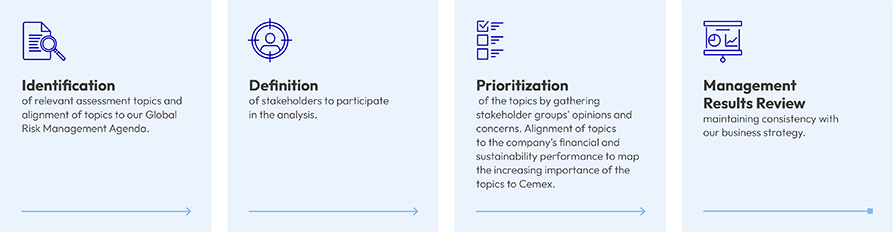
| Contents | ||
| Our Company | ||
| Our Strategy | ||
| Financial Performance | ||
| Environmental Excellence | ||
| Stakeholder Engagement | ||
| Governance | ||
| Appendix | ||
| Selected Consolidated Financial Information | ||
| Financial Information | ||
| Non-Financial Information | ||
| Scope and Boundaries of This Report | ||
| ● Cemex’s Materiality Assessment | ||
| Stakeholder Engagement | ||
| Governance | ||
| EU Taxonomy | ||
| GRI Content Index | ||
| International Sustainability Standards Board (ISSB) | ||
| Sustainability Accounting Standards Board Response (SASB) | ||
| Task Force on Climate-related Financial Disclosure Response (TCFD) | ||
| Terms We Use | ||
| Cautionary Statement Regarding Forward-Looking Statements | ||
| Investor, Contact and Feedback Information | ||
| 223 Cemex 2024 Integrated Report | ||
Our Materiality Matrix
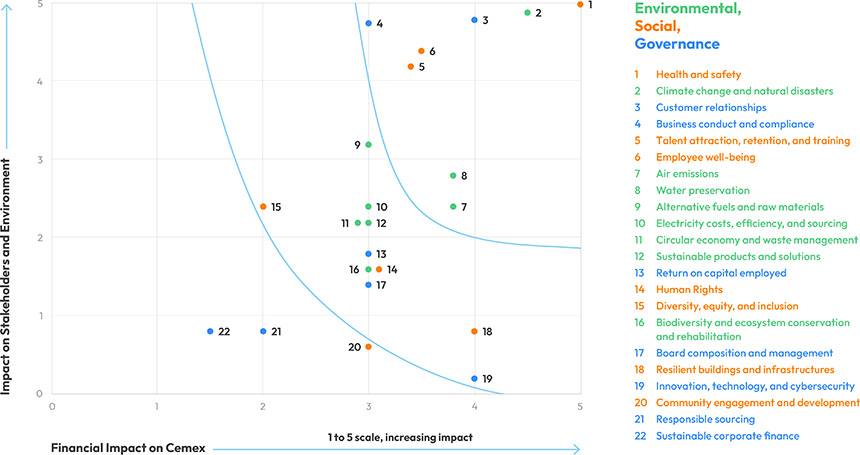
| Contents | ||
| Our Company | ||
| Our Strategy | ||
| Financial Performance | ||
| Environmental Excellence | ||
| Stakeholder Engagement | ||
| Governance | ||
| Appendix | ||
| Selected Consolidated Financial Information | ||
| Financial Information | ||
| Non-Financial Information | ||
| Scope and Boundaries of This Report | ||
| Cemex’s Materiality Assessment | ||
| ● Stakeholder Engagement | ||
| Governance | ||
| EU Taxonomy | ||
| GRI Content Index | ||
| International Sustainability Standards Board (ISSB) | ||
| Sustainability Accounting Standards Board Response (SASB) | ||
| Task Force on Climate-related Financial Disclosure Response (TCFD) | ||
| Terms We Use | ||
| Cautionary Statement Regarding Forward-Looking Statements | ||
| Investor, Contact and Feedback Information | ||
| 224 Cemex 2024 Integrated Report | ||
How We Engage With Our Stakeholders
We aim to conduct stakeholder relations with honesty, respect, and integrity. The framework for our stakeholder engagement process is determined mainly by our Code of Ethics, Business Conduct, Public Affairs, and Stakeholder Engagement Policy.
Our process reflects key topics and priorities raised by our stakeholders in our Materiality Assessment, and we work through various communication channels to engage with our stakeholders and promote dialogue and collaboration.
| Stakeholder
|
| Workforce
|
|
Customers
|
| Investors
| ||||||
| Objective | Our employees are a key part of our competitive advantage and the reason for our success. We continually seek to provide them with opportunities for growth and development, as well as a safe, healthy, diverse, and inclusive work environment. | By understanding our customers’ needs and challenges, we aim to place them at the center of everything we do and become their partner of choice. | We have a robust investor engagement strategy to foster a clear understanding of our company’s performance, strategy, and risks. | |||||||||
| Key Collaboration Topics | • Company priorities and challenges • Health and safety • Business ethics • Employee well-being, experience, and engagement • Diversity and inclusion • Training, development, and career path | • Customer experience and engagement • Industry needs and challenges • Quality products, services, and solutions • Sustainability management practices • Our products’ sustainable attributes | • Company’s financial performance • Return on capital employed • Pricing integrity and antitrust compliance • Business ethics and legal compliance • ESG disclosure and performance • Risks and opportunities | |||||||||
| Engagement Channels and Frequency | • Leader email messages and videos • Ethics and compliance campaigns • Employee experience surveys • Global and local newsletters • HR teams and HR process platforms • Open dialogues and meetings with leaders, including town halls with CEO and Executive Committee Members • ETHOSline 24/7 reporting line | • Sales representatives’ ongoing relationship management • Cemex Go digital platform 24/7 • Regular commercial events • Customer satisfaction surveys • Satisfaction surveys, service centers, and helplines • ETHOSline 24/7 reporting line | • Regular meetings, webcasts, and conference calls • Quarterly financial updates and guidance • Annual integrated and 20-F reports, and mandatory filings • Ongoing website updates and press releases • Cemex Day investor event • Company position papers | |||||||||
| Outcomes | • Understanding of our employees’ needs • Talent management strategy • Ethics case reports for investigation • Learning strategy • Positive health and safety culture in the workplace • Safety workplace environment • Diversity and Inclusion Policy, committees, and initiatives, including participation in external programs • Speaking-up culture • Engaged workforce • Human Rights Due Diligence Approach including our Human Rights Self Assessment | • Customer centricity strategy • A clear understanding of our customers’ needs and concerns • Net promoter score (NPS) • Digitalized solutions | • Understanding of financial position, performance, business perspectives, and risks • Strengthening of Cemex’s ESG practices and metrics • Enhancement of reporting quality and transparency | |||||||||
| Contents | ||
| Our Company | ||
| Our Strategy | ||
| Financial Performance | ||
| Environmental Excellence | ||
| Stakeholder Engagement | ||
| Governance | ||
| Appendix | ||
| Selected Consolidated Financial Information | ||
| Financial Information | ||
| Non-Financial Information | ||
| Scope and Boundaries of This Report | ||
| Cemex’s Materiality Assessment | ||
| ● Stakeholder Engagement | ||
| Governance | ||
| EU Taxonomy | ||
| GRI Content Index | ||
| International Sustainability Standards Board (ISSB) | ||
| Sustainability Accounting Standards Board Response (SASB) | ||
| Task Force on Climate-related Financial Disclosure Response (TCFD) | ||
| Terms We Use | ||
| Cautionary Statement Regarding Forward-Looking Statements | ||
| Investor, Contact and Feedback Information | ||
| 225 Cemex 2024 Integrated Report | ||
| Stakeholder
|
| Suppliers
|
| Communities
|
| Civil Society
| ||||||
| Objective | We develop a strong relationship across our network of suppliers, aiming to ensure compliance with our Code of Ethics and Business Conduct and our Code of Conduct When Doing Business With Us. | Our regular, formal dialogues with our neighboring communities have proven key to building mutual trust. By understanding their expectations, we can review progress and work together toward achieving agreed plans. | We actively engage and cooperate with governments and policy makers; global, national, and regional business associations; NGOs; and academic institutions. This collaboration helps us to participate in industry regulations policy discussions, foster partnerships to promote our core businesses, align with entities sharing our vision of building a better future, and support scientific research to enhance the environmental, social, and economic impacts of our products. | |||||||||
| Key Collaboration Topics | • Business ethics, legal compliance, and respect for human rights • Quality of products and services • Supply chain reliability and efficiency • Health and safety • Sustainability management practices | • Health and safety • Education and capability development • Community infrastructure programs and housing • Community employability skills and well-being • Respect for human rights • Local employment opportunities | • Health and safety • Business ethics, legal compliance, and respect for human rights • Environmental standards, climate change, and emissions • Energy costs, efficiency, and sourcing • Circular economy and waste materials • Sustainable cities and communities, community infrastructure programs, and housing • Sustainability principles and challenges | • Our products’ sustainable attributes • Best practice sharing across the industry • Sustainability performance and disclosure • Energy and climate change solutions • Natural resources conservation • Innovation and business development • Public policy and advocacy | ||||||||
| Engagement Channels and Frequency | • Daily interactions • Ongoing training and capacity-building programs • Health and safety and sustainability verification platforms • Annual Smart Innovation process • ETHOSline 24/7 reporting line | • Ongoing dialogues with communities • Annual open house days at operating sites • Ongoing educational programs and training • Community infrastructure, volunteering, and social investment initiatives • Co-creation of inclusive business programs • Community engagement plans • ETHOSline 24/7 reporting line | • Company position papers • Ongoing public policy discussions, working groups, and research studies • Long-term partnerships • Working groups • Periodic plant visits, meetings • Events and conferences • Annual integrated and 20-F reports | • Collaborative research portfolios, technical papers, and advisory services • Subject matter expert participation in company events • Best practices and methodologies playbooks • ETHOSline 24/7 reporting line | ||||||||
| Outcomes | • Supplier sustainability assessment for critical suppliers • Promotion of local suppliers • Third-party due diligence process • Contractor health and safety verifications in accordance with our internal health and safety policies and controls | • Improvement to community infrastructure and well-being • Increased participation of women in the local economy • Reduced figures of not-in-employment-or-education youth • Economic growth in the community • Volunteering program | • Successful adaptations to new local, national, and regional regulations • Compliance with applicable laws • Creation of joint initiatives that require a multidisciplinary approach, such as ARISE • Coordinated initiatives, statements, whitepapers, and communications campaigns. • Industry best practice sharing | • Strengthened positioning of cement and concrete as sustainable building materials • Incremental quality and transparency in company reporting • Strategic partnerships built with business associations, NGOs, and top universities • Awareness of global industry trends • New talent attraction for company • Risk and opportunities assessment | ||||||||
| Contents | ||
| Our Company | ||
| Our Strategy | ||
| Financial Performance | ||
| Environmental Excellence | ||
| Stakeholder Engagement | ||
| Governance | ||
| Appendix | ||
| Selected Consolidated Financial Information | ||
| Financial Information | ||
| Non-Financial Information | ||
| Scope and Boundaries of This Report | ||
| Cemex’s Materiality Assessment | ||
| Stakeholder Engagement | ||
| ● Governance | ||
| EU Taxonomy | ||
| GRI Content Index | ||
| International Sustainability Standards Board (ISSB) | ||
| Sustainability Accounting Standards Board Response (SASB) | ||
| Task Force on Climate-related Financial Disclosure Response (TCFD) | ||
| Terms We Use | ||
| Cautionary Statement Regarding Forward-Looking Statements | ||
| Investor, Contact and Feedback Information | ||
| 226 Cemex 2024 Integrated Report | ||
| Contents | ||
| Our Company | ||
| Our Strategy | ||
| Financial Performance | ||
| Environmental Excellence | ||
| Stakeholder Engagement | ||
| Governance | ||
| Appendix | ||
| Selected Consolidated Financial Information | ||
| Financial Information | ||
| Non-Financial Information | ||
| Scope and Boundaries of This Report | ||
| Cemex’s Materiality Assessment | ||
| Stakeholder Engagement | ||
| ● Governance | ||
| EU Taxonomy | ||
| GRI Content Index | ||
| International Sustainability Standards Board (ISSB) | ||
| Sustainability Accounting Standards Board Response (SASB) | ||
| Task Force on Climate-related Financial Disclosure Response (TCFD) | ||
| Terms We Use | ||
| Cautionary Statement Regarding Forward-Looking Statements | ||
| Investor, Contact and Feedback Information | ||
| 227 Cemex 2024 Integrated Report | ||
Board of Directors’ Skill Set Connectivity in Managing Risk Factors
1. Uncertain Economic Conditions
Relation to the Board of Directors’ Skillset: Economic uncertainty poses a significant risk to the Company’s business, financial condition, liquidity, and results of operations. Our Board of Directors’ expertise in Global Affairs, Public Affairs, Economics and Finance, Business Strategy, Procurement /Supply Chain, Energy, Manufacturing, Logistics and Sales allows them to address these challenges, formulate strategies, and make decisions that mitigate the impact of uncertain economic conditions on our operations and business.
2. Changes in Competitive Landscape
Relation to the Board of Directors’ Skillset: Operating in an evolving and highly competitive landscape poses a risk to the Company’s business, financial condition, liquidity, and results of operations. Our Board of Directors’ members have expertise in Business Strategy, Mergers and Acquisitions, Entrepreneurship, Research and Development, Construction and Business Materials, Supply System, Procurement / Supply Chain, Logistics, and Energy, which enables them to identify and adapt to potential changes in the competitive landscape and develop strategies to maintain Cemex’s competitive advantage within the building and construction materials industry.
3. Political Uncertainty
Relation to the Board of Directors’ Skillset: Political uncertainty, incoming new governments and elections, and social instability may affect various countries and regions where the Company operates. Our Board of Directors’ members can adapt to changes in economic, political, and social conditions in the countries where we operate based on their expertise in Administration, Global Affairs, Public Affairs, Economics and Finance, Regulatory and Legal Matters, and Ethics and Compliance. This ensures the Company is equipped to manage political risks and adapt to social changes that may arise in the countries where we operate.
4. Unexpected Escalation of a Geopolitical Conflict
Relation to the Board of Directors’ Skillset: As a global company, geopolitical tensions pose a risk to the Company’s business, financial condition, liquidity, and results of operations. Our Board of Directors’ members’ expertise in Global Affairs, Public Affairs, Economics and Finance, Corporate Risk Management Operation and Supervision, and Procurement / Supply Chain allows them to analyze and respond effectively to the impacts of geopolitical conflicts on the Company, including our operations.
5. Difficulties in Materializing Benefits of Assets Divestments and/or Investment Strategies
Relation to the Board of Directors’ Skillset: The successful execution of asset divestments, acquisitions and investments requires strategic decision-making, a deep understanding of the market, and risk management capabilities. Our Board of Director’s expertise in Business Strategy, Mergers and Acquisitions, Entrepreneurship, Research and Development, Construction and Building Materials, Procurement / Supply Chain, Logistics, Energy, and Corporate Risk Management Operation and Supervision enables the Company to effectively navigate challenges related to materializing the benefits of divestments and executing successful investment and acquisition strategies, as well as procuring that stakeholders are appropriately informed and aligned with the Company’s strategic goals during these processes.
6. Climate-related Risks
Relation to the Board of Directors’ Skillset: Climate-related risks, such as policy, technology, market, and reputation transition risks, as well as acute or chronic physical risks can all materialize and have adverse impacts on our business, financial condition, liquidity, and results of operations. Our Board of Directors’ members are prepared with a set of skills that include general ESG-Related Legal and Regulatory Frameworks, Trends, and Compliance to Climate Change Risk Assessment, Climate Change Mitigation and Adaptation Strategies, CO2 Emissions Reduction Targets and Programs, Climate Change Advocacy Initiatives and Partnerships, and
Green Technologies Renewable Energy Solutions and Circular Economy. This skillset provides Cemex with helpful insight to address these risks associated with climate change, environmental challenges, and pressure from our stakeholders to continue evolving towards becoming a more sustainable company and be on track with Cemex’s emissions reduction targets.
7. Regulatory and Compliance Requirements,
Including Sustainability Regulations
Relation to the Board of Directors’ Skillset: Cemex is subject to the laws and regulations of different jurisdictions across the countries in which it operates. Members of our Board of Directors garner skills in areas such as Public Affairs, Investor Relations, Human Resources, Labor Matters and Executive Compensation Structures and Transparency, Energy, Telecommunications, Human Rights in Supply Chain Due Diligence, Cybersecurity and/or Risk Management Threats, Ethics and Compliance, Sustainable and Green Finance, Data Privacy, and particularly ESG Matters-Related Legal and Regulatory Frameworks and Trends and Compliance and Regulatory and Legal Matters, all of which supports Cemex in striving to remain compliant with applicable laws and regulations, as well as to comply with new legal requirements.
8. Financial Risks
Relation to the Board of Directors’ Skillset: The current financial environment poses risk to our business, financial condition, liquidity, and results of operations. Our Board of Directors’ expertise in Administration, Global Affairs, Public Affairs, Corporate Risk Management Operation and Supervision, Business Strategy, Investor Relations, Sales, Economics and Finance, and Sustainable and Green Finance enables the Board of Directors to analyze and address financial risks that could impact the Company’s liquidity and financial performance, as well as allow the Company to manage global and domestic financial risks.
| Contents | ||
| Our Company | ||
| Our Strategy | ||
| Financial Performance | ||
| Environmental Excellence | ||
| Stakeholder Engagement | ||
| Governance | ||
| Appendix | ||
| Selected Consolidated Financial Information | ||
| Financial Information | ||
| Non-Financial Information | ||
| Scope and Boundaries of This Report | ||
| Cemex’s Materiality Assessment | ||
| Stakeholder Engagement | ||
| ● Governance | ||
| EU Taxonomy | ||
| GRI Content Index | ||
| International Sustainability Standards Board (ISSB) | ||
| Sustainability Accounting Standards Board Response (SASB) | ||
| Task Force on Climate-related Financial Disclosure Response (TCFD) | ||
| Terms We Use | ||
| Cautionary Statement Regarding Forward-Looking Statements | ||
| Investor, Contact and Feedback Information | ||
| 228 Cemex 2024 Integrated Report | ||
9. Energy Price Volatility Including Alternative Fuels
Relation to the Board of Directors’ Skillset: High and volatile energy prices, including those of alternative fuels used by Cemex, may significantly impact our cost structure. Our Board of Directors includes individuals with expertise spanning various domains that can aid Cemex in anticipating and reacting to fluctuations in energy prices, including those in alternative fuels. These areas of expertise include, but are not limited to Business Strategy, Energy, Supply System, Procurement / Supply Chain, Climate Change Mitigation and Adaptation Strategies, Global Affairs, Logistics, Corporate Risk Management Operation and Supervision, Research and Development, among others.
10. Lower Availability or Increased Cost of Raw Materials
Relation to the Board of Directors’ Skillset: Certain raw materials essential for our business operations may become scarce or substantially increase in costs. Within our Board of Directors, various members possess expertise in Construction and Building Materials, Energy, Procurement, Logistics, Procurement / Supply Chain, Manufacturing, Sales, and Supply System, which enables Cemex to manage the risk associated with potential shortages or rising costs of our key raw materials.
11. Cyberthreats and Information Technology Risks
Relation to the Board of Directors’ Skillset: As digital transformation advances and we continue to execute our digital transformation initiative, Working Smarter, integrating digital technologies into our operations increases risks in information technology and third-party reliance. Our Board of Directors has expertise in Cybersecurity and/or Risk Management Threats, Data Privacy, Administration and Risk Management, Corporate Risk Management Operation and Supervision, Global Affairs, Sales, Telecommunications, as well as other related fields, providing Cemex with the necessary insight to mitigate cybersecurity and information technology risks.
12. Operational Disruption Due to Different Interests from Stakeholders
Relation to the Board of Directors’ Skillset: Several members of our Board of Directors bring to the table a set of skills in different areas that encompass overall the different interests our stakeholders may have in Cemex, including but not limited to the expertise in areas such as Corporate Risk Management Operation and Supervision, Experience and Best Practices in ESG Matters in the construction building materials industry, Branding and Marketing, Corporate Governance, Media Communications, Diversity Equity and Inclusion, Entrepreneurship, Climate Change Risk Assessment, Global Affairs, Public Affairs, Human Rights, Investor Relations, and Community Engagement and Social Impact Projects. All of this helps Cemex in complying, to the best of its efforts, with its stakeholders’ expectations and allows Cemex to better communicate with interest groups and other related parties.
13. Health and Safety Risks
Relation to the Board of Directors’ Skillset: Operations not conducted responsibly can lead to injuries, illnesses, or even fatalities. Members of our Board of Directors have expertise in Health & Safety matters, as well as in Human Resources, Labor Matters and Executive Compensation Structures and Transparency, and Human Rights in Supply Chain Due Diligence, that provides significant insight regarding the health and safety of our employees in all our operations, ensuring their well-being, and prevent any accidents or fatalities.
14. Labor Relations, Talent Attraction and Retention
Relation to the Board of Directors’ Skillset: A specialized workforce is an invaluable asset for companies around the globe and maintaining satisfactory labor relations is key to business stability; therefore, attracting, hiring, retaining and adequately managing talent is critical for Cemex’s success. Our Board of Directors may provide key insights in human resources programs and labor relations with the expertise gathered in Business Strategy, Human Resources, Labor Matters, Executive Compensation Structures and Transparency, Health and Safety, ESG Matters-focused training and education, Human Rights in Supply Chain and due diligence, Diversity and Inclusion, and Ethics and Compliance, supporting the Company’s efforts to attract and retain skilled talent, as well as maintain satisfactory labor relations.
15. Emergence of a Pandemic, Epidemic,
or any Other Public Health Threat
Relation to the Board of Directors’ Skillset: Public health threats pose a significant risk to the Company’s business, financial condition, liquidity, and results of operations. Our Board of Directors’ members can analyze and react to health crises, as some of the members have previous background experience in Global Affairs, Corporate Risk Management Operation and Supervision, Procurement / Supply Chain, Logistics, Procurement, Health and Safety, and Healthcare. The foregoing also allows them to design and implement, as well as to adhere to or adapt, contingency plans that allow for business continuity.
16. Industry Disruptions by Emerging Technologies
or Alternative Solutions
Relation to the Board of Directors’ Skillset: Amidst a rapidly changing industry marked by emerging technologies, failure to adapt our business model to potential industry disruptors could pose a risk to our capacity to compete and our business, financial condition, liquidity, and results of operations. The ability of our Board of Directors to seek resilient and alternative solutions to potential disruptions is an indispensable skill. To do so, in addition to experience on Other Boards of Directors, some of the most relevant areas of expertise of our Board of Directors include Administration, Corporate Risk Management Operation and Supervision, Business Strategy, Entrepreneurship, Research and Development, Construction and Building Materials, Energy, Media and Communication, Telecommunications, Green Technologies, Renewable Energy Solutions and/or Circular Economy, and Cybersecurity and/or Risk Management Threats. This set of skills allows them to address potential industry disruptions and seek the implementation of new technologies, processes, materials, and solutions in our Company in an effective manner.
| Contents | ||
| Our Company | ||
| Our Strategy | ||
| Financial Performance | ||
| Environmental Excellence | ||
| Stakeholder Engagement | ||
| Governance | ||
| Appendix | ||
| Selected Consolidated Financial Information | ||
| Financial Information | ||
| Non-Financial Information | ||
| Scope and Boundaries of This Report | ||
| Cemex’s Materiality Assessment | ||
| Stakeholder Engagement | ||
| ● Governance | ||
| EU Taxonomy | ||
| GRI Content Index | ||
| International Sustainability Standards Board (ISSB) | ||
| Sustainability Accounting Standards Board Response (SASB) | ||
| Task Force on Climate-related Financial Disclosure Response (TCFD) | ||
| Terms We Use | ||
| Cautionary Statement Regarding Forward-Looking Statements | ||
| Investor, Contact and Feedback Information | ||
| 229 Cemex 2024 Integrated Report | ||
17. Just Transition: Addressing the Potential Impacts from our Decarbonization Activities
Relation to the Board of Directors’ Skillset: The transition towards a low-carbon economy and the adoption of more environmentally and socially responsible practices across our stakeholders presents challenges and opportunities. Our Board of Directors, through their experience in Other Boards of Directors, as well as their expertise in Business Strategy, Mergers and Acquisitions, Entrepreneurship, Research and Development, Construction and Building Materials, Supply System, Procurement / Supply Chain, Logistics, Energy, Climate Change Risk Assessment, Climate Change Mitigation and Adaptation Strategies, Climate Change Mitigation and Adaptation Strategies, CO2 Emissions Reduction Targets and Programs, and Green Technologies, Renewable Energy Solutions, and Circular Economy, possess the necessary skillset to drive further Cemex’s commitment to become a net-zero CO2 company by 2050, as well as address any potential impacts our decarbonization strategy may bring about.
18. Inadequate Implementation and Use of AI
Relation to the Board of Directors’ Skillset: The increasing extent to which AI can develop, limited AI-governance efforts, the potential misuse of AI by bad actors and other AI-related issues can pose several risks to our business, financial condition, liquidity, and results of operations, many of which we may not have identified yet due to the rapidly changing AI-environment and breakthroughs. Skills such as Global Affairs, Corporate Risk Management Operation and Supervision, Research and Development, Media and Communications, Telecommunications, and in Cybersecurity and Risk Management Threats allow our Board of Directors to discern the implications and better position the Company to face risks posed by AI and align Cemex with opportunities AI technologies may provide.
19. Geoeconomic Confrontation Could Impact Growth Prospects and Reshape Global Business Landscape
Relation to the Board of Directors’ Skillset: Geoeconomic confrontations, such as trade tensions, sanctions, or shifts in global economic alliances, could disrupt business operations and reshape market dynamics. Our Board of Directors’ expertise in Global Affairs, Economics and Finance, Public Affairs, Business Strategy, Corporate Risk Management Operation and Supervision, Supply Chain, Logistics, Energy, and Investor Relations equips the Company to assess and manage the impact of geopolitical shifts on its operations, with insight on adapting to changing global business environments and enabling Cemex to navigate potential disruptions and seize new growth opportunities in evolving markets.
| Contents | ||
| Our Company | ||
| Our Strategy | ||
| Financial Performance | ||
| Environmental Excellence | ||
| Stakeholder Engagement | ||
| Governance | ||
| Appendix | ||
| Selected Consolidated Financial Information | ||
| Financial Information | ||
| Non-Financial Information | ||
| Scope and Boundaries of This Report | ||
| Cemex’s Materiality Assessment | ||
| Stakeholder Engagement | ||
| Governance | ||
| ● EU Taxonomy | ||
| GRI Content Index | ||
| International Sustainability Standards Board (ISSB) | ||
| Sustainability Accounting Standards Board Response (SASB) | ||
| Task Force on Climate-related Financial Disclosure Response (TCFD) | ||
| Terms We Use | ||
| Cautionary Statement Regarding Forward-Looking Statements | ||
| Investor, Contact and Feedback Information | ||
| 230 Cemex 2024 Integrated Report | ||
The European Union (EU) Taxonomy is a classification system established by the EU Taxonomy Regulation to define environmentally sustainable economic activities. It is a tool to help channel private investment towards the transition to a more sustainable economy.
The Taxonomy is based on six environmental objectives: climate change mitigation, climate change adaptation, sustainable use and protection of water and marine resources, transition to a circular economy, pollution prevention and control, and protection and restoration of biodiversity and ecosystems.
For an economic activity to be considered environmentally sustainable under the Taxonomy, it must contribute substantially to one or more of these six objectives, not significantly harm any of the other objectives, and meet minimum social safeguards. Technical Screening Criteria (TSC) have been developed in order to set out how these requirements are to be applied in detail, pursuant to various Commission Delegated Regulations (Delegated Acts) adopted under the Taxonomy Regulation.
The Taxonomy Regulation requires non-financial undertakings that are required to report under the EU’s Corporate Sustainability Reporting Directive to disclose how and to what extent the undertaking’s activities are associated with economic activities that are environmentally sustainable and in particular the proportion of their turnover which is derived from products or services associated with economic activities that qualify as environmentally sustainable and the proportion of their capital expenditure (CapEx) and operating expenditure (OpEx) which is related to assets or processes associated with economic activities that are environmentally sustainable.
Although Cemex is currently not legally required to report under the Taxonomy Regulation or the Corporate Sustainability Reporting Directive, since 2022, Cemex has worked on providing Taxonomy-related disclosures aiming to ensure that our stakeholders understand the extent to which Cemex’s activities are aligned with the Taxonomy.
Cemex has identified its core activity “manufacture of cement”, as well as “material recovery from non-hazardous waste”, as Taxonomy-eligible under the climate change mitigation objective. “Material recovery from non-hazardous waste” relates to construction and operation of facilities for the sorting and processing of separately collected non-hazardous waste streams into secondary raw materials. Additionally, for the objective of “transition to a circular economy”, Cemex engages in “sorting and material recovery of non-hazardous waste”. Other economic activities that Cemex carries out, such as the production of aggregates and ready-mixed concrete and certain other businesses, do not fall within activities that are currently eligible under the Taxonomy. Finally, we have reported on certain other Cemex activities in respect of the climate change mitigation objective, but only in respect of their contribution to Cemex CapEx. These activities are primarily “electricity generation from solar and waste heat” and “freight transport services by road”.
Turnover
Turnover is defined as the sales generated by all activities of the company, as shown in Cemex’s Financial Statements (referred to in the relevant Delegated Act as the denominator). The turnover generated by the eligible and aligned activities is then calculated for the reporting year (referred to in the relevant Delegated Act as the numerator).
For 2024, the total Cemex turnover under the Taxonomy stands at US$16,200 million, with the proportion of turnover eligible under the Taxonomy being US$6,927 million (42.76%) for the cement business, US$42 million (0.26%) for circular activities embedded in our aggregates business, and US$8 million (0.05%) for urbanization solutions. The proportion of turnover aligned with the Taxonomy is US$1,023 million (6.31%) for Cement, and US$16 million (0.10%) for Aggregates, and US$6 million (0.04%) for Urbanization Solutions.
| In Million US Dollars | 2024 Percentage (%) | 2023 Percentage (%) | ||||||||||
| Taxonomy Non-eligible Turnover | 9,223 | 56.93% | 55.63% | |||||||||
| Taxonomy-eligible but not aligned Turnover | 5,932 | 36.62% | 40.30% | |||||||||
| Taxonomy-eligible and aligned Turnover | 1,045 | 6.45% | 4.07% | |||||||||
| Total Turnover | 16,200 | 100% | 100% | |||||||||
Capital Expenditure (CapEx)
In respect of CapEx, the Taxonomy (in overview) requires that Cemex reports the proportion of Taxonomy eligible and aligned CapEx (referred to in the relevant Delegated Act as the numerator) compared to general CapEx (referred to in the relevant Delegated Act as the denominator).
The definition of CapEx under the Taxonomy differs from the definition of CapEx used by Cemex in its financial statements. CapEx pursuant to the Taxonomy is defined in the relevant Delegated Act as fixed assets plus intangible assets, which, in our case, include deferred charges in the financial statements plus business combinations during the fiscal year. The denominator corresponds to Cemex group’s total CapEx, which includes investments in intangible assets, investments in property, machinery and equipment, and investments in right-of-use assets. CapEx includes the work carried out by the company for its fixed assets and capitalized financial expenses. The numerator comprises the portion of CapEx included in the denominator that pertains to assets or processes associated with eligible economic activities. This also includes assets that are part of a plan to expand the economic activities aligned with the Taxonomy or to facilitate the alignment of economic activities eligible under the Taxonomy in the future, in this case by 2030 even though a ten-year period is justified on the CapEx plan conditions set forth in the relevant Delegated Act.
| Contents | ||
| Our Company | ||
| Our Strategy | ||
| Financial Performance | ||
| Environmental Excellence | ||
| Stakeholder Engagement | ||
| Governance | ||
| Appendix | ||
| Selected Consolidated Financial Information | ||
| Financial Information | ||
| Non-Financial Information | ||
| Scope and Boundaries of This Report | ||
| Cemex’s Materiality Assessment | ||
| Stakeholder Engagement | ||
| Governance | ||
| ● EU Taxonomy | ||
| GRI Content Index | ||
| International Sustainability Standards Board (ISSB) | ||
| Sustainability Accounting Standards Board Response (SASB) | ||
| Task Force on Climate-related Financial Disclosure Response (TCFD) | ||
| Terms We Use | ||
| Cautionary Statement Regarding Forward-Looking Statements | ||
| Investor, Contact and Feedback Information | ||
| 231 Cemex 2024 Integrated Report | ||
For 2024, the total CapEx calculated pursuant to the Taxonomy Regulation amounts to US$1,684 million. Within this amount, US$674 million (40.03%) is allocated to Taxonomy-eligible CapEx for our cement business -including US$14 million (0.83%) for the CapEx plan-, US$1 million (0.05%) and $4 million (0.27%) for circular activities in our urbanization solutions and aggregates business, respectively, US$8 million (0.45%) for electricity generation using solar and waste heat technologies and US$84 million (4.98%) for freight transport services by road. The portion of CapEx aligned with the Taxonomy constitutes US$89 million (5.30%) for cement, US$1 million (0.05%) and US$3 million (0.20%) for circular activities in our urbanization solutions and aggregates business, respectively, US$8 million (0.45%) for electricity generation using solar and waste heat technologies and US$36 million (2.14%) for freight transport services by road. These aligned CapEx figures encompass US$137 million from property, machinery, and equipment additions, right-of-use assets, and intangible assets incurred during the fiscal year prior to depreciation, amortization, and any new valuations, including those arising from revaluations and impairments, for the fiscal year, excluding fair value changes. Leases not leading to the recognition of a right-of-use asset are not classified as CapEx under the Taxonomy.
| In Million US Dollars | 2024 Percentage (%) | 2023 Percentage (%) | ||||||||||
| Taxonomy Non-eligible CapEx | 913 | 54.22% | 60.89% | |||||||||
| Taxonomy-eligible but not aligned CapEx | 634 | 37.64% | 34.69% | |||||||||
| Taxonomy-eligible and aligned CapEx | 137 | 8.14% | 4.42% | |||||||||
| Total CapEx Pursuant to Taxonomy | 1,684 | 100% | 100% | |||||||||
Operational Expenditure (OpEx)
In respect of OpEx, the Taxonomy (in overview) requires that Cemex reports the proportion of Taxonomy eligible and aligned OpEx (referred to in the relevant Delegated Act as the numerator) compared to general OpEx (referred to in the relevant Delegated Act as the denominator).
OpEx, as defined under the Taxonomy, also has a different definition to OpEx in respect of Cemex’s financial statements. Under the Taxonomy, OpEx is defined as non-capitalized direct costs that relate to research and development, building renovation measures, short-term leases, maintenance and repairs, as well as other direct expenditures related to the day-to-day maintenance of property, machinery, and equipment, by the company or a third party to whom activities are outsourced, and which are necessary to ensure the continuous and effective functioning of those assets.
For 2024, the total OpEx calculated pursuant to the Taxonomy amounted to US$1,258 million. Within this figure, Taxonomy-eligible OpEx was identified as US$607 million (48.24%) for cement.
Regarding the Taxonomy-eligible research and development expenditure in the cement sector, direct allocation to specific Taxonomy-aligned plants was not feasible. Therefore, such expenditure was allocated proportionally among all plants using a metric based on total cement production. Furthermore, OpEx figures are not available for all Construction, Demolition and Excavation Waste (CDEW) sites, so the information regarding these sites has not been considered.
In summary, US$72 million (5.70%) of OpEx for our cement business, was aligned with the Taxonomy. These aligned expenditures consist of research and development costs, maintenance and repair expenses (internal & external), and short-term leases.
| In Million US Dollars | 2024 Percentage (%) | 2023 Percentage (%) | ||||||||||
| Taxonomy Non-eligible OpEx | 651 | 51.76% | 48.59% | |||||||||
| Taxonomy-eligible but not aligned OpEx | 535 | 42.55% | 46.96% | |||||||||
| Taxonomy-eligible and aligned OpEx | 72 | 5.70% | 4.45% | |||||||||
| Total OEx Pursuant to Taxonomy | 1,258 | 100% | 100% | |||||||||
Cemex methodology and progress
Disclosures were prepared on a consolidated level for the entire Group, and activities outside the EU were evaluated in the same way as activities within the EU. Turnover, CapEx, and OpEx were gathered at the site level and then distributed proportionally to product-level production for the relevant activity. We excluded white cement/clinker production, as there are no applicable TSC. We also excluded trading activities and grinding facilities producing cement with external clinker. Additionally, OpEx figures are not available for all Construction, Demolition and Excavation Waste (CDEW) facilities, so the information on these sites has not been considered.
The stringency of the Taxonomy means that we expect further Taxonomy alignment of our activities gradually over time, as has been proved in our 2024 results vs. 2023. We envisage that the outcome of our initial Taxonomy reporting will reflect the fact that some operations in regions outside of Europe will face challenges due to the lack of strong regulatory frameworks in those jurisdictions.
| Contents | ||
| Our Company | ||
| Our Strategy | ||
| Financial Performance | ||
| Environmental Excellence | ||
| Stakeholder Engagement | ||
| Governance | ||
| Appendix | ||
| Selected Consolidated Financial Information | ||
| Financial Information | ||
| Non-Financial Information | ||
| Scope and Boundaries of This Report | ||
| Cemex’s Materiality Assessment | ||
| Stakeholder Engagement | ||
| Governance | ||
| ● EU Taxonomy | ||
| GRI Content Index | ||
| International Sustainability Standards Board (ISSB) | ||
| Sustainability Accounting Standards Board Response (SASB) | ||
| Task Force on Climate-related Financial Disclosure Response (TCFD) | ||
| Terms We Use | ||
| Cautionary Statement Regarding Forward-Looking Statements | ||
| Investor, Contact and Feedback Information | ||
| 232 Cemex 2024 Integrated Report | ||
Proportion of turnover from products or services associated with Taxonomy-aligned economic activities – disclosure covering year 2024
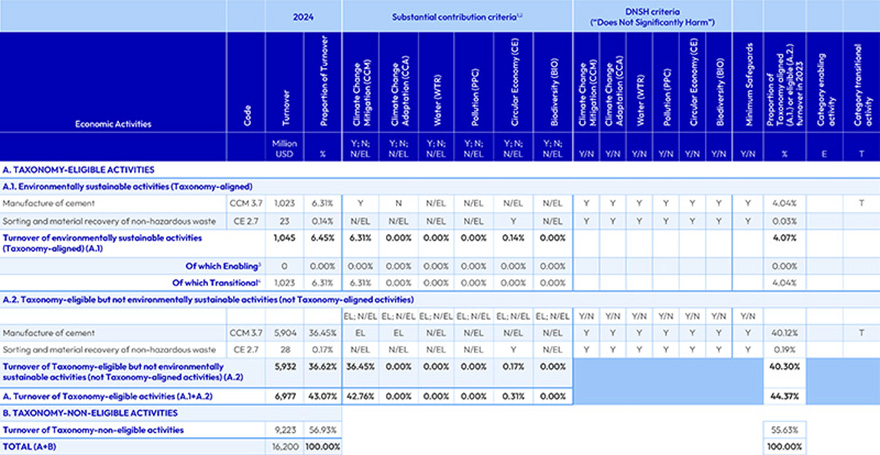
| 1. Y – Yes, Taxonomy-eligible and Taxonomy-aligned activity with the relevant environmental objective; N – No, Taxonomy-eligible but not Taxonomy-aligned activity with the relevant environmental objective; N/EL – Not eligible, Taxonomy-non-eligible activity for the relevant environmental objective. 2. EL – Taxonomy-eligible activity for the relevant objective; N/EL – Taxonomy-non-eligible activity for the relevant objective. 3. Enabling activities: Activities that enable other activities to make a substantial contribution to one or more of the objectives, and where that activity; a) Does not lead to a lock-in in assets that undermine long-term environmental goals, considering the economic lifetime of those assets; and b) Has a substantial positive environmental impact on the basis of lifecycle considerations. | 4. Transitional activities: Must contribute to climate change mitigation and a pathway to keeping global warming in line with Paris Agreement commitments. Transitional activities only qualify where the following criteria are met: a) There are no technologically or economically feasible low-carbon alternatives; b) Green House Gas emission levels correspond to the best performance in the sector or industry; and c) The activity does not lead to carbon lock-in or hamper the development and deployment of low-carbon alternatives. |
| Contents | ||
| Our Company | ||
| Our Strategy | ||
| Financial Performance | ||
| Environmental Excellence | ||
| Stakeholder Engagement | ||
| Governance | ||
| Appendix | ||
| Selected Consolidated Financial Information | ||
| Financial Information | ||
| Non-Financial Information | ||
| Scope and Boundaries of This Report | ||
| Cemex’s Materiality Assessment | ||
| Stakeholder Engagement | ||
| Governance | ||
| ● EU Taxonomy | ||
| GRI Content Index | ||
| International Sustainability Standards Board (ISSB) | ||
| Sustainability Accounting Standards Board Response (SASB) | ||
| Task Force on Climate-related Financial Disclosure Response (TCFD) | ||
| Terms We Use | ||
| Cautionary Statement Regarding Forward-Looking Statements | ||
| Investor, Contact and Feedback Information | ||
| 233 Cemex 2024 Integrated Report | ||
Proportion of CapEx from products or services associated with Taxonomy-aligned economic activities – disclosure covering year 2024
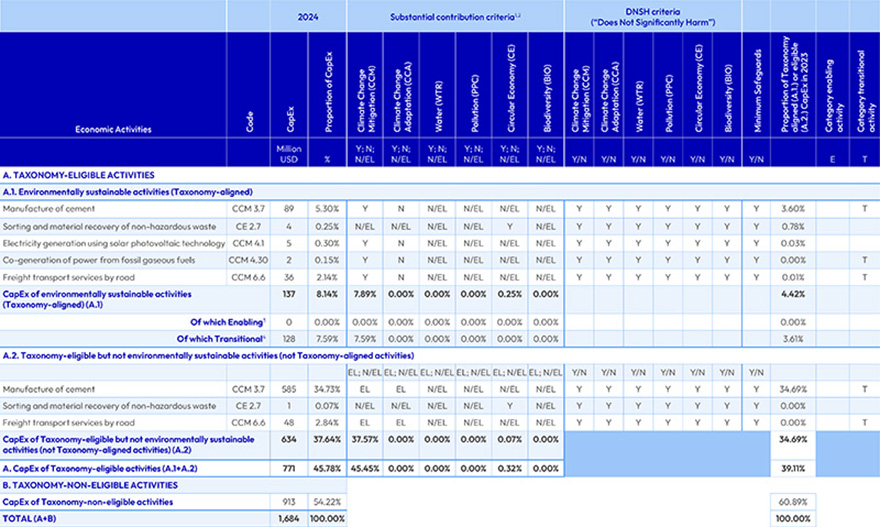
| 1. Y – Yes, Taxonomy-eligible and Taxonomy-aligned activity with the relevant environmental objective; N – No, Taxonomy-eligible but not Taxonomy-aligned activity with the relevant environmental objective; N/EL – Not eligible, Taxonomy-non-eligible activity for the relevant environmental objective. 2. EL – Taxonomy-eligible activity for the relevant objective; N/EL – Taxonomy-non-eligible activity for the relevant objective. 3. Enabling activities: Activities that enable other activities to make a substantial contribution to one or more of the objectives, and where that activity; a) Does not lead to a lock-in in assets that undermine long-term environmental goals, considering the economic lifetime of those assets; and b) Has a substantial positive environmental impact on the basis of lifecycle considerations. | 4. Transitional activities: Must contribute to climate change mitigation and a pathway to keeping global warming in line with Paris Agreement commitments. Transitional activities only qualify where the following criteria are met: a) There are no technologically or economically feasible low-carbon alternatives; b) Green House Gas emission levels correspond to the best performance in the sector or industry; and c) The activity does not lead to carbon lock-in or hamper the development and deployment of low-carbon alternatives. |
| Contents | ||
| Our Company | ||
| Our Strategy | ||
| Financial Performance | ||
| Environmental Excellence | ||
| Stakeholder Engagement | ||
| Governance | ||
| Appendix | ||
| Selected Consolidated Financial Information | ||
| Financial Information | ||
| Non-Financial Information | ||
| Scope and Boundaries of This Report | ||
| Cemex’s Materiality Assessment | ||
| Stakeholder Engagement | ||
| Governance | ||
| ● EU Taxonomy | ||
| GRI Content Index | ||
| International Sustainability Standards Board (ISSB) | ||
| Sustainability Accounting Standards Board Response (SASB) | ||
| Task Force on Climate-related Financial Disclosure Response (TCFD) | ||
| Terms We Use | ||
| Cautionary Statement Regarding Forward-Looking Statements | ||
| Investor, Contact and Feedback Information | ||
| 234 Cemex 2024 Integrated Report | ||
Proportion of OpEx from products or services associated with Taxonomy-aligned economic activities – disclosure covering year 2024
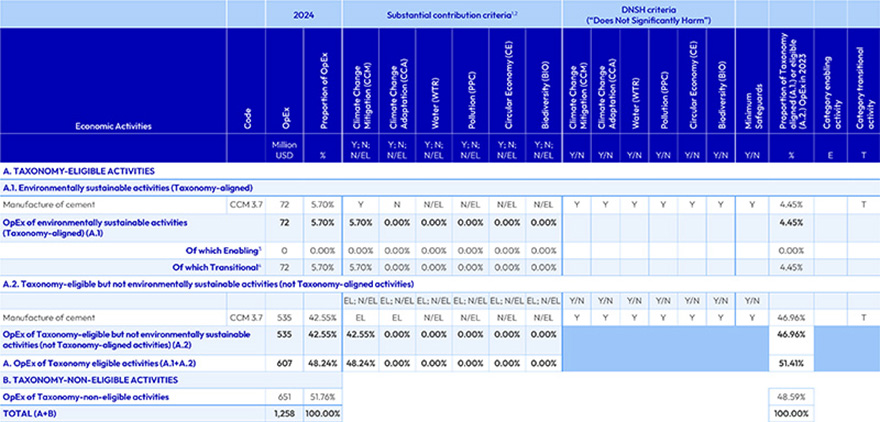
| 1. Y – Yes, Taxonomy-eligible and Taxonomy-aligned activity with the relevant environmental objective; N – No, Taxonomy-eligible but not Taxonomy-aligned activity with the relevant environmental objective; N/EL – Not eligible, Taxonomy-non-eligible activity for the relevant environmental objective. 2. EL – Taxonomy-eligible activity for the relevant objective; N/EL – Taxonomy-non-eligible activity for the relevant objective. 3. Enabling activities: Activities that enable other activities to make a substantial contribution to one or more of the objectives, and where that activity; a) Does not lead to a lock-in in assets that undermine long-term environmental goals, considering the economic lifetime of those assets; and b) Has a substantial positive environmental impact on the basis of lifecycle considerations. | 4. Transitional activities: Must contribute to climate change mitigation and a pathway to keeping global warming in line with Paris Agreement commitments. Transitional activities only qualify where the following criteria are met: a) There are no technologically or economically feasible low-carbon alternatives; b) Green House Gas emission levels correspond to the best performance in the sector or industry; and c) The activity does not lead to carbon lock-in or hamper the development and deployment of low-carbon alternatives. |
| Contents | ||
| Our Company | ||
| Our Strategy | ||
| Financial Performance | ||
| Environmental Excellence | ||
| Stakeholder Engagement | ||
| Governance | ||
| Appendix | ||
| Selected Consolidated Financial Information | ||
| Financial Information | ||
| Non-Financial Information | ||
| Scope and Boundaries of This Report | ||
| Cemex’s Materiality Assessment | ||
| Stakeholder Engagement | ||
| Governance | ||
| EU Taxonomy | ||
| ● GRI Content Index | ||
| International Sustainability Standards Board (ISSB) | ||
| Sustainability Accounting Standards Board Response (SASB) | ||
| Task Force on Climate-related Financial Disclosure Response (TCFD) | ||
| Terms We Use | ||
| Cautionary Statement Regarding Forward-Looking Statements | ||
| Investor, Contact and Feedback Information | ||
| 235 Cemex 2024 Integrated Report | ||
| GRI Standard | Disclosure | Page reference and/or direct answers | Omissions | SDG link | UNGC | |||||||
| Universal Standards | ||||||||||||
| GRI 1: Foundation 2021 | ||||||||||||
| General disclosures | ||||||||||||
| GRI 2: General Disclosures 2021 | 2-1 Organizational details | p. 220-221 - Scope and Boundaries of this Report | ||||||||||
|
2-2 Entities included in the organization’s sustainability reporting |
p. 220-221 - Scope and Boundaries of this Report | |||||||||||
|
2-3 Reporting period, frequency and contact point |
p. 220-221 - Scope and Boundaries of this Report | |||||||||||
|
2-4 Restatements of information |
p. 220-221- Scope and Boundaries of this Report | |||||||||||
|
2-5 External assurance |
p. 217-219 - Independent Limited Assurance Report on Key Indicators of Sustainability Performance | |||||||||||
|
2-6 Activities, value chain and other business relationships |
p. 7-8 - Cemex Overview
p. 76 - Customer Centricity: Driving a Superior Customer Experience
p. 83 - Community Development: Engaging With Communities to Deliver Transformative Outcomes
| |||||||||||
|
2-7 Employees |
p. 83-84 - Community Development: Engaging With Communities to Deliver Transformative Outcomes | |||||||||||
|
2-8 Workers who are not employees |
p. 68 - Global Employee Composition | |||||||||||
|
2-9 Governance structure and composition |
p. 93-105 - Corporate Governance
| |||||||||||
| Contents | ||
| Our Company | ||
| Our Strategy | ||
| Financial Performance | ||
| Environmental Excellence | ||
| Stakeholder Engagement | ||
| Governance | ||
| Appendix | ||
| Selected Consolidated Financial Information | ||
| Financial Information | ||
| Non-Financial Information | ||
| Scope and Boundaries of This Report | ||
| Cemex’s Materiality Assessment | ||
| Stakeholder Engagement | ||
| Governance | ||
| EU Taxonomy | ||
| ● GRI Content Index | ||
| International Sustainability Standards Board (ISSB) | ||
| Sustainability Accounting Standards Board Response (SASB) | ||
| Task Force on Climate-related Financial Disclosure Response (TCFD) | ||
| Terms We Use | ||
| Cautionary Statement Regarding Forward-Looking Statements | ||
| Investor, Contact and Feedback Information | ||
| 236 Cemex 2024 Integrated Report | ||
| GRI Standard | Disclosure | Page reference and/or direct answers | Omissions | SDG link | UNGC | |||||||
|
GRI 2: General Disclosures 2021 |
2-10 Nomination and selection of the highest governance body |
p. 94 - Our Board of Directors
• Item 6: Directors, Senior Management and Employees
Since 2022, each candidate to become a member of the Board of Directors has been elected in an individual manner. | ||||||||||
|
2-11 Chair of the highest governance body |
p. 94 - Our Board of Directors
• Item 6: Directors, Senior Management and Employees | |||||||||||
|
2-12 Role of the highest governance body in overseeing the management of impacts |
p. 92 - Governance
p. 94 - Our Board of Directors
p. 103-105 - Board committees | |||||||||||
|
2-13 Delegation of responsibility for managing impacts |
p. 92 - Governance
p. 94 - Our Board of Directors
p. 106-108 - Executive Committee | |||||||||||
|
2-14 Role of the highest governance body in sustainability reporting |
p. 103-105 - Board Committees - Sustainability, Climate Action, Social Impact, and Diversity Committee | |||||||||||
|
2-15 Conflicts of interest |
p. 111 - Ethics and Compliance
p. 103-105 - Board Committees
p. 117 - Risk and Opportunity management: Regulatory and Compliance Requirements, including Sustainability Regulations
• Item 7- Major Shareholders and Related Party Transactions
• Item 16G- Corporate Governance
• Item 6: Directors, Senior Management and Employee | |||||||||||
|
2-16 Communication of critical concerns |
p. 117-118 - Risks and Opportunity management
p. 111 - Ethics and Compliance | |||||||||||
|
2-17 Collective knowledge of the highest governance body |
p. 102 - Board of Directors Skills Matrix
p. 226-229 - Cemex’s Board of Directors Skills Matrix
• Item 6: Directors, Senior Management and Employees | |||||||||||
|
2-18 Evaluation of the performance of the highest governance body |
| |||||||||||
|
2-19 Remuneration policies |
p. 109 - Executive Compensation
p. 135 - Notes to the consolidated financial statements
• Item 6: Directors, Senior Management and Employees | |||||||||||
| Contents | ||
| Our Company | ||
| Our Strategy | ||
| Financial Performance | ||
| Environmental Excellence | ||
| Stakeholder Engagement | ||
| Governance | ||
| Appendix | ||
| Selected Consolidated Financial Information | ||
| Financial Information | ||
| Non-Financial Information | ||
| Scope and Boundaries of This Report | ||
| Cemex’s Materiality Assessment | ||
| Stakeholder Engagement | ||
| Governance | ||
| EU Taxonomy | ||
| ● GRI Content Index | ||
| International Sustainability Standards Board (ISSB) | ||
| Sustainability Accounting Standards Board Response (SASB) | ||
| Task Force on Climate-related Financial Disclosure Response (TCFD) | ||
| Terms We Use | ||
| Cautionary Statement Regarding Forward-Looking Statements | ||
| Investor, Contact and Feedback Information | ||
| 237 Cemex 2024 Integrated Report | ||
| GRI Standard | Disclosure | Page reference and/or direct answers | Omissions | SDG link | UNGC | |||||||
| GRI 2: General Disclosures 2021 |
2-20 Process to determine remuneration |
p. 109 - Executive Compensation
• Item 6: Directors, Senior Management and Employees
• Item 5: Operating and Financial Review and Prospects
Cemex offers a competitive compensation package based on the responsibility level of the position, and it is designed considering the following: the representation of the labor markets in which a given Cemex Business Unit competes for talent; the data should be compiled from independent, professional, third party surveys; the data should include market base pay and total cash compensation of comparable companies. | ||||||||||
|
2-21 Annual total compensation ratio |
p. 211 - Non-Financial Information – Employee highest to median compensation ratio by region | |||||||||||
|
2-22 Statement on sustainable development strategy |
p. 3 - Letter to our Stakeholders
p. 11 - Our Sustainability Targets | |||||||||||
|
2-23 Policy commitments |
| |||||||||||
|
2-24 Embedding policy commitments |
p. 111 - Ethics and Compliance | |||||||||||
|
2-25 Processes to remediate negative impacts |
p. 224 - How We Engage With Our Stakeholders
p. 115 - Reporting and Investigations
p. 128 - Respect for Human Rights Is Embedded in Our Business
p. 131 - Human Rights: Our Policies and Processes
p. 83-91 - Community Development: Engaging With Communities to Deliver Transformative Outcomes
p. 84 - Cemex Community Engagement Process
p. 31 - Environmental Excellence | |||||||||||
|
2-26 Mechanisms for seeking advice and raising concerns |
p. 224 - How We Engage With Our Stakeholders
p. 115 - Reporting and Investigations | |||||||||||
|
2-27 Compliance with laws and regulations |
p. 111 - Ethics and Compliance
p. 117 - Risk and Opportunity management: Regulatory and Compliance Requirements, including Sustainability Regulations
p. 194 - Notes to the Consolidated Financial Statements - Legal Proceedings
• Item 4: Information on the Company: Regulatory Matters and Legal Proceedings
• Item 18: Financial Statements | |||||||||||
|
2-28 Membership associations |
p. 63 - Memberships and Industry Associations
| |||||||||||
|
2-29 Approach to stakeholder engagement |
p. 21 - Stakeholder Alignment: Placing People at the Center of Every Business Decision
p. 224 - How We Engage With Our Stakeholders
p. 76 - Customer Centricity: Driving a Superior Customer Experience
p. 83-91 - Community Development: Engaging With Communities to Deliver Transformative Outcomes
Cemex’s Net Promoter Score (NPS) for 2024 was 74 | |||||||||||
|
2-30 Collective bargaining agreements |
p. 211 - Non-Financial Information, Employees covered by a collective bargaining agreement by region (%) | |||||||||||
| Contents | ||
| Our Company | ||
| Our Strategy | ||
| Financial Performance | ||
| Environmental Excellence | ||
| Stakeholder Engagement | ||
| Governance | ||
| Appendix | ||
| Selected Consolidated Financial Information | ||
| Financial Information | ||
| Non-Financial Information | ||
| Scope and Boundaries of This Report | ||
| Cemex’s Materiality Assessment | ||
| Stakeholder Engagement | ||
| Governance | ||
| EU Taxonomy | ||
| ● GRI Content Index | ||
| International Sustainability Standards Board (ISSB) | ||
| Sustainability Accounting Standards Board Response (SASB) | ||
| Task Force on Climate-related Financial Disclosure Response (TCFD) | ||
| Terms We Use | ||
| Cautionary Statement Regarding Forward-Looking Statements | ||
| Investor, Contact and Feedback Information | ||
| 238 Cemex 2024 Integrated Report | ||
| GRI Standard | Disclosure | Page reference and/or direct answers | Omissions | SDG link | UNGC | |||||
| Material topics | ||||||||||
| GRI 3: Material Topics 2021 |
3-1 Process to determine material topics
|
p. 222 - Cemex’s Materiality Assessment
p. 220-221 - Scope and Boundaries of This Report
| ||||||||
|
3-2 List of material topics
|
p. 223 - Our Materiality Matrix
| |||||||||
| Community Engagement and Development | ||||||||||
| GRI 3: Material Topics 2021 |
3-3 Management of material topics |
p. 83-91 - Community Development: Engaging With Communities to Deliver Transformative Outcomes
p. 222-223 - Cemex’s Materiality Assessment
p. 224-225 - How We Engage With Our Stakeholders
| ||||||||
|
202-1 Ratios of standard entry level wage by gender compared to local minimum wage
|
p. 211 - Non-Financial Information, Cemex entry level to local minimum wage ratio by region
| 1.2, 5.1, 8.5 | 6 | |||||||
| GRI 202: Market Presence 2016 |
202-2 Proportion of senior management hired from the local community |
p. 131-132 - Human Rights: Our Policies and Processes
p. 83 - Community Development: Engaging With Communities to Deliver Transformative Outcomes
p. 211 - Non-Financial Information, Countries with practices to promote local hiring (%)
| 8.5 | 6 | ||||||
| GRI 203: Indirect Economic Impacts 2016 |
203-1 Infrastructure investments and services supported |
p. 54-58 - Innovation and Partnerships: Catalyzing Innovation Across Our Business and Industry
p. 83 - Community Development: Engaging With Communities to Deliver Transformative Outcomes
p. 86 - Global Volunteering
p. 212 - Non-Financial Information- Social Impact
p. 84 - Cemex Community Engagement Process
|
5.4, 9.1, 11.2 |
9 | ||||||
|
203-2 Significant indirect economic impacts |
p. 83 - Community Development: Engaging With Communities to Deliver Transformative Outcomes
p. 212 – Non-Financial Information - Social Impact
Cemex’s indirect economic impacts, particularly those resulting from community initiatives, contribute to international goals and policy agendas associated with health, affordable housing, education, and environmental sustainability
|
1.2, 3.8, 8.2, 8.3, 8.5 | ||||||||
|
GRI 413: Local Communities 2016 |
413-1 Operations with local community engagement, impact assessments, and development programs |
p. 212 - Non-Financial Information - Social Impact | ||||||||
| Responsible Sourcing | ||||||||||
| GRI 3: Material Topics 2021 |
3-3 Management of material topics |
p. 80-82 - Supplier Networks: Building Strong Relationships, Fostering Mutual Value
p. 222-223 - Cemex’s Materiality Assessment
| ||||||||
| GRI 204: Procurement Practices 2016 |
204-1 Proportion of spending on local suppliers |
p. 215 - Non-Financial Information - Purchases sourced from locally-based suppliers (%) We believe that local sourcing is, in and of itself, a sustainable business practice. It creates jobs, which in turn stimulate local economies, while developing new skills among local workers. Whenever feasible, we support small, locally based suppliers everywhere we operate. The definition of local supplier is specific to each country where we operate.
| 8.3 | |||||||
| Contents | ||
| Our Company | ||
| Our Strategy | ||
| Financial Performance | ||
| Environmental Excellence | ||
| Stakeholder Engagement | ||
| Governance | ||
| Appendix | ||
| Selected Consolidated Financial Information | ||
| Financial Information | ||
| Non-Financial Information | ||
| Scope and Boundaries of This Report | ||
| Cemex’s Materiality Assessment | ||
| Stakeholder Engagement | ||
| Governance | ||
| EU Taxonomy | ||
| ● GRI Content Index | ||
| International Sustainability Standards Board (ISSB) | ||
| Sustainability Accounting Standards Board Response (SASB) | ||
| Task Force on Climate-related Financial Disclosure Response (TCFD) | ||
| Terms We Use | ||
| Cautionary Statement Regarding Forward-Looking Statements | ||
| Investor, Contact and Feedback Information | ||
| 239 Cemex 2024 Integrated Report | ||
| GRI Standard | Disclosure | Page reference and/or direct answers | Omissions | SDG link | UNGC | |||||
| 308-1 New suppliers that were screened using environmental criteria
| p. 80-82 - Supplier Networks: Building Strong Relationships, Fostering Mutual Value | |||||||||
| GRI 308: Supplier Environmental Assessment 2016 |
308-2 Negative environmental impacts in the supply chain and actions taken | We have local initiatives to assess suppliers in each country. In 2024, 74 critical suppliers were identified to have potential impacts with issues related to the ESG topics. The relationship between 7 of those companies and Cemex was terminated, the rest must carry out a remediation plan provided by the 3rd party evaluator, if said plan is not implemented it can be decided to terminate the relationship.
| ||||||||
| GRI 414: Supplier Social Assessment 2016 |
414-1 New suppliers that were screened using social criteria |
p. 80-82 - Supplier Networks: Building Strong Relationships, Fostering Mutual Value
Additionally, we have local initiatives to assess suppliers in each country.
|
5.2, 8.8,
16.1 |
2, 6 | ||||||
|
414-2 Negative social impacts in the supply chain and actions taken |
We have local initiatives to assess suppliers in each country. In 2024, 74 critical suppliers were identified to have potential impacts with issues related to the ESG topics. The relationship between 7 of those companies and Cemex was terminated, the rest must carry out a remediation plan provided by the 3rd party evaluator, if said plan is not implemented it can be decided to terminate the relationship.
| 5.2, 8.8,
16.1 |
2 | |||||||
| Ethics and Compliance | ||||||||||
| GRI 3: Material Topics 2021 | 3-3 Management of material topics | p. 220-221 - Scope and boundaries of this Report
p. 115-116 - Reporting and Investigations
| ||||||||
|
205-1 Operations assessed for risks related to corruption |
As part of the ETHOS organization’s responsibilities, enhanced monitoring is given to the most sensitive countries concerning corruption risks pertinent to the countries in which we operate. During 2024, our main standalone operations in terms of revenues were: the United Kingdom (low risk), and Germany (low risk). We also operate in other countries of which some are medium risk (such as the United States, France, Israel, Spain, and Poland, among others), and high risk (such as Mexico, Colombia, and Panama, among others). This risk classification is based on Transparency International’s 2024 Corruption Perception Index. We believe Our Code of Ethics and Business Conduct reflects the requirements of the Sarbanes-Oxley Act of 2002 (SOX).
|
16.5 |
10 | |||||||
| GRI 205: Anti-corruption 2016 |
205-2 Communication and training about anti-corruption policies and procedures |
p. 114 - Training on Business Ethics and Compliance Principles
We use communication resources to distribute our Global Anti-Corruption Policy to all (100%) governance body members and employees. Regarding our business partners, supplier contracts include not only anti-bribery clauses, but also compliance declarations that cover anti-bribery matters.
|
16.5 |
10 | ||||||
|
205-3 Confirmed incidents of corruption and actions taken |
There were no confirmed incidents that met the Foreign Corrupt Practices Act and UK Bribery Act standard for corruption, nor were any legal cases regarding corrupt practices by either our organization or our employees concluded during the reporting period. We continuously monitor our employees’ behavior and compel our employees to report any possible corruption acts through ETHOSline.
| |||||||||
| GRI 206: Anti-competitive Behavior 2016 |
206-1 Legal actions for anti-competitive behavior, anti-trust, and monopoly practices | p. 194 - Notes to the consolidated financial statements: 25) Legal proceedings
• Item 4: Information on the Company: Regulatory Matters and Legal Proceedings
| ||||||||
| Contents | ||
| Our Company | ||
| Our Strategy | ||
| Financial Performance | ||
| Environmental Excellence | ||
| Stakeholder Engagement | ||
| Governance | ||
| Appendix | ||
| Selected Consolidated Financial Information | ||
| Financial Information | ||
| Non-Financial Information | ||
| Scope and Boundaries of This Report | ||
| Cemex’s Materiality Assessment | ||
| Stakeholder Engagement | ||
| Governance | ||
| EU Taxonomy | ||
| ● GRI Content Index | ||
| International Sustainability Standards Board (ISSB) | ||
| Sustainability Accounting Standards Board Response (SASB) | ||
| Task Force on Climate-related Financial Disclosure Response (TCFD) | ||
| Terms We Use | ||
| Cautionary Statement Regarding Forward-Looking Statements | ||
| Investor, Contact and Feedback Information | ||
| 240 Cemex 2024 Integrated Report | ||
| GRI Standard | Disclosure | Page reference and/or direct answers | Omissions | SDG link | UNGC | |||||||
| Sustainable Products and Solutions | ||||||||||||
| GRI 3: Material Topics 2021 | 3-3 Management of material topics | p. 32-46 - Environmental Excellence | ||||||||||
| 301-1 Materials used by weight or volume | Confidentiality constraints: this information is key for our business strategy. | |||||||||||
| GRI 301: Materials 2016 | 301-2 Recycled input materials used | p. 35 - Sustainable Products and Solutions: Expanding the Sustainability Features of Our Products
p. 44 - Circular Economy: Repurposing Materials to Minimize Our Environmental Impact
p. 213 - Non-Financial Information, Waste Management and Circularity | ||||||||||
| Electricity Costs, Efficiency, and Sourcing/ Alternative Fuels and Raw Materials | ||||||||||||
| GRI 3: Material Topics 2021 | 3-3 Management of material topics | p. 32-46 - Environmental Excellence | ||||||||||
| GRI 302: Energy 2016 | 302-1 Energy consumption within the organization | p. 213 - Non-Financial Information, Carbon Strategy and Energy - Fuel Consumption, Power Consumption
See the
All units are available in the | ||||||||||
| 302-3 Energy intensity | p. 213 - Non-Financial Information, Carbon Strategy and Energy - Specific heat consumption (MJ/ton clinker), Specific power consumption (kWh/ton cement)
More information about our energy intensity can be found in our CDP submission: www.cdp.net | |||||||||||
| GRI 302: Energy 2016 | 302-4 Reduction of energy consumption | p. 213 - Non-Financial Information, Carbon Strategy and Energy
Energy included: Fuels and electricity used during the process of production. Baseline: 1990
All units are available in the | ||||||||||
|
302-5 Reductions in energy requirements of products and services |
p. 35 - Sustainable Products and Solutions: Expanding the Sustainability Features of Our Products
p. 213 - Non-Financial Information, Carbon Strategy and Energy |
Confidentiality constraints: Cemex has a number of products and solutions that result in energy savings, however this information is key for our business strategy. | ||||||||||
| Water Preservation | ||||||||||||
| GRI 3: Material Topics 2021 | 3-3 Management of material topics |
p. 47 - Water, Biodiversity, and Air Quality: Building a Nature-Positive Future | ||||||||||
| Contents | ||
| Our Company | ||
| Our Strategy | ||
| Financial Performance | ||
| Environmental Excellence | ||
| Stakeholder Engagement | ||
| Governance | ||
| Appendix | ||
| Selected Consolidated Financial Information | ||
| Financial Information | ||
| Non-Financial Information | ||
| Scope and Boundaries of This Report | ||
| Cemex’s Materiality Assessment | ||
| Stakeholder Engagement | ||
| Governance | ||
| EU Taxonomy | ||
| ● GRI Content Index | ||
| International Sustainability Standards Board (ISSB) | ||
| Sustainability Accounting Standards Board Response (SASB) | ||
| Task Force on Climate-related Financial Disclosure Response (TCFD) | ||
| Terms We Use | ||
| Cautionary Statement Regarding Forward-Looking Statements | ||
| Investor, Contact and Feedback Information | ||
| 241 Cemex 2024 Integrated Report | ||
| GRI Standard | Disclosure | Page reference and/or direct answers | Omissions | SDG link | UNGC | |||||||
| GRI 303: Water and Effluents 2018 |
303-1 Interactions with water as a shared resource |
p. 47-48 - Water, Biodiversity, and Air Quality: Building a Nature-Positive Future
Cement manufacturing requires water for heavy equipment cooling, for exhaust gas conditioning and for other parts of the process. We are taking actions to offset our water footprint. | ||||||||||
|
303-2 Management of water discharge-related impacts |
p. 47-48 - Water, Biodiversity, and Air Quality: Building a Nature-Positive Future
Cemex complies with the | |||||||||||
| GRI 303: Water and Effluents 2018 |
303-3 Water withdrawal |
p. 47-48 - Water, Biodiversity, and Air Quality: Building a Nature-Positive Future
p. 214 – Non-Financial Information, Water management | ||||||||||
|
303-4 Water discharge |
p. 47-48 - Water, Biodiversity, and Air Quality: Building a Nature-Positive Future
p. 214 – Non-Financial Information, Water management | |||||||||||
|
303-5 Water consumption |
p. 47-48 - Water, Biodiversity, and Air Quality: Building a Nature-Positive Future
p. 214 – Non-Financial Information, Water management | |||||||||||
| Biodiversity and Ecosystem Conservation and Rehabilitation | ||||||||||||
|
GRI 3: Material Topics 2021 |
3-3 Management of material topics |
p. 49-52 - Water, Biodiversity, and Air Quality: Building a Nature-Positive Future | ||||||||||
| GRI 304: Biodiversity 2016 |
304-1 Operational sites owned, leased, managed in, or adjacent
to, protected areas and areas of high biodiversity value outside protected areas |
p. 49-52 - Water, Biodiversity, and Air Quality: Building a Nature-Positive Future
p. 215 - Non-Financial Information, Biodiversity Management | ||||||||||
|
304-2 Significant impacts of activities, products and services on biodiversity |
p. 49-52 - Water, Biodiversity, and Air Quality: Building a Nature-Positive Future | |||||||||||
|
304-3 Habitats protected or restored |
p. 49-52 - Water, Biodiversity, and Air Quality: Building a Nature-Positive Future
p. 52 - El Carmen Nature Reserve: Habitat Restoration and Species Conservation | |||||||||||
| Climate Change and Natural Disasters | ||||||||||||
|
GRI 3: Material Topics 2021 |
3-3 Management of material topics |
p. 32-34 - Future in Action: Achieving Decarbonization Targets Toward a Net-Zero Future | ||||||||||
| Contents | ||
| Our Company | ||
| Our Strategy | ||
| Financial Performance | ||
| Environmental Excellence | ||
| Stakeholder Engagement | ||
| Governance | ||
| Appendix | ||
| Selected Consolidated Financial Information | ||
| Financial Information | ||
| Non-Financial Information | ||
| Scope and Boundaries of This Report | ||
| Cemex’s Materiality Assessment | ||
| Stakeholder Engagement | ||
| Governance | ||
| EU Taxonomy | ||
| ● GRI Content Index | ||
| International Sustainability Standards Board (ISSB) | ||
| Sustainability Accounting Standards Board Response (SASB) | ||
| Task Force on Climate-related Financial Disclosure Response (TCFD) | ||
| Terms We Use | ||
| Cautionary Statement Regarding Forward-Looking Statements | ||
| Investor, Contact and Feedback Information | ||
| 242 Cemex 2024 Integrated Report | ||
| GRI Standard | Disclosure | Page reference and/or direct answers | Omissions | SDG link | UNGC | |||||
| GRI 305: Emissions 2016 |
305-1 Direct (Scope 1) GHG emissions |
p. 212 - Non-Financial Information, Carbon strategy and energy, Scope 1 CO2 emissions (million tons) Absolute CO2 from biomass sources= 1.8 million t CO2 (including biomass content of mixed fuels) Base year: 1990 following best industry practices (e.g. GCCA Protocol). | ||||||||
|
305-2 Energy indirect (Scope 2) GHG emissions |
p. 212 - Non-Financial Information, Carbon strategy and energy, Scope 2 CO2 emissions (million tons) Base year:
1990 following best industry practices (e. g. GCCA Protocol).
More information about our Scope 2 emissions can be found in our CDP submission: www.cdp.net | |||||||||
|
305-3 Other indirect (Scope 3) GHG emissions |
p. 212-213 - Non-Financial Information, Carbon strategy and energy, Scope 3 CO2 emissions (million tons) | |||||||||
|
305-4 GHG emissions intensity |
p. 212 – Non-Financial Information, Carbon Strategy and Energy
Scope 1 specific gross CO2 emissions (kg CO2/ton of cementitious product)
Scope 1 specific net CO2 emissions (kg CO2/ton of cementitious product)
Scope 2 specific CO2 emissions (kgCO2/ton of cementitious product) | |||||||||
|
305-5 Reduction of GHG emissions |
p. 212-213 - Non-Financial Information, Carbon Strategy and Energy
Gases Included: CO2, following GCCA Cement CO2 and Energy Protocol, Version 3.1
Base year: 1990 following best industry practices (e. g. GCCA Protocol) | |||||||||
| Air Emissions | ||||||||||
|
GRI 3: Material Topics 2021 |
3-3 Management of material topics |
p. 53 - Reducing Emissions to Improve Air Quality
Grievances: Any relevant fines or non-compliance cases are included in:
p. 194 - Notes to the consolidated financial statements: 25) Legal proceedings | ||||||||
| GRI 305: Emissions 2016 |
305-7 Nitrogen oxides (NOx), sulfur oxides (SOx), and other significant air emissions |
p. 213-214 - Non-Financial Information, Air quality management
Cemex reports on the air emissions that the | ||||||||
| Circular Economy and Waste Management | ||||||||||
|
GRI 3: Material Topics 2021 |
3-3 Management of material topics |
p. 44-46 - Circular Economy: Repurposing Materials to Minimize Our Environmental Impact | ||||||||
| GRI 306: Waste 2020 |
306-1 Waste generation and significant waste-related impacts |
p. 7-11 - About Cemex
p. 44-46 - Circular Economy: Repurposing Materials to Minimize Our Environmental Impact In our waste reporting process, we record the volumes and end use/destination of kiln dust in our filters, bypass, cooler, and/or precipitator that is either re-used within the kiln system or when leaving the kiln system is subsequently re-cycled, recovered or disposed of as waste. We also record the volumes and end use/ destination of returned and waste ready-mix concrete. | ||||||||
|
306-2 Management of significant waste-related impacts |
p. 44-46 - Circular Economy: Repurposing Materials to Minimize Our Environmental Impact
p. 213 - Non-Financial Information, Waste management | |||||||||
|
306-3 Waste generated |
p. 213 - Non-Financial Information, Waste management | |||||||||
| GRI 306: Waste 2020 |
306-4 Waste diverted from disposal |
p. 213 - Non-Financial Information, Waste management | ||||||||
|
306-5 Waste directed to disposal |
p. 213 - Non-Financial Information, Waste management | |||||||||
| Contents | ||
| Our Company | ||
| Our Strategy | ||
| Financial Performance | ||
| Environmental Excellence | ||
| Stakeholder Engagement | ||
| Governance | ||
| Appendix | ||
| Selected Consolidated Financial Information | ||
| Financial Information | ||
| Non-Financial Information | ||
| Scope and Boundaries of This Report | ||
| Cemex’s Materiality Assessment | ||
| Stakeholder Engagement | ||
| Governance | ||
| EU Taxonomy | ||
| ● GRI Content Index | ||
| International Sustainability Standards Board (ISSB) | ||
| Sustainability Accounting Standards Board Response (SASB) | ||
| Task Force on Climate-related Financial Disclosure Response (TCFD) | ||
| Terms We Use | ||
| Cautionary Statement Regarding Forward-Looking Statements | ||
| Investor, Contact and Feedback Information | ||
| 243 Cemex 2024 Integrated Report | ||
| GRI Standard | Disclosure | Page reference and/or direct answers | Omissions | SDG link | UNGC | |||||||
| Talent Attraction, Retention, and Training | ||||||||||||
| GRI 3: Material Topics 2021 | 3-3 Management of material topics | p. 67-75 - Workforce Experience: Investing in Our People to Unlock Their Potential
|
| |||||||||
| GRI 401: Employment 2016 | 401-1 New employee hires and employee turnover | p. 210-212 - Non-Financial Information, Our People, Workforce
p. 211- 212 - Non-Financial Information, Our People, Employee Turnover (%), Employee Voluntary Turnover by gender (%), Employee Voluntary Turnover by age (%), Employee Involuntary Turnover by gender (%), Employee Involuntary Turnover by age (%), Total new hires (No.), New hires by gender (%), New hires by age (%), New hires by region (%) | ||||||||||
| 401-2 Benefits provided to full-time employees that are not provided to temporary or part-time employees | Number of Countries providing these benefits to Full-Time Employees:
Life Insurance 23, Health Care 23, Disability and invalidity coverage 19, Parental leave 21, Retirement Provision 19, Stock Ownership 17
Number of Countries providing these benefits to Part-Time Employees:
Life Insurance 6, Health Care 6, Disability and invalidity coverage 5, Parental leave 8, Retirement Provision 7, Stock Ownership 3 | |||||||||||
| GRI 404: Training and Education 2016 | 404-1 Average hours of training per year per employee | p. 212 - Non-Financial Information, Employee training by gender (average hours/year),
p. 212 - Non-Financial Information, Employee training by position (average hours/year) | 4.3, 4.4, 4.5, 5.1, 8.2, 8.5, 10.3 | 6 | ||||||||
| 404-2 Programs for upgrading employee skills and transition assistance programs | p. 70 - Continuous Learning Builds Capabilities, Enables Workforce
p. 64 - Social Commitment: Accelerating Our Responsibilities for a Just Transition | 8.2, 8.5 | ||||||||||
| GRI 404: Training and Education 2016 | 404-3 Percentage of employees receiving regular performance and career development reviews | Online executives and employees have access to our Institutional Tool of Performance and Career development reviews. 75% received feedback of 2024 performance at the end of February 2024. The feedback process continues through March.
Executives are entitled to an annual “Talent Review” process - 100% of the target audience were evaluated.
Other employees and operators also receive regular performance and career development reviews but are not registered in a global tool; in these cases, managers are responsible for holding feedback and performance review sessions. | Legal prohibitions: information gathering and disclosure by gender or employee category is not permitted in some countries where we operate. | 5.1, 8.5, 10.3 | 6 | |||||||
| Contents | ||
| Our Company | ||
| Our Strategy | ||
| Financial Performance | ||
| Environmental Excellence | ||
| Stakeholder Engagement | ||
| Governance | ||
| Appendix | ||
| Selected Consolidated Financial Information | ||
| Financial Information | ||
| Non-Financial Information | ||
| Scope and Boundaries of This Report | ||
| Cemex’s Materiality Assessment | ||
| Stakeholder Engagement | ||
| Governance | ||
| EU Taxonomy | ||
| ● GRI Content Index | ||
| International Sustainability Standards Board (ISSB) | ||
| Sustainability Accounting Standards Board Response (SASB) | ||
| Task Force on Climate-related Financial Disclosure Response (TCFD) | ||
| Terms We Use | ||
| Cautionary Statement Regarding Forward-Looking Statements | ||
| Investor, Contact and Feedback Information | ||
| 244 Cemex 2024 Integrated Report | ||
| GRI Standard | Disclosure | Page reference and/or direct answers | Omissions | SDG link | UNGC | |||||
| Health and Safety/ Employee Well-Being | ||||||||||
| GRI 3: Material Topics 2021 | 3-3 Management of material topics | p. 14-20 - Health and Safety: Our #1 Value and Priority
p. 210 – Non-Financial Information, Health and Safety
| ||||||||
| 403-1 Occupational health and safety management system | p. 14-20 - Health and Safety: Our #1 Value and Priority
Cemex’s Health and Safety Policy requires all sites to implement a Health & Safety Management System that goes beyond local regulation and is based on the OHSAS 18001 standards. | |||||||||
| 403-2 Hazard identification, risk assessment, and incident investigation | p. 16 - Health and Safety: Health and Safety Management System
Management of risk is a continuous process and the cornerstone of the Cemex H&S Management System. We constantly identify hazards and assess the risks associated with our activities. We take action to manage the risk and prevent or reduce the impact of potential incidents.
Processes are established and promoted to identify hazards associated with Cemex activities and to assess risks, control the hazard and manage the risks to acceptable levels. Risk assessments and risk management/ control measures are documented and resulting actions implemented through local procedures. | |||||||||
| GRI 403: Occupational Health and Safety 2018 | 403-3 Occupational health services | p. 14-20 - Health and Safety: Our #1 Value and Priority
Health and Safety (H&S) specialists are appointed to assist management and others in the management of health and safety. H&S specialists possess formal, approved qualifications, are competent and have experience in Health and Safety disciplines.
Non-Occupational related health checks are offered to all employees.
| 8.8 | 6 | ||||||
| 403-4 Worker participation, consultation, and communication on occupational health and safety | Senior Health & Safety and Executive Management are responsible for ensuring the Cemex HSMS is reviewed by the appropriate people at enough intervals. This evaluation shall include (but is not limited to) the review of policies, guidelines, standards, self-assessments, audit results and achievement of performance targets and objectives.
Outcomes of Management Reviews are communicated to employees through Central and Regional Management structures. Similarly, employees can use their management structures to provide feedback and suggestions for improvement. This information is considered by the relevant Management Committee and incorporated into scheduled HSMS reviews.
97% of the workforce is represented in formal joint management-worker health and safety committees. Health and Safety committees are managed at a local (country) level. | |||||||||
| Contents | ||
| Our Company | ||
| Our Strategy | ||
| Financial Performance | ||
| Environmental Excellence | ||
| Stakeholder Engagement | ||
| Governance | ||
| Appendix | ||
| Selected Consolidated Financial Information | ||
| Financial Information | ||
| Non-Financial Information | ||
| Scope and Boundaries of This Report | ||
| Cemex’s Materiality Assessment | ||
| Stakeholder Engagement | ||
| Governance | ||
| EU Taxonomy | ||
| ● GRI Content Index | ||
| International Sustainability Standards Board (ISSB) | ||
| Sustainability Accounting Standards Board Response (SASB) | ||
| Task Force on Climate-related Financial Disclosure Response (TCFD) | ||
| Terms We Use | ||
| Cautionary Statement Regarding Forward-Looking Statements | ||
| Investor, Contact and Feedback Information | ||
| 245 Cemex 2024 Integrated Report | ||
| GRI Standard | Disclosure | Page reference and/or direct answers | Omissions | SDG link | UNGC | |||||||
| GRI 403: Occupational Health and Safety 2018 |
403-5 Worker training on occupational health and safety |
p. 14 - Our Health and Safety Culture Starts at the Top
p. 15 - Health and Safety Leadership Development Process
p. 18 - Our Programs, Campaigns Keep Health and Safety Top of Mind
p. 20 - Our Holistic Approach to Well-Being: Enriching Quality of Life | ||||||||||
| | Health & Safety Academy | Cemex University | |||||||||||
|
Line Managers identify training needs and the competencies necessary for their employees to carry out their assigned work in a healthy and safe manner. Where high-risk tasks and occupations are identified, higher levels of training, awareness and competency shall be carried out. Training is evaluated to determine its effectiveness
| ||||||||||||
| Cemex provides H&S training to on-site contractors to ensure all Cemex safety rules, regulations and site-specific procedures are understood. | ||||||||||||
|
403-6 Promotion of worker health | p. 14-20 - Health and Safety: Our #1 Value and Priority
Operations implement proactive health and wellbeing programs and initiatives to encourage healthy living, both inside and outside of work. Health and wellbeing programs are reviewed against objectives to assess their effectiveness and to continually improve.
| |||||||||||
| | Cemex Global Data Protection and Privacy Policy | |||||||||||
|
403-7 Prevention and mitigation of occupational health and safety impacts directly linked by business relationships |
p. 14-20 - Health and Safety: Our #1 Value and Priority
Processes are established and promoted to identify hazards associated with Cemex activities and to assess risks, control the hazard and manage the risks to acceptable levels. Risk assessments and risk management/ control measures are clearly documented and resulting actions implemented through local procedures. Risk assessments are reviewed and updated at specified intervals, as changes are planned or where there is any reason to believe they are no longer valid. | |||||||||||
|
403-8 Workers covered by an occupational health and safety management system |
p. 210 - Non-Financial Information, Health and Safety, Sites with a Health and Safety Management System implemented (%)
Cemex’s Health and Safety Policy requires all sites to implement a Health & Safety Management System that goes beyond local regulation and is based on the OHSAS 18001 standards. | |||||||||||
|
403-9 Work-related injuries |
p. 17 - Our Zero4Life Commitment: Zero Injuries Across Our Business
p. 210 - Non-Financial Information, Health and Safety, Fatalities
p. 210 - Non-Financial Information, Health and Safety, Employee fatality rate
p. 210 - Non-Financial Information, Health and Safety, Lost time injuries (LTIs)
p. 210 - Non-Financial Information, Health and Safety, Lost time injury frequency rate (LTI FR) | 8.8 | ||||||||||
|
403-10 Work-related ill health |
Processes are established and promoted to identify hazards associated with Cemex activities and to assess risks, control the hazard and manage the risks to acceptable levels. This includes but is not limited to Cemex Global Health and Safety Standards | |||||||||||
| Diversity, Equity, and Inclusion | ||||||||||||
| GRI 3: Material Topics 2021 |
3-3 Management of material topics |
p. 74-75 Embracing Diversity: One of Our Essential Cultural Drivers
p. 115 - Reporting and Investigations
p. 128 - Respect for Human Rights Is Embedded in Our Business
| ||||||||||
| | Code of Ethics and Business Conduct | |||||||||||
|
|
Cemex Human Rights Policy | |||||||||||
| Contents | ||
| Our Company | ||
| Our Strategy | ||
| Financial Performance | ||
| Environmental Excellence | ||
| Stakeholder Engagement | ||
| Governance | ||
| Appendix | ||
| Selected Consolidated Financial Information | ||
| Financial Information | ||
| Non-Financial Information | ||
| Scope and Boundaries of This Report | ||
| Cemex’s Materiality Assessment | ||
| Stakeholder Engagement | ||
| Governance | ||
| EU Taxonomy | ||
| ● GRI Content Index | ||
| International Sustainability Standards Board (ISSB) | ||
| Sustainability Accounting Standards Board Response (SASB) | ||
| Task Force on Climate-related Financial Disclosure Response (TCFD) | ||
| Terms We Use | ||
| Cautionary Statement Regarding Forward-Looking Statements | ||
| Investor, Contact and Feedback Information | ||
| 246 Cemex 2024 Integrated Report | ||
| GRI Standard | Disclosure | Page reference and/or direct answers | Omissions | SDG link | UNGC | |||||||
| GRI 405: Diversity and Equal Opportunity 2016 | 405-1 Diversity of governance bodies and employees | p. 74 - DEI Framework
p. 94-102 Our Board of Directors
p. 103-105 - Board Committees
p. 106-108 - Executive Committee
p. 210-212 - Non-Financial Information, Our people | 5.5, 8.5 | 6 | ||||||||
|
405-2 Ratio of basic salary and remuneration of women to men |
p. 210 - Non-Financial Information, Women to men remuneration ratio by region
p. 211 - Non-Financial Information, Women to men remuneration ratio by position
These calculations include all countries where Cemex operates. | 8.5, 10.3 | 6 | |||||||||
| GRI 406: Non- discrimination 2016 |
406-1 Incidents of discrimination and corrective actions taken | p. 115 - Reporting and Investigations
ETHOS instances received 54 reports related to discrimination. For 8 of the reports, we were able to confirm that discrimination occurred, and 57 other accusations were false, 9 are still in process at the moment of this report. In all the reports received, measures are implemented and monitored by local ethics committees comprising high level executives from the local business unit. | 5.1, 8.8 | 6 | ||||||||
| Human Rights | ||||||||||||
| GRI 3: Material Topics 2021 |
3-3 Management of material topics |
p. 115 - Reporting and Investigations
p. 128 - Respect for Human Rights Is Embedded in Our Business
p. 21 - Stakeholder Alignment: Placing People at the Center of Every Business Decision
p. 224-225 - How We Engage With Our Stakeholders
| ||||||||||
|
| Cemex Human Rights Policy | |||||||||||
|
| Code of Ethics and Business Conduct | |||||||||||
|
| Code of Conduct when doing Business with Us | |||||||||||
|
| Sourcing Approach
| |||||||||||
| GRI 407: Freedom of Association and Collective Bargaining 2016 | 407-1 Operations and suppliers in which the right to freedom of association and collective bargaining may be at risk | No material risks to freedom of association or collective bargaining were identified.
p. 211 - Non-Financial Information - Employees covered by a collective bargaining agreement by region (%) | 8.8 | 3 | ||||||||
| GRI 408: Child Labor 2016 | 408-1 Operations and suppliers at significant risk for incidents of child labor | No risks of this kind were identified. At Cemex we are strongly committed to protecting and respecting the rules regarding child labor in every country we operate. Our company policy is to only hire people who are 18 or older. Our selection and hiring process requires the presentation of government-issued identification, as well as a rigorous investigation of the person’s information. This process also extends to our contracted labor suppliers. | 8.7, 16.2 | 5 | ||||||||
| GRI 409: Forced or Compulsory Labor 2016 | 409-1 Operations and suppliers at significant risk for incidents of forced or compulsory labor | By policy, no person working in Cemex should be forced to perform hazardous tasks against their will or tasks that are detrimental to their health or well-being. All our employees are free to leave the company anytime and we do not offer any benefit used as a leverage to force labor | 8.7 | 4 | ||||||||
| GRI 410: Security Practices 2016 | 410-1 Security personnel trained in human rights policies or procedures | Training sessions were conducted with employees regarding policies and procedures related to human rights, harassment and Code of Ethics. Part of this training goes to security personnel as we do not differentiate per type of employee while implementing our Human Rights training program. | 16.1 | 1 | ||||||||
| GRI 411: Rights of Indigenous Peoples 2016 | 411-1 Incidents of violations involving rights of indigenous peoples | We are not aware that any violations involving rights of indigenous people have taken place in our operations | 2.3 | 1 | ||||||||
| Contents | ||
| Our Company | ||
| Our Strategy | ||
| Financial Performance | ||
| Environmental Excellence | ||
| Stakeholder Engagement | ||
| Governance | ||
| Appendix | ||
| Selected Consolidated Financial Information | ||
| Financial Information | ||
| Non-Financial Information | ||
| Scope and Boundaries of This Report | ||
| Cemex’s Materiality Assessment | ||
| Stakeholder Engagement | ||
| Governance | ||
| EU Taxonomy | ||
| ● GRI Content Index | ||
| International Sustainability Standards Board (ISSB) | ||
| Sustainability Accounting Standards Board Response (SASB) | ||
| Task Force on Climate-related Financial Disclosure Response (TCFD) | ||
| Terms We Use | ||
| Cautionary Statement Regarding Forward-Looking Statements | ||
| Investor, Contact and Feedback Information | ||
| 247 Cemex 2024 Integrated Report | ||
| GRI Standard | Disclosure | Page reference and/or direct answers | Omissions | SDG link | UNGC | |||||||
| Customer Relationships | ||||||||||||
| GRI 3: Material Topics 2021 | 3-3 Management of material topics | p. 76 - Customer Centricity: Driving a Superior Customer Experience
H&S is considered in every phase of product development, from design to disposal. We are committed to abiding by all applicable legislation and H&S requirements when designing our products and have developed Material Safety Data Sheets that describe potential hazards and precautions to take when handling each of our products. Proud of our work, we promote a strong H&S culture. | ||||||||||
| Resilient buildings and infrastructures | ||||||||||||
| GRI 3: Material Topics 2021 | 3-3 Management of material topics | p. 90-91 - Built Environment | ||||||||||
| Innovation, technology & cybersecurity | ||||||||||||
| GRI 3: Material Topics 2021 | 3-3 Management of material topics | p. 54 - Innovation and Partnerships: Catalyzing Innovation Across Our Business and Industry
p. 70 - Continuous Learning Builds Capabilities, Enables Workforce
p. 77 - Enhanced Knowledge Enriches Customer Experience
p. 78 - Digital Solutions: Key to Superior Customer Experience
p. 124 - Cyberthreats and Information Technology Risks | ||||||||||
| Sustainable corporate finance | ||||||||||||
| GRI 3: Material Topics 2021 | 3-3 Management of material topics | p. 28 - Sustainable Finance | ||||||||||
| Contents | ||
| Our Company | ||
| Our Strategy | ||
| Financial Performance | ||
| Environmental Excellence | ||
| Stakeholder Engagement | ||
| Governance | ||
| Appendix | ||
| Selected Consolidated Financial Information | ||
| Financial Information | ||
| Non-Financial Information | ||
| Scope and Boundaries of This Report | ||
| Cemex’s Materiality Assessment | ||
| Stakeholder Engagement | ||
| Governance | ||
| EU Taxonomy | ||
| GRI Content Index | ||
| ● International Sustainability Standards Board (ISSB) | ||
| Sustainability Accounting Standards Board Response (SASB) | ||
| Task Force on Climate-related Financial Disclosure Response (TCFD) | ||
| Terms We Use | ||
| Cautionary Statement Regarding Forward-Looking Statements | ||
| Investor, Contact and Feedback Information | ||
| 248 Cemex 2024 Integrated Report | ||
Standards Board (ISSB) Index
This report partially applies the IFRS Sustainability Disclosure Standards IFRS S1 and IFRS S2 as issued by the International Sustainability Standards Board (ISSB). Cemex plans to achieve full compliance with IFRS Sustainability Disclosure Standards when sufficient sustainability data becomes available, and after it has further refined its control systems and processes for sustainability disclosure.
Cemex is proudly part of the IFRS Corporate Champions Program, and we are working towards the evolution of our disclosure and adoption of the IFRS standards. We support the ISSB in its aim to develop consistent, comparable and reliable global sustainability standards.
| Topic | Reference location and pages | |
| IFRS S1 General Requirements for Disclosure of Sustainability-related Financial Information | ||
| Governance | ||
| Governance body responsible | p. 103-105 - Board Committes p. 226 - Board of Directors Skills Matrix p. 252-269 - Task Force on Climate-Related Financial Disclosure Response (TCFD) | |
| Management role | p. 252-269 - Task Force on Climate-Related Financial Disclosure Response (TCFD) | |
| Strategy | ||
| Sustainability-related risks and opportunities | p. 118-127 - Main Strategic Risks and Mitigation Strategies p. 252-269 - Task Force on Climate-Related Financial Disclosure Response (TCFD) | |
| Business model and value chain | p. 118-127 - Main Strategic Risks and Mitigation Strategies | |
| Strategy and decision-making | p. 118-127 - Main Strategic Risks and Mitigation Strategies | |
| Financial position, financial performance and cash flows | Not disclosed | |
| Resilience | Not disclosed | |
| Risk management | ||
| Risk management | p. 118-127 - Risk and Opportunity Management p. 13 - Our Value Creation Model p. 118-127 - Main Strategic Risks and Mitigation Strategies | |
| Metrics and targets | ||
| Metrics and targets | p. 210-215 - Non-financial Information p. 250-251 - Sustainability Accounting Standards Board Response (SASB) | |
| IFRS S2 Climate-related Disclosures | ||
| Governance | ||
| Governance body responsible | p. 103-105 - Board Committees p. 226 - Board of Directors Skills Matrix p. 252-269 - Task Force on Climate-Related Financial Disclosure Response (TCFD) | |
| Management role | p. 103-105 - Board Committees p. 252-269 - Task Force on Climate-Related Financial Disclosure Response (TCFD) | |
| Contents | ||
| Our Company | ||
| Our Strategy | ||
| Financial Performance | ||
| Environmental Excellence | ||
| Stakeholder Engagement | ||
| Governance | ||
| Appendix | ||
| Selected Consolidated Financial Information | ||
| Financial Information | ||
| Non-Financial Information | ||
| Scope and Boundaries of This Report | ||
| Cemex’s Materiality Assessment | ||
| Stakeholder Engagement | ||
| Governance | ||
| EU Taxonomy | ||
| GRI Content Index | ||
| ● International Sustainability Standards Board (ISSB) | ||
| Sustainability Accounting Standards Board Response (SASB) | ||
| Task Force on Climate-related Financial Disclosure Response (TCFD) | ||
| Terms We Use | ||
| Cautionary Statement Regarding Forward-Looking Statements | ||
| Investor, Contact and Feedback Information | ||
| 249 Cemex 2024 Integrated Report | ||
| Topic | Reference location and pages | |
| IFRS S2 Climate-related Disclosures (continued) | ||
| Strategy | ||
| Climate-related risks and opportunities | p. 252-269 - Task Force on Climate-Related Financial Disclosure Response (TCFD) | |
| Business model and value chain | p. 252-269 - Task Force on Climate-Related Financial Disclosure Response (TCFD) | |
| Strategy and decision-making | p. 38-43 - Decarbonizing Our Operations: Moving Rapidly to Achieve Our Ambitious Goals p. 252-269 - Task Force on Climate-Related Financial Disclosure Response (TCFD) p. 32-34 - Future in Action: Achieving Decarbonization Targets Toward a Net-Zero Future p. 31-65 - Environmental Excellence | |
| Financial position, financial performance and cash flows | p. 252-269 - Task Force on Climate-Related Financial Disclosure Response (TCFD) | |
| Climate resilience | p. 252-269 - Task Force on Climate-Related Financial Disclosure Response (TCFD) | |
| Risk management | ||
| Risk management | p. 117-118 - Risk and Opportunity Management p. 252-269 - Task Force on Climate-Related Financial Disclosure Response (TCFD) p. 13 - Our Value Creation Model p. 118-127 - Main Strategic Risks and Mitigation Strategies | |
| Metrics and targets | ||
| Greenhouse gases | p. 210-215 - Non-Financial Information p. 252-269 - Task Force on Climate-Related Financial Disclosure Response (TCFD) p. 220-221 - Scope and Boundaries of This Report | |
| Climate-related transition risks, physical risks, and opportunities | p. 252-269 - Task Force on Climate-Related Financial Disclosure Response (TCFD) | |
| Capital deployment | p. 32-34 - Future in Action: Achieving Decarbonization Targets Toward a Net-Zero Future | |
| Internal carbon prices | p. 252-269 - Task Force on Climate-Related Financial Disclosure Response (TCFD) | |
| Remuneration | p. 109 - Executive Compensation p. 252-269 - Task Force on Climate-Related Financial Disclosure Response (TCFD) | |
| Industry-based metrics | p. 250-251 Sustainability Accounting Standards Board Response (SASB) | |
| Climate-related targets | p. 38-43 - Decarbonizing Our Operations: Moving Rapidly to Achieve Our Ambitious Goals p. 252-269 - Task Force on Climate-Related Financial Disclosure Response (TCFD) p. 103-105 - Board Committees | |
| Climate-related targets - Carbon credits | p. 252-269 - Task Force on Climate-Related Financial Disclosure Response (TCFD) | |
| IFRS S2 Industry-based Guidance on implementing Climate-related Disclosures Volume 8 - Construction Materials | ||
| Metrics and targets | p. 250-251 Sustainability Accounting Standards Board Response (SASB) | |
| Contents | ||
| Our Company | ||
| Our Strategy | ||
| Financial Performance | ||
| Environmental Excellence | ||
| Stakeholder Engagement | ||
| Governance | ||
| Appendix | ||
| Selected Consolidated Financial Information | ||
| Financial Information | ||
| Non-Financial Information | ||
| Scope and Boundaries of This Report | ||
| Cemex’s Materiality Assessment | ||
| Stakeholder Engagement | ||
| Governance | ||
| EU Taxonomy | ||
| GRI Content Index | ||
| International Sustainability Standards Board (ISSB) | ||
| ● Sustainability Accounting Standards Board Response (SASB) | ||
| Task Force on Climate-related Financial Disclosure Response (TCFD) | ||
| Terms We Use | ||
| Cautionary Statement Regarding Forward-Looking Statements | ||
| Investor, Contact and Feedback Information | ||
| 250 Cemex 2024 Integrated Report | ||
Sustainability Accounting Standards
Board - Content Index
In 2019, we started reporting aligned to the Sustainability Accounting Standard Board (SASB) for the applicable industry-specific requirements.
This content index is aligned with the most recent guidelines published in 2023 for the Construction Materials industry standard.
| CM – Construction Materials Industry Standard | ||||||
| SASB Code | Metric | Unit of measure | Reference | |||
| EM-CM-000.A | Production by major product line | Metric tons (t) | p. 7-8 – Cemex Overview | |||
| Greenhouse Gas Emissions | ||||||
| EM-CM-110a.1 | Gross global Scope 1 emissions | Metric tons (t) CO2-e | p. 38-43 – Decarbonizing Our Operations: Moving Rapidly to Achieve Our Ambitious Goals p. 212 – Non-Financial Information – Scope 1 CO2 gross emissions | |||
| EM-CM-110a.1 | Percentage covered under emissions-limiting regulations | Percentage (%) | p. 220-221 – Scope and Boundaries of this Report | |||
| EM-CM-110a.2 | Discussion of long-term and short-term strategy or plan to manage Scope 1 emissions, emissions reduction targets, and an analysis of performance against those targets | n/a | p. 32-34 – Future in Action: Achieving Decarbonization Targets Toward a Net-Zero Future p. 38-43 – Decarbonizing Our Operations: Moving Rapidly to Achieve Our Ambitious Goals | |||
| Air Quality | ||||||
| EM-CM-120a.1 | Air emissions of the following pollutants: (1) NOx (excluding N2O), (2) SOx, (3) particulate matter (PM10), (4) dioxins/furans, (5) volatile organic compounds (VOCs), (6) polycyclic aromatic hydrocarbons (PAHs) and (7) heavy metals | Metric tons (t) | p. 53 – Water, Biodiversity, and Air Quality: Building a Nature-Positive Future and Reducing Emissions to Improve Air Quality p. 213-214 – Non-Financial Information – Air Quality Management | |||
| Energy Management | ||||||
| EM-CM-130a.1 | (1) Total energy consumed | GWh | p. 42 – Decarbonizing Our Operations: Moving Rapidly to Achieve Our Ambitious Goals - Scope 2: Cemex Reduces its Electricity Emissions p. 212-213 – Non-Financial Information – Carbon Strategy and Energy | |||
|
(2) Percentage grid electricity |
Percentage (%) |
p. 212-213 – Non-Financial Information – Carbon Strategy and Energy | ||||
|
(3) Percentage alternative |
Percentage (%) | |||||
|
(4) Percentage renewable |
Percentage (%) | |||||
| Water Management | ||||||
| EM-CM-140a.1 | (1) Total water withdrawn | Million cubic meters (million m3) | p. 47-48 – Water, Biodiversity and Air Quality: Building a Nature-Positive Future - Protecting Humanity’s Most Precious Resource: Water p. 214 – Non-Financial Information – Water Management | |||
|
(2) Total water consumed |
Million cubic meters (million m3) | |||||
|
Percentage of each in regions with High or Extremely High Baseline Water Stress |
Percentage (%) | |||||
| Contents | ||
| Our Company | ||
| Our Strategy | ||
| Financial Performance | ||
| Environmental Excellence | ||
| Stakeholder Engagement | ||
| Governance | ||
| Appendix | ||
| Selected Consolidated Financial Information | ||
| Financial Information | ||
| Non-Financial Information | ||
| Scope and Boundaries of This Report | ||
| Cemex’s Materiality Assessment | ||
| Stakeholder Engagement | ||
| Governance | ||
| EU Taxonomy | ||
| GRI Content Index | ||
| International Sustainability Standards Board (ISSB) | ||
| ● Sustainability Accounting Standards Board Response (SASB) | ||
| Task Force on Climate-related Financial Disclosure Response (TCFD) | ||
| Terms We Use | ||
| Cautionary Statement Regarding Forward-Looking Statements | ||
| Investor, Contact and Feedback Information | ||
| 251 Cemex 2024 Integrated Report | ||
| CM – Construction Materials Industry Standard | ||||||
| Waste Management | ||||||
| EM-CM-150a.1 | Amount of waste generated | Thousand metric tons | p. 44-46 – Circular Economy: Repurposing Materials to Minimize Our Environmental Impact p. 213 – Non-Financial Information – Waste Management | |||
|
Percentage hazardous |
Percentage (%) | |||||
|
Percentage recycled |
Percentage (%) | |||||
| SASB Code | Metric | Unit of measure | Reference | |||
| Biodiversity Impacts | ||||||
| EM-CM-160a.1 | Description of environmental management policies and practices for active sites | n/a | p. 53 – Water, Biodiversity and Air Quality: Building a Nature-Positive Future – Environmental Stewardship Includes Compliance Standards p. 215 - Non-Financial Information – Biodiversity Management | |||
| EM-CM-160a.2 |
Terrestrial land area disturbed |
Hectares (ha) | ||||
|
Percentage of impacted area restored |
Percentage (%) | |||||
| Workforce Health & Safety | ||||||
| EM-CM-320a.1 | (1) Total recordable incident rate (TRIR) for direct employees and contract employees | Rate | p. 14-20 - Health and Safety: Our #1 Value and Priority p. 210 - Non-Financial Information – Health and Safety | |||
| Product Innovation | ||||||
| EM-CM-410a.1 | Percentage of products that qualify for credits in sustainable building design and construction certifications | Percentage (%) | p. 35-37 – Sustainable Products and Solutions: Expanding the Sustainability Features of Our Products p. 212 - Non-Financial Information – Sustainable Construction | |||
|
EM-CM-410a.2 |
Total addressable market and share of market for products that reduce energy, water or material impacts during usage or production |
Percentage (%) | ||||
| Contents | ||
| Our Company | ||
| Our Strategy | ||
| Financial Performance | ||
| Environmental Excellence | ||
| Stakeholder Engagement | ||
| Governance | ||
| Appendix | ||
| Selected Consolidated Financial Information | ||
| Financial Information | ||
| Non-Financial Information | ||
| Scope and Boundaries of This Report | ||
| Cemex’s Materiality Assessment | ||
| Stakeholder Engagement | ||
| Governance | ||
| EU Taxonomy | ||
| GRI Content Index | ||
| International Sustainability Standards Board (ISSB) | ||
| Sustainability Accounting Standards Board Response (SASB) | ||
| ● Task Force on Climate-related Financial Disclosure Response (TCFD) | ||
| Terms We Use | ||
| Cautionary Statement Regarding Forward-Looking Statements | ||
| Investor, Contact and Feedback Information | ||
| 252 Cemex 2024 Integrated Report | ||
Financial Disclosure Response
(TCFD)
We support the recommendations of the Task Force on Climate-related Financial Disclosures (TCFD), which was established by the Financial Stability Board (FSB). TCFD recommendations provide a useful framework to increase transparency on climate-related risks and opportunities within financial markets and are an important step towards achieving the goals outlined in the Paris Agreement, supporting the global transition to a low-carbon and climate-resilient economy. In addition, this report complements our voluntary application of the IFRS Sustainability Disclosure Standards issued by the International Sustainability Standards Board (ISSB).
Governance1
Disclose the organization’s governance around climate-related risks and opportunities.
| a) | Describe the board’s oversight of climate-related risks and opportunities. |
Our Board of Directors is ultimately responsible for supervising the overall operation of our company and is composed of qualified executives who provide appropriate oversight2.
Chaired by Rogelio Zambrano, our Board of Directors consists of 13 directors, 10 of whom qualify as independent directors according to criteria specified under the Mexican Securities Markets Law (Ley del Mercado de Valores)1. During 2024, our Board of Directors met five times to discuss and consider a wide range of relevant issues, including sustainability and climate-related concerns and financial strategy, with a board meeting attendance of approximately 98%.
Our Board Committees include the Corporate Practices and Finance Committee, the Audit Committee, and the Sustainability, Climate Action, Social Impact and Diversity Committee3.
| 1 | As of December 31, 2024. |
| 2 | For more information on our Board of Directors’ expertise, please refer to the Cemex Board of Directors Skills Matrix section in page 226 of our 2024 Integrated Report. |
| 3 | For more information about our Board Committees, please refer to our 2024 Integrated Report, page 103-105, or our latest annual report filed on Form 20-F. |

The Sustainability, Climate Action, Social Impact and Diversity Committee provides board-level oversight of our sustainability and climate action strategy. The Committee is currently comprised of four members of the Board of Directors, which are approved by our shareholders at Cemex’s shareholders meeting considering their skills and competences2. During 2024, the Committee met four times with a meeting attendance of approximately 94%.
The sessions of the Committee are usually briefed by the Vice President of Global Sustainability. These briefings include in-depth reviews of previously defined topics as well as unforeseen recent developments that are considered material enough to be brought to the Board’s attention or that require guidance from the Sustainability, Climate Action, Social Impact and Diversity Committee. The Committee also reviews and discusses Cemex’s Sustainability Risk and Opportunity Agenda at least once a year. This Sustainability Risk and Opportunity Agenda identifies key sustainability related risks and opportunities that could impact Cemex’s sustainability priorities, including but not limited to our Future in Action program, our global climate action program to rapidly transform our business through climate action, developing, lower-carbon products, solutions, and processes to become a net-zero CO2 company by 2050.
The Committee members are responsible for providing insights and direction on managing these sustainability and climate risks and opportunities, and strategy seeking alignment with Cemex’s overall management strategy.
The main responsibilities of the Sustainability, Climate Action, Social Impact and Diversity Committee of the Board of Directors are:
| • | Overseeing sustainability, social impact, and diversity policies, strategies, goals and programs; |
| • | Supporting and overseeing the implementation of our Human Rights program, including our Human Rights Policy; |
| • | Evaluating the effectiveness of sustainability and climate action, social impact, and diversity programs, goals and initiatives; |
| • | Identifying the main risks and opportunities concerning sustainability-related matters (including human rights) and overseeing mitigating actions; |
| • | Providing assistance to the Chief Executive Officer and senior management team regarding the strategic direction on sustainability and social responsibilities model; and |
| • | Providing assistance to the Corporate Practices and Finance Committee as needed on diversity matters. |
| Contents | ||
| Our Company | ||
| Our Strategy | ||
| Financial Performance | ||
| Environmental Excellence | ||
| Stakeholder Engagement | ||
| Governance | ||
| Appendix | ||
| Selected Consolidated Financial Information | ||
| Financial Information | ||
| Non-Financial Information | ||
| Scope and Boundaries of This Report | ||
| Cemex’s Materiality Assessment | ||
| Stakeholder Engagement | ||
| Governance | ||
| EU Taxonomy | ||
| GRI Content Index | ||
| International Sustainability Standards Board (ISSB) | ||
| Sustainability Accounting Standards Board Response (SASB) | ||
| ● Task Force on Climate-related Financial Disclosure Response (TCFD) | ||
| Terms We Use | ||
| Cautionary Statement Regarding Forward-Looking Statements | ||
| Investor, Contact and Feedback Information | ||
| 253 Cemex 2024 Integrated Report | ||
The President of the Sustainability, Climate Action, Social Impact and Diversity Committee is the primary responsible person for the oversight of the Climate Action Strategy in Cemex and is an independent member of our Board of Directors. On March 26, 2020, Cemex, S.A.B. de C.V. held an ordinary general shareholders’ meeting in which the shareholders for the first time approved the appointment of the members of the Sustainability, Climate Action, Social Impact and Diversity Committee (then known as the Sustainability Committee), elevating the appointment of the members of the Committee from Board of Directors level to shareholder level. The responsibilities of the President of the Committee include, among others, the implementation of Cemex’s Future in Action program and the revision and resources assurance of the CO2 Reduction Roadmap initiatives.
In 2024, the Sustainability, Climate Action, Social Impact and Diversity Committee meetings included the following climate change related topics:
| • | Review of key sustainability performance indicators (e.g., climate action, reduction of CO2 emissions, H&S, water, biodiversity, air quality, circular economy, social impact), of benchmarking with industry peers, and of Cemex’s ESG rankings and ratings; |
| • | Review of the 2024-2025 sustainability risk agenda; |
| • | Review of Cemex’s Future in Action six pillars and the progress in achieving Cemex’s sustainability objectives for 2025 and 2030; |
| • | Inclusion in the financial statements of notes related to Cemex’s climate action, as well as on CO2 emissions and sustainable financing; |
| • | Discussion of the sustainability strategy in the United States and South, Central America and the Caribbean; |
| • | Review of the communication strategy in sustainability issues. |
The Sustainability, Climate Action, Social Impact and Diversity Committee discussions in 2024 were enriching and led to valuable outcomes related to climate change, such as:
| • | Record-breaking CO2 reduction in Cemex since the launch of the Future in Action program. |
| • | Maintained our utilization of alternative fuels with biomass content and further decreased our clinker factor. |
| • | Future in Action program enhancement. |
| • | Achievement of the 2025 targets of 50% cement and ready-mix sales of Vertua® products one year ahead. |
| • | Deeper analysis of ESG risks and opportunities, especially climate-related. |
| • | Continued focus on disclosure compliance in respect of ESG-related matters. |
| • | Become the first company in the cement industry to provide environmental impact information, including CO2 emissions, for its core products. |
| | To know more about our climate-related achievements in 2024, please refer to page 10 in our 2024 Integrated Report. |
| b) | Describe management’s role in assessing and managing climate-related risks and opportunities. |
At the executive level, our CEO and members of our Executive Committee (ExCo) oversee the day-to-day operation of our company. They guide the implementation of our global business strategy. On a monthly basis, the ExCo reviews the progress and performance of our Future in Action program.
The Vice President of Global Sustainability, reporting directly to Cemex’s CEO, coordinates and executes the sustainability and climate change strategy of the company. The Vice President of Global Sustainability oversees the integration and progress of all sustainability-related initiatives and targets across all the company, including the climate-related. This is achieved through the support of the Sustainability department, which has leadership in each operating region to facilitate coordination with other functions that contribute to this strategy. This role also involves consolidating sustainability efforts and mitigating potential risks across all business units.
The responsibilities of the Vice President of Global Sustainability as the management role with respect to climate change include:
| • | Monitoring the company’s performance in terms of sustainability, including metrics of our Future in Action program, CO2 emissions and other related climate KPIs; |
| • | Monitoring of the company’s global sustainability and climate strategy, including our CO2 roadmap implementation and resources assurance for the execution of the reduction initiatives and presentation to the ExCo and Board for approval;4 |
| • | Coordination of the Future in Action program and its related sustainability and climate initiatives and targets; |
| • | Assessment of sustainability and climate-related risks and opportunities together with the Enterprise Risk Management function; |
| • | Reviewing the sustainability risk agenda, considering residual risks (including climate-related risks and opportunities) over the short, medium and long term, and presenting it to the Board; |
| • | Climate-related targets definition and implementation and sustainability initiatives for approval by the Executive Committee and Board of Directors. |
| 4 | For more information on our risk prioritization, please refer to the Risk Management section of this TCFD report. |
| Contents | ||
| Our Company | ||
| Our Strategy | ||
| Financial Performance | ||
| Environmental Excellence | ||
| Stakeholder Engagement | ||
| Governance | ||
| Appendix | ||
| Selected Consolidated Financial Information | ||
| Financial Information | ||
| Non-Financial Information | ||
| Scope and Boundaries of This Report | ||
| Cemex’s Materiality Assessment | ||
| Stakeholder Engagement | ||
| Governance | ||
| EU Taxonomy | ||
| GRI Content Index | ||
| International Sustainability Standards Board (ISSB) | ||
| Sustainability Accounting Standards Board Response (SASB) | ||
| ● Task Force on Climate-related Financial Disclosure Response (TCFD) | ||
| Terms We Use | ||
| Cautionary Statement Regarding Forward-Looking Statements | ||
| Investor, Contact and Feedback Information | ||
| 254 Cemex 2024 Integrated Report | ||
Link to remuneration
Cemex has established a consistent set of targets for achieving specific net CO2 emissions (kg CO2/ton of cementitious product) at regional, national, and plant levels, and these are linked to our publicly disclosed 2030 targets. These targets are a mandatory part of the performance evaluation for the CEO, Executive Committee members (regional level), and Country Managers (business unit level) and are transmitted in a top-to-bottom manner across the organization.
As part of this effort, all regional cement operations leaders and cement plant heads are required to assign at least 20% of their individual performance results weighting to the achievement of their specific CO2 emissions target as part of their variable compensation.
Since 2022, and to strive for progress of our 2030 target, Cemex’s Executive Variable Compensation Plan includes a CO2 Emissions Component related to carbon reduction goals that could have an impact ranging from -10% to +10% in the total cash payout of the annual Variable Compensation Plan. In March 2022, the Variable Compensation Plan was expanded to cover more than 4,400 executives, including our CEO and senior management. During 2024, the variable compensation payment to employees was US$130.5 million.
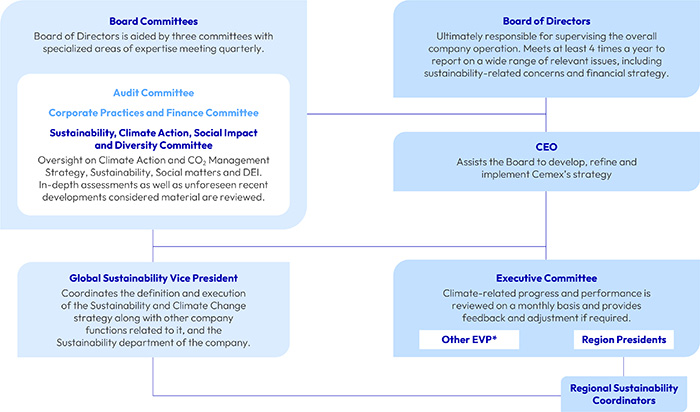
*Enterprise Risk Management included in the Executive Vice President of Corporate Affairs, Enterprise Risk Management and Social Impact
| Contents | ||
| Our Company | ||
| Our Strategy | ||
| Financial Performance | ||
| Environmental Excellence | ||
| Stakeholder Engagement | ||
| Governance | ||
| Appendix | ||
| Selected Consolidated Financial Information | ||
| Financial Information | ||
| Non-Financial Information | ||
| Scope and Boundaries of This Report | ||
| Cemex’s Materiality Assessment | ||
| Stakeholder Engagement | ||
| Governance | ||
| EU Taxonomy | ||
| GRI Content Index | ||
| International Sustainability Standards Board (ISSB) | ||
| Sustainability Accounting Standards Board Response (SASB) | ||
| ● Task Force on Climate-related Financial Disclosure Response (TCFD) | ||
| Terms We Use | ||
| Cautionary Statement Regarding Forward-Looking Statements | ||
| Investor, Contact and Feedback Information | ||
| 255 Cemex 2024 Integrated Report | ||
Strategy
Disclose the actual and potential impacts of climate-related risks and opportunities on the organization’s businesses, strategy, and financial planning where such information is material.
| a) | Describe the climate-related risks and opportunities the organization has identified over the short, medium, and long term. |
| b) | Describe the impact of climate-related risks and opportunities on the organization’s businesses, strategy, and financial planning. |
Our risks and opportunities are measured and assessed taking into consideration Cemex’s time horizons definition as short-term, medium-term, and long-term as follows:
| Short-term | Medium-term | Long-term | ||
| 1 year | 5 years | +5 years | ||
This time horizons are aligned with Cemex’s strategic planning decisions and are used as reference for this climate-related risks and opportunities assessment.
Cemex assesses climate-related risks and opportunities into two main categories: transition, which refer to the potential impacts of moving into a low-carbon economy; and physical, which refer to potential weather events that could directly affect our assets and operations.
The following is a brief description of some of the main short, medium and long-term climate-related risks and opportunities faced by Cemex, including information and details related to the effects of these on the business strategy and decision making, mitigation actions, and financial effects:
| Risk: Transition – Policy Time horizon effects: Short-medium term | ||
| Description | ||
| Cemex is subject to a growing number of CO2 regulations aiming to incentivize CO2 emissions reduction. In jurisdictions with carbon regulation in place, such regulations often manage CO2 pricing in the form of cap-and-trade systems, particularly in Europe and some states in the U.S. In other geographies, new or stricter CO2 regulations are under discussion or development and could imply a higher CO2 cost for Cemex in the short- and medium-term, for example, in the form of emission trading systems or CO2 taxes. Unclear CO2 regulations could result in double regulations. For instance, an entity may be subject to a cap-and-trade scheme as well as an emissions tax, which may have inconsistent or overlapping policy objectives.
| Likewise, the unequal application of a CO2 pricing mechanism between local and foreign producers could cause competitive disadvantages. On the other hand, government policies that incentivize the use of alternative technologies to reduce CO2 emissions (e.g., circular economy practices) are not advancing at the required pace or at the same pace in all geographies in which we operate, which may slow down the reduction of CO2 emissions. | |
| Current and anticipated effects on business model and value chain | Effects on strategy and decision-making | Current and anticipated financial effects | ||
| We are experiencing increased costs in our direct operations and value chain in countries with existing Emissions Trading Systems (ETS), including our European operations, California in the USA, and we expect in the future to increase our costs in Mexico which is currently in the pilot phase as of the date of this report. Additionally, higher costs are arising in countries with carbon taxes, such as several Mexican states and Colombia.
Cemex fully supports the implementation of the Paris Agreement and collaborates with governments worldwide to define and implement Nationally Determined Contributions (NDCs). Whether driven by such NDCs or otherwise, there is an increasing amount of climate-related regulations across the jurisdictions in which we operate. Even small changes to free allocation of carbon allowances to our installations, overall scarcity of allowances, or the level of taxes, for example, can have significant implications for Cemex.
| At Cemex, we have our cement plant-by-plant CO2 Roadmap, which includes all the initiatives to reduce CO2 needed to accomplish our 2030 targets. We have identified, evaluated and prioritized more than 400 initiatives to execute during this decade, including the switch to alternative fuels, specifically biomass, clinker substitutes and the use of decarbonated raw materials. The initiatives are calendarized and their implementation is monitored in a monthly basis by the CEO and ExCo. We also participate in the development of CCUS (Carbon Capture Utilization and Storage) technology as a long-term solution beyond 2030.
Additionally, as part of our strategy, we have implemented robust advocacy efforts across the geographies where we operate. In Mexico, we collaborate with the Mexican government through CANACEM to review the expected ETS regulations; in the SCA&C region, we collaborate with FICEM to assess the economic and emissions impact of carbon tax regulations versus ETS.
| Increased costs resulting from regulation and carbon pricing, potentially exacerbated by competitive pressure from imports from countries with less stringent CO2 regulations, and penalties for non-compliance with laws and regulations could have a material adverse effect on our business, financial condition, and results of operations.
An increase in production costs is already impacting on our operating expenses, particularly in our European cement operations and in California, due to regulatory changes. | ||
| Contents | ||
| Our Company | ||
| Our Strategy | ||
| Financial Performance | ||
| Environmental Excellence | ||
| Stakeholder Engagement | ||
| Governance | ||
| Appendix | ||
| Selected Consolidated Financial Information | ||
| Financial Information | ||
| Non-Financial Information | ||
| Scope and Boundaries of This Report | ||
| Cemex’s Materiality Assessment | ||
| Stakeholder Engagement | ||
| Governance | ||
| EU Taxonomy | ||
| GRI Content Index | ||
| International Sustainability Standards Board (ISSB) | ||
| Sustainability Accounting Standards Board Response (SASB) | ||
| ● Task Force on Climate-related Financial Disclosure Response (TCFD) | ||
| Terms We Use | ||
| Cautionary Statement Regarding Forward-Looking Statements | ||
| Investor, Contact and Feedback Information | ||
| 256 Cemex 2024 Integrated Report | ||
| Risk: Transition – Technology Time horizon effects: Long term | ||
| Description | ||
| The development and scaling of new technologies are essential to reducing CO2 emissions and meeting our 2050 Net-Zero CO2 emissions target, the sustainability-related key performance indicators (KPIs) in our financing arrangements, and the limits of any cap-and-trade systems applicable to Cemex. However, some CO2 reduction technologies still require validation in terms of technical feasibility, viability, and scalability. Developing breakthrough technologies also requires significant capital investment. | Failure to effectively select, develop deploy, or invest in the necessary technologies, or delays in their implementation, could prevent Cemex from achieving its 2050 Net-Zero CO2 emissions target and complying with limits under cap-and-trade systems to which Cemex is subject and sustainability-related KPIs in its financial agreements. It could also result in failure to meet stakeholders’ expectations. Furthermore, delays or shortcomings in developing sustainability-related technologies may limit the range of eligible projects for certain financing proceeds and reduce the effectiveness of those investments.
| |
| Current and anticipated effects on business model and value chain | Effects on strategy and decision-making | Current and anticipated financial effects | ||
| We face increased costs due to the development and deployment of new technologies for products, solutions and implementation across direct operations and upstream and downstream value chains.
The process to secure government funding is highly competitive, and economic or regulatory incentives for developing and testing these technologies are not available in all geographies. | Cemex, through our Global R&D department and Cemex Ventures, constantly evaluates and assesses new climate-related and lower-carbon technologies, whether proprietary or external. We collaborate with startups, universities, industry players and partners from other industries. Some of our R&D initiatives include low-CO2 clinker and carbon capture, utilization, and storage (CCUS) projects. We work under the EU H2020 scheme and the EU Innovation Fund and also collaborate with the National Petroleum Council (NPC) in the U.S. on CCUS technologies.
As of the date of this report, Cemex is participating in over 280 innovation projects. To build and expand this portfolio, we are seeking and expect to continue seeking government funding in Europe and the United States, where there are well established programs to foster green technology innovation.
| High capital investment in research and development and new technologies, along with potential write-offs or early retirement of existing assets and the cost of asset upgrades, poor capital allocation, substantial penalties, higher capital costs, and stakeholder activism could have a material adverse effect on our business, financial condition, and results of operations. | ||
| Contents | ||
| Our Company | ||
| Our Strategy | ||
| Financial Performance | ||
| Environmental Excellence | ||
| Stakeholder Engagement | ||
| Governance | ||
| Appendix | ||
| Selected Consolidated Financial Information | ||
| Financial Information | ||
| Non-Financial Information | ||
| Scope and Boundaries of This Report | ||
| Cemex’s Materiality Assessment | ||
| Stakeholder Engagement | ||
| Governance | ||
| EU Taxonomy | ||
| GRI Content Index | ||
| International Sustainability Standards Board (ISSB) | ||
| Sustainability Accounting Standards Board Response (SASB) | ||
| ● Task Force on Climate-related Financial Disclosure Response (TCFD) | ||
| Terms We Use | ||
| Cautionary Statement Regarding Forward-Looking Statements | ||
| Investor, Contact and Feedback Information | ||
| 257 Cemex 2024 Integrated Report | ||
| Risk: Transition - Market Time horizon effects: Medium term | ||
| Description | ||
| More stringent construction and energy efficiency standards are expected to drive demand for new lower-carbon products and construction solutions. As consumer expectations continue evolving, there is a risk that Cemex may fail to meet future market demands for new or alternative lower-carbon products and solutions. | On the other hand, a lack of regulatory incentives or regulations promoting the use of lower-carbon products could fail to incentivize their adoption. If customers are unwilling to bear the additional costs associated with transitioning to a low-carbon industry, this could also compromise our roadmap to achieving net-zero emissions by 2050. As industry peers embark on decarbonizing strategies, the competition for raw materials with lower-carbon footprint increases, driving up costs and limiting availability.
| |
| Current and anticipated effects on business model and value chain | Effects on strategy and decision-making | Current and anticipated financial effects | ||
| Effects on direct operations and value chain, both upstream and downstream, related to the development of new lower-carbon products to meet new construction standards, requirements and expectations. | Cemex’s commercial department closely monitors demand for lower-carbon products, while the R&D department continuously researches for innovative low-carbon solutions to expand our solutions portfolio, including our family of products with sustainable attributes, Vertua®.
Cemex’s fourth core business, Urbanization Solutions, aims to provide sustainable alternatives for metropolises growth, providing the market with high efficiency building solutions, and promoting circular economy through enhanced waste management schemes for cities. Through Cemex Ventures, we aim to identify, develop, and partner with disruptive construction projects and companies to accelerate the commercialization of low-carbon solutions. | The following factors could have a material adverse effect on our business, financial condition, liquidity, and results of operation: (1) reduced demand for our products and solutions due to shifting consumer preferences toward sustainable products could impact our revenue stream; (2) increased production costs due to more competition for lower-carbon and alternative raw materials; (3) higher capital expenses to adjust production processes and technology to incorporate lower-carbon alternative raw materials, and renewable energy; and (4) potential damage to our reputation if sustainability expectations are not met.
| ||
| Risk: Transition – Reputation Time horizon effects: Short term | ||||
| Description | ||||
| According to the GCCA, the cement industry accounts for approximately 5% - 8% of the world’s CO2 emissions. Cement could be perceived as a relevant contributor to CO2 global emissions. Negative company reputation or industry stigmatization to CO2 emissions, along with related stakeholder activism could have a negative impact on our stakeholders’ preferences for Cemex products.
| ||||
| Current and anticipated effects on business model and value chain | Effects on strategy and decision-making | Current and anticipated financial effects | ||
| Effects on direct operations and value chain, both upstream and downstream, which could potentially affect the demand for our products and solutions, capital availability or cost, and business continuity. | Cemex is in constant communication with its stakeholders to understand their views and expectations. This risk is monitored on a regular and coordinated basis by the Social Impact, Public Affairs, Sustainability, and Investor Relations departments through several channels: regular stakeholder surveys evaluating our image and materiality matrix, dialogue with the investment community, such as institutional investors, financial and sustainability analysts, and review of external reports by NGOs, authorities, or media.
Cemex is actively involved in industry associations in the jurisdictions where it operates, including the Global Cement and Concrete Association (GCCA).
| Negative disposition towards Cemex and the cement industry could reduce the demand for our products and solutions, affecting our revenue, reducing capital availability and/ or increasing our cost of capital, increasing stakeholder’s activism and business operations disruption. All these events could have a material adverse effect on our business, financial condition, liquidity, and results of operations. | ||
| Contents | ||
| Our Company | ||
| Our Strategy | ||
| Financial Performance | ||
| Environmental Excellence | ||
| Stakeholder Engagement | ||
| Governance | ||
| Appendix | ||
| Selected Consolidated Financial Information | ||
| Financial Information | ||
| Non-Financial Information | ||
| Scope and Boundaries of This Report | ||
| Cemex’s Materiality Assessment | ||
| Stakeholder Engagement | ||
| Governance | ||
| EU Taxonomy | ||
| GRI Content Index | ||
| International Sustainability Standards Board (ISSB) | ||
| Sustainability Accounting Standards Board Response (SASB) | ||
| ● Task Force on Climate-related Financial Disclosure Response (TCFD) | ||
| Terms We Use | ||
| Cautionary Statement Regarding Forward-Looking Statements | ||
| Investor, Contact and Feedback Information | ||
| 258 Cemex 2024 Integrated Report | ||
|
Risk: Acute and Chronic Physical Time horizon effects: Short-medium term | ||||
| Description | ||||
| Climate change is expected to intensify the severity and frequency of natural disasters already experienced in most geographies, such as tropical cyclones or other extreme storms, while also bringing new environmental changes that could impact people’s lives and economic activities. Our operations and business are exposed to the event-driven acute physical risks and the chronic physical risks associated with longer-term shifts in climate patterns.
| ||||
| Current and anticipated effects on business model and value chain | Effects on strategy and decision-making | Current and anticipated financial effects | ||
| The increased frequency and severity of extreme weather events could cause direct damage to our operations and downstream value chain, as well as the disruption of our business continuity, specifically in geographies with a high occurrence probability of natural disasters, including but not limited to the United States, Spain, the Caribbean and Mexico. | Since 2023, we have partnered with Risilience, an enterprise risk management specialist, to assess our exposure to climate-related risks and opportunities under different global average-temperature increase scenarios.
Additionally, the assessment of physical climate risks is a constant task of Cemex’s Enterprise Risk Management (ERM) system, which includes updating local emergency plans and collaborating with insurers to understand the potential changes in insured risks. ERM develops recovery strategies for PREPSI (People, Resources, Equipment, Premises, Suppliers, and Information). The loss of PREPSI is considered in two stages: operational continuity (by temporarily continuing to provide the goods or services agreed with our customers) and a return to business as usual (recovering business back to normal levels of operation).
To manage the physical risks, we aim to minimize the potential impact of a disruptive event in our business through our Business Continuity & Crisis Management (BC&CM) program. Under the scope of the BC&CM, a business recovery plan is implemented in each identified site, enabling the continuity and recovery of operations. BC&CM includes training, drills, and protocols which are essential to our ability to respond to unexpected operational risks with potential to disrupt business continuity, protecting people, surroundings, and operations. More information on our BC&CM program is available on page 118 of our 2024 Integrated Report.
| Asset damage, business disruption, loss of sales, cost increase and even reputation damage or possible litigation. The decrease in sales volume caused by physical hazard events is usually counterbalanced by the increase in the demand for our products and solutions during the reconstruction phases. Chronic physical risks could result also in supply chain disruptions as it was the case of shipping capacity restrictions in the Panama Canal due to low water levels. Supply chain disruptions could have a negative impact on the product delivery time and the cost of serving our markets.
Increased frequency and strength of tropical cyclones, as well as other extreme storms, can also cause loss of production in our operations due to the time to recover the plant to its original production before the event. | ||
| Contents | ||
| Our Company | ||
| Our Strategy | ||
| Financial Performance | ||
| Environmental Excellence | ||
| Stakeholder Engagement | ||
| Governance | ||
| Appendix | ||
| Selected Consolidated Financial Information | ||
| Financial Information | ||
| Non-Financial Information | ||
| Scope and Boundaries of This Report | ||
| Cemex’s Materiality Assessment | ||
| Stakeholder Engagement | ||
| Governance | ||
| EU Taxonomy | ||
| GRI Content Index | ||
| International Sustainability Standards Board (ISSB) | ||
| Sustainability Accounting Standards Board Response (SASB) | ||
| ● Task Force on Climate-related Financial Disclosure Response (TCFD) | ||
| Terms We Use | ||
| Cautionary Statement Regarding Forward-Looking Statements | ||
| Investor, Contact and Feedback Information | ||
| 259 Cemex 2024 Integrated Report | ||
| Opportunity: Market - Products and services - Increased sales of existing products and services Time horizon effects: Medium term | ||
| Description | ||
| More stringent building codes are likely to foster the development and use of new materials and constructive solutions, we expect this to present cement innovative companies with a competitive edge and allow for higher margins on already existing and new higher performance products, by the increment in demand for low-carbon products across different regions. We believe that we have several opportunities to expand our business by contributing to the development of sustainable cities, which involves lowering the total energy consumption of buildings through innovative design and construction practices. This transition is expected to increase the construction activity as older buildings are replaced or refurbished. Additionally, there is potential for increased demand for products and solutions that help to comply with new construction standards requirements.
| There is an opportunity to increase the demand of concrete products to support societal growth and attend the need of adapting buildings and infrastructure to expected climate change effects. In the IEA’s Net-Zero by 2050 scenario, it is acknowledged that the demand per capita of cement and other materials tends to rise when economies are developing. Over the last two decades, cement demand has increased by a factor of 2.4 in response to global economic and population growth. Future demand for cement is expected to grow as it is required to build additional transport infrastructure, such as roads, cycles, cars, and trucks, as well as energy infrastructure like power plants and wind turbines to adapt to new net-zero CO2 scenarios. | |
| Current and anticipated effects on business model and value chain | Effects on strategy and decision-making | Current and anticipated financial effects | ||
| Downstream value chain, including countries such as Egypt, Colombia, Israel, Nicaragua, Mexico, Puerto Rico, Panama, Barbados, Trinidad and Tobago, United Arab Emirates, and United States of America.
As Cemex has a high presence in developing countries’ markets such as South, Central America and the Caribbean, Mexico and Egypt, it is likely that the demand for concrete products increases first, to attend societal growth needs and then, due to the need of adapting buildings and infrastructure to expected effects of climate change, mainly in those geographies most exposed to extreme weather events, including but not limited to the United States, Spain, the Caribbean and Mexico.
For instance, we observed a slightly higher demand, mainly in Latin America, for products like Promptis, a rapid-hardening concrete that develops compressive strength within four hours, allowing sites to recover time lost during lockdowns and catch up with construction schedules. We also saw increased demand for Pervia, a draining pavement solution that facilitates water permeation and directs it to a water management system.
| Cemex offers a range of lower-carbon cement and concrete products, such as Vertua® lower-carbon concrete and our lower-carbon cement, along with other products with sustainable attributes like energy efficiency, water conservation, recycled materials and design optimization. These products have been rapidly adopted by our customers across different geographies. As of December 31, 2024, Vertua®, accounted for 63% of our total cement sales and 55% of our total concrete sales, achieving our 2025 target of 50% of total cement and ready-mix sales one year ahead of schedule. | Increased revenues are expected due to rising demand for products and services, along with access to new and emerging markets. This competitive edge could also allow for higher margins on both existing and newly developed higher performance products. | ||
| Contents | ||
| Our Company | ||
| Our Strategy | ||
| Financial Performance | ||
| Environmental Excellence | ||
| Stakeholder Engagement | ||
| Governance | ||
| Appendix | ||
| Selected Consolidated Financial Information | ||
| Financial Information | ||
| Non-Financial Information | ||
| Scope and Boundaries of This Report | ||
| Cemex’s Materiality Assessment | ||
| Stakeholder Engagement | ||
| Governance | ||
| EU Taxonomy | ||
| GRI Content Index | ||
| International Sustainability Standards Board (ISSB) | ||
| Sustainability Accounting Standards Board Response (SASB) | ||
| ● Task Force on Climate-related Financial Disclosure Response (TCFD) | ||
| Terms We Use | ||
| Cautionary Statement Regarding Forward-Looking Statements | ||
| Investor, Contact and Feedback Information | ||
| 260 Cemex 2024 Integrated Report | ||
| Opportunity: Products and services - Development of new products or services through R&D and innovation Time horizon effects: Medium term | ||
| Description | ||
| Cement and concrete offer several important characteristics for a low-carbon transition, including longevity, resistance, thermal properties for hot and cold weather, and wide availability. These attributes contribute to building resilient infrastructure capable of withstanding the detrimental consequences of climate change and providing the level of climate-proofing that could become mandatory as national building codes are revised to address more extreme weather events.
| These building codes foster the development of new materials and construction solutions and products, creating significant potential for further developments to decrease embodied carbon, improve the insulating properties of concrete, further increase its strength, and introduce smart functions to extend maintenance intervals and technical lifespans. | |
| Current and anticipated effects on business model and value chain | Effects on strategy and decision-making | Current and anticipated financial effects | ||
| Effects on the downstream value chain. Cemex has observed increasing demand for lower-carbon products mainly in Europe and other countries like Colombia. | Our R&D is constantly adapting our product portfolio to meet evolving customer and societal needs.
Cemex conducts R&D projects to anticipate future needs and challenges of society and evaluate existing and emerging technologies through the “Tech Intelligence Program”. This program is comprised of Cemex members from different disciplines who assess “technology alerts” (emerging or already developed) and provide insights to guide solution development.
Additionally, through our Urbanization Solutions core business, Cemex leverages its expertise in building materials to offer complementary solutions that address pressing societal needs, such as resilient buildings and infrastructure appropriate for disaster relief, energy efficiency, and affordability. | Increased revenues resulting from increased demand for products and services and from access to new and emerging markets.
Revenues are mainly impacted by the increase in sales expected for new, resilient and lower-carbon products. As soon as our customers understand the magnitude and importance of having a lower-carbon footprint and product life cycle assessment, the opportunity could become even more significant.
The cost of developing a new high-energy-efficiency product depends on several factors and is part of R&D activities. Additional expenses include certification, market introduction, R&D staffing, and market penetration efforts.
Additionally, we have received support through EU “Innovation Funds” for our new R&D technologies, and we have been granted funding from the U.S. DOE for innovation.
| ||
| Contents | ||
| Our Company | ||
| Our Strategy | ||
| Financial Performance | ||
| Environmental Excellence | ||
| Stakeholder Engagement | ||
| Governance | ||
| Appendix | ||
| Selected Consolidated Financial Information | ||
| Financial Information | ||
| Non-Financial Information | ||
| Scope and Boundaries of This Report | ||
| Cemex’s Materiality Assessment | ||
| Stakeholder Engagement | ||
| Governance | ||
| EU Taxonomy | ||
| GRI Content Index | ||
| International Sustainability Standards Board (ISSB) | ||
| Sustainability Accounting Standards Board Response (SASB) | ||
| ● Task Force on Climate-related Financial Disclosure Response (TCFD) | ||
| Terms We Use | ||
| Cautionary Statement Regarding Forward-Looking Statements | ||
| Investor, Contact and Feedback Information | ||
| 261 Cemex 2024 Integrated Report | ||
| Opportunity: Technology - Resource efficiency - Cost savings Time horizon effects: Long term | ||
| Description | ||
| Both the environment and Cemex’s revenues can benefit from co-processing if the right waste management regulations are in place. It could enable the development of a profitable waste management business by, for instance, imposing taxes and bans on landfills. This could lead to an increase in the availability of alternative fuels at a lower cost and reduce CO2 emissions. | The benefits of co-processing, which consist of switching from conventional fossil fuels to alternative fuels, mainly RDF (Refuse Derived Fuels), are not widely understood in our areas of influence, especially in those regions with a lack of or low regulatory enforcement, like Latin America, Asia and Africa and some areas in the USA. These are precisely the markets where Cemex could benefit the most from increased alternative fuel rates at lower costs.
| |
| Current and anticipated effects on business model and value chain | Effects on strategy and decision-making | Current and anticipated financial effects | ||
| Direct operations, including countries such as Egypt, Colombia, Mexico, Nicaragua, Panama, Jamaica, Puerto Rico, Barbados, United Arab Emirates and United States of America.
Countries in Europe have already leverage on this opportunity. For example, Poland, where appropriate waste regulations and economic incentives are in place, has achieved an alternative fuel substitution rate of 80-90% year over year, while Cemex’s 2024 global alternative fuels rate was 37%. | To capitalize on the opportunity to increase the use of lower-emissions sources of energy in our kilns, Cemex launched Regenera in 2023, a business unit focused on circularity services. Regenera offers waste management solutions to private and public sectors, including the reception, management, recycling, and coprocessing of different kinds of waste. The integration of processed waste into the cement and concrete manufacturing processes decreases the need for natural raw materials and fossil fuels for cement production.
Additionally, we have other lines of action: (1) Contact the Local/Regional/National administrations to promote the implementation of the proper regulation, and (2) Promote co-processing in our communities and with our main stakeholders.
| Reducing exposure to future fossil fuel price increases by switching from fossil fuels to alternative fuels, reducing our direct costs.
This can impact on financial planning costs associated with the alternative fuels strategy when the price lowers or is expected to lower. The impact of this lever is still low, primarily affecting some EU operations, mainly in the UK and Poland.
The long-term costs of realizing this opportunity worldwide include lobbying expenses to support the implementation of appropriate waste management policies and to promote the unique benefits of co-processing. | ||
| Contents | ||
| Our Company | ||
| Our Strategy | ||
| Financial Performance | ||
| Environmental Excellence | ||
| Stakeholder Engagement | ||
| Governance | ||
| Appendix | ||
| Selected Consolidated Financial Information | ||
| Financial Information | ||
| Non-Financial Information | ||
| Scope and Boundaries of This Report | ||
| Cemex’s Materiality Assessment | ||
| Stakeholder Engagement | ||
| Governance | ||
| EU Taxonomy | ||
| GRI Content Index | ||
| International Sustainability Standards Board (ISSB) | ||
| Sustainability Accounting Standards Board Response (SASB) | ||
| ● Task Force on Climate-related Financial Disclosure Response (TCFD) | ||
| Terms We Use | ||
| Cautionary Statement Regarding Forward-Looking Statements | ||
| Investor, Contact and Feedback Information | ||
| 262 Cemex 2024 Integrated Report | ||
Cemex’s Transition Plan
Future in Action is our global climate action program focused on developing lower-carbon products, solutions, and processes, including a range of qualities beyond just lower-carbon, with the primary objective of achieving net-zero CO2 emissions across the company by 2050.
As part of this program, Cemex is leveraging on the CO2 Reduction Roadmap, developed and launched across all our cement sites to model and assess the carbon mitigation potential at each site. This roadmap considers different factors and specific actions to achieve our 2030 decarbonization goals throughout our Scope 1, Scope 2 and Scope 3 emissions by implementing different technical measures, like increasing the use of alternative fuels, particularly biomass, upgrading technology assets, increasing the use of clinker substitutes or changing portfolio products. To implement this roadmap, Cemex seeks to invest an approximate of USD$150 million annually.
In 2022, Cemex validated its 2050 net-zero CO2 roadmap and its 2030 decarbonization goals under the Science Based Targets initiative’s (SBTi) 1.5°C Scenario, becoming one of the first companies in the industry to do so.
| | To learn more about our Future in Action program and CO2 Roadmap, please refer to pages 32-63 in our 2024 Integrated Report or visit cemex.com |
Cemex has also adopted several organizational measures, including awareness-raising, monitoring, and reporting of emissions, as well as the extensive use of our proprietary carbon footprint tool, CerO2. To reinforce this commitment, all operations set an annual emissions reduction goal tied to our CO2 metrics, with a portion of employee compensation linked to the achievement of this goal.
Additionally, as part of our transition plan, Cemex is making significant investments in R&D to achieve our 2050 net-zero CO2 target. One of the major contributors to reducing our emissions and achieving carbon neutrality will be the capture and storage, or utilization of CO2 (CCUS) emitted from our processes. Cemex is currently developing large-scale CCUS projects in Europe and the U.S., along with several pilot programs and emerging CCUS technologies designed to improve and accelerate decarbonization. Recently, in collaboration with Linde, we were granted €157 million from the EU Innovation Fund for the development of a CCUS project that will capture 1.3 million metric tons of CO2 per year from Cemex Rüdersdorf’s cement plant, ultimately decarbonizing the site by 2030.
| | To learn more about our innovation and research projects and efforts, please refer to pages 54-58 of our 2024 Integrated Report. |
Internal Carbon Price
Since 2020, Cemex has implemented an internal carbon price as a shadow price to drive low-carbon investments and change internal behaviors. This approach reflects a simulated cost for CO2 emissions, assuming that all our sites worldwide operate under an emission trading system (ETS). Each year, we update the price of carbon according to the latest EU ETS average price forecast from a report by ten analysts (65.3 EUR/t for 2024 and 145 EUR/t for 2030; UKA 2024: 37.7 GBP/ton). This also includes UK ETS price forecast. The California market price is adjusted based on Analyst’s Best Estimate used for our California operation (37.3 USD/t in 2024, and 95 USD/t in 2030). For non-regulated countries outside the EU and California, we apply a carbon floor price of 24 USD/ton in 2024, and 36 USD/t in 2030. These forecasts are used in all our business units, enabling managers to make operational and investment decisions while considering the impact of CO2 emissions on present and future financial performance.
| c) | Describe the resilience of the organization’s strategy, taking into consideration different climate-related scenarios, including a 2°C or lower scenario. |
To better assess, quantify, and report climate-related risks, since 2023, we have engaged with Risilience, an enterprise risk management specialist that uses technology pioneered by the Centre for Risk Studies at the University of Cambridge Judge Business School. This partnership allows us to assess our exposure to climate-related risks and opportunities under different global average-temperature increase scenarios. The technology allowed us to develop a digital twin of our operations to model impacts for both our physical and transition risks.
The 2023 pilot project focused on the physical risks of twenty of our most significant facilities and locations. In 2024, we expanded the assessment to include all key assets from our cement, ready-mix and aggregates business, covering more than 1,500 assets5. The digital twin incorporates five emission scenarios and Shared Socioeconomic Pathways (“SSP”) defined by the Intergovernmental Panel on Climate Change (IPCC): Paris Ambition (SSP1-1.9), Paris Agreement (SSP1-2.6), Stated policy (SSP2-4.5), Current policy (SSP3-7.0), and No policy (SSP5-8.5).
These pathways define possible future emission scenarios with different narratives that explore how society, demographics, and economics will affect greenhouse gas emissions, resultant radiative forcing, and temperature rise across the globe. The scenarios are based on the Shared Socioeconomic Pathways (SSPs) combined with the Representative Concentration Pathways (RCPs), which form the basis of the Sixth Assessment Report (AR6) from the Intergovernmental Panel on Climate Change (IPCC).
This scenario analysis assesses the resilience of Cemex’s climate strategy over the short-term (1 year), medium-term (5 year), and long-term (2040). The identified risks and opportunities are assessed based on their impact on business activity, financial and earnings position, and cash flow (USD million).
| 5 | Risiliance assessment considers discontinued operations. |
| Contents | ||
| Our Company | ||
| Our Strategy | ||
| Financial Performance | ||
| Environmental Excellence | ||
| Stakeholder Engagement | ||
| Governance | ||
| Appendix | ||
| Selected Consolidated Financial Information | ||
| Financial Information | ||
| Non-Financial Information | ||
| Scope and Boundaries of This Report | ||
| Cemex’s Materiality Assessment | ||
| Stakeholder Engagement | ||
| Governance | ||
| EU Taxonomy | ||
| GRI Content Index | ||
| International Sustainability Standards Board (ISSB) | ||
| Sustainability Accounting Standards Board Response (SASB) | ||
| ● Task Force on Climate-related Financial Disclosure Response (TCFD) | ||
| Terms We Use | ||
| Cautionary Statement Regarding Forward-Looking Statements | ||
| Investor, Contact and Feedback Information | ||
| 263 Cemex 2024 Integrated Report | ||
| Scenario Name and Reference | No Policy Action (SSP5-8.5) | Current Policy (SSP3-7.0) | Stated Policy (SSP2-4.5) | Paris Agreement (SSP1-2.6) | Paris Ambition (SSP1-1.9) | |||||
| Description | Governments fail to implement policies and therefore, CO2 emissions go unregulated | Existing CO2 emission reduction policies are followed | Existing and planned CO2 emission reduction policies are implemented and followed | There is an attempt to follow environmentally friendly practices; most of the major consequences of climate change are averted | Strict environmentally friendly practices are adopted, avoiding major consequences of climate change | |||||
| Temperature change vs average global temperature of 1850-1900 | 2030 – 1.6°C 2050 – 2.4°C 2100 – 4.4°C | 2030 – 1.5°C 2050 – 2.1°C 2100 – 3.6°C | 2030 – 1.5°C 2050 – 2.0°C 2100 – 2.7°C | 2030 – 1.5°C 2050 – 1.7°C 2100 – 1.8°C | 2030 – 1.5°C 2050 – 1.6°C 2100 – 1.4°C | |||||
| Relevant Underlying Assumptions | ||||||||||
| Industry policies and incentives to technology development | Lack of global GHG policies and regulations. | Climate policies remain limited and are likely to vary by region with different levels of enforcement. Energy efficiency in plants is primarily pursued as a cost-effective measure. | Different measures depending on the geography.
EU: New Industrial Strategy and country-level spending on green industry pilots, circular economy and hydrogen.
U.S.: Investments from a Department of Energy program to decarbonize manufacturing.
LATAM: No incentives, except in Brazil. | Across all regions, policies are expected to support increased deployment of CCUS and hydrogen, promote the circular economy, and enhance minimum energy performance standards for electric motors by 2025, along with mandatory energy audits. | Achieving these targets will require a much faster pace of technological innovation than previously achieved, and at a competitive cost. Most new clean technologies in heavy industry are expected to be demonstrated at scale by 2030, with over 90% of heavy industrial production reaching low emissions by 2050. | |||||
| Building sector policies | NA | Building codes and standards vary significantly between regions, with weaker regulations in developing areas, which lag behind more developed regions. The integration of renewable energy sources in buildings is low, and buildings continue to rely on fossil fuels to meet their energy and electricity demands. | Policies and measures differ by region: in the EU, there are country-level incentives for renovations and appliance upgrades, new building codes, and support for clean heating incentives and investments; in Egypt, minimum performance standards apply only to incandescent lamps; in the USA, updated minimum energy performance standards are in place; in LATAM, no building policies are currently in effect. | Mandatory energy conservation building codes, including net-zero emissions requirement for all new buildings by 2030, at the latest. | Universal energy access is anticipated, with all new buildings being zero-carbon-ready, and 85% of all buildings reaching zero-carbon readiness by 2050. | |||||
| Carbon price (IEA reference) USD/ton | NA | Low carbon prices due to weak climate policies. | EU: 2030: 65 / 2040: 75 / 2050:90
Colombia, Mexico: 2030: 15 / 2040: 20 / 2050: 30 US: Price only in California. | Advanced economies: 2030: 120 / 2040: 170 / 2050: 200
Colombia and Mexico with NZ pledge: 2030: 40 / 2040: 110 / 2050: 160 | Advanced economies: 2030: 130 / 2040: 205 / 2050: 250
Developing economies: 2030:15 / 2040: 35 / 2050: 55 | |||||
| Cement demand and demand of lower carbon products | No demand for lower-carbon products. Cement demand increases to build infrastructure adapted to the dramatic effects of climate change, such as floods or droughts | Slow adoption of lower-carbon products with developed countries having higher adoption rates than developing regions. Cement demand increases due to high population growth and urbanization in developing countries.
| CAAGR: +0.7 in 2030 and -0.2 in 2050
Lower-carbon products demand increase +0.1 | CAAGR: +0.7 in 2030 and -0.4 in 2050
Lower-carbon products demand increase +0.2 | CAAGR: -0.20 in 2030 and -0.3 in 2050
Lower-carbon products demand increase +0.5 | |||||
| Contents | ||
| Our Company | ||
| Our Strategy | ||
| Financial Performance | ||
| Environmental Excellence | ||
| Stakeholder Engagement | ||
| Governance | ||
| Appendix | ||
| Selected Consolidated Financial Information | ||
| Financial Information | ||
| Non-Financial Information | ||
| Scope and Boundaries of This Report | ||
| Cemex’s Materiality Assessment | ||
| Stakeholder Engagement | ||
| Governance | ||
| EU Taxonomy | ||
| GRI Content Index | ||
| International Sustainability Standards Board (ISSB) | ||
| Sustainability Accounting Standards Board Response (SASB) | ||
| ● Task Force on Climate-related Financial Disclosure Response (TCFD) | ||
| Terms We Use | ||
| Cautionary Statement Regarding Forward-Looking Statements | ||
| Investor, Contact and Feedback Information | ||
| 264 Cemex 2024 Integrated Report | ||
| No Policy (SSP5-8.5) | Current Policy (SSP3-7.0) | Stated Policy (SSP2-4.5) | Paris Agreement (SSP1-2.6) | Paris Ambition (SSP1-1.9) | ||||||||||||||||||||||||||||
| Timeframe | Risk | Opportunity | Risk | Opportunity | Risk | Opportunity | Risk | Opportunity | Risk | Opportunity | ||||||||||||||||||||||
| Policy | 2025 |  | | | |  | ||||||||||||||||||||||||||
| 2030 | | | |  | | |||||||||||||||||||||||||||
| 2040 | | | | | | |||||||||||||||||||||||||||
| Technology | 2025 | | | | | | | | | | | |||||||||||||||||||||
| 2030 | | | | | | | | | | | ||||||||||||||||||||||
| 2040 | | | | | | | | | | | ||||||||||||||||||||||
| Market | 2025 | | | | | | | | | | | |||||||||||||||||||||
| 2030 | | | | | | | | | | | ||||||||||||||||||||||
| 2040 | | | | | | | | | | | ||||||||||||||||||||||
| Reputation | 2025 | | | | | | ||||||||||||||||||||||||||
| 2030 | | | | | | |||||||||||||||||||||||||||
| 2040 | | | | | | |||||||||||||||||||||||||||
| Physical (acute and chronical) | 2025 | | | | | | ||||||||||||||||||||||||||
| 2030 | | | | | | |||||||||||||||||||||||||||
| 2040 | | | | | | |||||||||||||||||||||||||||
Quantification based on potential impact
on business activity, financial and earnings
position, and cash flow (USD Million) (assuming
no mitigation):
| Contents | ||
| Our Company | ||
| Our Strategy | ||
| Financial Performance | ||
| Environmental Excellence | ||
| Stakeholder Engagement | ||
| Governance | ||
| Appendix | ||
| Selected Consolidated Financial Information | ||
| Financial Information | ||
| Non-Financial Information | ||
| Scope and Boundaries of This Report | ||
| Cemex’s Materiality Assessment | ||
| Stakeholder Engagement | ||
| Governance | ||
| EU Taxonomy | ||
| GRI Content Index | ||
| International Sustainability Standards Board (ISSB) | ||
| Sustainability Accounting Standards Board Response (SASB) | ||
| ● Task Force on Climate-related Financial Disclosure Response (TCFD) | ||
| Terms We Use | ||
| Cautionary Statement Regarding Forward-Looking Statements | ||
| Investor, Contact and Feedback Information | ||
| 265 Cemex 2024 Integrated Report | ||
Cemex recognizes that climate action is the greatest challenge of our time and our climate strategy remains aligned with the most ambitious scenario, Paris Ambition (SSP1-1.9). The assessment considers the inherent risk to Cemex but does not account for residual risk. However, the results confirm that Cemex’s carbon strategy is generally robust and demonstrates strong climate initiatives and performance. Particularly, we have robust efforts in technology and market, as these two areas show a high impact quantification throughout the three time frames considered in this assessment. Our innovation and R&D teams are continuously working to identify, develop, and invest in new technologies that deliver innovative building materials and solutions to build resilient cities, urban projects, buildings, and infrastructure. We are also investing in and forming partnerships to develop and leverage technologies as we enhance our production processes, in line with our climate commitments.
Additionally, our portfolio of products and solutions with sustainable attributes, Vertua®, which includes our lower-carbon concrete and cement, has gained rapid adoption by customers across the geographies where we operate. Cemex remains committed to offering products and services that address our customers’ sustainability-related concerns while maintaining alignment with the most ambitious net-zero scenario efforts by 2050.
The results of this assessment, along with the analysis of our Future in Action program, our climate action plan launched in 2020, with its related initiatives, progress and plans, demonstrate that our strategy is robust and well-prepared to tackle the most ambitious challenges expected under each scenario and to deliver on our climate commitments.
We will continue working toward our 2030 target of reducing our net specific CO2 emissions by 47% compared to our 1990 baseline. Also, Cemex expects to continue investing in research and development, capitalizing on Cemex Ventures, Urbanization Solutions, and strategic partnerships, to continue at the forefront of the building materials industry by offering cutting-edge sustainable products and solutions and improving our production processes in line with our decarbonization roadmap. We anticipate that these efforts will be further strengthened in the most carbon-constrained scenarios.
Risk Management
Disclose how the organization identifies, assesses and manages climate-related risks.
| a) | Describe the organization’s processes for identifying and assessing climate-related risks. |
| b) | Describe the organization’s processes for managing climate-related risks. |
| c) | Describe how processes for identifying, assessing, and managing climate-related risks are integrated into the organization’s overall risk management. |
Cemex’s Enterprise Risk and Opportunity Management
Cemex has an Enterprise Risk Management (“ERM”) system established throughout the organization with global policies and procedures designed to anticipate and manage the main risks and opportunities that could affect our business. Our ERM system is established at country, regional and global levels following a bottom-up and top-down strategy that allows information flow across the organization and supports better-informed decision making. The ERM and the Sustainability functions are the primary responsible departments for assessing climate-related risks and opportunities.
Our risk and opportunity agenda, developed at country, regional, and global level, results from a comprehensive ERM process that identifies and manages different types of risks, trends, emerging concerns, and opportunities that could impact Cemex’s strategic priorities in the short, medium, and long term. This agenda is developed at least twice a year, and it is presented to the Risk Management Committee, composed of the Executive Committee members, and to the Board of Directors for its insight, discussion and approval. This agenda includes sustainability, ESG, and climate-related risks and opportunities, which are managed within the ERM system.
Through the Sustainability, Climate Action, Social Impact and Diversity Committee, the Board of Directors oversees and discusses in detail the climate-related risks and opportunities previously identified in the risk and opportunity agenda. These risks and opportunities are prioritized based on their overall risk rating assessed by ERM, which is based on their estimated probability (likelihood of the risk materializing) and impact (qualitative/quantitative consequences for Cemex if the risk materializes).
In addition to our ERM system to identify, assess, monitor and manage climate-related risks and opportunities, a scenario analysis is elaborated, integrating the risks and opportunities identified in the agendas, and using relevant inputs and parameters to assess each element. This assessment is presented in the Strategy section of this TCFD report.
| Contents | ||
| Our Company | ||
| Our Strategy | ||
| Financial Performance | ||
| Environmental Excellence | ||
| Stakeholder Engagement | ||
| Governance | ||
| Appendix | ||
| Selected Consolidated Financial Information | ||
| Financial Information | ||
| Non-Financial Information | ||
| Scope and Boundaries of This Report | ||
| Cemex’s Materiality Assessment | ||
| Stakeholder Engagement | ||
| Governance | ||
| EU Taxonomy | ||
| GRI Content Index | ||
| International Sustainability Standards Board (ISSB) | ||
| Sustainability Accounting Standards Board Response (SASB) | ||
| ● Task Force on Climate-related Financial Disclosure Response (TCFD) | ||
| Terms We Use | ||
| Cautionary Statement Regarding Forward-Looking Statements | ||
| Investor, Contact and Feedback Information | ||
| 266 Cemex 2024 Integrated Report | ||
Risk and Opportunity Management Process at Cemex
Our risk and opportunity management process is an ongoing systematic approach present in corporate, regions, countries, and operational business units. The climate-related risks and opportunities are also considered within this company risk and opportunity management process, along with other risks and opportunities relevant to the company. It is a proactive, preventive, and corrective approach to address all potential risks and identify opportunities. There is coordination with the Sustainability function and the climate action strategy of the company.
Our risk and opportunity management processes adhere to best practices from the ISO 31000, ISO 22301 and ISO 22361 standards for risk management, business continuity and crisis management, and also the Business Continuity Institute guidelines. Additionally, our ERM team is formed by accredited professionals on ISO 31000 and ISO 31010 techniques, and members of the Risk Management Society and other international risk management networks.
| | For more information on Cemex’s Risk and Opportunity Management, please refer to pages 117 in our 2024 Integrated Report. |
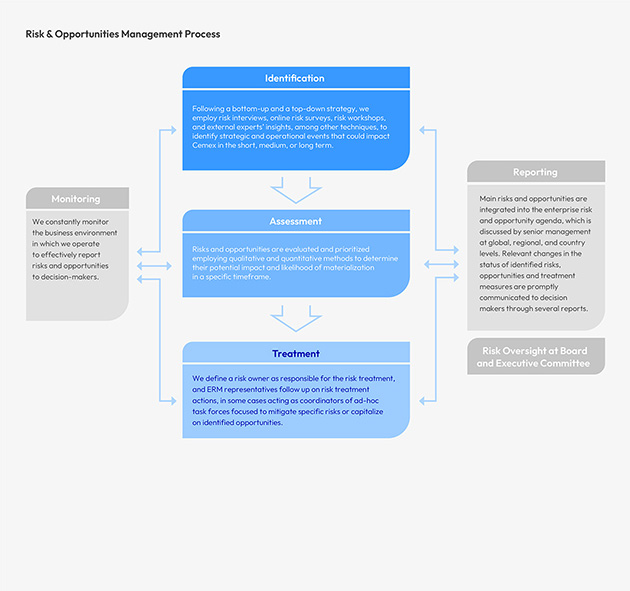
| Contents | ||
| Our Company | ||
| Our Strategy | ||
| Financial Performance | ||
| Environmental Excellence | ||
| Stakeholder Engagement | ||
| Governance | ||
| Appendix | ||
| Selected Consolidated Financial Information | ||
| Financial Information | ||
| Non-Financial Information | ||
| Scope and Boundaries of This Report | ||
| Cemex’s Materiality Assessment | ||
| Stakeholder Engagement | ||
| Governance | ||
| EU Taxonomy | ||
| GRI Content Index | ||
| International Sustainability Standards Board (ISSB) | ||
| Sustainability Accounting Standards Board Response (SASB) | ||
| ● Task Force on Climate-related Financial Disclosure Response (TCFD) | ||
| Terms We Use | ||
| Cautionary Statement Regarding Forward-Looking Statements | ||
| Investor, Contact and Feedback Information | ||
| 267 Cemex 2024 Integrated Report | ||
Metrics and Targets
Disclose the metrics and targets used to assess and manage relevant climate-related risks and opportunities where such information is material.
| a) | Disclose the metrics used by the organization to assess climate-related risks and opportunities in line with its strategy and risk management process. |
| b) | Disclose Scope 1, Scope 2, and, if appropriate, Scope 3 greenhouse gas (GHG) emissions, and the related risks. |
| GHG Emissions | 2022 | 2023 | 20241 | |||||||||
| Scope 1 absolute gross CO2 emissions in cement (million ton)2 | 35.3 | 32.5 | 26.4 | |||||||||
| Scope 1 absolute net CO2 emissions in cement (million ton)2,3 | 31.9 | 29.0 | 23.9 | |||||||||
| Scope 2 absolute CO2 emissions in cement (million ton)4,5 | 3.0 | 2.7 | 2.0 | |||||||||
| Scope 1 specific gross CO2 emissions (kg CO2/ton of cementitious product)2 | 621 | 603 | 580 | |||||||||
| Scope 1 specific net CO2 emissions (kg CO2/ton of cementitious product)2,6 | 562 | 541 | 526 | |||||||||
| Scope 2 specific CO2 emissions (kg CO2/ton of cementitious product)2,7 | 52.4 | 50.6 | 44.7 | |||||||||
| Scope 1 + 2 specific gross CO2 emissions (kg CO2/ton of cementitious product) | 673 | 654 | 625 | |||||||||
| Reduction in CO2 emissions per ton of cementitious product from 1990 baseline (%) | 29.9 | 32.6 | 33.9 | |||||||||
| Reduction in CO2 emissions per ton of cementitious product from 2020 baseline (%) | 9.3 | 12.8 | 15.2 | |||||||||
| Scope 1 CO2 gross emissions (million ton)8 | 36.2 | 33.3 | 27.2 | |||||||||
| Scope 2 CO2 emissions (million ton)9 | 3.1 | 2.9 | 2.2 | |||||||||
| Scope 3 CO2 emissions (million ton)10 | 17.8 | 16.4 | 13.4 | |||||||||
| Category 1: Purchased goods and services (million ton)11 | 6.3 | 5.9 | 4.8 | |||||||||
| Category 2: Capital goods (million ton) | 0.2 | 0.2 | 0.2 | |||||||||
| Category 3: Fuel and energy related (million ton)11 | 2.7 | 2.4 | 2.0 | |||||||||
| Category 4: Upstream transport (million ton) | 2.2 | 2.0 | 1.7 | |||||||||
| Category 5: Waste (million ton) | 0.002 | 0.002 | 0.002 | |||||||||
| Category 6: Business travel (million ton) | 0.04 | 0.02 | 0.02 | |||||||||
| Category 7: Employee commuting (million ton) | 0.03 | 0.06 | 0.05 | |||||||||
| Category 8: Upstream leased assets (million ton) | - | - | - | |||||||||
| GHG Emissions | 2022 | 2023 | 20241 | |||||||||
| Category 9: Downstream transport (million ton) | 0.9 | 0.6 | 0.6 | |||||||||
| Category 10: Processing of sold products (million ton) | 0.2 | 0.1 | 0.1 | |||||||||
| Category 11: Use of sold products (million ton)11 | 3.9 | 3.6 | 2.0 | |||||||||
| Category 12: End-of-life treatment of sold products (million ton) | 0.5 | 0.6 | 0.9 | |||||||||
| Category 13: Downstream leased assets (million ton) | - | - | - | |||||||||
| Category 14: Franchises (million ton) | - | - | - | |||||||||
| Category 15: Investments (million ton) | 1.0 | 1.0 | 1.0 | |||||||||
| CO2 emissions intensity per US$ of revenue (Scope 1 + 2) (kg CO2/US$) | 2.5 | 2.1 | 1.8 | |||||||||
| CO2 avoided emissions (million tons) | 11.2 | 11.6 | 11.1 | |||||||||
| CO2 emissions from biogenic carbon (million tons)2 | 1.9 | 1.8 | 1.8 | |||||||||
| Scope of emissions covered by an ETS/carbon taxation regime (% Scope 1)8 | 32 | 30 | 34 | |||||||||
| Alternative Raw Materials & Waste Management | 2022 | 2023 | 20241 | |||||||||
| Clinker Factor (Cementitious) (%) | 73.7 | 72.3 | 71.8 | |||||||||
| Alternative raw material rate (%)12,13 | 11.6 | 12.7 | 14.0 | |||||||||
| Total waste sent for disposal (thousand ton)14 | 400.0 | 826.5 | 848.0 | |||||||||
| Total waste-derived sources repurposed (million ton)15 | 26.8 | 27.9 | 27.1 | |||||||||
| Percentage of own operational waste that is recycled (%)14 | 94 | 87 | 82 | |||||||||
| Contents | ||
| Our Company | ||
| Our Strategy | ||
| Financial Performance | ||
| Environmental Excellence | ||
| Stakeholder Engagement | ||
| Governance | ||
| Appendix | ||
| Selected Consolidated Financial Information | ||
| Financial Information | ||
| Non-Financial Information | ||
| Scope and Boundaries of This Report | ||
| Cemex’s Materiality Assessment | ||
| Stakeholder Engagement | ||
| Governance | ||
| EU Taxonomy | ||
| GRI Content Index | ||
| International Sustainability Standards Board (ISSB) | ||
| Sustainability Accounting Standards Board Response (SASB) | ||
| ● Task Force on Climate-related Financial Disclosure Response (TCFD) | ||
| Terms We Use | ||
| Cautionary Statement Regarding Forward-Looking Statements | ||
| Investor, Contact and Feedback Information | ||
| 268 Cemex 2024 Integrated Report | ||
| Water Management16 | 2022 | 2023 | 20241 | |||||||||
| Total water withdrawals (million m3) | 58.7 | 52.5 | 50.1 | |||||||||
| Total water discharge (million m3) | 18.5 | 14.1 | 12.7 | |||||||||
| Total water consumption (million m3) | 40.3 | 38.4 | 37.4 | |||||||||
| Total freshwater withdrawn in sites located in water-stressed areas (million m3) | 6.3 | 3.8 | ||||||||||
| Total freshwater consumption in sites located in water-stressed areas (million m3) | 5.7 | 3.6 | ||||||||||
| Specific water consumption | ||||||||||||
| Cement (l/cement ton)17 | 265 | 255 | 262 | |||||||||
| Ready-mix (l/m3) | 232 | 233 | 235 | |||||||||
| Aggregates (l/ton) | 123 | 135 | 140 | |||||||||
| Sites with water recycling systems (%) | 82 | 87 | 89 | |||||||||
| Energy Consumption | 2022 | 2023 | 20241 | |||||||||
| Specific heat consumption (MJ/ton clinker)12 | 4,063 | 4,110 | 4,113 | |||||||||
| Specific power consumption (kWh/ton cement)12 | 123 | 124 | 126 | |||||||||
| Fuel Consumption (TJ) | 177,017 | 165,960 | 139,488 | |||||||||
| Power Consumption (GWh) | 7,252 | 7,031 | 6,191 | |||||||||
| Total Energy Consumption (GWh) | 56,424 | 53,131 | 44,937 | |||||||||
| Cement Fuel Mix (%) | ||||||||||||
| Primary Fuels | 65.0 | 63.2 | 63.3 | |||||||||
| Petroleum coke | 37.1 | 41.6 | 36.6 | |||||||||
| Coal | 18.8 | 12.1 | 12.2 | |||||||||
| Fuel oil + Diesel | 3.0 | 2.0 | 2.1 | |||||||||
| Natural gas | 6.1 | 7.5 | 12.4 | |||||||||
| Alternative Fuels | 35.0 | 36.8 | 36.7 | |||||||||
| Fossil-based waste | 23.0 | 25.0 | 21.8 | |||||||||
| Biomass waste | 12.0 | 11.8 | 14.9 | |||||||||
| Power consumption from clean energy in cement (%)18 | 33 | 36 | 34 | |||||||||
Footnotes:
| 1 | 2024 figures do not include discontinued operations. |
| 2 | Calculation according to the GCCA Sustainability Guidelines for the monitoring and reporting of CO2 emissions from cement manufacturing. |
| 3 | The figures for 2022 and 2023 are 28.2 and 25.6, respectively, without considering discontinued operations. |
| 4 | Marked based. |
| 5 | The figures for 2022 and 2023 are 2.5 and 2.3, respectively, without considering discontinued operations. |
| 6 | The figures for 2022 and 2023 are 564 and 539, respectively, without considering discontinued operations. |
| 7 | The figures for 2022 and 2023 are 50.4 and 48.7, respectively, without considering discontinued operations. |
| 8 | Figure includes emissions from Cemex-owned road transport fleet. |
| 9 | Scope 2 CO2 emissions for cement in 2024 are 2.0 million tons. |
| 10 | All categories of Scope 3 are included. |
| 11 | Reporting data as verified by KPMG. |
| 12 | Cement only. |
| 13 | Calculation according to GCCA Sustainability Guidelines for co-processing fuels and raw materials in cement manufacturing. |
| 14 | Starting 2023, internal update on waste categorization criteria. 2023 and 2022 figures for “Percentage of own operational waste that is recycled (%)” have been restated due to divestments and change in accounting criteria. |
| 15 | Includes non-recyclable waste consumed in our operations as alternative raw material and fuel, alternative aggregates, own recycled material in our businesses and other waste managed by the company. 2023 and 2022 figures have been restated due to divestments and change in accounting criteria. |
| 16 | Classification according to GCCA Sustainability Guidelines for the monitoring and reporting of water in cement manufacturing. |
| 17 | The figures for 2022 and 2023 are 13.6 and 12.3 million m3, respectively, without considering discontinued operations. |
| 18 | Our definition of clean energy includes renewable energy sources such as solar, wind, hydro, geothermal, and biomass, together with power generated from waste heat recovery systems. |
| Contents | ||
| Our Company | ||
| Our Strategy | ||
| Financial Performance | ||
| Environmental Excellence | ||
| Stakeholder Engagement | ||
| Governance | ||
| Appendix | ||
| Selected Consolidated Financial Information | ||
| Financial Information | ||
| Non-Financial Information | ||
| Scope and Boundaries of This Report | ||
| Cemex’s Materiality Assessment | ||
| Stakeholder Engagement | ||
| Governance | ||
| EU Taxonomy | ||
| GRI Content Index | ||
| International Sustainability Standards Board (ISSB) | ||
| Sustainability Accounting Standards Board Response (SASB) | ||
| ● Task Force on Climate-related Financial Disclosure Response (TCFD) | ||
| Terms We Use | ||
| Cautionary Statement Regarding Forward-Looking Statements | ||
| Investor, Contact and Feedback Information | ||
| 269 Cemex 2024 Integrated Report | ||
| c) | Describe the targets used by the organization to manage climate-related risks and opportunities and performance against targets. |
Cemex is among the first companies in the global cement industry to validate its 2030 decarbonization targets and 2050 net-zero goal through the Science Based Targets initiative (SBTi) for alignment under the 1.5°C scenario, the most ambitious for the cement industry. This validation includes Scope 1, 2, and 3 emission targets, allowing us to align with the Paris Agreement objective. Our 2030 and 2050 net-zero targets do not consider the use of offsets or carbon credits, in alignment with SBTi Criteria.
To reach our climate targets, we have developed a CO2 roadmap including specific reduction initiatives for each cement site, identifying the necessary resources (CAPEX) and calendar for their implementation. Each region monitors monthly its site-by-site plan to strive to comply with its implementation and resources allocation.
Scope 1-specific CO2 emissions
(kg CO2/ton of cementitious product)
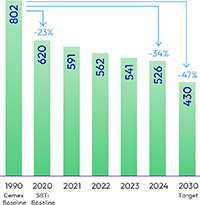
| Climate-related Targets | 2020 Baseline | 2024 Performance | 2030 Target | 2050 Target | ||||
| Scope 1 | ||||||||
| Reduction of net CO2 emissions in cement per ton of cementitious product (kgCO2/ton of cementitious product) | 620 | 526 15% reduction1 | < 430 31% reduction | |||||
| Clinker factor (%) | 71.8 | 68 | ||||||
| Alternative fuels (%) | 37 | 55 | ||||||
| Scope 2 | ||||||||
| Reduction of CO2 emissions per ton of cementitious product (kgCO2/ton of cementitious product) | 57 | 44.7 18% reduction1 | 24 58% reduction |
Net-zero CO2 emissions across the company | ||||
|
Clean electricity (%) | 28 | 34 | ||||||
|
Scope 3 | ||||||||
| Reduction of CO2 emissions per ton of purchased clinker and cement (kgCO2/ton) | 850 | 819 | 25% reduction | |||||
| Reduction of CO2 emissions per ton of purchased fuels (kgCO2/ton) | 255 | 205 | 40% reduction | |||||
| Reduction of absolute CO2 emissions of traded fuels (tons of CO2) | 5,730,384 | 1,980,527 | 42% reduction | |||||
| 1 | Like-for-like, excluding discontinued operations. |
| Contents | ||
| Our Company | ||
| Our Strategy | ||
| Financial Performance | ||
| Environmental Excellence | ||
| Stakeholder Engagement | ||
| Governance | ||
| Appendix | ||
| Selected Consolidated Financial Information | ||
| Financial Information | ||
| Non-Financial Information | ||
| Scope and Boundaries of This Report | ||
| Cemex’s Materiality Assessment | ||
| Stakeholder Engagement | ||
| Governance | ||
| EU Taxonomy | ||
| GRI Content Index | ||
| International Sustainability Standards Board (ISSB) | ||
| Sustainability Accounting Standards Board Response (SASB) | ||
| Task Force on Climate-related Financial Disclosure Response (TCFD) | ||
| ● Terms We Use | ||
| Cautionary Statement Regarding Forward-Looking Statements | ||
| Investor, Contact and Feedback Information | ||
| 270 Cemex 2024 Integrated Report | ||
Financial
American Depositary Shares (ADSs). A means for non- U.S.-based corporations to list their ordinary equity on an American stock exchange. Denominated in U.S. dollars, they confer economic rights to the corporation’s underlying shares, which are held on deposit by a custodian bank in the company’s home country or territory. In relation to Cemex, Citibank, N.A. is the depositary of Cemex’s ADSs and each ADS represents 10 CPOs. The Cemex ADSs are listed on the New York Stock Exchange.
EBITDA. Means Operating EBITDA: Operating earnings before other expenses, net plus depreciation and operating amortization.
Free cash flow. Cemex defines it as Operating EBITDA minus net interest expense, maintenance and expansion capital expenditures, change in working capital, taxes paid, and other cash items (net other expenses less proceeds from the disposal of obsolete and/or substantially depleted operating fixed assets that are no longer in operation and coupon payments on our subordinated notes with no fixed maturity).
IFRS. International Financial Reporting Standards, as issued by the International Accounting Standards Board.
Maintenance capital expenditures. Investments incurred with the purpose of ensuring the company’s operational continuity. These include capital expenditures on projects required to replace obsolete assets or maintain current operational levels, and mandatory capital expenditures, which are projects required to comply with governmental regulations or company policies.
Net debt. Total debt (debt plus convertible bonds and financial leases) minus cash and cash equivalents.
Ordinary Participation Certificates (CPOs). Issued under the terms of a CPO Trust Agreement governed by Mexican law and represent two of Cemex’s series A shares and one of Cemex’s series B shares. This instrument is listed on the Mexican Stock Exchange.
pp. Percentage points.
Prices. All reference to pricing initiatives, price increases or decreases, refer to our prices for our products.
Sales. When referring to reportable segment sales, revenues are presented before eliminations of intragroup transactions. When referring to Consolidated Sales, these represent the total revenues of the company as reported in the financial statements.
SG&A expenses. Selling and administrative expenses.
Strategic capital expenditures. Investments incurred to increase the company’s profitability. These include capital expenditures on projects designed to increase profitability by expanding capacity, and margin improvement capital expenditures, which are projects designed to increase profitability by reducing costs.
Total debt plus other financial obligations. Cemex defines it as current and non-current debt plus liabilities secured with account receivables and leases. It is not a GAAP measure.
Working capital equals operating accounts receivable (including other current assets received as payment in kind) plus historical inventories minus operating accounts payable.
Industry
Additives refer to any material that is added to either cement/binders or concrete (primarily inorganic) to achieve a specific target (e.g., alter flow properties, substitute clinker/cement, etc).
Admixtures refer to any chemical product (primarily organic molecules) that is added or applied to (our core business products) cement/binders, concrete, or aggregates to achieve a targeted performance.
Aggregates are inert granular materials, such as stone, sand, and gravel, which are obtained from land-based sources (mainly quarries) or by dredging marine deposits. While they do not contribute to concrete’s strength, they play a crucial role in optimizing the mix by occupying volume and reducing the amount of cement needed, allowing concrete to achieve the required strength more efficiently and cost-effectively. They give ready-mix concrete its necessary volume and add to its overall strength.
Blended cement Blended types of cement (or blended cements) are composed of a reduced amount of clinker blended with supplementary cementitious materials (SCMs) that have the same strength, resilience, and durability performance as traditional cement and the subsequently produced concrete.
Clinker is an intermediate cement product formed through a high-temperature solid-state reaction known as “clinkering”, in which limestone, clay, and iron oxide are heated in a kiln at around 1,450 degrees Celsius. One metric ton of clinker is used to make approximately 1.1 metric tons of gray Portland cement.
CO2, or carbon dioxide, is a chemical compound with the chemical formula CO2. It is a greenhouse gas, which means it contributes to the warming of the Earth’s atmosphere by trapping heat that would otherwise escape into space.
CO2 emissions refer to the release of CO2 into the atmosphere as a result of our direct and indirect activities. These activities can include the burning of fossil fuels (such as coal, gas, and diesel), and emissions derived from the decarbonization of limestone (process emissions).
Fly ash is a combustion residue from coal-fired power plants with cementitious capabilities when mixed with Clinker and can be used as a supplementary cementitious material.
Gray Ordinary Portland cement used for construction purposes, is a hydraulic binding agent with a traditional composition by weight of approximately 90% to 95% clinker and up to 5% of a minor component (usually calcium sulfate and limestone). Blended Portland cement has lower clinker factor, usually below 90%, which results in lower CO2 emissions. Both traditional and blended Portland cement, when mixed with sand, stone or other aggregates and water, produce concrete.
Installed capacity is the theoretical annual production capacity of a plant; whereas effective capacity is a plant’s actual optimal annual production capacity, which can be 10–20% less than installed capacity.
Tons means metric tons. One metric ton equals 1.102 short tons.
| Contents | ||
| Our Company | ||
| Our Strategy | ||
| Financial Performance | ||
| Environmental Excellence | ||
| Stakeholder Engagement | ||
| Governance | ||
| Appendix | ||
| Selected Consolidated Financial Information | ||
| Financial Information | ||
| Non-Financial Information | ||
| Scope and Boundaries of This Report | ||
| Cemex’s Materiality Assessment | ||
| Stakeholder Engagement | ||
| Governance | ||
| EU Taxonomy | ||
| GRI Content Index | ||
| International Sustainability Standards Board (ISSB) | ||
| Sustainability Accounting Standards Board Response (SASB) | ||
| Task Force on Climate-related Financial Disclosure Response (TCFD) | ||
| ● Terms We Use | ||
| Cautionary Statement Regarding Forward-Looking Statements | ||
| Investor, Contact and Feedback Information | ||
| 271 Cemex 2024 Integrated Report | ||
Petroleum coke (pet coke) is a by-product of the oil refining coking process that can be incorporated into the cement production process as fuel, in substitution of other primary fuels such as natural gas or coal.
Portland Cement is a hydraulic binding agent that hardens even under water and which, when mixed with aggregates and water, produces a composite material typically referred to as concrete.
Ready-mix concrete is a mixture of cement, aggregates, and water that is produced through a central batching process and transferred to a ready-mix truck for delivery or is mixed directly in the ready-mix truck (dry batching process).
Slag is a by-product of smelting ore to purify metals.
Urbanization Solutions is one of our four core businesses. It is a business that complements our value offering of products and solutions, looking to connect with the broader metropolis ecosystem, address urbanization challenges, and provide means to all stakeholders in the construction value chain to enable sustainable urbanization by focusing on four market segments: performance materials, circularity, industrialized construction, and related services.
White cement is a specialty Portland cement used primarily for decorative purposes with the same or higher performance of gray Portland cement. The white color of the cement is typically (but not limited to) achieved by reducing the iron-bearing phases in clinker to a minimum.
| Contents | ||
| Our Company | ||
| Our Strategy | ||
| Financial Performance | ||
| Environmental Excellence | ||
| Stakeholder Engagement | ||
| Governance | ||
| Appendix | ||
| Selected Consolidated Financial Information | ||
| Financial Information | ||
| Non-Financial Information | ||
| Scope and Boundaries of This Report | ||
| Cemex’s Materiality Assessment | ||
| Stakeholder Engagement | ||
| Governance | ||
| EU Taxonomy | ||
| GRI Content Index | ||
| International Sustainability Standards Board (ISSB) | ||
| Sustainability Accounting Standards Board Response (SASB) | ||
| Task Force on Climate-related Financial Disclosure Response (TCFD) | ||
| Terms We Use | ||
| ● Cautionary Statement Regarding Forward-Looking Statements | ||
| Investor, Contact and Feedback Information | ||
| 272 Cemex 2024 Integrated Report | ||
Regarding Forward-Looking Statements
Except as the context otherwise may require, references in this report to “Cemex,” “we,” “us,” or “our,” refer to Cemex, S.A.B. de C.V. and its consolidated entities. The information included in this report contains forward-looking statements within the meaning of Section 27A of the Securities Act of 1933, as amended, and Section 21E of the Securities Exchange Act of 1934, as amended. We intend these forward-looking statements to be covered by the “safe harbor” provisions for forward-looking statements within the meaning of the US Private Securities Litigation Reform Act of 1995. These forward-looking statements and information are necessarily subject to risks, uncertainties, and assumptions, including but not limited to statements related to Cemex’s plans, objectives, and expectations (financial or otherwise), and typically, , these statements can be identified by the use of words such as “will,” “may,” “assume,” “might,” “should,” “could,” “continue,” ‘would,” “can,” “consider,” “anticipate,” “estimate,” “expect,” “envision,” “plan,” “believe,” “foresee,” “predict,” “potential,” ‘target,” “goal,” “strategy,” “intend,” “aimed” or other forward-looking words. These forward-looking statements reflect, as of the date such forward-looking statements are made, unless otherwise indicated, Cemex’s expectations and projections about future events based on Cemex’s knowledge of present facts and circumstances, and assumptions about future events. These forward-looking statements and information are necessarily subject to risks, uncertainties, and assumptions, including but not limited to statements related to Cemex’s plans, objectives, and expectations (financial or otherwise). Although Cemex believes that its expectations are reasonable, we can give no assurance that these expectations will prove to be correct, and actual results may vary materially from historical results or those anticipated by forward-looking statements due to various factors. Among others, such risks, uncertainties,
assumptions and other important factors that could cause results to differ, or that otherwise could have an impact on us or our consolidated entities include those discussed in Cemex’s most recent annual report filed on Form 20-F and those detailed from time to time in Cemex’s other filings with the Securities and Exchange Commission and the Mexican Stock Exchange (Bolsa Mexicana de Valores), which factors are incorporated herein by reference. Such factors also include, but are not limited to:
| • | changes in general economic, political and social conditions, including new governments and decisions implemented by such new governments, elections, changes in inflation, interest and foreign exchange rates, employment levels, population growth, any slowdown in the flow of remittances into countries where we have operations, consumer confidence and the liquidity of the financial and capital markets in Mexico, the U.S., the European Union, the UK or other countries in which we operate; |
| • | the cyclical activity of the construction sector and reduced construction activity in our end markets; |
| • | our exposure to sectors that impact our and our clients’ businesses, particularly those operating in the commercial and residential construction sectors, and the infrastructure and energy sectors; |
| • | volatility in pension plan asset values and liabilities, which may require cash contributions to the pension plans; |
| • | changes in spending levels for residential and commercial construction; |
| • | the availability of short-term credit lines or working capital facilities, which can assist us in connection with market cycles; |
| • | any impact of not maintaining investment-grade debt rating on our cost of capital and on the cost of the products and services we purchase; |
| • | availability of raw materials and related fluctuating prices of raw materials, as well as of goods and services in general, in particular increases in prices as a result of inflation; |
| • | our ability to maintain and expand our distribution network and maintain favorable relationships with third parties who supply us with equipment and essential suppliers; |
| • | competition in the markets in which we offer our products and services; |
| • | the impact of environmental cleanup costs and other remedial actions, and other environmental, climate and related liabilities relating to existing and/or divested businesses, assets and/or operations; |
| • | our ability to secure and permit aggregates reserves in strategically located areas; |
| • | the timing and amount of federal, state and local funding for infrastructure; |
| • | changes in our effective tax rate; |
| • | our ability to comply with regulations and implement technologies and other initiatives that aim to reduce and/or capture CO2 emissions in jurisdictions with carbon regulations in place or in countries in which we operate; |
| • | the legal and regulatory environment, including environmental, energy, tax, antitrust, export controls, human rights, diversity, equality and inclusion matters, and labor welfare, acquisition-related rules and regulations in the countries and regions in which we operate; |
| • | the effects of currency fluctuations on our results of operations and financial conditions; |
| • | our ability to satisfy our obligations under our debt agreements, the indentures that govern our outstanding notes, and our other debt instruments and financial obligations, including our subordinated notes with no fixed maturity; |
| • | adverse legal or regulatory proceedings or disputes, such as class actions or enforcement or other proceedings brought by any third-parties, government and regulatory agencies; |
| • | our ability to protect our reputation; |
| • | our ability to consummate asset sales or consummate asset sales in terms favorable to Cemex, fully integrate newly acquired businesses, achieve cost-savings from our cost-reduction initiatives, implement our pricing initiatives for our products, and generally meet our business strategy’s goals; |
| • | the increasing reliance on information technology infrastructure for our sales, invoicing, procurement, financial statements, and other processes that can adversely affect our sales and operations in the event that the infrastructure does not work as intended, experiences technical difficulties, or is subjected to invasion, disruption, or damage caused by circumstances beyond our control, including cyber-attacks, catastrophic events, power outages, natural disasters, computer system or network failures, or other security breaches; |
| • | the effects of climate change, in particular reflected in weather conditions, including but not limited to excessive rain and snow, shortage of usable water, and natural disasters, such as earthquakes and floods, that could affect our facilities or the markets in which we offer our products and services or from where we source our raw materials; |
| Contents | ||
| Our Company | ||
| Our Strategy | ||
| Financial Performance | ||
| Environmental Excellence | ||
| Stakeholder Engagement | ||
| Governance | ||
| Appendix | ||
| Selected Consolidated Financial Information | ||
| Financial Information | ||
| Non-Financial Information | ||
| Scope and Boundaries of This Report | ||
| Cemex’s Materiality Assessment | ||
| Stakeholder Engagement | ||
| Governance | ||
| EU Taxonomy | ||
| GRI Content Index | ||
| International Sustainability Standards Board (ISSB) | ||
| Sustainability Accounting Standards Board Response (SASB) | ||
| Task Force on Climate-related Financial Disclosure Response (TCFD) | ||
| Terms We Use | ||
| ● Cautionary Statement Regarding Forward-Looking Statements | ||
| Investor, Contact and Feedback Information | ||
| 273 Cemex 2024 Integrated Report | ||
| • | trade barriers, comprising tariffs or import taxes, including those imposed by the United States to key markets in which Cemex operates, in particular Mexico and the EU, and changes in existing trade policies or changes to, or withdrawals from, free trade agreements, including the United States-Mexico-Canada Agreement; |
| • | availability and cost of trucks, railcars, barges and ships, as well as their licensed operators and drivers, for transport of our materials; |
| • | labor shortages and constraints; |
| • | our ability to hire, effectively compensate and retain our key personnel and maintain satisfactory labor relations; |
| • | our ability to detect and prevent money laundering, terrorism financing and corruption, as well as other illegal activities; |
| • | terrorist and organized criminal activities, social unrest, as well as geopolitical events, such as hostilities, war and armed conflicts, including the current war between Russia and Ukraine, conflicts in the Middle East, and any insecurity and hostilities in Mexico related to illegal activities or organized crime and any actions any government takes to prevent these illegal activities and organized crime; |
| • | the impact of pandemics, epidemics, or outbreaks of infectious diseases and the response of governments and other third parties, which could adversely affect, among other matters, the ability of our operating facilities to operate at full or any capacity, supply chains, international operations, availability of liquidity, investor confidence and consumer spending, as well as the availability of, and demand for, our products and services; changes in the economy that affect demand for consumer goods, consequently affecting demand for our products and services; |
| • | the depth and duration of an economic slowdown or recession, instability in the business landscape and lack of availability of credit; |
| • | declarations of insolvency or bankruptcy, or becoming subject to similar proceedings; |
| • | natural disasters and other unforeseen events (including global health hazards such as COVID-19); and |
| • | our ability to implement our “Future in Action” climate action program and achieve our sustainability goals and objectives. |
Cemex’s expectations, expected results, and/or projections expressed in this report may not be reached due to a number of factors and/or the expected benefits and/or results not produced, as any such benefits or results are subject to uncertainties, costs, performance, and rate of success and/or implementation of technologies, some of which are not yet proven, among other factors. Should one or more of these risks or uncertainties materialize, or should underlying assumptions prove incorrect, actual results may vary materially from historical results, performance, or achievements and/or results, performance or achievements expressly or implicitly anticipated by the forward-looking statements, or otherwise could have an impact on us or our consolidated entities. Forward-looking statements should not be considered guarantees of future performance, nor the results or developments are indicative of results or developments in subsequent periods. Actual results of Cemex’s operations and the development of market conditions in which Cemex operates, or other circumstances that may materialize, may differ materially from those described in, or suggested by, the forward-looking statements contained herein. Any or all of Cemex’s forward-looking statements may turn out to be inaccurate and the factors identified above are not exhaustive. Accordingly, undue reliance on forward-looking statements should not be placed, as such forward-looking statements speak only as of the dates on which they are made. The forward-looking statements and the information contained in this report are made and stated as of the dates specified in this report and are subject to change without notice, and except to the extent legally required, we expressly disclaim any obligation or undertaking to update or correct the information contained in this report or revise any forward-looking statements in this report, whether to reflect new
information, the occurrence of anticipated or unanticipated future events or circumstances, any change in our expectations regarding those forward-looking statements, any change in events, conditions or circumstances on which any such statement is based, or otherwise. You should review future reports filed or furnished by us with the U.S. Securities and Exchange Commission and the Mexican Stock Exchange (Bolsa Mexicana de Valores). Market data used in this report not attributed to a specific source are estimates of Cemex and have not been independently verified. Certain financial and statistical information contained in this report is subject to rounding adjustments. Accordingly, any discrepancies between the totals and the sums of the amounts listed are due to rounding. Unless otherwise specified, all references to records are internal records.
This report includes certain non-International Financial Reporting Standards (“IFRS”) financial measures that differ from financial information presented by Cemex in accordance with IFRS in its financial statements and reports containing financial information. The aforementioned non-IFRS financial measures include “Operating EBITDA” (operating earnings before other expenses, net plus depreciation and amortization) and “Operating EBITDA Margin”. The closest IFRS financial measure to Operating EBITDA is “Operating earnings before other expenses, net”, as Operating EBITDA adds depreciation and amortization to the IFRS financial measure. Our Operating EBITDA Margin is calculated by dividing our Operating EBITDA for the period by our revenues as reported in our financial statements. We believe there is no close IFRS financial measure to compare Operating EBITDA Margin. These non-IFRS financial measures are designed to complement and should not be considered superior to financial measures calculated in accordance with IFRS. Although Operating EBITDA and Operating EBITDA Margin are not measures of operating performance, an alternative to cash flows or a measure of financial position under IFRS, Operating EBITDA is the financial measure used by Cemex’s management to review operating
performance and profitability, for decision-making purposes and to allocate resources. Moreover, our Operating EBITDA is a measure used by Cemex’s creditors to review our ability to internally fund capital expenditures, service or incur debt and comply with financial covenants under our financing agreements. Furthermore, Cemex’s management regularly reviews our Operating EBITDA Margin by reportable segment and on a consolidated basis as a measure of performance and profitability. These non-IFRS financial measures do not have any standardized meaning and are therefore unlikely to be comparable to similarly titled measures presented by other companies. Non- IFRS financial measures presented in this report are being provided for informative purposes only and shall not be construed as investment, financial, or other advice.
Also, this report includes statistical data regarding the production, distribution, marketing, and sale of cement, ready-mix concrete, clinker, aggregates, and Urbanization Solutions. Cemex generated some of this data internally, and some were obtained from independent industry publications and reports that we believe to be reliable sources, that were available as of the date of this report. We have not independently verified this data nor sought the consent of any organizations to refer to their reports in this report. Cemex acts in strict compliance of antitrust laws and as such, among other measures, maintains an independent pricing policy that has been independently developed and its core element is to price Cemex’s products and services based upon their quality and characteristics as well as their value to Cemex’s customers. Cemex does not accept any communications or agreements of any type with competitors regarding the determination of Cemex’s prices for Cemex’s products and services. Unless the context indicates otherwise, all references to pricing initiatives, price increases or decreases refer to Cemex’s prices for its products.
| Contents | ||
| Our Company | ||
| Our Strategy | ||
| Financial Performance | ||
| Environmental Excellence | ||
| Stakeholder Engagement | ||
| Governance | ||
| Appendix | ||
| Selected Consolidated Financial Information | ||
| Financial Information | ||
| Non-Financial Information | ||
| Scope and Boundaries of This Report | ||
| Cemex’s Materiality Assessment | ||
| Stakeholder Engagement | ||
| Governance | ||
| EU Taxonomy | ||
| GRI Content Index | ||
| International Sustainability Standards Board (ISSB) | ||
| Sustainability Accounting Standards Board Response (SASB) | ||
| Task Force on Climate-related Financial Disclosure Response (TCFD) | ||
| Terms We Use | ||
| ● Cautionary Statement Regarding Forward-Looking Statements | ||
| Investor, Contact and Feedback Information | ||
| 274 Cemex 2024 Integrated Report | ||
IMPORTANT NOTICE
Caution about Environmental, Social and Governance (ESG) and sustainability related data, metrics, and methodologies.
The information contained in this report includes non-financial metrics, estimates or other information that are subject to significant measurement uncertainties, which may include the methodology, collection and verification of data, various estimates and assumptions, and/or underlying data that is obtained from third parties, some of which cannot be independently verified.
The preparation of certain information in this report requires the application of a number of key judgments, assumptions and estimates, including with respect to the concept of sustainability.
The reported measures in this report reflect good faith estimates, assumptions and judgments at the given point in time. There is a risk that these judgments, estimates or assumptions may subsequently prove to be incorrect and/or, to the extent legally required, may need to be restated or changed.
Sustainability reporting is not yet subject to the same globally recognized or accepted reporting or accounting principles and rules as traditional financial reporting. Accordingly, there is a lack of commonly accepted reporting practices for us to follow or align to and ESG measures between organizations in our industry may be non-comparable.
In addition, the maturity of underlying data, systems and controls that support non-financial reporting is generally considerably less sophisticated than the systems and internal controls for financial reporting and it also includes manual processes. This may result in non-comparable information between organizations and between reporting periods within organizations as methodologies continue to develop and/or socialize. The further development of accounting and/or reporting standards for non-financial information could materially impact the performance metrics, data points and targets contained in this
report and the reader may therefore not be able to compare non-financial information performance metrics, data points or targets from one reporting period to another, on a direct like-for-like basis.
We plan to continue to enhance our methodology and processes to improve the robustness of our ESG reporting over time.
Caution about the lack of definitions or standards.
There is currently no single globally recognized or accepted, consistent and comparable set of definitions or standards (legal, regulatory or otherwise) of, nor widespread cross-market consensus (i) as to what constitutes, a “green”, “social” or “sustainable” or having equivalent-labelled activity, product or asset; or (ii) as to what precise attributes are required for a particular activity, product or asset to be defined as “green”, “social” or “sustainable” or such other equivalent label; or (iii) as to climate and sustainable funding and financing activities and their classification and reporting.
Therefore, there is little certainty, and no assurance or representation is given that such activities and / or reporting of those activities will meet any present or future expectations or requirements for describing or classifying our activities as “green”, “social” or “sustainable” or attributing similar labels.
We expect policies, regulatory requirements, standards, and definitions to be developed and continuously evolve over time.
Caution about forward-looking ESG or sustainability statements in this report.
Certain sections in this report contain ESG or sustainability related forward-looking statements, such as aims, ambitions, goals, estimates, forecasts, plans, projections and targets and other metrics, including but not limited to Climate and Emissions, Business and Human Rights (BHR), Corporate Governance, Research & Development and partnerships, development of products and services that intend to address sustainability-related concerns
and sustainability related targets/ambitions when finalized, including the implementation technologies and other initiatives that aim to reduce and/or capture CO2 emissions.
There are many significant uncertainties, assumptions, judgements, opinions, estimates, forecasts and statements made of future expectations underlying these forward-looking statements which could cause actual results, performance, outcomes or events to differ materially from those expressed or implied in these forward-looking statements, including, without limitation: (a) the extent and pace of climate change, including the timing and manifestation of physical and transition risks, (b) the macroeconomic environment; (c) uncertainty around future climate-related policy, including the timely implementation and integration of adequate government policies; (d) the effectiveness of actions of governments, legislators, regulators, businesses, investors, customers and other stakeholders to mitigate the impact of climate and sustainability-related risks; (e) changes in customer behavior and demand, changes in the available technology for mitigation; (f) the roll-out of low carbon infrastructure, and carbon capture, circular utilization and sequestration technologies; (g) the availability of accurate, verifiable, reliable, consistent and comparable climate-related data; (h) lack of transparency and comparability of climate-related forward-looking methodologies; (i) variation in approaches and outcomes – variations in methodologies may lead to under or overestimates, and consequently present exaggerated indication of climate-related risk; and (j) reliance on assumptions and future uncertainty (calculations of forward-looking metrics are complex and require many methodological choices and assumptions).
Accordingly, undue reliance should not be placed on these forward-looking statements. Furthermore, changing national and international standards, industry and scientific practices, regulatory requirements and market expectations regarding climate change, which remain under continuous development, are subject to different interpretations.
There can be no assurance that these standards, practices, requirements and expectations will not be interpreted differently than our understanding when defining its sustainability related ambitions and targets or change in a manner that substantially increases the cost or effort for us to achieve such ambitions and targets.
No offer of securities or investment.
The information, statements and opinions contained in this report do not constitute a public offer under any applicable legislation, an offer to sell or solicitation of any offer to buy any securities or financial instruments, or any advice or recommendation with respect to such securities or other financial instruments. This report, the information, statements and disclosure included in this report are not formally part of any offering documents and are not contractually binding.
| Contents | ||
| Our Company | ||
| Our Strategy | ||
| Financial Performance | ||
| Environmental Excellence | ||
| Stakeholder Engagement | ||
| Governance | ||
| Appendix | ||
| Selected Consolidated Financial Information | ||
| Financial Information | ||
| Non-Financial Information | ||
| Scope and Boundaries of This Report | ||
| Cemex’s Materiality Assessment | ||
| Stakeholder Engagement | ||
| Governance | ||
| EU Taxonomy | ||
| GRI Content Index | ||
| International Sustainability Standards Board (ISSB) | ||
| Sustainability Accounting Standards Board Response (SASB) | ||
| Task Force on Climate-related Financial Disclosure Response (TCFD) | ||
| Terms We Use | ||
| Cautionary Statement Regarding Forward-Looking Statements | ||
| ● Investor, Contact and Feedback Information | ||
| 275 Cemex 2024 Integrated Report | ||
Investor, Contact, and Feedback Information
Exchange Listings
Bolsa Mexicana de Valores (BMV)
Mexico
Ticker Symbol: CEMEXCPO
Listed Securities: CPO
(representing two Series A shares
and one Series B share)
New York Stock Exchange (NYSE)
United States
Ticker Symbol: CX
Listed Securities: ADS
(each ADS representing 10 CPOs)
Contact and Feedback
Investor Relations
ir@cemex.com
From the U.S.: 1-877-7CX-NYSE
From other countries: +1-212-317-6000
Public Affairs
publicaffairs@cemex.com
Sustainability
sd@cemex.com
Media Relations
mediarelations@cemex.com
Headquarters
Cemex, S.A.B. de C.V.
Av. Ricardo Margain Zozaya 325
66265, San Pedro Garza Garcia, Nuevo Leon
Mexico
+52-81-8888-8888
www.cemex.com